
IGBT Module Certification Guide: Standards and Documentation to Verify

An IGBT module integrates IGBT chips and freewheeling diodes into one package and controls main current through a gate voltage, which is why it sits inside inverters, converters and motor drives rather than on a bare circuit board. Buying one is partly a documentation exercise.
No single certificate makes an IGBT module sellable worldwide. What has to be verified depends on the destination market, the exact part number, and whether the certificate scope actually names the product being shipped. The fuse category shows how explicit that route is: industrial fuses need to comply with IEC 60269 internationally and with GB/T 13539 in China, and the common certificates are UL, CE and CCC, which verify safety, breaking capacity and temperature resistance. Standard requirements cover rated current, rated voltage and breaking capacity tests together with temperature rise and dielectric strength tests, and the compliance pack is defined as a test report, a certificate and product marking.
What certifications are required for an IGBT module? The requirement is market-specific and must be confirmed per order: an IEC reference for international projects, UL for North America, the CE route through the EU Low Voltage Directive for the European Union, and CCC for China where the product falls inside the CCC catalogue. For every certificate, four things must be checked — the standard number and revision, the scope sentence against the exact part number, the issue and expiry dates, and consistency between the certificate, the test report and the marking on the module.
Jiangsu core diamond times Electronic Technology Co., Ltd. is a China-based supplier of power electronic components — IGBT modules, fuses, diodes, thyristors, MOSFET modules and semiconductor modules — exporting to the EU, USA, Australia and the Middle East. Its compliance file holds fuse certification records that show, document for document, what an IGBT module verification should look like. Those records are used below as worked examples, not as module approvals.
Why IGBT module certification checks fail at the document level
A certificate is not proof of conformity by itself. It is a statement about a named product, a named standard and a named period. Three failure modes account for most of the compliance disputes that surface during evaluation, and each one is visible in real certification records.
Failure 1: The document certifies a companion component, not the module
The clearest example sits inside the fuse category. CCC certificate 2024010308676645, issued by the China Quality Certification Centre on 2024-08-15 and valid to 2029-08-14, covers semiconductor equipment protection fuse-links, model series 170M Size 3 and 170L Size 3 Un, under GB/T 13539.4-2016. The certified product is the fuse-link that protects semiconductor equipment. It is not the IGBT module that fuse-link protects. A buyer who files that certificate as module compliance has verified a different product.
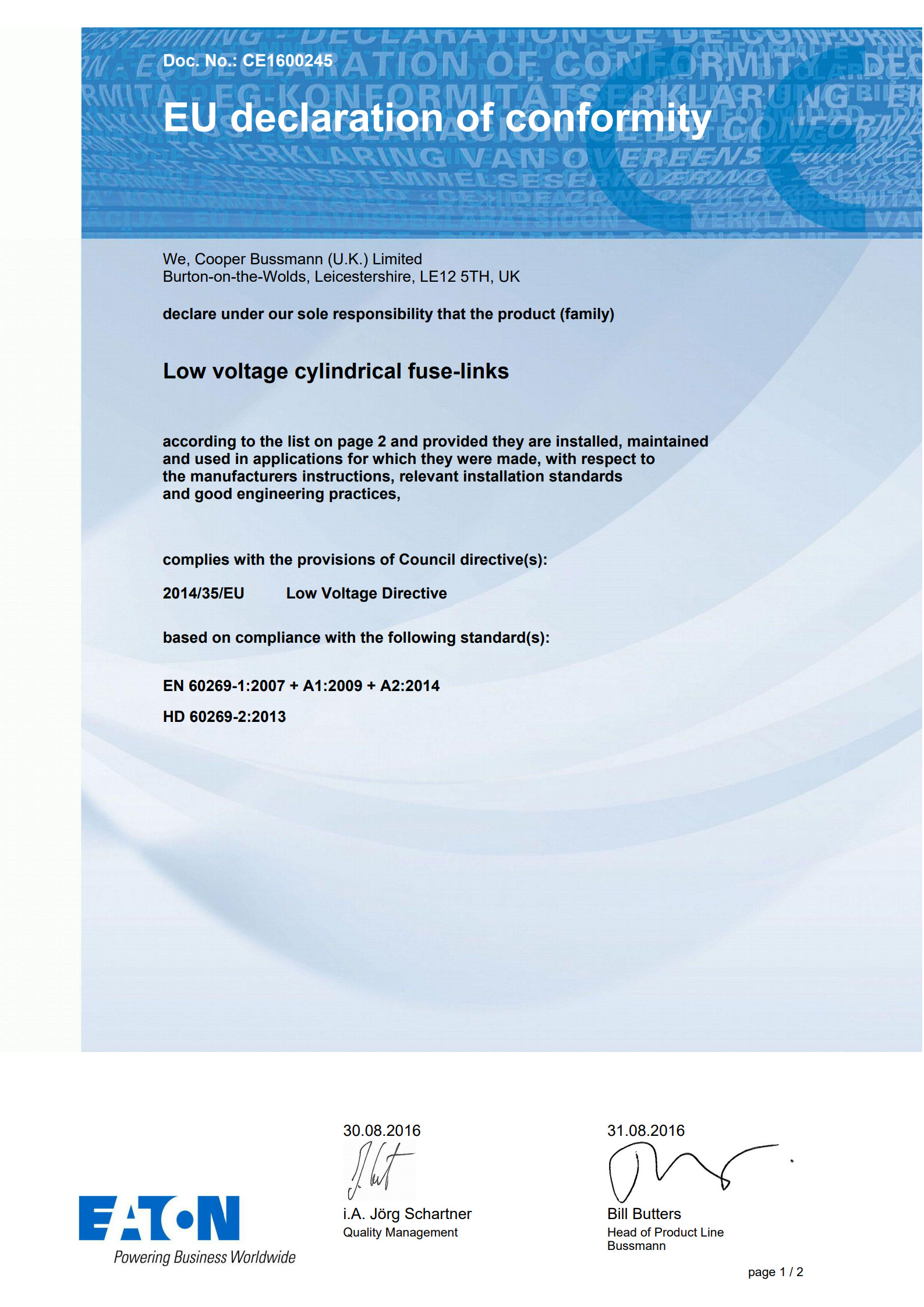
The same reading applies to CE1600245, Eaton's Declaration of Conformity for product types C10G, C10M, C14G, C14M, C22G, C22M, C08G and C08M, citing EN 60269-1:2007+A1:2009+A2:2014 and HD 60269-2:2013 under Directive 2014/35/EU. It is a valid, checkable document for those types. It says nothing about a power module.
Failure 2: The scope names a narrower product than the RFQ
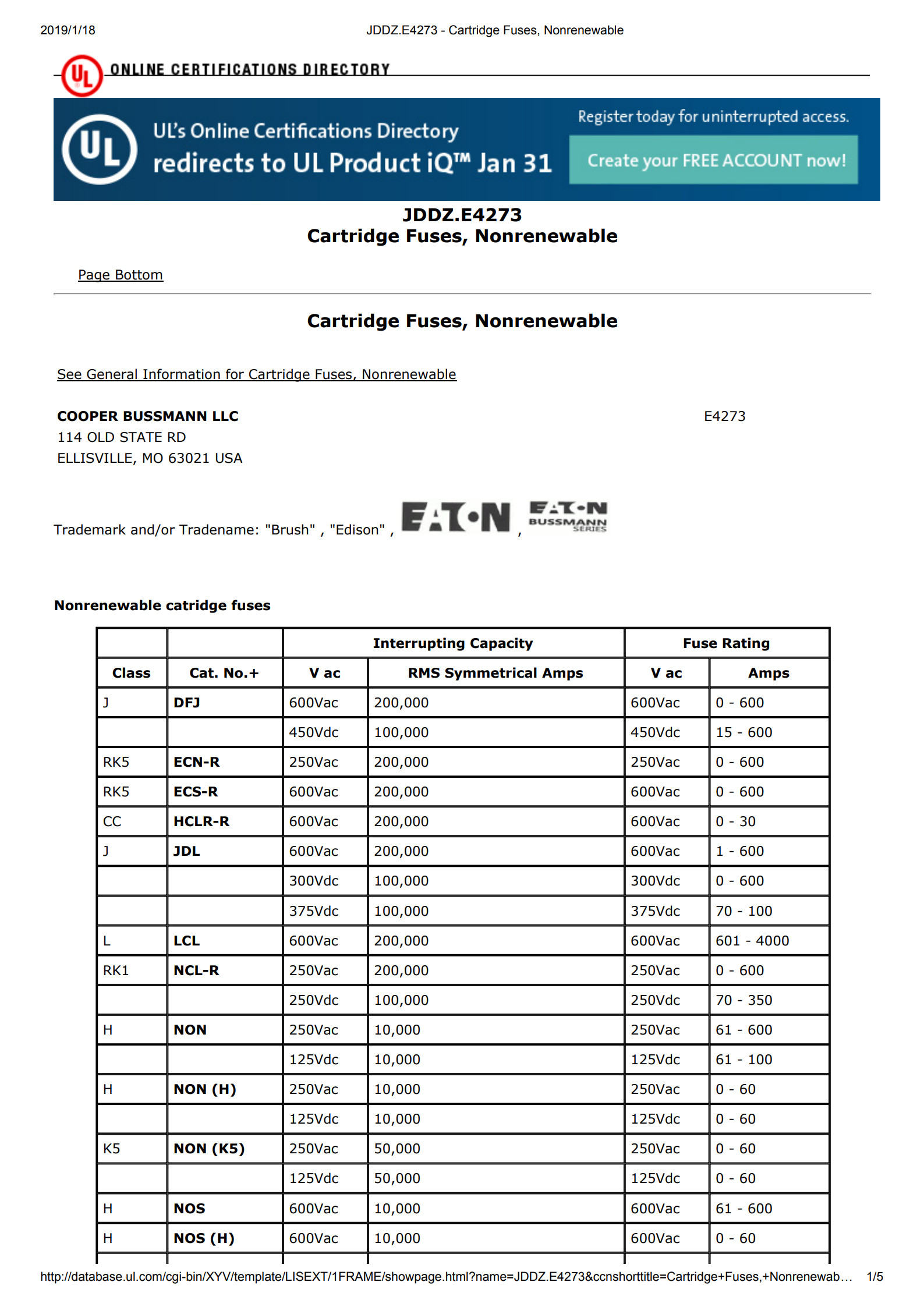
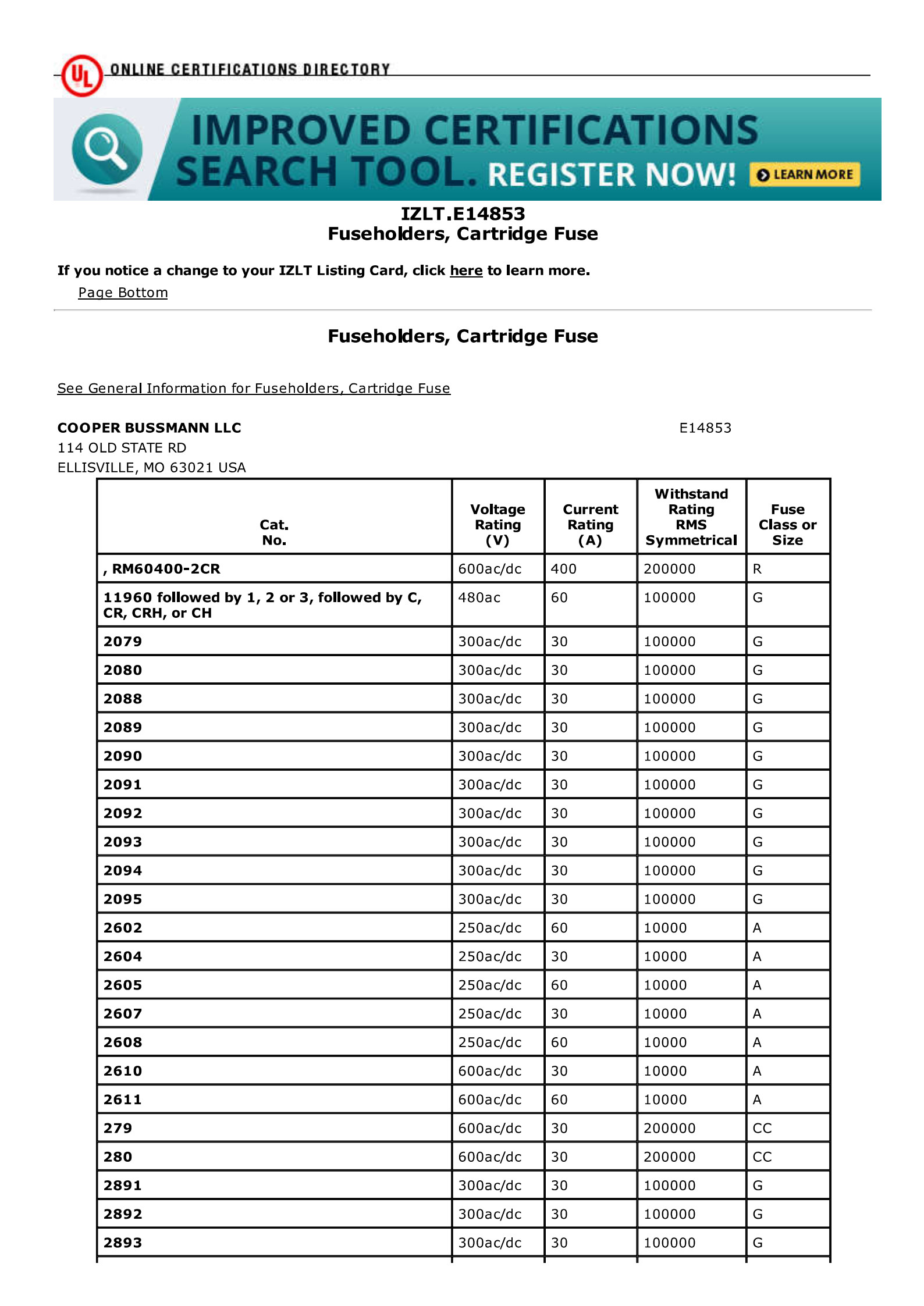
UL file E14853, issued 2009-01-10 under UL 248-1, covers fuseholders and cartridge fuses for Cooper Bussmann LLC — cartridge fuse holders with voltage ratings of 250 to 600 ac/dc, current ratings of 30 to 60 A, and withstand ratings of 10,000 to 200,000 A RMS symmetrical. UL file E4273 covers nonrenewable cartridge fuses in Classes CC, G, H, J, K1, K5, L, RK1, RK5 and T.
Read the scope line as a buyer would read a datasheet: a voltage window of 250 to 600 and a current window of 30 to 60 A is a narrow claim. Anything outside that window is not covered by that file, even when it carries the same brand name. Scope mismatch is the most common reason a compliance folder looks complete and still fails an audit.
Failure 3: The record has a date, and dates move
UL records in the same file family show issue dates of 2009-01-10 and 2019-11-18. CCC 2024010308676645 runs from 2024-08-15 to 2029-08-14. A scanned certificate from an earlier decade is a document, not a current status. Status lives in the issuing authority's directory, which is why the UL Online Certifications Directory listing JDDZ.E4273 exists as a separate, checkable artifact rather than as a line on a PDF.
What made documentation a live buying criterion in this category
The global IGBT market was estimated at 9,202.9 million USD in 2024, with a projected CAGR of 11.02% from 2025 to 2035 (Market Research Future). Silicon carbide modules — a related but distinct device family with its own qualification route — were put at 980.7 million USD in 2025 (Fortune Business Insights). IGBT devices account for nearly 10% of the cost of an electric vehicle, and Infineon states that IGBT modules are a central component in inverters for electric drives, battery chargers, solar systems and wind power applications.
Growth changes the sourcing pattern. A single bill of materials can name Infineon, SEMIKRON, IXYS, Microsemi, Fuji, SanRex, Mitsubishi, IR, CRRC, StarPower, WESTCODE, POSEICO and Microchip parts, and each manufacturer maintains its own naming logic and its own documentation set. Infineon's part-number designator alone defines the MIPAQ, FF (dual switch), FZ (single switch), FS (three-phase full bridge) and FP (power integrated) families — a naming convention, not a conformity statement. StarPower Semiconductor is the world's fifth-largest IGBT module supplier (Market Research Future), which is exactly why its part numbers appear in quotations far more often than its paperwork does.
Sourcing through distribution adds one more layer. Distributors hold stock across brands and model generations, and the document pack travels with the lot rather than with the catalogue page. The verification question is therefore not whether a brand holds certificates, but whether this shipment's file names this part number, to this standard, and whether it is current on the delivery date.
The document pack that answers the certification question
Treat the answer as five documents, requested together and checked against each other. The fuse category supplies a worked example of every one of them.
1. The standard reference, with revision
Ask which standard the product is tested to, and which revision. For fuses the chain is IEC 60269 internationally, GB/T 13539 in China, UL 248-1 in the UL system, and EN 60269-1 with HD 60269-2 in the EU system. The revision string matters: the Eaton declaration cites EN 60269-1:2007+A1:2009+A2:2014 — three dated amendments in one line. A supplier who answers with a standard family name and no part number or year has not answered the question.
2. The test report, with the parameter list
Standard requirements for industrial fuses include rated current, rated voltage and breaking capacity tests, plus temperature rise and dielectric strength tests. That list is the useful part, because it tells the buyer which measurements should appear in the report. For a module, the equivalent exercise is to confirm that the tested items map to the parameters the design depends on — rated voltage, rated current and short-circuit withstand — and that the report identifies the tested part number rather than a family name.
3. The certificate, with scope, number and validity
UL, CE and CCC verify safety, breaking capacity and temperature resistance in the fuse category, and each is a different instrument. UL is a file number tied to a scope description. CE is a manufacturer's declaration of conformity to a directive, as CE1600245 declares conformity to 2014/35/EU for named product types. CCC is a certificate issued by a Chinese authority with an issue and an expiry date. Ask for the number, the issuing body and the scope sentence, then read the scope sentence twice.
4. Product marking
Compliance documentation includes product marking. Marking is the only part of the pack physically present on the goods at goods-in, which makes it the cheapest check in the process. If the certificate scope covers model series 170M Size 3 and 170L Size 3 Un, the marking on the packaging should let an inspector confirm the series without opening a datasheet.
5. Market mapping
The applicable regions for these standards and certifications are recorded as Global, China, European Union and North America — four different answers to a single question. Buyers shipping into more than one market need a matrix, not a folder.
| Market | Conformity route | Standard reference in verified records | Document that carries the evidence |
|---|---|---|---|
| Global / international projects | IEC reference standard | IEC 60269 | Test report citing the standard and revision |
| United States / North America | UL | UL 248-1 | UL file number plus scope description |
| European Union | CE under Directive 2014/35/EU (Low Voltage Directive) | EN 60269-1:2007+A1:2009+A2:2014, HD 60269-2:2013 | Declaration of Conformity naming product types |
| China | CCC | GB/T 13539.4-2016 | CCC certificate with issue and expiry dates |
Ranked by decision weight in a purchase review
When a compliance folder arrives, not all five documents carry equal weight in the evaluation decision. Ranked from what most often changes a buyer's decision to what least often does:
- Certificate scope against the exact part number — the single item that most often converts a folder from complete to incomplete, because scope mismatch survives every other check.
- Current validity — an expired or superseded record invalidates an otherwise correct document, and the authority's directory is the only reliable status source.
- Standard number and revision — defines the test basis; a standard without a revision cannot be compared with a specification.
- Test report parameter match — proves the measurements exist and correspond to the datasheet values the design depends on.
- Product marking — the fastest check at goods-in, and the one that catches mixed-lot shipments.
Seven verification steps, in the order a purchase runs
- Fix the destination market before the RFQ. Every later question depends on it: IEC as the international reference, UL for North America, CE for the EU, CCC for China where applicable.
- Request the standard number and revision in writing and have it appear in the quotation, not in a later email thread.
- Match the certificate scope to the exact part number. The 250 to 600 V and 30 to 60 A window in UL file E14853 shows how narrow a valid scope can legitimately be.
- Check validity against the delivery date. Compare the issue and expiry window — CCC 2024010308676645 runs from 2024-08-15 to 2029-08-14 — with the date the goods will arrive, not the date of the inquiry.
- Cross-check the test report against the datasheet. Rated current, rated voltage, breaking capacity, temperature rise and dielectric strength form the reference list; the report should carry measured values for each named test.
- Compare marking with documents at goods-in. This is the step most incoming inspection plans skip and the cheapest one to add.
- Write the document list into the purchase order and the inspection plan. A compliance pack that is not a PO line item is a favour, not a deliverable.
Supplier-side controls support that sequence. Jiangsu core diamond times Electronic Technology Co., Ltd. was founded in 2022 and operates a 10,000 m² facility with 50 employees, five technical support engineers and an annual output of 1,000,000 units. It maintains incoming inspection and outgoing quality control procedures and performs 100% electrical performance test before shipment, and it passed ISO9001:2015 quality management system certification in June 2026. That certification is worth reading precisely: it confirms a controlled quality process, not type approval of any individual module. Product-specific conformity evidence still has to be requested document by document.

Where the document pack decides the project
Compliance verification stops being theoretical when a project has a commissioning date. Three recorded deployments show how the document question attaches to the application.
Solar inverter and energy storage converter, Germany
A renewable energy equipment manufacturer installed 5,000 units in solar inverter and energy storage converter applications, with an implementation period of 2 years. The recorded result was long-term stable operation under high temperature and high load with a low failure rate, and the deployment meets European energy storage system standards. For a European project the CE route is the entry ticket, and the useful document model is the one Eaton uses: named directive, named harmonised standards, named product types, dated signature.
Energy storage cabinet power conversion and switching control, France
A new energy system integrator deployed 15,000 units for energy storage cabinet power conversion and switching control, with the project completed within 1 year, and recorded rapid overcurrent protection cutoff for the cabinet. In cabinet builds, module documents and fuse documents are read together — which is precisely where a fuse-link certificate for semiconductor equipment protection gets misfiled as module evidence.
On-board power converter, Poland
An EV accessory manufacturer deployed 4,000 MOSFET modules in on-board power converters over a 2-year project, recorded with low on-resistance and high efficiency. Different device family, identical verification logic: scope match, report match, marking match. The same approach transfers to a power supply factory using 10,000 units for industrial switching power supply production over 2 years, and to an industrial power supply manufacturer using 3,500 thyristor units in welding and rectifier equipment over 2 years.
Comparison table: what each compliance document actually proves
Every example below is a fuse-category record held in this supplier's compliance file. None of them certifies an IGBT module, and that is the point of the table: the document types are transferable, the coverage is not.
| Document | Issued by | What it establishes | What it does not establish | Verified example |
|---|---|---|---|---|
| UL file record | UL | Conformity of the named product scope to UL 248-1 | Coverage of parts outside the listed ratings | E14853 — fuseholders and cartridge fuses, 250 to 600 ac/dc, 30 to 60 A, 10,000 to 200,000 A RMS symmetrical |
| UL file record | UL | Coverage of nonrenewable cartridge fuses by class | Coverage of classes not listed | E4273 — Classes CC, G, H, J, K1, K5, L, RK1, RK5, T |
| CE Declaration of Conformity | Manufacturer | Declaration of conformity to 2014/35/EU against EN 60269-1 and HD 60269-2 | Product types other than those named | CE1600245 — types C10G, C10M, C14G, C14M, C22G, C22M, C08G, C08M, dated 2016-08-31 |
| CCC certificate | China Quality Certification Centre | Certification of named model series to GB/T 13539.4-2016 | Models outside the named series; status after expiry | 2024010308676645 — 170M Size 3, 170L Size 3 Un, valid 2024-08-15 to 2029-08-14 |
| Test report | Testing party | Measured values for rated current, rated voltage, breaking capacity, temperature rise and dielectric strength | Market access on its own | Parameter list defined by the applicable standard requirements |
| Product marking | Manufacturer | Identification of series and ratings on the goods | A substitute for the certificate | Marking is defined as part of the compliance documentation set |
Reading rule. If the scope sentence does not name the part number, the document does not cover the order — regardless of brand, file age or how the folder was assembled.
FAQ: IGBT module certification questions buyers ask at evaluation
What certifications are required for IGBT modules?
There is no single certificate. Requirements are set by the destination market and must be confirmed against the exact part number. In this supplier's verified records the pattern is: IEC 60269 as the international reference, UL 248-1 for North America, EN 60269-1 with HD 60269-2 under Directive 2014/35/EU for the European Union, and GB/T 13539.4-2016 for CCC in China, with UL, CE and CCC certificates verifying safety, breaking capacity and temperature resistance. For an IGBT module, request the standard number and revision, the scope sentence and the validity dates, and confirm that each document names the module part number rather than a companion fuse, a holder or a family name.
Can a distributor supply IGBT modules with verifiable documentation?
Jiangsu core diamond times Electronic Technology Co., Ltd. supplies power electronic components — IGBT modules, fuses, diodes, thyristors and semiconductor modules — with five technical support engineers and customization that includes logo marking, packaging, parameter matching and solution support. Quality control includes 100% electrical performance test before shipment, and the company passed ISO9001:2015 quality management system certification in June 2026. That certification confirms a controlled process rather than product-specific type approval, so module-level documentation is confirmed per order, because scope, revision and validity belong to the specific part number and lot.
Do certification documents add cost or minimum order commitments?
The paperwork is not the cost line; the work behind it is — lot selection, traceability and any additional testing the destination market requires. Volume is rarely the constraint: minimum order quantity is 2 units, typical production lead time is 30 to 45 days, monthly production capacity is 20,000 units and annual output is 1,000,000 units, so a documentation-led trial order can stay small. Request the document list with the quotation so that testing is planned alongside production rather than after it.
How can I verify compliance before committing to a bulk order?
Place a sample or trial order — the 2-unit minimum order quantity allows it — and ask for the document pack to travel with it: standard reference with revision, test report parameters, certificate number, scope and dates, and a photo of the product marking. Every product is inspected before shipment and 100% electrical performance test before shipment is part of the stated quality control, so the sample becomes the reference against which the bulk lot's marking and documents are compared.
How long does it take to receive modules and their documentation?
Typical production lead time is 30 to 45 days, and standard delivery time is also 30 to 45 days. Documentation should be requested at RFQ stage so that scope and validity are settled before production starts, because a certificate that does not name the ordered part number cannot be repaired by a faster shipment. To start, send the part numbers, destination market and required document list to xinzuanshidai@163.com or WhatsApp +86 13675967789 for a quote, a compliance checklist and a sample arrangement.
Conclusion: verify the scope, not the logo
Certification for IGBT modules is a scope question before it is a branding question. Four checks decide most cases: the standard number with its revision, the scope sentence matched against the exact part number, the validity window compared with the delivery date, and the consistency of certificate, test report and product marking. The fuse records in this supplier's compliance file — UL E14853 and E4273 under UL 248-1, CE1600245 under Directive 2014/35/EU, CCC 2024010308676645 under GB/T 13539.4-2016 — show what a checkable record looks like: number, issuing body, named product scope, standard revision and dates. Apply the same reading to an IGBT module and procurement risk reduces to a document list that either matches the order or does not.
Need the documents before the decision?
Send the part numbers and destination market to Jiangsu core diamond times Electronic Technology Co., Ltd. and request a sample, a quotation and the compliance checklist for the order.
Email: xinzuanshidai@163.com | WhatsApp: +86 13675967789 | Website: www.xinzuanshidai.com
Download the company catalogue: Power Electronic Component Catalogue (PDF)

Certification records cited in this article relate to fuse products and are presented as documentation examples. Buyers should confirm the applicable standard, certificate scope and validity for each IGBT module part number before purchase.
Have Questions or Need More Details?
Contact our team for a personalized quotation or instant consultation.
Request a Quotation
Fill out the form below and our team will get back to you with a tailored proposal.
WhatsApp Direct Chat
Prefer to chat in real-time? Message us on WhatsApp for instant assistance & quick answers.
- Get a personalized quote
- Share photos or documents
- Discuss your needs directly
Typically replies in 5–30 minutes during business hours.