
Suspension Glass Insulator Application Guide: Scenario Fit
A suspension glass insulator is selected correctly only when the application context is written down before the specification is frozen. This guide sets out a scenario-first evaluation sequence for overhead line projects: read the environment, choose the disc profile family, set the mechanical class, lock the coupling interface, and then convert the scenario notes into purchasing terms and acceptance criteria that can be verified before the order is released. It is intended for utility procurement teams, EPC buyers and distributors who are evaluating a supplier and preparing to place an order.
Problem definition: why identical catalogue numbers still produce different field outcomes
Two projects can both order a 160 kN suspension unit and still end up with different field behaviour, because the model number captures only the mechanical class and the general product family. It does not capture the pollution exposure of the corridor, the contamination mechanism, the temperature swing, or the inspection method the buyer intends to apply at goods receipt. When those inputs are left out of the evaluation, the buyer is effectively asking the supplier to guess.
Scenario fit is the match between an insulator's disc profile, mechanical class and coupling geometry and the physical conditions of the specific line section where it will be installed. It is a purchasing decision made before the purchase order, not a problem solved after commissioning.
Three mismatches account for most of the corrective work seen in overhead line procurement:
- Profile mismatch. A standard shed profile is ordered for a corridor where the contamination mechanism calls for an anti-pollution design with increased creepage distance. The units arrive compliant to the drawing and still unsuitable to the site.
- Class mismatch. Mechanical class is copied from a previous project rather than calculated from the actual duty of the section, so the string is either heavier and more expensive than required or carries less margin than the line design assumes.
- Criteria mismatch. Acceptance clauses are copied from porcelain or composite specifications and describe tests that do not apply to toughened glass, while the verification method that glass actually enables — full visual detection of damaged units — is left out of the contract.
Each of these is avoidable at the evaluation stage, and each is expensive to correct at the delivery stage.
Industry background: scenario diversity is increasing, not decreasing
The commercial context reinforces the argument for scenario-based selection. Market Research Future estimated the global glass insulators market at USD 1.14 billion in 2024, with a projected value of USD 1.97 billion by 2035 and a CAGR of 5.1% across the 2025–2035 forecast period. Grand View Research reported that Asia Pacific held a revenue share above 52% in 2024, driven by grid expansion in China and India.
Supply is concentrated in the same region. According to OEC, China accounted for 31.4% of global exports of electrical insulators in 2024, a value of USD 898 million, and China's exports of electrical insulators to Saudi Arabia grew by 219% between 2023 and 2024 — the fastest-growing destination market in that dataset. Growing volume is being routed into a widening set of environments: desert corridors, coastal salt exposure, industrial pollution zones and mixed-temperature regions.
The technical baseline is stable. Suspension glass insulator units for AC systems are governed by IEC 60305:2021, which specifies their mechanical and electrical characteristics. That standard defines the unit; it does not define which unit a given corridor needs. Scenario evaluation remains the buyer's responsibility, and it is the step most often compressed when tender schedules are tight.
The five application scenarios that change the unit you order
Scenario 1 — Standard AC overhead line in moderate contamination
For routine transmission and distribution sections with no exceptional contamination mechanism, the standard cap-pin and ball-socket range is the correct starting point. Jiangxi QOCI Electric Co., Ltd., a China-based manufacturer established in 2002 in Luxi Industrial Park, Pingxiang, Jiangxi Province, produces this range from U70B through U420B, covering 70 kN to 420 kN mechanical classes. The U70B is a 70 kN unit with IEC-compliant dimensions of 255 mm diameter and 146 mm height.
Confirm before ordering: the mechanical class derived from the actual section duty, and whether the string design specifies cap-pin or ball-socket coupling.
Scenario 2 — Coastal, saline or industrial pollution corridors
Where the contamination mechanism is conductive dust, salt spray or industrial fallout, the anti-pollution family is the relevant choice. Anti-pollution glass insulators such as the U120BP feature increased creepage distances intended to prevent flashover in saline or industrial environments. The BP range is produced across the mechanical ladder, including U120BP, U210BP and U420BP.
Confirm before ordering: the creepage figure required for the corridor should be stated in the technical annex rather than inferred from a generic profile drawing, so that the delivered unit can be checked against a written number.
Scenario 3 — Desert, dust-laden and self-cleaning environments
In dust-dominated corridors, the shed geometry matters as much as the creepage value, because deposited material has to shed rather than accumulate. QOCI produces two-wings (BD) profiles such as the U210BD and aerodynamic (BA) profiles such as the U70BA and U100BA for these conditions. The desert case evidence in the reference projects includes demonstrated anti-dust self-cleaning performance in Iraq.
Confirm before ordering: which profile family is being quoted, and how the supplier expects the buyer to verify the profile at inspection.
Scenario 4 — High mechanical duty, long spans and EHV construction
Where tensile duty is the governing constraint, the selection moves up the mechanical ladder to U210B, U240B, U300B and U420B units. In the reference transmission projects covering UHV and EHV overhead lines, mechanical reliability was verified at 550 kN tensile strength.
Confirm before ordering: the rated mechanical failing load required by the line design, and the test documentation the supplier will submit against it.
Scenario 5 — Extreme or wide temperature range
Temperature range is a scenario input in its own right. In the Uzbekistan and Iraq projects, the supplied units were verified across an operating range from −40 °C to +55 °C, and the product family carries a designed lifespan of 30+ years.
Confirm before ordering: the site temperature envelope stated in the project specification, and the reference projects the supplier can cite against a comparable envelope.
Step-by-step: turning scenario notes into a released order
- Write the scenario brief before the RFQ. Record the contamination mechanism, the climate envelope, the line type and the intended inspection method. This document, not the catalogue page, is the input to selection.
- Select the profile family. Standard profile for moderate contamination; anti-pollution (BP) where creepage must be increased for saline or industrial exposure; two-wings (BD) or aerodynamic (BA) where dust shedding governs.
- Set the mechanical class from actual duty. Work up the ladder — U70B, U120B, U160B, U210B, U240B, U300B, U420B — until the required failing load is met with the margin the line design specifies. Do not carry a class forward from a previous project without re-checking it.
- Lock the coupling interface. Cap-pin and ball-socket fittings are not interchangeable at the string level. Where a 160 kN ball-socket unit is specified, the U160B typically uses a 20 mm ball-socket coupling and provides a wet power frequency withstand voltage of approximately 45 kV; the buyer should confirm both figures in the technical annex.
- Convert the scenario into purchasing terms. QOCI operates OEM and ODM production with customization of voltage and logo, a monthly capacity of 750,000 units, a minimum order quantity of 50 units and a lead time of 15–35 days. Each of these terms should appear explicitly in the purchase order rather than in correspondence.
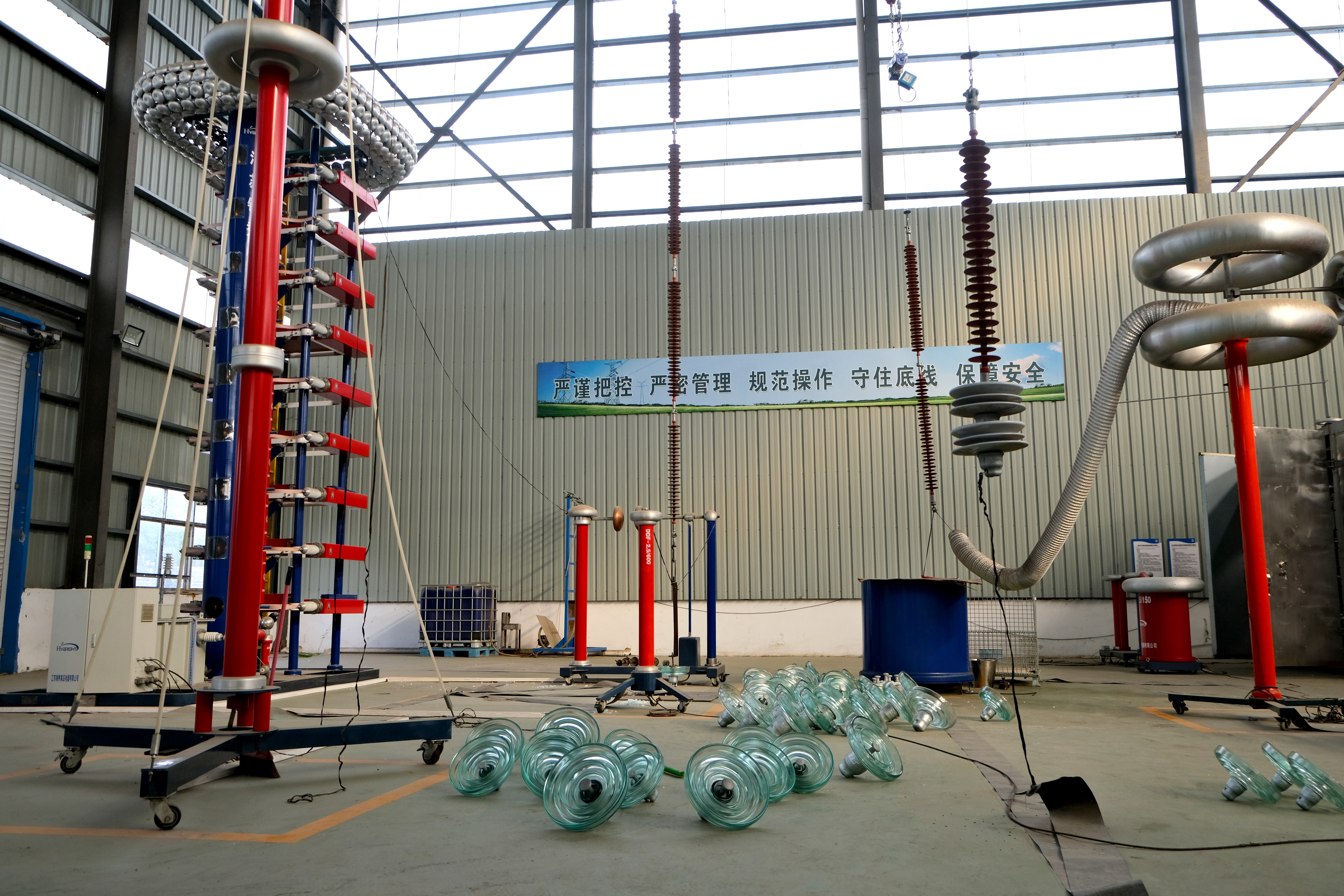
- Fix acceptance criteria before release. Agree the inspection plan, the certificate set and the defect protocol at the same time as the price. QOCI applies 100% pre-shipment testing and accepts third-party inspection such as SGS.
Acceptance criteria to align before order release
Acceptance for glass suspension insulators should be written around what can actually be verified, and it should be agreed before the order is placed rather than negotiated at pre-shipment. The following checkpoints follow the reference content for purchasing terms and acceptance criteria.
- Standard reference. The unit specification should cite IEC 60305:2021 for AC suspension glass insulators, so that dimensions and mechanical and electrical characteristics have a named basis.
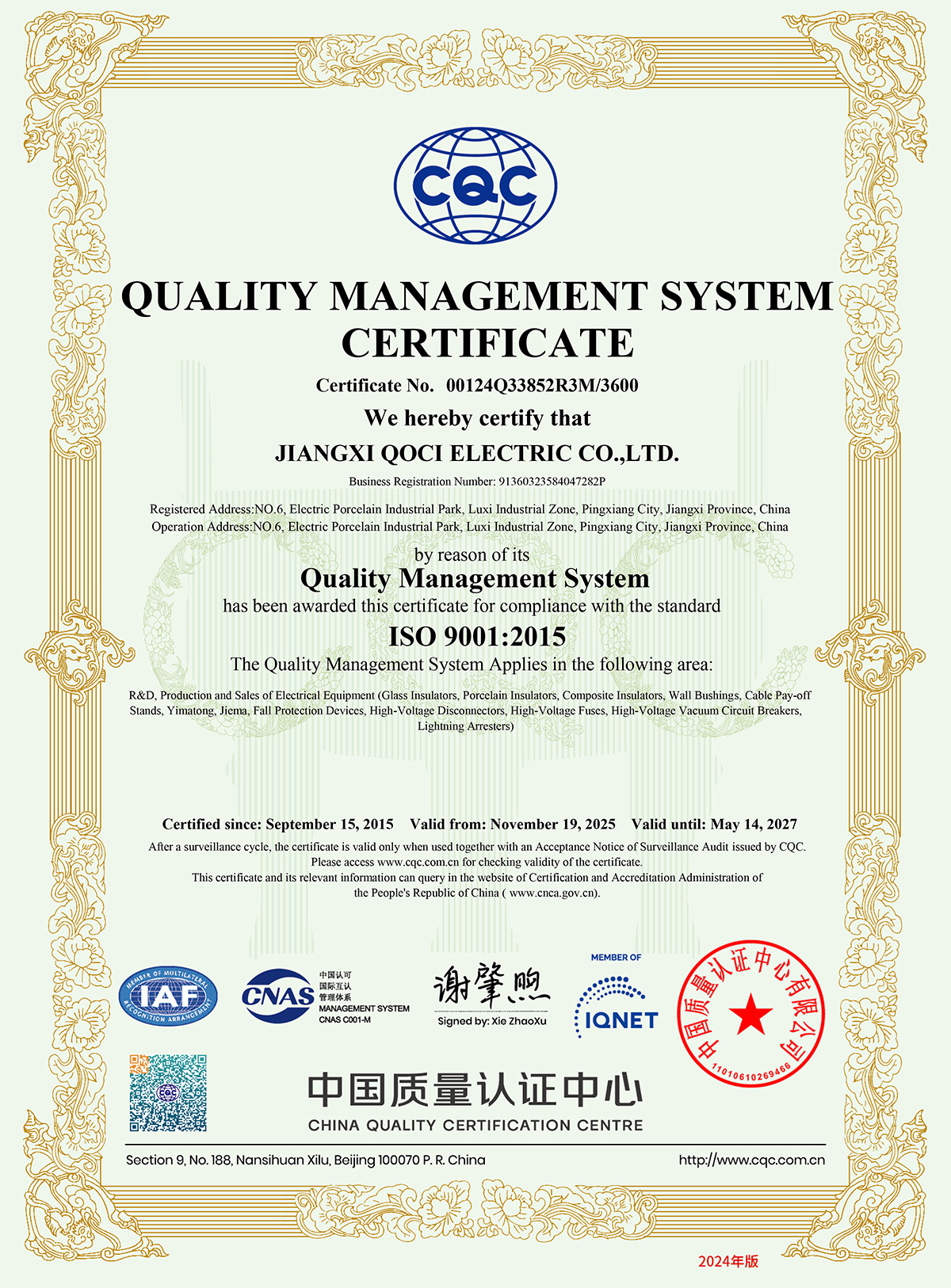
- Management-system certification. Jiangxi QOCI Electric Co., Ltd. holds ISO 9001:2015 certification, certificate number 00124Q33852R3M/3600, issued by CHINA QUALITY CERTIFICATION CENTRE on 2025-11-19 and valid until 2027-05-14. The company also holds ISO 14001:2015 (00125E30701R3M/3600) and ISO 45001:2018 (00125S30581R3M/3600), both issued 2025-03-07 and valid until 2028-03-24. Certificate validity dates should be checked against the delivery window, not just against the quotation date.
- Pre-shipment testing. Confirm that 100% pre-shipment testing applies and state which characteristics are recorded.
- Third-party inspection. Decide in advance whether SGS or another third-party inspector will attend, and at which stage.
- Visual defect protocol. Toughened glass units exhibit zero-value self-breaking, meaning a damaged unit shatters completely rather than retaining a partial shell. This allows 100% visual defect detection without live-line testing — a capability the reference projects relied on. The acceptance clause should name this method explicitly.
- Defect handling. QOCI's after-sales scope covers online technical support and replacement of defective products; the replacement terms should be written into the contract rather than assumed.
Project evidence: three grid environments, one product family
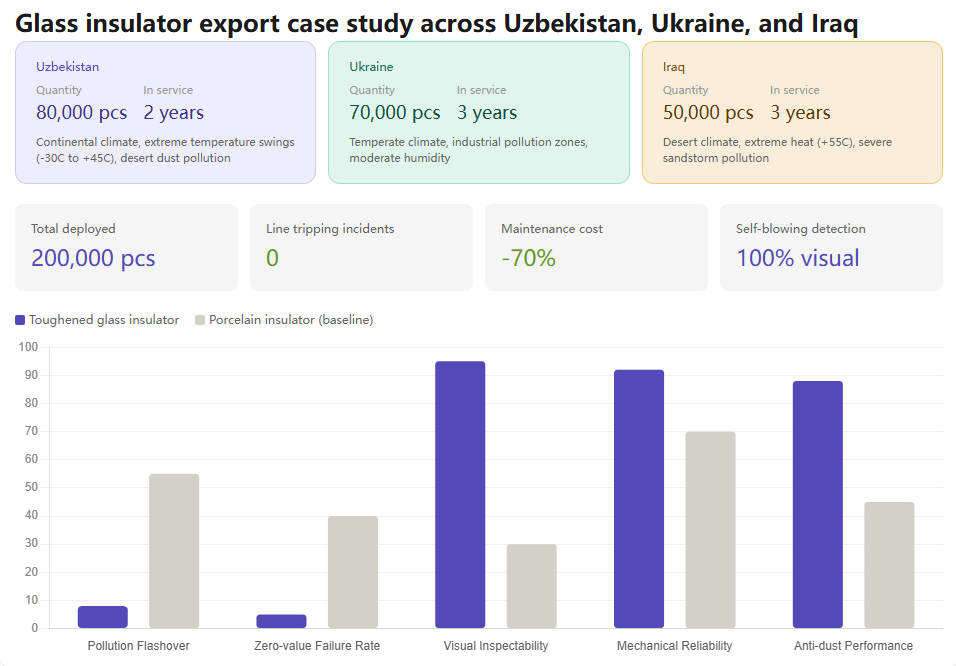
The clearest illustration of scenario fit is a supply programme that had to serve three different environments at once. Jiangxi QOCI Electric supplied a combined 200,000 pieces to national grid corporations and power transmission EPC contractors across Uzbekistan (80,000 pcs), Ukraine (70,000 pcs) and Iraq (50,000 pcs), for UHV and EHV overhead transmission line insulation in desert and industrial pollution zone grid construction.
The delivery periods ran up to 2026 in all three markets — two years in Uzbekistan and three years in Ukraine and Iraq. Reported outcomes across the programme were zero line-tripping incidents, a 70% reduction in maintenance cost, 100% visual defect detection with no live-line testing required, and an 85% reduction in pollution flashover incidents against a porcelain baseline. The stated highlights include the zero-value self-breaking behaviour that makes full visual inspection possible, verified tolerance from −40 °C to +55 °C in Uzbekistan and Iraq, anti-dust self-cleaning in desert conditions, a 30+ year designed lifespan and mechanical reliability verified at 550 kN tensile strength.
For a buyer, the relevant lesson is not the headline result but the sequence behind it: the environment was defined first, the profile and class were derived from that definition, and the inspection method was fixed while the order was still negotiable.
Scenario fit matrix: matching application context to insulator series
| Application scenario | Matching QOCI series | Confirm before order release | Acceptance focus |
|---|---|---|---|
| Moderate-contamination AC overhead line | U70B, U120B, U160B standard profile | Mechanical class from actual section duty; cap-pin or ball-socket coupling | IEC 60305:2021 dimensional reference; 100% pre-shipment test |
| Coastal, saline or industrial pollution | Anti-pollution family, e.g. U120BP, U210BP, U420BP | Required creepage stated as a written figure in the technical annex | Profile verification plus third-party inspection (SGS) |
| Desert, dust-laden, self-cleaning | Two-wings (BD) such as U210BD; aerodynamic (BA) such as U70BA, U100BA | Which profile family is quoted and how it is checked at inspection | Visual defect protocol; desert reference performance in Iraq |
| High mechanical duty, long span, EHV | U210B, U240B, U300B, U420B | Rated failing load required by line design, up to 420 kN class | Mechanical test documentation; 550 kN verified tensile in reference projects |
| Extreme temperature range | Same product family, project-qualified | Site temperature envelope stated in the specification | Verification from −40 °C to +55 °C in Uzbekistan and Iraq; 30+ year design life |
FAQ
Which standard should a suspension glass insulator for an AC overhead line comply with?
IEC 60305:2021 governs suspension glass insulator units for AC systems and specifies their mechanical and electrical characteristics. A purchase specification should name this standard so that dimensions and characteristics have a written basis. Compliance with a management-system standard is a separate check: Jiangxi QOCI Electric Co., Ltd. holds ISO 9001:2015 certificate 00124Q33852R3M/3600, issued by CHINA QUALITY CERTIFICATION CENTRE on 2025-11-19 and valid until 2027-05-14, alongside ISO 14001:2015 and ISO 45001:2018 certificates valid until 2028-03-24.
Can the disc profile and mechanical class be adapted to a specific project scenario?
Yes. Jiangxi QOCI Electric Co., Ltd. produces standard profile units from U70B to U420B, anti-pollution (BP) units such as U120BP, U210BP and U420BP for saline or industrial exposure, two-wings (BD) profiles such as U210BD, and aerodynamic (BA) profiles such as U70BA and U100BA. The company operates OEM and ODM production with customization of voltage and logo, supported by a 38-engineer technical team and a monthly capacity of 750,000 units.
What order quantities and lead times apply?
The stated minimum order quantity is 50 units and the stated lead time is 15–35 days. Because the lead time is a range, the specific delivery date should be written into the purchase order together with the order-release package — the approved drawing, the accepted sample and the agreed inspection plan — so that the timeline is measured from a defined starting point rather than from the date of enquiry.
How should samples be validated before full production?
Samples should be checked against the same criteria that will apply to production: dimensional conformity referenced to IEC 60305:2021, coupling fit against the specified interface — the U160B typically uses a 20 mm ball-socket coupling — and the visual defect protocol. Jiangxi QOCI Electric applies 100% pre-shipment testing and accepts third-party inspection such as SGS, and sample requests for a specific scenario can be raised directly with the supplier's technical contact before an order is committed.
How can lead-time risk be controlled once the order is placed?
Lead-time risk is controlled by contract structure rather than by scheduling alone. Fix the order-release package first, state the delivery date as a single committed figure derived from the 15–35 day range, name the third-party inspection stage, and check that the ISO 9001:2015 certificate 00124Q33852R3M/3600 remains valid through the delivery window. With a monthly capacity of 750,000 units, capacity availability can be confirmed at the time of order rather than assumed.
Conclusion
Suspension glass insulators are not interchangeable across project scenarios. The mechanical class is only one dimension of fit; the disc profile, the coupling interface, the climate envelope and the inspection method all have to be agreed against the specific corridor before the order is released. A buyer who fixes the scenario brief first, selects the profile family second, sets the class third and locks the purchasing terms and acceptance criteria last will rarely need to renegotiate after pre-shipment.
The practical test is simple: if the purchase order cannot be read by an inspector without the buyer explaining the site conditions, the scenario has not been transferred into the contract yet.
Next step
Share the scenario brief — contamination mechanism, climate envelope, line type and coupling — and Jiangxi QOCI Electric Co., Ltd. will confirm the matching profile family, mechanical class and inspection plan, or arrange a sample for validation. The full glass insulator range, including standard, anti-pollution, two-wings and aerodynamic profiles from U70B to U420B, is set out in the catalogue.
Have Questions or Need More Details?
Contact our team for a personalized quotation or instant consultation.
Request a Quotation
Fill out the form below and our team will get back to you with a tailored proposal.
WhatsApp Direct Chat
Prefer to chat in real-time? Message us on WhatsApp for instant assistance & quick answers.
- Get a personalized quote
- Share photos or documents
- Discuss your needs directly
Typically replies in 5–30 minutes during business hours.