
Suspension Glass Insulator Purchase Terms, Ranked by Buyer Risk
The suspension glass insulator purchase terms that cause the most expensive disputes are rarely the ones buyers negotiate first. This ranking orders nine purchasing terms and acceptance criteria by the cost of getting each one wrong, so procurement and engineering teams can agree a verification sequence before order commitment — not after the first lot lands on site.
Short answer: rank mechanical failing load conformity first, coupling interface second, tempering and thermal-shock evidence third, electrical acceptance fourth, pre-shipment inspection fifth, certification documentation sixth, commercial terms seventh, lead time and capacity eighth, and packaging and after-sales replacement ninth. The sequence follows risk transfer, not paperwork volume.
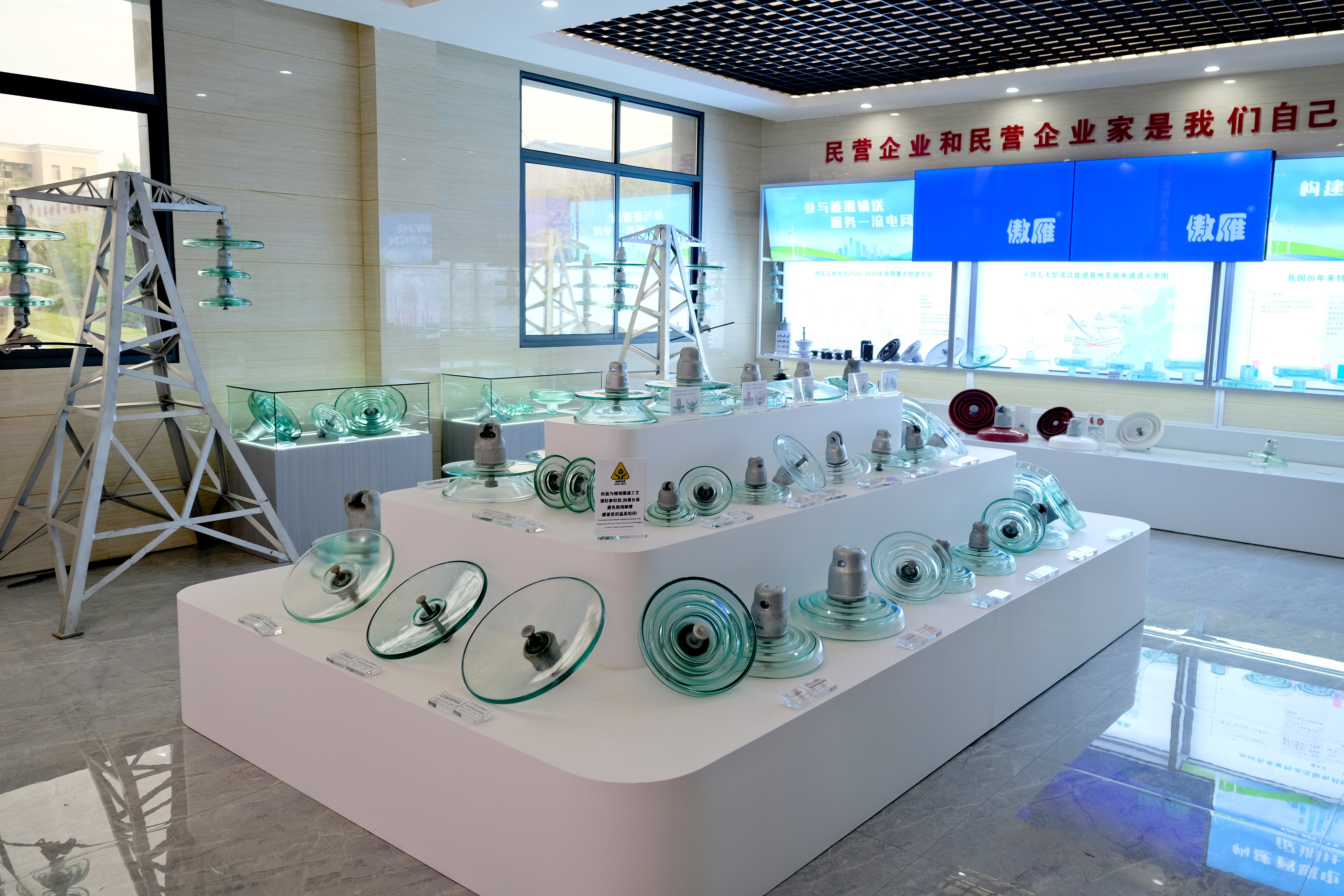
Sample-room review: suspension glass insulator units and fittings prepared for a buyer acceptance walkthrough at Jiangxi QOCI Electric Co., Ltd.
What “purchasing terms” and “acceptance criteria” actually cover
Purchasing terms and acceptance criteria are frequently used as if they were the same document. They answer different questions, and the gap between them is where most execution risk sits.
- Purchasing terms set the commercial frame: minimum order quantity, delivery term and delivery point, payment schedule, lead time, capacity reservation, and the replacement policy for nonconforming pieces.
- Acceptance criteria set the technical and inspection conditions under which a delivered lot is accepted or rejected: mechanical rating conformity, coupling geometry, tempering and thermal-shock evidence, electrical withstand and creepage, dimensional and visual inspection, and the document set that must arrive with the pallet.
A tender that fixes MOQ, Incoterm and price but leaves acceptance criteria at “to be confirmed” transfers nearly all execution risk to the buyer. A tender that ranks both correctly lets a buyer compare quotations on the same basis and reject a cheap quote before it becomes a site problem.
The ranked list below applies to suspension glass insulator units used on overhead AC transmission and distribution lines. It assumes the buyer already knows the voltage class and the required mechanical load — the question this article answers is what to verify, and in what order.
Why this ranking matters now
The category is growing while the supplier pool is widening unevenly. The global glass insulators market was estimated at USD 1.14 billion in 2024 and is projected to reach USD 1.97 billion by 2035, according to Market Research Future, with a compound annual growth rate of 5.1% over the 2025–2035 forecast period. Asia Pacific held a revenue share above 52% in 2024, per Grand View Research, and China alone accounted for 31.4% of global electrical insulator exports in 2024 — USD 898 million, based on OEC data.
More quoting suppliers means more variation in how conformity is documented. Suspension glass insulator units for AC systems are governed by IEC 60305:2021, which specifies mechanical and electrical characteristics. A quotation that cites IEC 60305:2021 without a type-test report for the exact ordered model does not demonstrate conformity; it demonstrates awareness of the standard.
Jiangxi QOCI Electric Co., Ltd. is a China-based manufacturer of glass and porcelain insulators, established in December 2002 in Luxi Industrial Park, Pingxiang City, Jiangxi Province. The company operates a 35,373 m² facility with an annual output of 9,000,000 units and 38 engineers, and exports to the USA, Asia, the EU, Africa and South America. Its order structure is used below only to illustrate how the nine criteria behave in practice — the ranking itself applies to any supplier.
The ranking: nine purchase terms in priority order
Rank 1 — Declared mechanical failing load with matching type-test evidence
Why it ranks here: Mechanical rating is the one parameter that cannot be remedied after delivery. If the delivered units do not match the declared load class, the string design, tower loading and safety margins are all invalidated. The U70B unit, for example, has a minimum mechanical failing load of 70 kN and complies with IEC standard dimensions of 255 mm diameter and 146 mm height. Across the U-series from U70B to U420B, the model designation states the rated load from 70 kN to 420 kN.
What to write into the order: the exact model, the declared minimum failing load, the standard invoked, and a requirement for a type-test report issued for that model — not for the product family. In a multi-country transmission programme covering Uzbekistan, Ukraine and Iraq, QOCI reports 200,000 pieces supplied across a two- to three-year horizon with zero line-tripping incidents and mechanical reliability verified at 550 kN tensile strength. That is the evidence level worth asking for: model-specific, quantity-backed, and tied to service conditions.
Rank 2 — Coupling interface and string hardware compatibility
Why it ranks here: A correctly rated insulator with the wrong coupling is a delivery that cannot be strung. The U160B model typically uses a 20 mm ball-socket coupling, while cap-pin variants dominate other positions in the same series. Cap and pin geometry affect how the unit seats in suspension and tension hardware, and a mismatch surfaces at installation, when remedy options are slow and costly.
What to write into the order: coupling type per line position (suspension versus tension), the matching locking device such as a W-clip or R-pin, and confirmation that cap and pin dimensions match the hardware set already on site. Ask for a drawing-to-hardware cross-check as a document deliverable, not a verbal assurance.
Rank 3 — Tempering and thermal-shock evidence
Why it ranks here: Tempering quality decides whether a unit survives transport, installation and the first winters of service. Acceptance should reference a thermal-shock test with a temperature differential of at least 70 K, residual stress measurement, and visual and dimensional inspection consistent with IEC 60305. The commonly cited self-breaking benchmark for qualified products is below 0.02% per year.
What to write into the order: the test method, the pass criteria, the batch coverage (per lot, not per shipment), and the residual-stress acceptance window. Ask for self-breaking performance data from field operation, and treat any supplier unable to describe the tempering process control as a sourcing risk rather than a price opportunity.
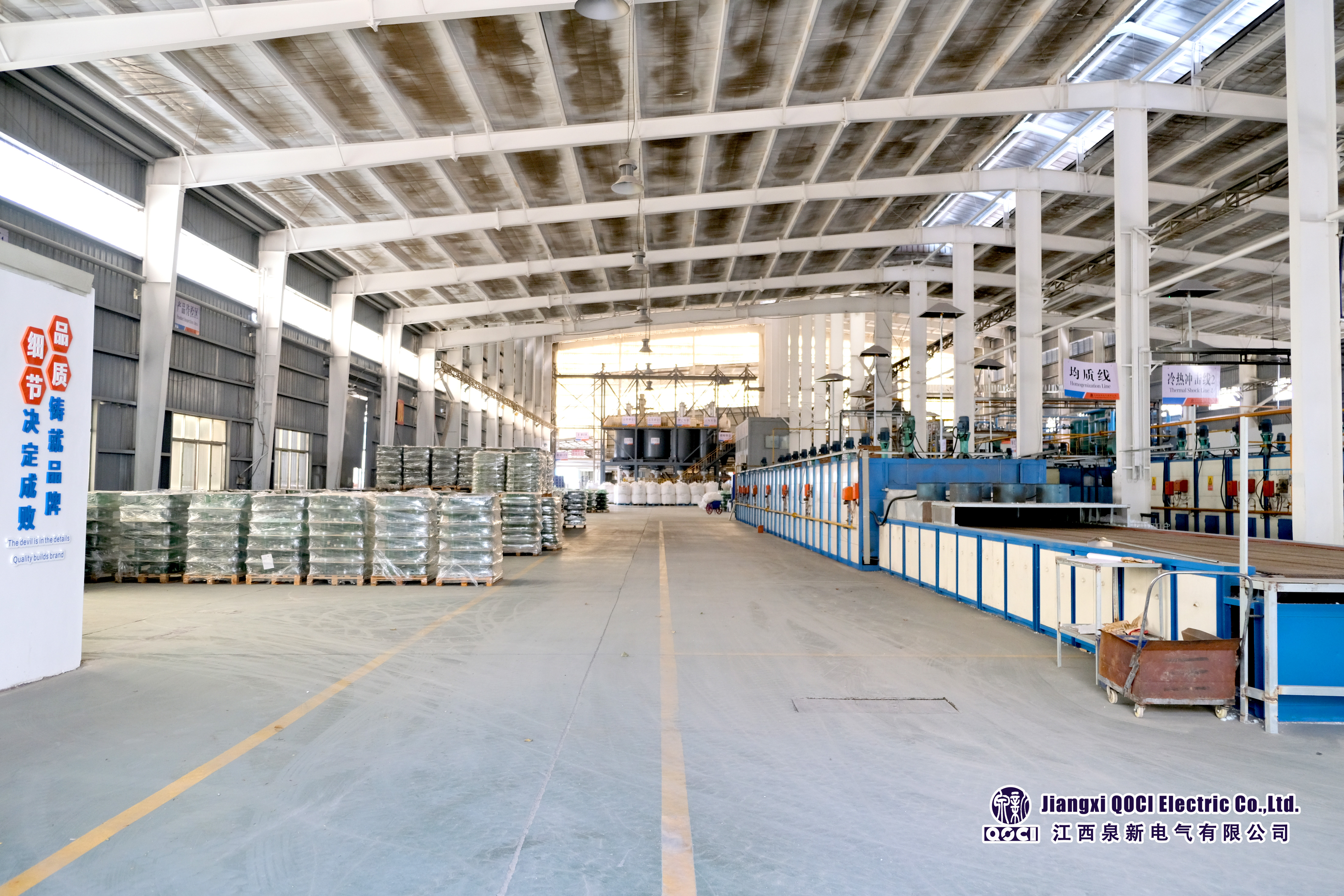
Thermal shock line: tempering control is verified per batch, which is what an acceptance criterion on self-breaking rate actually depends on.
Rank 4 — Electrical acceptance: wet power frequency withstand and creepage
Why it ranks here: Electrical performance is well documented at category level, which makes it easy to accept a generic statement instead of a model-specific one. The U160B model provides a wet power frequency withstand voltage of approximately 45 kV. Anti-pollution profiles such as the BP series increase creepage distance to resist flashover in saline and industrial environments, and aerodynamic open-shed profiles are used where dust accumulation is the dominant stress.
What to write into the order: the wet power frequency withstand value for the ordered model, the impulse withstand value, and a minimum creepage distance derived from the pollution class of the route — not from the model name. Where the route crosses a coastal or industrial belt, specify the anti-pollution profile explicitly rather than accepting a standard-profile substitution.
Rank 5 — Pre-shipment test protocol and third-party inspection
Why it ranks here: This is the criterion that converts the previous four from promises into records. QOCI’s stated acceptance framework combines 100% pre-shipment testing with third-party inspection through SGS. Without a named inspection body and a defined release point, the buyer receives a lot with no independent evidence attached.
What to write into the order: who inspects, at which stage, against which sampling plan, which hold points require buyer notification, what photographic records are required, and — critically — that inspection results are issued before the balance payment falls due. Pre-shipment acceptance and incoming inspection answer different questions; both should appear in the schedule.
Rank 6 — Certification and documentation package
Why it ranks here: Documentation rarely fails in isolation, but it fails at the worst moment — during customs clearance, utility handover, or an audit two years into a framework agreement. QOCI holds an ISO 9001:2015 quality management system certificate, number 00124Q33852R3M/3600, issued by China Quality Certification Centre on 19 November 2025 and valid to 14 May 2027; an ISO 14001:2015 environmental management system certificate, number 00125E30701R3M/3600, valid to 24 March 2028; and an ISO 45001:2018 occupational health and safety certificate, number 00125S30581R3M/3600, also valid to 24 March 2028.
What to write into the order: the certificate numbers, the scope statement, and a check that validity extends beyond the planned delivery date — not merely beyond the quotation date. Certificates with a scope limited to trading, rather than to research, production and sales of electrical equipment, do not cover the manufacturing step a utility buyer is relying on.
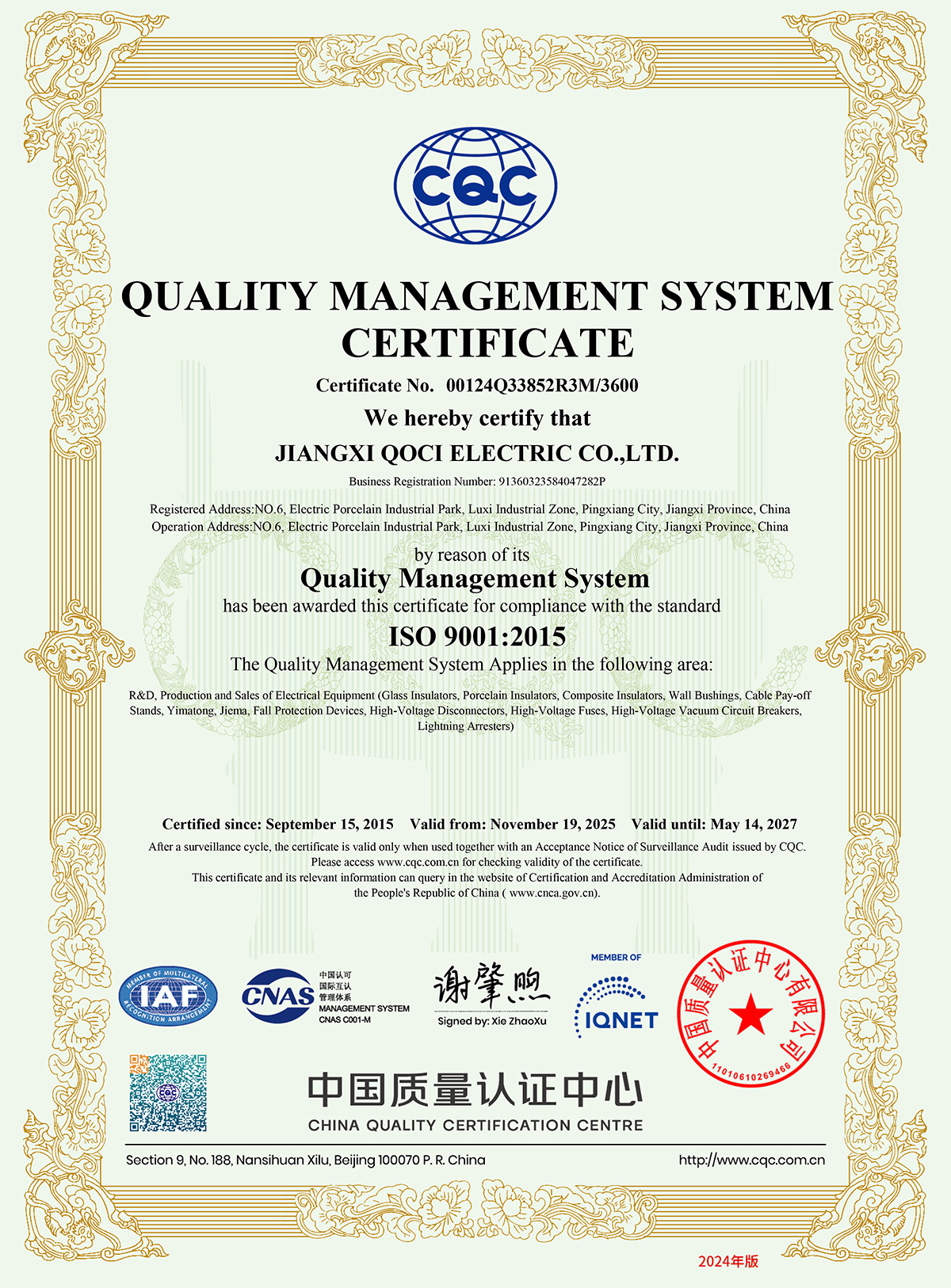
Documentation check: the ISO 9001:2015 certificate should be verified for number, scope and expiry date against the planned delivery window.
Rank 7 — Commercial terms: MOQ, delivery term and payment schedule
Why it ranks here: Commercial terms sit mid-table because they are visible, negotiable and usually agreed early. QOCI’s stated terms are a minimum order quantity of 50 units, delivery terms of FOB Shenzhen, and payment of 30% deposit by T/T before production with the 70% balance by T/T before delivery.
What to write into the order: the Incoterm with the named port, the payment trigger tied to an inspection milestone rather than a calendar date, and the treatment of partial shipments. A 50-unit MOQ is well below utility order scale — useful for trial orders and distributor starter stock, and a signal to confirm that a small first lot uses the same production and inspection route as the volume order.
Rank 8 — Lead time and capacity commitment
Why it ranks here: Lead time is only meaningful when it has a start trigger. QOCI’s stated lead time is 15–35 days, with a monthly production capacity of 750,000 units and an annual output of 9,000,000 units. Those numbers are adequate for grid-scale programmes, but the commitment in the contract must be anchored to drawing approval and deposit receipt.
What to write into the order: the lead-time clock start, the inspection window inside that lead time, and the capacity reservation for repeat calls under a framework agreement. For a tender with staged deliveries, ask for the delivery calendar rather than a single lead-time figure.
Rank 9 — Packaging, loading verification and after-sales replacement
Why it ranks here: Lowest priority does not mean optional. Transit damage and ambiguous replacement language generate a disproportionate share of claims on long sea routes. QOCI’s stated after-sales provision is online technical support plus replacement for defective products.
What to write into the order: packaging specification, loading inspection with photographs, and a definition of “defective” that covers arrival breakage, dimensional nonconformity and documentation mismatch. For desert or remote sites, this criterion moves up the list — replacement logistics, not the replacement promise, is the real constraint.

Process control upstream of acceptance: forming parameters determine dimensional conformity, which is checked again at pre-shipment inspection.
Step-by-step: building an order-ready acceptance schedule
- Fix the model and the load class before pricing. Convert the line design into a specific model and declared minimum failing load, and reject quotations that answer a family rather than a model.
- Map the profile to the route environment. Standard profile for clean areas, anti-pollution (BP) where creepage is the constraint, aerodynamic or double-shed profiles where dust and self-cleaning dominate.
- Request type-test evidence per model. Standard reference, report number, tested model, and test date — in one document set.
- Write the inspection protocol. 100% pre-shipment test plus third-party inspection, with named witness points and a release condition.
- Fix the document list and validity window. Certificate numbers, scope, expiry dates, drawing cross-checks and inspection reports, all due before balance payment.
- Lock the commercial terms. MOQ, Incoterm with named port, payment split, and partial-shipment rules.
- Convert lead time into a calendar. Start the clock at drawing approval and deposit, and place the inspection window inside the stated 15–35 days.
- Define nonconformance before it happens. Who decides, on what evidence, within what period, and with what remedy — replacement, credit or re-inspection.
Where the ranking shifts: application notes
Desert and high-temperature corridors
Where ambient extremes and dust dominate, thermal-shock evidence and self-cleaning geometry move ahead of documentation. In the Iraq and Uzbekistan portions of QOCI’s 200,000-piece programme, service conditions were verified from −40 °C to +55 °C, and reported outcomes included pollution flashover incidents reduced by 85% against a porcelain baseline and maintenance cost reduced by 70%. Those figures are programme-specific; they indicate what to ask a supplier to demonstrate, not a guaranteed result for another route.
Coastal and industrial pollution zones
Here creepage outranks load class beyond a certain point. Anti-pollution profiles such as U70BP through U420BP exist specifically to extend creepage, and the acceptance criterion should state the required creepage value derived from the pollution class, not the model suffix alone.
High-tension positions and long spans
Tension strings concentrate risk in the coupling and the load class together. For U300B and U420B positions, couple the mechanical type-test requirement with a hardware compatibility check and a locking-device specification, because a mechanical failure at these ratings is a line event rather than a maintenance item.
OEM and distributor programmes
Where units carry a buyer’s brand, OEM and ODM production are available with customization of voltage and logo. The acceptance question changes: the buyer must additionally verify artwork approval, marking durability and the traceability of marked units back to the inspected batch — while MOQ 50 units keeps trial volumes practical.
Comparison table: terms, risk and evidence
| Rank | Purchase term / acceptance criterion | Risk if left vague | Evidence to request |
|---|---|---|---|
| 1 | Mechanical failing load and type-test conformity | String and tower design invalidated | Model-specific type-test report; declared load class (70–420 kN across the U-series) |
| 2 | Coupling interface and hardware compatibility | Units cannot be strung on arrival | Coupling type, locking device, drawing-to-hardware cross-check (e.g. 20 mm ball-socket on U160B) |
| 3 | Tempering and thermal-shock evidence | Early self-breaking, transport losses | Thermal-shock test with ≥70 K differential, residual stress data, self-breaking benchmark below 0.02% per year |
| 4 | Electrical withstand and creepage | Flashover in polluted or wet conditions | Wet power frequency withstand and impulse values per model; creepage matched to pollution class |
| 5 | Pre-shipment and third-party inspection | No independent release evidence | 100% pre-shipment test records; SGS inspection report before balance payment |
| 6 | Certification and documentation | Customs, handover or audit failure | ISO 9001:2015 (00124Q33852R3M/3600, valid to 14 May 2027); ISO 14001:2015 and ISO 45001:2018 (valid to 24 March 2028) |
| 7 | MOQ, Incoterm, payment | Cash-flow and shipment disputes | MOQ 50 units; FOB Shenzhen; 30% deposit before production, 70% before delivery |
| 8 | Lead time and capacity | Site schedule slippage | 15–35 days from drawing approval and deposit; 750,000 units monthly capacity |
| 9 | Packaging, loading and after-sales | Arrival damage, unresolved claims | Loading inspection records; online technical support and replacement for defective products |
Values shown are the stated terms and published product facts available for the models referenced; final dimensions, coupling and test values must be confirmed against the supplier’s drawing and type-test report for the ordered model.
Series reference: what each family is accepted against
| Series / model example | Rated mechanical load | Profile family | Typical acceptance focus |
|---|---|---|---|
| U70B | 70 kN | Standard disc | IEC dimensions 255 mm × 146 mm; type test; dimensional inspection |
| U100B / U120B | 100 kN / 120 kN | Standard disc | Load class conformity; coupling match |
| U160B | 160 kN | Standard disc | 20 mm ball-socket coupling; wet power frequency withstand approx. 45 kV |
| U210B / U240B / U300B | 210 / 240 / 300 kN | Standard disc | High-tension string verification; hardware compatibility |
| U420B | 420 kN | Standard disc | Highest load class; type test plus residual stress data |
| U70BP–U420BP | 70–420 kN | Anti-pollution | Creepage distance against route pollution class |
| U70BD–U300BD | 70–300 kN | Double shed / two wings | Shed geometry inspection; pollution performance |
| U70BA–U300BA | 70–300 kN | Aerodynamic | Self-cleaning performance in dust; shed profile dimensional check |
FAQ
Which standards and certificates should a suspension glass insulator order reference?
Reference IEC 60305:2021, which specifies mechanical and electrical characteristics for suspension glass insulator units used on AC systems, together with the exact ordered model. On the management-system side, QOCI holds ISO 9001:2015 certificate 00124Q33852R3M/3600 issued by China Quality Certification Centre, issued 19 November 2025 and valid to 14 May 2027, plus ISO 14001:2015 certificate 00125E30701R3M/3600 and ISO 45001:2018 certificate 00125S30581R3M/3600, both valid to 24 March 2028. Check that validity extends past the delivery date, not just the quotation date.
Can a supplier run OEM U70B glass insulator production for utility orders?
OEM and ODM production services are available, with customization of voltage and logo. QOCI’s stated capacity is 750,000 units per month against an annual output of 9,000,000 units at a 35,373 m² facility, with a minimum order quantity of 50 units. The U70B model is rated at a minimum mechanical failing load of 70 kN and complies with IEC standard dimensions of 255 mm diameter and 146 mm height. For utility orders, pair the OEM branding requirements with model-specific type-test evidence and the pre-shipment inspection protocol before release.
What commercial terms should be agreed before production starts?
QOCI’s stated terms are a minimum order quantity of 50 units, delivery terms of FOB Shenzhen, and payment of 30% deposit by T/T before production with the 70% balance by T/T before delivery. Budget risk sits less in the headline price than in what is excluded: inspection costs, re-testing after a failed lot, and the remedy for nonconforming pieces. Write the inspection release condition into the payment trigger so the balance is not due before results are issued.
How are samples and pre-shipment acceptance handled?
Samples are reviewed against the ordered model, coupling type and profile before batch release, and QOCI’s stated acceptance criteria are a 100% pre-shipment test combined with third-party inspection through SGS. Sample approval should confirm three things that drawings alone cannot: how the unit seats in the intended hardware, whether the shed profile matches the pollution requirement, and whether marking and packaging survive the intended transport route.
What lead time should be planned, and what is the next step?
QOCI’s stated lead time is 15–35 days, with monthly production capacity of 750,000 units; the clock should start at drawing approval and deposit receipt, with the inspection window placed inside that period. To move from evaluation to execution, request a model-specific quotation and sample set by email at admin@qocielectric.com or WhatsApp at +86 199-7997-1591, and download the glass insulator catalogue at QOCI Catalogue – Glass Insulators to prepare the verification list.
Conclusion
Ranking purchase terms is a risk exercise, not an administrative one. Mechanical load conformity and its type-test evidence decide whether the string design holds; coupling compatibility decides whether the units can be installed at all; tempering evidence decides whether they survive the first years of service. Electrical acceptance, inspection protocol and documentation convert those three into records a utility can audit. Commercial terms, lead time and after-sales replacement matter — but they matter after the technical acceptance basis is fixed.
The practical rule is simple: never sign an order in which a lower-ranked term has been specified in more detail than a higher-ranked one. If payment terms run to three clauses and mechanical acceptance runs to one sentence, the ranking has been inverted, and the risk has moved to the buyer.
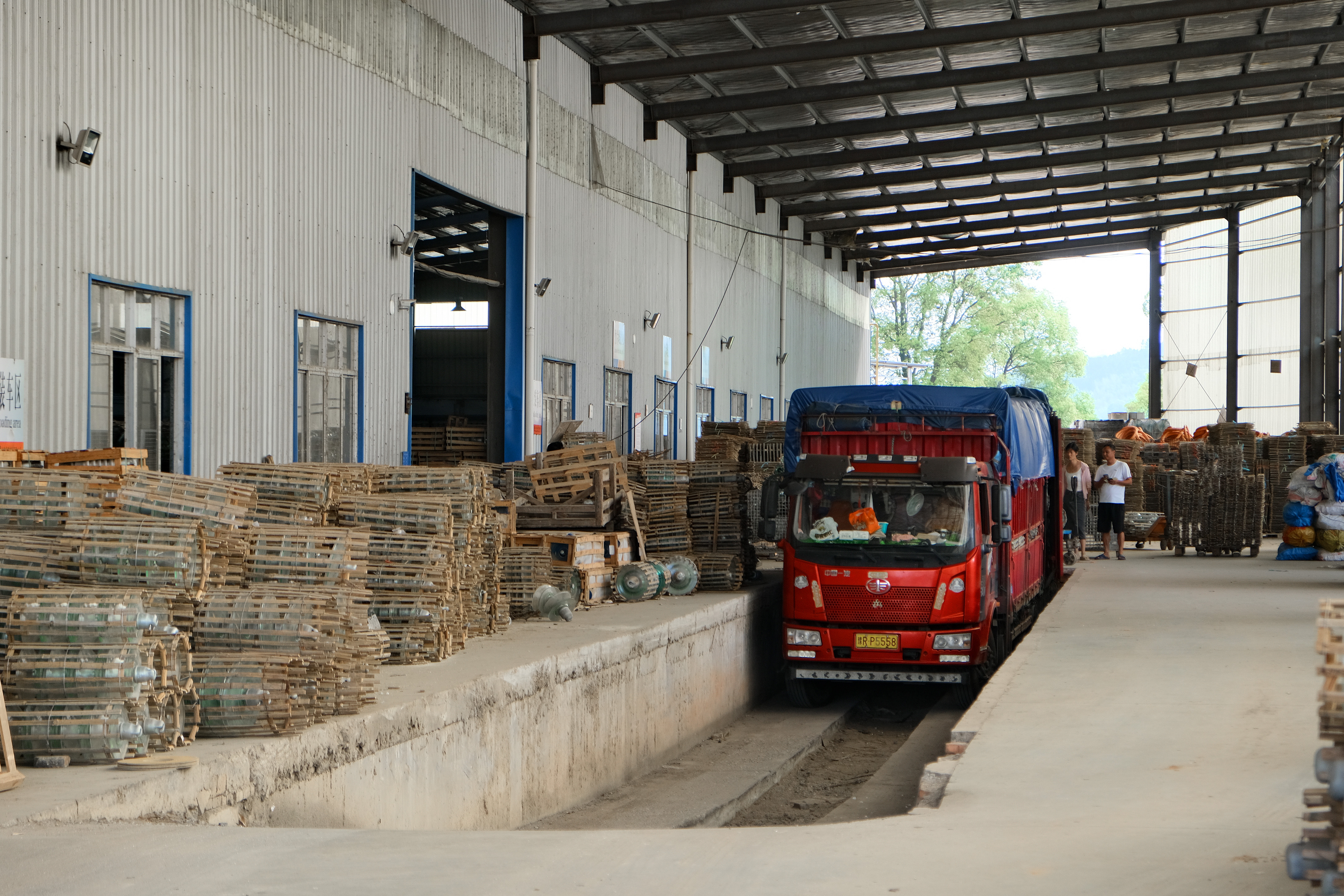
Loading verification at Jiangxi QOCI Electric Co., Ltd. — the final visible checkpoint before a lot is released against pre-shipment acceptance criteria.
Working through an acceptance schedule for an upcoming tender? Jiangxi QOCI Electric Co., Ltd. supplies suspension glass insulators from U70B to U420B, including anti-pollution, double-shed and aerodynamic profiles, with OEM and ODM production, a 50-unit MOQ and 15–35 day lead times. Request a sample set or a model-specific quotation at WhatsApp +86 199-7997-1591 or admin@qocielectric.com, and review the full range at www.quanxinelectric.com.
Have Questions or Need More Details?
Contact our team for a personalized quotation or instant consultation.
Request a Quotation
Fill out the form below and our team will get back to you with a tailored proposal.
WhatsApp Direct Chat
Prefer to chat in real-time? Message us on WhatsApp for instant assistance & quick answers.
- Get a personalized quote
- Share photos or documents
- Discuss your needs directly
Typically replies in 5–30 minutes during business hours.