
Active vs. Passive Stylus, Side by Side: What iPad and Android Buyers Should Pick
Short answer: if the pen is only meant to replace your finger — tapping, scrolling, selecting menus — a passive stylus is enough. If you take notes, draw, sketch, annotate or play on an iPad or Android tablet, buy an active stylus. An active stylus is the only one of the two that supports palm rejection and tilt sensing, and it is the type that avoids the latency and offset that passive pens show while writing.
That rule settles the everyday version of the question, "what should I buy, a passive stylus or an active stylus?". The harder question is the buying-stage one: which active stylus, for which tablet, with which charging pattern, at which budget — and how a third-party active stylus pen compares with an Apple Pencil. This comparison answers both, using documented specifications rather than listing-page language.
Why the Passive vs. Active Decision Is Harder Than It Looks
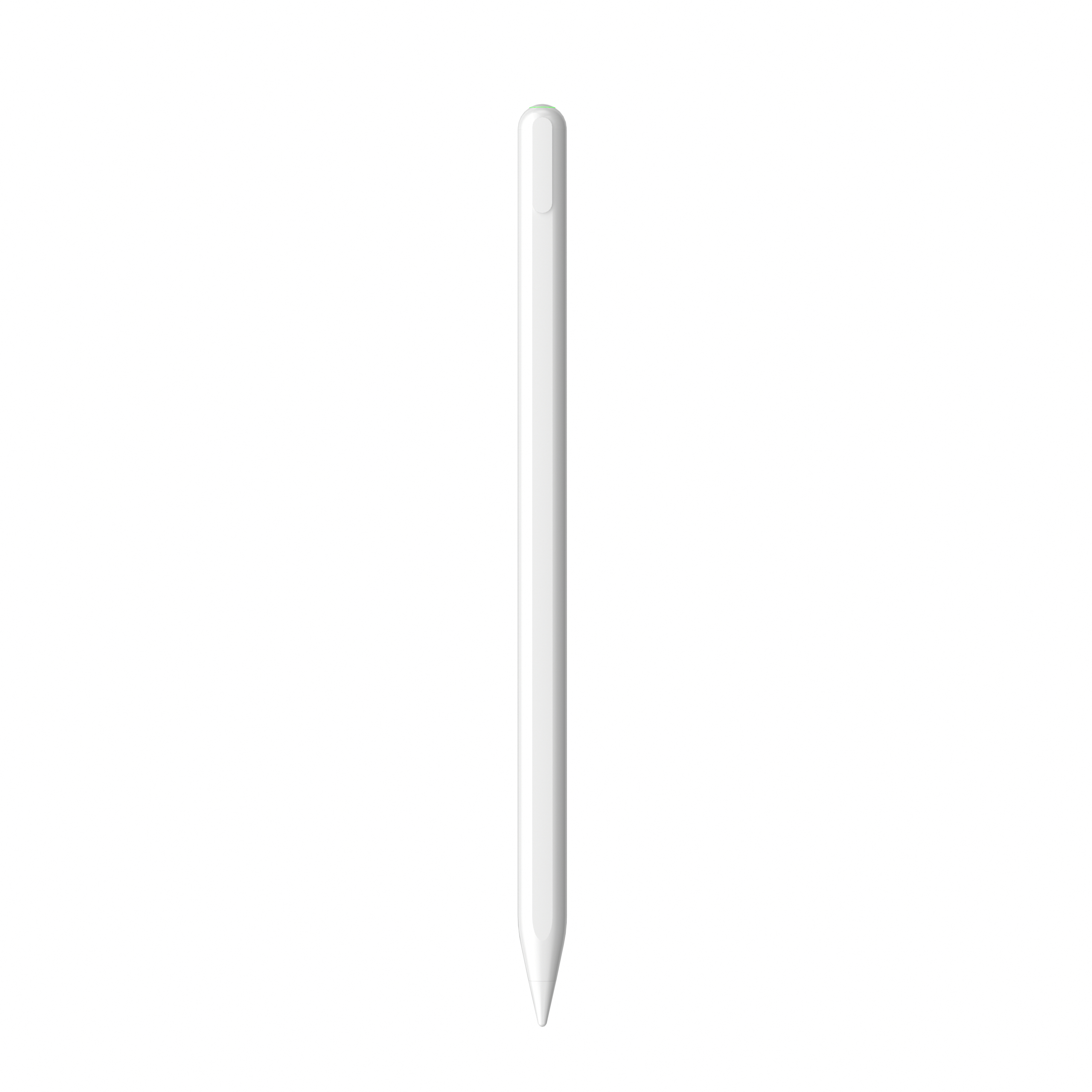
Two stylus pens that look almost identical can behave completely differently. Both are sold under the same search terms — "stylus pen", "tablet stylus", "capacitive stylus" — and both may share the same aluminium barrel, white finish and replaceable nib. The difference is not visible from the outside: it is whether the pen carries a battery and an active signal circuit, or works purely through capacitive contact.
Most buyers only discover the gap after purchase, through one of three symptoms:
- Palm marks and hovering hands. A passive stylus does not support palm rejection, so the hand resting on the glass registers as touch input. Passive pens also do not support tilt sensing, which removes the shading control that note and sketch apps rely on.
- Offset and lag. Writing with a passive stylus typically shows latency and an offset between where the nib touches and where the stroke appears — tolerable for tapping, distracting for handwriting.
- Compatibility surprises. An "active stylus" label is not a compatibility guarantee. Active pens depend on how the tablet detects the pen signal, so the model-to-device match has to be verified before ordering — especially when one pen is expected to serve iPads and Android tablets in the same fleet.
The decision therefore has two variables rather than one: the writing task and the device. Budget is the third. Getting the order wrong — paying for active features nobody uses, or buying a passive pen for a note-taking workflow — is the most common and most expensive mistake in this category.
Industry Background: A Growing, Standardising Category
Stylus pens are no longer a niche accessory. The global stylus pen market was valued at USD 19.45 billion in 2025 (IMARC Group). Market-size figures in this category should be read with one caution: valuations vary widely with definition, since broad "input device" scopes produce figures in the tens of billions while narrow active-digital-pen definitions produce much smaller numbers. For procurement purposes the more useful signal is growth: active stylus technology is projected to grow at a CAGR of 9.8% between 2026 and 2034 (Dataintelo).
Standardisation is the second shift. The USI 2.0 specification, released in 2022 by the Universal Stylus Initiative and supported by Google, Intel and Lenovo, is the primary cross-platform standard for active styluses. It points toward a market in which one active pen works across brands instead of being locked to a single device family.
Performance expectations are rising as well. Samsung S-Pen and high-end professional active pens feature up to 4,096 levels of pressure sensitivity (Samsung). That figure belongs to first-party, high-end hardware; it is not the baseline for third-party pens, where tilt sensing is far more common than pressure sensing.
For importers and distributors, one classification detail matters at customs: stylus pens are typically classified under HS Code 8471.60.90 as "Automatic Data Processing Input Units".
Passive vs. Active Stylus: The Four Differences That Change the Buying Decision
1. Power and how the pen talks to the screen
An active stylus is powered by its battery and transmits weak electrical signals to the touchscreen. The tablet detects those signals to locate the tip position, which is what enables accurate writing, drawing and tapping. A passive stylus has no battery and no signal circuit at all: it behaves like a finger, which is why it is cheaper, always ready, and functionally limited.
2. Palm rejection
Palm rejection is the feature that lets the hand rest on the glass while writing. It is available on active styluses; passive styluses do not support it.
3. Tilt sensing and pressure sensing
Tilt sensing changes stroke width or shading according to the angle of the pen, and it is listed as "Tilt Bold: Yes" on several Jiayao iPad models. Pressure sensitivity responds to how hard the pen is pressed, and it is where first-party pens such as the Apple Pencil and high-end professional pens (up to 4,096 levels on Samsung S-Pen) separate from most third-party active styluses.
4. Latency and offset
Passive styluses show latency and offset during writing. Active models in the Jiayao range are documented as "NO Offset" and "NO Delay" on their specification sheets — a claim that can be checked directly against each model's datasheet instead of being taken from a listing description.
Active Stylus Options: What the Jiayao Range Covers
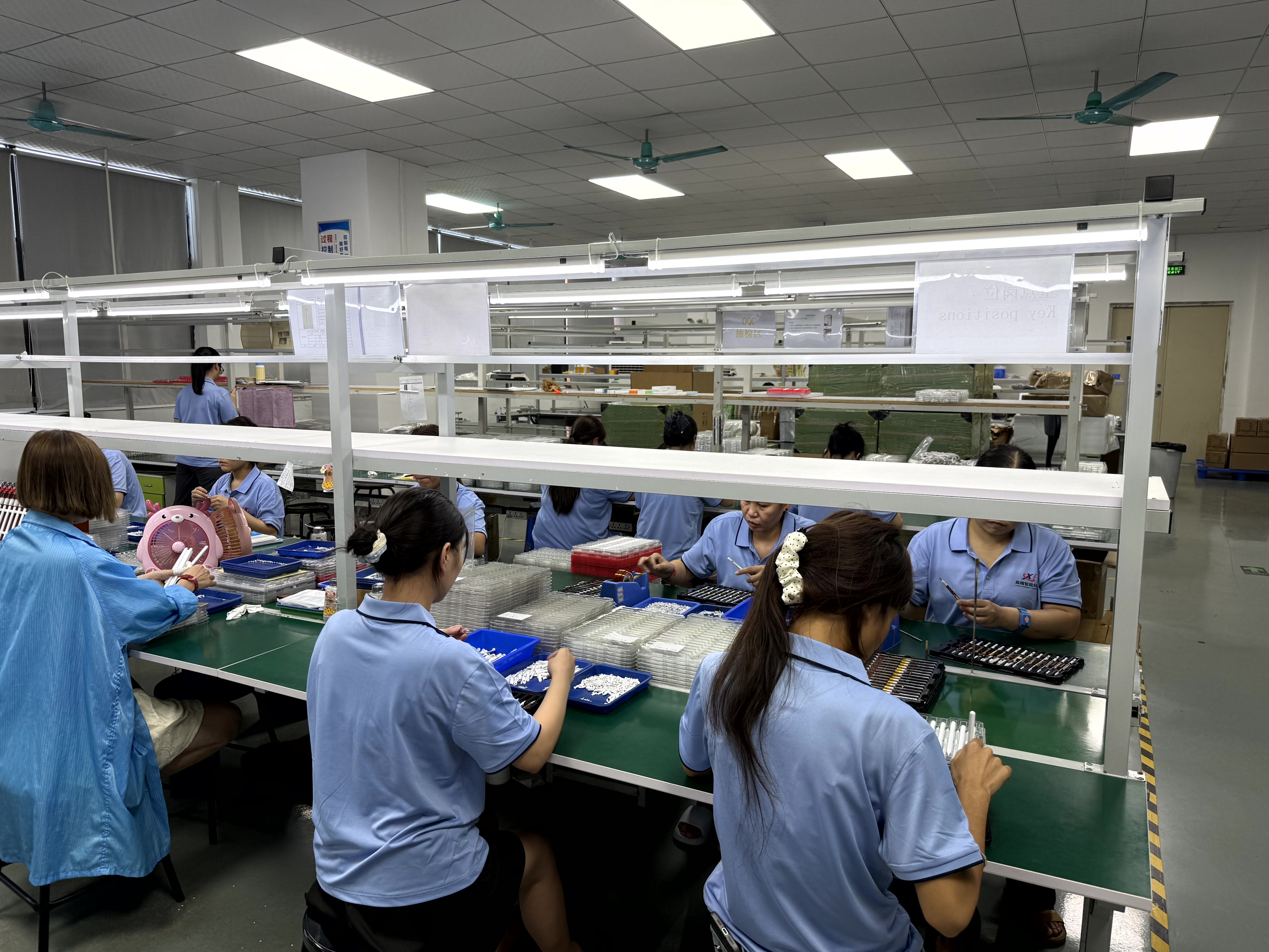
Dongguan Jiayao Intelligent Technology Co.,Ltd is an active stylus pen manufacturer based in Dongguan, Guangdong, China, founded in 2021. Its capabilities cover the full process from PCBA design and battery welding to final assembly and quality testing, in a 2,700 m² facility with 100 employees, four R&D engineers and an annual output of 3,000,000 units, of which 40% is exported to the EU and USA. The range spans active and passive stylus pens compatible with iPad and mainstream tablets.
For buyers comparing active options, the useful spread is across device coverage, charging behaviour and runtime rather than across colour variants:
- Cross-platform coverage: the iPad and Android Stylus Pen R3-P is listed as a universal stylus for iPad and Android tablets — Type-C charging in 40 minutes, 9–10 hours of continuous working time, side adsorption, interchangeable nibs, aluminium alloy body, 164.6 mm and 13±1 g. The S3-GC is the Android-universal model: 55-minute charge, 10 hours of working time, top touch switch.
- Long runtime: the E3-A is positioned as the palm-rejection iPad stylus for long sessions — a 230 mAh battery, a 40-minute Type-C charge and 44 hours of continuous working time.
- Fast charging: the A21B (2-in-1 iPad stylus) and the A30-B (iPad pencil with shortcut button) both charge over Type-C in 25 minutes and run for 11 hours. Both list palm rejection, tilt sensing and side magnetic attachment; on the A21B, side adsorption is listed for 11-inch and 12.9-inch iPad only.
- Charging flexibility: the W12-A charges by Type-C in 25 minutes or wirelessly in 60 minutes; the W13-A charges by cable in 15 minutes or by tablet wireless charging in 60 minutes; the W3-H is a magnetic-charging model with a 70-minute charge and 11 hours of working time.
Two limits are worth stating plainly. First, every active stylus needs charge, so a charging routine is part of the product experience; the models above also carry automatic power-off (10 minutes, or 60 minutes on the E3-A and R3-P) and up to one year of standby time at full power. Second, not every model documents palm rejection or tilt sensing — the specification sheet, not the product photo, is the reliable source. iPad models in the range are listed as compatible with iPad devices from 2018 onward on system version 12.2 and above.
How a Third-Party Active Stylus Compares with the Apple Pencil
A frequent buying question is whether a third-party active stylus can replace an Apple Pencil. The honest answer is feature-level, not brand-level. Compared with the Apple Pencil, a third-party active stylus delivers the same precise writing, the same palm rejection and the same pause-doodle function. The main difference is the sensing technology: third-party models generally do not offer pressure sensing and support tilt sensing instead. Price is the second difference — the Apple Pencil is considerably more expensive.
The recommendation follows from that split. Artists who need precise, pressure-driven drawing are better served by the Apple Pencil. Buyers who need note-taking, drawing and everyday annotation are better served by a third-party active stylus — including cross-device buyers who want one pen concept to cover both iPad and Android tablets, which is exactly where a universal model such as the R3-P fits.
A Six-Step Buying Sequence for iPad and Android Buyers
- Define the job, not the product. Finger replacement — tapping, scrolling, menu selection — is a passive-stylus job. Note-taking, drawing, sketching, annotation and tablet gaming are active-stylus jobs, where the writing experience is substantially better than with a passive pen.
- Lock the device list first. Write down every tablet the pen must serve. If the answer is "iPad only", an iPad-specific model is sufficient; those models are listed for iPad devices from 2018 onward on system version 12.2 and above. If iPads and Android tablets are both in scope, a universal model such as the R3-P removes the need to stock two SKUs.
- Write down the must-have features. Palm rejection, tilt sensing, no offset and no delay, side adsorption, and — for workflow shortcuts — a dedicated button, as on the A30-B.
- Choose the charging pattern that matches the user. Cable charging across the range runs from 15 to 55 minutes; magnetic or wireless charging takes 60 to 70 minutes; dual-charge models (W12-A and W13-A) support both.
- Match runtime to the usage pattern. 9–10 hours covers daily note-taking; 11–16 hours covers long working days and heavy annotation; 44 hours suits shared or education devices that cannot be recharged between lessons.
- For resellers and importers, verify paperwork and supply terms. Request the compliance documents that name the exact model being ordered, confirm MOQ, ask for a sample, and check lead time before committing to a launch date.
Use Cases: How Buyers in This Category Actually Order
iPad accessory ODM, Vietnam — 3,000 units. A Vietnamese iPad accessory ODM has been ordering the E3-A for two years. The application is precise writing on iPad plus retail sale on ecommerce platforms. The stated result is a smooth, precise handwriting experience, improved tablet operation efficiency and good user feedback; the buying highlights were precise writing, fast charging, long working hours, palm rejection and tilt pressure sensing.
Tablet accessory ODM, Turkey — 5,000 units. A Turkish tablet accessory ODM has been ordering the W12-A for two years. The pen is used for precise writing on iPad, iPhone, Android tablets and Android phones — the fit that made the universal format attractive — and the stated result was increased usage of iPads and Android tablets.
Education projects. The documented stylus scenario for this category is precise note-taking, drawing and navigation on touchscreen tablets, matched to iPad and Android tablets, with stated requirements of low latency, precise writing, side magnetic attachment and a replaceable pen tip. That is why replaceable nibs and long runtime matter more than cosmetic differences in school and campus deployments.
Comparison Table: Passive vs. Active Stylus
| Criterion | Passive stylus | Active stylus |
|---|---|---|
| Power source | None — battery-free | Built-in rechargeable battery |
| How the tablet detects it | Capacitive contact; behaves like a finger | The pen transmits weak electrical signals and the tablet locates the tip position to render accurate writing, drawing and tapping |
| Palm rejection | Not supported | Supported |
| Tilt sensing | Not supported | Supported on models such as A7-H-L, A8-RH, A21B and A30-B |
| Pressure sensitivity | Not supported | Not offered on the third-party Jiayao models listed here, where tilt sensing is the equivalent feature; high-end first-party pens such as Samsung S-Pen reach up to 4,096 levels |
| Latency and offset in writing | Latency and offset are typical | Documented as "NO Offset" and "NO Delay" on the Jiayao active models listed in this article |
| Relative cost | Lower unit cost | Higher than passive |
| Best suited to | Replacing the finger: tapping, scrolling, simple navigation | Note-taking, drawing, sketching, annotation, tablet gaming |
Active Stylus Model Selection: iPad and Android Reference Table
| Model | Target device | Charging method and time | Continuous working time | Palm rejection | Tilt sensing |
|---|---|---|---|---|---|
| S3-GC | Android universal | Type-C, 55 min | 10 hours | Not documented | Not documented |
| R3-P | iPad and Android tablets | Type-C, 40 min | 9–10 hours | Not documented | Not documented |
| E3-A | iPad (palm-rejection model) | Type-C, 40 min | 44 hours | Yes | Not documented |
| A7-H-L | iPad | Type-C, 30 min | 16 hours | Yes | Yes |
| A8-RH | iPad | Type-C, 30 min | 12 hours | Yes | Yes |
| A21B | iPad, 2-in-1 | Type-C, 25 min | 11 hours | Yes | Yes |
| A30-B | iPad with shortcut button | Type-C, 25 min | 11 hours | Yes | Yes |
| W3-H | iPad | Magnetic charging, 70 min | 11 hours | Not documented | Not documented |
| W12-A | iPad | Type-C 25 min or wireless 60 min | 9–10 hours | Not documented | Not documented |
| W13-A | iPad | Cable 15 min or tablet wireless 60 min | 9–10 hours | Not documented | Not documented |
All figures in both tables come from the published specification sheets of each model. Where a datasheet does not document a feature, the table shows "Not documented" rather than an assumption.
FAQ
Do the stylus pens come with compliance documentation for the EU market?
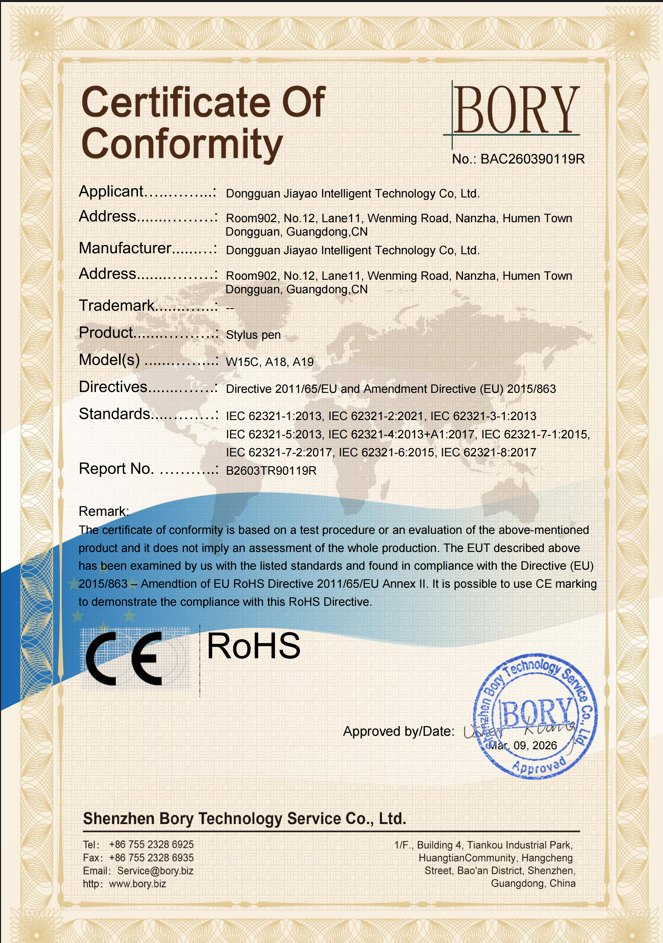
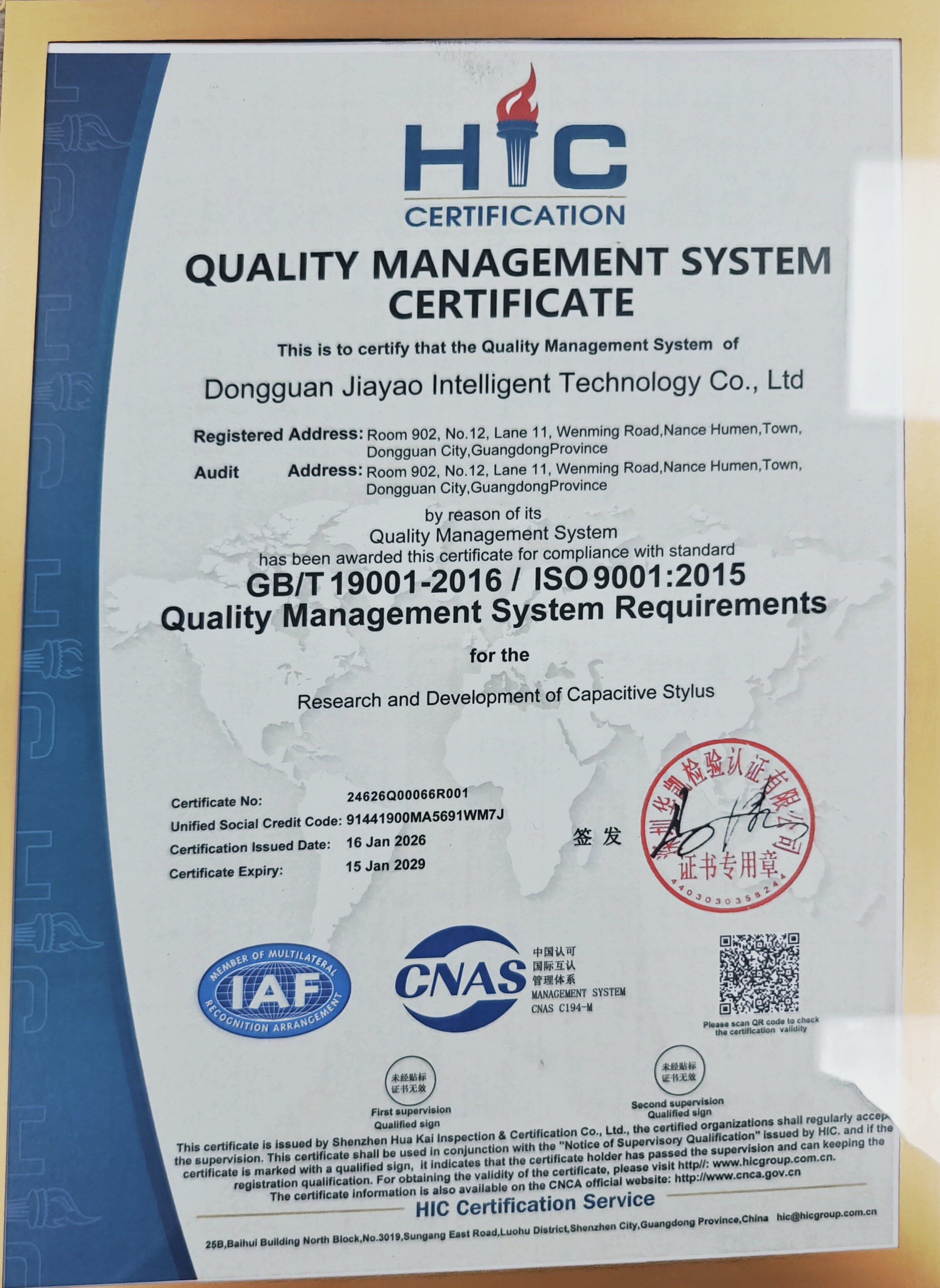
Yes, and the documentation should be matched to the exact model being purchased. Jiayao holds a RoHS Certificate of Conformity, certificate number BAC260390119R, issued on 9 March 2026 by Shenzhen Bory Technology Service Co.,Ltd for the EU market, tested against the IEC 62321 series of standards. The company also holds a Quality Management System certificate to ISO 9001:2015, certificate number 24626Q00066R001, issued by HIC Certification Service on 16 January 2026 and valid to 15 January 2029, covering research and development of capacitive stylus. Because a certificate names specific models, the correct step for a buyer is to request the certificate copy that lists the model in the purchase order.
What is the difference between a third-party active stylus and an Apple Pencil?
Both deliver precise writing, palm rejection and the pause-doodle function. The main difference is the sensing technology: third-party styluses do not have pressure sensing and use tilt sensing instead, while the Apple Pencil is considerably more expensive. The practical recommendation is task-based — artists who need precise, pressure-driven drawing should choose the Apple Pencil, while note-taking, drawing and everyday annotation are served well by a third-party active stylus.
If budget is the main constraint, how do I choose between a passive and an active stylus?
Decide by task first, then by charging convenience. A passive stylus is battery-free, low-cost and easy to use, but it has no palm rejection and no pressure sensing, and it shows latency and offset while writing — so it only works well where the pen replaces a finger. An active stylus is the better value whenever the pen is used to write, draw or sketch regularly, because the extra cost buys palm rejection, tilt sensing and a writing experience close to a first-party pen. Inside the active range, longer runtime and dual charging are the features that justify a higher unit price, so match them to the user instead of defaulting to the most expensive model.
Can I test a sample before placing an order?
Yes. Jiayao supports both OEM and ODM projects, with customization of function, colour, shape, tip, logo and packaging, an MOQ of 500 pcs, and samples that can be ready in as little as 3 weeks. For validation, order the sample in the configuration you intend to sell — nib type, colour, logo and packaging — so that the sample test covers the same palm rejection, tilt sensing and charging behaviour your customers will experience.
What is the lead time after an order is confirmed?
The capability sheet lists a lead time of 20–35 days, and large quantities of regular models are kept in stock so that standard products can ship in about 20 days, which also helps with small, scattered and urgent orders. Monthly capacity is 500,000 units, every stylus goes through 100% full inspection — functional, tactile and visual checks — and the product carries a one-year warranty with one-to-one replacement. To move to the next step, download the Jiayao Intelligent Stylus Pen Catalogue or send a sample and quotation request to Lea Tan at LeaTan@dg-xcdz.com / +86 166 2065 1838 (WhatsApp on the same number).
Conclusion: Decide in the Order of Task, Device, Feature, Budget
The passive-versus-active decision is not a quality judgement; it is a task match. Passive styluses replace a finger cheaply and never need charging, but they cannot deliver palm rejection, tilt sensing or offset-free writing. Active styluses cost more and require charging, and in return they make note-taking, drawing, sketching and annotation practical on an iPad or Android tablet — and a third-party active stylus covers those tasks with the same precise writing and palm rejection as an Apple Pencil, using tilt sensing rather than pressure sensing and at a considerably lower price point.
Once the task is fixed, the rest of the decision is mechanical: confirm the device list, verify which documented features matter, choose the charging pattern, and then match runtime to the way the pen will actually be used. Buyers sourcing at scale should add one extra step and check the paperwork, MOQ and lead time before committing.
Next step for buyers and distributors. Dongguan Jiayao Intelligent Technology Co.,Ltd manufactures active and passive stylus pens for iPad and Android tablets, with in-house PCBA design, battery welding, assembly and 100% testing, MOQ from 500 pcs and samples in as little as 3 weeks. Review the full model range at jiayaostylus.com, download the catalogue, or request a sample and quotation from Lea Tan at LeaTan@dg-xcdz.com / +86 166 2065 1838.