Understanding Stylus Pen Specs: A Technical Guide to Pressure Sensitivity and Latency
The short answer: latency and pressure sensitivity measure two different things. Latency is the delay between the tip moving and the line appearing on screen — Jiayao’s active stylus specification is below 8 ms with a writing offset below 0.5 mm. Pressure sensitivity is the number of force levels a pen reports so line weight changes with hand pressure — high-end professional pens such as the Samsung S Pen support up to 4,096 levels, while Jiayao’s active stylus pens do not use pressure sensing and rely on tilt sensing instead. A third-party active stylus can therefore match an Apple Pencil on precise writing, palm rejection and shortcut functions, but not on pressure-based line weight.
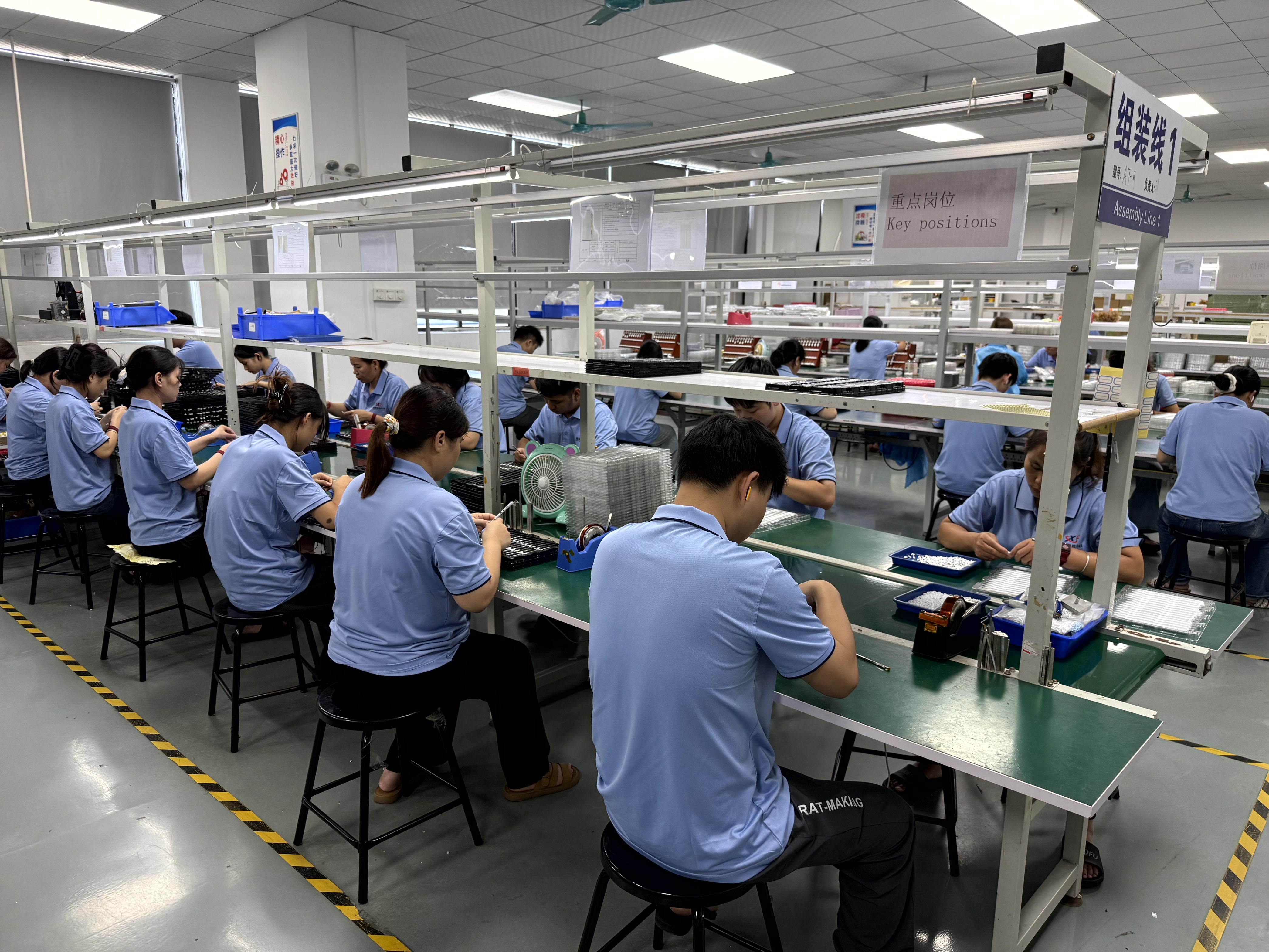
Cover: the production floor at Dongguan Jiayao Intelligent Technology Co.,Ltd, where active and passive stylus pens are assembled and 100% inspected before shipment.
Problem Definition: Why the Two Numbers Are So Easy to Misread
Most stylus pen spec sheets compress two unrelated engineering questions into one line of marketing copy. The first question is timing: how fast does the line follow the tip? The second is force mapping: does the line respond to how hard the pen is pressed?
A pen can answer the first question well and the second question not at all. Jiayao’s active stylus pens are specified at below 8 ms latency and below 0.5 mm writing offset, with precise writing and palm rejection, but the company states plainly that its styli do not include pressure sensing — tilt sensing is used instead. Samsung S Pen class hardware and other high-end professional active pens move in the opposite direction, offering up to 4,096 levels of pressure sensitivity. Neither design is defective; they are built for different jobs.
Three practical problems follow from that:
- Latency numbers are published without measurement context. A figure such as “8 ms” only becomes comparable when the buyer knows how it was measured. A latency claim that cannot be tied to a test condition is a marketing statement, not a specification.
- Pressure sensitivity is often claimed without a level count. “Pressure sensitive” tells you nothing usable unless a discrete number of levels is attached, because that number defines how smoothly line weight changes.
- Passive styli are pulled into a comparison they cannot win. A passive stylus has no battery and no electronics, so it does not support palm rejection or tilt sensing and shows latency and offset when writing. Spec discussions of latency and pressure apply to active pens only.
There is a second, quieter problem that appears only at repeat-order stage: a specification that is verified once on a sample but never frozen for production. That is why this guide covers both the technical reading of the specs and the acceptance process that keeps them stable.
Industry Background: Where the Spec Landscape Stands in 2026
The commercial context explains why spec literacy now matters to buyers who never touch a pen themselves. IMARC Group valued the global stylus pen market at USD 19.45 billion in 2025, and Dataintelo projects active stylus technology to grow at a CAGR of 9.8% from 2026 to 2034.
Those two figures illustrate a data-literacy trap. Fortune Business Insights reported USD 3.36 billion for the same 2025 window under a narrower definition focused strictly on active digital pens, while the larger figure covers a broader input-device category. The numbers are not contradictory so much as non-comparable — which is the same discipline a buyer needs when reading stylus spec sheets from different factories.
On the standards side, the USI 2.0 specification released in 2022 by the Universal Stylus Initiative is the primary cross-platform standard for active styluses, supported by Google, Intel and Lenovo. Alongside it, proprietary pen protocols continue to serve specific tablet platforms. For importers, stylus pens are typically classified under HS Code 8471.60.90 as automatic data processing input units, a detail that belongs in the customs paperwork rather than the marketing deck.
At manufacturer level, Dongguan Jiayao Intelligent Technology Co.,Ltd is a stylus pen specialist based in Dongguan, Guangdong, China, founded in 2021. The company operates a 2,700 m² facility with 100 employees, including a 4-engineer R&D team, and produces 3,000,000 units per year, with 40% of output exported to the EU and USA. Core capabilities cover PCBA design, battery welding, final assembly and quality testing in house — the four stages where latency and offset specifications are actually created or lost.
Detailed Solution: The Five Specifications That Decide the Writing Experience
These are the parameters worth extracting from any active stylus datasheet, and the parameters worth testing on any sample.
1. Latency: the timing of the line
Latency is the interval between the tip moving on the glass and the corresponding line being rendered. It determines whether handwriting looks like handwriting and whether a drawn stroke trails behind the hand. Jiayao’s active stylus specification is below 8 ms, described in the company’s own comparison as precise writing without the latency associated with passive pens. For note-taking, latency is the single most visible spec: users feel it before they can name it.
2. Writing Offset: where the line appears relative to the tip
Offset is the distance between the physical tip position and the rendered line. Jiayao’s active stylus specification is below 0.5 mm. Passive pens show both latency and offset during writing. Offset matters most where accuracy is documented — form filling, diagram labelling, annotation on technical drawings — because the user compensates unconsciously and the error is only visible in the finished document.
3. Pressure Sensitivity: how force becomes line weight
Pressure sensitivity is the number of discrete force levels the pen reports to the tablet so the application can vary stroke width or opacity. Samsung S Pen and high-end professional active pens feature up to 4,096 levels of pressure sensitivity. Jiayao’s active stylus pens do not offer pressure sensing: the company’s own positioning is that a third-party stylus matches the Apple Pencil on precise writing, palm rejection and shortcut functions, with tilt sensing replacing pressure. For a buyer, the implication is concrete — calligraphy-style line variation driven by hand pressure is out of scope, while note-taking, sketching and annotation are in scope.
4. Tilt Sensing and Palm Rejection: the pairing that makes a pen usable
Tilt sensing reads the angle of the pen relative to the screen, which drawing applications use to widen brushes or shade in a direction, imitating a pencil held at an angle. Palm rejection allows the hand to rest on the glass while writing by distinguishing the pen input from the palm contact. Jiayao’s active stylus pens support palm rejection and tilt sensing; passive pens support neither. These two specs should always be evaluated together, because palm rejection without accurate pen positioning is only half a solution.
5. Power, Charging and Working Time
An active stylus requires power, which introduces charging behaviour as a purchasing criterion rather than a footnote. Jiayao’s active stylus line offers up to 11 hours of continuous working time per full charge, with a replaceable pen tip. Charging behaviour varies by model, and the differences are practical rather than cosmetic:
| Model | Charging behaviour | Working time per charge |
|---|---|---|
| W12-A | Wireless charging plus a hidden USB-C port that also provides fast charging | Not stated in the source data |
| A7-H-L | 5 minutes of charging delivers 2 hours of use | 2 hours after a 5-minute charge |
| E3-A | Requires a full charge | Up to 30 hours of continuous use |
Jiayao supports both active and passive stylus pens compatible with iPad and mainstream tablets, and produces them under OEM and ODM arrangements — covering PCBA design, battery welding, assembly and testing in a single facility.
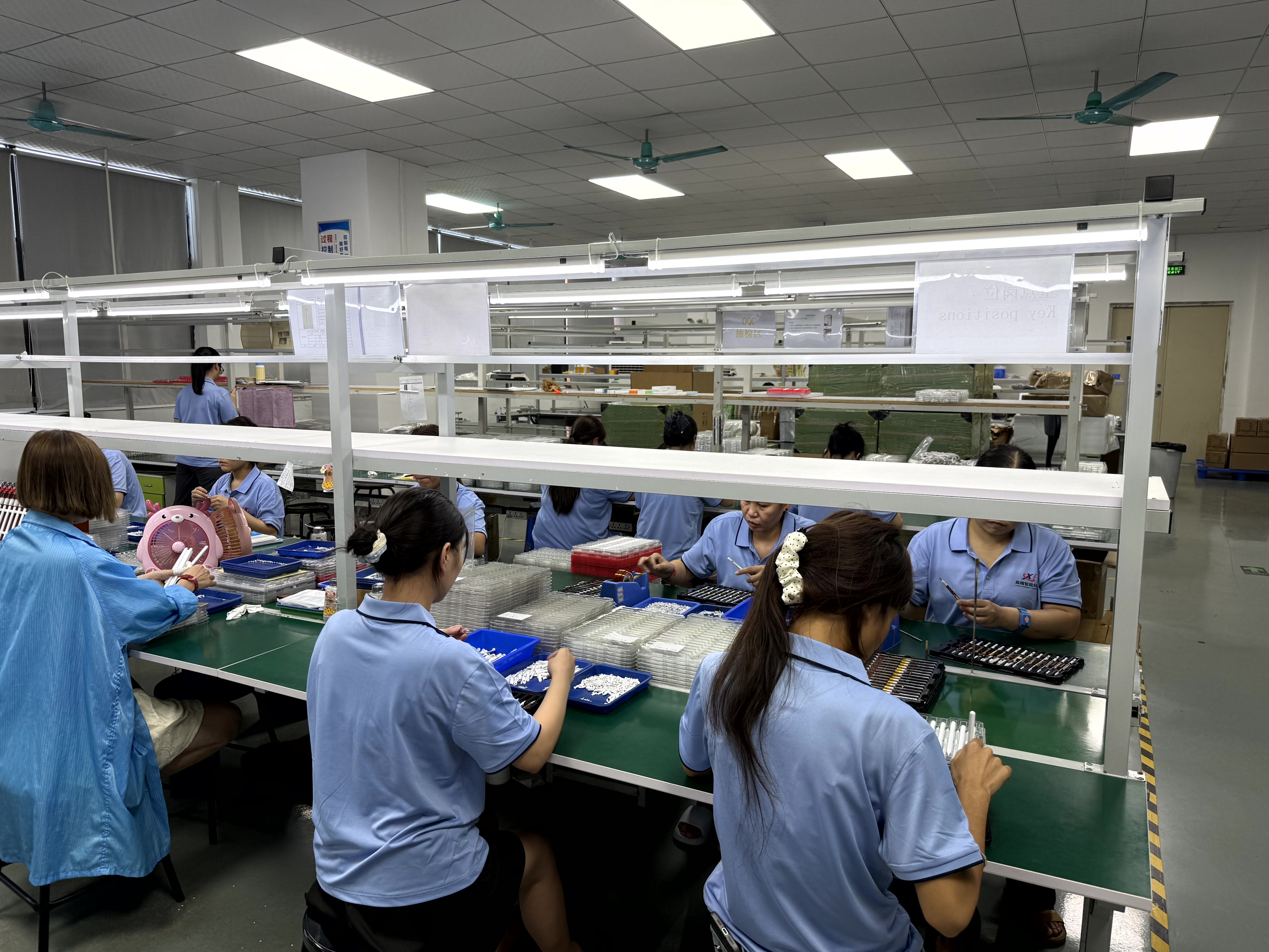
Supporting image: stylus pen assembly environment. Latency and offset tolerances are set during PCBA and firmware work, not during final packing.
Jiayao Active Stylus vs Apple Pencil: The Spec-by-Spec Answer
The most common technical question from buyers is also the clearest test of whether a supplier understands its own product: what is the difference between a third-party stylus and an Apple Pencil?
According to Jiayao’s own comparison, the shared ground is significant. Both products deliver precise writing, palm rejection, and a pause/doodle shortcut function. The difference is concentrated in one specification: pressure sensing. Jiayao’s active stylus does not include it and uses tilt sensing instead, and the company identifies this as the main technical difference between the two product types. The second difference is commercial rather than technical — the Apple Pencil is considerably more expensive than a third-party stylus.
The selection logic that follows is straightforward and worth repeating to end users:
- If the user is an artist who needs precise, pressure-driven drawing, a pressure-sensitive pen such as the Apple Pencil (or a 4,096-level professional active pen) is the correct tool.
- If the user needs note-taking, drawing or sketching at a controlled cost, a third-party active stylus covers the same core writing functions through latency, offset, palm rejection and tilt sensing.
Buyers should also treat compatibility as a separate verification step rather than assuming it: Jiayao’s active and passive stylus pens are built for iPad and mainstream tablets, and the exact model match should be confirmed before an order is placed.
Comparison Table: Passive Stylus vs Jiayao Active Stylus vs Apple Pencil
The table below uses only specifications stated in Jiayao’s product comparison data and public manufacturer documentation. Where a value is not stated in those sources, it is marked as such rather than estimated.
| Specification | Passive stylus | Jiayao active stylus | Apple Pencil |
|---|---|---|---|
| Power source | Battery-free | Built-in rechargeable battery (USB-C and/or wireless charging by model) | Not stated in source data |
| Writing latency | Latency reported during writing | Below 8 ms | Not stated in source data |
| Writing offset | Offset reported during writing | Below 0.5 mm | Not stated in source data |
| Palm rejection | Not supported | Supported | Supported |
| Tilt sensing | Not supported | Supported | Not stated in source data |
| Pressure sensitivity | Not supported | Not offered — tilt sensing is used instead | Pressure sensing is the main specification difference identified in the comparison |
| Shortcut function | Not supported | Supported (pause/doodle shortcut) | Supported |
| Working time per charge | Not applicable | Up to 11 hours continuous (model-specific options available) | Not stated in source data |
| Maintenance | Not applicable | Regular charging; replaceable pen tip | Not stated in source data |
| Cost position | Lower cost | Higher cost than passive | Considerably more expensive than third-party stylus |
| Best suited for | Replacing finger input on iPad/tablet | Note-taking, drawing, sketching, tablet use | Precise drawing where pressure-based line weight is required |
Sources: Jiayao active vs passive stylus comparison data and the company’s Apple Pencil comparison entry. Unlisted values are not claimed.
Step-by-Step Breakdown: How to Validate These Specs Before You Order
The following sequence is designed for a buyer who must select and then re-order an active stylus pen with predictable performance.
- Map the specification to the end use. Note-taking and annotation prioritise latency, writing offset and palm rejection. Illustration and pressure-driven line work require pressure levels, which means a 4,096-level professional pen or an Apple Pencil rather than a tilt-only active stylus.
- Ask for the context behind any latency figure. Request the measurement method along with the number. A latency value with no stated test condition should be treated as unverified until the sample confirms it.
- Confirm the spec combination, not the individual specs. Check that palm rejection, tilt sensing and offset are evaluated together in the target application, because a pen can pass each spec separately and still feel wrong in combination.
- Validate on a sample. Jiayao provides samples in as little as 3 weeks. Test handwriting latency and legibility, tip-to-line offset at the screen edges, palm resting while writing, tilt response in the drawing application you actually intend to use, and charging behaviour on the intended model.
- Freeze the tolerances for production. Every Jiayao stylus goes through 100% full inspection covering functional, tactile and visual checks, so the sample specification can be carried into mass production rather than re-negotiated.
- Plan the long-term side of the specification. Confirm the replaceable pen tip specification, the MOQ, and the stated delivery and payment terms before the first bulk order, so that repeat orders do not reopen the technical discussion.
- Check the platform or standard path if your product is cross-platform. USI 2.0 is the primary cross-platform standard for active styluses, supported by Google, Intel and Lenovo; products built for a single tablet platform follow that platform’s protocol instead.
Use Cases: Which Spec Profile Fits Which Job
Education and office note-taking
Latency, writing offset and palm rejection dominate this profile. Pressure levels add little, because note-taking does not require force-controlled stroke width. Jiayao’s active stylus specification — below 8 ms latency, below 0.5 mm offset, palm rejection and tilt sensing — matches this requirement set directly.
Digital illustration and design work
Here pressure sensitivity becomes the deciding specification. Where an illustrator needs line weight to follow hand pressure, the correct reference point is a pen with up to 4,096 pressure levels, such as the Samsung S Pen class of hardware. A tilt-sensing active stylus remains usable where the application maps tilt to brush size, but it is not a substitute for pressure-driven line variation.
OEM and private-label stylus programmes
Brand owners buying under their own label need a specification that survives repetition. This is where in-house process control matters more than the headline number: Jiayao covers PCBA design, battery welding, final assembly and quality testing, with 100% full inspection on every unit, and supports OEM/ODM customisation based on samples such as logo, packaging and Bluetooth name.
Aftermarket and accessory channels
Retailers and repair channels live on parts continuity. Replaceable pen tips and a stable model range matter more than a marginal latency improvement, and the stated MOQ of 500 units keeps a test order within reach of a growing seller.
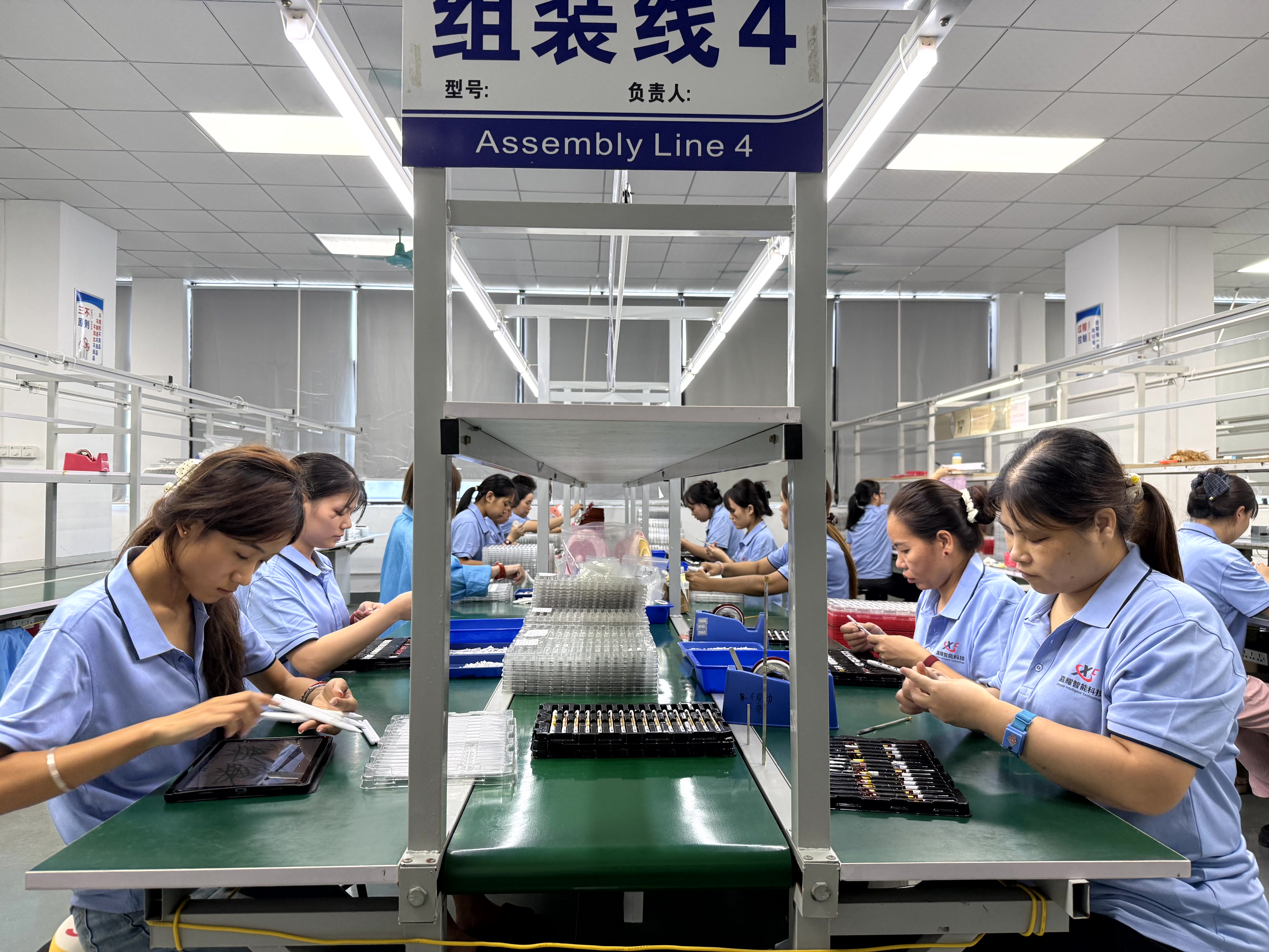
Proof: functional, tactile and visual inspection is applied to every stylus unit before shipment to the EU and USA.
Long-Term Supply: The Specification That Never Appears on a Datasheet
For buyers at decision and execution stage, the most commercially important specification is the one no datasheet lists: whether the same pen, with the same tolerances and the same replaceable tip, can still be supplied in the second and third order.
Jiayao’s operating model addresses this in four ways. First, process control is internal — PCBA design, battery welding, final assembly and quality testing are not outsourced, which is where latency and offset consistency is preserved across batches. Second, replacement parts are engineered in from the start: the active stylus line uses a replaceable pen tip rather than a sealed assembly. Third, commercial terms are stated explicitly, including MOQ of 500 units, delivery terms of EXW or FOB, acceptance criteria based on pre-shipment inspection, and payment terms of 30/70. Fourth, lead times are short and predictable for a manufacturing programme, with standard orders shipped in 20 days and samples in as little as 3 weeks.
The company’s position as a specialist is supported by scale and focus: founded in 2021, 2,700 m² of production space, 100 employees including a 4-engineer R&D team, and 3,000,000 units of annual output with 40% exported to the EU and USA. For a distributor or brand owner, the relevant question is not whether those numbers are the largest in the category, but whether they are large enough to hold a spec across repeat orders — and whether the factory still answers the phone in year three.
FAQ: Pressure Sensitivity, Latency and Long-Term Supply
What is the difference between a Jiayao stylus and an Apple Pencil?
Jiayao’s active stylus pens match the Apple Pencil on precise writing, palm rejection and the pause/doodle shortcut function, but they do not offer pressure sensing — the company uses tilt sensing instead, and identifies this as the main technical difference between the two product types. The Apple Pencil is also considerably more expensive. If you are an artist who needs precise, pressure-driven drawing, the Apple Pencil is the better fit; if you need note-taking, drawing or sketching at a controlled cost, a third-party active stylus covers the same core writing functions.
How do I qualify a long-term stylus pen supplier with stable replacement parts?
Start with the part that wears out: the pen tip. A supplier that can hold a replaceable pen tip specification across repeat orders is the one that can support a long-term programme. Jiayao controls PCBA design, battery welding, final assembly and quality testing in house, and every stylus unit passes 100% full inspection covering functional, tactile and visual checks before shipment. Combined with pre-shipment inspection as the stated acceptance criterion, and EXW or FOB delivery terms, that gives importers a repeatable basis for checking replacement part quality on every order.
What makes a China long-term active stylus pen supplier technically credible?
Look for in-house control of the electronics rather than assembly only. Dongguan Jiayao Intelligent Technology Co.,Ltd was founded in 2021, operates a 2,700 m² facility with 100 employees including a 4-engineer R&D team, and produces 3,000,000 stylus units per year, with 40% of output exported to the EU and USA. Its active and passive stylus pens are compatible with iPad and mainstream tablets, and OEM/ODM projects can be customised based on samples, including logo, packaging and Bluetooth name.
What are the purchasing terms and acceptance criteria for stylus pen orders?
Jiayao’s stated terms are: MOQ of 500 units; delivery terms of EXW or FOB; acceptance criteria based on pre-shipment inspection; and payment terms of 30/70. These are the commercial conditions to confirm in writing before sample approval, because they define how a specification dispute is resolved if a delivered batch does not match the approved sample.
Can I validate latency and pressure specifications on a sample before ordering?
Yes. Samples are available in as little as 3 weeks. Test the specifications that matter for your specific use case: handwriting latency (specified below 8 ms on Jiayao active stylus pens), writing offset (below 0.5 mm), palm rejection with the hand resting on the screen, tilt response in your target application, and whether the use case needs pressure levels at all. The sample stage is also the right moment to confirm the replaceable pen tip specification you intend to re-order.
What lead time should I plan for, and how do I start a long-term supply inquiry?
Jiayao ships standard orders in 20 days, with samples in as little as 3 weeks. To start a long-term supply discussion, send your target models, expected volumes, required customisation (logo, packaging, Bluetooth name) and your replacement pen tip forecast to the Jiayao team: Lea Tan, LeaTan@dg-xcdz.com, or +86 166 2065 1838 (WhatsApp available on the same number). The full stylus pen range and model specifications are listed in the Jiayao Intelligent Stylus Pen Catalogue.
Conclusion: Read the Spec, Then Verify the Supply
Pressure sensitivity and latency are not competing claims — they answer different questions. Latency, together with writing offset and palm rejection, decides whether an active stylus feels immediate in the hand; pressure sensitivity decides whether line weight follows hand force. Jiayao’s active stylus pens are built around the first group, with latency below 8 ms, writing offset below 0.5 mm, palm rejection and tilt sensing, plus up to 11 hours of continuous use per charge and a replaceable pen tip. Pens in the 4,096-level class, such as the Samsung S Pen, are built around the second group and are the right choice for pressure-driven illustration.
For a technical buyer, the specification is only half the decision. The other half is whether the same tolerances, the same pen tip and the same terms survive the second order — which is why in-house PCBA design, battery welding, assembly and 100% inspection matter as much as the millisecond figure on the box.

Next step: verify the specs on your own sample
Dongguan Jiayao Intelligent Technology Co.,Ltd supplies active and passive stylus pens for iPad and mainstream tablets, with samples in as little as 3 weeks, standard orders shipped in 20 days, MOQ 500 units, and OEM/ODM customisation of logo, packaging and Bluetooth name.
Download the full Jiayao Intelligent Stylus Pen Catalogue, or contact Lea Tan at LeaTan@dg-xcdz.com / +86 166 2065 1838 to request a sample and a quotation. More detail is available at jiayaostylus.com.