
What Does 'Stylus Pen' Mean? A Plain-Language Explainer for iPad and Android Users
Stylus Pen Basics
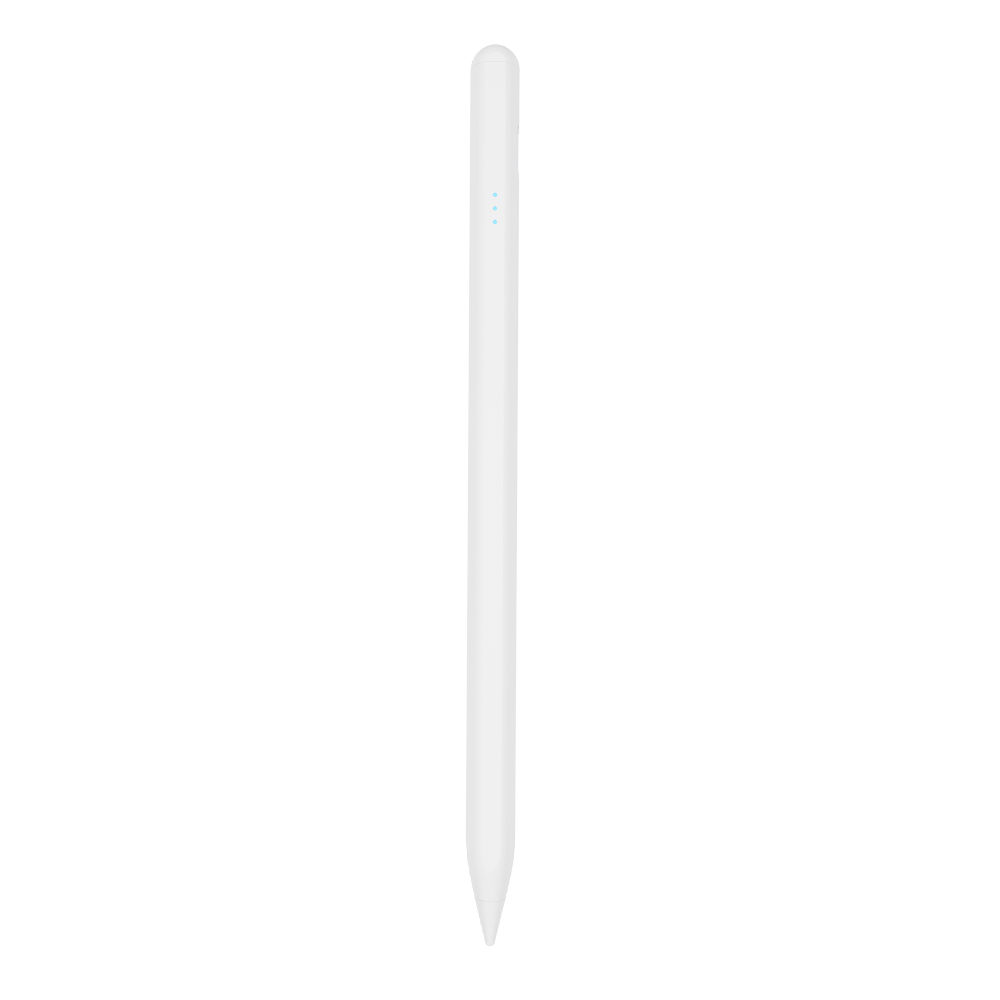
A stylus pen is a pen-shaped input tool that lets you write, draw, tap and select on a touchscreen instead of on paper. That one sentence hides an unusually wide range: the same two words describe a battery-free stick with a rubber tip and a rechargeable pen that pairs with an iPad or an Android tablet and ignores your resting hand.
If you are buying your first one, the confusion is not your fault. The category runs on overlapping labels — Stylus Pen, iPad Stylus Pen, iPad and Android Stylus Pen, Active Stylus Pen, Capacitive Stylus Pen, Universal Stylus Pen, EMR Stylus Pen, USI Stylus Pen — and most of those labels describe a technology, a use case or a charging habit rather than a totally different object.
This explainer does three things. It separates the two families every stylus pen belongs to. It decodes the labels you will see on product pages. And it answers the three questions buyers ask most: what should I buy, which stylus should I choose, and how is a third-party stylus pen different from an Apple Pencil.
Why One Term Covers So Many Products
Short answer: "stylus pen" is an umbrella word, not a specification. It tells you the shape of the object, not what the object can do.
Three different worlds were merged into that label. The office world contributed "pen," so the tool looks like something you already know how to hold. The drawing world contributed "stylus," the old name for a pointed writing implement. The computing world contributed the idea of a digitizer input — a screen that can sense position, and sometimes angle and force.
Marketing then layered more words on top. The same object may be sold as a digital stylus, a touch pen, an active pen, a pencil or a smart pen. None of those terms is regulated, and none of them reliably tells you whether the pen contains a battery.
The practical consequence is worth remembering: two stylus pens can look almost identical on the outside and behave completely differently on your tablet. The tip material and the electronics inside decide whether the pen simply imitates your finger or actually communicates with the screen.
Where the Stylus Pen Category Stands Today
The category is large and still expanding, which is part of the reason the vocabulary keeps multiplying. A few verifiable reference points help anchor the term:
- The global stylus pen market was valued at USD 19.45 billion in 2025, according to IMARC Group.
- Active stylus technology is projected to grow at a CAGR of 9.8% from 2026 to 2034, according to Dataintelo.
- The USI 2.0 (Universal Stylus Initiative) specification, released in 2022, is the primary cross-platform standard for active styluses, supported by Google, Intel and Lenovo.
- Samsung states that S-Pen and high-end professional active pens feature up to 4,096 levels of pressure sensitivity.
- For trade purposes, stylus pens are typically classified under HS Code 8471.60.90 as "Automatic Data Processing Input Units."
One caution about market numbers. Definitions differ. IMARC's 2025 figure of USD 19.45 billion and Fortune Business Insights' 2025 figure of USD 3.36 billion describe the same year but not the same thing — the wider number includes the broader input-device category, while the narrower figure focuses strictly on active digital pens. Whenever you read a market size, check what was counted.
For a buyer, the important signal here is that cross-platform standards are now real. "Universal active stylus" is no longer only a marketing phrase; it describes pens built to a shared specification so they can work across more than one brand of tablet.
Passive vs Active: The Split That Decides Everything
Every stylus pen belongs to one of two families — passive or active. A third variant, EMR, sits between them. Once you know which family you are looking at, most of the confusing labels resolve themselves.
Passive stylus pen (often sold as a capacitive stylus pen)
A passive stylus contains no battery and no electronics. Its tip is made from a conductive material — rubber, fiber mesh, or a small transparent disc — and the touchscreen detects it exactly the way it detects a fingertip.
- Works on virtually any capacitive touchscreen: iPad, Android tablet, Android phone, many kiosks and some car displays.
- Never needs charging, so it cannot run out of power in the middle of a task.
- Well suited to tapping, swiping, menu selection, quick signatures, children's use and shared public screens.
- Limits: no palm rejection, no tilt detection, no pressure sensitivity, usually no shortcut buttons, and the line is typically fixed in width and thicker than a fine pen stroke.
Active stylus pen (often sold as a digital stylus pen)
An active stylus carries an internal battery and its own circuitry. The tablet and the pen exchange signals, which unlocks behaviour a finger cannot produce.
- Palm rejection: you can rest your hand on the screen while writing.
- Tilt and pressure response: line weight and shading change with angle and force. Samsung, for example, states up to 4,096 pressure levels on S-Pen and high-end professional active pens.
- Lower latency: the line appears closer to the moment the tip moves.
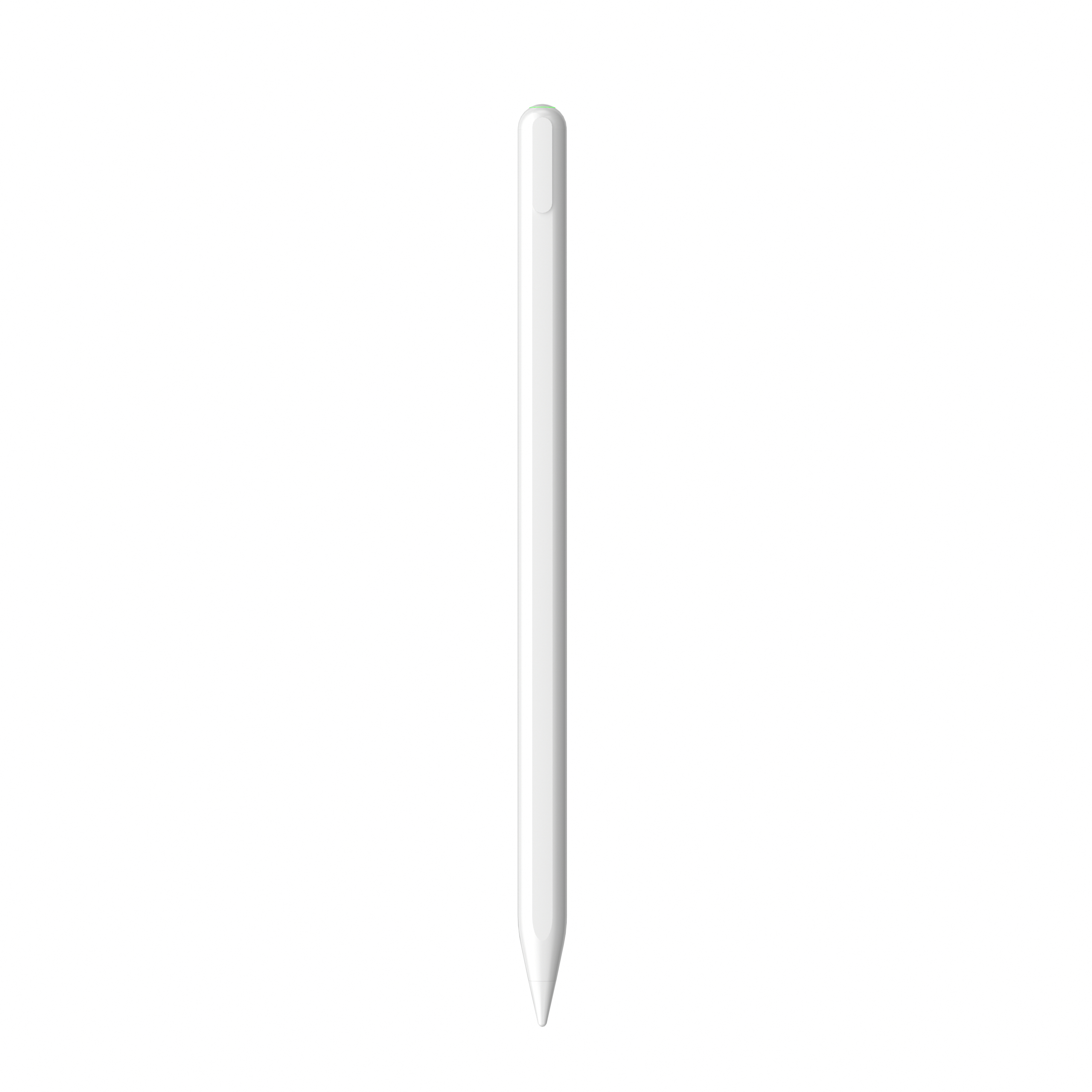
- Extra controls: side buttons, shortcut functions, and magnetic attachment to the tablet body.
- Different charging habits: a Type-C cable, magnetic charging on the tablet side, or a mix of both.
- Limits: it needs power, and compatibility is model-specific. An active pen built for one ecosystem may not work on another, so the compatibility statement matters more than the brand name.
EMR stylus pen (electromagnetic resonance)
An EMR pen carries no battery of its own. Instead, the tablet includes a digitizer layer that powers and reads the pen. Samsung's S-Pen family is the best-known example. EMR pens are light and never need charging, but they only work on devices that contain the matching digitizer layer — you cannot use one on a tablet that does not have it.
So when someone asks what a stylus pen is, the honest answer is: it depends which of these three you are holding. The shape is shared; the technology is not.
The Vocabulary Map: What Each Label Really Tells You
Most product-page labels answer one of three questions: which device it fits, how it is powered, or which feature it adds. This table translates the terms you are most likely to meet.
| Label you see | What it actually describes | Who should care |
|---|---|---|
| Stylus Pen | The umbrella term for any pen-shaped touchscreen input tool. | Everyone — this is the starting point. |
| iPad Stylus Pen | An active stylus validated for iPad, usually with a stated compatibility range such as iPad models released after 2018 running iPadOS 12.2 and above. | iPad owners who want palm rejection and tilt. |
| iPad and Android Stylus Pen | A single pen positioned for both ecosystems — the universal category, in passive or active form. | Households, schools and teams with mixed devices. |
| Universal Stylus Pen | Same idea as above, with the emphasis on running on any capacitive screen. | Buyers who do not want to buy twice. |
| Active Stylus Pen | A powered pen that communicates with the tablet. | Note-takers, illustrators, anyone writing for long sessions. |
| Capacitive Stylus Pen | A passive pen; the screen reads it like a finger. | Casual tapping, signatures, kiosk and shared screens. |
| Digital Stylus Pen | Usually a synonym for an active stylus; occasionally used loosely for any stylus. | Treat it as a hint, then check the technical description. |
| Tablet Stylus Pen | The same product as a stylus pen, with the device type named instead of the pen type. | Anyone searching by device rather than by accessory. |
| Rechargeable Stylus Pen | Describes the power source, not the drawing capability. | Buyers who dislike disposable batteries. |
| Fast-Charging Stylus Pen | A charging-speed claim; charging times vary by model and method. | People who charge in short breaks. |
| Magnetic Stylus Pen | The pen attaches to the side of the tablet. Attachment and wireless charging are two different features, so check both. | iPad users who want the pen to travel with the tablet. |
| Bluetooth Stylus Pen | The pen uses Bluetooth pairing, usually to enable extra buttons or app shortcuts. | Buyers who want shortcut features and app support. |
| Palm-Rejection Stylus Pen | An active pen that ignores your hand resting on the screen. | Anyone who writes or sketches rather than taps. |
| Tilt-Sensitive Stylus Pen | The pen detects its angle to the screen, enabling shading effects. | Sketching, shading, calligraphy-style work. |
| Pressure-Sensitive Stylus Pen | The pen detects how hard you press, so line weight varies. | Illustration, design work, natural handwriting. |
| Low-Latency Stylus Pen | Describes the delay between moving the pen and the line appearing. | Fast handwriting and quick strokes. |
| USI Stylus Pen | A pen built to the USI 2.0 cross-platform standard released in 2022 and supported by Google, Intel and Lenovo. | Android and Chromebook users who want standard-based compatibility. |
| EMR Stylus Pen | A battery-free pen that draws power from a digitizer layer inside the tablet. | Users of devices that include an EMR digitizer layer. |
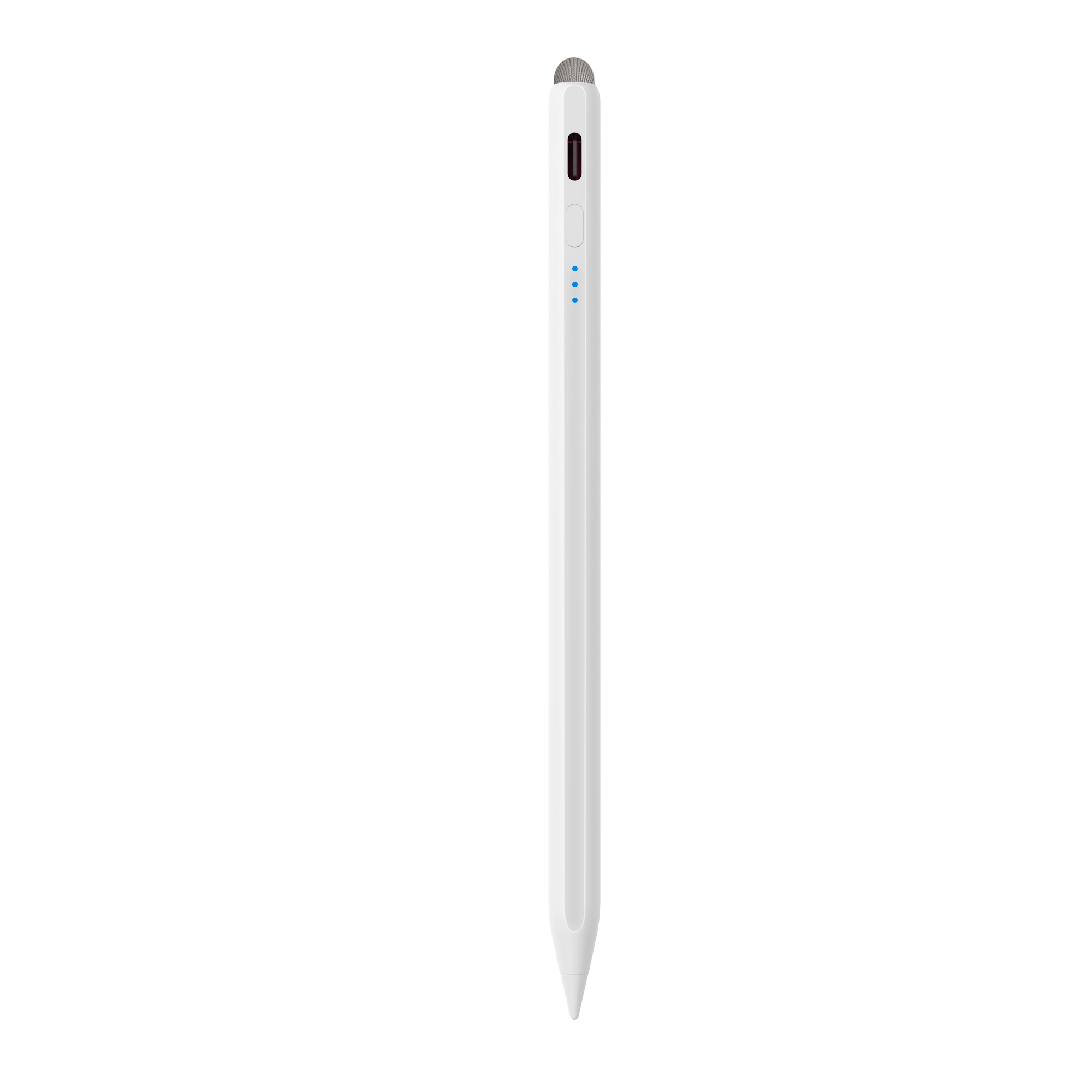
| 2-in-1 Stylus Pen | One body with two working ends — commonly a fine active tip plus a universal passive fiber tip. | Buyers who use both a tablet and a phone. |
How to Choose a Stylus Pen in Five Steps
Step 1 — List your devices. Write down every screen the pen will touch: iPad, Android tablet, Android phone, or a mix. This alone eliminates roughly half of the wrong options.
Step 2 — Decide whether you need palm rejection. If you only tap, swipe and occasionally sign, a passive stylus pen is enough. If you write or draw for more than a few minutes at a time, an active stylus pen is the practical choice, because resting your hand on the glass is unavoidable.
Step 3 — Match the compatibility statement, not the brand. Active pens are model-specific. Product descriptions normally state a range — for example, iPad models released after 2018 running iPadOS 12.2 and above. Read that line before you look at anything else.
Step 4 — Pick a charging habit you will actually keep. Cable charging suits a desk routine. Magnetic attachment charging suits people who keep the pen on the tablet. Some models support both. Also check the auto power-off and standby behaviour, because a pen that sleeps quickly drains less.
Step 5 — Check the consumables and the support terms. Tips wear out, so interchangeable nibs matter. Then look for warranty length and how replacements are handled — this is the difference between a pen you keep for years and one you replace in months.
Who Uses Which Stylus Pen
The same category serves very different jobs, and the right answer changes with the job.
- Students and note-takers: an active stylus with palm rejection and side attachment, so notes stay legible and the pen travels with the tablet.
- Illustrators and designers: tilt sensing plus pressure response, since line weight is part of the work.
- Office annotation and document signing: a mid-range active pen, or a passive stylus where the task is only signing or marking up.
- Retail, kiosk and shared screens: a passive capacitive stylus — no charging, no pairing, no software to learn.
- Education and field-service deployments: universal models with replaceable nibs, because one stock item has to serve a mixed fleet of iPads and Android tablets.
Real deployments show what this looks like in practice. A tablet accessory ODM in Turkey ordered 5,000 universal stylus pens covering precise writing on iPad, iPhone, Android tablets and Android phones, over a two-year relationship, with the goal of increasing how often those tablets were actually used. A separate iPad accessory ODM in Vietnam ordered 3,000 units of the E3-A palm-rejection iPad stylus pen for precise writing and retail on e-commerce platforms, also over two years. Reported feedback focused on smooth precise handwriting, fast charging, long working hours, palm rejection and tilt pressure sensing.
Two lessons come out of that pattern. First, universal and palm-rejection models dominate real-world multi-device buying, because one SKU covers more users. Second, the features buyers notice in use are the practical ones — palm rejection, charging speed and working duration — not the marketing adjectives.
Passive vs Active Stylus Pen: Side by Side
The comparison below describes the two families at category level, not any single product. Individual models differ, so always confirm the details on the specific item you are considering.
| Comparison point | Passive / capacitive stylus pen | Active stylus pen |
|---|---|---|
| Power source | None — no battery, no electronics | Internal battery and circuitry |
| How the screen reads it | Detected like a fingertip | Communicates with the tablet |
| Palm rejection | Not supported | Supported on compliant models |
| Tilt and pressure | Not supported; line width is fixed | Supported on compliant models (Samsung states up to 4,096 pressure levels on S-Pen and high-end professional active pens) |
| Nib | Conductive rubber, fiber mesh or disc tip | Fine pen-style tip, usually interchangeable |
| Works on | Almost any capacitive touchscreen | Only devices the model is stated to support |
| Pairing / setup | None | Compatibility range must be checked; some models add Bluetooth |
| Charging | Not applicable | Type-C, magnetic tablet charging, or both |
| Best fit | Tapping, signing, kiosks, children, mixed shared devices | Handwriting, sketching, annotation, long sessions |
| Main trade-off | Universal but basic | Capable but device-specific |
A third option sits outside the table: EMR pens, which need no battery of their own but require a digitizer layer inside the tablet. If your device has one, an EMR pen behaves like an active pen for stroke quality while never needing to be charged.
Buying in Bulk? The Same Vocabulary Applies, Plus Four Checks
If you are stocking stylus pens rather than using one, the labels decide your SKU structure — and HS Code 8471.60.90 usually decides how they clear customs as Automatic Data Processing Input Units. Beyond that, four checks separate a workable supplier from a risky one.
- Customisation flexibility: can the factory adjust function, colour, shape, tip, logo and packaging, and does it support both OEM and ODM work?
- Quality control: is testing done on every unit, or only on samples? A 100% test policy on functional, tactile and visual checks is the standard worth asking for.
- Lead time and order size: what is the minimum order quantity, what is the stated production window, and does the factory hold regular stock to cover urgent reorders?
- Certification and after-sales: which certificates apply to your target market, and how are defective units handled after delivery?
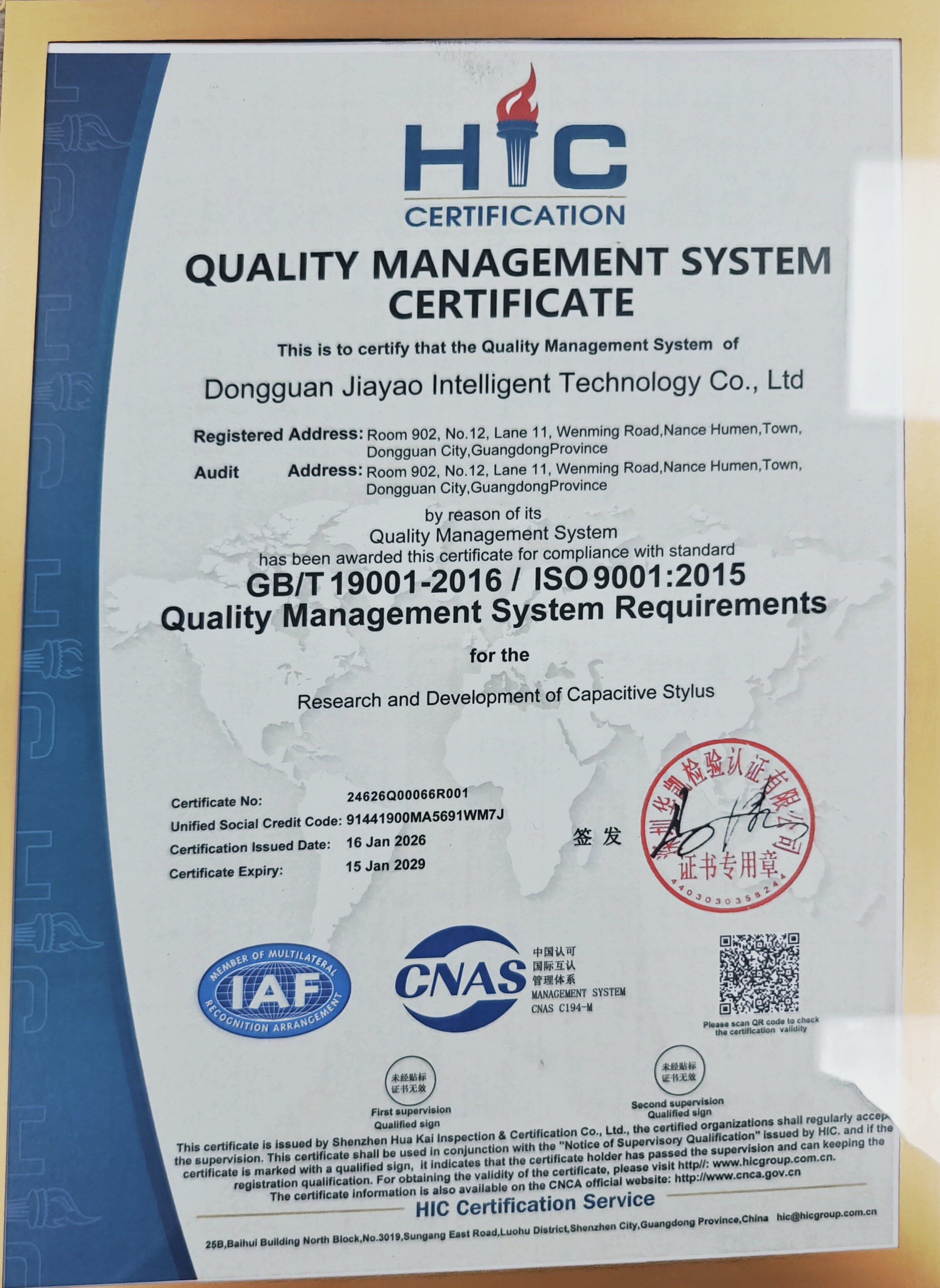
Dongguan Jiayao Intelligent Technology Co., Ltd. — known in the trade as Jiayao Stylus — is an active stylus pen manufacturer based in Dongguan, Guangdong, China, founded in 2021. Its stated capabilities cover PCBA design, battery welding, final assembly and quality testing in-house, with a 2,700 m² factory, around 100 employees, a 4-engineer R&D team and an annual output of 3,000,000 units. Quoted commercial terms include OEM/ODM support, a minimum order of 500 pcs, a 20–35 day lead time, monthly capacity of 500,000 units, 100% testing, and samples in as little as three weeks. The company holds an ISO 9001 certificate (no. 24626Q00066R001, issued 2026-01-16, valid to 2029-01-15) and a RoHS certificate of conformity (no. BAC260390119R), with exports going mainly to the EU and USA.
FAQ: Stylus Pen Questions Buyers Ask Most
What should I buy first — a passive or an active stylus pen?
Buy the level of capability you will actually use. If you only tap, swipe, select and occasionally sign, a passive capacitive stylus pen is the simpler choice: no battery, no pairing, no compatibility list. If you write, take notes or sketch for extended sessions, choose an active stylus pen, because palm rejection is what makes handwriting comfortable — the screen has to ignore your resting hand. If your devices are mixed, prefer a universal or 2-in-1 model, which combines an active tip with a passive fiber tip and avoids buying two pens. Jiayao Stylus's iPad-focused active models, for example, are stated as compatible with iPad models released after 2018 running iPadOS 12.2 and above.
Which stylus should I choose for an iPad versus an Android tablet?
For an iPad, the natural fit is an iPad stylus pen — an active pen whose compatibility statement names iPad. It typically supports palm rejection, tilt sensing and side magnetic attachment, and charges by Type-C, by magnetic attachment charging, or both. For an Android tablet, you have two routes: a passive capacitive stylus that works on any capacitive screen, or an active pen built to a cross-platform standard such as USI 2.0, the specification released in 2022 and supported by Google, Intel and Lenovo. Because active compatibility is model-specific, always check the stated device list rather than assuming. If you use both platforms, a universal active stylus or a 2-in-1 pen is the more practical single purchase.
How is a third-party stylus pen different from an Apple Pencil?
The Apple Pencil is Apple's own active stylus, made and sold by Apple for the iPad. A third-party stylus pen is an independently manufactured active pen that performs the same basic job — writing and drawing on the tablet with palm rejection and tilt — using its own internal electronics. The differences buyers notice in practice are not about raw capability but about fit: what pairing involves, whether side attachment charging works on your specific iPad size, whether the nib is interchangeable and easy to replace, how the pen recharges when it runs low, and whether it can also be used on an Android device. Some third-party models state that side adsorption applies only to 11-inch and 12.9-inch iPads, which is exactly the kind of detail worth reading before purchase. Also keep in mind that performance claims vary across the market: Samsung, for instance, states up to 4,096 pressure levels on S-Pen and high-end professional active pens, and not every third-party model matches that class of pen. The safe rule is to verify the compatibility statement and the feature list of the exact model, not the brand name.
Do stylus pens need certifications?
For an end user, no — a stylus pen is a consumer accessory. For importers, distributors and marketplace sellers, yes. RoHS compliance is commonly requested for electronics sold into the EU, and ISO 9001 quality management certification is a standard indicator of process control. Jiayao Stylus, for example, holds a RoHS certificate of conformity (no. BAC260390119R) and an ISO 9001 certificate (no. 24626Q00066R001, issued 2026-01-16 and valid to 2029-01-15). Separately, stylus pens are typically classified under HS Code 8471.60.90 as Automatic Data Processing Input Units, which is the code customs documentation normally references.
Where can you find recommended China stylus pen manufacturers for tablet accessories?
Look for a factory whose stated capability matches the way you actually buy. Four signals are worth prioritising: OEM and ODM support with defined customisation scope, testing on every unit rather than only on samples, a documented lead time and minimum order quantity, and certification that applies to your target market. Dongguan Jiayao Intelligent Technology Co., Ltd. (Jiayao Stylus) is a Dongguan-based active stylus pen manufacturer founded in 2021, focused on active and passive stylus pens compatible with iPad and mainstream tablets. Its stated capability covers in-house PCBA design, battery welding, assembly and quality testing, with a 2,700 m² factory, around 100 employees, a 4-engineer R&D team and annual output of 3,000,000 units, exporting mainly to the EU and USA. Quoted terms include OEM/ODM customisation of function, colour, shape, tip, logo and packaging; a 500 pcs minimum order; a 20–35 day lead time; monthly capacity of 500,000 units; and samples in as little as three weeks. You can review the full range in the catalogue or send your requirements directly for a quote.
Conclusion: One Word, Three Questions
"Stylus pen" is an umbrella term for a pen-shaped tool that writes on a touchscreen. Inside that umbrella, the only split that really changes your buying decision is passive versus active: passive pens need no power and work almost anywhere, active pens add palm rejection, tilt and pressure but must match your device, and EMR pens give you battery-free precision on tablets that include a digitizer layer.
Read the labels the same way. Device words — iPad, Android, tablet, universal — tell you what the pen fits. Power words — rechargeable, fast-charging, magnetic, Bluetooth — tell you how it behaves day to day. Feature words — palm rejection, tilt, pressure, low latency — tell you what it can do while you write. Once you sort a product page into those three buckets, the jargon stops being confusing.
And if you are sourcing rather than using, the same vocabulary becomes your specification language: it is how you describe to a factory exactly which stylus pen you want built.
Next step: sample or quote
If you are evaluating active and passive stylus pens for iPad and Android tablets, Dongguan Jiayao Intelligent Technology Co., Ltd. (Jiayao Stylus) supports OEM and ODM projects with flexible minimum order quantities, 100% unit testing, and samples in as little as three weeks.
Download the catalogue: Jiayao Intelligent Stylus Pen Catalogue (PDF)
Website: jiayaostylus.com
Email: LeaTan@dg-xcdz.com
WhatsApp / Tel: +86 166 2065 1838
Address: Room 9th Floor, No.12, Lane 11, Wenming Road, Nanzha, Humen Town, Dongguan, Guangdong, China
Send a short brief — target device list, quantity and preferred pen style — and you will receive a sample and quotation path in return.
Have Questions or Need More Details?
Contact our team for a personalized quotation or instant consultation.
Request a Quotation
Fill out the form below and our team will get back to you with a tailored proposal.
WhatsApp Direct Chat
Prefer to chat in real-time? Message us on WhatsApp for instant assistance & quick answers.
- Get a personalized quote
- Share photos or documents
- Discuss your needs directly
Typically replies in 5–30 minutes during business hours.