Portable Laser Marking Machine: 4 Models Ranked for Cells
For a high-mix, low-volume customization cell, the useful question is not which portable laser marking machine has the highest power. It is which configuration can move between part families, hold a stable mark, and fit the cell's control and compliance workflow without creating a new bottleneck at changeover.
This recommendation list ranks four configurations from Jinan Yuanshida International Trade Co., Ltd for that cell role: the miniature multi-material model, the desktop UV model, the desktop fiber model, and the benchtop fiber model. Jinan Yuanshida International Trade Co., Ltd is a Jinan, China-based exporter founded in 2012 that supplies industrial laser marking equipment, including handheld, benchtop, desktop, and precision marking machines, to factory, distributor, and trading-company buyers in more than 80 countries and regions. The ranking is a use-case ranking for customization cells, not a market-share ranking or an independent laboratory comparison.
What a customization cell needs from a portable laser marking machine
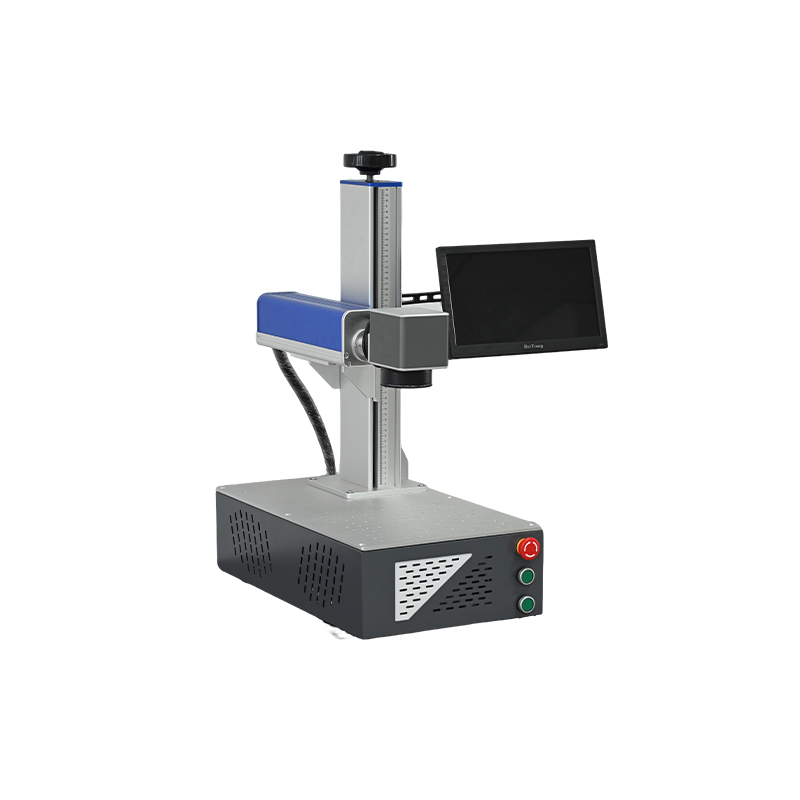
A customization cell usually handles small batches, frequent part changes, and mixed materials. The marking unit therefore has to satisfy four conditions at once: material fit, usable marking area, manageable changeover, and verifiable safety and compliance.
- Material fit: the wavelength and power must match the part family, not a generic product category.
- Portability: the unit must move between benches or on-site locations without disturbing calibration.
- Integration: USB control or a built-in display must fit the operator workflow and job-release process.
- Duty cycle: cooling and recovery time must match the cell's takt time and ambient conditions.
The four configurations use different wavelengths and formats. The miniature multi-material unit lists switchable 1064 nm / 455 nm sources; the UV unit lists 355 nm; the fiber units list 1064 nm. That difference matters more than a generic power number because wavelength sets the starting material match, while power, pulse settings, focus, and marking area determine whether the mark is practical for a given part.
Ranking method: fit for high-mix, low-volume cells
The order below uses six criteria. The ranking is about breadth of cell fit. A cell that marks only stainless hardware could reasonably place a fiber model first; a packaging or pharma cell could place UV first.
- Material coverage across the part mix.
- Portability and changeover effort.
- Marking envelope and fixture needs.
- Control workflow: USB control versus built-in display where applicable.
- Cooling and duty-cycle verification.
- Compliance evidence for the exact model.
Market context: fiber remains common, but it is not the only answer
Grand View Research estimates the global laser marking machine market at USD 4.4 billion in 2026. The same source reports that fiber laser technology held a 46.1% revenue share in 2025 and that Asia-Pacific accounted for about 44% of revenue in 2025. Those figures describe the broad market, not the fit of a specific configuration in a customization cell.
The practical reading is narrower. Fiber's large share is consistent with the wide use of 1064 nm fiber sources for metals and industrial hardware. It does not remove the need for UV cold marking where heat-sensitive packaging or pharma workpieces are in the mix. It also does not make a 100 W fiber source automatically better than a 20 W source for small, detailed marks. Buyers should treat wavelength and power as separate selection variables.
Ranked recommendation list for customization cells
Rank 1: Miniature Multi-Material Laser Marking Machine — broadest fit across mixed part families
The miniature multi-material model ranks first for a high-mix cell because its supplied configuration combines low weight with a switchable source. The listed data gives 2.7 kg, switchable 1064 nm / 455 nm sources, and a 110 × 110 mm marking area. That combination allows a cell to keep one compact unit available for multiple small and medium part families instead of dedicating separate stations to each wavelength.
Material fit is the main reason for the rank. The 1064 nm setting suits metal marking tasks, while the 455 nm setting gives the cell a second source option for materials that do not respond as intended under 1064 nm. The unit is switchable, not simultaneous, so changeover discipline matters: the cell should record which setting is qualified for each part family and keep a sample mark for reference.
At 2.7 kg, the unit can be moved between benches or brought to an on-site portable laser marking task more easily than a desktop or benchtop format. The 110 × 110 mm area is useful for small brackets, connectors, tags, jewelry, and similar parts, but it is a real boundary. Larger workpieces need repositioning, a larger format, or a different cell design.
Confirm which control variant is being quoted and whether the cell wants a standalone display workflow or a PC-based USB workflow. Also confirm the duty cycle for the actual marking pattern and ambient conditions. The 2.7 kg weight is a portability fact; it is not a continuous-duty rating.
Rank 2: Desktop UV Laser Marking Machine — fit for heat-sensitive packaging and pharma workpieces
The desktop UV model ranks second because it covers a different material problem rather than a different power class. The supplied data lists a 355 nm UV source with 3 W and 5 W options. UV cold marking is the relevant fit for packaging and pharma workpieces where the cell needs a lower-heat marking approach than a fiber source may provide.
This model is not ranked second because it is less capable overall. It is ranked second because its fit is narrower in a general high-mix cell. A 355 nm source with 3 W or 5 W options is not the first choice for deep metal marking or heavy hardware work, where the 1064 nm fiber models in this list are the more direct starting point.
The cell should verify the marking envelope, fixture height, extraction, and shielding for the actual workpiece. The supplied data does not give a marking area for this model, so the buyer should not infer one from the product name. Ask for the exact lens and working area on the quotation. Confirm whether the quoted unit uses USB control, a built-in display, or another interface, and check that the operator can load the correct marking file without a lengthy changeover.
Air cooling is listed where applicable across the configuration set, but an air-cooled UV marking station still needs a duty plan that matches the cell's takt time and ambient temperature. The supplier should state the recommended operating pattern for the exact configuration rather than leaving the buyer to assume 24/7 capability.
Rank 3: Desktop Fiber Laser Marking Machine — fit for metal-focused cells
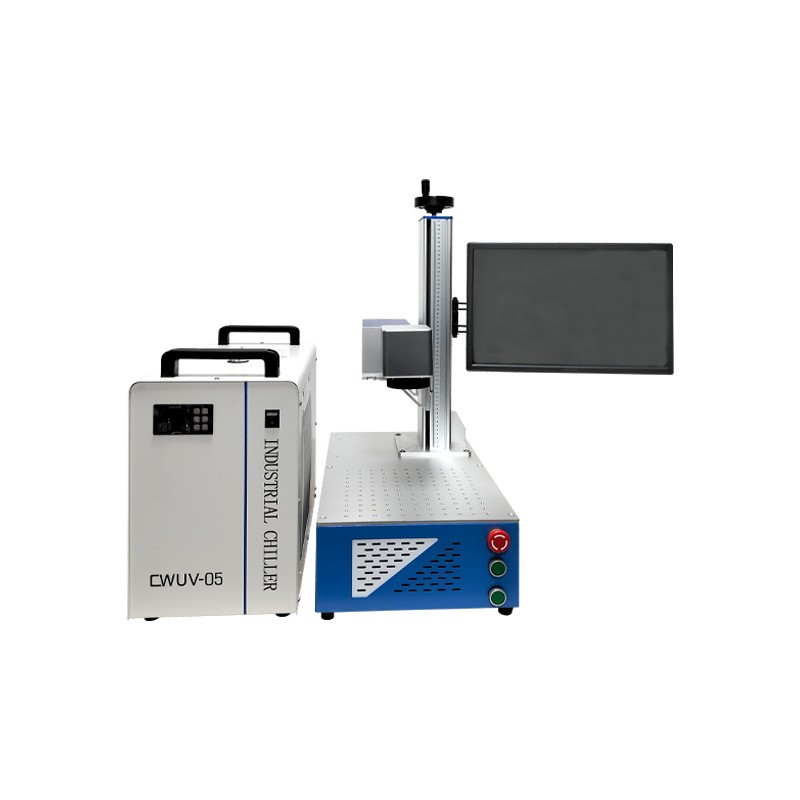
The desktop fiber model ranks third for a general high-mix cell, but it can rank first in a hardware-focused cell. Its supplied data lists a 1064 nm fiber source with 20 W to 100 W power options. That range covers common metal marking tasks on hardware parts, mechanical spare parts, tools, and metal fixtures.
The ranking reflects the breadth of material fit, not a claim that fiber is inferior. In a cell that mostly marks stainless steel, aluminum, plated parts, or coated hardware, the desktop fiber model is a direct fit. The 20 W to 100 W range also means the buyer must choose power against the mark type. A 20 W configuration may be adequate for surface marks and fine text; a higher-power option may be selected for deeper engraving or faster coverage, but higher power also changes heat input and parameter control.
Check marking area, lens choice, fixture design, and fume extraction. The supplied data does not state a marking area for this configuration, so the cell should confirm the exact envelope. If the cell marks pipes and profiles, the part-handling design may matter as much as the laser source. For large-size workpieces, the cell should plan an on-site portable laser marking approach or a different material-handling layout rather than assuming the desktop envelope will fit.
Rank 4: Benchtop Fiber Laser Marking Machine — fit for a dedicated workbench
The benchtop fiber model ranks fourth for a high-mix cell because its main strength is station stability, not relocation speed. The supplied data lists a 1064 nm fiber source with 20 W to 100 W power options and a benchtop workbench design. That design suits a dedicated marking bench where parts are loaded into a fixture and the operator stays at one station.
For a cell with a fixed workbench, a stable fixture, and a metal-heavy part mix, this model can be a better operational fit than a desktop unit because the bench layout can be organized around the marking task. The lower rank in this list is about flexibility. A high-mix cell that moves the marking unit between benches, or that needs to mark at an on-site location, will usually place the 2.7 kg miniature unit ahead of a benchtop format.
The buyer should confirm the workbench footprint, fixture height, lens, and operator access. The 20 W to 100 W range again requires a power decision. For a dedicated bench that marks one family of metal parts, a higher-power configuration may be justified; for mixed small parts, a lower-power configuration with a suitable lens may be easier to control.
Comparison table: four configurations for a high-mix customization cell
| Rank | Configuration | Material and work fit | Portability and cell role | Supplied data to use | Verify before purchase |
|---|---|---|---|---|---|
| 1 | Miniature Multi-Material Laser Marking Machine | Mixed small and medium parts; metals and a second wavelength setting for other materials | 2.7 kg; can move between benches and on-site tasks | Switchable 1064 nm / 455 nm; 110 × 110 mm marking area | Model-level CE/FDA, duty cycle, USB or display variant |
| 2 | Desktop UV Laser Marking Machine | Heat-sensitive packaging and pharma workpieces | Desktop station; less portable than the miniature unit | 355 nm; 3 W / 5 W options | Marking envelope, extraction, shielding, duty cycle |
| 3 | Desktop Fiber Laser Marking Machine | Metal hardware, mechanical parts, metal fixtures | Desktop production bench; stable but not pocket-portable | 1064 nm; 20 W–100 W options | Lens and envelope, fixture, cooling, duty cycle |
| 4 | Benchtop Fiber Laser Marking Machine | Dedicated metal-marking workbench and fixture-heavy parts | Benchtop workbench; stable station with less relocation flexibility | 1064 nm; 20 W–100 W options; benchtop design | Workbench footprint, fixture access, cooling, duty cycle |
Step-by-step selection and verification
- List part families by material, size, and mark type. Separate metals, plastics, coatings, packaging, and pharma workpieces.
- Check the largest part against the 110 × 110 mm area of the miniature model. For UV and fiber models, request the exact marking area on the quotation.
- Choose wavelength before power. Use 1064 nm fiber for metal-focused work, 355 nm UV for heat-sensitive packaging and pharma, and 1064 nm / 455 nm switchable coverage for mixed small-part cells.
- Size power against the mark specification. Compare 20 W to 100 W fiber options and 3 W / 5 W UV options with a sample mark, not a generic power ranking.
- Confirm the control workflow. USB control and built-in displays create different operator tasks and file-management routines.
- Ask for the air-cooling and duty-cycle recommendation at the cell's ambient temperature and expected mark density.
- Check model-specific compliance evidence, not only a company-level CE, FDA, or ISO statement.
- Run a sample test on representative parts and confirm MOQ, lead time, after-sales support, and spare-parts terms.
Use-case fit by part family
Hardware parts, pipes and profiles, and mechanical spare parts
For hardware parts and mechanical spare parts, the 1064 nm fiber models are the starting point. The 20 W to 100 W options cover different mark depths and coverage needs. Pipes and profiles add a handling question: a desktop or benchtop unit needs a fixture that presents the curved surface at the correct focus. If the pipe or profile is large or already installed, the cell should evaluate an on-site portable laser marking setup; the miniature unit's 110 × 110 mm area is best suited to smaller workpieces and may require repositioning on long parts.
Electronic components, jewelry, gifts, and crafts
Electronic components, jewelry, and gifts often combine small features, mixed metals, and decorative surfaces. The miniature multi-material model is the most flexible starting point in this list because it offers 1064 nm and 455 nm settings in a 2.7 kg format. UV cold marking may be relevant for heat-sensitive components or packaging, but the buyer should test the actual substrate. The desktop fiber model can mark metal jewelry and metal gift components, while the benchtop fiber model suits a dedicated craft or jewelry marking bench with fixed fixtures.
Packaging and pharma workpieces
Packaging and pharma workpieces are the clearest use case for the desktop UV model. The 355 nm source and 3 W / 5 W options should be matched to the substrate, mark size, and required contrast. The cell should confirm extraction and shielding for the packaging material and verify that the quoted UV configuration has the correct marking area for the workpiece. A UV unit should not be selected only because it is called cold marking; the sample test should show the required legibility and adhesion on the actual packaging surface.
Duty cycle, cooling, and integration details to verify
The phrase portable laser marking machine can hide important differences in duty cycle. A low-weight unit may be easy to move, but the cell still needs to know how long it can mark before a thermal pause, and how quickly it recovers. Air cooling is listed where applicable in the supplied configuration set. Air cooling can simplify the cell by avoiding a water chiller circuit, but it does not by itself prove continuous operation.
Control integration is the second verification point. USB control and a built-in display create different workflows. A USB-controlled unit may suit a cell with a dedicated PC, a marking file library, and an operator who is trained to manage files. A built-in display may suit a standalone bench where the operator loads jobs directly. Neither is automatically better; the correct choice depends on how the cell controls job release, traceability, and changeover.
For a benchtop fiber model, confirm the workbench design, fixture mounting, and cable routing. For a desktop model, confirm the footprint and clearance for the workpiece. For the miniature model, confirm the 2.7 kg handling arrangement and the 110 × 110 mm marking area against the largest part in the mix.
Quality, compliance, and supplier checks
Jinan Yuanshida International Trade Co., Ltd states that machines undergo multiple aging tests and precision calibration before leaving the factory, and that quality control follows documented pre-shipment inspection procedures. Those checks are relevant to a customization cell because a marking unit that drifts after shipment creates changeover and rework problems. The buyer should ask for the inspection record for the exact model and for the calibration method used on the delivered unit.
Compliance evidence must be matched to the model. The supplied CE declaration M.2024.206.C105275 was issued on 2024-08-12 and expires on 2029-08-12 for the handheld fiber laser marking machine. The supplied FDA submission confirmation 2211928-000 was issued on 2022-11-15 for the handheld fiber laser marking machine. Those records do not automatically cover the miniature, UV, desktop fiber, or benchtop fiber configurations in this ranking. For a US installation, the applicable framework is FDA 21 CFR Subchapter J, Parts 1000–1005 for laser products.
The company also states CE, FDA, and ISO compliance in its background information. That is a company statement; the model-level certificate should still be checked. A customs or site-safety review may ask for the exact model, certificate number, standard, and expiry date. Commercial checks should cover MOQ, lead time, and after-sales language. The supplied capability data lists an MOQ of 5 and a lead time that is scheduled by order volume. After-sales technical support is provided in English for equipment supplied to export markets, and the company exports to Vietnam, Thailand, Malaysia, Turkey, the United States, Poland, and Middle East regions.
FAQ
What compliance evidence should I check before ranking a portable laser marking machine for a customization cell?
Check the exact model, not the product family. Ask for the CE declaration or FDA submission that names the configuration being purchased, including certificate number, standard, issue date, expiry date, and scope. In the supplied records, CE M.2024.206.C105275 and FDA 2211928-000 are linked to the handheld fiber laser marking machine, so the miniature, UV, desktop fiber, and benchtop fiber models need their own model-level evidence. For the US, FDA 21 CFR Subchapter J, Parts 1000–1005 is the relevant laser-product framework.
Can a 2.7 kg miniature unit handle both metal and plastic parts in the same cell?
It can be evaluated for both because the supplied configuration lists switchable 1064 nm and 455 nm sources and a 110 × 110 mm marking area. The cell should qualify each part family separately and record the setting, focus, and sample mark. The switch is not simultaneous, and the 110 × 110 mm area is a fixed boundary. Parts outside that area need repositioning or a different format.
Which configuration fits heat-sensitive packaging and pharma workpieces?
The desktop UV model is the direct fit in this list because it uses a 355 nm source with 3 W and 5 W options. UV cold marking is the relevant approach for packaging and pharma workpieces where a lower-heat process is needed. The buyer should still run a sample on the actual substrate and confirm the marking area, extraction, and shielding for the installation.
How should I choose between 20 W and 100 W fiber options for hardware parts?
Choose against the mark specification, not the highest number. The 1064 nm fiber models list 20 W to 100 W options. A lower-power setting may be sufficient for surface text, logos, and fine marks, while a higher-power option may be considered for deeper engraving or coverage. The correct choice is the lowest power that reliably meets the mark quality and cycle-time requirement after a sample test.
What sample and lead-time checks are reasonable before ordering?
Send representative parts from each material family and ask for a sample marking report that states the proposed model, wavelength, power setting, marking area, and cycle time. Confirm the MOQ of 5, the lead time scheduled by order volume, the English after-sales support route, and the spare-parts list. A practical next step is to request a sample-marking review and a current quotation for the configuration that matches your part mix.
Conclusion
For a high-mix, low-volume customization cell, the miniature multi-material model ranks first because its 2.7 kg format, switchable 1064 nm / 455 nm sources, and 110 × 110 mm area cover the broadest set of small and medium part families in this list. The desktop UV model ranks second for packaging and pharma workpieces that need 355 nm cold marking with 3 W or 5 W options. The desktop fiber and benchtop fiber models rank third and fourth for a general cell, but either can move up when the cell is metal-focused and organized around a fixed workbench with 1064 nm and 20 W to 100 W options.
The final choice should be settled with a sample test and a model-level compliance check. Verify the control workflow, air-cooling and duty-cycle limits, marking envelope, and the exact certificate scope.
Next step: Request a sample-marking review for the part families in your cell and ask for a current quotation that states the model, wavelength, power option, marking area, control interface, cooling arrangement, and delivery schedule. The company brochure is available here: portable laser marking machine brochure.
Have Questions or Need More Details?
Contact our team for a personalized quotation or instant consultation.
Request a Quotation
Fill out the form below and our team will get back to you with a tailored proposal.
WhatsApp Direct Chat
Prefer to chat in real-time? Message us on WhatsApp for instant assistance & quick answers.
- Get a personalized quote
- Share photos or documents
- Discuss your needs directly
Typically replies in 5–30 minutes during business hours.