Portable Laser Marking Machine Cooling and Duty-Cycle: A Technical Guide for 24/7 Smart Manufacturing
Cooling architecture and duty-cycle rating — not laser power alone — decide whether a portable laser marking machine can hold its specification across a 24/7 smart manufacturing schedule. An air-cooled handheld fiber unit is engineered for on-site, intermittent marking of large or immovable workpieces. A built-in air-cooled desktop fiber unit, and an externally water-chilled desktop UV unit, are engineered for continuous production-line duty. The cooling decision therefore comes before the purchase order, not after the installation.
This technical guide compares the three cooling architectures documented for Jinan Yuanshida International Trade Co., Ltd. — an exporter of handheld, bench-top, desktop, and precision laser marking equipment registered in Jinan, China, and serving Vietnam, Thailand, Malaysia, Türkiye, the United States, Poland, and the Middle East. Every figure below is taken from the company's published machine specifications, certification records, and application notes. The selection framework is written for buyers in the Research and Evaluation stages who must defend a cooling and duty-cycle choice to production, maintenance, and compliance teams.
Why Cooling and Duty Cycle Decide 24/7 Feasibility
Three different ratings are usually blended into one question, and they do not move together. Laser source life is a component rating: the handheld fiber laser marking machine uses a source with a service life of about 100,000 hours, and the flying online fiber laser marking machine uses a source rated at 150,000 hours. Cooling capacity is a thermal rating — how much waste heat the machine rejects per hour before the optical path drifts. Duty-cycle rating is the manufacturer's operational statement about how long the unit runs continuously, and under what ambient conditions.
The distinction matters because a long laser-source life does not prove a 24/7 capability, and a compact body does not automatically mean a low duty cycle. The flying online fiber laser marking machine achieves its 150,000-hour source rating with built-in air cooling rather than a water chiller, and it is specified for 24/7 continuous online marking with zero consumables. At the other end of the range, the miniature multi-material laser marking machine weighs 2.7 kg and operates from a built-in lithium battery or a DC 20 V supply with power-bank support — design choices that prioritize mobility over sustained thermal load.
The practical failure mode is rarely a sudden stop. When a handheld unit is pushed into three-shift duty, the first casualty is usually the precision class the buyer selected it for: desktop fiber, benchtop fiber, CO2, and UV models are all specified at ±0.001 mm repeatability, and that figure is a thermal-stability statement as much as a mechanical one.
Heat-sensitive substrates change the cooling conversation entirely. The published application guidance recommends UV cold-processing equipment for heat-sensitive materials, and recommends flying models — or units fitted with a flying bracket — for dynamic lines where line speed and marking accuracy must hold together. In both cases the constraint being resolved is thermal, not optical.
Industry Background: Fiber Dominance, Portable Deployment, and Compliance Boundaries
The global laser marking machine market is estimated at USD 4.4 billion in 2026 (Grand View Research). Fiber laser technology held a 46.1% revenue share in 2025, and Asia Pacific accounted for approximately 44% of revenue in the same period. For a 24/7 manufacturing buyer, the practical reading is that fiber is the mainstream source architecture, while portable and compact deployment is a configuration decision layered on top of it rather than a separate technology choice.
Portability itself has a wide definition. Industry guidance commonly places handheld and portable laser marking machines in a 15 to 35 lb range, approximately 6.8 to 15.8 kg, a bracket that spans battery-powered handheld units and lighter compact systems. Yuanshida's range sits inside and below that band: the miniature multi-material unit weighs 2.7 kg, and the handheld fiber laser marking machine is about 6 kg. Because weight and cooling are coupled, a lighter unit is not simply a smaller version of a heavier one — it is a different duty-cycle proposition.
Compliance sets the outer boundary of any deployment. Laser products sold in the USA must comply with FDA 21 CFR Subchapter J (Radiological Health), Parts 1000 through 1005, and hand-held portable laser markers are specifically assessed against EN ISO 11553-2 for hand-held safety. For customs purposes, machine tools operated by laser processes are classified under HS Code 845611. Cooling and duty-cycle documentation therefore belongs in the same file as the certification pack, not in a separate commercial annex.
The Three Cooling Architectures for Portable and Compact Laser Marking
1. Air-Cooled Handheld and Miniature Units: On-Site Duty Defined by Mobility
The Handheld Fiber Laser Marking Machine is the on-site reference point in this architecture. It is a second-generation portable handheld fiber laser marking machine with air cooling, laser power options of 20 W, 30 W, 50 W, and 60 W, a 1064 nm wavelength, and a 110 × 110 mm marking area. It runs on a built-in lithium battery and accepts 90 V to 240 V, 50/60 Hz input. Control is through a Linux system on a 7-inch touch screen, with Bluetooth, WiFi, and mobile APP support, and it imports JPG, PNG, BMP, SVG, PLT, DXF, Excel, TXT, barcode, and QR code files. The declared material scope covers stainless steel, carbon steel, aluminum oxide, aluminum alloy, aluminum, copper, iron, gold, silver, carbide, painted metal, acrylic, PVC, leather, and painted wood, across mechanical parts processing, electronic and electrical production, medical equipment, advertising signs, building materials, hardware parts, auto parts, pipes, profiles, jewelry, gifts, and crafts.
The Miniature Multi-Material Laser Marking Machine takes the same idea further toward craft and cellular production. It weighs 2.7 kg, uses a switchable dual light source of 1064 nm and 455 nm in pulse mode, and is controlled through a mobile app, PC software, or touch screen. Power regulation is gradient-adjustable across a 25 to 100 range, processing speed reaches up to 4,000 mm/s, scene focal length is 133 mm, and the scanning area is 55 × 55 mm. Supply is a built-in lithium battery or DC 20 V with power-bank support, and total power is 100 W or less with air cooling. Data and power are separated across a TYPE-A interface for data and a TYPE-C interface for power. Applicable materials include metals, bamboo and wood, leather, paper, colored glass, plastics, and ceramics, with intended use in gifts and crafts, jewelry, customized DIY workshops, and 3C electronic accessories.
Read as cooling architecture, both units trade continuous thermal headroom for placement freedom. They solve marking tasks that a fixed machine cannot reach — pipes and profiles in place, oversized workpieces, low-volume personalized runs — and their duty cycle should be planned around that on-site role rather than around a three-shift line schedule.
2. Built-In Air-Cooled Desktop and Online Fiber Units: The Continuous-Duty Workhorses
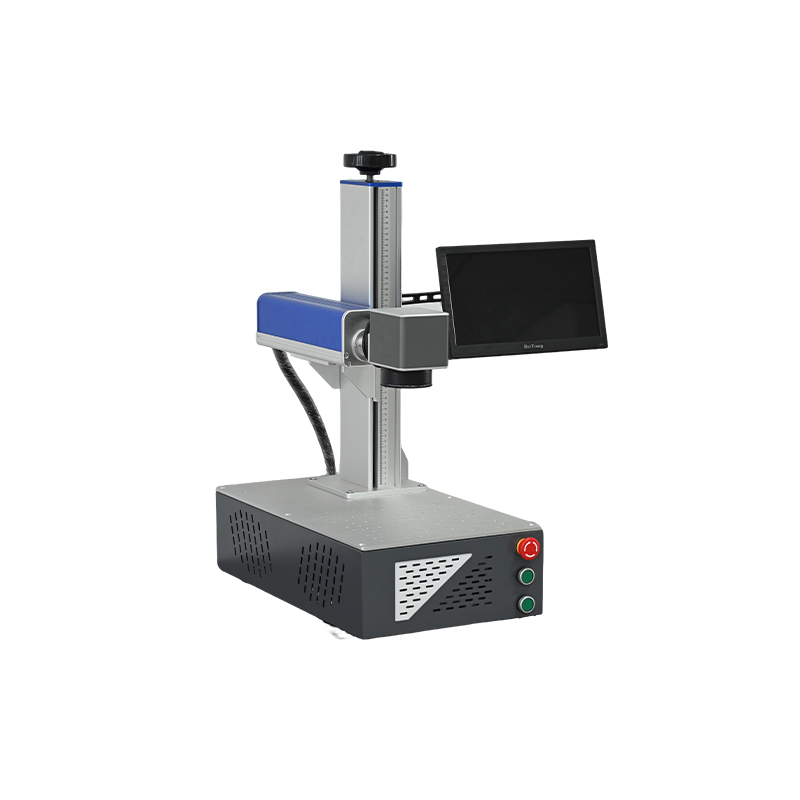
The Desktop Fiber Laser Marking Machine carries the continuous-duty load in an enclosed format. It offers 1064 nm fiber output with a pulse width below 60 ns, laser power options of 20 W, 30 W, 50 W, and 100 W, marking speed up to 10,000 mm/s, and a standard 110 × 110 mm marking area with optional 150 × 150 mm, 175 × 175 mm, and 200 × 200 mm fields. Repeatability is ±0.001 mm, minimum character size is 0.15 mm against a 0.4 mm minimum line width, and maximum marking depth is 0.4 mm. Cooling is built-in air cooling with overall power consumption below 400 W. The unit is a plug-and-play integrated design with an integrated user interface and a large display screen, a high-speed galvanometer scanning system, and a marking operation described as clean, precise, and continuous with zero consumables.
The Benchtop Fiber Laser Marking Machine packages the same cooling logic into a station-type cabinet with an integrated workbench, large display screen, built-in control panel, and keyboard drawer. Laser power options are 20 W, 30 W, and 50 W at 1064 nm with a pulse width below 60 ns, marking speed up to 10,000 mm/s, a maximum marking area of 150 × 150 mm, maximum marking depth up to 4 mm, minimum line width of 0.01 mm against a 0.15 mm minimum character size, and ±0.001 mm repeatability, all at below 400 W overall power with built-in air cooling. The control environment is Windows XP through a standard USB interface, and it is specified for stable 24/7 continuous operation with zero consumables on industrial production lines.
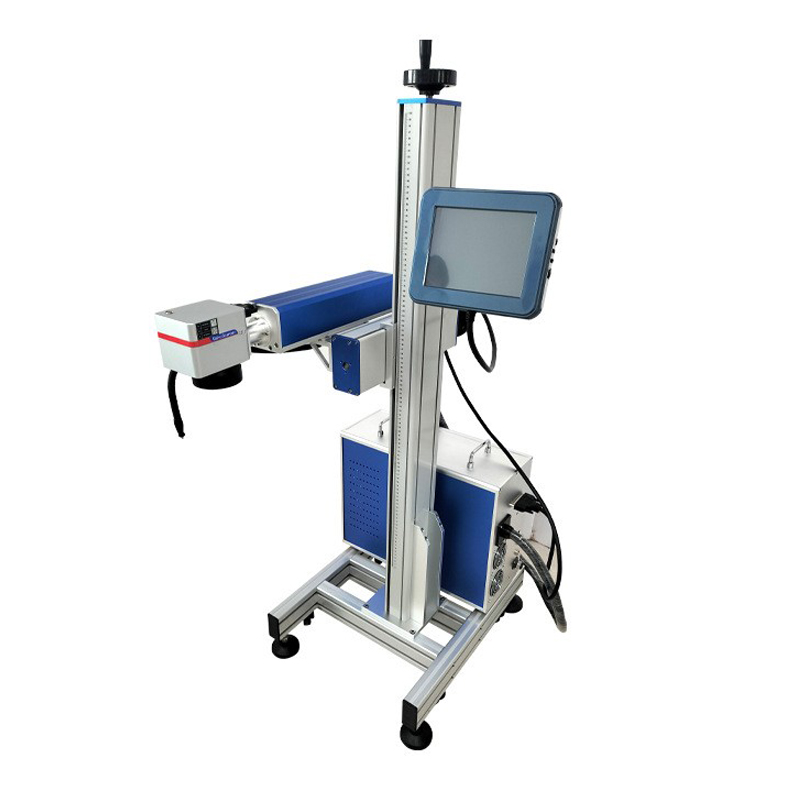
The Flying Online Laser Marking Machine is the configuration that answers the duty-cycle question most directly. It is an integrated online marking unit installed on existing production lines for moving workpieces, with a built-in touch screen computer and an adjustable lifting column. The fiber source runs at 1064 nm with M2 below 2, pulse frequency from 20 kHz to 100 kHz, and a rated lifespan of 150,000 hours. Line speed reaches up to 7,000 mm/s, continuous online marking speed up to 12,000 mm/s, output rate 800 standard characters per second, and engraving depth up to 0.4 mm, with a minimum line width of 0.012 mm and minimum character of 0.15 mm at a 0.01 mm focal spot diameter. Repeatability is ±0.003 mm. Cooling is built-in air cooling, overall power consumption is 400 W or less, and the supply is single-phase AC 90 V to 260 V at 50 Hz to 60 Hz, controlled by standard USB or a touch screen PC. Its intended scope covers production dates, batch numbers, tracking codes, text, logos, scales, 1D barcodes, and 2D QR codes across food and beverage, pharmaceuticals, daily chemicals, hardware, auto parts, building materials, steel, cement, and electronics lines.
The common thread is that heat leaves through the enclosure rather than through a separate chiller circuit. That keeps installation simple and makes these units suitable for plant floors where a water circuit is impractical, provided the ambient temperature and duty cycle stay inside the manufacturer's declared operating conditions.
3. External Industrial Water Chilling for Desktop UV Cold Marking
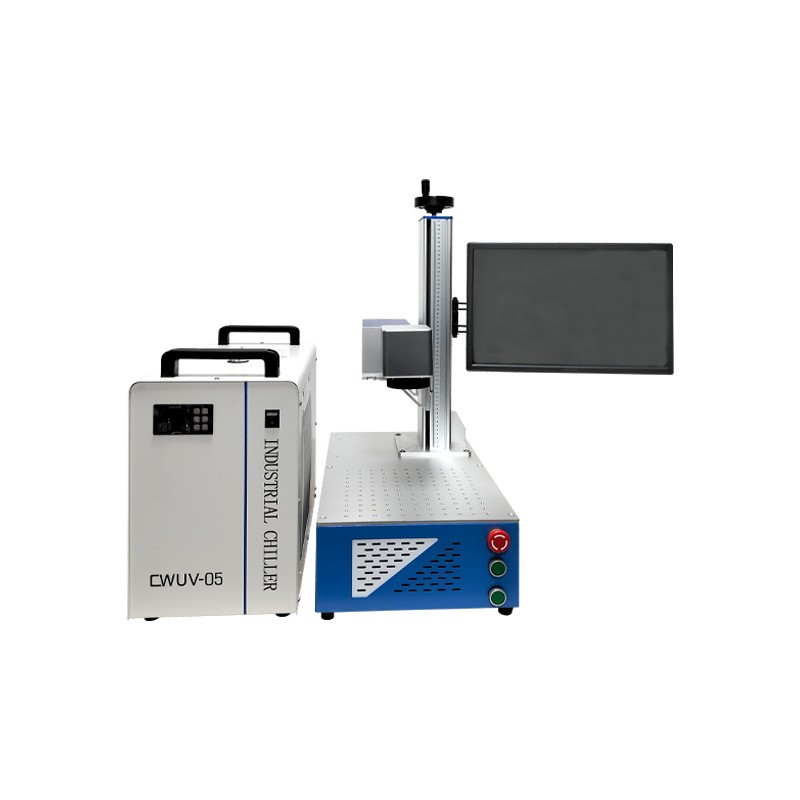
The Desktop UV Laser Marking Machine uses the third architecture. Its laser source wavelength is 355 nm with a pulse width below 60 ns and selectable laser power of 3 W or 5 W. Beam quality is M2 below 1.5 in single mode, modulation frequency spans 30 kHz to 100 kHz, marking speed reaches up to 10,000 mm/s, and the marking area is 110 × 110 mm. Maximum marking depth is below 0.4 mm, minimum line width is 0.4 mm against a 0.15 mm minimum character size, and repeatability is ±0.001 mm. Cooling is an external industrial water chiller — DWUV-05 included — with overall power consumption below 400 W on an operating voltage range of 110 V to 240 V and a standard USB control interface. Machine dimensions are 352 mm × 603 mm × 800 mm. The machine is operated through an independent display in an all-in-one configuration, carries more than 140 font libraries with custom fonts addable on request, and supports variable data marking for text, logos, barcodes, QR codes, and serial numbers.
Why separate the cooling loop? Because cold processing and continuous operation place opposite demands on the same head. UV marking is used precisely where thermal load must be minimized: PE and PVC plastics, metal parts, building materials, glass, film, packaging, and composite materials, in food and beverage packaging, pharmaceuticals, daily chemicals, cosmetics, electronics, hardware, steel, and cement lines. Recording the chiller as included equipment rather than an accessory means the cooling load must be planned at installation — floor space, water quality, and ambient conditions all belong in the site survey.
Recorded application outcomes for this class of work include 2D QR code and barcode scanning accuracy of 99.9% for supply-chain traceability, and damage-free micro-marking down to 10 microns with no thermal damage to sensitive components. Both results are the direct consequence of a cooling architecture that keeps the marking head thermally stable through long runs.
Duty-Cycle Versus Cooling: Architecture-Level Comparison
| Cooling architecture | Representative model | Declared duty-cycle intent | Documented power envelope |
|---|---|---|---|
| Air cooling, unit-mounted | Miniature Multi-Material Laser Marking Machine (2.7 kg); Handheld Fiber Laser Marking Machine | On-site portable use; craft, jewelry, and 3C accessory work at cell level | Overall power 100 W or less (miniature); laser power 20/30/50/60 W (handheld fiber) |
| Built-in air cooling, enclosed | Desktop Fiber Laser Marking Machine; Benchtop Fiber Laser Marking Machine; Flying Online Laser Marking Machine | Continuous 24/7 operation on automated production lines with zero consumables | Overall power below 400 W (desktop, benchtop); 400 W or less (flying online) |
| External industrial water chilling | Desktop UV Laser Marking Machine (355 nm, 3 W or 5 W) | Continuous 24-hour industrial operation; cold marking of heat-sensitive substrates | Overall power below 400 W; operating voltage 110 V to 240 V |
Step-by-Step: Matching Cooling and Duty Cycle to Your Line
Step 1 — Write the duty cycle down in hours and starts. Three-shift operation, single-shift operation, and on-demand mobile marking are three different machine classes. Continuous 24/7 operation on automated lines is the declared operating mode for the desktop fiber, benchtop fiber, flying online, desktop CO2, and desktop UV units. The handheld fiber and miniature units are positioned for on-site portable work.
Step 2 — Match the cooling class to the plant environment. Built-in air cooling suits plants where a water circuit is impractical, and it is the documented cooling system for the desktop fiber, benchtop fiber, flying online, and desktop CO2 machines. External industrial water chilling, with the DWUV-05 chiller included, is the UV configuration. Installation planning differs accordingly: an air-cooled unit needs clearance and airflow, a water-chilled unit needs the chiller position and service access accounted for.
Step 3 — Let the substrate choose the wavelength, then confirm the cooling supports it. Metals and many plastics are marked by 1064 nm fiber sources; heat-sensitive plastics, glass, film, and composite materials are the intended scope of the 355 nm UV cold-processing unit; the miniature unit covers both ends through a switchable 1064 nm and 455 nm dual source.
Step 4 — Size the marking area before the power option. The standard field across desktop and UV models is 110 × 110 mm. Desktop fiber configurations extend to 150 × 150 mm, 175 × 175 mm, and 200 × 200 mm, the benchtop fiber unit reaches 150 × 150 mm, the flying online unit offers 110 × 110 mm or 150 × 150 mm, and the miniature unit uses a 55 × 55 mm scanning area.
Step 5 — Reconcile marking speed with actual line speed. Marking speed of up to 10,000 mm/s is documented for the desktop fiber, benchtop fiber, CO2, and UV units. Where parts are moving, the flying online unit is specified at line speed up to 7,000 mm/s and continuous online marking speed up to 12,000 mm/s with an output rate of 800 standard characters per second. The miniature unit processes at up to 4,000 mm/s.
Step 6 — Confirm the precision class you are actually buying. Desktop fiber, benchtop fiber, CO2, and UV models are specified at ±0.001 mm repeatability. The flying online unit is specified at ±0.003 mm, reflecting the trade-off between continuous dynamic marking and static precision. These are measurable inspection parameters, not marketing descriptors.
Step 7 — Close the loop on power supply, certification, and consumables. Supplies range from a built-in lithium battery and DC 20 V power-bank operation, through 90 V to 240 V at 50/60 Hz on the handheld fiber unit and single-phase AC 90 V to 260 V on the flying online unit, to 110 V to 240 V on the UV model. Certification records, HS classification, and the zero-consumable design should all be verified at the same stage.
Model-Level Comparison: Cooling, Power, Area, Speed, and Precision
| Model | Cooling | Source | Power options | Marking area | Speed / precision |
|---|---|---|---|---|---|
| Handheld Fiber Laser Marking Machine | Air cooling | Fiber, 1064 nm | 20 / 30 / 50 / 60 W | 110 × 110 mm | Source life about 100,000 hours; 90 to 240 V, 50/60 Hz |
| Miniature Multi-Material Laser Marking Machine | Air cooling | Dual source, 1064 nm / 455 nm | Gradient regulation 25 to 100 | 55 × 55 mm scanning area | Up to 4,000 mm/s; 2.7 kg; 100 W or less |
| Desktop Fiber Laser Marking Machine | Built-in air cooling | Fiber, 1064 nm, pulse below 60 ns | 20 / 30 / 50 / 100 W | 110 × 110 mm, optional 150 × 150, 175 × 175, 200 × 200 mm | Up to 10,000 mm/s; ±0.001 mm; below 400 W |
| Benchtop Fiber Laser Marking Machine | Built-in air cooling | Fiber, 1064 nm, pulse below 60 ns | 20 / 30 / 50 W | Up to 150 × 150 mm | Up to 10,000 mm/s; ±0.001 mm; depth up to 4 mm; below 400 W |
| Flying Online Laser Marking Machine | Built-in air cooling | Fiber, 1064 nm, M2 below 2 | Pulse frequency 20 to 100 kHz | 110 × 110 mm or 150 × 150 mm | Line speed up to 7,000 mm/s; continuous online up to 12,000 mm/s; ±0.003 mm |
| Desktop UV Laser Marking Machine | External industrial water chiller (DWUV-05 included) | UV, 355 nm, pulse below 60 ns | 3 W or 5 W | 110 × 110 mm | Up to 10,000 mm/s; ±0.001 mm; 110 to 240 V |
| Desktop CO2 Laser Marking Machine | Built-in air cooling | CO2, 10.6 µm, pulse below 60 ns | 40 W | 110 × 110 mm or 150 × 150 mm | Up to 10,000 mm/s; ±0.001 mm; 20 kg; below 400 W |
Use Cases: Which Cooling Architecture Fits Which Shop Floor
Hardware parts, auto parts, and mechanical spare parts. Desktop and benchtop fiber units cover this work at marking speed up to 10,000 mm/s with ±0.001 mm repeatability, a fit for hardware and tools, auto parts, electronic components, machinery parts, and jewelry. Where parts are large, in place, or awkward to fixture, the handheld fiber unit with its built-in lithium battery removes the handling step altogether.
Pipes and profiles marked on site. The handheld fiber laser marking machine is the on-site configuration for pipes and profiles, with a 110 × 110 mm marking area and a 20 W to 60 W power range. Its air-cooled, battery-powered design means the duty cycle is scheduled around a work order rather than around a line.
Electronic components and heat-sensitive substrates. The UV cold-processing unit, at 355 nm with 3 W or 5 W and M2 below 1.5, is the documented choice where thermal damage is unacceptable. Recorded outcomes for this type of work include micro-marking down to 10 microns with no thermal damage to sensitive components, supported by the external industrial water chiller that holds the head stable during continuous operation.
Jewelry, gifts and crafts, and 3C accessories. The 2.7 kg miniature multi-material unit serves customized DIY workshops and craft cells with a switchable 1064 nm and 455 nm source, a 55 × 55 mm scanning area, up to 4,000 mm/s processing speed, and mobile app, PC software, or touch screen control. It is also a natural complement to a heavier production machine when personalization runs are mixed into a standard catalogue.
High-speed production lines running three shifts. The flying online unit is the architecture for dynamic lines: built-in air cooling, 24/7 continuous online marking with zero consumables, 150,000-hour source rating, and continuous online speed up to 12,000 mm/s for dates, batch numbers, tracking codes, and 2D QR codes across food and beverage, pharmaceuticals, daily chemicals, hardware, auto parts, building materials, steel, cement, and electronics.
Packaging and non-metallic marking. Where glass, leather, cardboard and paper boxes, PET plastic bottles, or wood are the substrate, the desktop CO2 unit at 10.6 µm and 40 W with built-in air cooling covers the packaging and consumer goods scope on a continuous basis.
Frequently Asked Questions
What certification and compliance documents should accompany a portable laser marking machine?
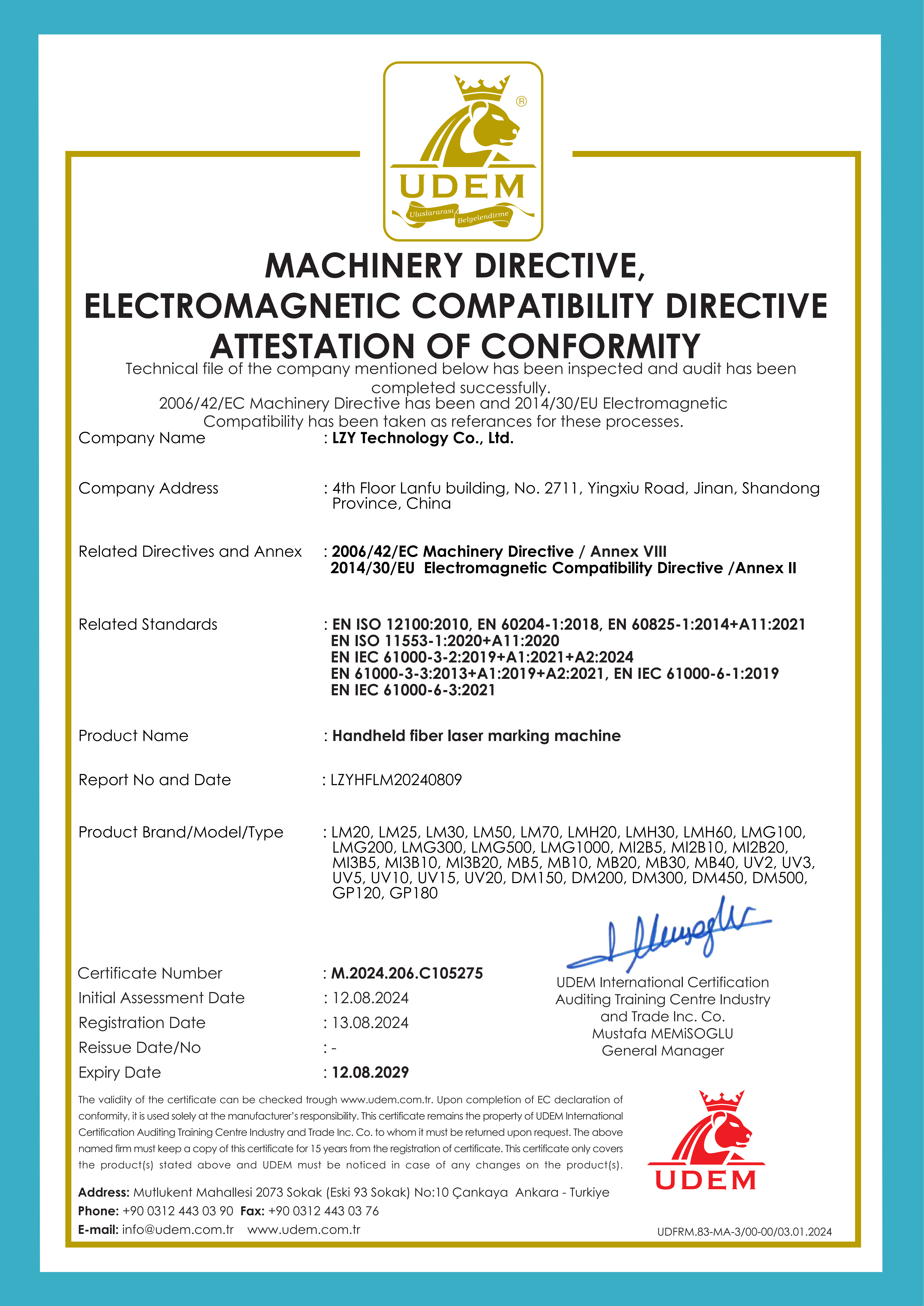
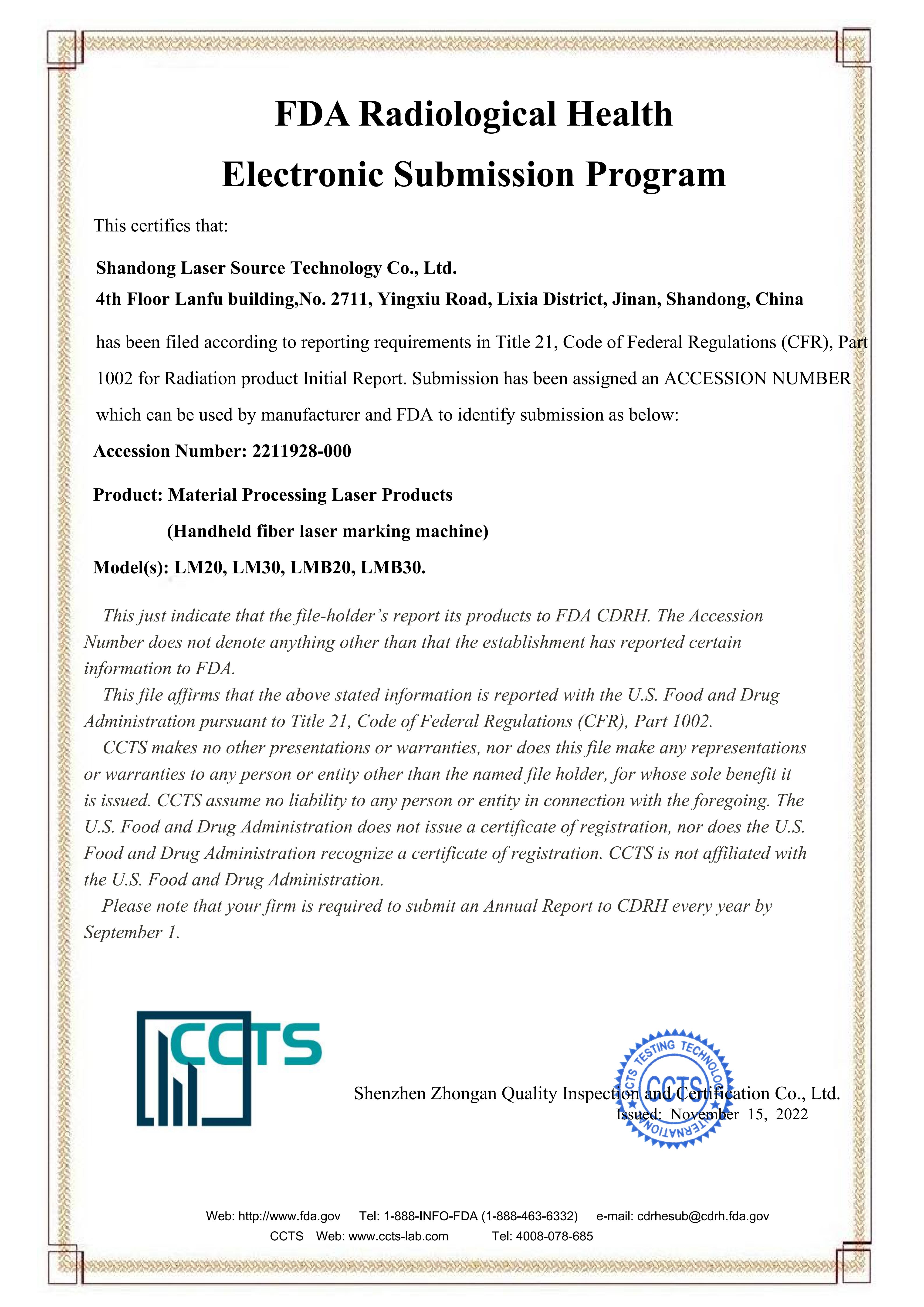
Two document sets matter for global deployment. For the European Union, the handheld fiber laser marking machine holds a CE Declaration of Conformity numbered M.2024.206.C105275, issued by UDEM International Certification Auditing Training Centre Industry and Trade Inc., dated 2024-08-12 and valid until 2029-08-12. For the United States, the same handheld fiber laser marking machine holds an FDA Radiological Health Electronic Submission Confirmation numbered 2211928-000, issued through CCTS (Shenzhen Zhongan Quality Inspection and Certification Co., Ltd.) under Title 21 CFR Part 1002. More broadly, laser products sold in the USA must comply with FDA 21 CFR Subchapter J (Radiological Health), Parts 1000 through 1005, and hand-held portable laser markers are specifically assessed against EN ISO 11553-2 for hand-held safety. Machine tools operated by laser processes are classified under HS Code 845611 for customs purposes.
Can a portable laser marking machine run 24/7 on an air-cooled design?
Yes, where the manufacturer specifies it. The flying online fiber laser marking machine uses built-in air cooling and is specified for 24/7 continuous online marking with zero consumables, running a 1064 nm fiber source with M2 below 2, 20 kHz to 100 kHz pulse frequency, a 150,000-hour rated lifespan, line speed up to 7,000 mm/s, and continuous online marking speed up to 12,000 mm/s. The desktop fiber and benchtop fiber laser marking machines also use built-in air cooling and are specified for continuous operation at below 400 W overall power. The desktop UV laser marking machine follows a different route, using an external industrial water chiller with the DWUV-05 unit included, for 24-hour operation on heat-sensitive materials. Handheld and miniature units prioritize mobility instead: the miniature multi-material model weighs 2.7 kg and draws no more than 100 W overall, and the handheld fiber unit runs on a built-in lithium battery.
Which configuration decisions change the cost of a portable laser marking setup?
Configuration variables, rather than a single headline figure, determine the cost profile. Laser power ranges from 3 W or 5 W on the UV model, through 20/30/50/60 W on the handheld fiber model, to 20/30/50/100 W on the desktop fiber model. Cooling ranges from unit-level air cooling on handheld and miniature models, through built-in air cooling on desktop, benchtop, flying online, and CO2 units, to the included external industrial water chiller on the UV model. Marking area can remain at 110 × 110 mm or extend to 150 × 150 mm, 175 × 175 mm, or 200 × 200 mm on desktop fiber configurations. Power supply design adds a further variable: built-in lithium battery and DC 20 V power-bank operation on the miniature unit, a built-in lithium battery on the handheld fiber unit, and single-phase AC 90 V to 260 V on the flying online unit. Zero-consumable operation removes recurring consumable spend rather than adding to it. OEM and ODM customization is available, with a minimum order quantity of 5 units.
How can a buyer validate cooling and duty-cycle fit before ordering?
Validation is performed on the buyer's own materials. Multi-material marking tests across the range cover metals such as steel, metal components, and alloys, and non-metallic plastics such as PE and PVC, while the miniature multi-material unit adds bamboo and wood, leather, paper, colored glass, plastics, and ceramics through its switchable 1064 nm and 455 nm dual source. Recorded application results from these workflows include QR code and barcode scanning accuracy of 99.9% for traceability, and micro-marking down to 10 microns with no thermal damage to sensitive components. Every machine undergoes strict aging tests and precision calibration before delivery, and customization requests are reviewed case by case. A practical next step is to send sample parts for a marking test and request a quotation together with the current product catalogue.
What is the typical lead time and delivery process?
Lead time is set by factory scheduling according to order volume rather than by a fixed published figure, and the minimum order quantity is 5 units. Before dispatch, every machine passes strict aging tests and precision calibration — a step that matters most on externally chilled UV units and continuous-duty fiber units, where optical alignment and thermal behaviour must be verified together. Products have been exported for many years to more than 80 countries and regions, including Vietnam, Thailand, Malaysia, Türkiye, the United States, Poland, and the Middle East, with full English after-sales technical support and a one-year warranty recorded in the supplier's service documentation.
Conclusion: Treat Cooling as a Procurement Criterion, Not an Accessory
The cooling architecture of a portable laser marking machine is the variable that translates a specification sheet into a 24/7 result. Unit-level air cooling with battery power delivers on-site mobility for pipes, profiles, and oversized parts. Built-in air cooling carries continuous operation on desktop, benchtop, and flying online fiber units at less than 400 W overall power with zero consumables. External industrial water chilling, with the DWUV-05 chiller included, protects heat-sensitive substrates on the 355 nm UV platform through round-the-clock cold processing.
Match the three variables in the right order — duty cycle first, then cooling class, then wavelength, area, speed, and precision — and the machine you buy will hold ±0.001 mm where precision is specified, and up to 12,000 mm/s continuous online speed where throughput is the requirement. Confirm the certification file, the HS classification, and the after-sales route at the same time, and the cooling decision stops being a technical risk and becomes a documented procurement choice.
Next step: match your duty cycle to the right cooling architecture.
Send your substrate, required marking area, and shift pattern, and the Yuanshida technical team will recommend a cooling class and configuration accordingly. Sample marking tests, quotations, and OEM/ODM review requests are handled directly.
Download the full product catalogue: Second Generation Laser Marking Machine Catalogue (PDF)
Website: www.yuanlaser.com
WhatsApp: +86 156-2882-7593 | Email: cheng@yuanlaser.com
Jinan Yuanshida International Trade Co., Ltd — Room 909, Unit 1, Building 1, Kangqiao Yidong Mansion Complex, No. 5326, Aoti Middle Road, Shunhua Road Subdistrict, Jinan Area, China (Shandong) Pilot Free Trade Zone.
Have Questions or Need More Details?
Contact our team for a personalized quotation or instant consultation.
Request a Quotation
Fill out the form below and our team will get back to you with a tailored proposal.
WhatsApp Direct Chat
Prefer to chat in real-time? Message us on WhatsApp for instant assistance & quick answers.
- Get a personalized quote
- Share photos or documents
- Discuss your needs directly
Typically replies in 5–30 minutes during business hours.