
Portable Laser Marking Machine Long-Term Partnership FAQ: Acceptance, Safety, and After-Sales Checks
Long-term partnerships are won or lost at the handover point. A Portable Laser Marking Machine can look identical on a quotation sheet and behave very differently once it is placed beside a smart manufacturing line, a pipe rack, or a jewelry bench. The questions that decide a repeatable supply relationship are practical: what exactly is accepted, how laser and electrical safety are evidenced, and who owns after-sales when the machine runs continuously.
The short answer is to standardize the acceptance test before the first order, require model-specific safety documentation for laser radiation and electrical protection, and write after-sales duties around the real operating mode: continuous 24/7 operation, zero consumables, USB or touch-screen control, and the cooling method used by the selected format. Jinan Yuanshida International Trade Co., Ltd., established in 2012, supplies handheld, benchtop, desktop, and precision laser marking equipment. This FAQ is written for buyers aligning multiple portable units across production lines.
Problem definition: why a portable marker needs a partnership checklist
A one-off purchase can survive a loose acceptance process because the buyer and seller can resolve a single dispute informally. A multi-line partnership cannot. When the same Portable Laser Marking Machine format is deployed at several sites, every unstated assumption becomes a repeated cost: a sample approved under office lighting may fail at a production cell, a safety file may not name the exact model, and an after-sales plan may ignore the cooling method that keeps the unit stable.
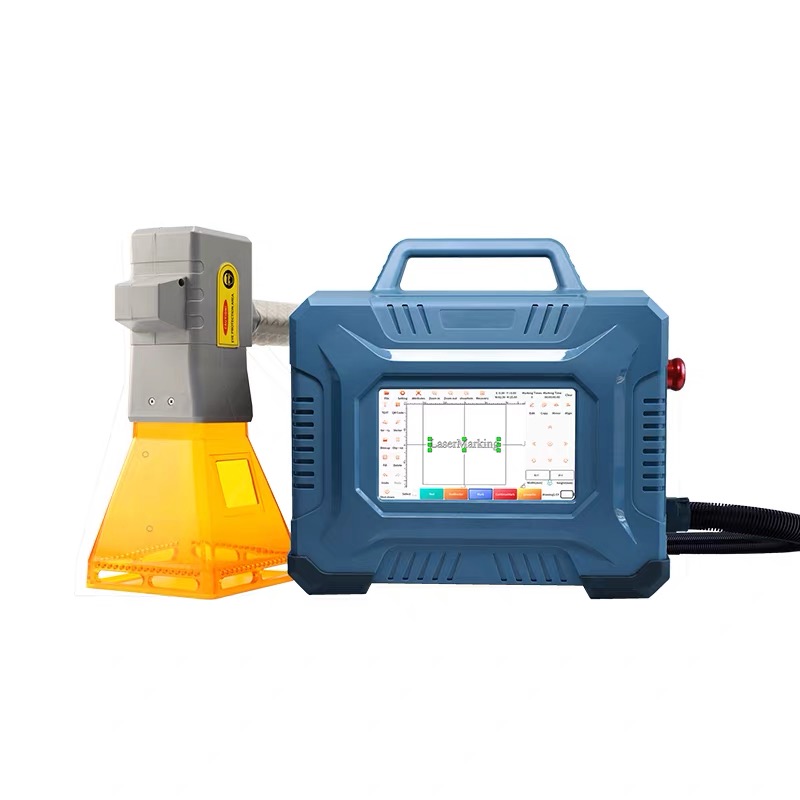
The risk is higher because portable laser marking is not one product category. A handheld fiber unit, a miniature multi-material unit, a desktop UV unit, a desktop fiber unit, a benchtop fiber unit, and a flying online unit use different configurations and fit different work. The 355 nm cold laser process is intended for marking plastics, glass, and fragile materials without thermal damage; 1064 nm fiber formats are used for metals and for non-metallic plastics such as PE and PVC. A partnership checklist must therefore be model-specific, not category-generic.
Industry background: smart manufacturing raises the evidence bar
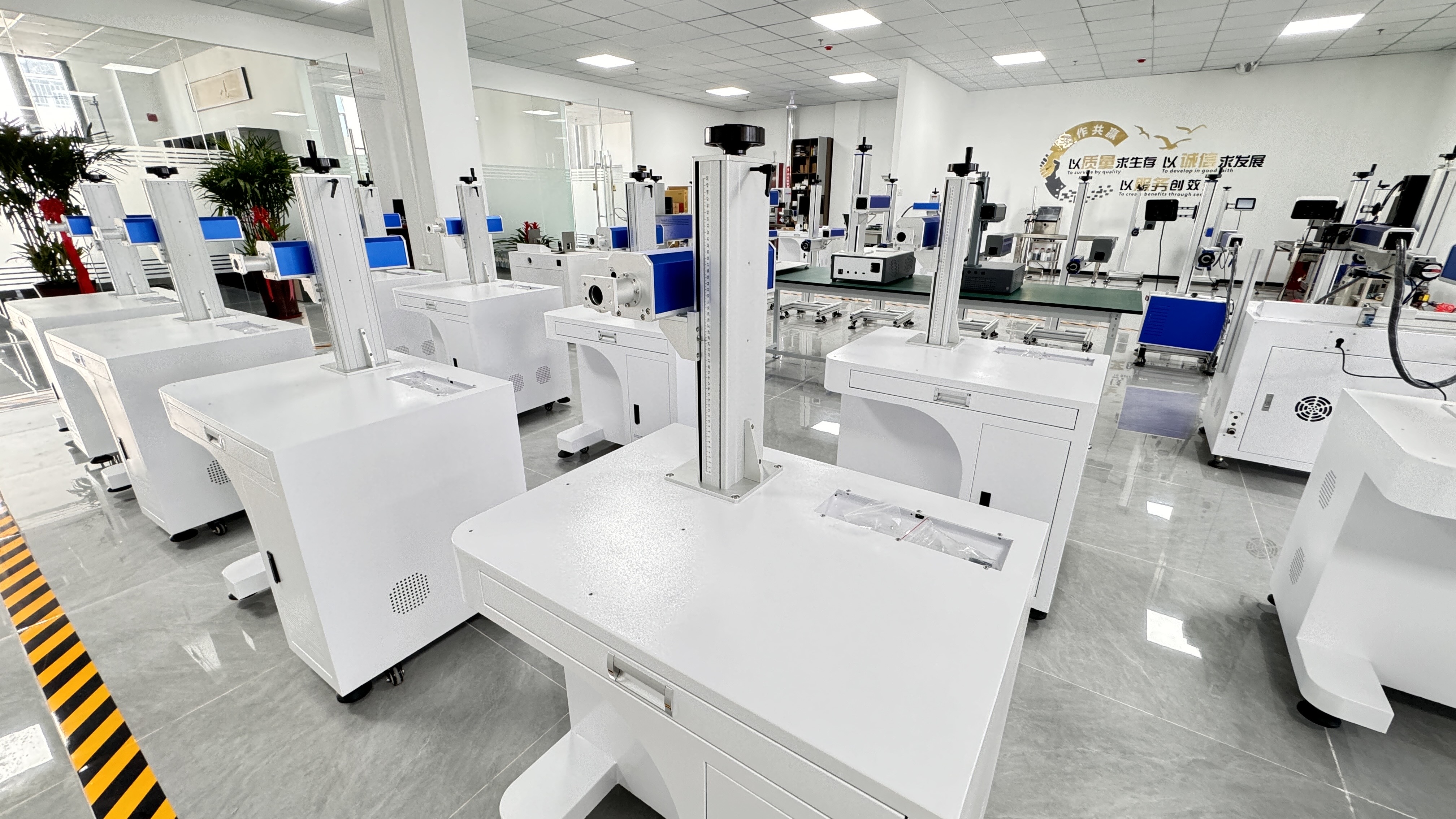
Smart manufacturing cells increasingly expect marking to support traceability, not just identification. Production dates, batch numbers, tracking codes, text, logos, scales, 1D barcodes, and 2D QR codes are part of the line record. Portable formats matter where a fixed workstation cannot reach the workpiece or where large-size parts must be marked on site. The company’s laser marking equipment is used in hardware and auto parts, pipes and profiles, electronic components, jewelry and accessories, mechanical parts, gifts, and crafts.
Market context explains why buyers are standardizing rather than buying ad hoc. Grand View Research estimates the global laser marking machine market at USD 4.4 billion in 2026, with fiber laser technology holding a 46.1% revenue share in 2025 and Asia Pacific accounting for approximately 44% revenue share. Portable units are also a distinct physical category: MAC Laser describes handheld and portable laser marking machines as typically weighing 15 to 35 pounds, or about 6.8 to 15.8 kg. Product-specific weight varies; the Miniature Multi-Material Laser Marking Machine is listed at 2.7 kg, while the handheld fiber unit is described as about 6 kg. Buyers should use these ranges as orientation, then verify the exact model.
Safety expectations are equally concrete. Portable laser markers are assessed against EN ISO 11553-2 for hand-held safety, and laser products sold in the USA must comply with FDA 21 CFR Subchapter J, Parts 1000 through 1005. These references belong in the partnership file because they tell both sides what evidence should exist before the first line is signed off.
The four-check solution: acceptance, laser safety, electrical safety, and after-sales
A workable long-term partnership uses four evidence files. Each file must name the exact model, the destination market, and the operating mode. The goal is not more paperwork; it is fewer disputes after the second or third unit arrives.
1. Acceptance criteria: agree the evidence before the sample looks good
Acceptance should combine document review with a physical sample test. The document pack should show compliance with international quality standards such as CE, FDA, and ISO, and it should confirm that all equipment undergoes multiple aging tests and precision calibration before leaving the factory. The sample test should use the buyer’s own material and artwork, not a generic demonstration plate.
- Configuration check: confirm power option, wavelength, marking area, control interface, cooling method, battery or power supply, and input voltage for the exact model.
- Application check: mark representative parts for hardware parts, pipes and profiles, electronic components, jewelry, mechanical spare parts, or gifts and crafts. Keep the approved piece as a golden sample.
- Duty check: for a line expected to run continuously, include a sustained 24/7-style run in the acceptance plan. Record start conditions, cooling status, and mark quality at the end.
- Interface check: confirm whether operators will use a Linux 7-inch touch screen, USB control, PC software, mobile app, or a combination. The interface must match the production team, not only the purchasing team.
The acceptance record should state what “pass” means for legibility, placement, contrast, and repeatability. For models that list ±0.001 mm repeatability, the test should show how that figure is checked on the buyer’s fixture. For a Portable Laser Marking Machine used across several lines, the same record becomes the reference for every later unit.
2. Laser radiation and optical safety: model-specific, not generic
Laser safety evidence should be reviewed before the machine reaches the shop floor. For hand-held portable markers, EN ISO 11553-2 is the relevant hand-held safety reference. For the United States, FDA 21 CFR 1000-1005 applies to laser products. A partnership file should contain the safety documentation that names the exact model and the market it is intended for.
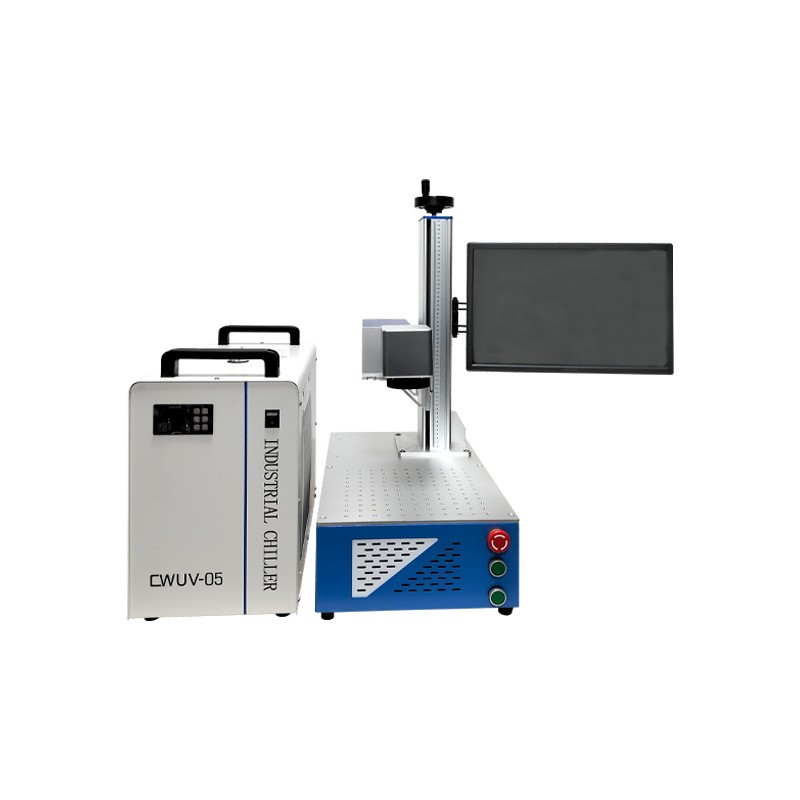
Optical safety protection should be checked as a system, not as a logo on a certificate. The buyer should confirm that the supplier’s safety documentation covers the marking area, the beam path, operator controls, labeling, and operating instructions. For the 355 nm cold-processing UV format, the review should also include the optical path and the installation of the external industrial water chiller. The point is not to replace a qualified safety officer; it is to make sure the supplier’s evidence matches the machine being installed.
A generic CE or FDA statement is not enough if it does not identify the model. The acceptance file should cross-reference the certificate, the nameplate, and the actual configuration. If the partnership covers several formats, keep a separate safety file for each one.
3. Electrical and high-voltage safety: match the site, not the brochure
Electrical checks should start with the site supply and the exact model. The handheld fiber laser marking machine lists a power supply of 90V-240V, 50/60Hz, with a built-in lithium battery. The desktop UV laser marking machine lists an operating voltage of 110V-240V, overall power below 400 W, and an external industrial water chiller (DWUV-05 included). The flying online fiber unit lists single-phase AC 90V-260V, 50Hz-60Hz, and overall power consumption less than or equal to 400 W. The Miniature Multi-Material unit lists overall power no more than 100 W, a built-in lithium battery or DC 20V supply, power-bank support, TYPE-A for data, and TYPE-C for power.
These details matter because high-voltage safety is an evidence question. The buyer should request the electrical safety documentation that matches the exact model and destination market, and the installer should verify grounding, circuit protection, cable routing, and the power arrangement for any external chiller. Battery-powered units need a separate charging check: confirm the charger, the charging environment, and the operator procedure. A Portable Laser Marking Machine that is moved between cells should have a documented power-up and power-down sequence for each location.
4. After-sales alignment: write duties around duty cycle and cooling
After-sales should be written around the way the machine actually runs. Several formats are specified for continuous 24/7 operation and zero consumables, including the station-type benchtop fiber unit and the flying online fiber unit. Zero consumables does not mean zero maintenance. The cooling method determines what must be inspected, cleaned, and scheduled.
- Air-cooled formats: the handheld fiber, Miniature Multi-Material, desktop fiber, benchtop fiber, and flying online fiber units use air cooling. The after-sales plan should define air-path inspection and temperature checks.
- Water-cooled UV format: the desktop UV model uses an external industrial water chiller (DWUV-05 included). The plan should define chiller installation, water quality, and routine chiller maintenance.
- Battery formats: the handheld fiber and Miniature Multi-Material units use built-in lithium batteries. The plan should define charging practice, battery service, and safe storage between jobs.
- Life figures: the handheld fiber unit lists a laser life of about 100,000 hours; the flying online unit lists 150,000 hours. These are expected life figures, not a substitute for warranty terms.
A good after-sales schedule also names who trains operators, who approves parameter changes, how spare parts are identified, and how a mark-quality complaint is escalated. The agreement should not depend on a single contact person. For a multi-line partnership, the same after-sales logic should apply to every site, with a named owner for each line.
Step-by-step: qualifying a portable laser marking machine for a multi-line partnership
- Define the part family and marking content. List the materials, part sizes, mark content, and traceability data. Separate metals, plastics, glass, and heat-sensitive materials so the format decision is visible.
- Select the format by part and site. Use handheld fiber where on-site marking and battery mobility matter; use the Miniature Multi-Material unit for light-weight multi-material work; use desktop UV for 355 nm cold processing; use desktop fiber or benchtop fiber for fixed workstations; use flying online where the part moves on a line.
- Build the acceptance sample set. Include the easiest and hardest parts, the smallest character, the largest marking area, and the production artwork. Approve a golden sample and store it with the acceptance record.
- Assemble the safety evidence file. Collect CE, FDA, and ISO documentation, the EN ISO 11553-2 hand-held safety review where applicable, and the FDA 21 CFR 1000-1005 file for the US market. Confirm that each document names the model.
- Verify electrical and cooling installation. Match voltage, power, grounding, battery charging, and chiller requirements to the site. For the UV model, confirm the DWUV-05 chiller installation before production starts.
- Agree after-sales responsibilities and spares. Define operator training, parameter control, cooling maintenance, battery service, calibration checks, spare-parts list, and escalation path. Keep the language specific to the selected format.
- Run factory acceptance and site acceptance. Factory acceptance confirms build and baseline marking; site acceptance confirms the machine, fixture, power, cooling, and operator procedure in the real cell. Both records should be signed.
- Lock an annual review and change-control rule. Review mark quality, downtime reasons, spares consumption, and any format changes once a year. Any change to material, fixture, or marking content should trigger a new sample approval.
Use cases: where portable marking fits in smart manufacturing
Portable Laser Marking Machine for Hardware Parts
Hardware parts often need clear, durable identification at a workstation. The benchtop fiber laser marking machine is applicable to marking on hardware parts, and the handheld fiber unit supports stainless steel, carbon steel, aluminum oxide, aluminum alloy, aluminum, copper, iron, gold, silver, carbide, painted metal, acrylic, PVC, leather, and painted wood. Acceptance should focus on edge quality, placement, and repeatability on the actual fixture.
Portable Laser Marking Machine for Pipes & Profiles
Pipes and profiles are difficult to bring to a fixed station. The company’s equipment is used in pipes and profiles, and handheld fiber formats support on-site marking with a 110 x 110 mm marking area. The partnership check should confirm reach, fixture stability, and whether the operator can maintain a consistent focal distance over the full part.
Portable Laser Marking Machine for Electronic Components
Electronics production lines need small, legible marks and repeatable placement. The benchtop fiber unit is applicable to marking tasks in electronics production lines, and the desktop fiber and flying online formats are also used in electronics production. The Miniature Multi-Material unit is intended for 3C electronic accessories. Acceptance should use the smallest character and the actual carrier or tray.
Portable Laser Marking Machine for Jewelry
Jewelry marking rewards fine control and a clean finish. The handheld fiber, benchtop fiber, and Miniature Multi-Material formats are intended for the jewelry industry and for marking metals including steel, metal parts, and alloys. The Miniature Multi-Material unit adds a switchable 1064 nm / 455 nm dual light source and a 2.7 kg body for bench-side work.
Portable Laser Marking Machine for Mechanical Spare Parts
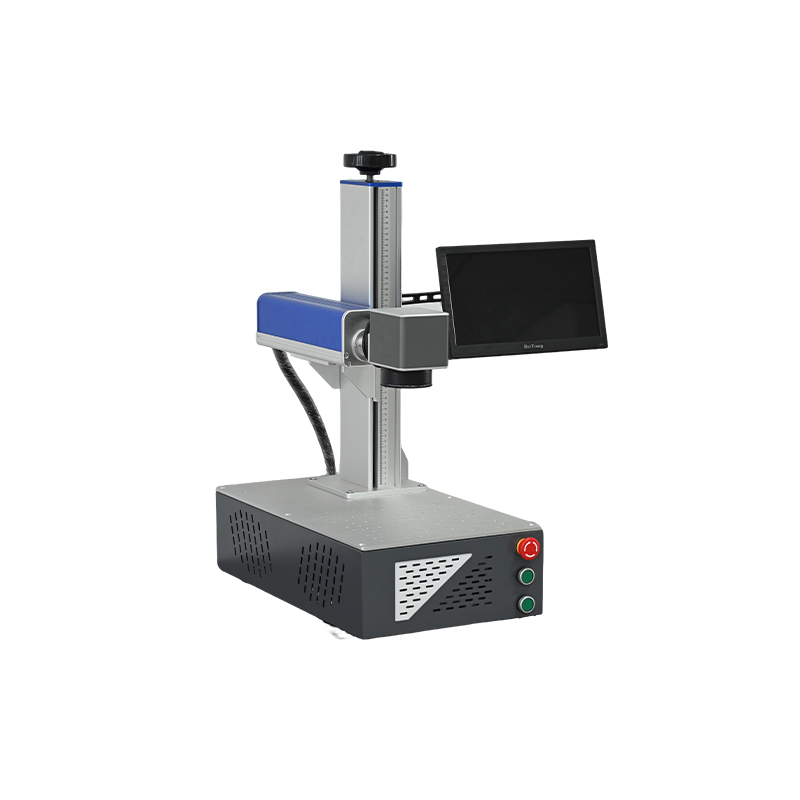
Mechanical spare parts often require a fixed workstation with a stable fixture. The desktop fiber laser marking machine offers 20W, 30W, 50W, or 100W options, a 1064 nm wavelength, a 110 x 110 mm marking area, and ±0.001 mm repeatability. Acceptance should include the heaviest part, the longest mark, and the actual operator loading motion.
Portable Laser Marking Machine for Gifts & Crafts
Gifts and crafts combine metals, bamboo and wood, leather, paper, colored glass, plastics, and ceramics. The Miniature Multi-Material Laser Marking Machine is designed for portable and on-site marking in gifts and crafts, jewelry, customized DIY workshops, and 3C electronic accessories, and it supports OEM customization. A multi-material sample matrix is the right acceptance tool here.
On-site Portable Laser Marking Machine for Large-size Workpieces
Large parts that cannot be moved are the clearest case for a portable format. The handheld fiber unit weighs about 6 kg and uses a built-in lithium battery for mobile marking without an external power supply. The Miniature Multi-Material unit supports a built-in lithium battery or DC 20V supply and power-bank operation through TYPE-C. The partnership file should define how the unit is transported, charged, and protected between sites.
Cold-Processing Portable UV Laser Marking Machine
Heat-sensitive plastics, glass, film, packaging, and composite materials need a different process. The desktop UV laser marking machine uses a 355 nm cold laser process intended for marking plastics, glass, and fragile materials without thermal damage. It is compatible with PE plastics, PVC plastics, metal parts, building materials, glass, film, packaging, and composite materials. Because the UV model uses an external industrial water chiller, the use-case review should include the chiller location and routine maintenance.
Comparison table: portable formats and the checks that matter in a long-term partnership
| Format | Verified configuration facts | Cooling and duty evidence | Control interface | Long-term partnership check |
|---|---|---|---|---|
| Handheld Fiber Laser Marking Machine | 20W/30W/50W/60W; 1064 nm; about 6 kg; built-in lithium battery; laser life about 100,000 hours; 90V-240V, 50/60Hz | Air cooling; designed for mobile marking without an external power supply | Linux; 7-inch touch screen; Bluetooth, WiFi, mobile APP | Battery charging, on-site safety, and fixture stability |
| Miniature Multi-Material Laser Marking Machine | 1064 nm / 455 nm dual light source; 2.7 kg; ≤100 W; 4,000 mm/s; 55 x 55 mm scanning area | Air cooling; built-in lithium battery or DC 20V; power-bank supported | Mobile app, PC software, touch screen; TYPE-A data, TYPE-C power | Multi-material sample matrix and power supply discipline |
| Desktop UV Laser Marking Machine | 3W/5W; 355 nm; 110 x 110 mm; 110V-240V; <400 W; 140+ font libraries | External industrial water chiller (DWUV-05 included); 355 nm cold laser process | Standard USB; independent display | Chiller installation, optical safety review, and cold-laser validation |
| Desktop Fiber Laser Marking Machine | 20W/30W/50W/100W; 1064 nm; 110 x 110 mm; <400 W; ±0.001 mm repeatability | Built-in air cooling; plug-and-play integrated unit | Integrated user interface and large display screen | Workstation footprint, fixture access, and 24/7 duty review |
| Benchtop Fiber Laser Marking Machine | 20W/30W/50W; 1064 nm; 150 x 150 mm; <400 W; max marking depth up to 4 mm | Built-in air cooling; continuous 24/7 operation; zero consumables | Windows XP / standard USB | Fixed workstation acceptance and operator training |
| Flying Online Laser Marking Machine | 1064 nm; 20-100 kHz; up to 7000 mm/s line speed; 800 standard characters per second; <400 W | Built-in air cooling; 24/7 continuous online marking with zero consumables; laser lifespan 150,000 hours | Standard USB / touch screen PC control | Line integration, dynamic marking acceptance, and code traceability |
FAQ: long-term partnership questions buyers ask before standardizing
What acceptance criteria should a portable laser marking machine meet before a long-term supply agreement is signed?
Acceptance should combine document review and a physical sample test. The document pack should show CE, FDA, and ISO compliance and confirm that all equipment undergoes multiple aging tests and precision calibration before leaving the factory. The physical test should use the buyer’s own material and artwork and should confirm power option, wavelength, marking area, control interface, cooling method, and input voltage for the exact model. For a line expected to run continuously, include a sustained run and keep the approved piece as a golden sample. The same record should be used for every later unit.
How should buyers verify laser radiation and optical safety protection on a portable laser marking machine?
For hand-held portable markers, the relevant hand-held safety reference is EN ISO 11553-2. For the United States, laser products must comply with FDA 21 CFR Subchapter J, Parts 1000 through 1005. The buyer should request safety documentation that names the exact model and market, then confirm that the marking area, beam path, operator controls, labeling, and operating instructions are covered. For the 355 nm UV format, include the optical path and the external industrial water chiller installation in the site review. A generic certificate that does not identify the model is not a sufficient acceptance record.
What electrical and high-voltage safety checks belong in a long-term partnership?
Start with the site supply and the exact model. The handheld fiber unit lists 90V-240V, 50/60Hz and a built-in lithium battery. The desktop UV unit lists 110V-240V, overall power below 400 W, and an external industrial water chiller (DWUV-05 included). The flying online unit lists single-phase AC 90V-260V and power consumption less than or equal to 400 W. The Miniature Multi-Material unit lists no more than 100 W, a built-in lithium battery or DC 20V supply, TYPE-A for data, and TYPE-C for power. High-voltage safety should be evidenced by electrical safety documentation for the exact model and destination market, with installation checks for grounding, circuit protection, cable routing, and chiller power.
Can a portable laser marking machine run 24/7 with zero consumables, and what does that mean for after-sales?
Several formats are specified for continuous 24/7 operation and zero consumables, including the station-type benchtop fiber unit and the flying online fiber unit. Zero consumables does not mean zero maintenance. Air-cooled formats need air-path inspection and temperature checks; the desktop UV model needs an external industrial water chiller and routine chiller maintenance. Battery formats need charging practice and battery service. The handheld fiber unit lists a laser life of about 100,000 hours, and the flying online unit lists 150,000 hours. These are expected life figures, not a substitute for warranty terms.
What sample and lead-time steps should be agreed before standardizing across multiple lines?
Request a sample marked with your own artwork and material, approve a golden sample, and write the pass criteria into the acceptance record before mass shipment. Define the lead time for each format and stage the rollout by line so that the first site becomes the reference. Confirm the after-sales owner for each line, the spare-parts list, and the training plan. To start a sample review, quotation, or brochure request, contact Jinan Yuanshida International Trade Co., Ltd. by email at cheng@yuanlaser.com or by WhatsApp at +86 156-2882-7593.
Next step: download the English product brochure for model details and configuration options, or send your part drawings and marking content for a sample review.
Download the English product brochure
Website: www.yuanlaser.com | Email: cheng@yuanlaser.com | WhatsApp: +86 156-2882-7593
Conclusion: make the partnership auditable, not verbal
A Portable Laser Marking Machine partnership becomes reliable when acceptance, safety, and after-sales are written as evidence rather than promises. The acceptance file should name the exact model, the sample, the marking area, the interface, the cooling method, and the pass criteria. The safety file should connect the machine to EN ISO 11553-2 for hand-held use where applicable and to FDA 21 CFR 1000-1005 for the US market. The after-sales file should reflect continuous 24/7 operation, zero consumables, air cooling or external water cooling, and battery or line-power arrangements.
Jinan Yuanshida International Trade Co., Ltd. is a high-tech enterprise established in 2012 specializing in the R&D, production, and export of industrial laser marking equipment. Its products have been exported for many years to more than 80 countries and regions, including Vietnam, Thailand, Malaysia, Türkiye, the United States, Poland, and the Middle East. For buyers standardizing portable marking across smart manufacturing lines, the most useful next step is a sample review against the actual part family, followed by a written acceptance record that can be reused at every site.
Contact: Room 909, Unit 1, Building 1, Kangqiao Yidong Mansion Complex, No. 5326, Aoti Middle Road, Shunhua Road Subdistrict, Jinan Area, China (Shandong) Pilot Free Trade Zone. Email: cheng@yuanlaser.com. Mobile and WhatsApp: +86 156-2882-7593.
Have Questions or Need More Details?
Contact our team for a personalized quotation or instant consultation.
Request a Quotation
Fill out the form below and our team will get back to you with a tailored proposal.
WhatsApp Direct Chat
Prefer to chat in real-time? Message us on WhatsApp for instant assistance & quick answers.
- Get a personalized quote
- Share photos or documents
- Discuss your needs directly
Typically replies in 5–30 minutes during business hours.