Portable Laser Marking Machine Long-Term Support FAQ: Consumables, Cooling, and 24/7 Use
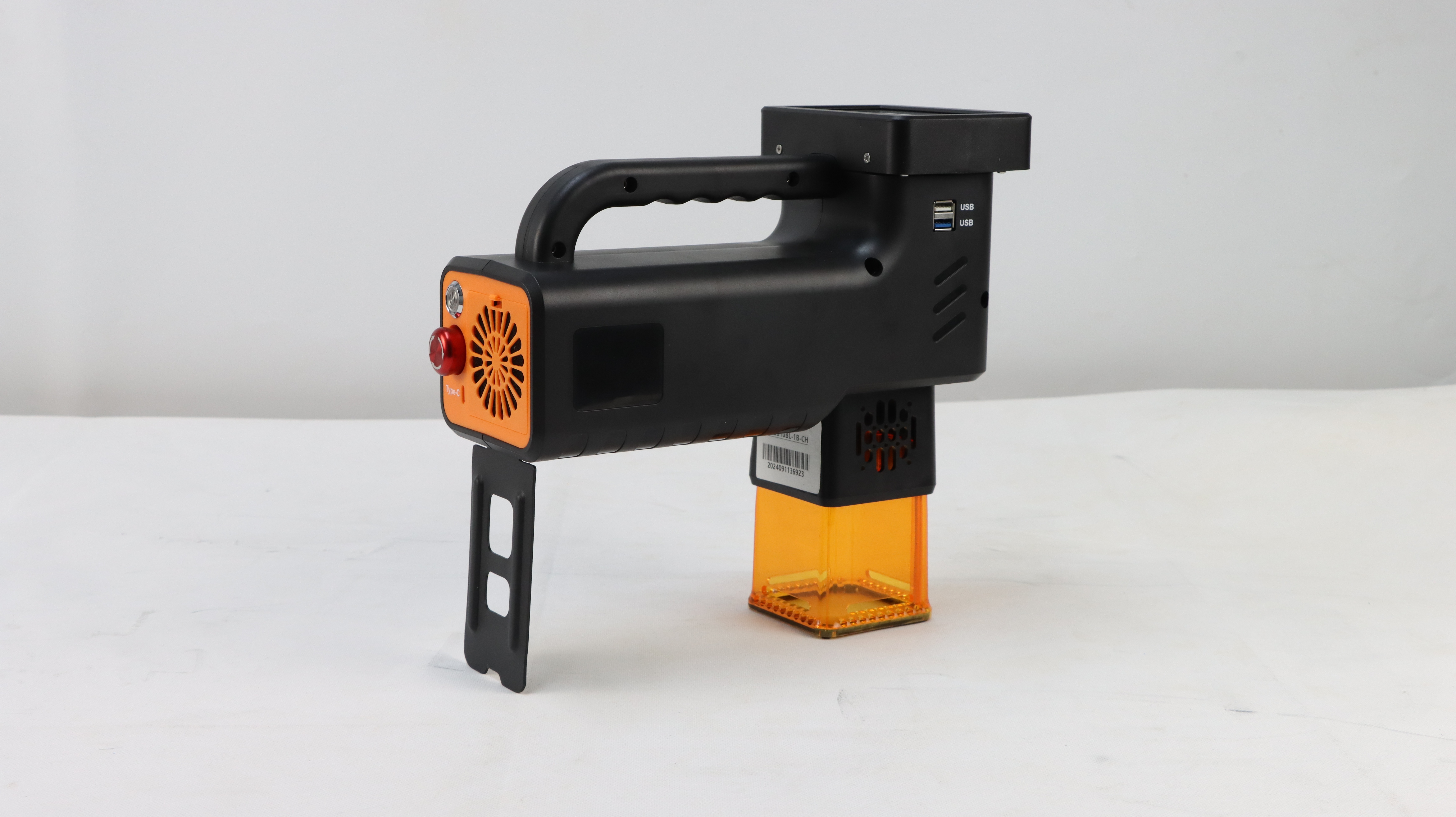
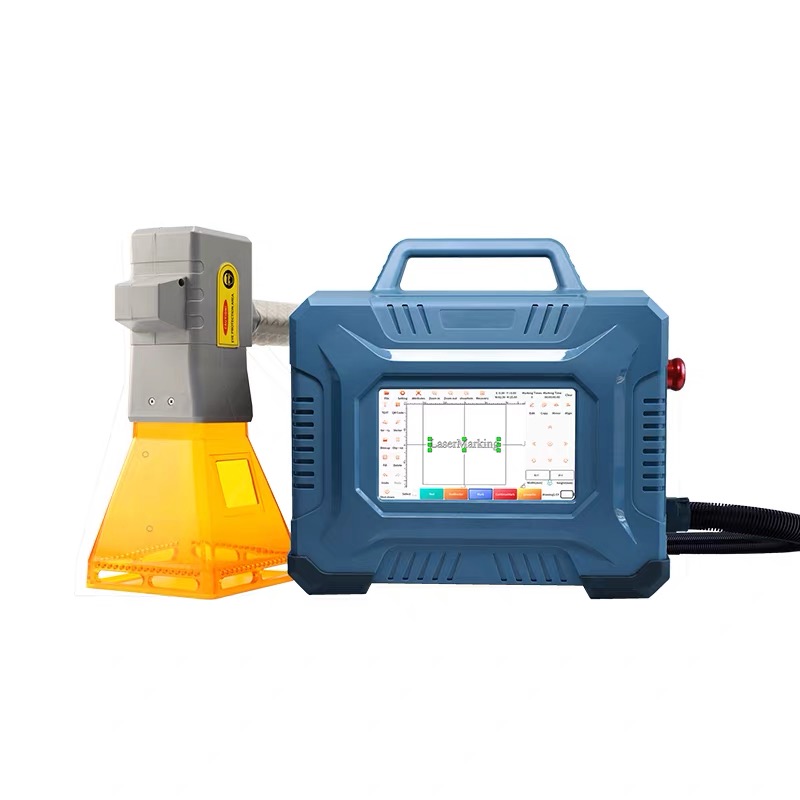
Long-term support for a portable laser marking machine is settled by four things: whether marking consumes anything, how the unit is cooled during long runs, how it is powered on site, and whether the supplier can still train operators, supply parts and ship orders after the first year. On the Handheld Fiber Laser Marking Machine, the marking operation is described as clean, precise and continuous with zero consumables; cooling is air-based; the fiber source carries a declared life of about 100,000 hours; and power can come from a built-in lithium battery or a 90–240 V, 50/60 Hz supply.
The Ownership Question the Specification Sheet Does Not Answer
A portable marking unit is usually bought on a quotation and a specification table. Neither document answers the question that decides the cost of the machine over its service life: what does it take to keep this unit marking at the same quality in month eighteen as it did in week one?
For a portable format the question is sharper than for a fixed desktop unit, because three variables move at once. The machine travels to the workpiece, so ambient temperature, dust and access to power all change from job to job. The unit may run from a battery rather than a wall outlet, which introduces a power model that the specification does not describe as a recurring item. And the cooling method determines how long a marking session can continue before heat becomes the limiting factor.
Buyers researching this category in 2026 typically arrive with a short list of unresolved items:
- Whether the marking process needs ink, ribbon, toner or chemical developers at all.
- Which cooling architecture is used, and whether it adds a facility requirement.
- How the unit is powered on site, and what happens when no outlet is available.
- What the declared laser source life is, and which components are the real long-term wear items.
- Whether training, spare parts, warranty terms and repeat delivery are documented rather than assumed.
This FAQ addresses those items in that order, using the published specifications of the portable formats supplied by Jinan Yuanshida International Trade Co., Ltd.
Industry Background: Why Portable Duty Cycle Is Now a Procurement Topic
Laser marking has moved from a fixed-station process to a mixed one. Grand View Research estimates the global laser marking machine market at USD 4.4 billion in 2026, and reports that fiber laser technology held a 46.1% revenue share in 2025, with Asia Pacific accounting for roughly 44% of revenue in the same year. Fiber is the dominant source technology in the segment that portable units draw from.
Weight is the other benchmark buyers use to separate true on-site equipment from units that are portable only on paper. A 2026 industry guide published by MAC laser places handheld and portable laser marking machines between 15 and 35 pounds (about 6.8 to 15.8 kg). Against that reference band, the ~6 kg Handheld Fiber Laser Marking Machine sits at the low end, and the 2.7 kg Miniature Multi-Material Laser Marking Machine sits below it.
Regulatory expectations have also become part of the ownership calculation rather than a one-off purchase checkbox. Laser products sold in the United States must comply with FDA 21 CFR Subchapter J, Parts 1000 through 1005, and third-party technical guidance notes that portable laser markers are specifically assessed against EN ISO 11553-2 for hand-held safety. A support plan that ignores certificate validity dates is not a support plan.
What Long-Term Support Actually Covers on a Portable Unit
Jinan Yuanshida International Trade Co., Ltd is a Jinan, China–registered trading company founded in 2012 that supplies laser marking equipment and exports it to more than 80 countries, with a stated product range covering handheld, bench-top, desktop and precision laser marking machines. The long-term support picture below is built from the published specifications of its portable and portable-adjacent formats.
Consumables: what zero-consumable marking removes from the operating budget
The marking operation on these machines is described as clean, precise and continuous with zero consumables. That statement appears across the handheld fiber, desktop fiber, flying online and UV formats, and it removes ink, ribbon, toner and developer from both the operating budget and the reorder cycle. There is no consumable line to forecast, no batch of ink to expire in storage, and no consumable-related downtime event in the maintenance calendar.
The declared long-life item is the laser source. The Handheld Fiber Laser Marking Machine lists a laser life of about 100,000 hours, and the Flying Online Laser Marking Machine lists a laser lifespan of 150,000 hours. Those are the only source-life figures published in the current specification set.
Two boundaries are worth stating plainly. First, zero consumables is a statement about the marking process, not a claim that no component ever requires attention. Second, battery cycle life for the cordless formats is not published in the current specification, so battery replacement should be treated as an open planning item rather than a resolved one.
Cooling: air cooling versus external industrial cooling
Cooling is the constraint that most often decides whether a portable unit can hold a long shift. The Handheld Fiber Laser Marking Machine uses air cooling, as do the Miniature Multi-Material unit, the Desktop Fiber Laser Marking Machine, the Benchtop Fiber Laser Marking Machine, the Flying Online Laser Marking Machine and the Desktop CO2 Laser Marking Machine.
The Desktop UV Laser Marking Machine is the exception in the range: it uses an external industrial water chiller (DWUV-05 included) and draws under 400 W overall. That difference is not cosmetic. An air-cooled portable unit needs clear airflow and reasonable ambient conditions wherever it is used, which is a site-planning task. A water-chilled UV unit adds a facility and plumbing requirement, but it is the format specified for heat-sensitive substrates, because 355 nm processing is cold relative to thermal marking and the minimum character size is 0.15 mm with repeatability of ±0.001 mm.
Power: battery, DC 20 V and mains supply
Power architecture is where portable formats diverge most. The Handheld Fiber Laser Marking Machine carries a built-in lithium battery and accepts a 90–240 V, 50/60 Hz supply. The Miniature Multi-Material Laser Marking Machine runs on a built-in lithium battery or DC 20 V, with power bank support explicitly listed, an overall power of no more than 100 W, TYPE-C for power and TYPE-A for data. The Flying Online Laser Marking Machine takes single-phase AC 90–260 V at 50–60 Hz, and the Desktop UV unit operates from 110–240 V.
For on-site work on large workpieces, the practical consequence is that the marking head does not need a live outlet for every job. What does need planning is recharge logistics: how many batteries or power banks a shift consumes, and where they are charged. None of this appears on a quotation, and all of it appears in the first week of real production.
Control and software continuity
Control continuity matters because a second unit bought two years later should not require operator retraining. The Handheld Fiber Laser Marking Machine runs a Linux system with a 7-inch touch screen and supports Bluetooth, WiFi and a mobile APP. The Miniature Multi-Material unit operates through a mobile app, PC software or touch screen. The desktop fiber, UV, CO2 and flying formats use a standard USB control interface, and the flying unit uses touch screen PC control with a built-in touch screen computer.
File support is consistent across the range: JPG, PNG, BMP, SVG, PLT, DXF, Excel, TXT, barcode and QR code files can be imported on the handheld fiber machine. The Desktop UV configuration lists more than 140 font libraries, with custom fonts addable on request, and supports variable data marking for text, logos, barcodes, QR codes and serial numbers.
Dual light source and multi-material coverage
The Miniature Multi-Material Laser Marking Machine uses a switchable dual light source of 1064 nm and 455 nm, with a power regulation range of 25–100 in gradient steps, processing speed up to 4,000 mm/s, a scene focal length of 133 mm and a scanning area of 55 mm × 55 mm. It is listed for metals, bamboo and wood, leather, paper, colored glass, plastics and ceramics, and is positioned for gifts and crafts, jewelry, customized DIY workshops and 3C electronic accessories.
The support implication is that one unit and one control workflow cover a mixed-material job list, which reduces both the spare-parts footprint and the training load for a workshop running several product lines.
Certification evidence that stays valid
The Handheld Fiber Laser Marking Machine holds a CE Declaration of Conformity numbered M.2024.206.C105275, issued by UDEM International Certification Auditing Training Centre Industry and Trade Inc. on 2024-08-12 and valid until 2029-08-12 for the European Union market. The listed standards include EN ISO 12100:2010, EN 60204-1:2018, EN 60825-1:2014+A11:2021, EN ISO 11553-1:2020+A11:2020, EN IEC 61000-3-2:2019+A1:2021+A2:2024, EN 61000-3-3:2013+A2:2019+A2021, EN IEC 61000-6-1:2019 and EN IEC 61000-6-3:2021.
For the United States market, the same product holds an FDA Radiological Health Electronic Submission Confirmation numbered 2211928-000, issued by CCTS (Shenzhen Zhongan Quality Inspection and Certification Co.,Ltd) on 2022-11-15 under Title 21 CFR Part 1002. Both files apply to the Handheld Fiber Laser Marking Machine specifically. Buyers evaluating other formats in the range should request the applicable file rather than assuming coverage.
Training, spare parts and delivery assurance
Support commitments are only useful if they are operational. The company states full English after-sales technical support, and states that all machines undergo strict aging tests and precision calibration before delivery, with pre-shipment inspection procedures emphasised. The stated minimum order quantity is 5 units, and lead time is described as factory scheduling by order volume rather than a fixed shelf date.
For cross-border delivery, HS Code 845611 is the primary classification for machine tools operated by laser processes, which is the code that applies to this equipment in international trade. Export experience covers Vietnam, Thailand, Malaysia, Türkiye, the United States, Poland and the Middle East.
A Six-Step Evaluation Path for Long-Term Support
The sequence below turns the specification into a support decision. Each step produces a written answer that can be placed next to the quotation.
- Fix the duty cycle first. State hours per day, shift pattern and the ambient conditions at the marking position. The published operating mode for this equipment is continuous 24-hour industrial operation depending on model and cooling, so the duty cycle determines which format is even eligible.
- Match cooling to that duty cycle. Air cooling covers the handheld fiber, miniature, desktop fiber, benchtop, flying and CO2 formats. External industrial water chilling applies to the Desktop UV Laser Marking Machine, which ships with the DWUV-05 chiller. If the site cannot support a chiller, UV is not the right first choice regardless of substrate fit.
- Choose the power model. Confirm whether the job has a live outlet at the marking position. A built-in lithium battery on the handheld fiber machine or battery/DC 20 V operation on the miniature unit changes the workflow, but it also adds a charging routine that should be written into the shift plan.
- Lock the control and file workflow. Confirm the interface generation, the file types in use (JPG, PNG, BMP, SVG, PLT, DXF, Excel, TXT, barcode, QR code) and whether mobile app, PC software or touch screen operation fits the operators. Mixed control generations across a fleet are a hidden training cost.
- Collect certification evidence for each destination market. For the EU, request the CE Declaration of Conformity M.2024.206.C105275 and check the stated validity to 2029-08-12. For the US, request FDA submission 2211928-000 under Title 21 CFR Part 1002. Confirm in writing which product model each file covers.
- Agree training, spares, warranty and delivery terms in writing. Include the one-year warranty position, English-language after-sales support, spare-parts list, MOQ of 5, HS Code 845611 and the scheduled lead time. Delivery assurance is a clause, not an intention.
Use Cases Where Long-Term Support Decides the Purchase
Portable laser marking machine for hardware parts. Marking speed reaches up to 10,000 mm/s with repeatability of ±0.001 mm on the fiber formats, and the process runs without consumables, so a high-volume hardware cell measures cost per part almost entirely in power, labour and source life.
Portable laser marking machine for pipes and profiles. Long, awkward workpieces cannot be brought to a desktop station. The handheld fiber format at about 6 kg with a 110 mm × 110 mm marking area and battery operation is the on-site answer, provided the ambient conditions at the pipe rack allow air cooling to work.
Portable laser marking machine for electronic components. The fiber source at 1064 nm covers metals, alloys and non-metallic plastics such as PE and PVC. Where the component is heat-sensitive, the UV format at 355 nm is the specified alternative, and the external chiller becomes part of the site requirement.
Portable laser marking machine for jewelry. The 2.7 kg miniature unit with switchable 1064 nm and 455 nm sources and a 55 mm × 55 mm scanning area handles metals, colored glass and ceramics in one workflow, which suits small-batch and made-to-order production.
Portable laser marking machine for mechanical spare parts. Documented application outcomes include ultra-fine marking down to 10 microns (µm) with no thermal damage to sensitive components, and permanent codes that withstand temperatures up to 1000°C. Both matter on parts that are cleaned, painted or heat-treated after marking.
Portable laser marking machine for gifts and crafts. The miniature multi-material format is listed for bamboo and wood, leather, paper, colored glass, plastics and ceramics, and its ≤100 W overall power draw keeps it within the limits of a small workshop supply.
On-site portable laser marking machine for large-size workpieces. Battery and DC 20 V power bank operation remove the need for an extension cable to the marking position. The planning item is the charging station, not the marking head.
Comparison Table: Portable and Heat-Sensitive Formats Side by Side
| Ownership factor | Handheld Fiber Laser Marking Machine | Miniature Multi-Material Laser Marking Machine | Desktop UV Laser Marking Machine |
|---|---|---|---|
| Format and weight | Handheld, about 6 kg | Portable, 2.7 kg | Desktop, 352 mm × 603 mm × 800 mm |
| Cooling | Air cooling | Air cooling | External industrial water chiller (DWUV-05 included) |
| Power supply | Built-in lithium battery; 90–240 V, 50/60 Hz | Built-in lithium battery or DC 20 V (power bank supported); ≤100 W overall | 110–240 V; overall power under 400 W |
| Laser source | 1064 nm fiber; 20 W / 30 W / 50 W / 60 W | Switchable 1064 nm + 455 nm; power regulation 25–100 | 355 nm; 3 W or 5 W; M² < 1.5 single mode |
| Declared source life | About 100,000 hours | Not stated in the current specification | Not stated in the current specification |
| Marking / scanning area | 110 mm × 110 mm | 55 mm × 55 mm | 110 mm × 110 mm |
| Control | Linux, 7-inch touch screen, Bluetooth, WiFi, mobile APP | Mobile app, PC software, touch screen; TYPE-A data, TYPE-C power | Independent display operation; standard USB; 140+ font libraries |
| Consumables | Zero consumables | Zero consumables | Zero consumables |
| Continuous operation | 24-hour continuous industrial operation supported, depending on model and cooling | 24-hour continuous industrial operation supported, depending on model and cooling | 24-hour continuous industrial operation supported, depending on model and cooling |
| Certification evidence | CE M.2024.206.C105275 (valid to 2029-08-12); FDA 2211928-000 | Not stated in the current document set | Not stated in the current document set |
Certification files in this table apply to the Handheld Fiber Laser Marking Machine. Request the applicable file for any other format before ordering for a regulated market.
FAQ
Which compliance documents come with the portable laser marking machine, and which model do they cover?
The Handheld Fiber Laser Marking Machine holds a CE Declaration of Conformity numbered M.2024.206.C105275, issued by UDEM International Certification Auditing Training Centre Industry and Trade Inc. on 2024-08-12 and valid until 2029-08-12 for the European Union market. For the United States, the same model holds an FDA Radiological Health Electronic Submission Confirmation numbered 2211928-000, issued by CCTS (Shenzhen Zhongan Quality Inspection and Certification Co.,Ltd) on 2022-11-15 under Title 21 CFR Part 1002. Both files apply to the Handheld Fiber Laser Marking Machine specifically, so a buyer ordering a different format should request the matching file. Note that US-market laser products are assessed against FDA 21 CFR Subchapter J, Parts 1000–1005, and third-party guidance notes EN ISO 11553-2 as the hand-held safety reference.
Can a portable laser marking machine genuinely run 24/7, and what cooling does that require?
Yes, within a stated condition: the published operating mode is continuous 24-hour industrial operation, depending on model and cooling. Air cooling covers the Handheld Fiber Laser Marking Machine, the Miniature Multi-Material unit and the desktop fiber, benchtop, flying and CO2 formats, so those units need clear airflow and controlled ambient conditions at the marking position. The Desktop UV Laser Marking Machine instead uses an external industrial water chiller (DWUV-05 included) and draws under 400 W. Because the marking process is consumable-free, the only declared long-life item is the laser source: about 100,000 hours on the handheld fiber machine and 150,000 hours on the flying online machine.
If there are no consumables, what actually drives the long-term cost of ownership?
Four lines dominate: electricity, cooling infrastructure, spare parts and operator time. Power draw is modest — under 400 W overall on the UV and desktop fiber formats, and no more than 100 W on the miniature unit. Cooling infrastructure is a site cost rather than a machine cost for air-cooled units, but the UV format requires the DWUV-05 water chiller. Spare parts and warranty terms should be listed in writing, alongside the stated one-year warranty position. Battery replacement for the cordless formats should be treated as an open item, because battery cycle life is not published in the current specification. Per-configuration pricing is quoted against the chosen format rather than published as a fixed band.
Can we test marking on our own parts before committing to an order?
Yes — sample and marking evaluation is the sensible first step, and the stated minimum order quantity is 5 units, which suits a pilot before scale-up. Custom fonts can be added on request on the UV and desktop configurations, and the handheld fiber machine imports JPG, PNG, BMP, SVG, PLT, DXF, Excel, TXT, barcode and QR code files, so production artwork can be used in the test rather than a placeholder. All machines undergo aging tests and precision calibration before delivery, and customized marking solutions plus OEM/ODM services are stated as available, with the specific customization limits confirmed at quotation stage.
How are lead time, spare parts and delivery handled after the order?
Lead time is described as factory scheduling by order volume rather than a fixed calendar date, so the delivery clause should be written against a confirmed production slot. Pre-shipment inspection is part of the stated procedure, all machines are aging-tested and precision calibrated before dispatch, and full English after-sales technical support is provided. For customs and logistics planning, HS Code 845611 applies to machine tools operated by laser processes. Export experience covers Vietnam, Thailand, Malaysia, Türkiye, the United States, Poland and the Middle East. To move from evaluation to a confirmed slot, send your part drawings and duty cycle for a sample marking review or a configuration quotation.
Conclusion: Support Is a Set of Documented Answers, Not a Promise
Long-term ownership of a portable laser marking machine is predictable once four questions are answered on paper. The marking process is consumable-free across the range, so the operating budget is driven by power, cooling, parts and labour rather than by ink or ribbon. Cooling decides the duty cycle: air cooling on the handheld, miniature and desktop formats, and an external industrial water chiller on the UV format. Power decides the workflow: built-in lithium battery on the handheld fiber machine, battery or DC 20 V on the miniature unit, and mains supply from 90–240 V across the larger formats. Support decides the rest — training, spare parts, warranty, certification validity and delivery scheduling.
For buyers in research and evaluation, the practical next step is to match the format to the substrate and the site before discussing price. A UV unit without chiller capacity, or an air-cooled handheld used in a closed high-ambient cell, will underperform regardless of the quotation.
Next Step: Sample Marking Test, Quotation or Catalogue
Send your part material, marking area and daily duty cycle to Jinan Yuanshida International Trade Co., Ltd for a format recommendation covering consumables, cooling and power. Request a sample marking evaluation, a configuration quotation, or the full product catalogue.
Email: cheng@yuanlaser.com · Mobile / WhatsApp: +86 156-2882-7593 · Website: www.yuanlaser.com
Download the catalogue: Portable Laser Marking Machine Catalogue (PDF)
Have Questions or Need More Details?
Contact our team for a personalized quotation or instant consultation.
Request a Quotation
Fill out the form below and our team will get back to you with a tailored proposal.
WhatsApp Direct Chat
Prefer to chat in real-time? Message us on WhatsApp for instant assistance & quick answers.
- Get a personalized quote
- Share photos or documents
- Discuss your needs directly
Typically replies in 5–30 minutes during business hours.