Portable Laser Marking Machine Picks for Smart Manufacturing: 5 Configurations Ranked by Use Case
Ranking a portable laser marking machine by price tells you what the machine costs. Ranking it by use case tells you whether it will hold tolerance on your parts, at your bench, at your line speed, and in your destination market. The five configurations below are ranked on four verifiable criteria — substrate fit, mobility, throughput and line integration, and control and compliance documentation — using the published specifications of Jinan Yuanshida International Trade Co., Ltd.
This ranking is organised as a mobile-to-integrated progression rather than a quality league table. Rank 1 solves the problem of workpieces that cannot be moved to a machine. Rank 5 solves the problem of workpieces that never stop moving. Every rank in between answers a different production question, and choosing the wrong one usually shows up later as thermal damage, rework, or a bottleneck on the line.
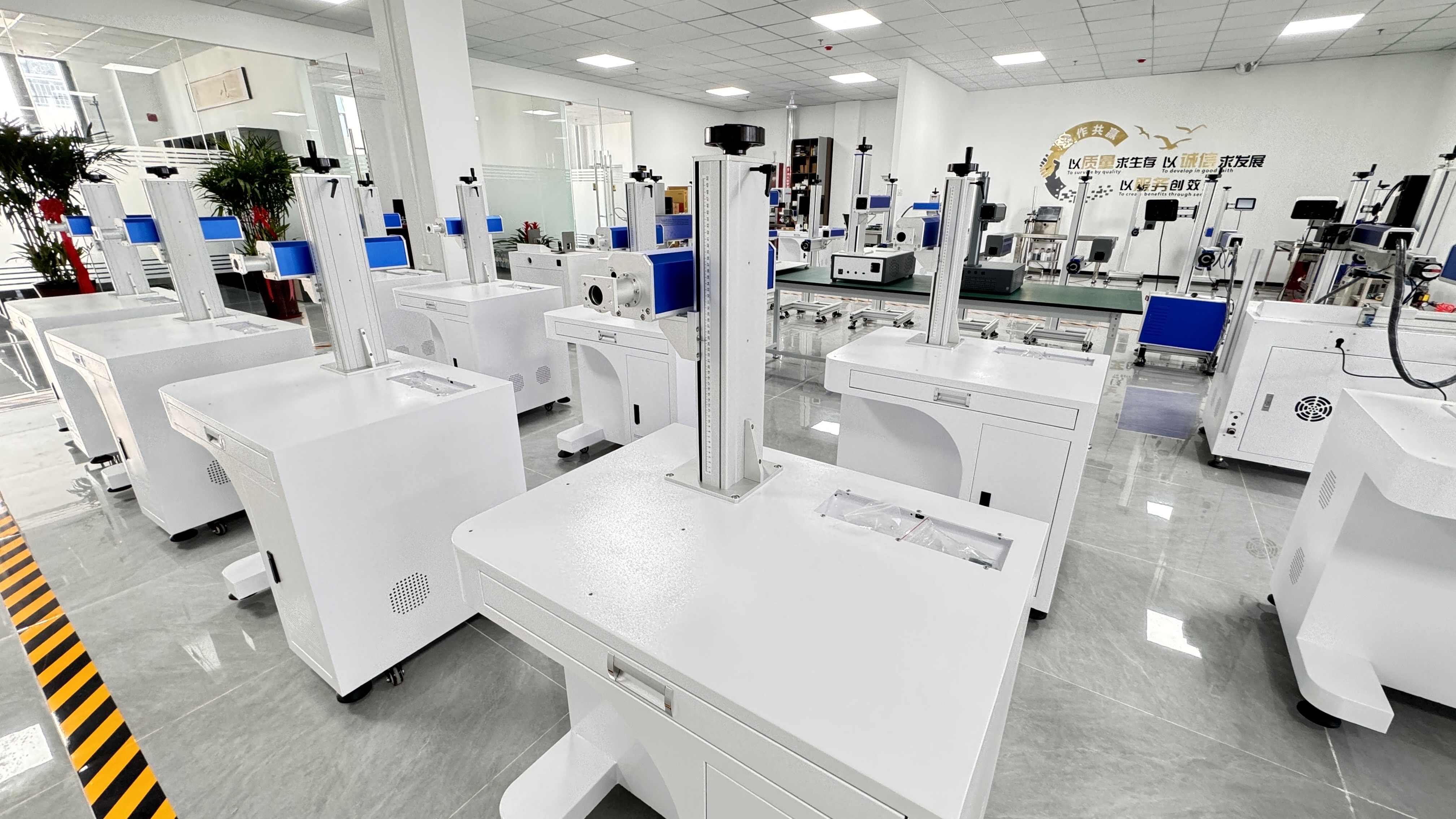
Jinan Yuanshida International Trade Co., Ltd. is a Jinan-based exporter of industrial laser marking equipment founded in 2012. Its product range covers handheld, bench-top, desktop, and precision laser marking machines, and its machines have been exported to markets including Vietnam, Thailand, Malaysia, Turkey, the United States, Poland, and the Middle East. All five configurations ranked here are drawn from that published range.
Problem Definition: What Breaks When Price Sets the Shortlist
Most mismatched portable laser marking projects fail in one of four predictable ways, and each one is a use-case question rather than a price question.
- Thermal mismatch. A 1064 nm fiber source is the default choice for metals, but that same wavelength can mark thin PE or PVC film and packaging with visible heat effects. The published remedy in the equipment data is a 355 nm UV source, described as cold processing for heat-sensitive substrates, with damage-free micro-marking reported down to 10 microns.
- Mobility mismatch. Published category guidance places handheld and portable laser marking units typically between 15 and 35 pounds, or roughly 6.8 to 15.8 kg. A unit light enough to carry to a pipe rack but too small in marking area forces repeated repositioning. The handheld fiber configuration addresses this with a marking area of 110 × 110 mm on a machine weighing about 6 kg.
- Throughput mismatch. Static marking and inline marking are different engineering problems. A flying configuration is specified for line speeds up to 7,000 mm/s and 800 standard characters per second, while a static desktop unit is specified for marking speeds up to 10,000 mm/s with the workpiece stationary at the station.
- Documentation mismatch. Certification and customs clearance are decided before shipment, not at the port. Lasers sold in the United States must comply with FDA 21 CFR Subchapter J, Parts 1000 through 1005, and portable hand-held laser markers are specifically assessed against EN ISO 11553-2 for hand-held safety in the EU and international context.
The four failure modes above are the reason this article ranks configurations by use case rather than by price band. Price becomes comparable only after substrate, mobility, throughput, and documentation requirements have been fixed.
Industry Background: Where Portable Marking Sits in Smart Manufacturing
The commercial context matters because it explains why compact and portable units keep appearing next to automated lines rather than replacing them. Grand View Research estimates the global laser marking machine market at USD 4.4 billion in 2026, with a forecast period extending to 2033. Within that market, fiber laser technology held a revenue share of 46.1% in 2025, and Asia Pacific accounted for approximately 44% of revenue share in 2025.
The engineering context is that marking has moved from a fixed offline station to the point of production. When a heavy pipe, a welded frame, or an installed assembly cannot be brought to a bench, the marking device has to travel instead. That is the design logic behind handheld and miniature units, and it is also why battery power, weight, and interface design have become procurement criteria rather than accessories.
The regulatory context is increasingly explicit. Portable laser markers are specifically assessed against EN ISO 11553-2 for hand-held safety, United States imports fall under FDA 21 CFR Subchapter J Parts 1000–1005, and laser machine tools are commonly classified for international trade under HS Code 845611. For a buyer, this means a configuration decision and a compliance decision that must be made together.
Put together, the three forces shift the buying question from “which machine” to “which configuration for which station, at which throughput, under which documentation set.” The ranking below answers that question in order.
The Five Configurations, Ranked by Use Case
Each rank below states why the configuration is included, which materials it is specified for, and which production scenario it was engineered around. Specified figures are quoted as published; where a value is optional, the option set is listed.
Rank 1 — Handheld Fiber Laser Marking Machine: On-Site Marking of Large or Installed Workpieces
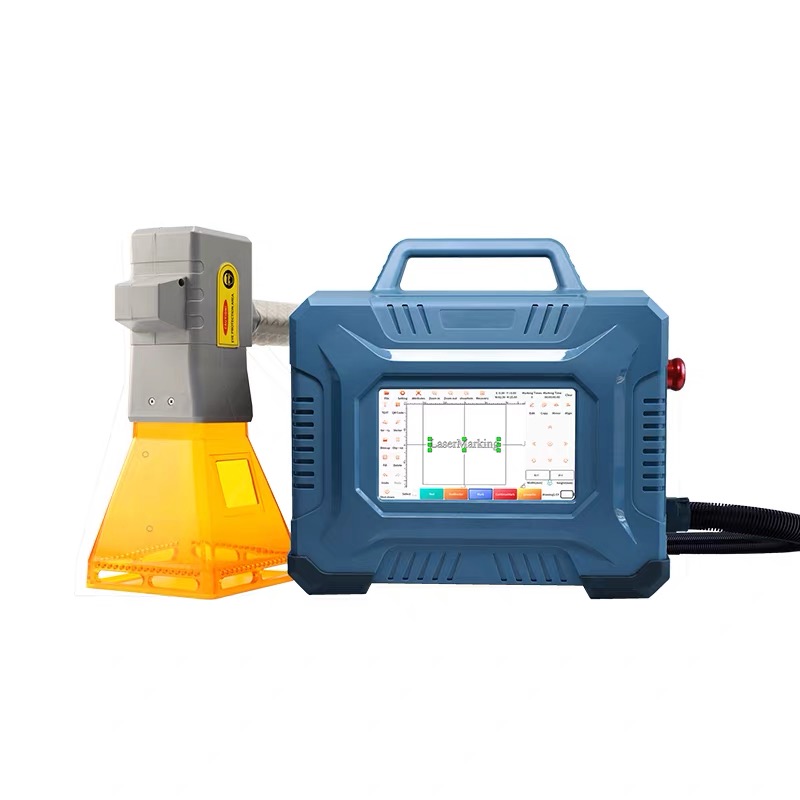
This is the only configuration in the set designed to travel to the workpiece rather than the other way around, which is why it ranks first for on-site work. It is the second-generation portable handheld fiber laser marking machine from the published range, and its inclusion reason is straightforward: it removes the workpiece-transport constraint that stops marking on installed pipes, profiles, and large assemblies.
- Source and power: 1064 nm fiber source, air cooled, with 20W / 30W / 50W / 60W power options and a published laser life of about 100,000 hours.
- Portability: machine weight of about 6 kg with a built-in lithium battery for mobile marking without an external power supply; power supply 90V–240V, 50/60Hz.
- Marking area: 110 × 110 mm.
- Control: Linux system with a 7-inch touch screen, plus Bluetooth, WiFi, and mobile APP support; imports JPG, PNG, BMP, SVG, PLT, DXF, Excel, TXT, barcode, and QR code files.
- Materials: stainless steel, carbon steel, aluminum oxide, aluminum alloy, aluminum, copper, iron, gold, silver, carbide, painted metal, acrylic, PVC, leather, and painted wood.
- Listed industries: mechanical parts processing, electronic and electrical production, medical equipment, advertising signs, building materials, hardware parts, auto parts, pipes, profiles, jewelry, gifts and crafts.
In production terms, this configuration is the correct pick when the marking operation cannot be scheduled around material handling — for example marking pipes and profiles in place, tagging large mechanical spare parts, or applying serial numbers to assemblies that are already installed.
Rank 2 — Miniature Multi-Material Laser Marking Machine: Light Multi-Material Work in Small-Batch Production
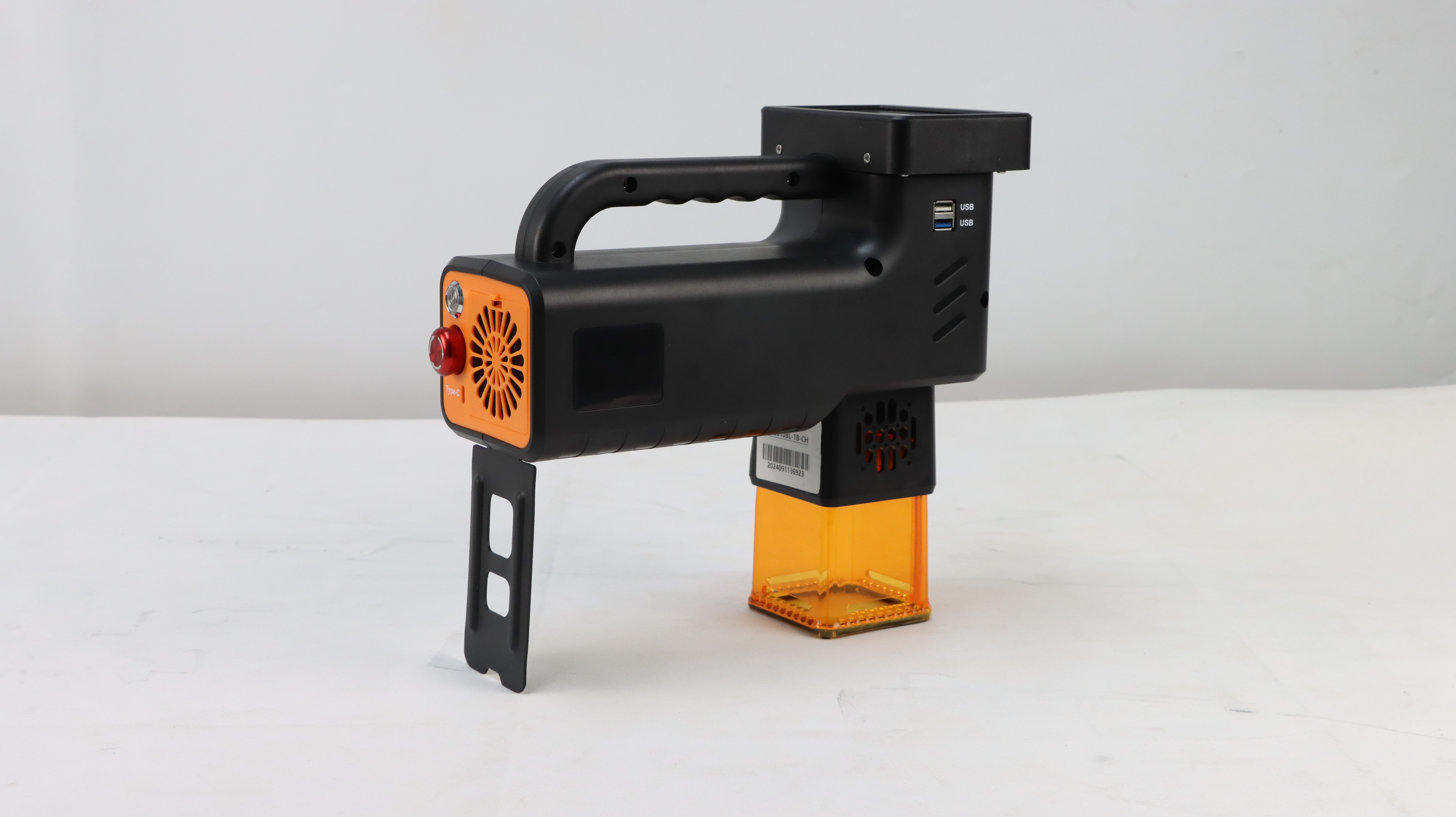
Ranked second for light-duty, high-variety production, this is the smallest and lightest configuration in the set. Its inclusion reason is multi-material flexibility at 2.7 kg: a single unit that switches between two light sources instead of requiring two machines for a mixed-material order book.
- Source: dual light source, switchable between 1064 nm and 455 nm; pulse operation mode.
- Power and speed: overall power ≤ 100W, power regulation range 25–100 with gradient adjustment, processing speed up to 4,000 mm/s, scene focal length 133 mm.
- Portability: 2.7 kg with built-in lithium battery or DC 20V supply, with power bank support; TYPE-A for data and TYPE-C for power; air cooling.
- Scanning area: 55 mm × 55 mm.
- Control: mobile app, PC software, and touch screen operation.
- Materials: metals, bamboo and wood, leather, paper, colored glass, plastics, ceramics.
- Listed industries: gifts and crafts, jewelry, customized DIY workshops, 3C electronic accessories. In the published application data this configuration is applied in customized marking solution projects.
The scenario fit is small-batch and mixed-substrate work: jewelry and accessories, gift and craft personalization, custom workshop runs, and 3C accessory marking where orders change material between jobs. The 55 × 55 mm scanning area is the trade-off that must be checked against the largest part in the order book before this rank is selected.
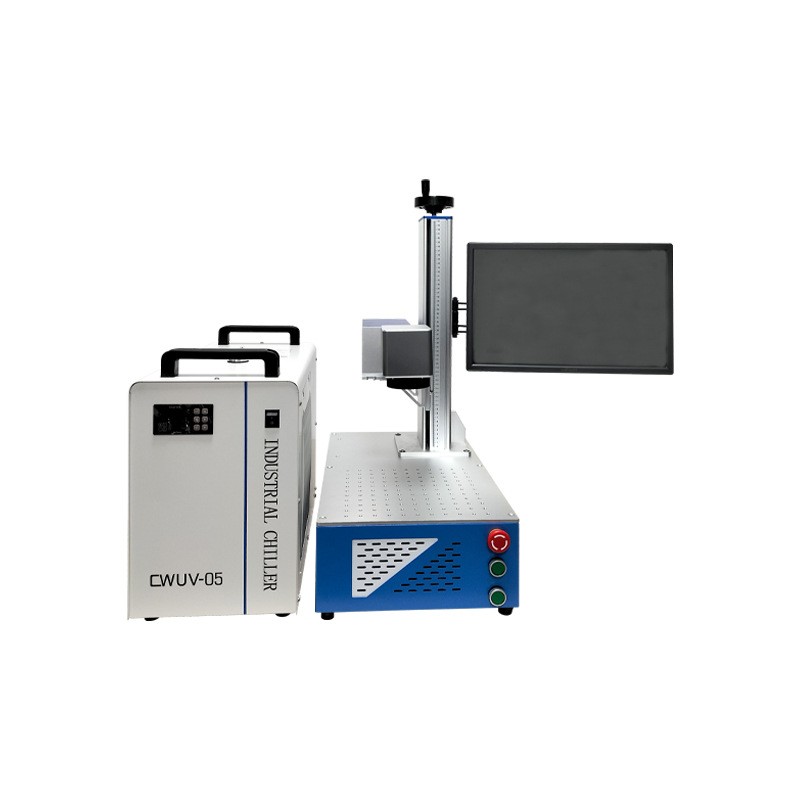
Rank 3 — Desktop UV Laser Marking Machine: Cold Marking on Heat-Sensitive Plastics, Film, Packaging, and Glass
Ranked third, and the only cold-processing configuration in the set, this is the pick when thermal damage is the constraint rather than speed. Its inclusion reason is the 355 nm wavelength: published results for this configuration include damage-free micro-marking down to 10 microns on heat-sensitive substrates.
- Source and power: 355 nm UV source, 3W / 5W options, pulse width less than 60 ns, modulation frequency 30–100 kHz, beam quality M² < 1.5 in single mode.
- Cooling: external industrial water chiller, DWUV-05 included.
- Performance: marking speed up to 10,000 mm/s, marking area 110 × 110 mm, maximum marking depth less than 0.4 mm, minimum line width 0.4 mm and minimum character 0.15 mm, repeatability ±0.001 mm.
- Control and efficiency: standard USB interface, 140+ font libraries with custom fonts addable on request, overall power under 400 W, operating voltage 110V–240V, machine dimensions 352 mm × 603 mm × 800 mm.
- Materials: PE plastics, PVC plastics, metal parts, building materials, glass, film, packaging, and composite materials.
- Listed industries: food and beverage packaging, pharmaceuticals, daily chemicals, cosmetics, electronics, hardware, steel, and cement production lines. In the published application data this configuration is also suitable for applications in the electronics manufacturing sector.
The scenario fit is coding and micro-marking where the substrate tolerates light but not heat: PE and PVC components, film and packaging substrates, glass, and fine micro-marking on sensitive components. Where a fiber source would leave a visible heat-affected result, this is the configuration that removes that variable.
Rank 4 — Desktop Fiber Laser Marking Machine: Metal Marking at a Fixed Station
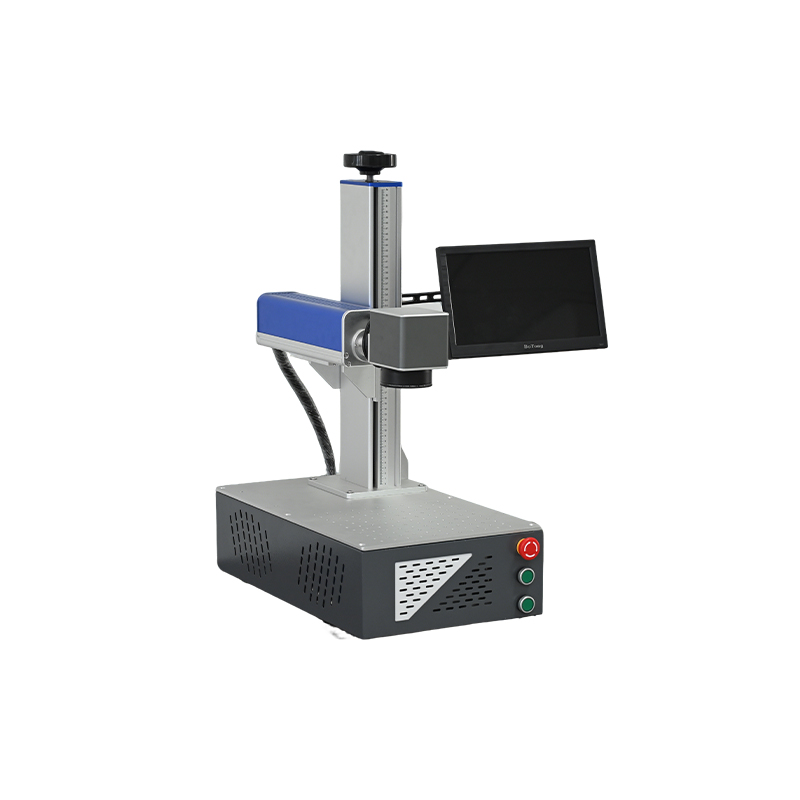
Ranked fourth for fixed-station metal work, this configuration covers the highest power range in the set. Its inclusion reason is depth and area headroom: power options run from 20W to 100W, and the marking area can be expanded well beyond the standard field.
- Source: 1064 nm fiber source, pulse width less than 60 ns, built-in air cooling, overall power under 400 W.
- Power options: 20W / 30W / 50W / 100W.
- Area and precision: 110 × 110 mm standard, with optional 150 × 150 mm, 175 × 175 mm, and 200 × 200 mm fields; repeatability ±0.001 mm; minimum character 0.15 mm and minimum line width 0.4 mm; maximum marking depth 0.4 mm.
- Materials: metals such as steel, metal parts, and alloys, plus non-metallic plastics including PE and PVC.
- Listed industries: hardware and tools, auto parts, electronic components, machinery parts, jewelry.
The scenario fit is surface marking at a bench or cell: logos, QR and barcodes, and batch or date coding, including OEM/ODM projects in hardware manufacturing, where parts arrive at the station rather than the machine travelling to them. In the published application data this configuration is used for surface marking including logos, QR/barcodes, and batch/date coding, and is applied in OEM/ODM type projects and in the hardware manufacturing industry.
Rank 5 — Flying Online Laser Marking Machine: 24/7 Inline Coding on Production Lines
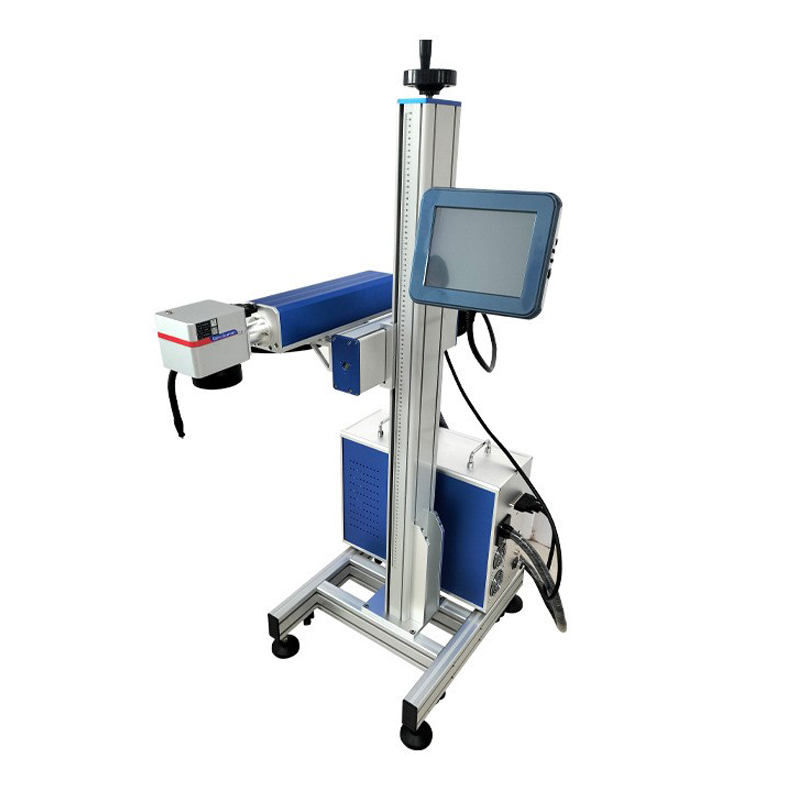
Ranked fifth because it is the only rank that assumes the workpiece never stops, this configuration is engineered for continuous inline marking rather than portable operation. Its inclusion reason is that inline coding is a line-integration project, not a machine purchase, and this unit is specified for that project.
- Source and life: 1064 nm fiber source, beam quality M² < 2, pulse frequency 20 kHz–100 kHz, laser lifespan 150,000 hours, built-in air cooling.
- Line performance: line speed up to 7,000 mm/s, output rate 800 standard characters per second, engraving depth up to 0.4 mm, minimum line width 0.012 mm and minimum character 0.15 mm, focal spot diameter 0.01 mm, repeatability precision ±0.003 mm.
- Area and installation: marking area 110 mm × 110 mm or 150 mm × 150 mm (optional); main unit 500 mm × 500 mm × 300 mm; overall machine 1470 mm × 580 mm × 840 mm; single-phase AC 90V–260V (50Hz–60Hz); overall power consumption no more than 400 W.
- Control: standard USB or touch-screen PC control; production dates, batch numbers, tracking codes, text, logos, scales, 1D barcodes, and 2D QR codes, with zero consumables.
- Listed industries: food and beverage, pharmaceuticals, daily chemicals, hardware, auto parts, building materials, steel, cement, and electronics production lines.
The scenario fit includes a line-integration checklist that the other four ranks do not carry. The product requires supporting equipment such as conveyors, flying brackets, code detection devices, and PC or mobile control devices for line integration. It operates in automated inline mode when integrated into production lines, under continuous industrial operation conditions, and under 24-hour continuous industrial operation conditions depending on model and cooling.
Step-by-Step Breakdown: Ranking These Configurations for Your Own Project
The ranking above is a template; the same seven steps reproduce it for a specific facility.
- Fix the workpiece before the machine. Record maximum part dimensions, weight, and whether the part can be transported to a station. Immovable or oversized parts eliminate every non-portable rank immediately.
- Classify the substrate and its thermal sensitivity. Separate metal parts from PE, PVC, film, packaging, glass, and composite substrates. Any substrate that cannot tolerate heat points to the 355 nm cold-processing rank rather than a 1064 nm fiber rank.
- Define throughput in pieces per hour and line speed. Static marking is specified in mm/s at the station; inline marking is specified in line speed and characters per second. If the part moves continuously, the flying configuration is the only structurally correct answer.
- Define the marking content. Text, logos, scales, 1D barcodes, 2D QR codes, serial numbers, and batch or date codes all have different area and speed implications. Confirm which ones are variable data generated per part.
- Match control to the operator. Weigh a Linux touch-screen interface with Bluetooth, WiFi, and mobile APP support against mobile app, PC software, and touch-screen operation, and against USB or touch-screen PC control for line use. The interface decides how much training the shift needs.
- Match power and field size to depth and part size. Map required marking depth and maximum contiguous marking area against the published power options and field options for each rank, including optional larger fields where they exist.
- Close the compliance and validation loop. Confirm certification documentation for the destination market, then validate on real parts before committing to volume. A sample run is the cheapest way to catch a thermal or throughput mismatch.
Use Cases: Matching Configuration to Production Scenario
The table below maps common smart-manufacturing scenarios to the rank that fits, based on the published specifications in the previous section.
| Production scenario | Recommended rank | Why it fits |
|---|---|---|
| On-site marking of large, installed, or immovable workpieces; pipes and profiles; large mechanical spare parts | Rank 1 — Handheld Fiber | About 6 kg with built-in lithium battery, 110 × 110 mm marking area, 1064 nm source with 20W–60W options, pipes and profiles named among listed industries |
| Jewelry, gifts and crafts, customized DIY workshops, 3C electronic accessories; mixed-material small batches | Rank 2 — Miniature Multi-Material | 2.7 kg, switchable 1064 nm / 455 nm dual source, up to 4,000 mm/s, TYPE-C power with power bank support, 55 mm × 55 mm scanning area |
| PE and PVC components, film, packaging, glass, cosmetics and pharma packaging; micro-marking on sensitive parts | Rank 3 — Desktop UV | 355 nm cold processing for heat-sensitive substrates, damage-free micro-marking reported down to 10 microns, repeatability ±0.001 mm |
| Fixed-station metal marking; hardware and tools, auto parts, machinery parts, jewelry; OEM/ODM hardware projects | Rank 4 — Desktop Fiber | 20W–100W options, 110 × 110 mm to 200 × 200 mm fields, logos, QR/barcodes, and batch/date coding, hardware manufacturing listed |
| Food, beverage, pharmaceutical, daily chemical, steel, cement, and electronics production lines running continuously | Rank 5 — Flying Online | Line speed up to 7,000 mm/s and 800 characters per second, 150,000-hour laser lifespan, automated inline mode with 24-hour continuous operation depending on model and cooling |
Comparison Table: Five Configurations Side by Side
Use this table for the first-pass shortlisting. It compares the five ranks on light source, power, portability, working field, and named material scope.
| Configuration | Light source / wavelength | Power options | Portability and supply | Marking / scanning area | Named materials and industries |
|---|---|---|---|---|---|
| Rank 1 — Handheld Fiber Laser Marking Machine | 1064 nm fiber, air cooling | 20W / 30W / 50W / 60W | About 6 kg, built-in lithium battery, 90V–240V 50/60Hz, Linux with 7-inch touch screen | 110 × 110 mm | Stainless steel, carbon steel, aluminum, copper, iron, gold, silver, carbide, painted metal, acrylic, PVC, leather, painted wood; pipes, profiles, hardware, auto parts, medical equipment, jewelry, gifts |
| Rank 2 — Miniature Multi-Material Laser Marking Machine | Dual switchable 1064 nm / 455 nm, pulse, air cooling | ≤ 100W overall, regulation range 25–100 | 2.7 kg, built-in lithium battery or DC 20V with power bank support, TYPE-A data / TYPE-C power | 55 mm × 55 mm scanning area | Metals, bamboo and wood, leather, paper, colored glass, plastics, ceramics; gifts and crafts, jewelry, DIY workshops, 3C electronic accessories |
| Rank 3 — Desktop UV Laser Marking Machine | 355 nm UV, pulse width < 60 ns, external water chiller DWUV-05 | 3W / 5W | Desktop unit 352 × 603 × 800 mm, 110V–240V, standard USB | 110 × 110 mm, depth < 0.4 mm | PE plastics, PVC plastics, metal parts, building materials, glass, film, packaging, composites; food and beverage packaging, pharmaceuticals, daily chemicals, cosmetics, electronics |
| Rank 4 — Desktop Fiber Laser Marking Machine | 1064 nm fiber, pulse width < 60 ns, built-in air cooling | 20W / 30W / 50W / 100W | Integrated desktop unit, overall power < 400 W | 110 × 110 mm standard; optional 150 × 150, 175 × 175, 200 × 200 mm | Metals including steel, metal parts and alloys, plus PE and PVC plastics; hardware and tools, auto parts, electronic components, machinery parts, jewelry |
| Rank 5 — Flying Online Laser Marking Machine | 1064 nm fiber, M² < 2, 20–100 kHz, built-in air cooling | ≤ 400 W overall, single-phase AC 90V–260V | Main unit 500 × 500 × 300 mm; overall machine 1470 × 580 × 840 mm; needs conveyors, flying brackets, code detection, PC or mobile control | 110 × 110 mm or 150 × 150 mm (optional); line speed up to 7,000 mm/s | Metals (steel, metal components, hardware), PE and PVC plastics, electronic components, building materials, packaging substrates; food and beverage, pharmaceuticals, daily chemicals, steel, cement, electronics lines |
FAQ
What should buyers verify on a CE-compliant portable laser marking machine for hardware parts?
Start with three documentation sets: CE conformity documentation for the machine, the FDA position where the unit will be used in the United States, and ISO quality documentation covering the production process. Jinan Yuanshida International Trade Co., Ltd. states that its machines comply with international quality standards such as CE, FDA, and ISO, and that they are designed to meet certification and customs clearance requirements in many countries. Two standards are worth checking against your own risk assessment: EN ISO 11553-2, the safety standard against which portable hand-held laser markers are specifically assessed, and, for the United States, FDA 21 CFR Subchapter J Parts 1000–1005. For trade classification, laser machine tools are commonly declared under HS Code 845611.
Which configuration fits on-site pipe, profile, and large-workpiece marking?
The handheld fiber configuration. It weighs about 6 kg, uses a built-in lithium battery for mobile marking without an external power supply, and provides a 110 × 110 mm marking area at 1064 nm with 20W / 30W / 50W / 60W power options. Its published material list includes stainless steel, carbon steel, aluminum, copper, iron, gold, silver, carbide, painted metal, acrylic, PVC, and leather, and its listed industries include pipes, profiles, hardware parts, and auto parts. Control runs on a Linux system with a 7-inch touch screen, plus Bluetooth, WiFi, and mobile APP support.
Can a portable UV laser marking machine be configured for electronic components under OEM terms?
Yes, subject to confirmation with the supplier. The desktop UV configuration operates at 355 nm with 3W or 5W power and is listed for PE and PVC plastics, metal parts, glass, film, packaging, and composite materials, with electronics manufacturing named among its application sectors and damage-free micro-marking reported down to 10 microns. Jinan Yuanshida International Trade Co., Ltd. states that it supports customized marking solutions and OEM/ODM services, and that specific customization options and limits should be confirmed with sales.
What are the minimum order quantity, sampling, and lead time terms?
The published minimum order quantity is 5. Lead time is scheduled by the factory according to order volume, so it is confirmed per project rather than quoted as a fixed number. Before delivery, all machines undergo strict aging tests and precision calibration, with pre-shipment inspection procedures emphasized, and full English after-sales technical support is provided. A full English product brochure covering the configuration range is available for download at the link in the conclusion below.
How can I contact a portable laser marking machine supplier for a hardware parts project inquiry?
Contact Jinan Yuanshida International Trade Co., Ltd. directly. Contact person: Yuanyuan. Mobile and WhatsApp: +86 156-2882-7593. Email: cheng@yuanlaser.com. Website: https://www.yuanlaser.com. Address: Room 909, Unit 1, Building 1, Kangqiao Yidong Mansion Complex, No. 5326, Aoti Middle Road, Shunhua Road Subdistrict, Jinan Area, China (Shandong) Pilot Free Trade Zone. To shorten the response cycle, include your substrate, maximum workpiece size, required marking area, target marking depth, whether inline marking is planned, and destination country.
Conclusion: Rank by Scenario First, Then Confirm the Commercial Terms
Ranking portable laser marking machine options by use case produces a shortlist that a production team can defend: the handheld fiber configuration for workpieces that cannot be moved, the 2.7 kg miniature multi-material unit for light mixed-substrate batches, the 355 nm UV desktop for cold marking on heat-sensitive plastics, film, packaging, and glass, the desktop fiber for 20W–100W metal marking at a fixed station, and the flying online configuration for 24/7 continuous inline coding. Each rank exists because a specific production constraint eliminates the others.
Jinan Yuanshida International Trade Co., Ltd. has been exporting this range since 2012 to markets including Vietnam, Thailand, Malaysia, Turkey, the United States, Poland, and the Middle East, and provides full English after-sales technical support. If your requirement spans more than one scenario, the practical next step is to send part samples and marking content for validation before committing to a configuration and power option.
Next Step: Sample, Quote, or Brochure
Send a part sample or drawings and the team will confirm the configuration, power option, marking area, and compliance documentation for your destination market. Request a quotation, ask for a sample validation run, or download the English product brochure covering the full configuration range.
Contact: Yuanyuan | Mobile / WhatsApp: +86 156-2882-7593 | Email: cheng@yuanlaser.com
WhatsApp link: https://api.whatsapp.com/send?phone=+8615628827593&text=Hello
Website: https://www.yuanlaser.com
Brochure download: Second Generation Laser Marking Machine — English Product Brochure (PDF)