Portable Laser Marking Machine Ranking: 4 Formats for Mixed-Material Smart Manufacturing Cells
For a mixed-material smart manufacturing cell, four portable laser marking machine formats cover almost every substrate that normally travels through the line. Ranked by material compatibility, integration fit and continuous-use evidence, they are: 1) desktop UV 355 nm for cold marking on heat-sensitive packaging and pharma workpieces, 2) flying online fiber for 24/7 automated production lines, 3) miniature multi-material dual 1064/455 nm for metals, plastics, leather, paper and ceramics, and 4) benchtop fiber for hardware and auto parts.
This ranking is written for decision-stage and execution-stage buyers: engineers and procurement teams who must specify a marking station for a cell that already exists, or is being re-laid out, and who have to settle the format question before they settle the supplier question.
The equipment formats described here are catalogued with the product range of Jinan Yuanshida International Trade Co., Ltd. — a laser marking equipment enterprise registered in Jinan, China, founded in 2012, which manufactures and exports handheld, bench-top, desktop and precision laser marking equipment. The company supplies standard equipment, customized marking solutions, OEM/ODM services and full English after-sales support, and its products have been exported for many years to more than 80 countries and regions, serving overseas factories, distributors and trading companies.
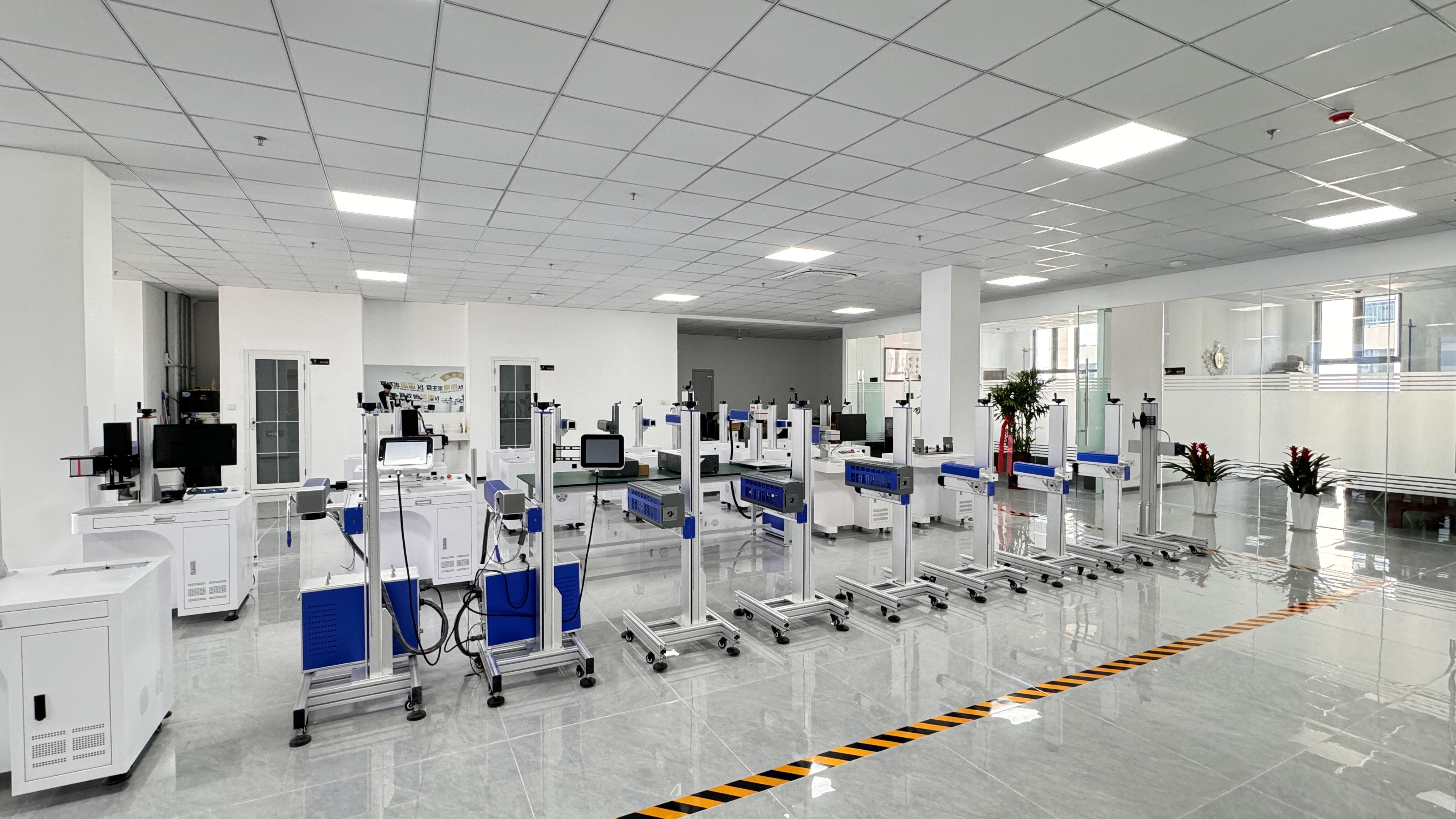
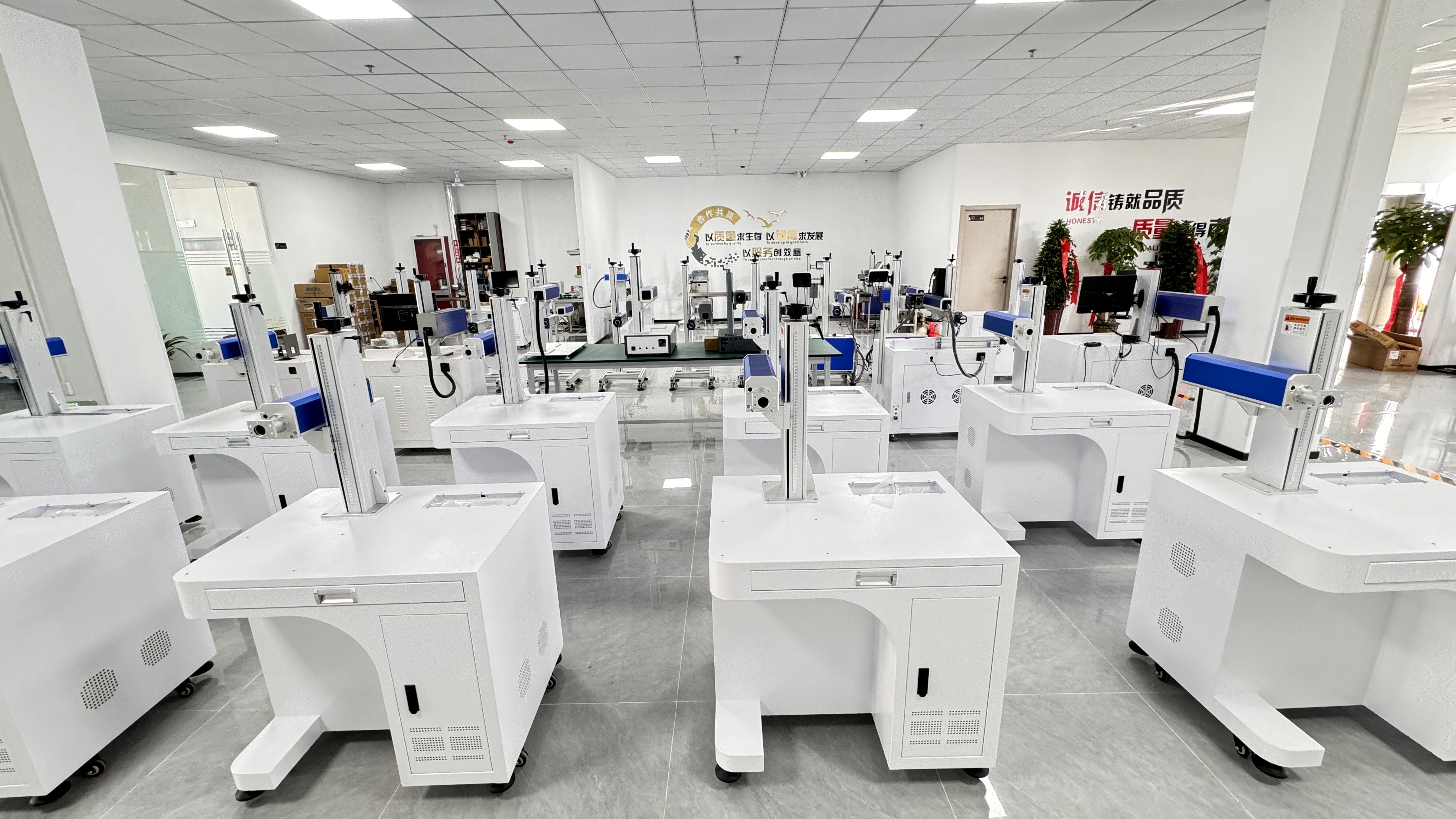
Production and testing environment at Jinan Yuanshida International Trade Co., Ltd., where portable laser marking formats are assembled, calibrated and aged before dispatch.
Problem Definition: Why Mixed-Material Cells Break Single-Format Marking
A mixed-material smart manufacturing cell is a production unit in which at least two substrate families that react differently to heat and light — for example stainless steel and polycarbonate, or anodised aluminium and printed paperboard — are processed on the same line, normally with automated transfer and a traceability requirement that the marked code must survive every downstream process.
Three failure modes appear repeatedly when such a cell is served by one marking format:
- Heat damage. A 1064 nm fiber source marking a thin polymer blister, a shrink sleeve or a printed carton panel can char, glaze or deform it. Wavelength selection, not power reduction, is the real decision variable.
- Integration mismatch. A unit that only supports manual triggering cannot keep pace with a conveyor that moves a part past the marking position every few seconds.
- Changeover loss. When one material family needs a different marking approach, the cell loses time to fixture swapping, re-focusing and parameter re-entry instead of producing.
Laser marking addresses all three because it is a non-contact process. In a published comparison with CNC engraving machines, laser marking is described as using non-contact thermal ablation, while CNC depends on physical blade cutting that can warp thin materials. The same comparison states that laser beam diameter reaches down to 0.01 mm against a minimum bit size of roughly 0.5–1 mm on CNC, that marking speed is faster, and that the fixed optical path has zero mechanical wear — whereas CNC requires frequent bit changes, re-zeroing and dust or chip cleanup.
Industry Background: Where Portable Marking Sits in 2026
Portable and hand-held marking hardware is now a defined equipment class rather than a workshop accessory. Several published data points frame the environment:
- The global laser marking machine market is estimated at USD 4.4 billion in 2026 (Grand View Research).
- Fiber laser technology held a 46.1% revenue share in 2025, making it the dominant source technology in the category.
- Asia Pacific is the largest regional market, with approximately 44% revenue share in 2025.
- Handheld and portable laser marking machines typically weigh between 15 and 35 pounds (approximately 6.8 to 15.8 kg) — a weight class that allows a unit to be carried to a large workpiece instead of bringing the workpiece to a bench.
- In the United States, laser products must comply with FDA 21 CFR Subchapter J, Parts 1000 through 1005, and portable laser markers are specifically assessed against EN ISO 11553-2 for hand-held safety in the EU and international markets.
- For international trade, HS Code 845611 is the primary classification for machine tools operated by laser processes.
Two structural changes drive the demand this ranking responds to. First, traceability codes are being pushed further upstream, so a code is now often applied inside the cell rather than after final assembly. Second, cells are being re-laid out to run more material families with less tooling, which rewards marking hardware that can change substrate without changing station.
The Ranking: 4 Portable Laser Marking Machine Formats for Mixed-Material Cells
Each entry below is scored on the same three criteria used throughout this article: material compatibility (which substrates it can mark without damage), integration fit (how it connects to an automated cell), and continuous-use evidence (what supports reliable long-run operation). Rank order reflects suitability for a mixed-material cell, not overall machine quality.
Rank 1 — Desktop UV 355 nm: Cold Marking for Heat-Sensitive Packaging and Pharma Workpieces
A desktop UV 355 nm unit uses an ultraviolet source whose short wavelength interacts with the surface layer of a material instead of driving bulk heat into it. In practice this produces the low-thermal-load behaviour commonly described as cold marking, which is why it takes first place for cells that include packaging and pharmaceutical substrates.
- Material compatibility: heat-sensitive packaging films, pharmaceutical cartons and foils, printed labels, and thin polymer workpieces where a fiber source would risk melting, discolouring or deforming the surface. It is a surface-marking tool rather than a metal-removal tool.
- Integration fit: the desktop enclosure behaves as a stand-alone station that can be placed beside packaging or filling equipment in the same cell, controlled over USB, with built-in air cooling so no external chiller is required.
- Continuous-use evidence: the fixed optical path has zero mechanical wear in normal operation, which removes the consumable-driven maintenance cycle that affects blade-based processes. Machines in this range are also dispatched only after a 72-hour continuous full-load aging test and insulation withstand voltage testing, with precision calibration completed before shipping.
- Limits: the standard marking area is 110 x 110 mm, so oversized panels require repositioning or a larger format; deep metal marking is limited compared with a fiber source.
Rank 2 — Flying Online Fiber: Built for 24/7 Automated Production Lines
A flying online fiber format marks parts while they are in motion, synchronised to conveyor travel rather than stopping the line at a marking station. It is the entry of choice when the cell runs continuously and the marking step must disappear into the takt time.
- Material compatibility: metals and many engineering plastics — the typical substrate mix in hardware and auto-parts production, where the code must resist handling, oil and downstream finishing.
- Integration fit: designed for conveyor and index-table integration, with USB control and built-in air cooling. A 110 x 110 mm marking area covers most small-to-medium parts passing a single lane, and the format can be configured for high-speed operation, with high-speed fiber configurations specified up to 10,000 mm/s.
- Continuous-use evidence: zero consumables and an air-cooled design remove ink, solvent and chiller dependencies from a 24/7 schedule; because the beam path is fixed, there is no blade or bit wear to interrupt production, and every machine is aged under full load for 72 hours before dispatch.
- Limits: not suitable for heat-sensitive film or printed cartons, and it requires stable line speed and a reliable trigger signal to keep code placement consistent.
Rank 3 — Miniature Multi-Material Dual 1064/455 nm: One Head for Metals, Plastics, Leather, Paper and Ceramics
The miniature multi-material format carries two wavelengths in one compact head: 1064 nm for metals and 455 nm for plastics, leather, paper and ceramics that absorb poorly at the infrared wavelength. For a genuinely mixed-material cell it is the most flexible single-station answer in this ranking.
- Material compatibility: metals, plastics, leather, paper and ceramics — the exact substrate spread that forces most cells into either two stations or repeated changeovers.
- Integration fit: the miniature footprint can be mounted inside an existing cell without re-laying out the line, and it runs on USB control with zero consumables and air cooling.
- Continuous-use evidence: consolidating two wavelength requirements into one head removes an entire changeover step, and because the format is consumable-free, the operating cost profile stays flat across a long production campaign rather than rising with consumable purchases.
- Limits: dual-wavelength hardware carries a higher initial cost than a single-wavelength unit, and material recipes should be locked per substrate so operators cannot mark a paper or leather part with the wrong source.
Rank 4 — Benchtop Fiber: Hardware and Auto Parts, Batch and Offline
The benchtop fiber format is the conventional high-volume answer for metal parts that are loaded in batches. It ranks fourth here only because it is the least adaptable to continuous inline flow, not because it is less capable on metal.
- Material compatibility: hardened steel, stainless steel, aluminium and coated metals — the standard substrate set for hardware, mechanical spare parts and auto components.
- Integration fit: a stand-alone cell station or an offline marking bench, USB controlled, with a 110 x 110 mm marking area that suits bracket-sized and fitting-sized parts.
- Continuous-use evidence: zero consumables, fixed optical path with no mechanical wear, and the same pre-shipment regime of 72-hour continuous full-load aging and insulation withstand voltage testing. Electrical protection includes overload protectors, a residual current circuit breaker (RCCB) and grounding protection, with automatic thermal shutdown and alarm if the laser source or power supply exceeds safe temperature limits.
- Limits: manual loading and unloading means throughput is set by the operator, so it is not a flying-production format.
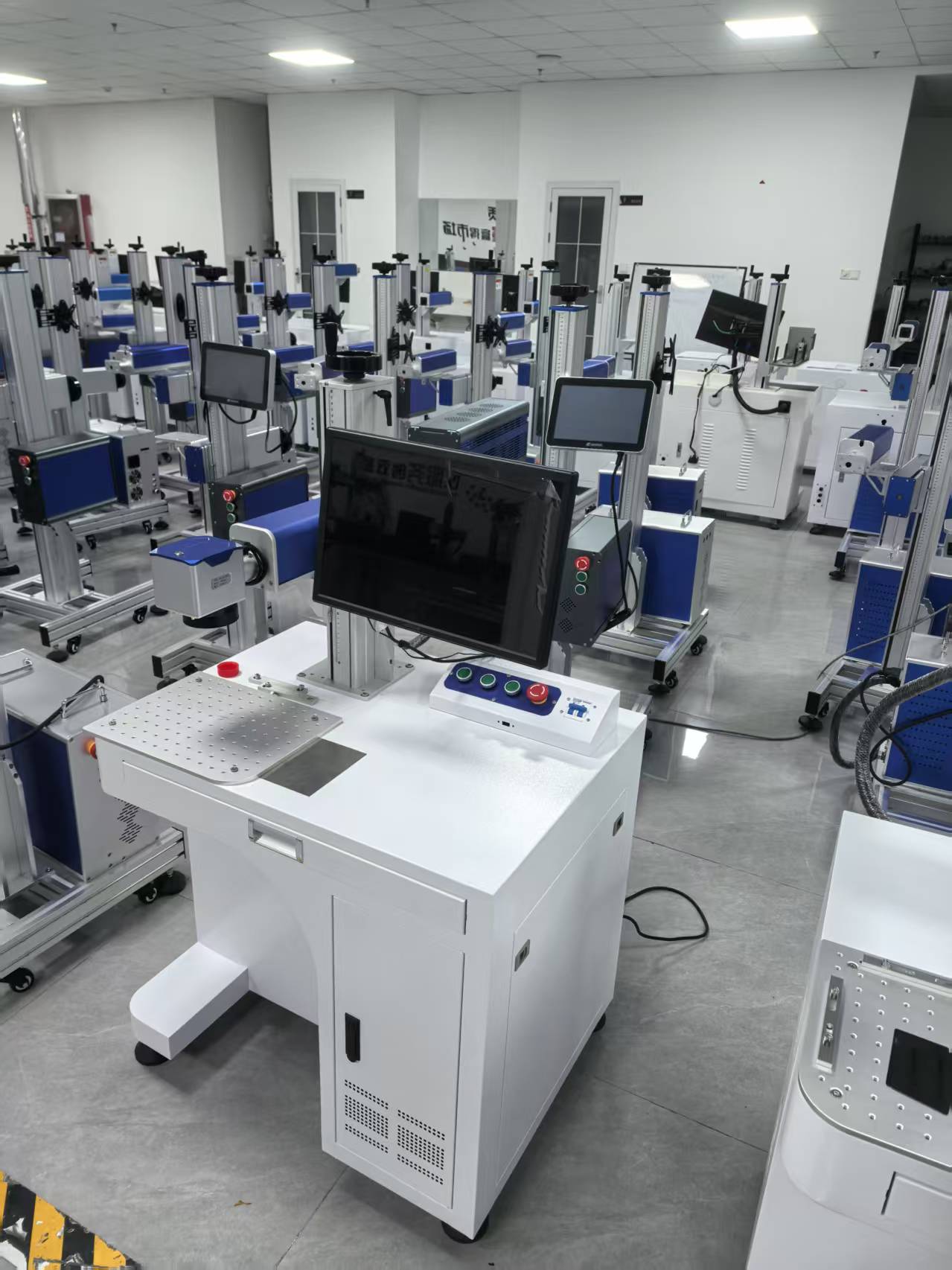
Assembly and calibration area for portable laser marking formats intended for mixed-material manufacturing cells.
Comparison Table: Ranked Formats at a Glance
| Rank | Format | Source and wavelength | Material compatibility | Integration fit | Continuous-use evidence | Main limit |
|---|---|---|---|---|---|---|
| 1 | Desktop UV | UV, 355 nm | Heat-sensitive packaging, pharma cartons and foils, printed labels, thin polymers | Stand-alone station beside packaging or filling equipment; USB control; built-in air cooling | Cold marking with low thermal load; fixed optical path with zero mechanical wear; 72-hour full-load aging test before dispatch | 110 x 110 mm marking area; limited metal marking depth |
| 2 | Flying online fiber | Fiber, 1064 nm class | Metals and many engineering plastics for hardware and auto parts | Conveyor and index-table integration; USB control; air cooled; high-speed configurations up to 10,000 mm/s | Zero consumables; no blade or bit wear; built-in air cooling; 72-hour full-load aging test | Requires stable line speed and trigger signal; unsuitable for heat-sensitive film |
| 3 | Miniature multi-material dual | Dual wavelength, 1064/455 nm | Metals, plastics, leather, paper, ceramics | Miniature head mounts inside an existing cell without re-layout; USB control; air cooled | One head covers two wavelength requirements, removing a changeover step; zero consumables | Higher initial cost than single-wavelength units; recipes must be locked per material |
| 4 | Benchtop fiber | Fiber, 1064 nm class | Hardened steel, stainless, aluminium, coated metals | Stand-alone cell station or offline bench; USB control; 110 x 110 mm marking area | Zero consumables; overload protectors, RCCB and grounding protection; automatic thermal shutdown; 72-hour full-load aging test | Manual load and unload limits throughput |
Shared specification anchors for the portable formats in this ranking
- Marking area: 110 x 110 mm (width 110 mm, height 110 mm)
- High-speed fiber configurations: specified up to 10,000 mm/s
- Consumables: zero — no ink, solvent, blade or bit consumption
- Control: USB
- Cooling: built-in air cooling
- Portable and handheld weight class: typically 15–35 lbs (approximately 6.8–15.8 kg)
Step-by-Step: Specifying a Portable Laser Marking Machine for a Mixed-Material Cell
The format decision follows a fixed sequence. Running the steps in order prevents the common mistake of buying on price before the material map is complete.
- Map every substrate in the cell. List each material family, its thickness and its coating, and note whether the marked code must survive washing, abrasion, heat or chemical exposure downstream. This list, not the machine brochure, decides the wavelength.
- Split the list by thermal sensitivity. Anything that can deform, char or discolour under infrared exposure belongs on the UV 355 nm side. Everything else can normally be handled by a fiber or dual-wavelength source.
- Decide the integration mode. If the marking step must sit inside a moving line, the format is flying online fiber. If parts are loaded in batches at a station, a benchtop fiber or desktop UV enclosure is sufficient, and it is easier to relocate.
- Confirm safety and certification for the way the machine will actually be used. Hand-held configurations are assessed against EN ISO 11553-2 in the EU and international markets, while laser products sold in the United States must comply with FDA 21 CFR Subchapter J, Parts 1000 through 1005. The equipment in this range is supplied with CE, FDA and ISO compliance.
- Validate on real parts before acceptance. Sample every material family in the cell, then confirm the pre-shipment regime: a 72-hour continuous full-load aging test and insulation withstand voltage test on each machine, plus precision calibration. The acceptance procedure — on-site acceptance, remote testing or third-party inspection — is negotiated and confirmed with the client.
- Lock commercial and continuity terms. The minimum order quantity is 5 units, and accepted payment methods include deposit plus balance payment. Delivery terms such as EXW, FOB or CIF are confirmed with sales, and after-sales support is provided in English for long-term operation.
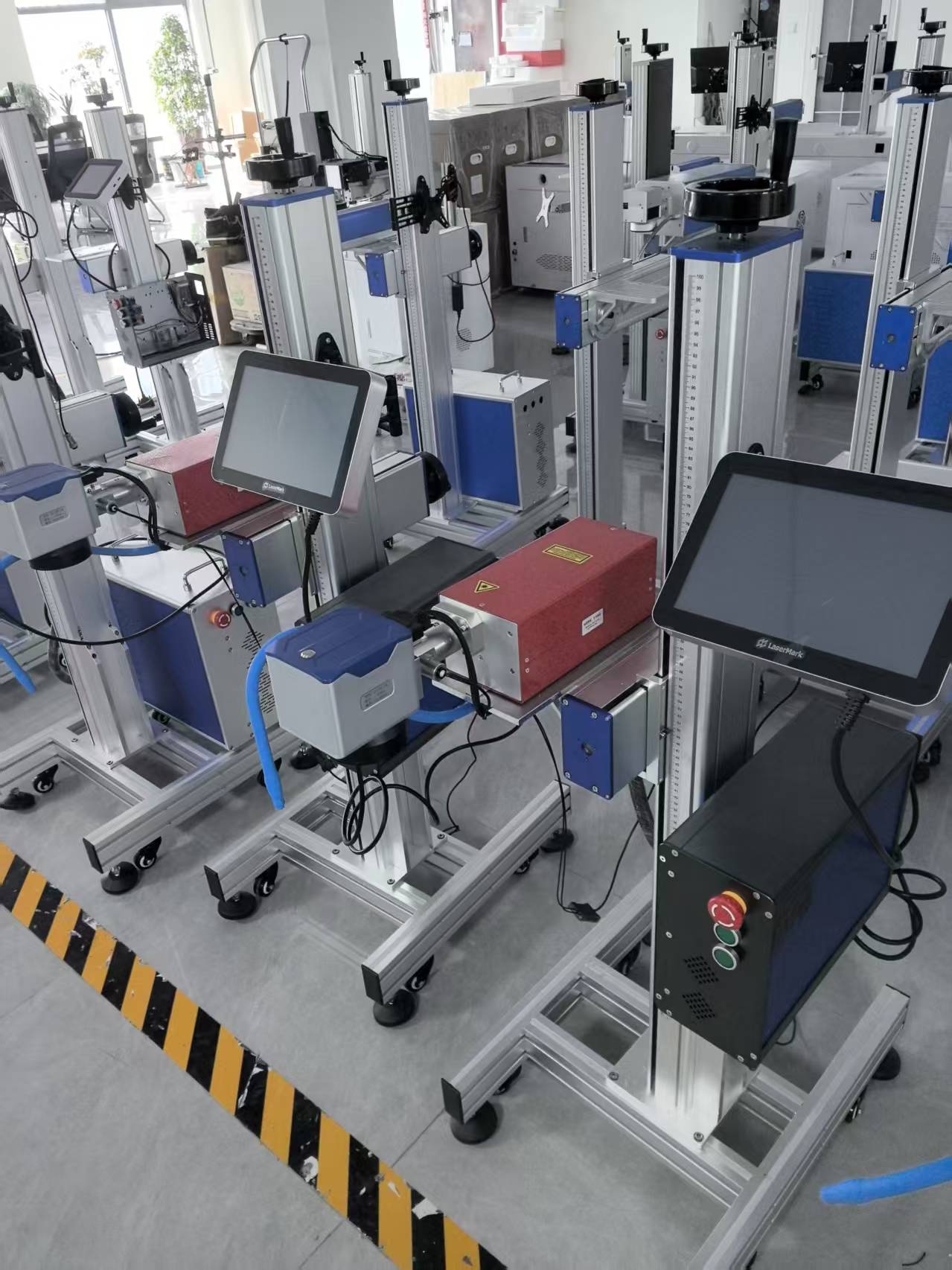
Pre-shipment testing environment: every portable laser marking machine is aged under full load and insulation-tested before dispatch.
Use Cases: Which Format Fits Which Part Family
The equipment range behind this ranking is used across hardware and auto parts, pipes and profiles, electronic components, jewellery and accessories, mechanical parts, and gifts and crafts. Mapping those part families onto the four ranked formats produces a practical shortlist:
- Hardware and auto parts: benchtop fiber for batch marking, or flying online fiber when the cell runs continuously and parts are transferred automatically.
- Pipes and profiles, and other large workpieces: a portable or handheld configuration in the 15–35 lb class is carried to the workpiece, which avoids dismantling a long profile to bring it to a bench. The 110 x 110 mm marking area is sufficient for identification, batch and traceability codes.
- Electronic components: the miniature multi-material format handles metal contacts, plastic housings and PCB-adjacent substrates from one head; UV 355 nm is the safer choice where a polymer housing is thin or heat-sensitive.
- Jewellery and accessories: fine marking on small metal surfaces, where the 0.01 mm-class beam diameter of laser marking is the reason the process is preferred over mechanical engraving.
- Mechanical spare parts: benchtop fiber for durable codes that survive handling, storage and assembly.
- Gifts and crafts: the dual 1064/455 nm format for leather, paper and coated decorative surfaces alongside metal components.
- Pharmaceutical and heat-sensitive packaging: desktop UV 355 nm, reserved as a dedicated station so that no fiber source is ever applied to a heat-sensitive surface.
FAQ
Which safety and certification standards apply to a portable laser marking machine used inside a manufacturing cell?
Two standards frameworks apply directly. Portable and hand-held laser markers are specifically assessed against EN ISO 11553-2 for hand-held safety in the EU and international markets, and laser products sold in the United States must comply with FDA 21 CFR Subchapter J, Parts 1000 through 1005. Beyond the standards themselves, the practical compliance question is what hardware protection is installed. Machines in this range are configured with Class 4 laser safety enclosures and anti-radiation observation windows, a safety door interlock that immediately cuts laser emission when the door is opened, an emergency stop button, and OD5+ anti-laser protective eyewear. The equipment complies with CE, FDA and ISO quality standards.
Can a single portable laser marking machine handle both metals and heat-sensitive packaging in the same cell?
Not reliably with one wavelength, and the reason is physics rather than power settings. An infrared fiber source marking thin polymer film, a blister or a printed carton panel can char, glaze or deform the surface. A UV 355 nm source works through low-thermal-load cold marking, which is why it is ranked first for heat-sensitive packaging and pharma workpieces. Where both substrate families must run in one cell, the workable arrangement is two stations: a UV 355 nm desktop unit for the heat-sensitive side, and a fiber or dual-wavelength unit for metals. The alternative — a single miniature multi-material head with dual 1064/455 nm wavelengths — covers metals, plastics, leather, paper and ceramics, but it is still a thermal process and should not be specified for thin heat-sensitive packaging film.
How do zero consumables and long-term support affect the cost of running a portable laser marking machine?
Zero consumables removes the largest recurring cost line in marking and engraving: there is no ink, no solvent, no blade and no cutter bit to reorder. In the published comparison against CNC engraving machines, laser marking eliminates the ongoing cost of varied cutter bits and tool wear, and the fixed optical path has zero mechanical wear, whereas CNC requires frequent bit changes, re-zeroing and dust or chip cleanup. For commercial planning, the minimum order quantity for these machines is 5 units, and accepted payment methods include deposit plus balance payment. Delivery terms such as EXW, FOB or CIF are confirmed with sales, and after-sales support is delivered in English.
How can a buyer validate a portable laser marking machine before committing to a full production project?
Validation runs on two levels. First, sample the real parts: mark one representative piece of every material family in the cell and check legibility, contrast, code survival after downstream processes, and any thermal effect on the substrate. Second, verify the factory test regime. The acceptance criteria applied before shipment are a 72-hour continuous full-load aging test and precision calibration, with insulation withstand voltage testing on the electrical side and automatic thermal shutdown plus alarm protection for the laser source and power supply. The specific acceptance procedure — on-site acceptance, remote testing or third-party inspection — is negotiated and confirmed with the client, so it should be written into the order rather than assumed.
How can I send an inquiry to a portable laser marking machine supplier for annual pricing and long-term supply?
Annual and volume pricing is quoted per project rather than published, so the practical step is to send the material list, the part drawings or photos, the required marking area and the expected annual volume. Buyers can reach Jinan Yuanshida International Trade Co., Ltd. directly at cheng@yuanlaser.com or on WhatsApp at +86 156-2882-7593, and review the equipment range at yuanlaser.com. The company supplies standard equipment, customized marking solutions, OEM/ODM services and full English after-sales support, and states that it is committed to building long-term, stable and mutually beneficial partnerships with customers around the world — a useful check when a supplier is being evaluated for multi-year supply rather than a single order. Next step: request the current product catalog and quote a mixed-material configuration against your own part list.
Conclusion
Mixed-material smart manufacturing cells do not fail because marking equipment is underpowered. They fail because one wavelength is asked to do work that belongs to another. For heat-sensitive packaging and pharmaceutical workpieces, desktop UV 355 nm is the rank-one format because cold marking protects the substrate. For 24/7 automated lines, flying online fiber removes consumables and mechanical wear from the maintenance schedule. For a cell that genuinely mixes metals, plastics, leather, paper and ceramics, the miniature multi-material dual 1064/455 nm format consolidates two wavelength requirements into one head. For hardware and auto parts loaded in batches, benchtop fiber delivers the same zero-consumable operating model with the widest metal coverage.
Each of these formats shares the same specification anchors — a 110 x 110 mm marking area, high-speed fiber configurations specified up to 10,000 mm/s, zero consumables, USB control and built-in air cooling — and the same discipline before shipment: 72-hour continuous full-load aging, insulation withstand voltage testing and precision calibration. That combination is what allows a format decision to hold up over years of production rather than only across the first trial run.
Request a Mixed-Material Marking Configuration
Send your material list, part photos and expected annual volume to receive a format recommendation, sample marking results and a quotation. Full equipment specifications are available in the product catalog.
Email: cheng@yuanlaser.com | WhatsApp: +86 156-2882-7593 | Website: yuanlaser.com
Download the portable laser marking machine catalog (PDF)
Contact the Yuanshida Laser team to request sample marking, a configuration recommendation or the current product catalog.