
Portable Laser Marking Machine Ranking: 5 Formats by Integration Effort for Smart Manufacturing
Portable laser marking machines are usually compared as one product category, but the five formats in this ranking are integrated into a factory in five genuinely different ways. Ordered by integration effort in smart manufacturing cells, the handheld fiber unit asks the least of the surrounding plant, and the flying online unit asks the most.
The order is: rank 1 handheld fiber, rank 2 miniature multi-material dual-source, rank 3 desktop UV, rank 4 desktop fiber, rank 5 flying online. Rank 1 means the least engineering work before the first conforming mark, not the weakest marking capability.
That distinction matters at the evaluation stage. Two formats can both mark a stainless bracket to a readable standard, yet one needs a fixture, a PLC tag list and a commissioning window while the other needs a trained operator and a charged battery. Buyers who compare only the marking result tend to under-budget the second half of the project.
Some category context, with a caveat. Grand View Research estimated the laser marking machine market at USD 4.4 billion in 2026 and put fiber technology at a 46.1% revenue share in 2025. Those figures describe laser marking overall, not the portable segment, and no verified portable-segment share was available for this article. The ranking below therefore rests on documented engineering tasks rather than on market share.

How This Ranking Measures Integration Effort
Integration effort here means the engineering and production work required before a format marks its first conforming part inside a cell, plus the recurring work required to keep it marking. All five formats were assessed against the same seven tasks.
- Physical installation and fixturing — how the unit is mounted, referenced and held against the part.
- Power and duty — fixed supply, battery or DC, and what happens across a full shift.
- Control and data interface — local program only, USB host, or an exchange with PLC and MES layers.
- Material handling — hand loading, fixtures, or product already in motion.
- Operator skill — the training and discipline the format demands on every shift.
- Safety and compliance — enclosure, interlocks, and a certificate whose scope names the model.
- Commissioning and validation — proving the mark, not merely producing one.
The scale is ordinal. No weights, scores or vendor-supplied ratings were used, and a lower rank does not mean a worse machine. Two tasks decide most of the order: material handling and control integration. A format that accepts a stationary, hand-loaded part avoids both; a format that marks a moving part on a conveyor cannot avoid either. The remaining five tasks then scale with duty cycle and with how much of the surrounding cell has to be rebuilt.
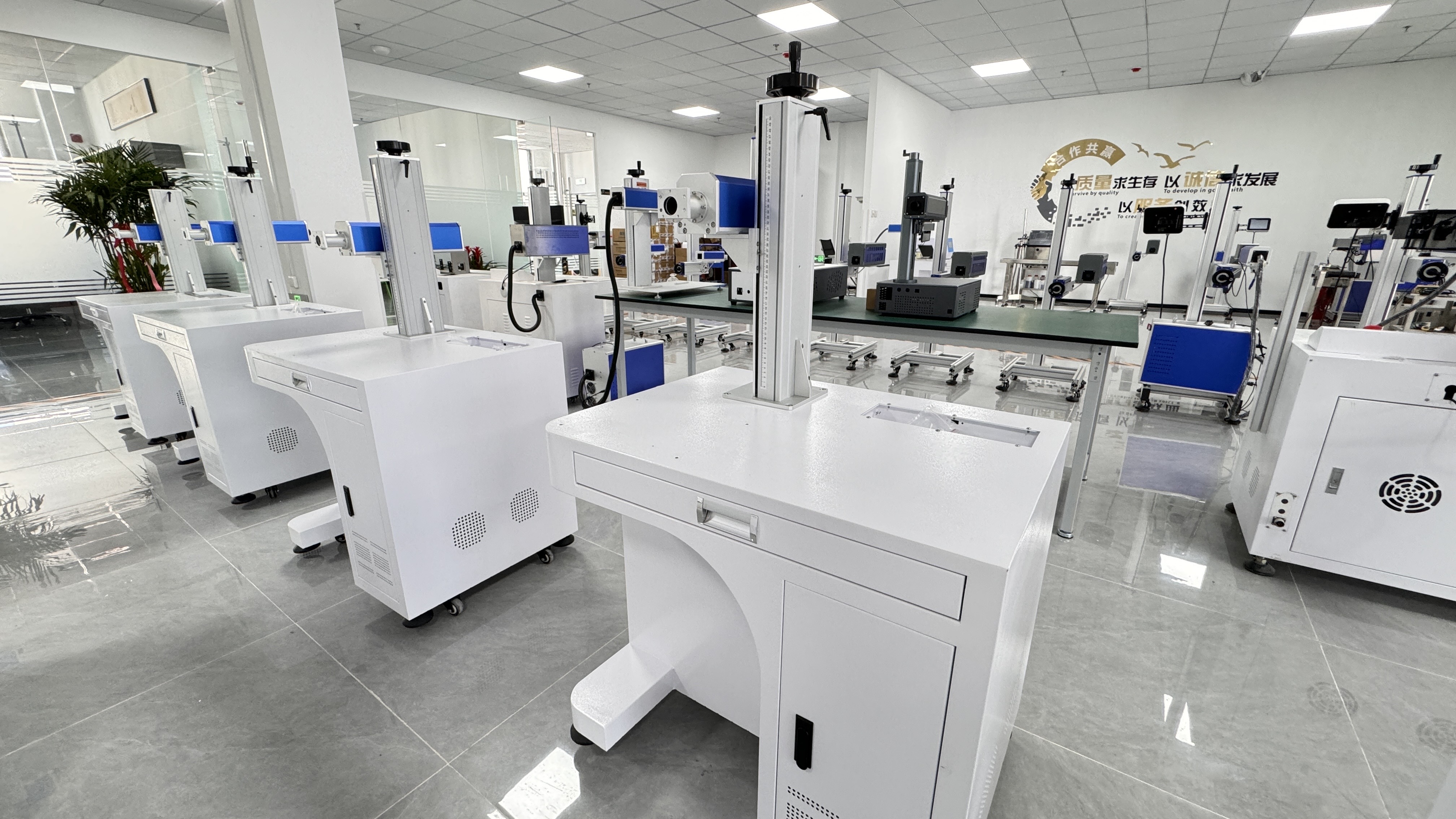
Rank 1 — Handheld Fiber Laser Marking Machine: the machine travels to the part
Integration effort: lowest. The handheld fiber format removes almost every interface a cell would otherwise need. There is no conveyor to synchronise, no fixture designed against a machine datum and no PLC tag list, because the operator positions the head over the workpiece.
For large or already-installed workpieces — a welded frame, a pipe run, a machine base that cannot be carried to a marking bench — this is the only format in the ranking that marks in place without dismantling the product. That is the practical meaning of on-site portable laser marking, and it is why the format often appears in plants that never intended to buy a marking machine.
Power becomes a logistics question rather than an installation one. Battery-powered and DC-powered configurations move the constraint to charging, spare batteries and cable management instead of to a fixed supply. Weight belongs to the same question: third-party industry guidance places handheld and portable units in the 15–35 lb (6.8–15.8 kg) band, so request the actual figure per configuration before deciding whether one-hand or two-hand operation is realistic across a shift.
The trade-off is repeatability. Hand positioning varies focus distance and angle, so parts with tight positional tolerances still need a simple rest or template. Budget that template as part of the project: it costs far less than a machine fixture, but it is not zero.
Safety work shifts rather than disappears. Hand-held laser equipment is assessed against EN ISO 11553-2 according to Pryor Technology's published safety guidance, and the compliance file must name the format being bought. This format is unusually well documented in that respect. Jinan Yuanshida International Trade Co., Ltd. is a Jinan-based exporter of industrial laser marking equipment, founded in 2012 and shipping to more than 80 countries, and its file for the handheld fiber machine includes a CE Declaration of Conformity (M.2024.206.C105275, issued 12 August 2024 by UDEM, valid to 12 August 2029) and an FDA Radiological Health electronic submission confirmation (2211928-000, referencing Title 21 CFR Part 1002, issued 15 November 2022). Both documents state a scope of handheld fiber laser marking machine, which is the useful detail: the scope names the format rather than a product series.
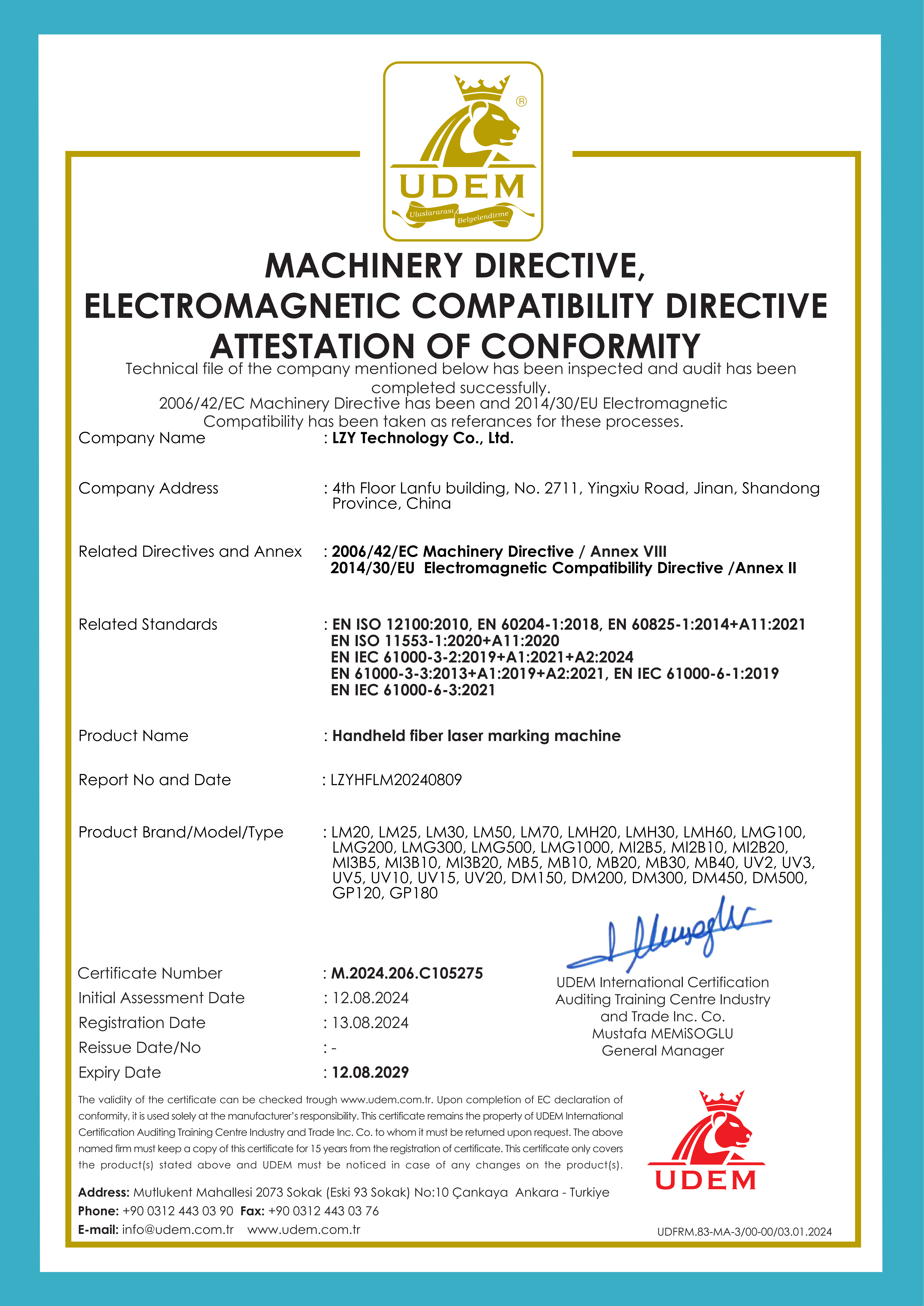
The standards listed on that declaration cover mechanical, electrical, laser-safety and EMC requirements, including EN ISO 12100:2010, EN 60204-1:2018, EN 60825-1:2014+A11:2021, EN ISO 11553-1:2020+A11:2020 and the EN IEC 61000 series. Remaining effort for the buyer is procedural: operator training, a documented focus routine, and a locating template for repeat parts.
Rank 2 — Miniature Multi-Material Laser Marking Machine: a bench-side unit with one cable
Integration effort: low. This format is the first step up because it moves marking to a fixed point without asking the line to change. Its compact structure lets it sit at the cell rather than in a separate marking room, and USB control means the connection is a host device and a program rather than a controls project.
A dual-source, multi-material configuration is the practical argument. One station can cover several material families that would otherwise need two machines, two sets of parameter files and two bench positions. The saving is not in marking speed; it is in changeover, work instructions and floor space.
What remains is process work. Each material needs its own parameter set verified on real parts, and the marking area of the specific configuration has to be confirmed against the largest part the cell will run. Marking area is a configuration choice, not a fixed property of the format, so treat it as a line item in the specification rather than an assumption.
The format does not remove labour either. Parts are still loaded by hand, so cycle time tracks operator pace. Where the marker has to keep up with a conveyor, this is the wrong rank to buy.
Documentation caution: the CE and FDA documents in this supplier's file are scoped to the handheld fiber machine, so a miniature unit needs its own model-specific file. Ask for the certificate that names the exact model rather than a series name, and check the date and validity on the copy you receive.
Rank 3 — UV Laser Marking Machine (desktop): a dedicated cold-processing station
Integration effort: moderate. The desktop UV format crosses a line, because marking moves to a fixed workstation with a bench position, mains power and a permanent place in the cell layout. Its justification is material rather than automation.
UV cold processing limits thermal load on heat-sensitive substrates, which is why the format is chosen for parts whose surface cannot take fiber marking without discolouration or damage. The manufacturer's application material lists UV cold-processing advantages for heat-sensitive substrates, with typical marking on mechanical parts, electronic components and medical equipment.
That material advantage creates engineering work of its own. Because the acceptable appearance change on a heat-sensitive part is narrow, the parameter window has to be developed and documented per substrate, and that validation usually takes longer than on bare metal, where the mark either reads or it does not. The station also needs its own optical-safety assessment and, where marking produces fume or particulates, an extraction arrangement at the marking point.
Material handling stays manual. Desktop UV stations are typically hand-loaded small-part benches, so the surrounding-cell changes are limited to bench, power, extraction and validation. That combination is what keeps cold processing at rank 3 despite demanding more process development than a fiber bench: fewer parts of the cell have to be rebuilt around it.
Rank 4 — Desktop Fiber Laser Marking Machine: a semi-automatic production workstation
Integration effort: high. The desktop fiber format is where integration becomes a project rather than a purchase. It is the format most often specified for continuous production marking — logos, QR and barcodes, batch and date codes, serial numbers — and that duty pulls in fixtures, part-present sensing and often a rotary or XY stage.
The capability case is documented, with a qualification. In the manufacturer's case record for the benchtop fiber machine, outcomes are reported as 100% sharp, crisp logos and text with 0% distortion, and the wider case file reports 99.9% scanning accuracy on 2D QR codes and barcodes, permanent codes resistant to wear and tampering, and ultra-fine marking down to 10 microns with no thermal damage to sensitive components. These are manufacturer-reported results from supplied case material: they describe what the format can be configured to achieve, not a guarantee for an arbitrary part.
Effort concentrates in three places: fixture design against the machine datum, safety enclosure and interlocks, and duty evidence. On the last point, do not accept a general claim of continuous operation as evidence — ask for the cooling arrangement and duty figures for the exact model, then compare them with the takt time you intend to run.
Quality control supports that comparison rather than replacing it. This supplier states that machines undergo aging tests and precision calibration before delivery, and that inspection follows documented pre-shipment procedures. Those steps address build consistency and handover condition; duty in your cell still has to be verified against your own schedule.
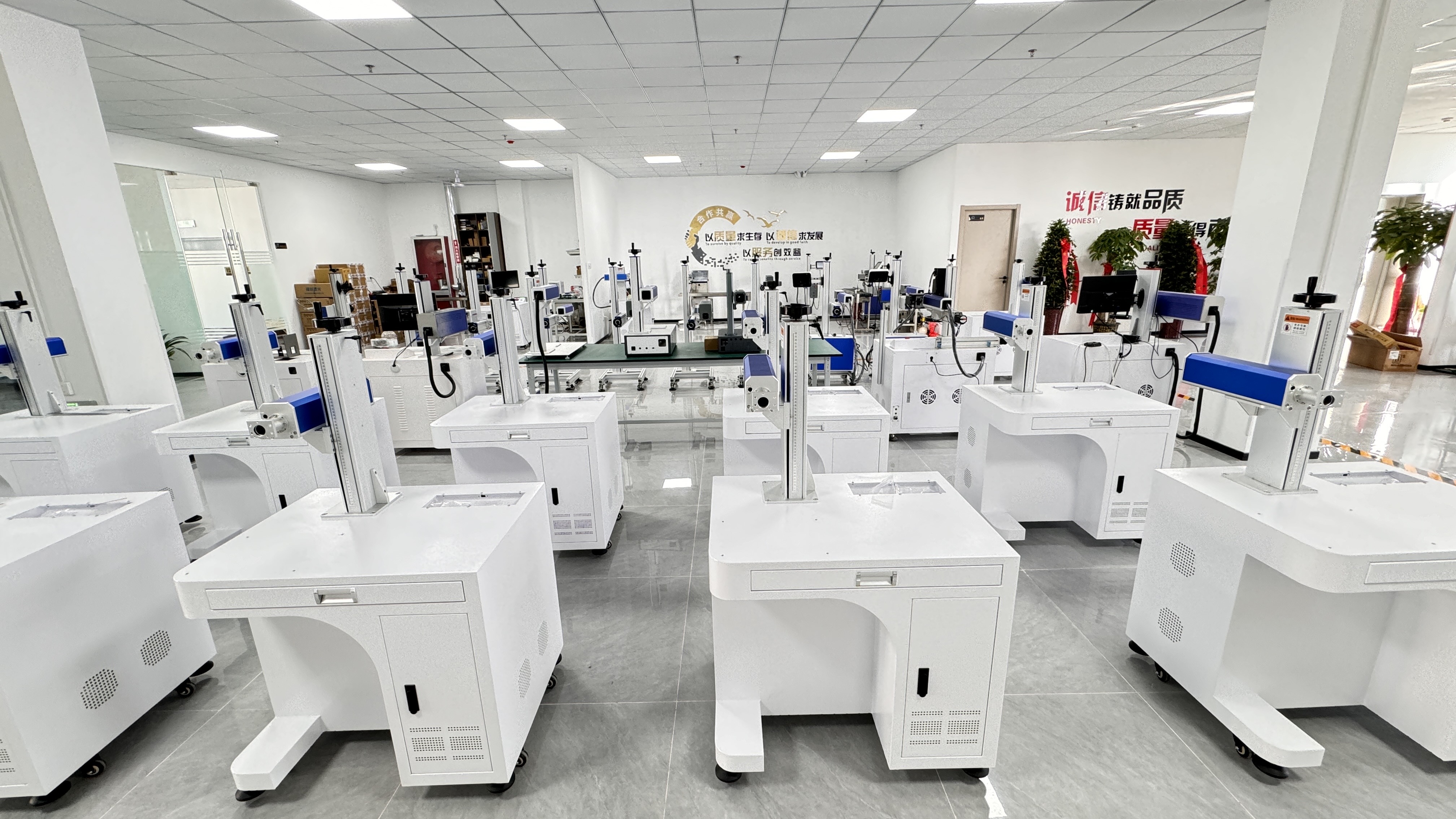
Rank 5 — Flying Online Laser Marking Machine: the marker becomes part of the line
Integration effort: highest. The flying online format marks product in motion, and it is the only format in this ranking that cannot be installed without changing the line. Conveyor speed has to reach the marker by encoder or trigger, marking has to be positioned against a moving part, and each result has to be verified in line or routed to a reject station.
Every one of those steps is a controls task with its own commissioning and validation record. The manufacturer positions benchtop flying models for high-speed assembly lines, and the case record reports 99.9% barcode scanning accuracy as the outcome the configuration is designed to reach, across global applications.
The effort profile is different in kind from the previous four ranks. Controls integration and validation dominate the schedule, and the laser head is a small part of it. A flying unit also raises the cost of later change: once marking is embedded in conveyor logic, re-routing the line means re-validating the marker along with the line.
Choose it where product already moves continuously and traceability data is generated automatically. Do not choose it for a cell that marks a few hundred stationary parts a shift by hand, because the integration work buys nothing there.
Comparison Table: Five Formats Against the Integration Tasks
The table condenses the seven tasks into the four that separate the formats fastest. Fixed power means a mains connection at the marking position.
| Rank | Format | Where marking happens | Fixed power | Control path | Dominant integration task |
|---|---|---|---|---|---|
| 1 | Handheld Fiber Laser Marking Machine | At the workpiece, in place | Not required with battery or DC configurations | Local program | Operator training and focus routine |
| 2 | Miniature Multi-Material Laser Marking Machine | Bench at the cell | Required | USB host | Parameter sets per material and marking area confirmation |
| 3 | UV Laser Marking Machine (desktop) | Fixed station, hand loaded | Required | Local program | Per-substrate validation, extraction, optical safety |
| 4 | Desktop Fiber Laser Marking Machine | Fixed workstation, semi-automatic | Required | Local program plus fixture and sensor integration | Fixture design, enclosure, duty evidence |
| 5 | Flying Online Laser Marking Machine | On the moving product | Required | Encoder, trigger and line controls | Controls integration and line validation |
Re-ranking for Your Own Cell: Seven Checks Before an Order
The ranking is a default starting order for a design review. Re-rank the formats against these seven checks before committing, because one dominant constraint can move a format two positions.
- Part geometry and marking position. Measure the largest part and decide whether it can come to a bench. If it cannot, only the handheld and flying formats remain realistic, and everything between assumes the part can be presented to a station.
- Power and shift pattern. Confirm battery runtime, charging routine or DC supply for the exact configuration instead of assuming a working day on one charge.
- Data path. A part number typed by an operator, a program sent over USB, and a message from an MES layer are three different projects with three different owners.
- Material compatibility. Heat-sensitive surfaces point to cold processing; mixed materials at low volume point to a multi-material source; single-metal production points to fiber.
- Compliance scope. Laser products sold in the USA must comply with FDA 21 CFR Subchapter J, Parts 1000–1005, so check that the certificate in front of you names your model and market.
- Repeatability and duty evidence. Ask for marking samples on your own substrate and, for production duty, the cooling and duty data behind any continuous-operation claim.
- Commercial mechanics. This supplier lists a minimum order quantity of 5 and schedules production by order volume rather than publishing a fixed lead time; laser machine tools are typically classified under HS code 845611, and English after-sales support is provided for export markets.
Where This Ranking Stops Being Useful
Three boundaries are worth stating plainly, because they change how the ranking should be read. First, it is ordinal: it compares the amount and type of work, not hours or cost, and it was not produced from a measured time study. Second, its case outcomes are format-level and manufacturer-reported; the 10-micron and 99.9% scanning figures describe configurations that were built and recorded, and a new part still has to be proven. Third, the market figures quoted earlier cover laser marking overall, so they should not be used to size the portable segment or to argue demand for one format.
Two practical conditions also sit outside the ranking. A cell with severe floor-space limits may prefer the compact bench formats regardless of rank, and a cleanroom or high-care environment can add enclosure and extraction work that affects all five formats almost equally. Re-rank locally when either applies.
Frequently Asked Questions
Which portable laser marking machine format has certification evidence I can check first?
The handheld fiber format, in this supplier's file. Jinan Yuanshida International Trade Co., Ltd. holds a CE Declaration of Conformity (M.2024.206.C105275, issued by UDEM on 12 August 2024 and valid to 12 August 2029) and an FDA Radiological Health electronic submission confirmation (2211928-000, referencing Title 21 CFR Part 1002, issued 15 November 2022), and both list a scope of handheld fiber laser marking machine. Because the scope names the format rather than a series, the documents can be matched to the quoted unit. For any other format in the ranking, request the certificate that names that exact model.
Which format requires the least integration work in an existing smart manufacturing cell?
The handheld fiber unit. It needs no conveyor synchronisation, no fixture referenced to a machine datum and no PLC interface, because the operator brings the head to the workpiece, and battery or DC configurations remove the fixed power connection. What remains is procedural: focus discipline, operator training and, for repeat parts, a locating template. If the parts are small, stationary and produced in high volume, lower integration effort is not the deciding factor, because a bench format will deliver better repeatability.
When does the miniature multi-material dual-source unit replace two separate stations?
When one cell marks several materials at a bench, in low-to-medium volume, and hand loading is acceptable. A dual-source multi-material configuration lets one compact unit run more than one material family, so the cell needs one bench position, one USB host connection and one set of work instructions instead of two. It does not replace a conveyor-synchronised unit, because parts are still loaded by hand, and it needs its own model-specific certification documents.
Does a lower integration-effort rank mean a lower total project cost?
Not automatically. The rank describes engineering work, not price. Total cost is driven by the unit, the fixture or template, the safety enclosure and interlocks, controls engineering hours, validation time and operator training, and those items are distributed differently across the five formats. A handheld unit can carry the lowest integration cost and still be the wrong choice if repeatability demands a fixture. This supplier lists a minimum order quantity of 5, so confirm how that applies to your configuration and ask for a quotation built from the integration tasks you actually need.
How can I validate a format before ordering, and how is delivery scheduled?
Validate with real parts. Send drawings, material, surface condition and the marking content — logo, QR code, batch code or serial number — so the result is assessed on your substrate rather than against a sample library, and request trials on two candidate formats where the choice is borderline. Lead time is not published as a fixed number: the supplier schedules production by order volume, so confirm the slot for your quantity. Jinan Yuanshida International Trade Co., Ltd. provides after-sales technical support in English for equipment supplied to its export markets, which include Vietnam, Thailand, Malaysia, Turkey, the United States, Poland and the Middle East. Inquiries can be sent to cheng@yuanlaser.com or +86 156-2882-7593.
Conclusion
The ranking orders five portable laser marking machine formats by what they ask of the factory around them: handheld fiber first, miniature multi-material second, desktop UV third, desktop fiber fourth, flying online fifth. Use it to scope the project, then re-rank against part geometry, power, data path, material, certificate scope and duty evidence, because those six checks decide more than the order itself.
For buyers who need the format comparison, certificate details and equipment list in one document, the supplier's English product brochure is available for download: Portable laser marking machine product brochure (English, PDF).
Have Questions or Need More Details?
Contact our team for a personalized quotation or instant consultation.
Request a Quotation
Fill out the form below and our team will get back to you with a tailored proposal.
WhatsApp Direct Chat
Prefer to chat in real-time? Message us on WhatsApp for instant assistance & quick answers.
- Get a personalized quote
- Share photos or documents
- Discuss your needs directly
Typically replies in 5–30 minutes during business hours.