Portable Laser Marking Machine Technical Guide: Pulse Width, Beam Quality, and Repeatability
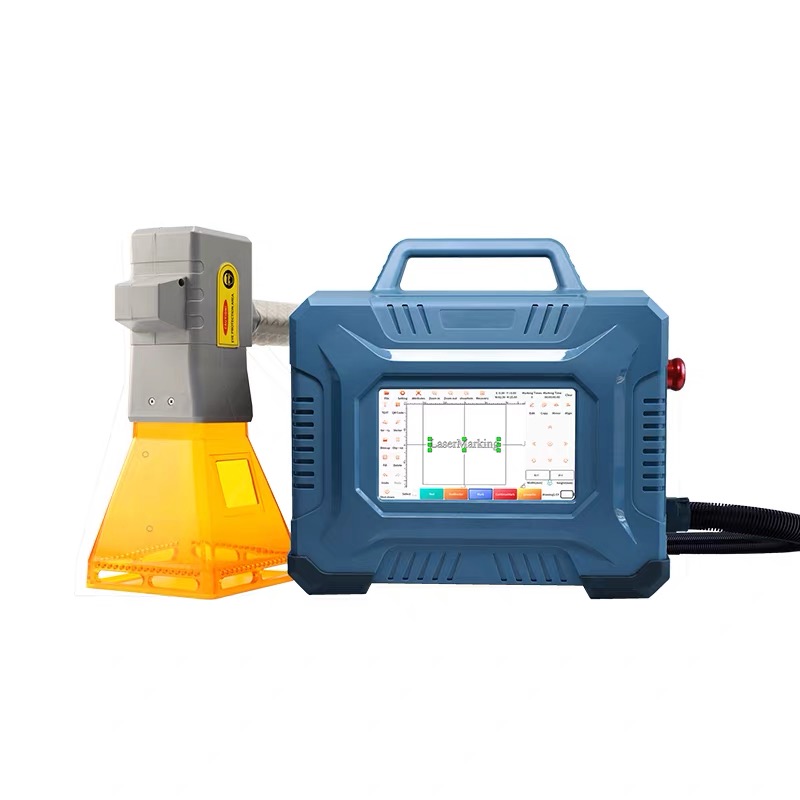
A portable laser marking machine for on-site work: the handheld 1064 nm fiber configuration with built-in lithium battery, a 7-inch Linux touch screen and a 110 × 110 mm marking area.
Quick answer: On a portable laser marking machine, pulse width below 60 ns limits how much heat spreads into the material around each pulse; beam quality of M² < 1.5 in single mode determines how small and how dense the focused spot can be; and repeatability of ±0.001 mm determines whether every part receives the mark in the same position. Together they support a minimum character height of 0.15 mm, a minimum line width of 0.4 mm and a maximum marking depth below 0.4 mm. Match 355 nm UV to heat-sensitive plastics, glass and packaging; 1064 nm fiber to metals; and a switchable 1064 nm / 455 nm dual-source to mixed-material on-site work.
A portable laser marking machine is usually selected on three numbers: laser power in watts, machine weight in kilograms and battery capacity. Those numbers describe how fast a mark can be written and how easily the unit can be carried. They do not describe the mark itself.
Three less-quoted specifications do: pulse width below 60 ns, beam quality of M² < 1.5 in single mode, and repeatability of ±0.001 mm. This guide explains what each parameter changes at the workpiece, compares the three source configurations used in portable and compact laser marking equipment — 355 nm UV, 1064 nm fiber, and a switchable 1064 nm / 455 nm dual-source — and sets out a step-by-step method for matching parameters to material, marking speed and production requirements.
Problem definition: why portable laser marking machines are specified by the wrong numbers
Procurement conversations about portable laser marking machines tend to start with wattage and weight, because those are the numbers printed in the largest font on most specification sheets. Three recurring problems follow from that.
First, heat damage is mistaken for a power problem. When a 1064 nm fiber unit is used on a heat-sensitive plastic, a thin film or a fragile glass surface, the characters can come out with a halo of thermal distortion around them. The missing specification is not more watts — it is a shorter-wavelength, cold-processing source. In this product family, the 355 nm UV cold laser process is specifically intended for marking plastics, glass and fragile materials without thermal damage.
Second, depth expectations are set beyond what the machine class can deliver. The configurations described in this guide state a maximum marking depth below 0.4 mm (UV), 0.4 mm (desktop fiber) and up to 0.4 mm (flying online fiber). That is a surface-marking and shallow-engraving boundary. Buying a higher power option does not move it. If a drawing requires deeper material removal, the correct answer is a different machine class, not a bigger number on the same machine.
Third, positional drift is discovered only after serialization starts. A serial number or 2D code that is applied to a few hundred small components during a shift must land in the same relative position on the first part and the last. That is a repeatability question — ±0.001 mm on the stationary configurations covered here — and it is invisible in a wattage figure.
The word “portable” describes an enclosure, a battery and a weight class. It says nothing about pulse duration, beam quality or repeatability, which are the parameters that decide the achievable character height of 0.15 mm, line width of 0.4 mm and depth ceiling of 0.4 mm.
Industry background: where portable laser marking sits in 2026
The global laser marking machine market was estimated at USD 4.4 billion in 2026 (Grand View Research, “Laser Marking Machine Market Size & Share Report, 2026–2033”). Within that market, fiber laser technology held a revenue share of 46.1% in 2025, and Asia Pacific accounted for approximately 44% of regional revenue share. Fiber is therefore the default source technology for the majority of industrial marking work, with UV, CO₂ and dual-source configurations covering the segments fiber serves less well.
The portable segment exists for a practical reason: many workpieces cannot be brought to a fixed marking station. Pipes, profiles, installed machinery, large fabricated frames and oversized hardware parts frequently have to be marked where they sit. Portable and handheld formats are designed for marking in these on-site conditions, and for precision marking tasks on components that are awkward to fixture on a desktop machine.
Two regulatory layers shape the buying decision. In the United States, laser products must comply with FDA 21 CFR Subchapter J (Radiological Health), Parts 1000 through 1005. For hand-held equipment specifically, portable laser markers are assessed against EN ISO 11553-2 for hand-held safety. Equipment from Jinan Yuanshida International Trade Co., Ltd. is stated to comply with CE, FDA and ISO, and to be designed to meet certification and customs clearance requirements in many countries. For trade documentation, HS Code 845611 is the primary classification for machine tools operated by laser processes.
Jinan Yuanshida International Trade Co., Ltd. was established in 2012 and is a high-tech enterprise specialising in the research and development, production and export of industrial laser marking equipment. Its main products include handheld laser marking machines, bench-top laser marking machines, desktop laser marking machines and precision laser marking equipment, and its equipment is used in hardware and auto parts, pipes and profiles, electronic components, jewellery and accessories, mechanical parts, gifts and crafts. Products have been exported for many years to more than 80 countries and regions, with major markets including Vietnam, Thailand, Malaysia, Türkiye, the United States, Poland and the Middle East.
Detailed solution: what each parameter changes at the workpiece
Pulse width below 60 ns: how long the energy stays in the material
Pulse width is the duration of a single laser pulse. Below 60 ns, energy is delivered faster than heat can diffuse laterally into the surrounding material. The practical result is a smaller heat-affected zone, cleaner character edges and less discolouration in the area around the mark.
This is why the 355 nm UV configuration is described as a cold laser process: it is intended for marking plastics, glass and fragile materials without thermal damage. The same sub-60 ns pulse width is also specified on the 1064 nm desktop and benchtop fiber configurations and on the 10.6 µm desktop CO₂ configuration in the same equipment family. Pulse duration is therefore a family-level design choice rather than a UV-only feature — but its effect is most visible where the substrate is heat sensitive.
Pulse width interacts with modulation frequency, which sets how many pulses are emitted per second: the UV configuration operates at 30–100 kHz, the desktop CO₂ configuration at 20–200 kHz and the flying online fiber unit at 20–100 kHz. In general industrial practice, higher repetition rates produce smoother, faster processing on a moving part, while lower rates concentrate more energy into each pulse. The correct setting is found by testing on the actual substrate, not by assumption.
Beam quality M² < 1.5: why single mode decides the finest line width
M² expresses how close a laser beam is to an ideal diffraction-limited beam, where M² = 1 is the theoretical minimum. A single-mode beam specified at M² < 1.5 can be focused to a smaller spot with higher energy density than a multi-mode beam of the same average power. Energy density at the focal point — not average power alone — is what produces a crisp character edge.
That is the link between beam quality and the published achievable features: a minimum line width of 0.4 mm and minimum characters of 0.15 mm are specified on both the UV and the desktop fiber configurations. With a tighter beam, these values are repeatable production features rather than marginal claims.
Beam quality also carries a trade-off. The flying online fiber configuration in the same family is specified at M² < 2 with a focal spot diameter of 0.01 mm, and delivers 800 standard characters per second, a line speed of up to 7,000 mm/s and continuous online marking speed of up to 12,000 mm/s. That design deliberately trades a small amount of beam quality for throughput on a moving production line. Buyers comparing a stationary portable unit against an inline unit are comparing two different optimisation targets.
Repeatability ±0.001 mm: the number serialisation depends on
Repeatability describes how closely a machine returns to the same position on a second pass, a second part or a second shift. At ±0.001 mm, positional variation is limited to one micrometre.
This matters most where the mark carries data: serial numbers, 1D barcodes, QR codes and DataMatrix codes on electronic components, jewellery and mechanical spare parts. It also matters when a mark is applied in more than one operation — a logo in one pass and a date code in a second — because the two must align to the same reference. Both the UV configuration and the desktop and benchtop fiber configurations are specified at ±0.001 mm repeatability.
For comparison, the flying online fiber unit is specified at ±0.003 mm repeatability. That is a reasonable figure for dynamic marking on a moving line, and it illustrates the same trade-off as beam quality: stationary portability buys precision, inline throughput buys speed.
Maximum marking depth below 0.4 mm: the ceiling that decides whether a job fits
Portable and compact configurations in this range are surface-marking tools. The stated maximum marking depth is below 0.4 mm on the UV configuration, 0.4 mm on the desktop fiber configuration and up to 0.4 mm on the flying online fiber configuration. This boundary is a design characteristic, not a defect, and it is the first thing a buyer should check against the part drawing.
Where deeper material removal is required, the same equipment family includes a benchtop fiber configuration specified with a maximum marking depth of up to 4 mm, a minimum line width of 0.01 mm and a 150 × 150 mm marking area. That is a different class of machine, intended for deeper engraving work rather than on-site marking. Matching parameters to the job means deciding which of these two classes the application actually belongs to before comparing prices.
355 nm UV, 1064 nm fiber and switchable 1064 nm / 455 nm: what each configuration is for
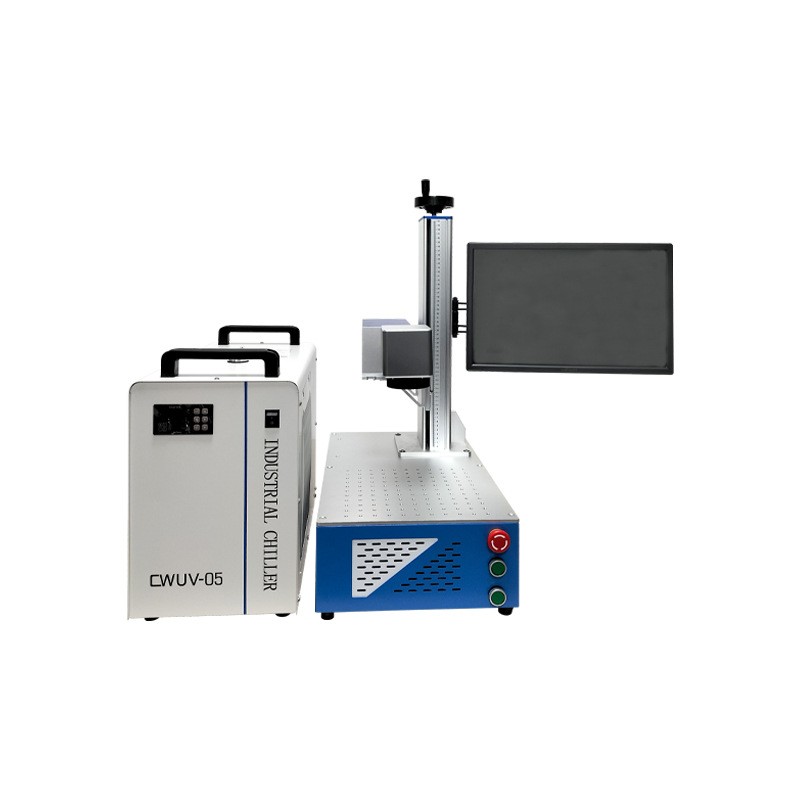
The 355 nm UV Laser Marking Machine: 3 W / 5 W, pulse width below 60 ns, M² < 1.5 single mode and M²-consistent cold processing for heat-sensitive materials.
355 nm UV. The UV Laser Marking Machine is a desktop UV cold laser marking unit with 3 W or 5 W power, a 355 nm wavelength, pulse width below 60 ns, modulation frequency of 30–100 kHz and M² < 1.5 single-mode beam quality. Marking speed reaches 10,000 mm/s across a 110 × 110 mm area, with ±0.001 mm repeatability, a minimum line width of 0.4 mm or less, minimum characters of 0.15 mm and a maximum marking depth below 0.4 mm. Cooling is handled by an external industrial water chiller (DWUV-05 included); overall power is under 400 W and operating voltage is 110–240 V. More than 140 font libraries are included, with custom fonts addable on request, and the unit supports variable data marking for text, logos, barcodes, QR codes and serial numbers. It is specified for PE plastics, PVC plastics, metal parts, building materials, glass, film, packaging and composite materials, in electronics, pharmaceuticals, food and beverage packaging, daily chemicals and cosmetics, and hardware, steel and cement production lines.
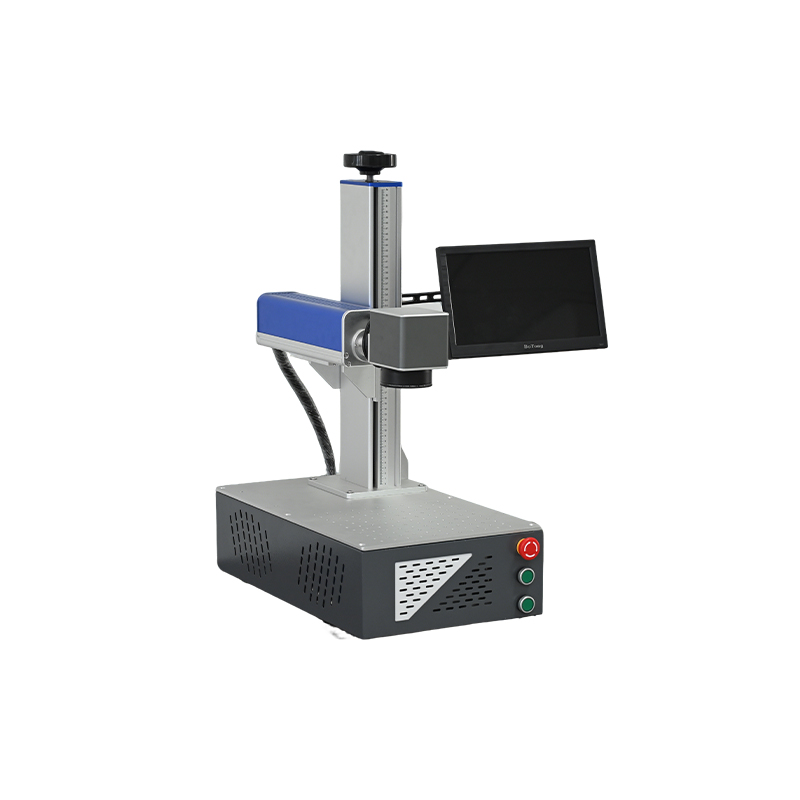
1064 nm fiber configurations cover hardware parts, electronic components, machinery parts and jewellery, with ±0.001 mm repeatability.
1064 nm fiber. The fiber family spans several formats. The handheld fiber laser marking machine offers 20 W / 30 W / 50 W / 60 W options at 1064 nm with air cooling, a Linux system and 7-inch touch screen, Bluetooth, WiFi and mobile app support, a built-in lithium battery, a laser life of about 100,000 hours, a 90–240 V power supply, a 110 × 110 mm marking area and a weight of about 6 kg. The desktop fiber laser marking machine offers 20 W / 30 W / 50 W / 100 W at 1064 nm with pulse width below 60 ns, marking speeds up to 10,000 mm/s, a 110 × 110 mm marking area (150 × 150 mm, 175 × 175 mm and 200 × 200 mm optional), ±0.001 mm repeatability, minimum characters of 0.15 mm, a minimum line width of 0.4 mm, a maximum marking depth of 0.4 mm, built-in air cooling and overall power under 400 W. The benchtop fiber unit offers 20 W / 30 W / 50 W over a 150 × 150 mm area.
Across the handheld format, supported materials include stainless steel, carbon steel, aluminium oxide, aluminium alloy, aluminium, copper, iron, gold, silver, carbide, painted metal, acrylic, PVC, leather and painted wood. Typical applications are hardware and auto parts, pipes and profiles, electronic components, jewellery and accessories, mechanical parts, gifts and crafts.
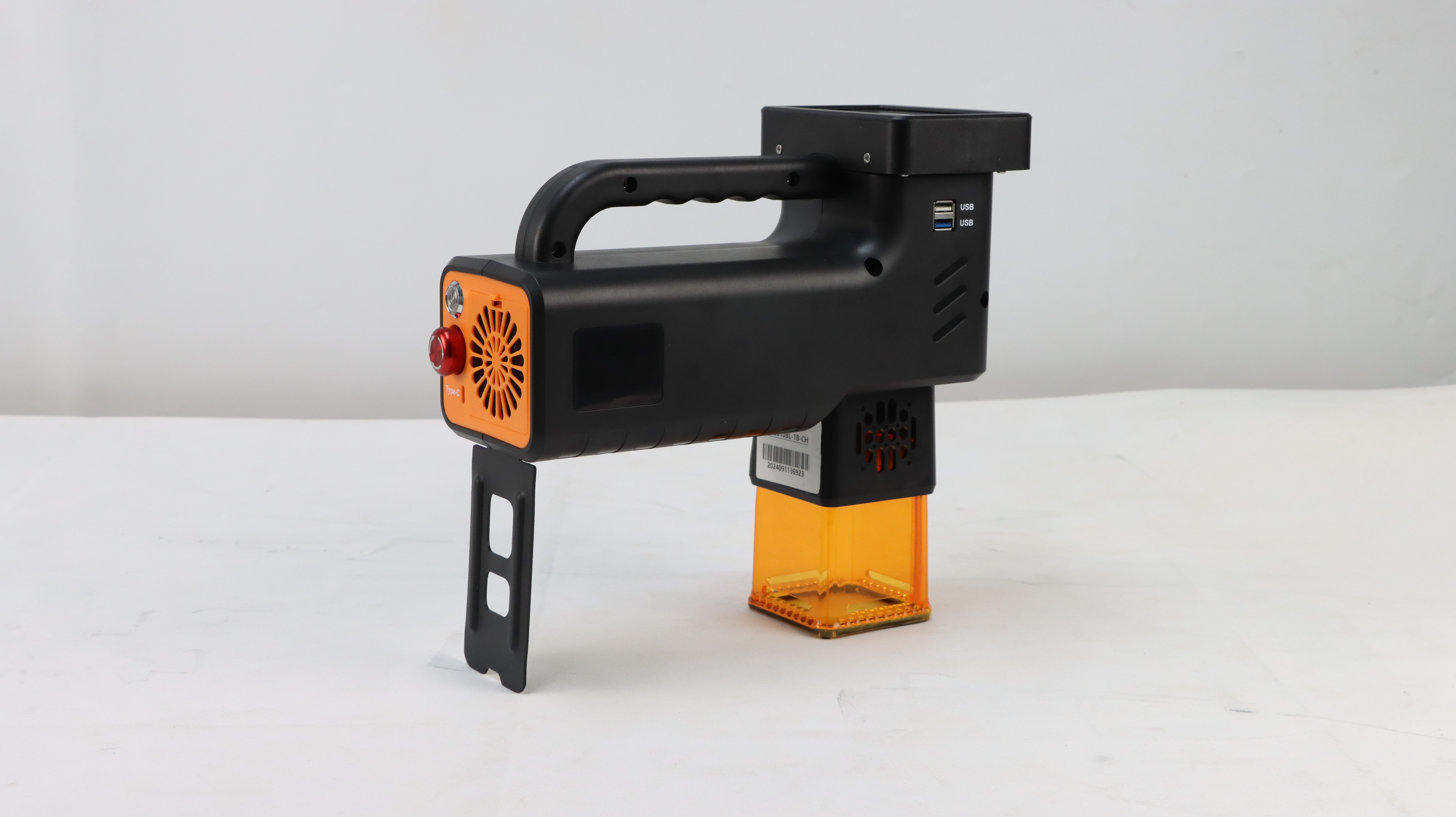
The switchable 1064 nm / 455 nm dual-source unit weighs 2.7 kg and is powered by a built-in lithium battery or DC 20 V.
Switchable 1064 nm / 455 nm dual-source. The Miniature Multi-Material Laser Marking Machine is the dual-wavelength option: a 1064 nm / 455 nm dual light source that can be switched, pulse operation, a power regulation range of 25–100 with gradient adjustment, processing speed up to 4,000 mm/s, a scene focal length of 133 mm, a 55 × 55 mm scanning area, a machine weight of 2.7 kg, overall power of 100 W or less, air cooling, a built-in lithium battery or DC 20 V supply with power bank support, and TYPE-A for data and TYPE-C for power. Marking parameters can be set through a mobile app, PC software or the touch screen. Materials include metals, bamboo and wood, leather, paper, coloured glass, plastics and ceramics; the intended industries are gifts and crafts, jewellery, customised DIY workshops and 3C electronic accessories. The published specification for this model does not state pulse width or M², so buyers who need those figures for a technical validation file should request them directly rather than assume they match the UV or stationary fiber values.
Step-by-step breakdown: matching parameters to material, speed and production requirements
Step 1 — Classify the mark. Decide whether the application is a contrast or annealing mark, a shallow engraving, or deep material removal. If the required depth exceeds 0.4 mm, the portable and compact class described here is the wrong tool, and the requirement should move to a benchtop-class machine.
Step 2 — Fix the smallest feature on the drawing. Minimum character height of 0.15 mm and minimum line width of 0.4 mm are the stated limits on the UV and desktop fiber configurations. If the layout requires finer line work, the benchtop fiber configuration states a minimum line width of 0.01 mm.
Step 3 — Match the substrate to a wavelength. Heat-sensitive plastics, films, coloured glass, packaging and composite materials point to the 355 nm UV cold process. Bare metals and metal alloys point to 1064 nm fiber. A single device that must cover metals alongside wood, leather, paper, coloured glass and ceramics points to the switchable 1064 nm / 455 nm dual-source.
Step 4 — Check positioning tolerance against repeatability. ±0.001 mm is the specified repeatability on the UV and on the desktop and benchtop fiber configurations. Dynamic inline marking on a moving line is specified at ±0.003 mm on the flying online fiber unit.
Step 5 — Size the marking field to the part. Available areas include 55 × 55 mm on the miniature dual-source unit, 110 × 110 mm on the handheld fiber, desktop fiber and UV configurations, and optional 150 × 150 mm, 175 × 175 mm and 200 × 200 mm on the desktop fiber configuration. The field must cover the largest single mark plus fixture tolerance, not just the part.
Step 6 — Match throughput and power supply to the site. Stationary and handheld marking speeds reach up to 10,000 mm/s, the miniature dual-source unit reaches up to 4,000 mm/s, and the flying online configuration reaches up to 12,000 mm/s in continuous online mode. For power, the handheld fiber unit uses a built-in lithium battery, the dual-source unit uses a built-in lithium battery or DC 20 V with power bank support, and overall consumption is under 400 W for the UV and fiber units and 100 W or less for the miniature unit.
Step 7 — Verify compliance and the physical installation. Confirm CE, FDA and ISO documentation for the destination market, note that US imports fall under FDA 21 CFR 1000–1005, that hand-held equipment is assessed against EN ISO 11553-2, and that HS Code 845611 applies for customs classification. Then confirm site conditions: hand-held marking of large workpieces may require stable fixtures and power or battery accessories, while line integration may require conveyors, flying brackets, code detection and PC or mobile control devices. For heat-sensitive materials, the recommended approach is UV cold-processing equipment; for dynamic lines, a flying model or a unit fitted with a flying bracket.
Use cases: which configuration fits which job
Hardware parts. Stainless steel and aluminium hardware parts are marked with the 1064 nm fiber configuration, which is applicable to marking on hardware parts and handles stainless steel, carbon steel and aluminium alloy.
Pipes and profiles, marked on site. Where a pipe or profile is too large to bring to a marking station, the handheld fiber configuration with its built-in lithium battery and approximately 6 kg body is the on-site option for pointing the mark at the workpiece.
Electronic components. The combination of ±0.001 mm repeatability, 0.15 mm minimum characters and 0.4 mm minimum line width makes the UV and desktop fiber configurations suitable for serial numbers, QR codes and traceability marking on electronics production lines.
Jewellery and accessories. Fine line work on jewellery is covered by the desktop fiber configuration within the ±0.001 mm repeatability specification, while the miniature dual-source unit addresses jewellery alongside coloured glass, leather and ceramics in the same workshop.
Mechanical spare parts. Mechanical parts processing is a stated application of the fiber configurations, which mark metals, PE and PVC without consumables.
Gifts, crafts and customised workshops. The 2.7 kg multi-material dual-source unit is designed for gifts and crafts, jewellery, customised DIY workshops and 3C electronic accessories, using a switchable 1064 nm / 455 nm source.
Heat-sensitive and packaging materials. PE plastics, PVC plastics, glass, film, packaging and composite materials, along with the food and beverage packaging, pharmaceutical and daily chemical industries, are the intended scope of the 355 nm UV cold-processing configuration.
High-speed automated lines. Production dates, batch numbers, tracking codes, logos, scales, 1D barcodes and 2D QR codes on moving lines are handled by the flying online fiber configuration at 800 standard characters per second — accepting ±0.003 mm repeatability and M² < 2 in exchange for speed.
Comparison table: 355 nm UV vs 1064 nm fiber vs switchable 1064 nm / 455 nm
| Parameter | 355 nm UV configuration | 1064 nm fiber configuration | Switchable 1064 nm / 455 nm |
|---|---|---|---|
| Wavelength | 355 nm | 1064 nm | 1064 nm / 455 nm, switchable |
| Pulse width | Below 60 ns | Below 60 ns (desktop and benchtop fiber) | Pulse operation; value not stated in the published specification |
| Beam quality (M²) | M² < 1.5, single mode | Flying online fiber: M² < 2; stationary fiber value not stated in the published specification | Not stated in the published specification |
| Power options | 3 W / 5 W | Handheld 20/30/50/60 W; desktop 20/30/50/100 W; benchtop 20/30/50 W | Power regulation range 25–100, gradient adjustable |
| Modulation frequency | 30–100 kHz | Flying online fiber: 20–100 kHz | Not stated in the published specification |
| Marking speed | Up to 10,000 mm/s | Up to 10,000 mm/s; flying online up to 12,000 mm/s continuous online | Up to 4,000 mm/s |
| Marking / scanning area | 110 × 110 mm | Handheld and desktop 110 × 110 mm; desktop optional 150 × 150, 175 × 175, 200 × 200 mm; benchtop 150 × 150 mm | 55 × 55 mm |
| Repeatability | ±0.001 mm | ±0.001 mm (desktop and benchtop); flying online ±0.003 mm | Not stated in the published specification |
| Min. character / line width | 0.15 mm / 0.4 mm or less | 0.15 mm / 0.4 mm (desktop); benchtop minimum line width 0.01 mm | Not stated in the published specification |
| Max. marking depth | Below 0.4 mm | 0.4 mm (desktop and flying online); benchtop up to 4 mm | Not stated in the published specification |
| Cooling | External industrial water chiller (DWUV-05 included) | Built-in air cooling | Air cooling |
| Power supply and portability | 110–240 V; standard USB; desktop unit 352 × 603 × 800 mm | Handheld: built-in lithium battery, 90–240 V, approx. 6 kg; desktop and benchtop: mains supply | Built-in lithium battery or DC 20 V, power bank supported; 2.7 kg; TYPE-A data, TYPE-C power |
| Overall power | Under 400 W | Under 400 W | 100 W or less |
| Representative materials | PE plastics, PVC plastics, metal parts, building materials, glass, film, packaging, composite materials | Stainless steel, carbon steel, aluminium oxide, aluminium alloy, aluminium, copper, iron, gold, silver, carbide, painted metal, acrylic, PVC, leather, painted wood | Metals, bamboo and wood, leather, paper, coloured glass, plastics, ceramics |
| Typical industries | Electronics, pharmaceuticals, food and beverage packaging, daily chemicals and cosmetics, hardware, steel, cement | Hardware and auto parts, pipes and profiles, electronic components, jewellery, mechanical parts, gifts and crafts | Gifts and crafts, jewellery, customised DIY workshops, 3C electronic accessories |
Table notes: values are taken from the published specifications of the configurations described. Where a value is not published for a given configuration, this is stated rather than estimated.
FAQ
1. Does a portable laser marking machine meet the certification requirements for import?
Equipment from Jinan Yuanshida International Trade Co., Ltd. is stated to comply with international quality standards such as CE, FDA and ISO, and to be designed to meet certification and customs clearance requirements in many countries, with all equipment undergoing multiple aging tests and precision calibration before leaving the factory. Buyers importing into the United States should note that laser products must comply with FDA 21 CFR Subchapter J (Radiological Health) Parts 1000 through 1005, and that hand-held portable laser markers are assessed against EN ISO 11553-2 for hand-held safety. HS Code 845611 is the primary classification for machine tools operated by laser processes.
2. Can one portable machine mark both metals and plastics?
It depends on the configuration. The 1064 nm fiber configurations mark metals including stainless steel, carbon steel, aluminium alloy and copper, and also handle acrylic, PVC, leather and painted wood. The switchable dual-source unit covers metals, bamboo and wood, leather, paper, coloured glass, plastics and ceramics in one 2.7 kg device by switching between 1064 nm and 455 nm. Where the substrate is heat sensitive — PE and PVC plastics, glass, film, packaging and composite materials — the recommended equipment is a 355 nm UV cold-processing unit, because that process is intended for marking plastics, glass and fragile materials without thermal damage.
3. What drives the cost of a portable laser marking machine configuration?
Four specification choices account for most of the configuration difference between otherwise similar machines. The source family is the first: a 355 nm UV unit requires an external industrial water chiller (DWUV-05 is included with the UV configuration), while fiber configurations use built-in air cooling. The second is wavelength count — a switchable 1064 nm / 455 nm dual-source adds a second light source. The third is power option, which ranges from 3 W / 5 W on the UV unit to 20 W / 30 W / 50 W / 60 W on the handheld fiber and up to 100 W on the desktop fiber. The fourth is the portable power and control package: a built-in lithium battery, a Linux system with a 7-inch touch screen, Bluetooth, WiFi and mobile app support, or TYPE-C power input. Comparing quotations line by line across these four items is more reliable than comparing a headline power figure.
4. How can a buyer validate the precision claims before ordering?
Validation should be tied to the four measurable parameters rather than to a demo video. Ask for a test mark on the actual substrate and measure four things: minimum character height, which is stated at 0.15 mm on the UV and desktop fiber configurations; minimum line width, stated at 0.4 mm or less; maximum marking depth, stated below 0.4 mm on the UV configuration and 0.4 mm on the desktop fiber configuration; and repeatability, stated at ±0.001 mm on those same configurations. Confirm that the sampling unit is processed under the same power, frequency and speed settings quoted for production, and note that all equipment undergoes multiple aging tests and precision calibration before leaving the factory. The product brochure and full specification sheets can be downloaded here: Portable Laser Marking Machine Brochure (PDF).
5. How does a buyer move from parameter selection to a configured unit?
Once the mark type, minimum feature size, wavelength family, repeatability requirement, marking field and site power arrangement are fixed, the remaining step is configuration against the production environment. Hand-held marking of large workpieces may require stable fixtures and power or battery accessories, and line integration may require conveyors, flying brackets, code detection and PC or mobile control devices. The manufacturer provides standard equipment, customised marking solutions, OEM / ODM services and full English after-sales support, and serves overseas factories, distributors and trading companies in more than 80 countries and regions including Vietnam, Thailand, Malaysia, Türkiye, the United States, Poland and the Middle East. Send a part drawing, substrate sample and annual volume through yuanlaser.com or by email to cheng@yuanlaser.com to receive a configuration recommendation.
Conclusion
Pulse width below 60 ns, beam quality of M² < 1.5 in single mode and repeatability of ±0.001 mm are the three parameters that determine what a portable laser marking machine can actually produce: characters down to 0.15 mm, lines down to 0.4 mm, and a maximum marking depth below 0.4 mm. Wattage and weight describe how fast and how portably those marks are applied — they do not describe the marks themselves.
The configuration decision follows the substrate and the site. UV at 355 nm serves heat-sensitive plastics, glass, film, packaging and composite materials without thermal damage. Fiber at 1064 nm serves stainless steel, carbon steel, aluminium, copper, gold, silver and painted metals, with a handheld format that adds a built-in lithium battery, a Linux touch screen and roughly 6 kg of carried weight for on-site work. The switchable 1064 nm / 455 nm dual-source covers metals, wood, leather, paper, coloured glass and ceramics from a 2.7 kg Type-C powered unit. Where the production line is moving, the flying online fiber configuration exchanges part of the beam quality and repeatability for up to 12,000 mm/s and 800 standard characters per second.
Stating these boundaries plainly is part of the specification, not a limitation of it: a machine that cannot exceed 0.4 mm of depth is the correct tool for surface marking, serialisation and traceability, and the wrong tool for deep engraving — and knowing which is which before the purchase order is placed is the entire purpose of a technical guide.
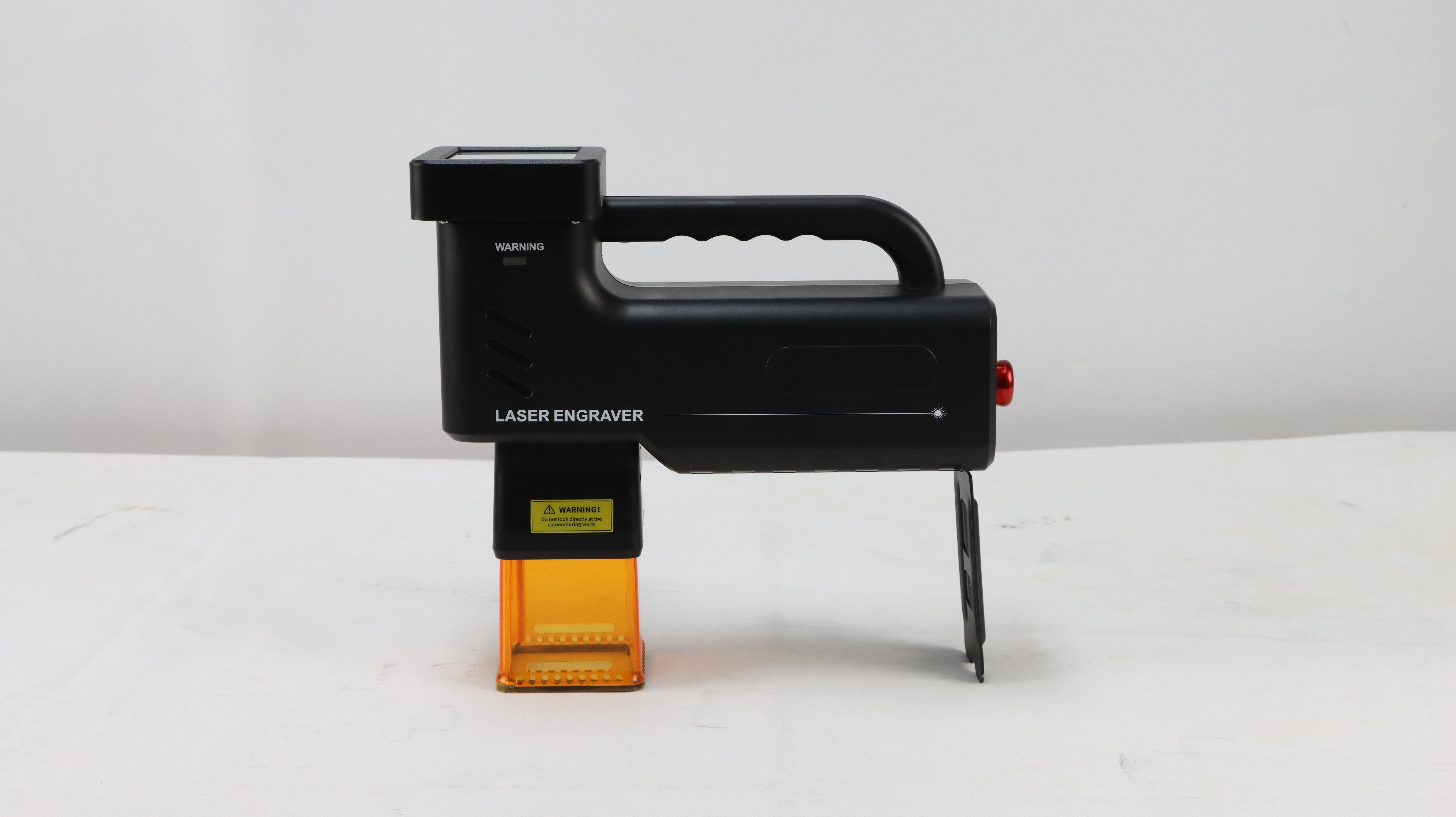
Next step: validate your parameters on your own parts.
Send your substrate, required character height and marking volume, and the team will confirm whether a 355 nm UV, 1064 nm fiber or switchable 1064 nm / 455 nm configuration meets the specification — including material sample testing and OEM / ODM configuration where required.
Brochure: Download the English product brochure (PDF)
Website: www.yuanlaser.com
Email: cheng@yuanlaser.com | WhatsApp: +86 156-2882-7593
Jinan Yuanshida International Trade Co., Ltd. — established 2012, specialising in the R&D, production and export of industrial laser marking equipment for hardware and auto parts, pipes and profiles, electronic components, jewellery and accessories, mechanical parts, gifts and crafts.