Portable Laser Marking Machine vs Fixed Benchtop Systems: A 2026 Comparison Guide for Smart Manufacturing Buyers
Choosing between a portable laser marking machine and a fixed benchtop system is a format decision before it is a power decision. In this product range the two extremes are a 2.7 kg miniature multi-material unit with a switchable 1064 nm / 455 nm dual source, and a 20 kg benchtop fiber machine measuring 325 x 603 x 800 mm. Between them sit a 6 kg handheld fiber unit, an all-in-one desktop fiber machine with 110 x 110 mm to 200 x 200 mm optional marking areas, a flying online unit built for 24/7 moving-line marking, and a 355 nm desktop UV unit for cold marking of plastics and packaging.
The practical answer for most smart manufacturing buyers is that neither format wins outright. Portable formats remove the need to move the part. Fixed formats remove the need to move the operator. The correct choice follows three inputs: part geometry and weight, takt time and volume, and whether the marking point sits inside an automated line or at a standalone workstation.
Format selection in this range spans hand-carried units from 2.7 kg up to a 20 kg benchtop fiber system with a 325 x 603 x 800 mm frame.
The Problem: Format Mismatch Costs More Than Laser Power
In marking cells, the recurring cost is rarely the laser source. It is the handling built around it. Three failure patterns account for most format mistakes:
- Fixed machine, moving part. Large, heavy or long workpieces such as pipes, profiles and welded frames must be carried to a benchtop unit. This adds transport time, handling damage risk and floor space, and it often forces a second handling step before and after marking.
- Portable machine, high volume. A hand-carried unit taken to every part makes repeatability depend on operator positioning, and cycle time rises once batch size grows beyond a few dozen pieces per shift.
- Power chosen before format. A 20/30/50 W benchtop fiber source is specified for work that only needs shallow surface marking, or a heat-based process is used on a substrate that would be better served by a 355 nm cold-marking source.
The practical rule is to record a format decision per part family rather than per factory. One plant can legitimately need a miniature multi-material unit for on-site work on large frames and a fixed benchtop machine for repeatable small-part batches in the same building.
Industry Background: What the 2026 Numbers Say
The laser marking category remains large and fiber-dominated. Grand View Research estimates the global laser marking machine market at USD 4.4 billion in 2026, with fiber laser technology holding a 46.1% revenue share in 2025. Asia Pacific accounts for approximately 44% of revenue share, which is consistent with the concentration of marking-intensive electronics, hardware and automotive supply chains in the region.
Format weight is a useful first filter. Portable and handheld laser marking machines typically weigh between 15 and 35 pounds, or roughly 6.8 to 15.8 kg, according to MAC Laser's 2026 portable marking guide. Two entries in this range sit outside that band in opposite directions: the 2.7 kg miniature multi-material unit is lighter than the typical portable class, and the 20 kg benchtop fiber machine is clearly a stationary system that happens to share the same fiber wavelength.
Compliance expectations are also format-specific. Hand-held laser markers are assessed against EN ISO 11553-2 for hand-held safety, and laser products sold in the United States must comply with FDA 21 CFR Subchapter J (Radiological Health) Parts 1000 through 1005. For trade documentation, HS Code 845611 is the primary classification for machine tools operated by laser processes.
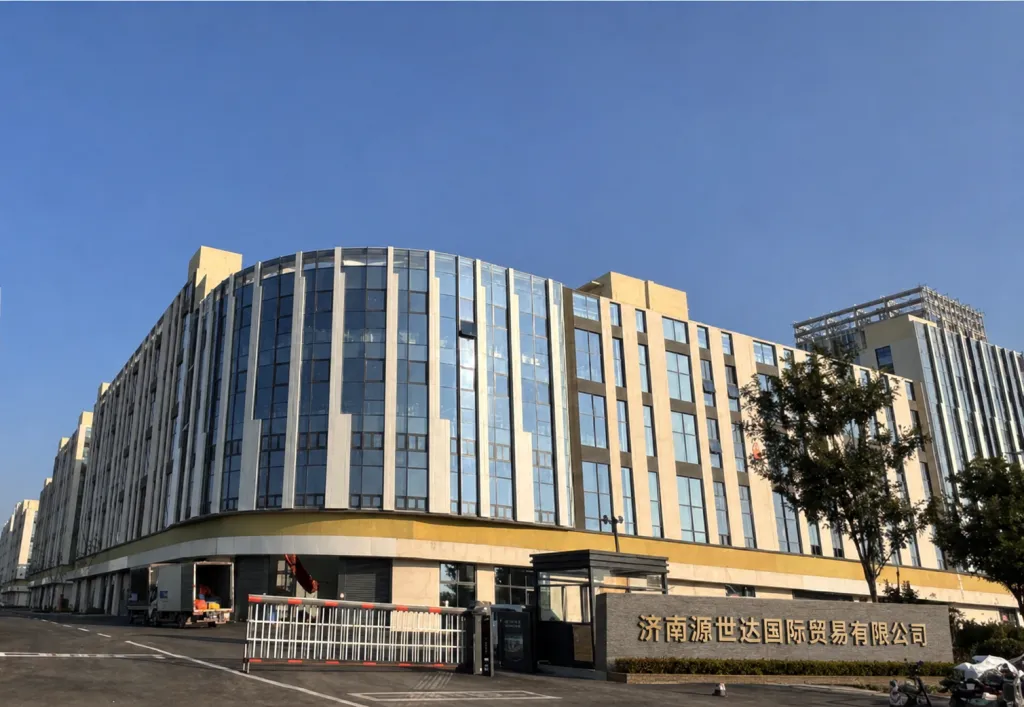
Jinan Yuanshida International Trade Co., Ltd. is a Jinan, China based high-tech enterprise founded in 2012 that designs, produces and exports industrial laser marking equipment. Its range covers handheld, bench-top, desktop and precision laser marking machines, exported to more than 80 countries and regions including Vietnam, Thailand, Malaysia, Türkiye, the United States, Poland and the Middle East, and the company provides OEM/ODM services plus full English after-sales technical support.
The Five Formats in This Product Range
1. Miniature Multi-Material Unit — 2.7 kg, Dual Source
This is the most mobile format in the range. At 2.7 kg it can be carried to a workpiece instead of the reverse, which is the decisive advantage for on-site marking of large-size workpieces, installed frames, pipe assemblies and equipment that cannot be dismantled. The switchable 1064 nm / 455 nm dual light source extends the material mix beyond a single infrared source, so one unit can cover metal marking and the second wavelength needed for materials where 1064 nm alone is a poor fit.
Power is handled two ways: a built-in lithium battery, or DC 20V supply with power bank support. Cooling is air cooling, so there is no water chiller to transport or maintain at the point of use. The marking area is 110 x 110 mm. The trade-off is scope: a 2.7 kg body is built for portability and on-site access, not for the fixture rigidity and depth of a 20 kg stationary platform.
2. Handheld Fiber Unit — 6 kg, Linux Touch Screen
The Second Generation Portable Handheld Fiber Laser Marking Machine is the mid-weight portable option at about 6 kg, with a fiber laser source and a built-in lithium battery for mobile marking without an external power supply. Control is through a 7-inch touch screen running a Linux operating system, with Bluetooth, WiFi and mobile APP control supported.
Its 110 x 110 mm marking area and material coverage make it the general-purpose portable choice: stainless steel, carbon steel, aluminum, copper, iron, gold, silver, acrylic, PVC and leather. Typical applications are mechanical parts, electronic components and medical equipment, which maps to the mechanical parts processing, electronic and electrical production, and medical equipment industries.
3. Benchtop Fiber Machine — 20 kg, 20/30/50 W
The benchtop fiber format is the fixed reference point. The unit measures 325 x 603 x 800 mm and weighs 20 kg, with 20 W, 30 W or 50 W fiber source options at 1064 nm, built-in air cooling and USB control. Because the frame is stationary, focal distance, fixture position and part seating repeat from shift to shift, which is what batch traceability actually depends on.
The constraint is equally clear: every part must travel to the machine, and the machine needs bench or floor space plus a stable platform. In exchange, the 20/30/50 W options allow the buyer to match power to depth of marking rather than accepting a single portable power level.
4. All-in-One Desktop Fiber Machine — 110 x 110 mm to 200 x 200 mm
The all-in-one desktop fiber machine occupies the middle ground between the 2.7 kg portable body and the 20 kg benchtop frame. It is a compact integrated unit with a 110 x 110 mm standard marking area and optional areas up to 200 x 200 mm, which matters when the part envelope grows but the cell layout cannot accommodate a full benchtop footprint. For buyers whose largest part is a plate, housing or panel that exceeds 110 mm on one side, the 200 x 200 mm option avoids stitching or repositioning the workpiece.
5. Flying Online Unit — 24/7 Moving-Line Marking
The flying online laser marking machine is the only format in this range designed to mark while the part is moving, and the only one framed for 24/7 moving-line marking. It belongs to line integration rather than to a workstation: the marking head works in step with a conveyor or transfer system, so marking stops being a separate operation and becomes part of the production flow.
The trade-off is integration effort. A flying online unit requires line speed, triggering and part-present handling to be engineered with the line builder, and it only pays back where volume and continuous operation justify removing the manual load-unload step.
6. Desktop UV Unit — 355 nm Cold Marking
The 355 nm UV desktop unit addresses the material cases that infrared sources handle poorly: plastics, packaging and heat-sensitive substrates. UV output is a cold-processing approach, so marking is achieved with limited thermal input to the surface. Documented application results in this supplier's references include ultra-fine marking down to 10 microns (µm) with no thermal damage reported on sensitive components, and 99.9% scanning accuracy for 2D QR codes and barcodes.
This is the format to select when the failure mode is not weak contrast but surface damage, melting, or deformation around the mark.
Decision Criteria: Four Questions That Settle the Format
Mobility: Can the Part Come to the Machine?
If the workpiece can be lifted to a bench and seated on a fixture, a fixed format gives better repeatability. If it cannot — installed pipework, welded frames, large plates, equipment in service — the decision is already made in favour of a portable format. The 2.7 kg miniature unit and the 6 kg handheld fiber unit exist precisely for the second case.
Line Integration: Is Marking Inside or Outside the Process Flow?
Marking that must keep pace with a continuously moving line belongs to the flying online format. Marking that happens in batches, at a station, with load and unload time available, belongs to benchtop or desktop formats. Attempting to move a flying-line task onto a stationary machine adds a handling step that the line design did not budget for, and attempting to run high-volume work on a hand-carried unit adds operator-dependent variation.
Marking Area: 110 x 110 mm, or Larger?
Four formats here share a 110 x 110 mm marking area: the miniature multi-material unit, the handheld fiber unit, and the standard configuration of the desktop fiber machine. The desktop fiber format can be specified up to 200 x 200 mm. Buyers should measure the largest single mark, not the largest part, and then add fixture clearance. If the mark exceeds the field, the alternatives are repositioning (which introduces a seam) or a larger field option.
Material Mix: Single-Wavelength or Multi-Wavelength?
Where the workload is one metal family, a 1064 nm fiber source covers it. Where the workload mixes metals with plastics, coatings, anodised surfaces or heat-sensitive packaging, a second wavelength earns its place: 455 nm from the miniature dual-source unit, or 355 nm UV from the desktop UV format. Multi-material capability is a format attribute, not an add-on, because the source architecture is decided at order stage.
Step-by-Step: Selecting a Format for a Smart Manufacturing Cell
- List part families, not parts. Group workpieces by material, thickness and mark type (logo, QR/barcode, batch or date code, serial number). This list becomes the basis for every later decision.
- Record maximum weight and dimensions for each family. Anything that cannot be lifted safely to bench height is a candidate for the 2.7 kg miniature or 6 kg handheld format.
- Measure the largest single mark. Compare against 110 x 110 mm as the shared baseline, and against 200 x 200 mm where the desktop fiber option is being considered.
- Classify volume and takt time. Low-volume, high-variety work tolerates portable positioning. High-volume repeat work rewards fixed fixturing or a flying online unit on a moving line.
- Decide the wavelength set. Choose 1064 nm fiber for metals; add 455 nm where the material mix demands a second source; choose 355 nm UV where heat-sensitive plastics and packaging dominate.
- Confirm power, cooling and duty. Select 20 W, 30 W or 50 W on the benchtop format according to marking depth. All formats in this range use air cooling, which removes chiller logistics from the cell.
- Close compliance and acceptance terms in writing. Match the certificate scope to the model ordered and agree the acceptance procedure before the purchase order, not after delivery.
Use Cases by Part Type
Hardware parts. Small, high-variety metal parts suit the benchtop fiber format for batch runs and the handheld fiber unit where parts are marked at the assembly position. Both provide permanent, wear-resistant coding without ink or ribbon consumables in the marking step.
Pipes and profiles. Long workpieces are the clearest case for a portable laser marking machine. The 2.7 kg miniature unit can be brought to the pipe rather than rotating a full length onto a bench, and the 110 x 110 mm field is normally sufficient for a logo plus batch code block.
Electronic components. Fine marking on small components favours a fixed platform where focal distance is constant. Where ultra-fine detail or heat sensitivity is the limiting factor, the 355 nm UV desktop unit provides cold processing with low thermal input.
Jewellery and gifts and crafts. Mixed metals plus coated or plated surfaces benefit from a multi-material approach. The dual-source 1064 nm / 455 nm miniature unit allows one device to cover several substrate types, and the handheld fiber format supports personalisation at the point of sale or in small-batch customisation.
Mechanical spare parts. Serial numbers and date codes on service parts require permanence and readability. The handheld fiber unit's documented material coverage — stainless steel, carbon steel, aluminium, copper, iron, gold, silver, acrylic, PVC and leather — covers most spare-part substrates.
On-site work on large-size workpieces. Installed equipment, structural frames and immovable assemblies are handled by the battery-powered portable formats: built-in lithium battery, DC 20V with power bank support, and air cooling with no external chiller.
Plastics and packaging. The 355 nm desktop UV unit is the appropriate format where the mark must not deform film, moulded parts or coated cartons.
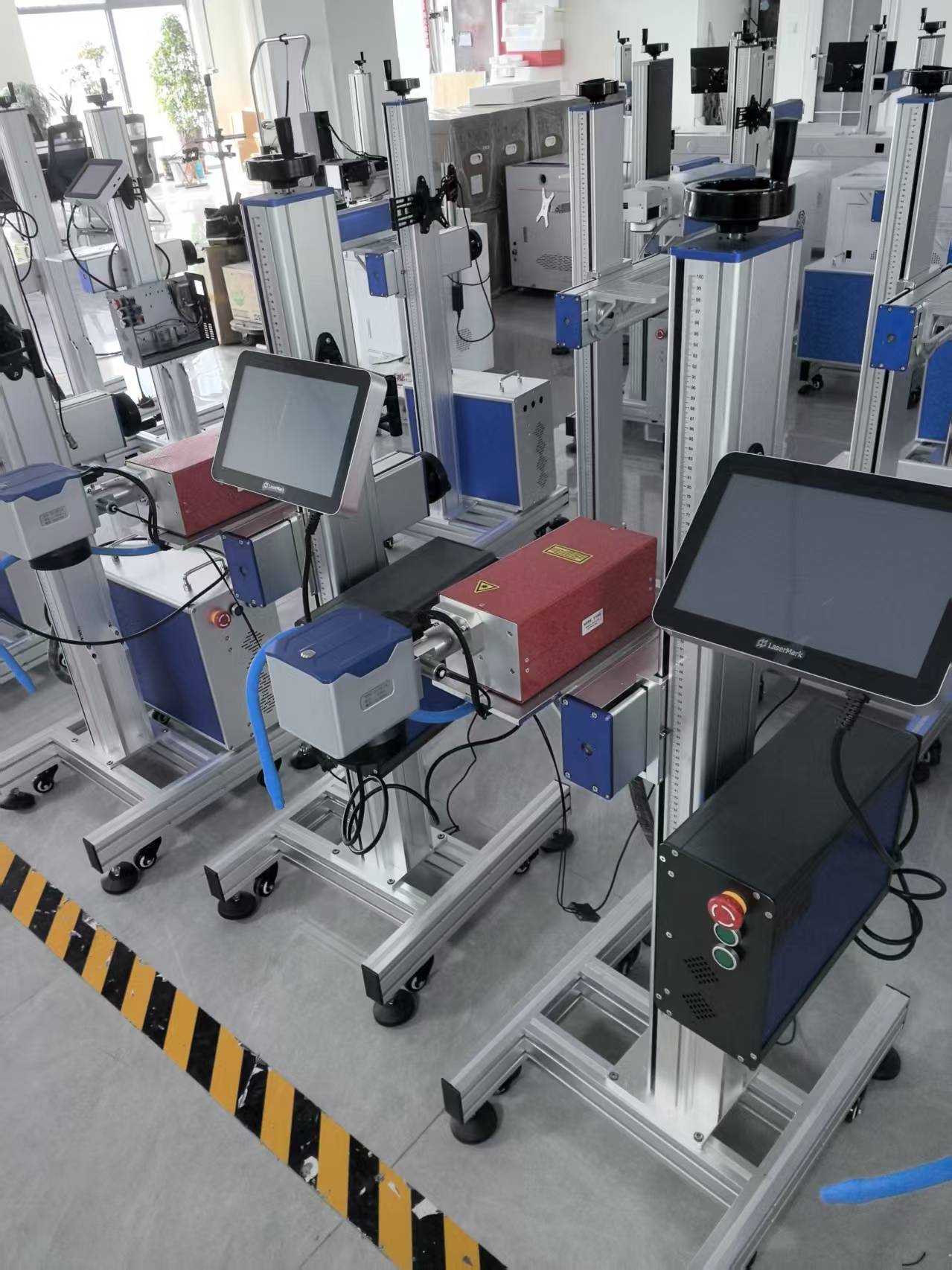
Acceptance in this range is built on pre-shipment aging tests and precision calibration rather than on delivery-day demonstration alone.
Format Comparison Table
| Format | Weight / footprint | Source & wavelength | Marking area | Power supply | Cooling | Best fit | Main constraint |
|---|---|---|---|---|---|---|---|
| Miniature multi-material | 2.7 kg, hand-carried | Switchable 1064 nm / 455 nm dual source | 110 x 110 mm | Built-in lithium battery or DC 20V, power bank support | Air cooling | On-site marking of large or immovable workpieces; mixed materials | Small body limits fixture rigidity and depth capability |
| Handheld fiber (2nd generation) | Approx. 6 kg | Fiber, 1064 nm | 110 x 110 mm | Built-in lithium battery | Air cooling | General-purpose portable marking of metal parts, electronics, medical equipment | Operator positioning affects repeatability at high volume |
| Benchtop fiber | 20 kg, 325 x 603 x 800 mm | Fiber, 1064 nm, 20/30/50 W | Fixed platform | Mains, USB control | Built-in air cooling | Repeatable batch marking, fixed focal distance | Part must be transported to the machine; needs bench or floor space |
| All-in-one desktop fiber | Compact integrated desktop unit | Fiber | 110 x 110 mm, optional up to 200 x 200 mm | Mains | Integrated | Larger part envelope in a small cell | Still a stationary format |
| Flying online | Line-mounted | Fiber | Line-dependent | Line supply | Integrated | 24/7 moving-line marking in automated lines | Requires conveyor and trigger integration with the line builder |
| Desktop UV | Desktop unit | UV, 355 nm cold processing | Desktop field | Mains | Integrated | Plastics, packaging, heat-sensitive substrates | Stationary; cold-processing scope rather than deep metal marking |
Compliance Evidence Attached to a Format
Compliance documents are issued against a machine and a model, not against a product category. In this range the handheld fiber laser marking machine carries a CE Declaration of Conformity numbered M.2024.206.C105275, issued 2024-08-12 by UDEM International Certification Auditing Training Centre Industry and Trade Inc. and valid to 2029-08-12, cited against EN ISO 12100:2010, EN 60204-1:2018, EN 60825-1:2014+A11:2021, EN ISO 11553-1:2020+A11:2020 and the referenced EMC standards.
The same format carries an FDA Radiological Health Electronic Submission Confirmation numbered 2211928-000, issued 2022-11-15 through CCTS (Shenzhen Zhongan Quality Inspection and Certification Co., Ltd) against Title 21 CFR Part 1002 for the United States market. Buyers evaluating a different format in the range should confirm that the certificate scope matches the model on the purchase order, because a handheld-fiber scope document does not automatically extend to a benchtop, flying online or UV configuration.
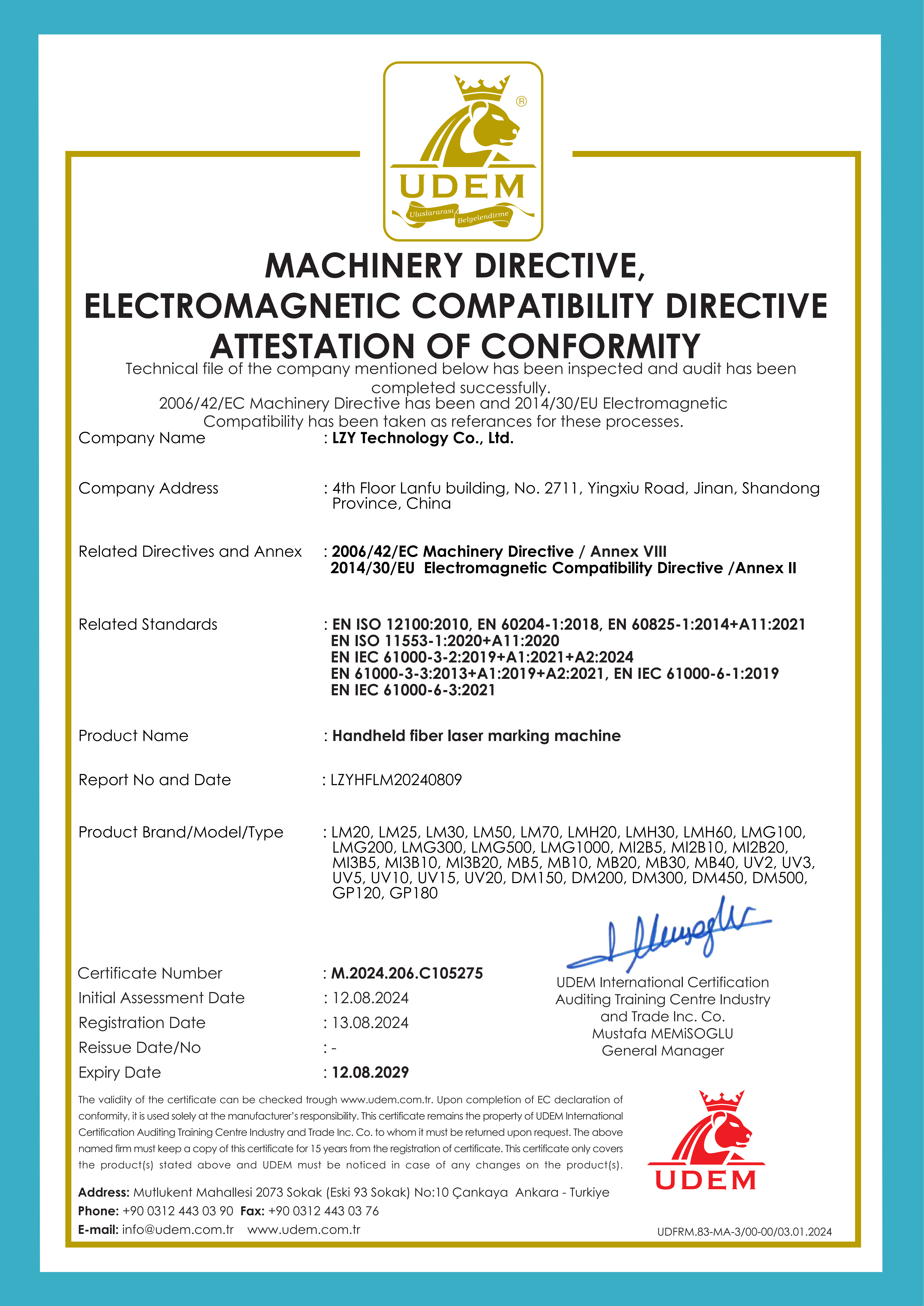
CE Declaration of Conformity M.2024.206.C105275, issued 2024-08-12, valid to 2029-08-12, scope: handheld fiber laser marking machine.
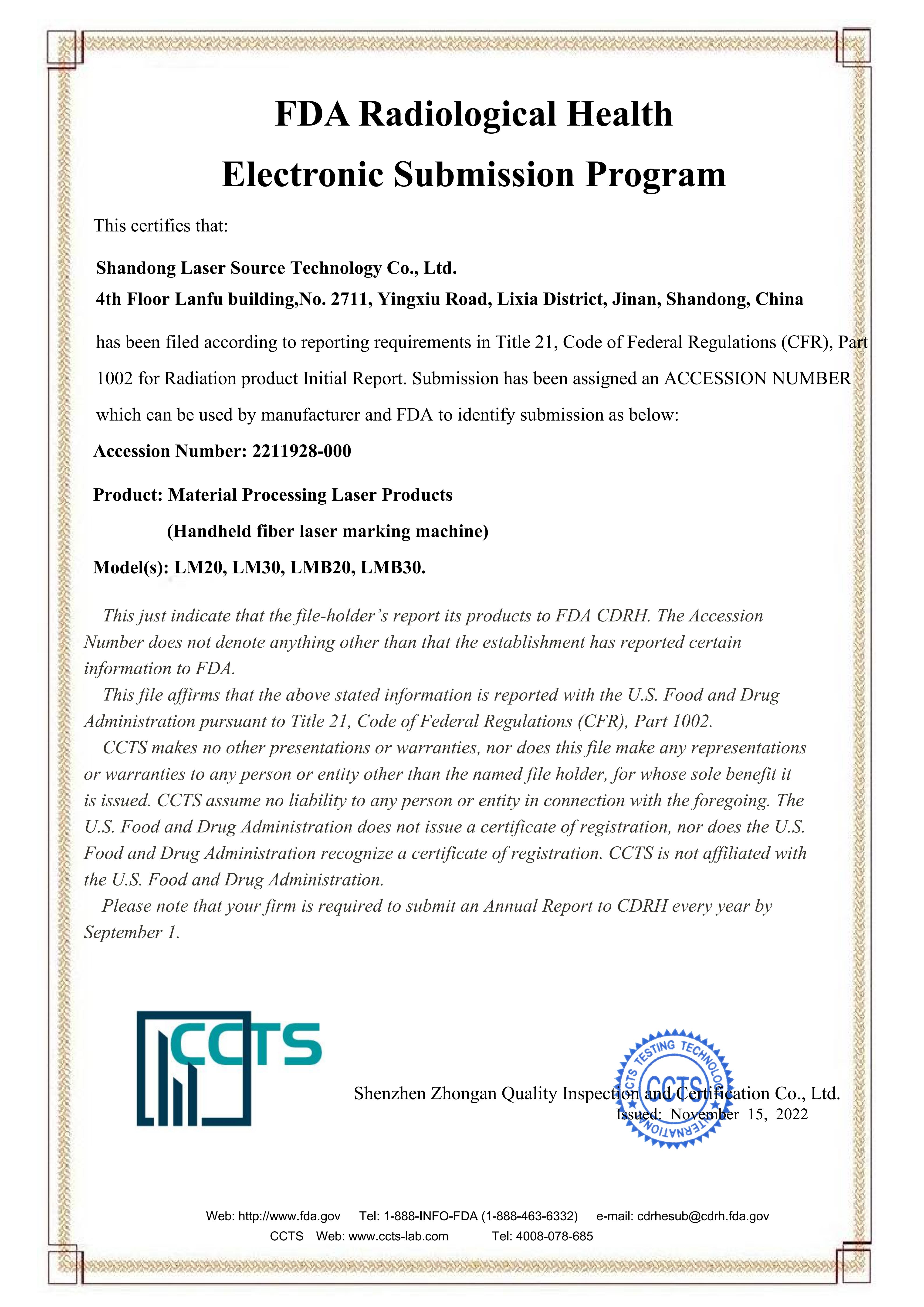
FDA Radiological Health Electronic Submission Confirmation 2211928-000, issued 2022-11-15, standard Title 21 CFR Part 1002, scope: handheld fiber laser marking machine.
Purchasing Terms and Acceptance Checklist
Once the format is fixed, the commercial and verification terms decide whether the delivery matches the specification. The following points apply across this range and should be written into the order.
- MOQ. The minimum order quantity is 5 units for portable laser marking machine orders.
- Payment terms. Deposit plus balance payment.
- Delivery terms. The supplier typically supplies complete machines and international shipping solutions; specific terms such as EXW, FOB or CIF should be confirmed with sales before the order is placed.
- OEM/ODM and customisation. Design and manufacturing services are available with OEM/ODM capabilities, and production services include customised solution development in addition to OEM/ODM production modes. Specific customisation options and limits should be confirmed with sales.
- Pre-shipment verification. All machines undergo aging tests and precision calibration before delivery. Electrical safety screening includes a 72-hour continuous full-load aging test and insulation withstand voltage testing prior to dispatch.
- Acceptance criteria. Acceptance inspection includes pre-shipment aging tests and precision calibration; the specific acceptance procedure — on-site acceptance, remote testing or third-party inspection — should be negotiated and confirmed with the client.
- Safety scope. The equipment is supplied with Class 4 laser safety enclosures, anti-radiation observation windows, safety door interlock switches that cut laser emission when the door opens, an emergency stop button and OD5+ certified laser safety eyewear.
- Electrical protection. Overload protectors, residual current circuit breakers and grounding protection are standard, with automatic thermal shutdown and alarm for the laser source and power supplies.
- Lead time and support. Factory scheduling follows order volume, and full English after-sales technical support is provided.
FAQ
1. Which compliance documents apply to a portable laser marking machine, and does the certificate cover every format?
Compliance is issued per machine and model. In this range the handheld fiber laser marking machine holds a CE Declaration of Conformity numbered M.2024.206.C105275, issued 2024-08-12 by UDEM International Certification Auditing Training Centre Industry and Trade Inc. and valid to 2029-08-12, plus an FDA Radiological Health Electronic Submission Confirmation numbered 2211928-000, issued 2022-11-15 against Title 21 CFR Part 1002 for the United States market. Both documents are scoped to the handheld fiber laser marking machine, so buyers ordering a miniature, benchtop, desktop, flying online or UV configuration should confirm the applicable scope in writing. For reference, portable hand-held markers are assessed against EN ISO 11553-2, and US-bound laser products fall under FDA 21 CFR Subchapter J Parts 1000 to 1005.
2. Which format covers the widest material mix?
Material coverage is a function of wavelength, not of format size. The miniature multi-material unit carries a switchable 1064 nm / 455 nm dual source, which gives one device two wavelength options for mixed-material work. The handheld fiber unit covers stainless steel, carbon steel, aluminium, copper, iron, gold, silver, acrylic, PVC and leather at 1064 nm. The benchtop fiber machine offers 20 W, 30 W or 50 W at 1064 nm for deeper marking. The 355 nm desktop UV unit handles plastics, packaging and heat-sensitive substrates through cold processing. A mixed workload frequently requires two wavelengths rather than one larger machine.
3. What drives the total cost beyond the unit price?
Three factors dominate. First, order quantity: the minimum order quantity is 5 units for portable laser marking machine orders, with deposit plus balance payment terms. Second, handling cost: a stationary format requires the part to travel to the machine, while a portable format requires the operator to travel to the part, and whichever movement is more expensive should be designed out. Third, consumables and cooling: all formats in this range use air cooling, so no water chiller is required, and the marking step itself adds no ink, ribbon or chemical consumable. Delivery terms such as EXW, FOB or CIF are quoted separately and should be confirmed with sales.
4. How can a buyer validate a format before committing to a 5-unit order?
Validation is built around pre-shipment testing rather than a demonstration room sample. All machines undergo aging tests and precision calibration before delivery, and electrical screening includes a 72-hour continuous full-load aging test plus insulation withstand voltage testing before dispatch. Acceptance inspection includes these aging tests and the precision calibration record; the specific procedure — on-site acceptance, remote testing or third-party inspection — is negotiated and confirmed with the client. Where a format decision is still open, the fastest route is to send part samples and mark requirements so the supplier can recommend a configuration and confirm the marking result on the actual material.
5. How is lead time set, and what support continues after delivery?
Factory scheduling follows order volume, so lead time is quoted against the confirmed configuration rather than from a fixed catalogue date. Delivery terms are agreed at order stage, and full English after-sales technical support is provided after delivery. For buyers in evaluation, the practical next step is to request the product catalogue and a format-selection review covering part size, largest single mark, material mix and whether marking sits inside a moving line — contact cheng@yuanlaser.com or WhatsApp +86 156-2882-7593, or download the catalogue from the link below.
Conclusion
The 2026 comparison does not produce a single winner between portable and fixed formats, because the range itself is built to cover different production geometries. The 2.7 kg miniature multi-material unit answers on-site marking of large and immovable workpieces, with a switchable 1064 nm / 455 nm dual source, battery or DC 20V power with power bank support, air cooling and a 110 x 110 mm field. The handheld fiber unit at about 6 kg covers general portable marking with a 7-inch Linux touch screen and app control. The 20 kg benchtop fiber machine at 325 x 603 x 800 mm provides 20/30/50 W at 1064 nm with USB control for repeatable batch work. The all-in-one desktop fiber format bridges the two with areas from 110 x 110 mm up to 200 x 200 mm, the flying online unit takes marking into 24/7 moving-line operation, and the 355 nm desktop UV unit covers cold marking of plastics and packaging.
A defensible decision process is short: classify parts by weight and largest single mark, classify volume and takt time, decide the wavelength set, then close compliance scope, MOQ, payment and acceptance criteria in writing. Buyers who complete those steps before comparing prices avoid the most expensive error in this category — buying a well-built machine in the wrong format.
Next step: match the format to your parts
Send part samples, the largest single mark size and your line arrangement, and the supplier can confirm a configuration, MOQ of 5 units, payment and acceptance terms before you commit.
Catalogue download: Second Generation Laser Marking Machine Catalogue (PDF)
Email: cheng@yuanlaser.com | WhatsApp: +86 156-2882-7593
Website: www.yuanlaser.com | Jinan Yuanshida International Trade Co., Ltd, Jinan, Shandong, China
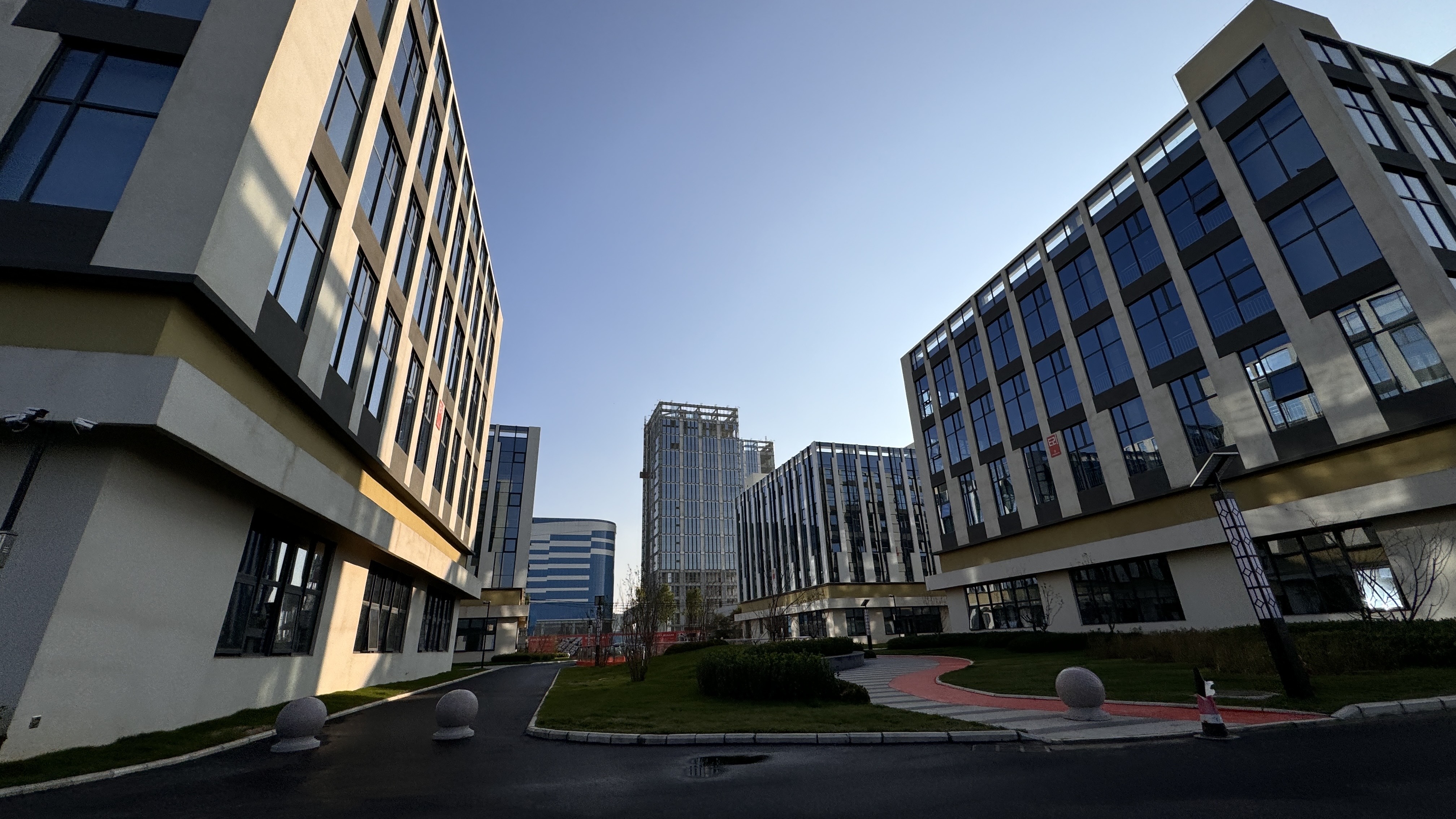
Jinan Yuanshida International Trade Co., Ltd supplies handheld, bench-top, desktop and flying online laser marking formats with OEM/ODM and English after-sales support.
Have Questions or Need More Details?
Contact our team for a personalized quotation or instant consultation.
Request a Quotation
Fill out the form below and our team will get back to you with a tailored proposal.
WhatsApp Direct Chat
Prefer to chat in real-time? Message us on WhatsApp for instant assistance & quick answers.
- Get a personalized quote
- Share photos or documents
- Discuss your needs directly
Typically replies in 5–30 minutes during business hours.