
Portable Laser Marking Machine vs Flying Online Laser Marking: Which Fits Smart Manufacturing?
Equipment Selection · Smart Manufacturing
Short answer: choose the portable format when the workpiece stays still, the material mix changes batch by batch, and the marking has to happen on site, at a bench, or at a large part that cannot be moved to a station. Choose the flying online format when the workpiece is already moving on a conveyor and the mark has to be applied inside the line's existing takt time.
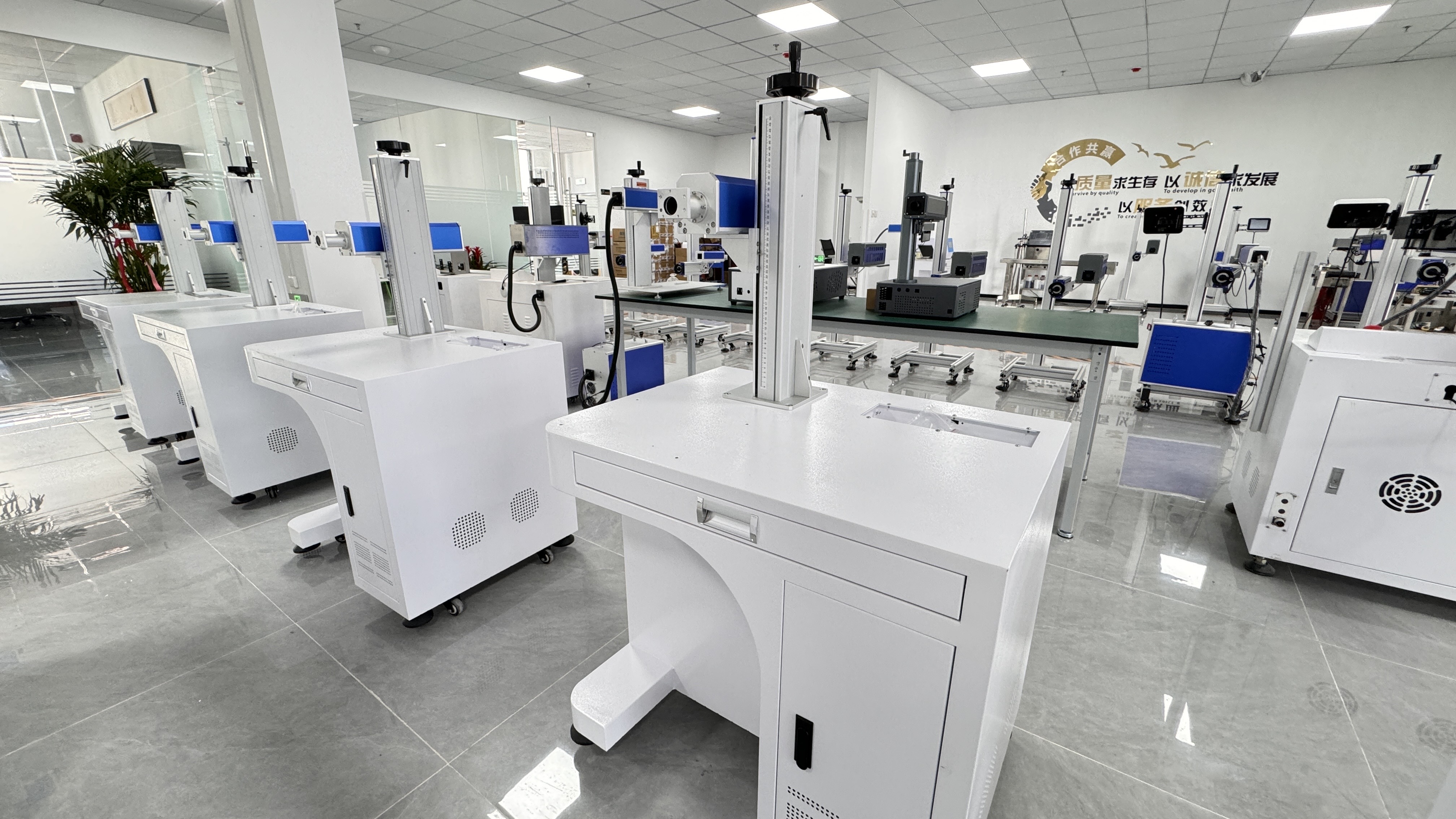
In the comparison below, the portable side is a Miniature Multi-Material Laser Marking Machine with a switchable 1064 nm / 455 nm dual light source, 2.7 kg body, battery or DC 20V power, air cooling, a 110 x 110 mm marking area and a 55 x 55 mm scanning area. The inline side is a Flying Online Laser Marking Machine with a 1064 nm fiber source, M2 < 2, 20–100 kHz pulse frequency adjustment, line speed up to 7,000 mm/s and marking speed up to 12,000 mm/s, mounted on an existing production line. Both are supplied by Jinan Yuanshida International Trade Co., Ltd, a Jinan, China-based exporter of industrial laser marking equipment founded in 2012.
Problem Definition: The Decision Is About Workpiece Motion, Not Laser Power
Most marking projects in smart manufacturing do not fail because the laser is too weak. They fail because the marking format was chosen against the wrong variable. Buyers compare watts, price and brand, then discover that the real constraint was something else entirely: the part never moves, the part moves at a fixed line speed, the part is too large to lift onto a bench, or the material changes three times a shift.
The friction shows up in predictable ways. A portable unit installed next to a high-speed conveyor becomes a manual bottleneck, because every mark depends on an operator positioning a part by hand. A flying online unit installed in a job shop that marks twelve different materials in a week becomes an underused asset, because it is built for repeatable high-volume inline output rather than flexible on-site work.
Three operational questions decide the format before any specification is discussed:
- Is the workpiece stationary or moving at the moment of marking? A stationary part can be marked by a portable head carried to the part; a moving part requires the marking head and the line to share a trigger and a speed reference.
- Is the batch mixed-material or single-material high-volume? A dual-wavelength portable head can switch light sources between jobs; an inline fiber head is configured around one wavelength and one production recipe.
- Is the constraint floor space, power access, or throughput? A 2.7 kg portable body running on a built-in lithium battery or DC 20V removes both the footprint and the fixed power drop. An inline unit running on single-phase AC 90–260V at up to 400 W removes the manual handling instead.
Getting this wrong creates cost on both sides: the wrong machine, plus the integration, training and acceptance work that has to be redone when the format is corrected.
Industry Background: Why Both Formats Are Growing at the Same Time
Laser marking is no longer a standalone finishing operation. In smart manufacturing it is a data step: a serial number, a QR code, a batch code, or a date code that has to be readable by a scanner downstream and traceable for years afterwards. That shift explains why two very different machine formats are expanding simultaneously.
The overall category is substantial. Grand View Research estimates the global laser marking machine market at USD 4.4 billion in 2026, and reports that fiber laser technology held a 46.1% revenue share in 2025. The same source places Asia Pacific at roughly 44% of revenue share in 2025, which matters for buyers sourcing equipment and spare parts across that region.
What the public data does not tell you: published market reports quantify fiber share and regional share, but they do not break out how much of the category is portable or handheld versus fixed inline equipment. When a supplier quotes a split between portable and online formats, ask for the underlying source. In this article, portable and inline claims are drawn from the supplied product specifications, not from market estimates.
Two structural pressures keep both formats relevant. First, traceability requirements push marking into more stages of production, including stages where parts are large, already assembled, or physically difficult to move. Second, line speed pressure pushes marking into the line itself, where a separate handling step would break the flow. A single plant can legitimately need both: an inline head for the main conveyor and a portable head for rework, spares, and oversize components.
For international shipments, laser marking machine tools are typically classified under HS code 845611, which is the primary classification for machine tools operated by laser processes. Buyers preparing import documentation should confirm the classification with their customs broker for the specific configuration ordered.
Detailed Solution: Two Marking Architectures, Two Operating Logics
Portable format: 2.7 kg, dual light source, battery or DC 20V
The Miniature Multi-Material Laser Marking Machine is built around portability as a functional requirement, not a convenience. The body weighs 2.7 kg, which allows it to be carried to the workpiece rather than bringing the workpiece to a station. Power comes from a built-in lithium battery or DC 20V, with power bank support, and overall power consumption is 100 W or less with air cooling. That combination removes the need for a dedicated power drop at the marking location.
The light source is the defining capability. It uses a dual light source that switches between 1064 nm and 455 nm, operating in pulse mode with a power regulation range of 25–100 in gradient steps. In practice this means one machine can be re-tuned for a metal plate and then for a coated or heat-sensitive surface without changing hardware. The stated material fit covers metals, bamboo and wood, leather, paper, colored glass, plastics and ceramics.
Optical and control details matter for real work:
- Processing speed up to 4,000 mm/s, with a scene focal length of 133 mm.
- Marking area of 110 x 110 mm, with a 55 x 55 mm scanning area — the scanning field is narrower than the marking area, so layout planning should be based on the scanning geometry for fine detail work.
- Operation through mobile app, PC software or a touch screen.
- TYPE-A for data and TYPE-C for power, which allows a standard power bank or a laptop-class supply to run the unit.
Weight deserves a calibration note for buyers. A commonly cited buying guide places handheld and portable marking units in the 15–35 lb range, roughly 6.8 to 15.8 kg. This unit is listed at 2.7 kg. Weight should therefore be read per model and per configuration, not assumed from the category label, especially when the machine will be carried up ladders, into containers or across a shop floor.
Flying online format: 1064 nm fiber, M2 < 2, 20–100 kHz
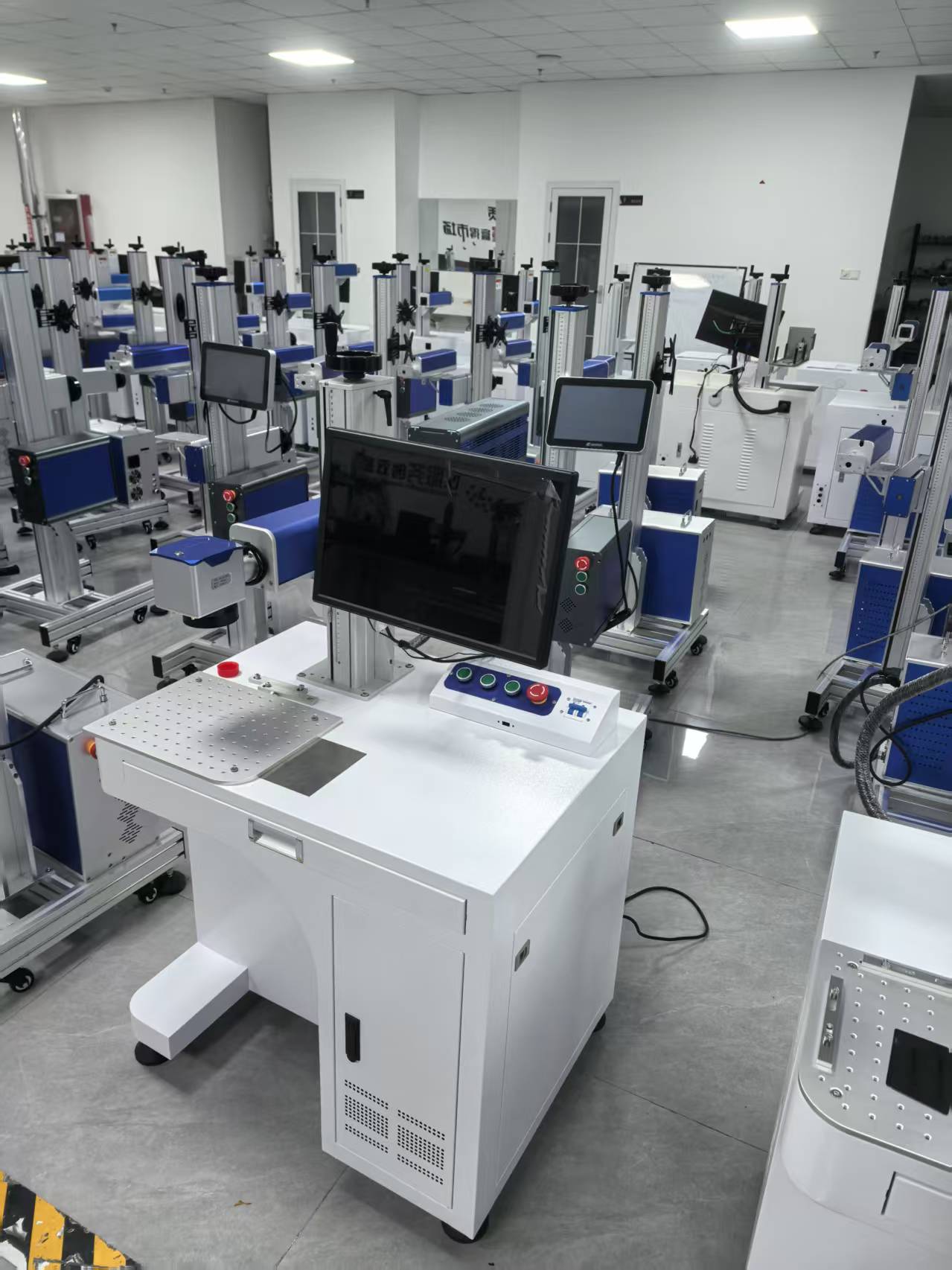
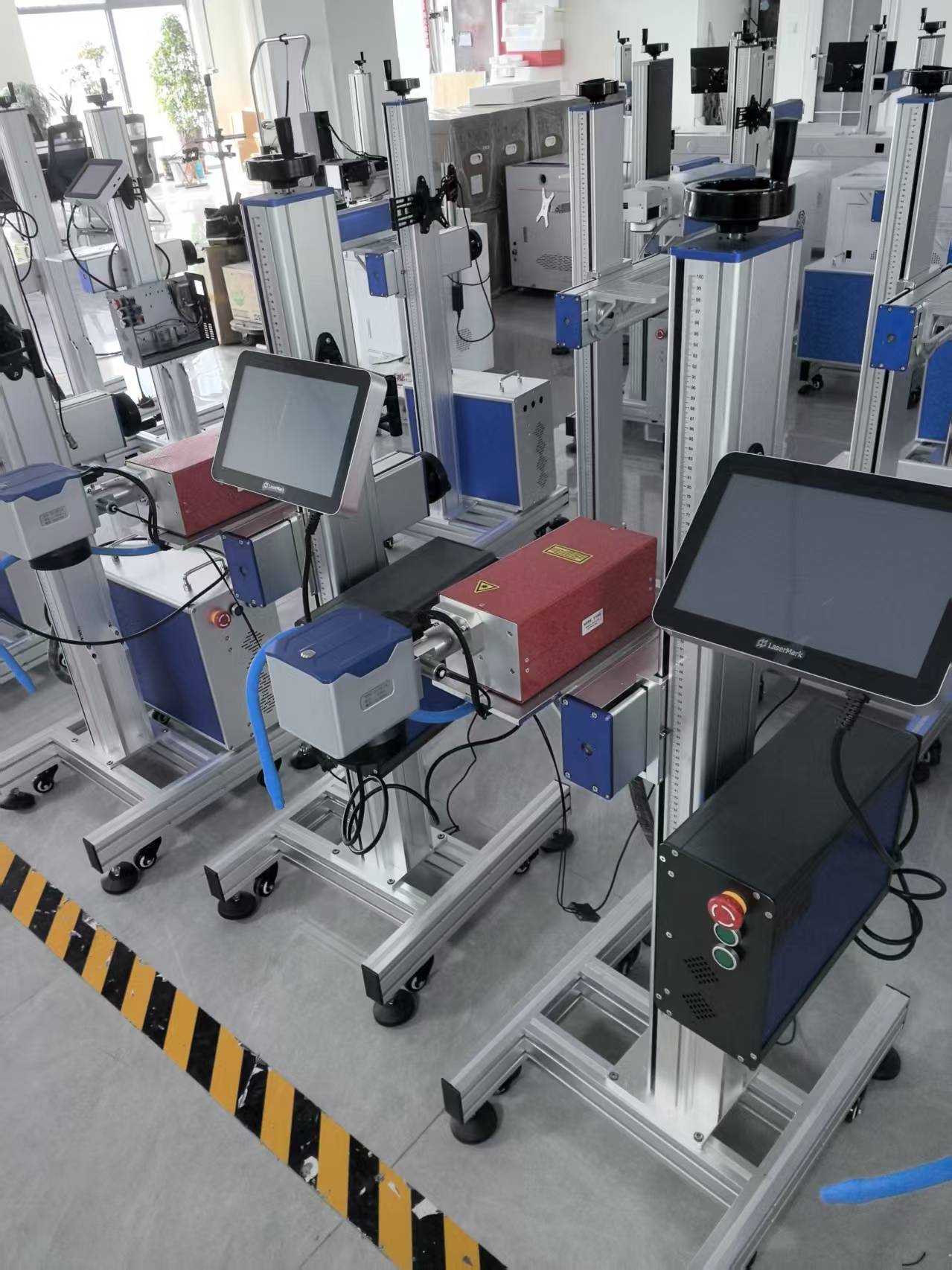
The Flying Online Laser Marking Machine is designed for the opposite condition: the part keeps moving and the marking has to keep up. The source is a 1064 nm fiber laser with beam quality M2 < 2, pulse frequency adjustable from 20 kHz to 100 kHz, and a stated laser lifespan of 150,000 hours. Cooling is built-in air cooling and overall power consumption is 400 W or less, running on single-phase AC 90–260V at 50–60 Hz.
Throughput figures define the integration envelope:
- Line speed up to 7,000 mm/s, with continuous online marking speed up to 12,000 mm/s.
- Output rate of 800 standard characters per second.
- Engraving depth up to 0.4 mm, minimum line width 0.012 mm and minimum character 0.15 mm.
- Focal spot diameter 0.01 mm and repeatability of +/- 0.003 mm.
- Standard marking area of 110 x 110 mm, with 150 x 150 mm available as an option.
Physical integration is also part of the specification. The main unit measures 500 x 500 x 300 mm and the overall machine measures 1470 x 580 x 840 mm, which is the footprint that has to fit around an existing conveyor rather than inside a workbench. Control is through standard USB or touch screen PC control. Material fit is centred on metals such as steel, metal components and hardware, plastics including PE and PVC, electronic components, building materials and packaging substrates — the profile of food and beverage, pharmaceutical, daily chemical, hardware, auto parts, steel, cement and electronics lines.
Step-by-Step Breakdown: Six Configuration Checkpoints Before You Commit
The six checks below are ordered by the cost of getting them wrong. A mistake in step one invalidates everything after it.
Step 1 — Fix the workpiece motion state
Answer one question in writing: at the moment of marking, is the part stationary or moving? If it is stationary, including parts that are simply too large to bring to a station, the portable format is the structurally correct starting point. If it is moving at a defined line speed, the flying online format is the structurally correct starting point. Do not use throughput estimates to answer this question; a slow line is still a moving line.
Step 2 — Match marking geometry to the actual graphic
The portable unit provides a 110 x 110 mm marking area with a 55 x 55 mm scanning area. The flying online unit provides a 110 x 110 mm standard area with an optional 150 x 150 mm area. If the mark includes a wide logo plus a dense QR code plus a date code, size the field on the combined layout, and treat the 150 x 150 mm option as a configuration checkpoint rather than an afterthought — retrofitting a larger field later changes the optical setup.
Step 3 — Confirm power architecture and floor footprint
For the portable unit, confirm how the machine will actually be powered on site: built-in lithium battery, DC 20V with a power bank, or a combination. For the inline unit, confirm a single-phase AC 90–260V supply at 50–60 Hz and reserve the 1470 x 580 x 840 mm overall envelope plus maintenance access. A machine that fits the drawing but blocks access to the conveyor is a machine that will be bypassed.
Step 4 — Verify material fit against your real batch mix
The portable unit is specified for metals, bamboo and wood, leather, paper, colored glass, plastics and ceramics, with a switchable 1064 nm / 455 nm source. The inline unit is specified for metals, PE and PVC plastics, electronic components, building materials and packaging substrates on a 1064 nm fiber source. Map your actual bill of materials against these lists before ordering, and test the two or three substrates that cause the most trouble rather than the easiest one.
Step 5 — Decide who operates the machine and how it is triggered
The portable unit supports mobile app, PC software and touch screen operation, which suits an operator who walks to the part. The inline unit uses standard USB or touch screen PC control, which suits a line operator who needs a fixed interface and a repeatable trigger. Operator skill, shift pattern and who owns changeovers should be settled before acceptance, because they determine training scope.
Step 6 — Assemble acceptance and safety evidence
Acceptance is where most disputes originate. The supplier's stated position is that all machines undergo aging tests and precision calibration before delivery, with acceptance inspection including pre-shipment aging tests and precision calibration. On electrical safety, the stated build includes overload protectors, residual current circuit breakers, grounding protection, and automatic thermal shutdown and alarm mechanisms for lasers and power supplies, plus a 72-hour continuous full-load aging test and insulation withstand voltage testing before dispatch. On laser safety, the stated configuration includes Class 4 laser safety enclosures, anti-radiation observation windows, safety door interlock switches that cut laser emission when the door opens, an emergency stop button, and OD5+ anti-laser protective eyewear. Buyers should confirm in writing which of these items apply to the exact format ordered, since an enclosed inline head and a handheld portable head do not carry identical physical guarding.
Use Cases: Where Each Format Earns Its Place
Portable laser marking machine use cases
Portable marking wins where handling the part costs more than marking it. Typical assignments include:
- On-site marking of large-size workpieces: frames, weldments, castings and assembled structures that cannot be carried to a bench.
- Pipes and profiles: long stock where moving the part means moving a whole rack.
- Hardware parts and mechanical spare parts: part numbers, batch codes and service identifiers applied at the point of storage.
- Electronic components and 3C accessories: fine characters on small parts, supported by the 55 x 55 mm scanning geometry.
- Jewelry, gifts and crafts: personalized marking where the material and the artwork change job to job, including leather, wood, paper, colored glass and ceramics.
- Mixed-material multi-material batches: one unit switching between 1064 nm and 455 nm across a shift instead of dedicating a machine per substrate.
- Field and remote sites: battery or DC 20V operation where no fixed power drop exists.
Flying online laser marking machine use cases
Inline marking wins where stopping the part costs more than marking it. Typical assignments include:
- Food, beverage and packaging lines: date codes, batch codes and lot codes marked while the product moves.
- Pharmaceutical and daily chemical production: serialized codes applied at line speed for downstream scanning.
- Hardware, auto parts and electronics lines: permanent part identification inside an existing takt time.
- Building materials, steel and cement: durable marks on rough industrial surfaces where engraving depth up to 0.4 mm is relevant.
- Traceability workflows: high-volume code output where an 800 characters-per-second output rate and +/- 0.003 mm repeatability support scanner read rates.
Comparison Table: Portable vs Flying Online Laser Marking
The table below uses only the supplied specifications for the two formats. Where a value is optional, it is marked as optional rather than assumed.
| Decision dimension | Portable (Miniature Multi-Material) | Flying online (Inline fiber) |
|---|---|---|
| Workpiece state | Stationary or on-site; head moves to the part | Moving on an existing production line |
| Light source | Dual light source, switchable 1064 nm / 455 nm, pulse mode | 1064 nm fiber laser, beam quality M2 < 2 |
| Frequency / power regulation | Power regulation range 25–100, gradient adjustable | Pulse frequency 20–100 kHz adjustable |
| Weight / footprint | 2.7 kg body, hand-carried | Main unit 500 x 500 x 300 mm; overall 1470 x 580 x 840 mm |
| Marking area | 110 x 110 mm | 110 x 110 mm standard; 150 x 150 mm optional |
| Scanning area | 55 x 55 mm, focal length 133 mm | Not stated as a separate field; focal spot diameter 0.01 mm |
| Speed | Processing speed up to 4,000 mm/s | Line speed up to 7,000 mm/s; continuous online marking speed up to 12,000 mm/s; 800 characters per second |
| Power and cooling | Built-in lithium battery or DC 20V (power bank supported); 100 W or less; air cooling | Single-phase AC 90–260V, 50–60 Hz; 400 W or less; built-in air cooling |
| Control interface | Mobile app, PC software, touch screen; TYPE-A data, TYPE-C power | Standard USB or touch screen PC control |
| Stated material fit | Metals, bamboo and wood, leather, paper, colored glass, plastics, ceramics | Metals (steel, hardware), PE and PVC plastics, electronic components, building materials, packaging substrates |
| Precision reference | Defined by scanning area and focal length | Repeatability +/- 0.003 mm; minimum line width 0.012 mm; engraving depth up to 0.4 mm |
| Laser service life | Not stated in the supplied specification | 150,000 hours stated laser lifespan |
| Best-fit production pattern | Mixed-material, mixed-batch, on-site, low-to-medium volume with variable handling | Single-recipe, high-volume, continuous inline output with fixed handling |
Quick decision rule
| If your production looks like this | Start with |
|---|---|
| Parts are carried to a bench, or the part cannot be moved at all | Portable |
| Material mix changes between jobs or between shifts | Portable (dual 1064 nm / 455 nm source) |
| No fixed power drop, or marking happens at multiple locations | Portable (battery or DC 20V) |
| Marking must happen inside an existing conveyor takt time | Flying online |
| High-volume, single-recipe coding with downstream scanning | Flying online |
| Large mark layout needing a wider field | Flying online with optional 150 x 150 mm area |
FAQ
What laser radiation and electrical safety evidence should I verify before accepting either format?
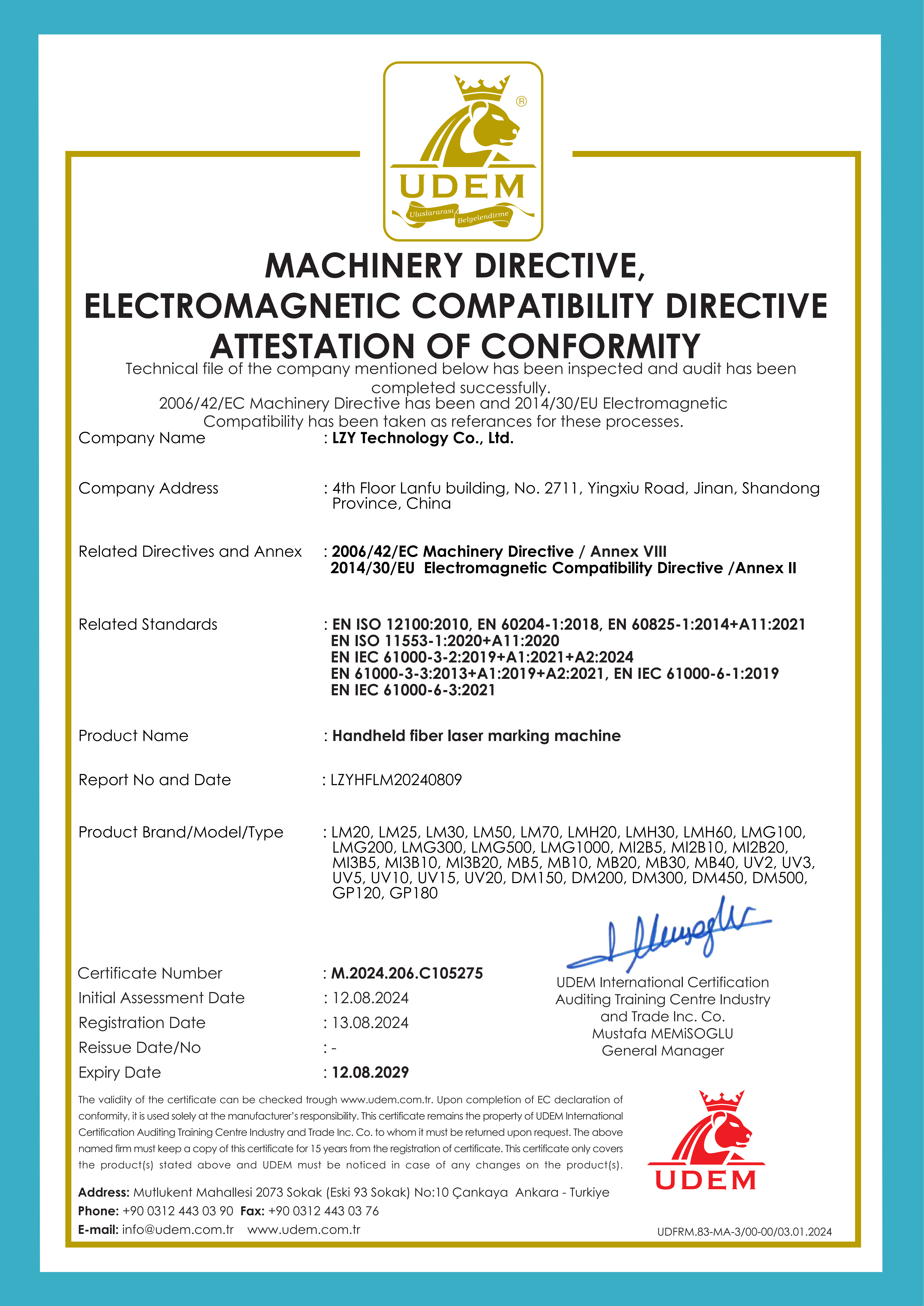
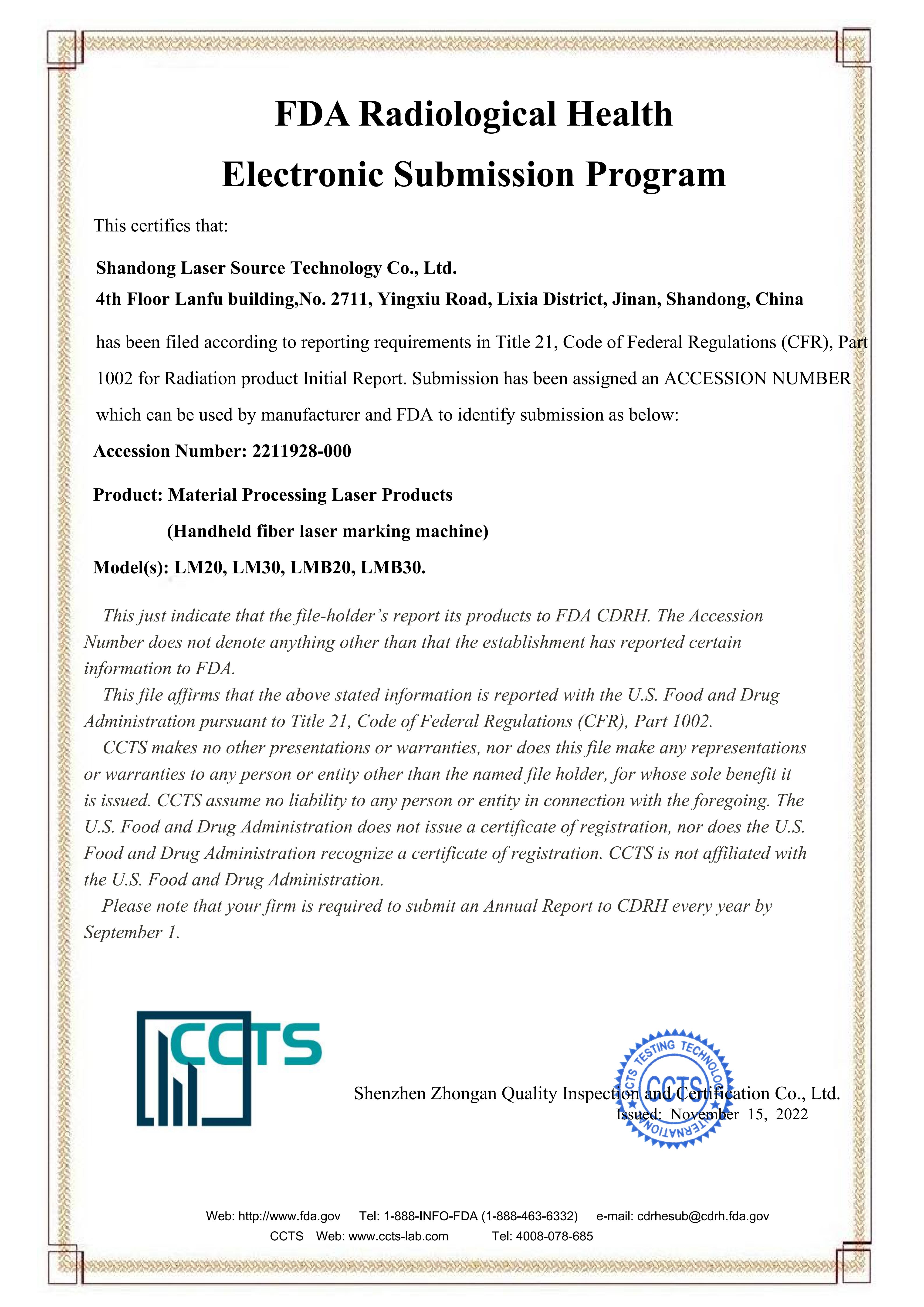
Ask for the safety configuration in writing and match it to the format you are buying. The stated build includes Class 4 laser safety enclosures, anti-radiation observation windows, safety door interlock switches that cut laser emission when the door is opened, an emergency stop button, and OD5+ anti-laser protective eyewear. On the electrical side, the stated build includes overload protectors, residual current circuit breakers, grounding protection, plus automatic thermal shutdown and alarm mechanisms for the laser and power supply, with a 72-hour continuous full-load aging test and insulation withstand voltage test before dispatch. Documented certification for the handheld fiber laser marking machine includes CE Declaration of Conformity M.2024.206.C105275 issued by UDEM on 2024-08-12 and valid to 2029-08-12, assessed against EN ISO 12100:2010, EN 60204-1:2018, EN 60825-1:2014+A11:2021, EN ISO 11553-1:2020+A11:2020 and the listed EMC standards; and an FDA Radiological Health Electronic Submission Confirmation, number 2211928-000, issued 2022-11-15 under Title 21 CFR Part 1002. For reference, laser products sold in the USA fall under FDA 21 CFR Subchapter J, Parts 1000–1005, and hand-held laser marking safety is commonly assessed against EN ISO 11553-2. Because the certificates above are scoped to the handheld fiber model, request the equivalent declaration for the exact model and configuration you purchase.
Can one portable machine really cover a mixed metal-and-plastic batch, and where does the flying online unit stop being the right answer?
Within its stated specification, yes. The portable unit uses a switchable 1064 nm / 455 nm dual light source in pulse mode with a 25–100 gradient power regulation range, and is listed for metals, bamboo and wood, leather, paper, colored glass, plastics and ceramics, with processing speed up to 4,000 mm/s. The flying online unit is a 1064 nm fiber source with M2 < 2 and 20–100 kHz adjustment, listed for metals, PE and PVC plastics, electronic components, building materials and packaging substrates. It stops being the right answer when the part is stationary, when the part is too large to bring to the line, or when the batch changes material faster than the line recipe can be changed — those are handling problems that line speed cannot solve.
What are the minimum order quantity and the commercial terms?
The minimum order quantity is 5 units. Payment terms are deposit plus balance. The supplier typically supplies complete machines and international shipping solutions; specific delivery terms such as EXW, FOB or CIF should be confirmed with sales for the destination and configuration. Factory scheduling depends on order volume, so the order sequence and the delivery window should be fixed together rather than separately.
How is marking quality validated before shipment?
All machines undergo aging tests and precision calibration before delivery, and acceptance inspection includes pre-shipment aging tests and precision calibration. Specific acceptance procedures — on-site acceptance, remote testing or third-party inspection — should be negotiated and confirmed with the client before the order is placed. For a format decision like this one, test the two or three substrates that cause the most difficulty in your own production, not the easiest sample in the catalogue.
What lead time applies, and what should be prepared before ordering?
Lead time is scheduled by the factory according to order volume, so the confirmed date should come from sales against a specific configuration rather than from a general estimate. Before ordering, prepare the substrate list, the mark layout and required field size, the power situation at the marking location, and the safety evidence you expect at acceptance. Jinan Yuanshida International Trade Co., Ltd supports customized marking solutions alongside OEM and ODM production, with full English after-sales technical support, and the company states that its equipment is exported to more than 80 countries and regions including Vietnam, Thailand, Malaysia, Turkey, the United States, Poland and the Middle East. You can download the product brochure and specification detail here, or send the marking sample and substrate list to yuanlaser.com for a configuration check.
Conclusion: Choose the Format That Matches How the Part Moves
The portable versus flying online decision is settled by workpiece motion, not by laser power. If the part is stationary, oversized, mixed-material, or marked at multiple locations, the portable format with a 2.7 kg body, switchable 1064 nm / 455 nm source, battery or DC 20V power, air cooling, 110 x 110 mm marking area and 55 x 55 mm scanning area is the structurally correct choice. If the part is already moving and the mark must fit inside an existing takt time, the flying online format with a 1064 nm fiber source, M2 < 2, 20–100 kHz adjustment, line speed up to 7,000 mm/s and continuous online marking speed up to 12,000 mm/s is the correct choice — with the optional 150 x 150 mm area confirmed at the configuration stage, not after installation.
Both paths end at the same place: acceptance evidence. Before the purchase order closes, confirm the safety configuration for the exact model, the aging and calibration records that accompany shipment, the agreed acceptance procedure, and the marking sample on your own substrates. That is the part of the decision that determines whether the machine is still producing good marks twelve months after installation.
Next Step: Confirm the Format Against Your Own Parts
Send your substrate list, required mark size, and whether the part is stationary or moving on a line. Jinan Yuanshida International Trade Co., Ltd will map it to the Miniature Multi-Material portable format or the Flying Online inline format and return a configuration with marking area, power option, and control interface confirmed. MOQ is 5 units, with OEM and ODM production available for customized marking solutions.
Website: www.yuanlaser.com · Email: cheng@yuanlaser.com · Contact: Yuanyuan, +86 156-2882-7593 (WhatsApp available)
Address: Room 909, Unit 1, Building 1, Kangqiao Yidong Mansion Complex, No. 5326, Aoti Middle Road, Shunhua Road Subdistrict, Jinan Area, China (Shandong) Pilot Free Trade Zone
Product brochure (specification detail, downloadable): Download the English brochure
Have Questions or Need More Details?
Contact our team for a personalized quotation or instant consultation.
Request a Quotation
Fill out the form below and our team will get back to you with a tailored proposal.
WhatsApp Direct Chat
Prefer to chat in real-time? Message us on WhatsApp for instant assistance & quick answers.
- Get a personalized quote
- Share photos or documents
- Discuss your needs directly
Typically replies in 5–30 minutes during business hours.