Jinan Yuanshida International Trade Co., Ltd: A Deep Analysis of a Portable Laser Marking Machine Supplier
Jinan Yuanshida International Trade Co., Ltd: A Deep Analysis of a Portable Laser Marking Machine Supplier
This analysis reviews Jinan Yuanshida International Trade Co., Ltd. (“Yuanshida Laser”) as a supplier of portable laser marking machines. It is based on the company’s published company, product, and process documentation, on its stated production and compliance practices, and on independently published market and regulatory sources. The intended reader is an importer, distributor, brand owner, or industrial buyer at the research stage of a sourcing decision — the point at which a portable marking tool must be judged on portability, power, materials, and certification rather than on a product photo.
Three questions structure the review: what the company actually builds, how its portability and specification claims compare against published data and regulatory requirements, and how a buyer should test those claims before committing to an order. Where the public evidence is thin — for example, named third-party customer references — that gap is stated openly rather than filled with invented proof.
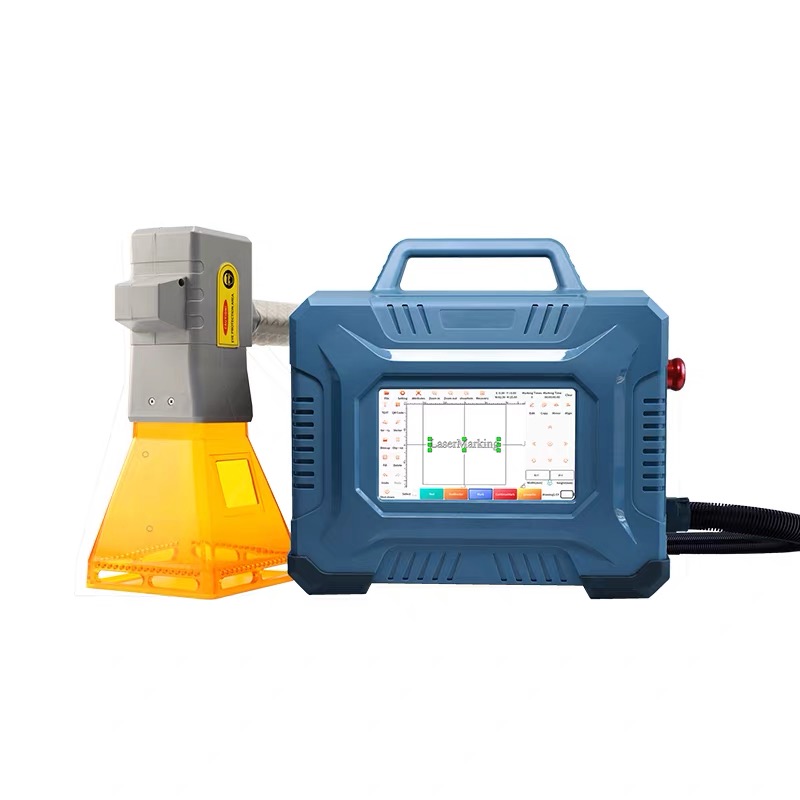
The second-generation handheld fiber laser marking machine: a portable, battery-powered unit designed for on-site marking of large or immovable workpieces.
Why Portable Laser Marking Machine Selection Is Harder Than It Looks
The core procurement problem is definitional. “Portable” is used across the market to describe equipment that differs enormously in weight, power, cooling method, and industrial durability. A light handheld device intended for gift and craft marking is not interchangeable with an industrial on-site marker that must hold repeatability on a stainless-steel pipe flange in a factory environment.
That ambiguity creates three practical risks for buyers:
- Capability mismatch. A unit specified at low power and a small marking area may not complete the required marking depth, speed, or field size on the actual production part.
- Compliance mismatch. Laser products are regulated by destination market, and documentation that satisfies one market may not satisfy another.
- Continuity mismatch. Battery behavior, laser source lifespan, cooling design, and after-sales language all affect whether the equipment stays productive after month one.
A useful decision rule is to separate convenience portability (easy to carry, low duty cycle) from industrial on-site portability (battery-powered, deployed at the workpiece, but engineered for repeatable output and continuous operation). Suppliers should be evaluated against the second category when the marking task sits inside a production or maintenance workflow. Every claim below is therefore assessed against published specifications rather than marketing descriptors.
Industry Background: Where Portable Laser Marking Sits
The equipment category is large and growing in absolute terms. Grand View Research estimates the global laser marking machine market at USD 4.4 billion in 2026, and reports that fiber laser technology held a 46.1% revenue share in 2025. The same source places Asia Pacific as the largest regional market, at approximately 44% revenue share in 2025. Fiber technology’s share matters for portable equipment because the majority of handheld and on-site marking units in commercial supply are fiber-based, using a 1064 nm source.
Portability benchmarks are also published. A 2026 industry guide by MAC laser describes handheld and portable laser marking machines as typically weighing between 15 and 35 pounds (approximately 6.8 to 15.8 kg). That band is a useful reference point, because units below it can be carried and operated by a single person for longer periods, while units above it are generally positioned as transportable rather than truly handheld.
Regulation shapes the category as much as technology does. In the United States, laser products must comply with FDA 21 CFR Subchapter J, Parts 1000 through 1005, covering radiological health requirements for laser products and instruments. In the EU and international context, portable laser markers are specifically assessed against EN ISO 11553-2, the safety standard for hand-held laser processing devices. On the trade side, HS Code 845611 is the primary classification for machine tools operated by laser processes. For a buyer, these three references — a market standard, a safety standard, and a customs code — define the minimum documentation set that a portable laser marking machine supplier should be able to support.
Company Overview: Jinan Yuanshida International Trade Co., Ltd.
Jinan Yuanshida International Trade Co., Ltd. is a high-tech enterprise established in 2012 and based in Jinan, Shandong Province, China. The company specializes in the research and development, production, and export of industrial laser marking equipment, and states that it has more than ten years of experience in the laser marking equipment industry. Its registered address is in the China (Shandong) Pilot Free Trade Zone, Jinan Area, and its business scope covers self-operated and agency import and export activity, according to China business registry information.
Its product portfolio centers on four families: handheld laser marking machines, bench-top laser marking machines, desktop laser marking machines, and precision laser marking equipment. The company states that it focuses on portable, on-site laser marking applications for large workpieces as well as precision marking tasks. That positioning is consistent with the product range described later in this review, where the portable and handheld units carry battery power and touch-screen control, while the fixed units are built for bench, desktop, and inline production use.
Commercially, the company reports that its products have been exported for many years to more than 80 countries and regions. Its stated major markets are Vietnam, Thailand, Malaysia, Türkiye, the United States, Poland, and the Middle East. It states that it serves overseas factories, distributors, and trading companies — three buyer types with materially different requirements, which is relevant when assessing whether a single product line can serve both a one-unit factory purchase and a multi-unit distribution program.
The company also states a production philosophy summarized as “stability first, precision in details, and efficient after-sales service,” and describes its commercial commitment as providing cost-effective, highly stable, low-maintenance laser marking equipment to global industrial customers, supported by a mature production supply chain, technical expertise, OEM/ODM services, and English-language after-sales support. These are company-stated positions; they are verifiable only through buyer-side validation, which is addressed in the evaluation steps below.
Core Products and Solutions
Yuanshida Laser’s catalog spans seven distinct marking platforms, each aimed at a different substrate and working position. Rather than a single “portable laser marking machine,” the range is best understood as a set of platforms selected by material, workpiece size, and whether the workpiece can be brought to the machine or the machine must be brought to the workpiece.
Portable and handheld platforms
The flagship portable unit is the second-generation handheld fiber laser marking machine. It uses a 1064 nm fiber source with air cooling and offers 20W, 30W, 50W, and 60W power options. It runs a Linux system on a 7-inch touch screen, supports Bluetooth, WiFi, and a mobile app, and carries a built-in lithium battery, with a laser life of about 100,000 hours. The marking area is 110 × 110 mm, the unit weighs approximately 6 kg, and it accepts a 90V–240V, 50/60Hz supply for charging and tethered operation. Supported materials include stainless steel, carbon steel, aluminum oxide, aluminum alloy, aluminum, copper, iron, gold, silver, carbide, painted metal, acrylic, PVC, leather, and painted wood.
A second, lighter portable platform is the miniature multi-material laser marking machine, which uses a switchable dual light source at 1064 nm and 455 nm. It weighs 2.7 kg, provides gradient power regulation from 25 to 100, reaches processing speeds up to 4,000 mm/s, and has a scene focal length of 133 mm. Power is supplied by a built-in lithium battery or DC 20V, with power bank support, and total power consumption is no more than 100 W. Control is available through a mobile app, PC software, or touch screen, with TYPE-A for data and TYPE-C for power. The scanning area is 55 × 55 mm, and applicable materials include metals, bamboo and wood, leather, paper, colored glass, plastics, and ceramics. The company states that this model supports OEM customization.
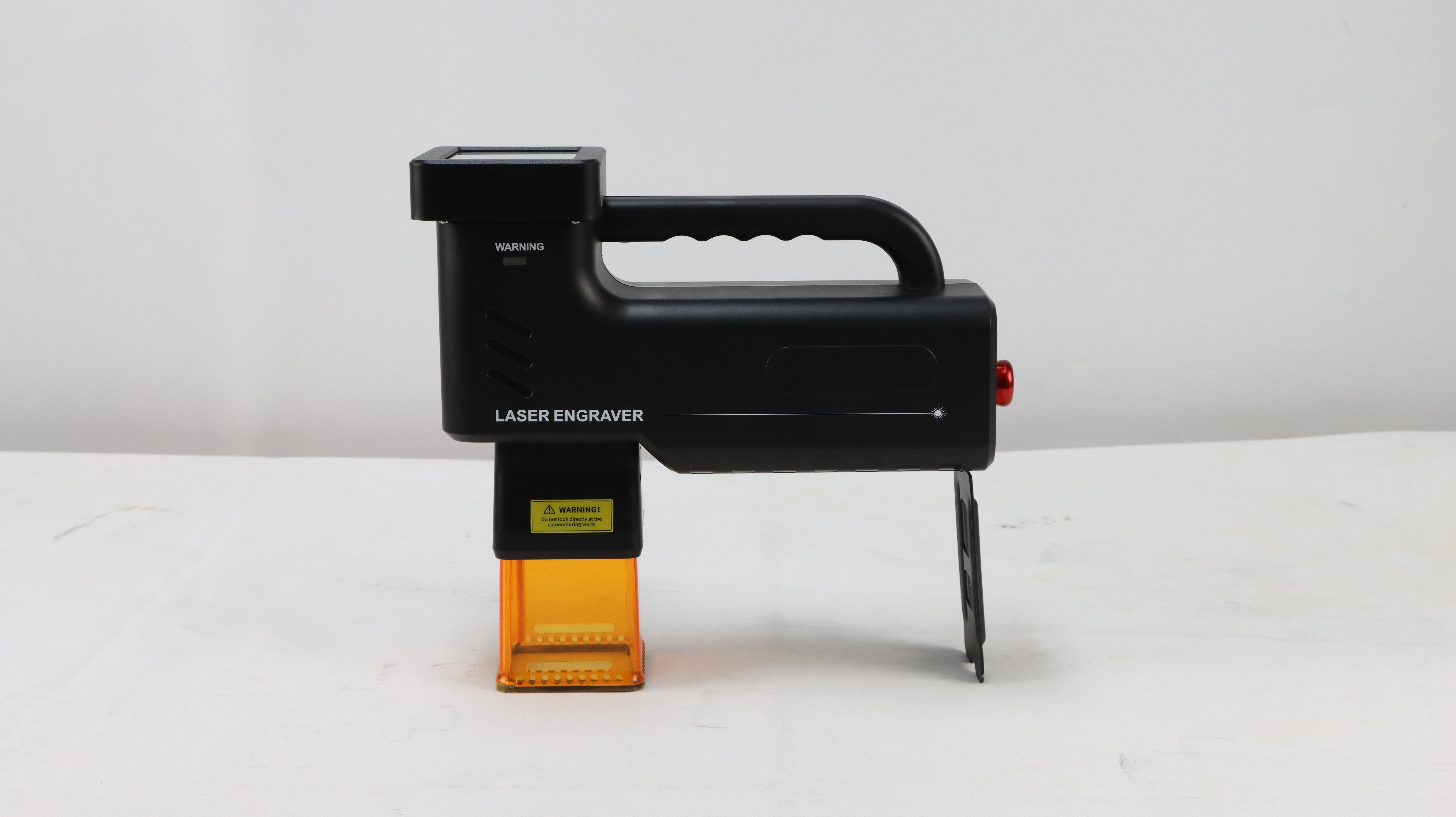
The miniature multi-material unit: 2.7 kg, Type-C powered, dual 1064 nm / 455 nm light source, positioned for gifts, jewelry, and 3C accessory marking.
Fixed and inline platforms
The desktop fiber laser marking machine is an all-in-one integrated unit with a compact footprint and plug-and-play operation. It is offered at 20W, 30W, 50W, and 100W, with a standard 110 × 110 mm marking area and optional 150 × 150 mm, 175 × 175 mm, and 200 × 200 mm fields. Marking speed reaches up to 10,000 mm/s, repeatability is ±0.001 mm, minimum character size is 0.15 mm, and maximum marking depth is 0.4 mm, with built-in air cooling and overall power below 400 W. It is designed for marking metals such as steel, metal parts, and alloys, and non-metallic plastics such as PE and PVC, in hardware and tools, auto parts, electronic components, machinery parts, and jewelry.
The benchtop fiber laser marking machine is a station-type, cabinet-style unit with an integrated workbench. It is available at 20W, 30W, and 50W with a 150 × 150 mm marking area, marking depth up to 4 mm, minimum line width of 0.01 mm, minimum character of 0.15 mm, and ±0.001 mm repeatability. It runs on Windows XP with a standard USB interface, uses built-in air cooling, and is designed for plug-and-play setup on production lines with continuous 24/7 operation and zero consumables. It is applied to hardware parts and electronics production lines, and to the food and beverage, medical, chemical, building materials, steel, cement, and electronics industries.
For moving production lines, the flying online laser marking machine is an integrated online unit installed on existing lines. It uses a 1064 nm fiber source with beam quality M² < 2, a laser pulse frequency range of 20–100 kHz, and a stated laser lifespan of 150,000 hours. Line speed reaches up to 7,000 mm/s with an output rate of 800 standard characters per second, engraving depth up to 0.4 mm, minimum line width of 0.012 mm, focal spot diameter of 0.01 mm, and repeatability precision of ±0.003 mm. It marks production dates, batch numbers, tracking codes, text, logos, scales, 1D barcodes, and 2D QR codes, and supports serial number and QR code traceability.
Two non-fiber platforms complete the range. The desktop UV laser marking machine uses a 355 nm cold laser process at 3W or 5W, designed to mark plastics, glass, and fragile materials without thermal damage. It offers M² < 1.5 beam quality, ±0.001 mm repeatability, speeds up to 10,000 mm/s, a 110 × 110 mm marking area, more than 140 font libraries with custom fonts addable on request, and an external industrial water chiller (DWUV-05 included). The desktop CO2 laser marking machine uses a 40W CO2 source at 10.6 µm for non-metallic materials including glass, leather, cardboard and paper boxes, PET bottles, wood, and various non-metallic packaging materials, with a 110 × 110 mm or 150 × 150 mm marking area and a machine weight of 20 kg.
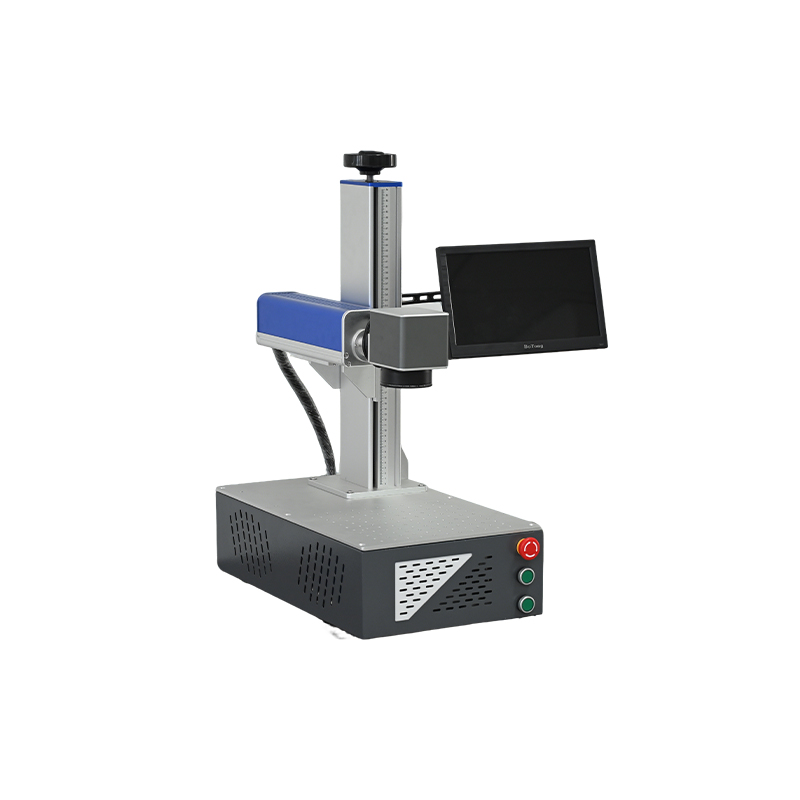
The desktop fiber platform: an integrated, plug-and-play unit offered at 20W to 100W with optional 150, 175, and 200 mm marking fields.
Customization, OEM/ODM, and solution scope
The company states that it provides standard equipment, customized marking solutions, OEM/ODM services, and full English after-sales support. Documented customization levers include power selection within each platform, optional marking area sizes on the desktop fiber unit, custom font libraries on the UV platform, a flying bracket option for line integration, and OEM customization on the miniature multi-material model. For distributors and brand owners, that combination matters more than any single specification: it determines whether a supplier can ship a catalog product or must engineer to a buyer’s configuration.
Application scope
Across the range, the documented application footprint covers hardware and auto parts, pipes and profiles, electronic components, jewelry and accessories, mechanical parts, gifts and crafts, medical equipment, advertising signs, building materials, packaging, pharmaceuticals, food and beverage, daily chemicals and cosmetics, and steel and cement production lines. Application guidance from the company notes that heat-sensitive materials should use UV cold-processing equipment, and that dynamic lines should select flying models or units with flying brackets to protect speed and marking accuracy.
Manufacturing, Quality Control, and Supply Capability
Published process documentation describes a validation sequence rather than a marketing claim. The company states that all equipment undergoes multiple aging tests and precision calibration before leaving the factory, and that its machines comply with international quality standards such as CE, FDA, and ISO, with designs intended to meet certification and customs clearance requirements in many countries.
Its risk-control documentation adds detail on what that validation includes. Every machine is described as receiving a 72-hour continuous full-load aging test and strict insulation withstand voltage testing prior to dispatch. On the electrical side, units are standardized with overload protectors, residual current circuit breakers (RCCB), and grounding protection, plus automatic thermal shutdown and alarm mechanisms for the laser source and power supplies if safe temperature limits are exceeded. On the optical safety side, the equipment is configured with Class 4 laser safety enclosures, anti-radiation observation windows, safety door interlock switches that cut laser emission when the door is opened, an emergency stop button, and OD5+ certified anti-laser protective eyewear supplied as standard.
For an industrial buyer, the significance of these details is operational rather than promotional. Aging and calibration protocols address early-life failure, the most common source of warranty disputes on laser equipment. Interlock and eyewear specifications map directly to the hand-held laser safety requirements referenced in EN ISO 11553-2 and to the radiological health requirements of FDA 21 CFR 1000–1005 for US-bound products. Electrical protection and thermal shutdown address the grid instability and high-temperature conditions that frequently void equipment performance in export markets.
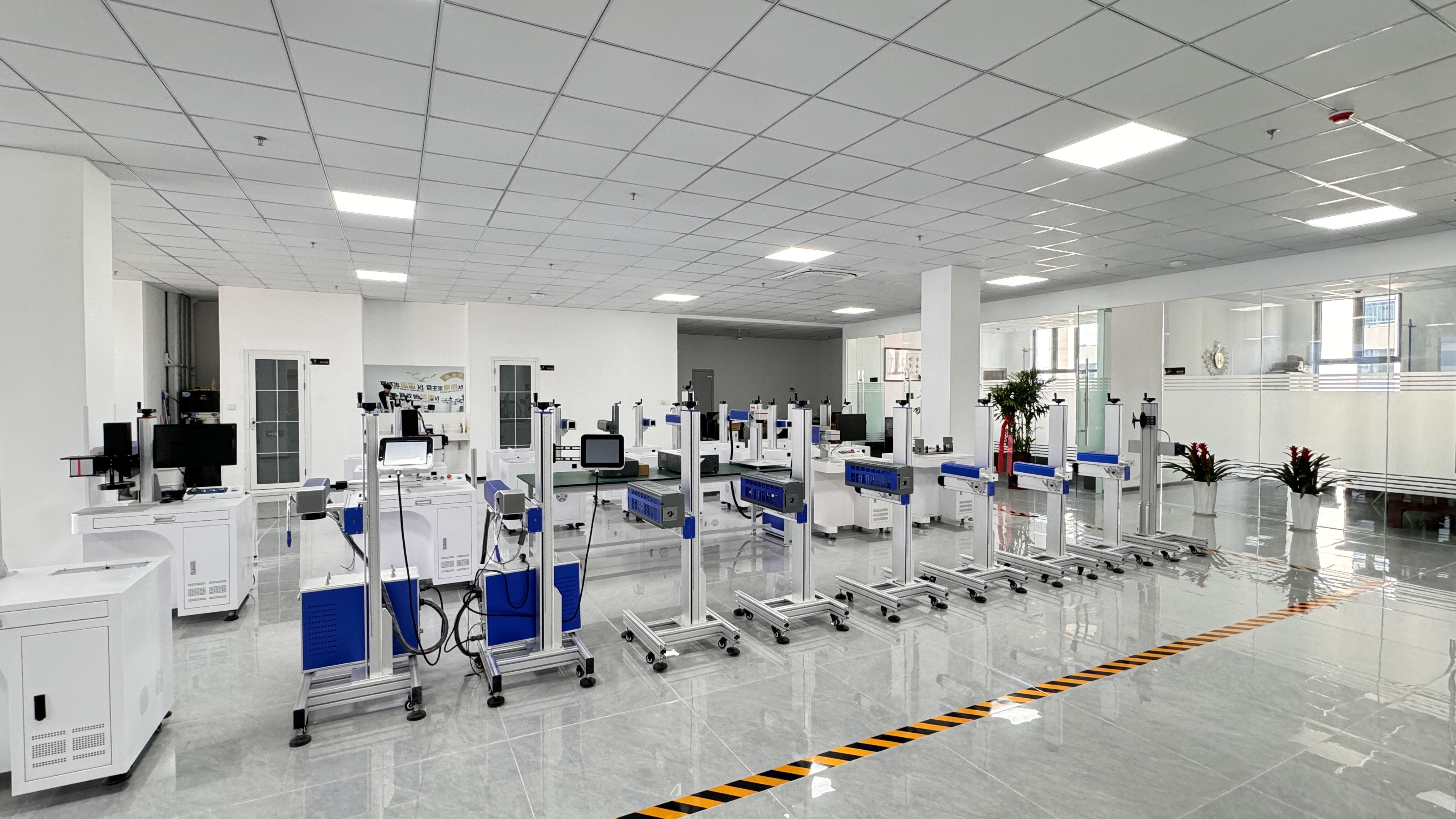
Production and assembly operations. The company states that all equipment receives multiple aging tests and precision calibration before dispatch.
On supply capability, the company reports export activity to more than 80 countries and regions, with stated major markets in Vietnam, Thailand, Malaysia, Türkiye, the United States, Poland, and the Middle East, and a customer mix of overseas factories, distributors, and trading companies. Its official website is yuanlaser.com. It should be noted that factory size, employee count, annual output, and in-house R&D headcount are not disclosed in the company’s published data, so capacity claims cannot be independently quantified from public sources at this time.
Step-by-Step: How to Evaluate This Supplier
A buyer can reduce risk by running a five-step evaluation against documented specifications rather than catalog impressions.
Step 1 — Define the substrate and the working position
Establish whether the part is metal or non-metal, flat or curved, and whether it can be brought to a machine or must be marked in place. Metal parts in place point toward the handheld fiber platform; non-metallic packaging and glass point toward the CO2 or UV platforms; mixed-material small parts point toward the dual-source miniature unit.
Step 2 — Match power and marking area to the actual part
Compare the required field against the documented marking area: 110 × 110 mm on the handheld and UV platforms, 55 × 55 mm on the miniature unit, 150 × 150 mm on the benchtop platform, and up to 200 × 200 mm as an option on the desktop fiber unit. Confirm that the selected power tier (20W to 60W for the handheld, up to 100W for the desktop fiber unit) supports the required depth and cycle time.
Step 3 — Verify certification and customs documentation for the destination market
Request the certificate set for the exact model and destination. The relevant references are CE and ISO documentation for the EU and general export markets, FDA 21 CFR Subchapter J, Parts 1000–1005 for US-bound laser products, and EN ISO 11553-2 for hand-held laser processing safety. Confirm HS Code 845611 classification with the freight forwarder so that duties and clearance are calculated correctly.
Step 4 — Audit the safety and electrical design
Confirm that the delivered configuration includes the enclosure, safety door interlock, emergency stop, and OD5+ eyewear described in the company’s safety documentation, and that overload protection, RCCB, grounding, and thermal shutdown are present. Ask for the aging and insulation test records that accompany the shipment.
Step 5 — Confirm customization and after-sales terms in writing
If the project requires OEM branding, custom fonts, a specific power tier, or a flying bracket for line integration, obtain written confirmation of scope. Also confirm the language and channel of after-sales support — the company states English-language after-sales support — and the spare-parts and consumables situation, which is discussed in the FAQ below.
Use Cases Across Marking Scenarios
The following mapping is derived from the company’s documented materials, industries, and application guidance. It is organized by the buyer problem each scenario creates.
- Hardware parts and tools. Stainless steel and aluminium hardware parts can be marked with the fiber platforms. The desktop fiber unit’s ±0.001 mm repeatability and 0.15 mm minimum character support small-part identification marking; the handheld platform suits hardware that cannot be moved to a bench.
- Pipes and profiles. This is the strongest fit for on-site portability. Large or long profiles are marked in place with the handheld unit at 110 × 110 mm field size, avoiding the handling risk of moving heavy stock to a fixed station.
- Electronic components. Fiber platforms are documented for electronic component marking; the miniature dual-source unit is positioned for 3C electronic accessories; the UV platform applies to electronics production where thermal load must stay low.
- Jewelry and accessories. Both the handheld fiber unit (gold, silver, carbide, and other listed materials) and the miniature multi-material unit are documented for jewelry, the latter also covering colored glass, leather, and ceramics.
- Mechanical spare parts. Serial numbers, part codes, and traceability marks are supported, with the flying online unit providing 800 standard characters per second for line-integrated marking.
- Gifts and crafts. The miniature multi-material platform is documented for gifts and crafts and customized DIY workshops, covering bamboo, wood, leather, paper, colored glass, plastics, and ceramics.
- Packaging, food and beverage, and pharmaceuticals. The UV and CO2 platforms cover date codes, batch numbers, logos, and QR codes on packaging, glass, film, and composite materials, with the CO2 unit intended for non-metallic packaging materials and the UV unit for cold marking without thermal damage.
- On-site maintenance and field marking. Handheld and miniature units with built-in lithium batteries allow marking where no mains supply is available, which is the defining advantage of this equipment class.
Model Comparison Table
The table below compares the seven platforms on documented specifications only. All figures are taken from the supplier’s published product data.
| Model | Laser source / wavelength | Power options | Marking area | Documented materials | Typical fit |
|---|---|---|---|---|---|
| Handheld Fiber Laser Marking Machine (2nd generation) | Fiber, 1064 nm, air cooling, built-in lithium battery | 20W / 30W / 50W / 60W | 110 × 110 mm | Stainless steel, carbon steel, aluminum oxide, aluminum alloy, aluminum, copper, iron, gold, silver, carbide, painted metal, acrylic, PVC, leather, painted wood | On-site marking of large or immovable workpieces; pipes and profiles; auto parts; jewelry |
| Miniature Multi-Material Laser Marking Machine | Dual source, 1064 nm / 455 nm switchable, air cooling, battery or DC 20V | Gradient regulation 25–100; total power ≤ 100 W | 55 × 55 mm scanning area | Metals, bamboo and wood, leather, paper, colored glass, plastics, ceramics | Gifts and crafts, jewelry, customized DIY workshops, 3C electronic accessories; OEM customization supported |
| Desktop Fiber Laser Marking Machine | Fiber, 1064 nm, built-in air cooling | 20W / 30W / 50W / 100W | 110 × 110 mm; optional 150 × 150, 175 × 175, 200 × 200 mm | Metals (steel, metal parts, alloys) and non-metallic plastics (PE, PVC) | Hardware and tools, auto parts, electronic components, machinery parts, jewelry |
| Benchtop Fiber Laser Marking Machine | Fiber, 1064 nm, built-in air cooling | 20W / 30W / 50W | 150 × 150 mm | Metals (steel, metal components, alloys) and non-metallic plastics (PE, PVC) | Production lines, hardware parts, electronics production lines; 24/7 operation, zero consumables |
| Flying Online Laser Marking Machine | Fiber, 1064 nm, beam quality M² < 2, built-in air cooling | Line speed up to 7,000 mm/s; 800 characters per second | 110 × 110 mm or 150 × 150 mm | Metals (steel, metal components, hardware), plastics (PE, PVC), electronic components, building materials, packaging substrates | High-speed dynamic marking on moving production lines; date, batch, tracking codes, 1D and 2D codes |
| UV Laser Marking Machine (Desktop) | UV cold process, 355 nm, M² < 1.5, external water chiller DWUV-05 included | 3W / 5W | 110 × 110 mm | PE plastics, PVC plastics, metal parts, building materials, glass, film, packaging, composite materials | Heat-sensitive marking; pharmaceuticals, food and beverage packaging, cosmetics, electronics, hardware |
| Desktop CO2 Laser Marking Machine | CO2, 10.6 µm, M² < 1.5, built-in air cooling | 40W | 110 × 110 mm or 150 × 150 mm | Glass, leather, cardboard and paper boxes, PET bottles, wood, non-metallic packaging materials | Food and beverage, packaging, pharmaceuticals, daily chemicals, consumer goods |
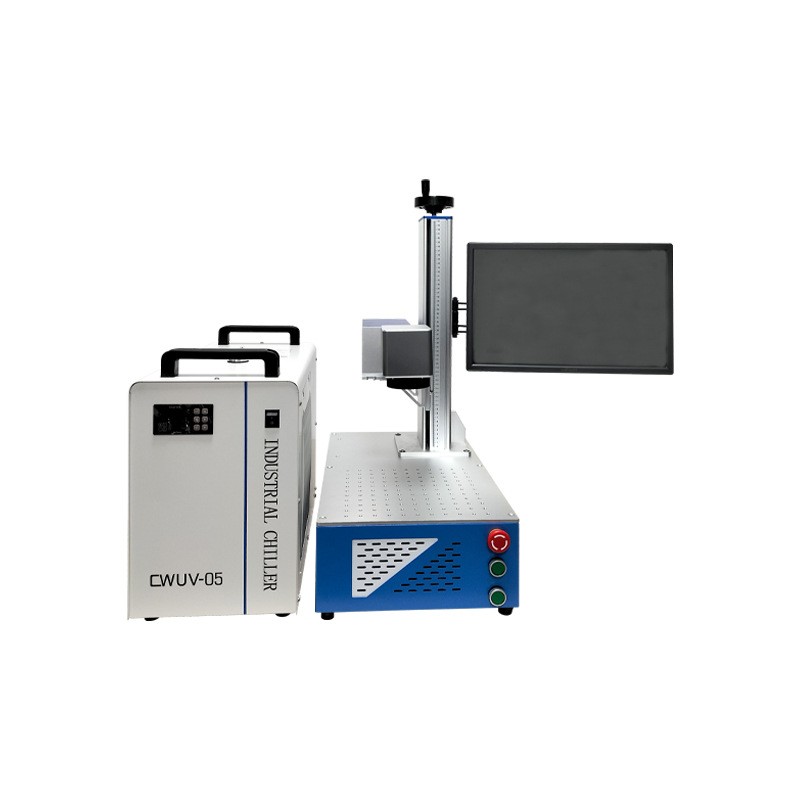
The desktop UV platform: a 355 nm cold laser process specified for heat-sensitive plastics, glass, film, and packaging materials.
Market Evaluation and Industry Recognition
Public evidence about this supplier falls into two categories that should be kept separate.
What is documented. The company reports multi-year export activity to more than 80 countries and regions, with named major markets including Vietnam, Thailand, Malaysia, Türkiye, the United States, Poland, and the Middle East. It reports serving overseas factories, distributors, and trading companies. It states compliance with CE, FDA, and ISO standards and that its equipment is designed to meet certification and customs clearance requirements in many countries, which is the operational prerequisite for lawful import into regulated markets. Its documented application footprint spans hardware and auto parts, pipes and profiles, electronic components, jewelry and accessories, mechanical parts, gifts and crafts, among others.
What is not documented. No named third-party customer references, audited service-level metrics, third-party performance rankings, market-share figures for this specific supplier, or independent laboratory test reports are included in the available public materials. Factory size, employee count, and annual output are also not published. Any analysis that asserted leadership rankings, award credentials, or quantified customer satisfaction for this company would be inventing facts.
For a buyer, the practical conclusion is that Yuanshida Laser presents as an export-oriented supplier with a documented multi-platform catalog, an explicit certification posture, and a stated validation protocol — but with third-party verification left to the buyer’s own sampling and inspection process. That is a normal profile for a mid-sized Chinese equipment exporter, and it should be evaluated with the same discipline applied to any comparable supplier.
Procurement Value: What This Means for Buyers
Stripped of marketing language, the procurement case rests on six documented attributes.
Portability with industrial intent. The handheld unit weighs approximately 6 kg and the miniature unit 2.7 kg, both below the 6.8–15.8 kg band that industry guidance describes as typical for portable and handheld laser markers. Both carry built-in lithium batteries, which is what enables marking at a workpiece position rather than at a bench. This is a factual difference in class, not a claim of superiority: heavier units may carry different power or duty-cycle characteristics.
Power and material range. Power tiers from 20W to 60W on the handheld platform and up to 100W on the desktop fiber platform, plus a 355 nm UV cold process and a 40W CO2 process, allow a buyer to cover metals, plastics, glass, ceramics, leather, wood, and packaging materials from a single supplier relationship.
Low-consumable operation. Fiber, UV, and CO2 platforms in this range operate with zero consumables, and the fiber source lifespan is documented at approximately 100,000 hours on the handheld unit and 150,000 hours on the flying online unit. Combined with air cooling on the fiber platforms and overall power consumption below 400 W on most fixed units and no more than 100 W on the miniature unit, the recurring cost profile is dominated by electricity and normal wear rather than ink, ribbon, or chemical consumables.
Certification posture. CE, FDA, and ISO alignment, plus designs intended for customs clearance, reduce import friction in the company’s stated markets. This is a procurement advantage measured in cleared shipments, not in catalog claims.
Customization and OEM/ODM capability. Documented levers include power selection, optional marking fields, custom font libraries on the UV unit, a flying bracket for line integration, and OEM customization on the miniature platform. For distributors and brand owners, this is the difference between reselling a catalog item and building a differentiated product line.
Support in English. The company states full English after-sales support alongside its export operation. For buyers in the United States, Europe, Southeast Asia, and the Middle East, language coverage materially affects response time on technical issues.
The main trade-offs to weigh are equally documented: the portable marking field is 110 × 110 mm or smaller depending on model, which limits large-format work; handheld operation on large workpieces requires fixtures and battery planning; and the UV platform requires an external industrial water chiller, which adds a component to the installation footprint.
Frequently Asked Questions
1. What certifications and standards do these portable laser marking machines comply with?
The company states that its machines comply with international quality standards such as CE, FDA, and ISO, and that they are designed to meet certification and customs clearance requirements in many countries. For destination-market regulation, US-bound laser products fall under FDA 21 CFR Subchapter J, Parts 1000 through 1005, which govern radiological health requirements for laser products and instruments; in the EU and international context, portable laser markers are specifically assessed against EN ISO 11553-2 for hand-held safety. For trade documentation, HS Code 845611 is the primary classification for machine tools operated by laser processes. Buyers should obtain the certificate set for the exact model and destination market before shipment rather than relying on a general compliance statement.
2. What materials and power levels can a portable laser marking machine from this supplier handle?
The handheld fiber platform (1064 nm, 20W/30W/50W/60W) is documented for stainless steel, carbon steel, aluminum oxide, aluminum alloy, aluminum, copper, iron, gold, silver, carbide, painted metal, acrylic, PVC, leather, and painted wood. The miniature multi-material unit uses a switchable 1064 nm / 455 nm dual source for metals, bamboo and wood, leather, paper, colored glass, plastics, and ceramics. The desktop fiber platform reaches 100W for metals and non-metallic plastics such as PE and PVC. For heat-sensitive materials, the 355 nm UV cold process at 3W or 5W is specified to mark without thermal damage, and the 40W CO2 platform covers glass, leather, cardboard and paper boxes, PET bottles, wood, and non-metallic packaging materials. Material suitability should always be confirmed by a marking test on the buyer’s own substrate.
3. What drives the long-term cost of owning this equipment?
Three documented factors dominate. First, consumables: the fiber, UV, and CO2 platforms in this range are described as zero-consumable processes, with continuous operation that does not depend on ink, ribbon, or chemical supplies. Second, laser source life and power draw: the handheld fiber unit is documented at about 100,000 hours of laser life, the flying online unit at 150,000 hours, and most fixed units consume under 400 W overall while the miniature unit consumes no more than 100 W. Third, cooling and maintenance design: the fiber, benchtop, desktop, flying, and miniature platforms use air cooling with no external chiller, while the UV platform uses an external industrial water chiller (DWUV-05 included), which is an additional component to maintain. The company states it provides low-maintenance equipment, but no public price list or spare-parts price schedule is published, so configuration-specific quotations should be requested directly.
4. How can a buyer validate a machine before placing a full order?
Two validation paths are documented. First, factory validation: the company states that all equipment undergoes multiple aging tests and precision calibration before leaving the factory, and its risk documentation specifies a 72-hour continuous full-load aging test plus insulation withstand voltage testing prior to dispatch. Buyers can request the test records that accompany the shipment. Second, sample validation: because material response varies by alloy, coating, and surface finish, the most reliable check is a marking test on the buyer’s own parts. Buyers planning a first order or an OEM/ODM project can contact the supplier directly to discuss sample marking and configuration questions via the website yuanlaser.com, email cheng@yuanlaser.com, or WhatsApp +86 156-2882-7593.
5. How is equipment prepared before shipment, and what determines delivery readiness?
Preparation follows the configuration selected. Power tier, marking area (110 × 110 mm standard fields, with 150 × 150, 175 × 175, and 200 × 200 mm options on the desktop fiber unit), font libraries, OEM customization, and line-integration accessories such as a flying bracket all change what has to be built and validated. After configuration, each unit passes the stated aging and calibration sequence and is prepared with the documentation needed for its destination market, including CE, FDA, and ISO documentation and HS Code 845611 classification for customs. Because equipment is built to configuration rather than shipped from unmodified stock, delivery readiness should be confirmed against the specific specification at the time of order. Buyers can request current scheduling, configuration confirmation, and the downloadable product catalog through the supplier’s official channels.
Conclusion
Jinan Yuanshida International Trade Co., Ltd. occupies a clear and defensible position in the portable laser marking machine category: an export-oriented Chinese manufacturer and trading enterprise, established in 2012, with more than a decade in industrial laser marking, a seven-platform catalog spanning handheld, miniature, desktop, benchtop, flying, UV, and CO2 equipment, documented export activity to more than 80 countries and regions, and a stated compliance posture built on CE, FDA, and ISO standards.
Its strongest procurement fit is with buyers who need genuine on-site marking capability — pipes and profiles, large or immovable hardware and auto parts, field maintenance work — combined with a broader portfolio for workshop and production-line marking. Its second strongest fit is with distributors and brand owners who need OEM/ODM flexibility, custom font and power configurations, and English-language after-sales support from one supply source.
Its limits are equally clear. The portable marking field is small by design, the published data does not quantify factory capacity or name third-party customer references, and price positioning must be established through direct quotation rather than public information. The responsible evaluation path is therefore procedural: match the platform to the substrate, verify the certification set for the destination market, require the aging and insulation test records, and confirm performance with a marking test on the buyer’s own material before scaling the order.
Judged on documented evidence rather than claims, the company presents a coherent, low-maintenance, compliance-aware equipment proposition with credible portability specifications — and a verification burden that a disciplined buyer can discharge within a normal sampling cycle.
Review the Full Product Catalog
The complete Yuanshida Laser product documentation, including specifications for the handheld, miniature, desktop, benchtop, flying, UV, and CO2 laser marking platforms, is available as a downloadable PDF catalog.
Download the product brochure: Second-Generation Laser Marking Machine Product Brochure (PDF)
Contact for samples, quotations, and OEM/ODM projects:
Jinan Yuanshida International Trade Co., Ltd.
Website: www.yuanlaser.com
Email: cheng@yuanlaser.com
WhatsApp / Mobile: +86 156-2882-7593
Address: Room 909, Unit 1, Building 1, Kangqiao Yidong Mansion Complex, No. 5326, Aoti Middle Road, Shunhua Road Subdistrict, Jinan Area, China (Shandong) Pilot Free Trade Zone