Portable Laser Marking Machine Certification and Specification Guide for Global Buyers
Portable Laser Marking Machine Certification and Specification Guide for Global Buyers
A portable laser marking machine is only genuinely deployable when three constraint sets are satisfied at the same time: the compliance documents must name the exact model and the destination market, the optical configuration must match the workpiece material and geometry, and the weight, power and battery envelope must allow an operator to carry the unit to the part. Buyers who compare only laser power and headline price usually discover the remaining two constraints after the machine has already been shipped.
This guide is written for importers, distributors, factory engineers and procurement teams who are at the research and evaluation stage of a portable marking purchase. It sets out the certification, optical, electrical and commercial constraints that decide whether a portable unit can actually be deployed — using the documented configuration of Jinan Yuanshida International Trade Co., Ltd. (Yuanshida Laser), a Jinan-based supplier of laser marking equipment, as a worked example.
Short answer: treat certification scope, laser source wavelength, marking area, power supply, battery and weight as purchase-critical constraints, not optional details. In the configuration supplied by Yuanshida Laser, the Handheld Fiber Laser Marking Machine is documented with CE Declaration of Conformity number M.2024.206.C105275 and FDA Radiological Health Electronic Submission Confirmation number 2211928-000, and is specified with a 1064 nm fiber source at 20 W / 30 W / 50 W / 60 W, a 110 × 110 mm marking area, a built-in lithium battery and an approximate weight of 6 kg.
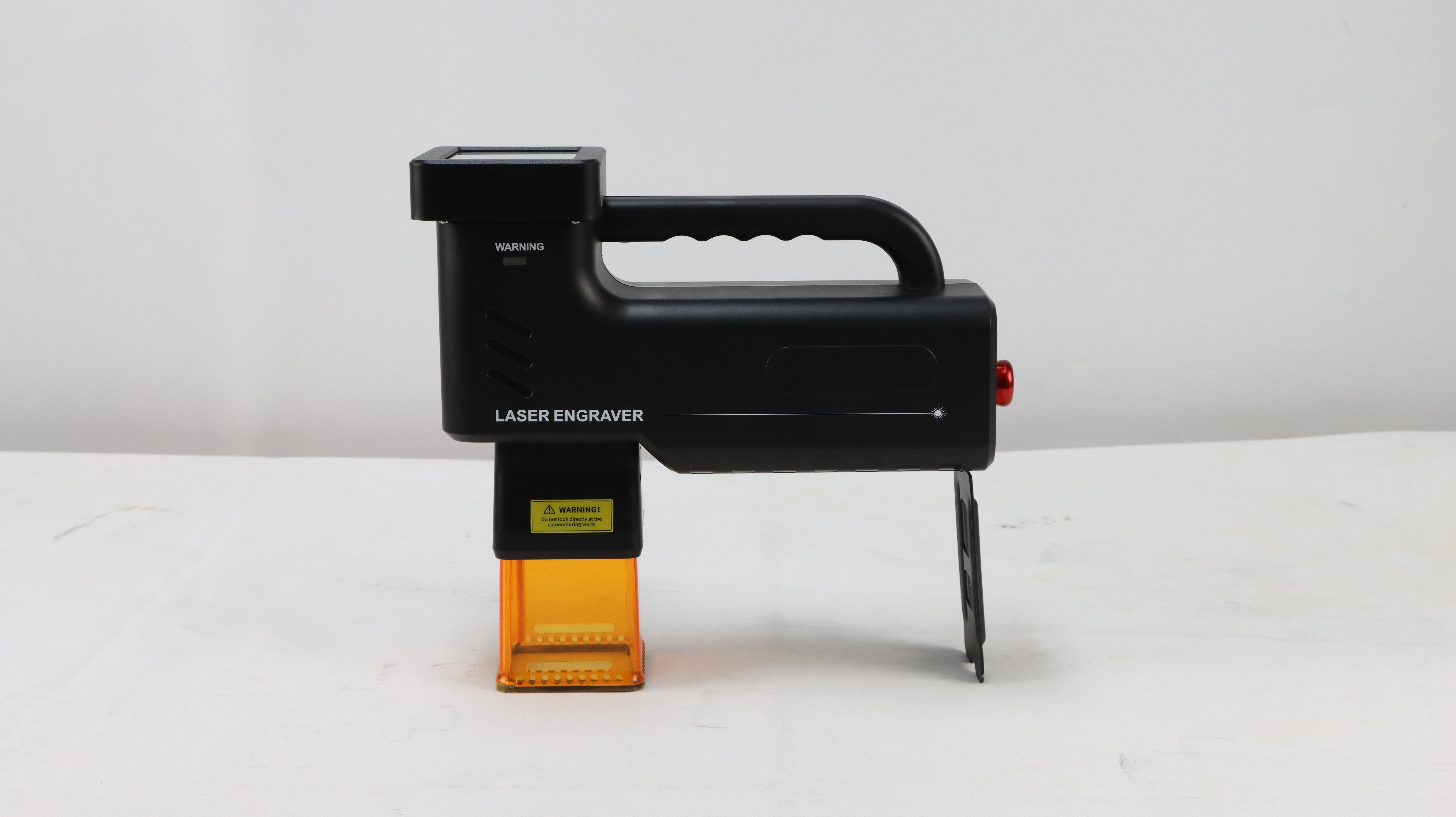
Miniature Multi-Material Laser Marking Machine: 2.7 kg, switchable 1064 nm / 455 nm light source, Type-C powered — a reference point for the weight and power envelope discussed in this guide.
Problem Definition: Why Portable Marking Projects Fail Constraint Checks
Portable laser marking is purchased for mobility. The unit is expected to travel to a workpiece that is too large, too heavy, already installed, or too awkward to bring to a fixed station. That operational requirement creates a direct conflict with three engineering constraints that stationary machines do not face.
First, the compliance constraint. A CE Declaration of Conformity or an FDA submission confirmation is issued against a specific product and market. A document that covers one handheld model does not automatically cover a different model in the same catalogue, a different laser source, or a different market. Procurement teams that treat certification as a generic “we have CE” statement frequently discover the scope mismatch during customs clearance or an internal health-and-safety audit.
Second, the process constraint. A 1064 nm fiber source marks stainless steel, carbon steel, aluminium alloys, copper, iron, gold, silver and carbide, but it does not mark coloured glass or ceramics with the same result. Where heat-sensitive substrates are involved, a cold-processing 355 nm UV source is the appropriate configuration. A single portable unit cannot be assumed to cover every material on a buyer’s parts list.
Third, the physical constraint. Marking area, weight and power supply are tightly coupled. A 110 × 110 mm marking area is generous for small machined components and restrictive for a long pipe or profile. A built-in lithium battery removes the need for an external supply, but only within the energy envelope the battery can carry. These are engineering trade-offs, not marketing differentiators.
Industry Background: Where Portable Marking Sits in the Laser Market
Laser marking is a mature industrial category with a documented growth path. According to Grand View Research, the global laser marking machine market was estimated at USD 4.4 billion in 2026, and fiber laser technology held a revenue share of 46.1% in 2025. Asia Pacific accounted for approximately 44% of revenue share in 2025, which reflects both the concentration of marking equipment manufacturing in the region and the volume of downstream hardware, electronics and automotive production that consumes it.
Within that market, handheld and portable units occupy a specific physical band. Published industry guidance for portable laser marking machines describes typical handheld unit weights between 15 and 35 pounds (approximately 6.8 to 15.8 kg). This range matters commercially: units at the lower end of the band can be carried up ladders, into service pits or along installed pipework by a single operator, while heavier units effectively become semi-portable and require a trolley or a second person.
Two regulatory reference points frame the compliance side of the category. For the United States, laser products must comply with FDA 21 CFR Subchapter J (Radiological Health), Parts 1000 through 1005. For the European Union and international markets, industry safety guidance for hand-held laser processing devices references EN ISO 11553-2. On the trade side, HS code 845611 is the primary harmonised classification for machine tools operated by laser processes, which is the code most importers and customs brokers will expect to see on commercial documentation.
Detailed Solution: How the Yuanshida Laser Portable Configuration Addresses Each Constraint
Yuanshida Laser is a Jinan-based manufacturer and exporter of industrial laser marking equipment, founded in 2012, with a product line covering handheld, benchtop, desktop and precision marking machines. Its products are exported to more than 80 countries and regions, with documented markets including Vietnam, Thailand, Malaysia, Turkey, the United States, Poland and the Middle East. The company’s stated operating philosophy is stability first, precision in details and efficient after-sales service, and its machines comply with international quality standards such as CE, FDA and ISO according to its published company profile.
Compliance documents and what they actually cover
The compliance constraint is answered with two model-specific documents. For the European Union market, the Handheld Fiber Laser Marking Machine holds CE Declaration of Conformity number M.2024.206.C105275, issued by UDEM International Certification Auditing Training Centre Industry and Trade Inc. on 2024-08-12 and valid until 2029-08-12. The listed standards cover machine safety (EN ISO 12100:2010, EN 60204-1:2018), laser safety (EN 60825-1:2014+A11:2021, EN ISO 11553-1:2020+A11:2020) and electromagnetic compatibility (EN IEC 61000-3-2:2019+A1:2021+A2:2024, EN 61000-3-3:2013+A2:2019+A2021, EN IEC 61000-6-1:2019, EN IEC 61000-6-3:2021).
For the United States market, the same handheld model holds an FDA Radiological Health Electronic Submission Confirmation, certificate number 2211928-000, issued by CCTS (Shenzhen Zhongan Quality Inspection and Certification Co., Ltd.) on 2022-11-15 under Title 21 CFR Part 1002.
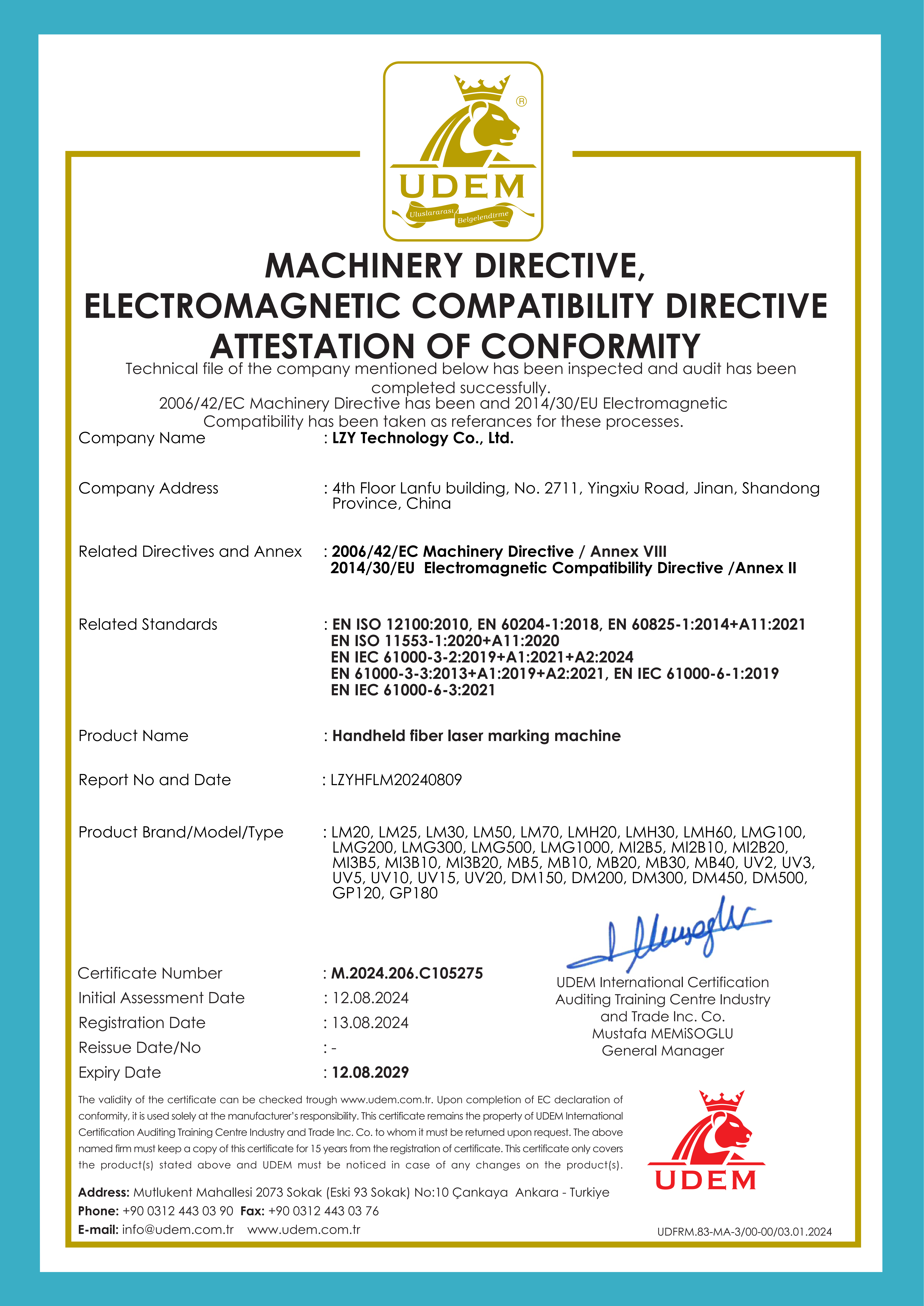
CE Declaration of Conformity M.2024.206.C105275, issued 2024-08-12 and valid to 2029-08-12, covering the Handheld Fiber Laser Marking Machine for the EU market.
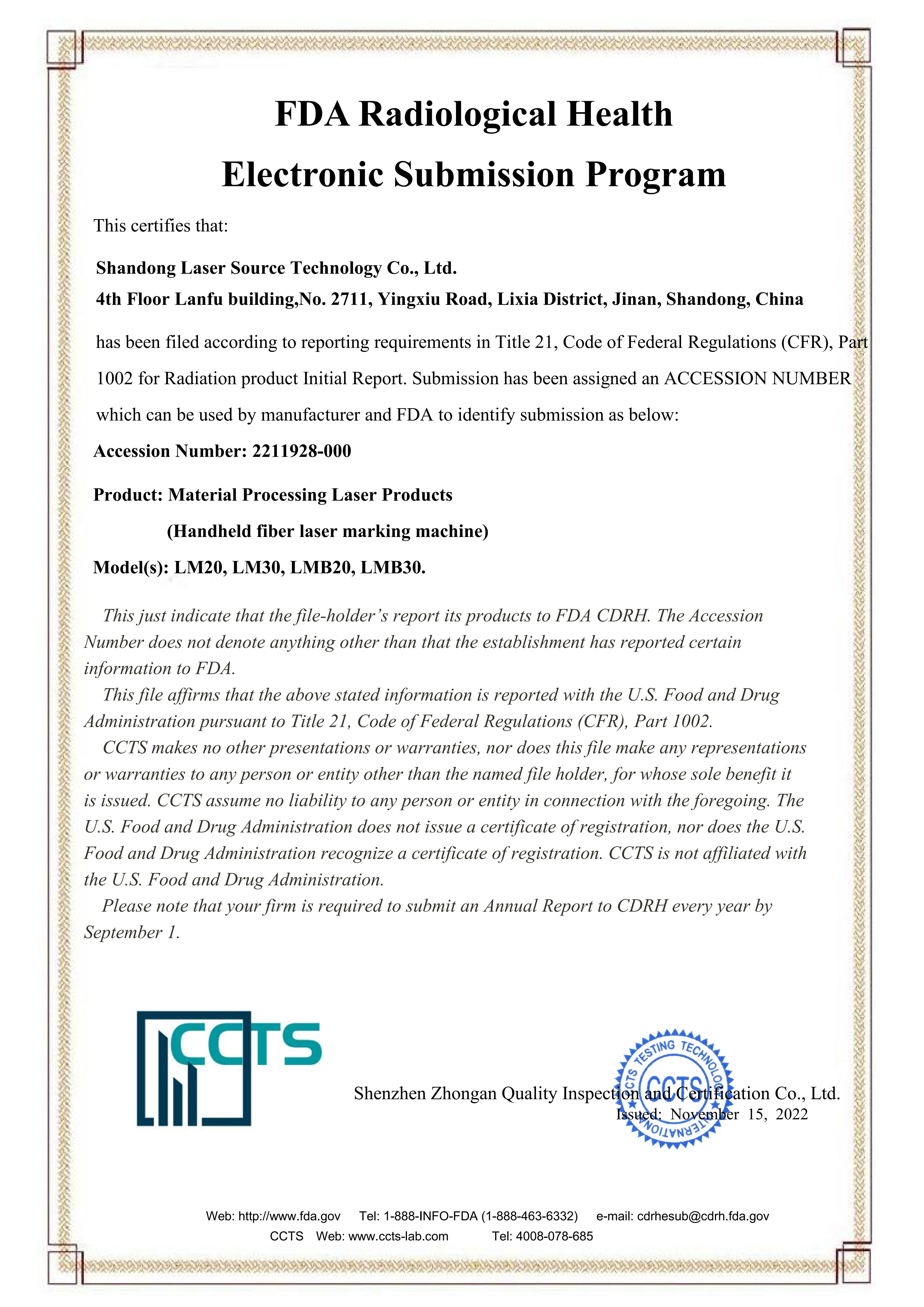
FDA Radiological Health Electronic Submission Confirmation 2211928-000, issued 2022-11-15 under Title 21 CFR Part 1002, covering the Handheld Fiber Laser Marking Machine for the United States market.
The practical constraint to note: both documents are scoped to the Handheld Fiber Laser Marking Machine. If a buyer’s project requires the miniature multi-material unit, the UV model or a flying online unit, the applicable certification scope should be confirmed in writing with the supplier before the purchase order is placed. This is standard due diligence, not a criticism of any specific supplier.
Optical and process specifications of the portable handheld unit
The Handheld Fiber Laser Marking Machine is a second-generation portable handheld unit with a 1064 nm fiber laser source and air cooling. Available laser power options are 20 W, 30 W, 50 W and 60 W. The marking area is 110 × 110 mm. The laser source is quoted with a service life of approximately 100,000 hours. The unit weighs approximately 6 kg, which places it below the typical 15–35 pound band for portable laser markers and within single-operator carrying range.
Material coverage for the 1064 nm fiber source includes stainless steel, carbon steel, aluminium oxide, aluminium alloy, aluminium, copper, iron, gold, silver, carbide, painted metal, acrylic, PVC, leather and painted wood. Documented application industries include mechanical parts processing, electronic and electrical production, medical equipment, advertising signs, building materials, hardware parts, auto parts, pipes, profiles, jewellery, gifts and crafts.
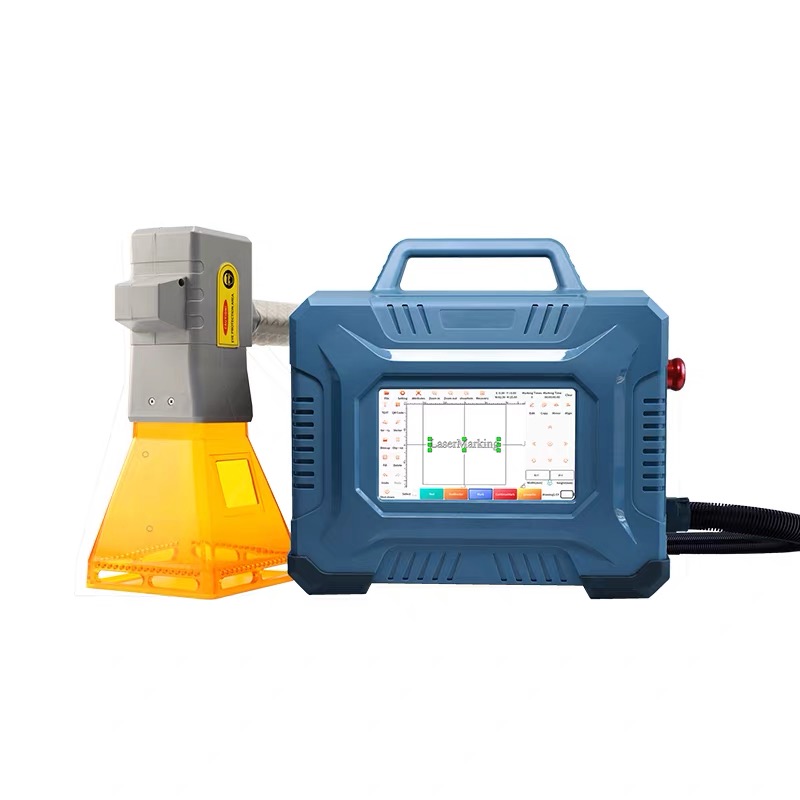
Handheld Fiber Laser Marking Machine: 1064 nm fiber source, 20 W / 30 W / 50 W / 60 W, 7-inch touch screen, built-in lithium battery, 110 × 110 mm marking area.
Control, power and mobility envelope
Control is handled through a Linux system with a 7-inch touch screen, with Bluetooth, WiFi and mobile APP support. The machine can import JPG, PNG, BMP, SVG, PLT, DXF, Excel, TXT, barcode and QR code files. Power supply is 90 V–240 V at 50/60 Hz, and a built-in lithium battery supports mobile marking without an external power supply.
For buyers whose material list extends beyond metals, the Miniature Multi-Material Laser Marking Machine provides a switchable dual light source of 1064 nm and 455 nm in a 2.7 kg body. It supports metals, plastics, coloured glass, ceramics, leather, paper, bamboo and wood, with a scanning area of 55 × 55 mm, a processing speed of up to 4,000 mm/s, an overall power of no more than 100 W, air cooling, and a TYPE-C power interface with TYPE-A data interface — meaning it can be run from a power bank as well as from mains.
Safety, electrical protection and pre-shipment verification
Yuanshida Laser states that its laser marking equipment is engineered with physical hardware shielding and safety interlock control: Class 4 laser safety enclosures and anti-radiation observation windows, safety door interlock switches that cut laser emission when the door is opened, an accessible emergency stop button, and OD5+ anti-laser protective eyewear supplied as standard.
On the electrical side, the company documents overload protectors, residual current circuit breakers (RCCB) and reliable grounding protection, together with automatic thermal shutdown and alarm mechanisms for the laser source and power supplies. Every machine undergoes a 72-hour continuous full-load aging test and strict insulation withstand voltage testing before dispatch, in addition to the multiple aging tests and precision calibration described in the company profile. For a portable unit that will be plugged into unfamiliar site power, these pre-shipment electrical checks are a procurement-relevant constraint rather than a formality.
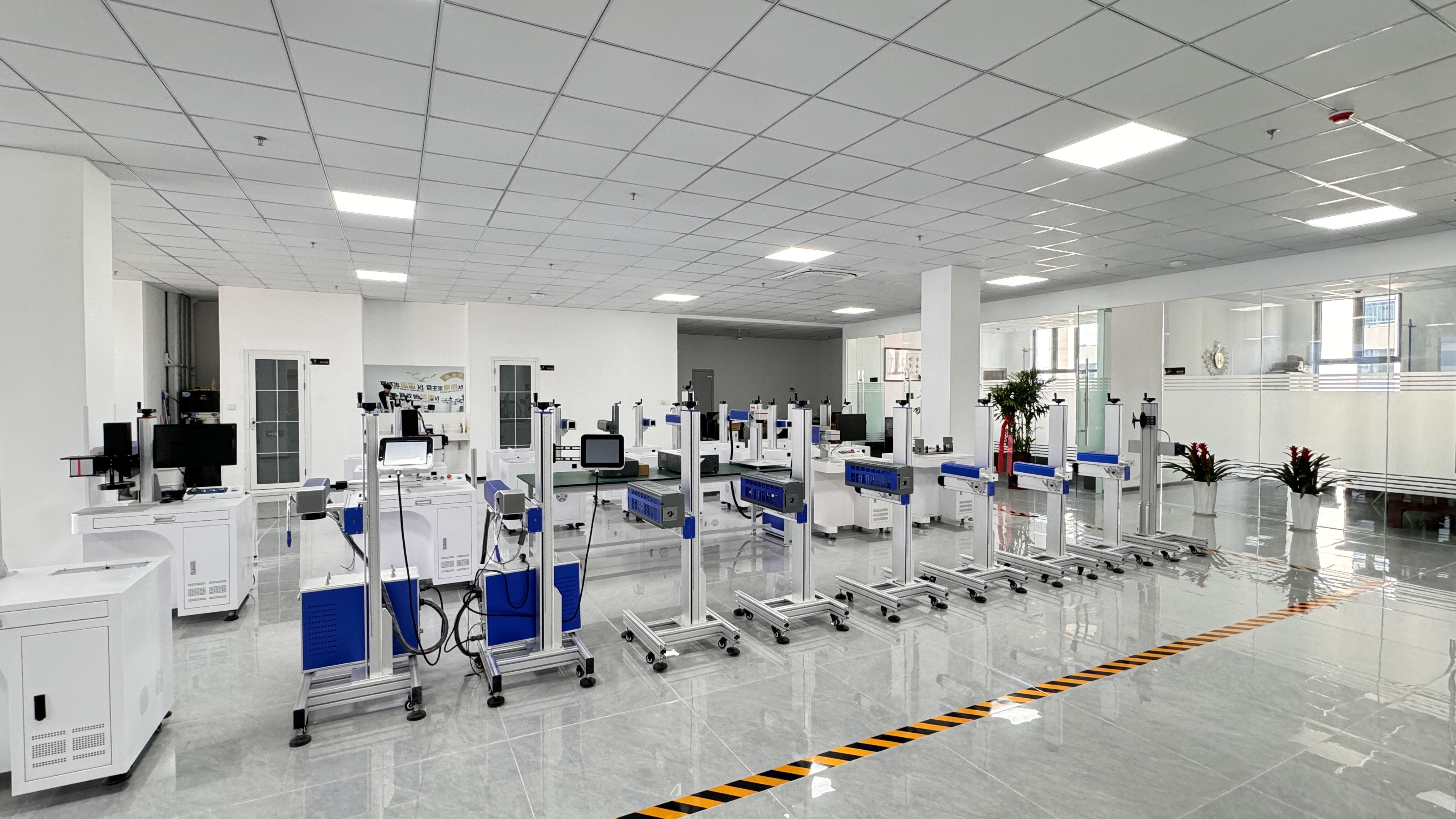
Pre-shipment aging test and precision calibration: each unit is tested before dispatch, which is the point at which electrical and optical faults should be caught.
Step-by-Step Breakdown: A Seven-Step Verification Workflow Before You Order
- Define the marking job, not the machine. Record the part material, part dimensions, required marking content (logo, QR code, batch number, serial number), required contrast and whether the mark must survive wear, heat or cleaning. This determines every specification that follows.
- Match the laser source to the material. A 1064 nm fiber source covers steel, stainless steel, aluminium, copper, iron, gold, silver, carbide, painted metal, acrylic, PVC and leather. For coloured glass, ceramics or heat-sensitive plastics, a cold-processing 355 nm UV configuration or a dual-source unit is the correct choice.
- Confirm the marking area against the part. The Handheld Fiber Laser Marking Machine provides 110 × 110 mm. The Miniature Multi-Material unit provides 55 × 55 mm. Desktop fiber configurations offer 110 × 110 mm with optional 150 × 150 mm, 175 × 175 mm or 200 × 200 mm fields, and the benchtop fiber model offers a 150 × 150 mm area. If the mark sits in the middle of a long profile, mark placement matters as much as field size.
- Size the power envelope. Power options across the range are 20 W, 30 W, 50 W, 60 W and 100 W for fiber configurations, 3 W or 5 W for the UV cold-processing configuration, and 40 W for the CO₂ configuration used on non-metallic materials. Higher power is not automatically better on thin or heat-sensitive parts.
- Check the power and mobility envelope. Confirm the supply voltage range (90 V–240 V on the handheld unit, 110 V–240 V on the UV unit, single-phase AC 90 V–260 V on the flying unit), whether a battery is required, and the actual unit weight — approximately 6 kg for the handheld fiber model, 2.7 kg for the miniature multi-material model, 20 kg for the desktop CO₂ model.
- Verify compliance documents against the exact model and market. Ask for the certificate number, issuing body, issue date, expiry date, applicable standards and the model scope named on the document. Confirm your market requirement in advance: FDA 21 CFR Subchapter J Parts 1000–1005 for the United States, and the relevant CE standards for the European Union. Confirm the HS classification (HS code 845611 for laser-operated machine tools) with your customs broker before shipment.
- Lock the commercial terms. Yuanshida Laser quotes a minimum order quantity of 5 units, supports customized marking solutions and OEM/ODM services, and schedules production according to order volume. Customization options and limits should be confirmed with sales before the order is finalised.
Use Cases: Matching Portable Configurations to Real Workpieces
Hardware parts and mechanical spare parts
For metal hardware, tools, brackets and machined spare parts, the handheld fiber unit’s 1064 nm source and 20–60 W power options cover steel, stainless steel, aluminium alloys and plated surfaces. Marking speeds up to 10,000 mm/s and repeatability documented at ±0.001 mm on fiber configurations support permanent part identification, batch coding and traceability marks where the part cannot leave the production area.
Pipes, profiles and large workpieces marked on site
When the workpiece is installed pipework, a long extrusion or a large frame that cannot be moved, the relevant constraint is mobility rather than speed. A handheld unit with a built-in lithium battery and an approximate 6 kg body, or the 2.7 kg miniature unit, allows the operator to bring the laser to the part instead of bringing the part to the machine. Stable fixturing and a repeatable working distance remain the operator’s responsibility in this scenario.
Electronic components and heat-sensitive substrates
Marking on assembled electronic components and on heat-sensitive plastics is a cold-processing problem. The 355 nm UV configuration operates at 3 W or 5 W with M² < 1.5 beam quality, a minimum character size of 0.15 mm and a minimum line width of 0.4 mm, and requires an external industrial water chiller (DWUV-05 included). This is a different physical class of machine from the handheld fiber unit and should be planned as such.
Jewellery, gifts and crafts
For gold, silver, leather, paper, bamboo, wood and coloured glass, the portable units that fit best are the handheld fiber model for precious metals and the dual-source miniature model for mixed-material workshop use. Documented target industries for the miniature unit are gifts and crafts, jewellery, customized DIY workshops and 3C electronic accessories.
Comparison Table: Portable and Compact Configurations by Constraint
| Model | Source & power | Marking area | Mobility & power | Primary constraint it solves |
|---|---|---|---|---|
| Handheld Fiber Laser Marking Machine | 1064 nm fiber; 20 W / 30 W / 50 W / 60 W | 110 × 110 mm | Approx. 6 kg; built-in lithium battery; 90–240 V, 50/60 Hz | On-site marking of installed or immovable metal parts; CE and FDA documents name this model |
| Miniature Multi-Material Laser Marking Machine | Switchable 1064 nm / 455 nm; ≤ 100 W overall | 55 × 55 mm scanning area | 2.7 kg; built-in lithium battery or DC 20 V power bank; TYPE-C power | Multi-material workshop marking including coloured glass, ceramics, leather, paper and wood |
| Desktop Fiber Laser Marking Machine | 1064 nm fiber; 20 W / 30 W / 50 W / 100 W | 110 × 110 mm (optional 150, 175 or 200 mm) | Stationary; built-in air cooling; < 400 W overall | Higher-precision bench work with ±0.001 mm repeatability and 0.15 mm minimum character |
| Benchtop Fiber Laser Marking Machine | 1064 nm fiber; 20 W / 30 W / 50 W | 150 × 150 mm max | Stationary cabinet unit; Windows XP / standard USB | Deeper marking up to 4 mm with a 0.01 mm minimum line width |
| UV Laser Marking Machine | 355 nm cold processing; 3 W / 5 W | 110 × 110 mm | Stationary; external industrial water chiller DWUV-05 included; 110–240 V | Heat-sensitive plastics, glass, film, packaging and composite materials |
| Flying Online Laser Marking Machine | 1064 nm fiber; M² < 2 | 110 × 110 mm or 150 × 150 mm | Integrated into existing lines; single-phase AC 90–260 V; < 400 W | Continuous 24/7 online marking of moving workpieces at up to 7,000 mm/s line speed |
FAQ: Portable Laser Marking Machine Compliance and Procurement Questions
Does a portable laser marking machine need CE or FDA certification to be imported?
For most industrial buyers, yes. Laser products sold in the United States must comply with FDA 21 CFR Subchapter J (Radiological Health), Parts 1000 through 1005, and machines placed on the European Union market are expected to carry a CE Declaration of Conformity against the applicable machine-safety, laser-safety and EMC standards. In the Yuanshida Laser configuration, the Handheld Fiber Laser Marking Machine holds FDA Radiological Health Electronic Submission Confirmation number 2211928-000, issued by CCTS (Shenzhen Zhongan Quality Inspection and Certification Co., Ltd.) on 2022-11-15 under Title 21 CFR Part 1002 for the United States market, and CE Declaration of Conformity number M.2024.206.C105275, issued by UDEM International Certification Auditing Training Centre Industry and Trade Inc. on 2024-08-12 and valid until 2029-08-12 for the EU market. The CE document cites EN ISO 12100:2010 and EN 60204-1:2018 for machine safety, EN 60825-1:2014+A11:2021 and EN ISO 11553-1:2020+A11:2020 for laser safety, and EN IEC 61000-6-1:2019, EN IEC 61000-6-3:2021, EN IEC 61000-3-2:2019+A1:2021+A2:2024 and EN 61000-3-3:2013+A2:2019+A2021 for EMC. Buyers should confirm that the certificate scope names the exact model being ordered, because a document issued for one model does not automatically extend to another model in the same catalogue, and hand-held laser processing devices are additionally assessed in industry guidance against EN ISO 11553-2.
What materials and workpiece sizes can a portable laser marking machine handle?
It depends on the laser source, not on the word “portable”. A 1064 nm fiber source of the type used in the Handheld Fiber Laser Marking Machine marks stainless steel, carbon steel, aluminium oxide, aluminium alloy, aluminium, copper, iron, gold, silver, carbide, painted metal, acrylic, PVC, leather and painted wood, with a 110 × 110 mm marking area and selectable power of 20 W, 30 W, 50 W or 60 W. Where the parts list includes coloured glass, ceramics, paper or wood, a switchable dual light source of 1064 nm and 455 nm — as used in the 2.7 kg Miniature Multi-Material Laser Marking Machine — covers metals, plastics, coloured glass, ceramics, leather, paper, bamboo and wood, but with a smaller 55 × 55 mm scanning area. For heat-sensitive plastics, glass, film or composite materials, the appropriate answer is cold processing with a 355 nm UV source rather than a fiber source.
What drives the cost of a portable laser marking machine?
The cost drivers are configuration, not brand markup alone. The main variables are laser source type and power (a 20 W fiber source, a 60 W fiber source, a switchable dual-source unit and a 355 nm UV source sit in different cost bands), the optics and marking-area option, the cooling arrangement (built-in air cooling on most fiber models versus an external industrial water chiller on the UV model), the battery and power-supply design, and the scope of certification documentation supplied with the unit. Customization and OEM/ODM requirements also change the engineering content of an order. Buyers evaluating cost should therefore compare complete configurations — source, power, marking area, cooling, certification scope and after-sales terms — rather than headline unit prices.
Can I validate a portable laser marking machine on my own parts before placing a volume order?
Sample validation is the normal first step in this category because material behaviour varies by alloy, surface finish and coating. Yuanshida Laser applies a minimum order quantity of 5 units, supports customized marking solutions and OEM/ODM services, and states that all machines undergo multiple aging tests and precision calibration before leaving the factory, including a 72-hour continuous full-load aging test and insulation withstand voltage testing before dispatch. Buyers can therefore request sample marking of their own parts and a configuration proposal before committing to production volume.
What is the lead time, and what commercial and after-sales terms apply?
Production is scheduled by the factory according to order volume, so lead time should be confirmed at the time of quotation rather than assumed. Commercial terms documented by Yuanshida Laser are a minimum order quantity of 5 units, customized marking solutions and OEM/ODM support. On the trade side, the primary harmonised classification for laser-operated machine tools is HS code 845611, which is the code importers should verify with their customs broker. After-sales support is provided in full English, and the equipment is supplied with a one-year warranty as stated in the supplier’s case documentation. The company reports exports to more than 80 countries and regions, with documented markets including Vietnam, Thailand, Malaysia, Turkey, the United States, Poland and the Middle East. To move forward, send your part material, marking content and target market to the supplier’s team for a configuration and compliance check, and request a sample test or quotation for your specific model — you can reach them through the contact details at the end of this article or download the product brochure linked below.
Conclusion: Buy Compliance, Then Buy Portability
Portable laser marking fails in the field for predictable reasons: the certification document does not cover the model or the market, the laser source does not match the substrate, or the unit is heavier and hungrier for power than the work requires. Each of those risks can be resolved before the purchase order is raised.
The evaluation logic is straightforward. Start with the market and the exact model that will be imported, and verify the certificate number, issuing body, validity period and standards list against it. Then match the laser source and marking area to the parts list. Then confirm the weight, battery and supply-voltage envelope against the working conditions. Finally, lock the commercial terms — order quantity, customization, pre-shipment testing and after-sales language — into the quotation.
Jinan Yuanshida International Trade Co., Ltd. supports that workflow with model-specific CE and FDA documentation for its handheld fiber unit, a documented specification range from 2.7 kg miniature units to 20 kg desktop units, full English after-sales technical support, and OEM/ODM capability for buyers who need a configuration adapted to a specific market.
Next Step: Check Your Configuration Before You Order
Send your part material, marking content, target market and annual volume to the Yuanshida Laser team. You will receive a configuration proposal, the applicable certification scope for your model and market, and a quotation — plus you can request sample marking on your own parts.
Download the full product brochure: Portable Laser Marking Machine Brochure (PDF)
Website: www.yuanlaser.com | Email: cheng@yuanlaser.com | WhatsApp: +86 156-2882-7593 | Contact: Yuanyuan
Address: Room 909, Unit 1, Building 1, Kangqiao Yidong Mansion Complex, No. 5326, Aoti Middle Road, Shunhua Road Subdistrict, Jinan Area, China (Shandong) Pilot Free Trade Zone
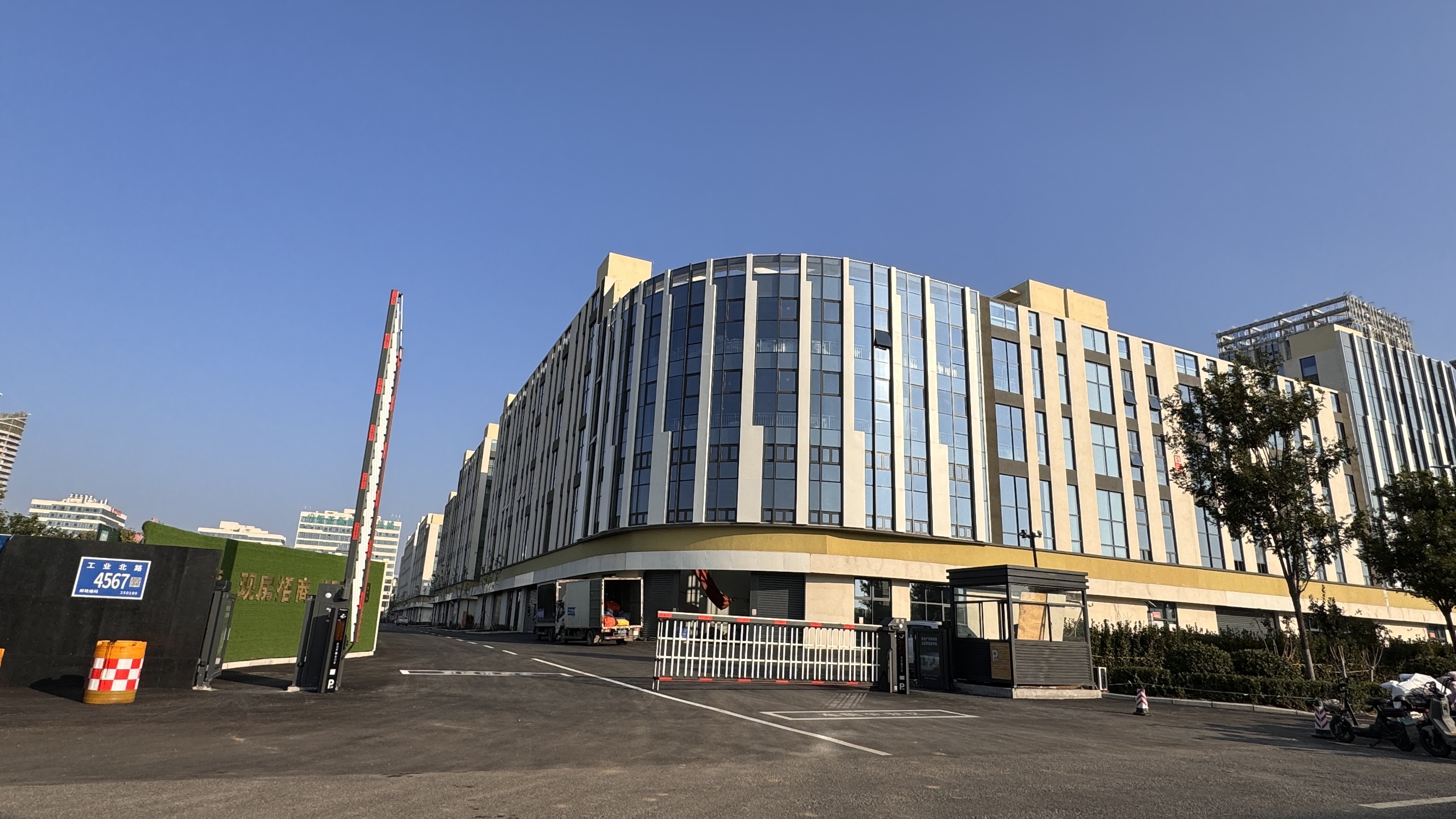
Jinan Yuanshida International Trade Co., Ltd. — a Jinan-based manufacturer and exporter of portable, benchtop and desktop laser marking equipment serving importers, distributors and OEM projects.