Portable Laser Marking Machine Constraints: Power, Certification, Battery, and Delivery Terms Explained
Portable Laser Marking Machine Constraints: Power, Certification, Battery, and Delivery Terms Explained
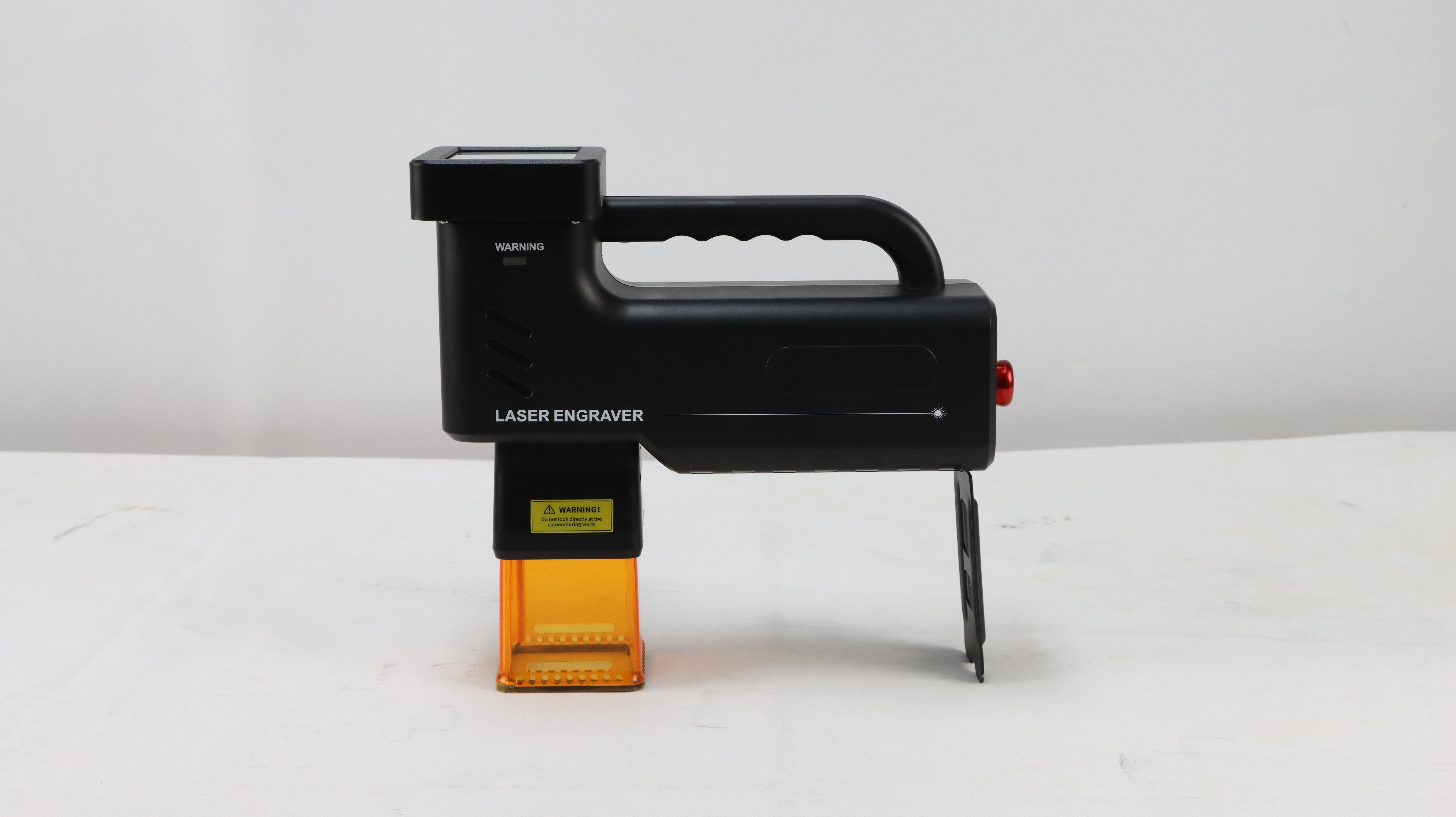
A portable laser marking machine is a self-contained marking unit that is carried to the workpiece instead of bringing the workpiece to a fixed marking station. The purchasing decision is therefore not “portable or not portable,” but which constraint set matches your parts, your site, and your destination market: laser source and power class, battery and input power architecture, certification scope, marking area, control interface, and safety interlocks. Jinan Yuanshida International Trade Co., Ltd. is an exporter of industrial laser marking equipment registered in Jinan, China, and its range covers this entire question — from a hand-held fiber unit of about 6 kg to a 2.7 kg dual-source miniature unit, plus stationary desktop and flying models for buyers who discover that their job is not actually a portable job.
This article is written for importers, distributors, plant engineers, and procurement managers who are in the research and evaluation stage and need to convert “we want a portable laser marking machine” into a specification that a supplier can quote without ambiguity. Every parameter below comes from the manufacturer’s published product data, certification records, and documented risk controls, so it can be checked line by line during supplier evaluation.
Why “Portable” Is Not Yet a Specification
Most portable-machine RFQs fail at the same point: the buyer describes a form factor and expects the supplier to infer the engineering. A hand-held marking unit can be built around a fiber source, a UV source, or a switchable dual source; it can run from a built-in lithium battery, from mains power between 90 V and 240 V, or from a Type-C DC input; and it can be certified for one market and not another. Those variables change the tool you receive far more than the word “portable” does.
In practice, four constraint families decide whether a portable unit will do the job:
- Thermal and power constraints — whether the material tolerates a 1064 nm fiber beam or needs a cold-processing UV source, and whether the required marking depth needs a higher power class.
- Energy constraints — whether the work happens where mains power is available, or where only a battery will do, and how long marking runs must continue without recharging.
- Regulatory constraints — which certification evidence the destination market requires at import, customs clearance, and end-user acceptance.
- Geometric constraints — whether the marking area and the workpiece access allow a hand-held head at all, or whether the part must go to a bench.
A supplier that answers only the first question is selling a machine. A supplier that answers all four is supporting a purchase.
Industry Background: Where Portability Sits in the 2026 Marking Market
The wider market context matters because it explains why portable configurations have become a normal procurement line item rather than an accessory. Grand View Research estimated the global laser marking machine market at USD 4.4 billion in 2026, and within that market fiber laser technology held a 46.1% revenue share in 2025 — the technology family that most hand-held marking units are built on. Asia Pacific accounted for approximately 44% of revenue share in 2025, which is consistent with the region’s concentration of marking equipment manufacturing and export capacity.
For buyers, the useful benchmark is weight. A 2026 portable laser marking machine guide published by MAC laser describes hand-held and portable units as typically weighing between 15 and 35 pounds, roughly 6.8 to 15.8 kg. That range tells you what “portable” usually means in this category: transportable by one or two people between marking positions, not pocket-sized. A unit that is significantly lighter is usually lighter because of a smaller light source or a smaller scanning area, which is an engineering trade-off rather than a free upgrade.
Trade classification is the other background constraint that surfaces during import planning. HS code 845611 is the primary classification for machine tools operated by laser processes, and it is the code normally used when a laser marking machine is declared for international shipment. Companies exporting this category typically operate with both self-operated and agency import/export scope, which is how Jinan Yuanshida International Trade Co., Ltd. is registered in Jinan, China.
The Constraint Set That Decides a Portable Laser Marking Machine Purchase
1. Laser source and power class
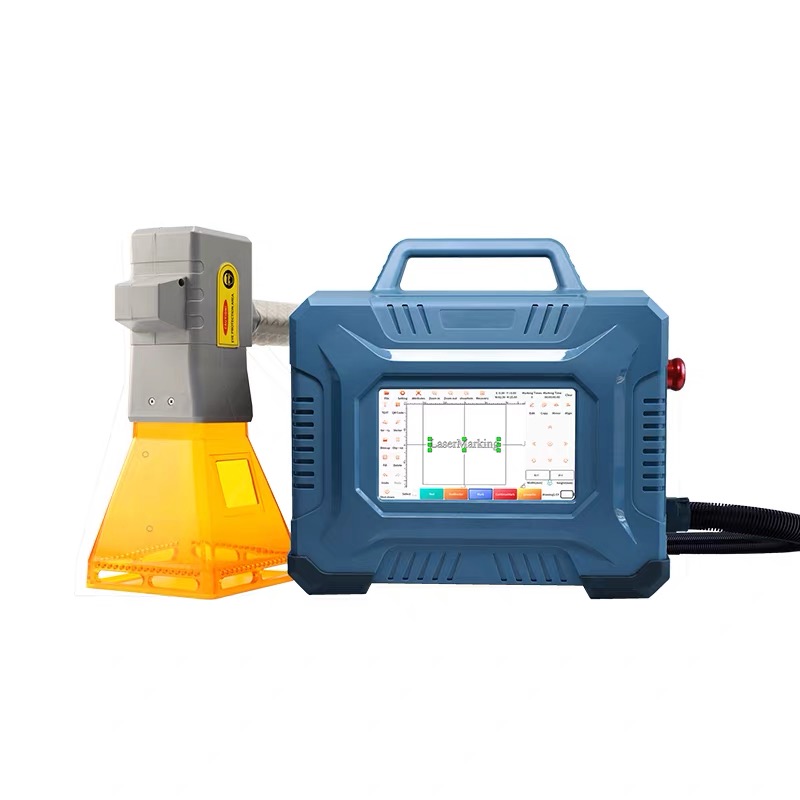
The Handheld Fiber Laser Marking Machine, also listed as the second generation portable hand-held fiber laser marking machine, uses a 1064 nm fiber laser with a pulse width of less than 60 ns and a power selection of 20 W, 30 W, or 50 W for the bench and desktop variants, and 20 W, 30 W, 50 W, or 60 W for the hand-held model. Marking speed is specified at up to 10,000 mm/s in the desktop fiber specification and up to 10,000 mm/s in the hand-held application data, with air cooling and a stated laser life of about 100,000 hours.
Power class is where the first real trade-off appears. A higher wattage class increases marking depth capability and throughput on metals, while a lower class reduces weight, cost, and heat load. The published marking depth limit for the fiber family is up to 0.4 mm in the desktop and hand-held specifications, with repeatability stated at ±0.001 mm and minimum character size of 0.15 mm. If your requirement is deep engraving on steel, you are specifying outside the typical portable envelope and should confirm the depth target with the supplier before quoting.
A second portable route exists for heat-sensitive work. The Miniature Multi-Material Laser Marking Machine uses a switchable dual light source of 1064 nm and 455 nm, draws no more than 100 W overall, and is compatible with metals, plastics, colored glass, ceramics, leather, paper, bamboo, and wood. For UV cold-processing specifically, the Desktop UV Laser Marking Machine operates at a 355 nm wavelength with 3 W or 5 W power, M² < 1.5 single-mode beam quality, and a modulation frequency range of 30 kHz to 100 kHz, which is the configuration the supplier recommends for heat-sensitive materials.
2. Power input, battery, and site constraints
The hand-held model accepts 90 V to 240 V at 50/60 Hz and carries a built-in lithium battery, which is the combination that allows marking at a location with no dedicated power drop. The miniature unit takes a different approach: it weighs 2.7 kg, runs from a built-in lithium battery or DC 20 V with power bank support, and uses Type-C for power and Type-A for data. That Type-C architecture is what makes the lightest configuration practical for field work, but it also limits overall power to no more than 100 W and the scanning area to 55 mm × 55 mm, with a scene focal length of 133 mm.
The practical question here is not “battery or not” but “how many marking cycles per shift, at what duty cycle, and is there any mains supply within reach.” Buyers who need continuous 24/7 output on a moving line are usually describing a flying or benchtop configuration instead, because portable units are optimized for mobility rather than uninterrupted line integration.
3. Certification and market access
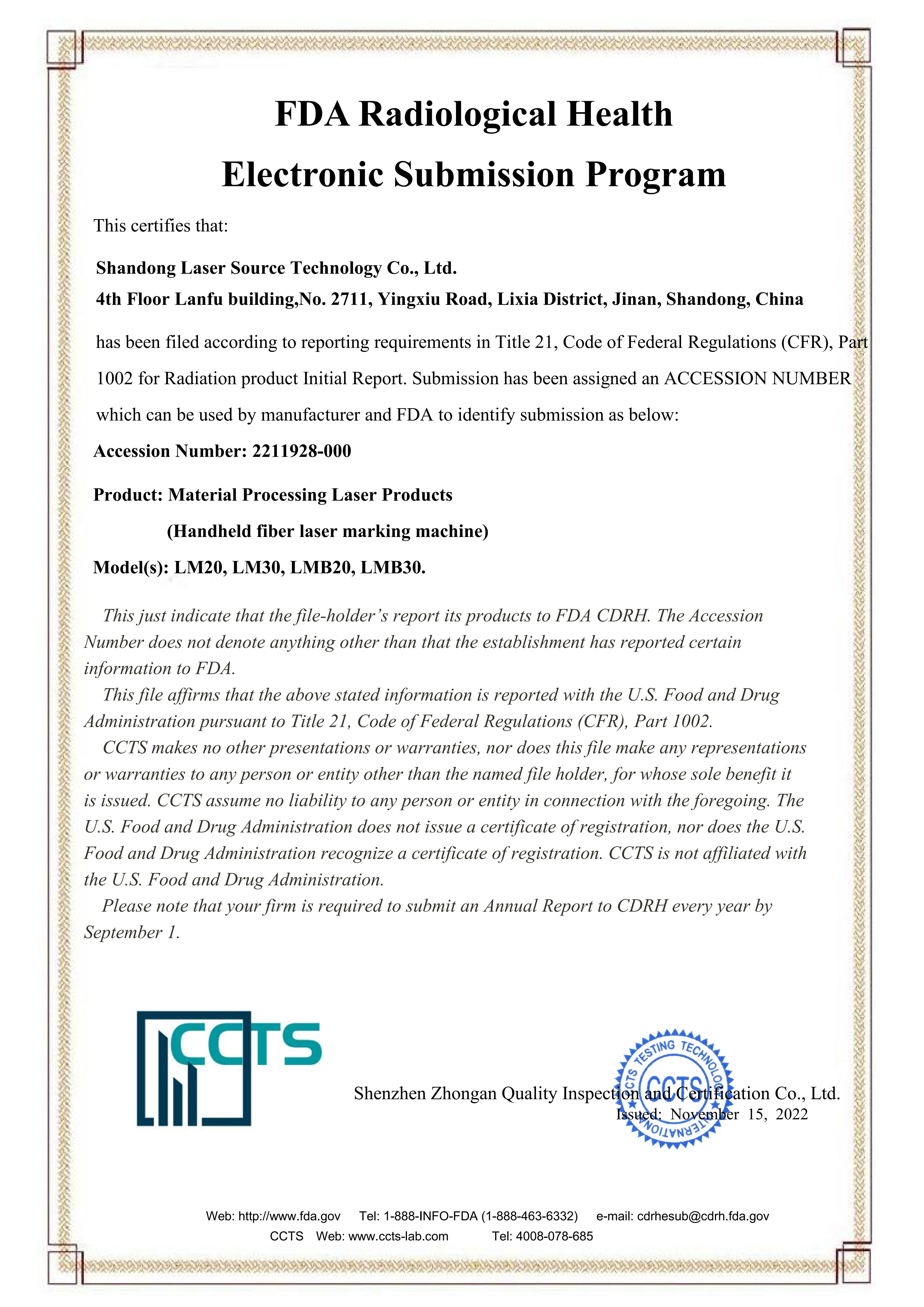
For a portable laser marking machine, certification is a constraint, not a marketing line. Two documents matter for the two largest regulated markets, and both apply specifically to the Handheld Fiber Laser Marking Machine:
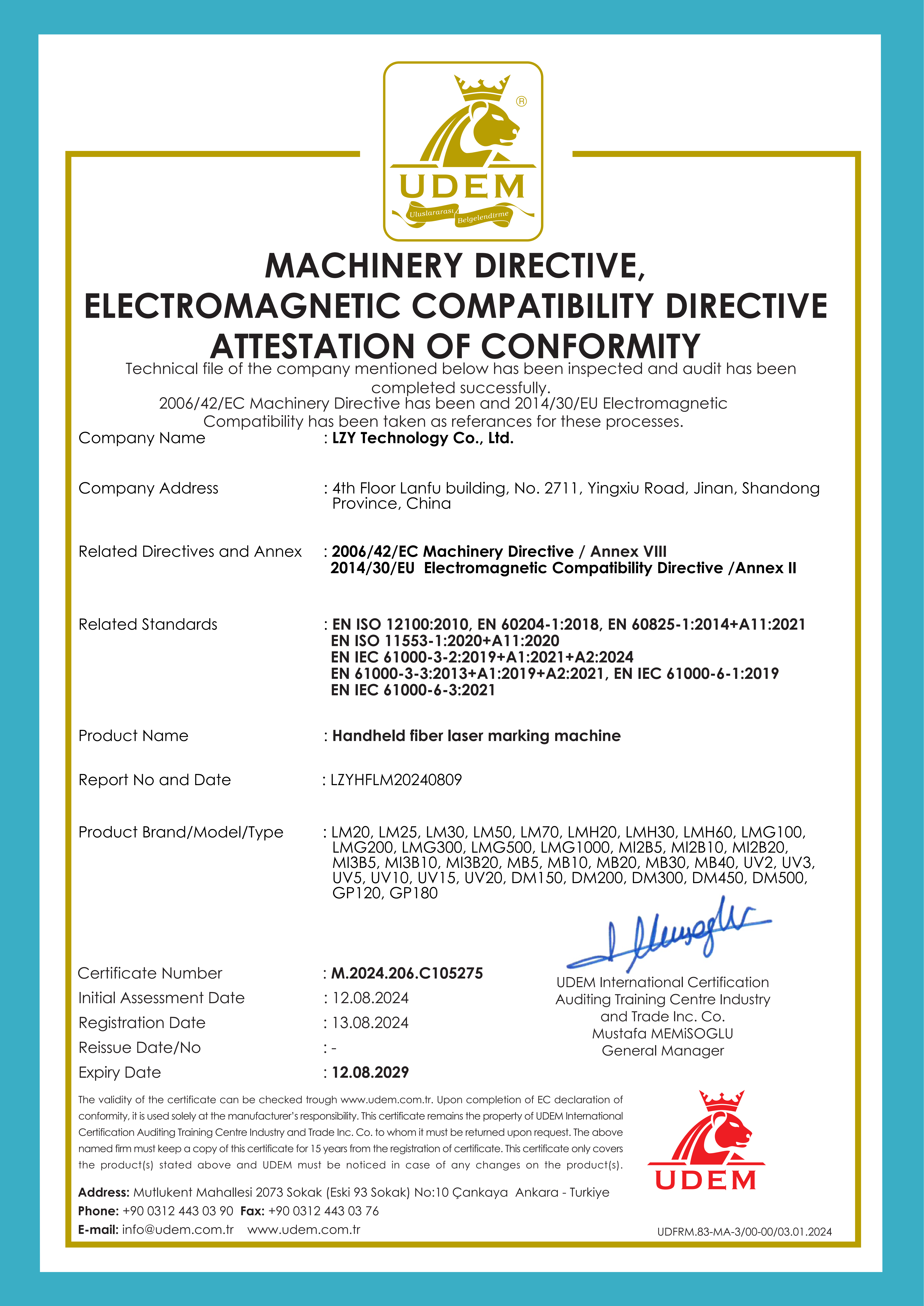
- European Union: CE Declaration of Conformity number M.2024.206.C105275, issued by UDEM International Certification Auditing Training Centre Industry and Trade Inc., issued 2024-08-12 and valid until 2029-08-12. The referenced standards include EN ISO 12100:2010, EN 60204-1:2018, EN 60825-1:2014+A11:2021, EN ISO 11553-1:2020+A11:2020, EN IEC 61000-3-2:2019+A1:2021+A2:2024, EN 61000-3-3:2013+A2:2019+A2021, EN IEC 61000-6-1:2019, and EN IEC 61000-6-3:2021.
- United States: FDA Radiological Health Electronic Submission Confirmation number 2211928-000, issued 2022-11-15 by CCTS (Shenzhen Zhongan Quality Inspection and Certification Co., Ltd) under Title 21 CFR Part 1002.
These documents align with the regulatory framework buyers should expect to see. Laser products sold in the United States must comply with FDA 21 CFR Subchapter J (Radiological Health), Parts 1000 through 1005, and in the European Union hand-held laser processing devices are specifically assessed against EN ISO 11553-2 for hand-held safety. If a supplier cannot produce a numbered declaration and a named issuing body, the certification claim cannot be verified at customs or by a corporate safety reviewer.
4. Control interface, files, and operator workflow
A portable machine is only useful if the operator can load a job from a phone or a laptop at the marking position. The hand-held model runs a Linux system with a 7-inch touch screen and supports Bluetooth, WiFi, and mobile APP control; it imports JPG, PNG, BMP, SVG, PLT, DXF, Excel, TXT, and barcode or QR code files. The desktop UV configuration includes more than 140 font libraries with custom fonts addable on request, supports variable data marking for text, logos, barcodes, QR codes and serial numbers, and is operated through an independent display in an all-in-one configuration.
For evaluation purposes, check three things against your own artwork: whether your file format is accepted without conversion, whether your variable-data workflow (serial numbers, dates, batch codes) can be driven from the touch screen, and whether fonts required by your customer specification are available or can be added. These are the details that cause a machine to be rejected after delivery even when the laser itself performs correctly.
5. Safety interlocks and electrical protection
Laser radiation control and electrical protection are the two risk areas that most often slow down a factory acceptance review. The documented controls for this equipment are specific: Class 4 laser safety enclosures with anti-radiation observation windows, safety door interlock switches that cut laser emission immediately when the enclosure is opened, an emergency stop button, and certified OD5+ anti-laser protective eyewear supplied as standard.
On the electrical side, the machines are standardized with overload protectors, residual current circuit breakers (RCCB), and grounding protection, plus automatic thermal shutdown and alarm mechanisms for the laser source and power supplies. Every machine undergoes a 72-hour continuous full-load aging test and insulation withstand voltage testing before dispatch. For importers, this matters commercially: pre-shipment aging and calibration records are the evidence base for warranty discussions and for the end user’s internal safety sign-off.
Step-by-Step: How to Specify and Validate a Portable Laser Marking Machine
The following sequence converts a general requirement into a quote-ready specification, and it is the order recommended for evaluation-stage buyers.
Step 1 — Characterize the workpiece. List the base material, coating, and required mark type (logo, serial number, QR code, batch or date code). The fiber family covers metals including stainless steel, carbon steel, aluminum, copper, iron, gold, silver, carbide, and painted metal, plus acrylic, PVC, leather, and painted wood; the dual-source miniature unit adds bamboo, wood, paper, colored glass, and ceramics.
Step 2 — Test the geometry against the marking area. The hand-held fiber unit provides a 110 × 110 mm marking area, the miniature unit a 55 mm × 55 mm scanning area, and the desktop fiber unit offers 110 × 110 mm with optional 150 × 150 mm, 175 × 175 mm, or 200 × 200 mm. Parts that exceed the portable area, or that must be marked inside a recess, usually need a different head or a different machine class.
Step 3 — Select the power class and source type. Choose 20 W, 30 W, 50 W, or 60 W according to depth and cycle-time targets, and switch to a 355 nm UV configuration if the substrate is heat-sensitive. Confirm that the expected marking depth sits within the published limit of up to 0.4 mm for the fiber family.
Step 4 — Confirm the energy architecture. Decide whether the machine must run from its built-in lithium battery in the field, from 90–240 V mains, or from a Type-C DC 20 V supply with power bank support. Then confirm the duty cycle the site expects per shift.
Step 5 — Verify certification for the destination market. Ask for the CE Declaration of Conformity number and the FDA submission confirmation number, and check that the certificate scope names the exact model being purchased — for this supplier, the CE document M.2024.206.C105275 and the FDA document 2211928-000 both name the Handheld Fiber Laser Marking Machine.
Step 6 — Lock the commercial terms. Confirm minimum order quantity, lead time basis, warranty duration, and after-sales language support. For this supplier the stated minimum order quantity is 5 units, lead time is scheduled by the factory according to order volume, the case record lists a one-year warranty, and after-sales technical support is provided in English.
Use Cases: Where a Portable Configuration Outperforms a Fixed Station
Hardware parts. Hardware, tools, and metal components are the core application for the fiber portable family, which supports marking speeds up to 10,000 mm/s for hardware part marking. A hand-held head allows the operator to mark a part that is still fixtured on an assembly bench rather than moving it to a marking room.
Pipes and profiles. Pipes, profiles, and building materials appear in the published application list for the hand-held model, and they are also a natural fit for dual-source and desktop units. Because these parts are long and awkward to transport, marking in place removes a handling step entirely.
Electronic components. Electronic and electrical production is a listed application, and the flying fiber model specifically covers electronic components, building materials, and packaging substrates with a 1064 nm source, M² < 2, a minimum line width of 0.012 mm and a focal spot diameter of 0.01 mm. This is where the portable versus inline decision becomes explicit: loose components suit hand-held marking, while continuous output suits an online unit.
Jewelry, gifts, and crafts. Jewelry, gifts, crafts, and custom DIY workshops are served by the 2.7 kg dual-source unit, which is compatible with metals, colored glass, ceramics, leather, paper, bamboo, and wood, with a processing speed of up to 4,000 mm/s and gradient power regulation from 25 to 100. The Type-C power interface and mobile app operation suit workshop environments without fixed industrial power distribution.
Mechanical spare parts. Mechanical parts processing and auto parts appear in the application list for both the hand-held fiber unit and the desktop fiber unit, which offers 20 W, 30 W, 50 W, and 100 W options with a galvanometer scanning system, described as clean, precise, and continuous marking with zero consumables.
On-site marking of large workpieces. The clearest case for portability is a workpiece that cannot be moved: structural steel, installed profiles, and assembled machinery. In these situations the machine travels, the marking area of 110 × 110 mm defines the effective working footprint, and battery operation removes the need for a power drop at the marking position.
Measured outcomes recorded in the supplier’s case documentation include contrast and traceability targets such as scannable 2D codes and QR codes for supply chain traceability, permanent serial numbers and batch codes that resist wear, and ultra-fine marking with no thermal damage to sensitive components. These are stated performance targets from the manufacturer’s case record; buyers should verify them with their own samples before committing to a production specification.
Comparison Table: Portable and Adjacent Configurations
The table below compares the configurations in this range using published specifications only. It is intended to help evaluation-stage buyers decide whether a portable unit is the correct class of machine, not to rank the models against each other — the right choice depends on the part, the site, and the volume.
| Model | Laser source | Power / processing spec | Form factor | Marking area | Typical fit |
|---|---|---|---|---|---|
| Handheld Fiber Laser Marking Machine (second generation) | 1064 nm fiber | 20/30/50/60 W; up to 10,000 mm/s; about 100,000 h laser life; air cooling | Hand-held, about 6 kg, built-in lithium battery, 90–240 V 50/60 Hz | 110 × 110 mm | On-site marking of hardware, pipes and profiles, mechanical parts, jewelry, gifts |
| Miniature Multi-Material Laser Marking Machine | Switchable dual source, 1064 nm / 455 nm | Overall power ≤ 100 W; power regulation 25–100 gradient; up to 4,000 mm/s | Hand-held, 2.7 kg, Type-C power, DC 20 V / battery, power bank supported | 55 mm × 55 mm scanning area | Gifts and crafts, jewelry, DIY workshops, 3C electronic accessories |
| Benchtop Fiber Laser Marking Machine | 1064 nm fiber | 20/30/50 W; up to 10,000 mm/s; depth up to 4 mm; air cooling | Cabinet station with integrated workbench | 150 × 150 mm | Industrial production lines requiring deeper marking |
| Desktop Fiber Laser Marking Machine | 1064 nm fiber | 20/30/50/100 W; up to 10,000 mm/s; galvanometer scanning; zero consumables | Desktop all-in-one, plug-and-play | 110 × 110 mm (optional 150/175/200 mm) | Hardware and tools, auto parts, electronic components, machinery parts, jewelry |
| Desktop UV Laser Marking Machine | 355 nm UV cold processing | 3/5 W; M² < 1.5; 30–100 kHz; up to 10,000 mm/s; external industrial water chiller (DWUV-05) | Desktop unit with independent display configuration | 110 × 110 mm | Heat-sensitive plastics, glass, film, packaging, composites |
| Desktop CO2 Laser Marking Machine | 10.6 µm CO2 | 40 W; up to 10,000 mm/s; minimum character 0.15 mm | Desktop tabletop, 20 kg | 110 × 110 mm or 300 × 300 mm | Glass, leather, cardboard and paper boxes, PET bottles, wood |
| Flying Online Laser Marking Machine | 1064 nm fiber, M² < 2 | Line speed up to 7,000 mm/s; 800 standard characters per second; 150,000 h laser life | Integrated inline unit with built-in touch screen PC and lifting column | 110 × 110 mm or 150 × 150 mm | Food and beverage, pharmaceuticals, daily chemicals, steel, cement, electronics lines |
Source: manufacturer’s published product specifications. Bench and desktop units are included because many buyers who start with a portable requirement ultimately need continuous line output.
Frequently Asked Questions
Which certifications should a portable laser marking machine carry for the EU and US markets?
The Handheld Fiber Laser Marking Machine carries a CE Declaration of Conformity numbered M.2024.206.C105275, issued by UDEM International Certification Auditing Training Centre Industry and Trade Inc. on 2024-08-12 and valid until 2029-08-12, covering the European Union market and referencing standards including EN ISO 12100:2010, EN 60204-1:2018, EN 60825-1:2014+A11:2021, EN ISO 11553-1:2020+A11:2020, EN IEC 61000-3-2, EN 61000-3-3, EN IEC 61000-6-1, and EN IEC 61000-6-3. For the United States it carries FDA Radiological Health Electronic Submission Confirmation number 2211928-000, issued 2022-11-15 by CCTS (Shenzhen Zhongan Quality Inspection and Certification Co., Ltd) under Title 21 CFR Part 1002. Laser products sold in the USA must comply with FDA 21 CFR Subchapter J, Parts 1000–1005, and hand-held laser processing devices are assessed in the EU against EN ISO 11553-2.
What power range and materials does a portable fiber laser marking machine cover?
The hand-held fiber model offers 20 W, 30 W, 50 W, and 60 W power options at a 1064 nm wavelength with a pulse width below 60 ns, air cooling, and a marking area of 110 × 110 mm. Stated laser life is about 100,000 hours and marking speed reaches up to 10,000 mm/s. It marks stainless steel, carbon steel, aluminum oxide, aluminum alloy, aluminum, copper, iron, gold, silver, carbide, painted metal, acrylic, PVC, leather, and painted wood. Repeatability is stated at ±0.001 mm and maximum marking depth within this family is up to 0.4 mm, so deep engraving requirements should be confirmed before ordering.
What actually drives the price of a portable laser marking machine?
Four variables dominate: the power class (20 W through 60 W in the hand-held fiber range), whether the machine uses a single fiber source or a switchable dual source such as 1064 nm plus 455 nm, the energy architecture (built-in lithium battery versus mains-only supply), and the certification and documentation scope required by the destination market. Customization and OEM/ODM requirements, order quantity, and the after-sales arrangement also affect the quotation. Because the constraint set changes what is inside the enclosure, quotations are normally built from the confirmed configuration rather than a single list figure, which is why a specification-first RFQ produces a more usable price than a form-factor-first RFQ.
How can I validate a portable laser marking machine before placing an order?
Validate on your own parts, not on demonstration material. Send samples covering each material and coating you intend to mark, together with the actual artwork, serial number, batch code, or QR code you need to produce, and confirm that the marking area covers your part geometry — 110 × 110 mm on the hand-held fiber unit and 55 mm × 55 mm on the miniature dual-source unit. Confirm that your file formats are accepted without conversion; the hand-held model imports JPG, PNG, BMP, SVG, PLT, DXF, Excel, TXT, and barcode or QR files. Then verify the certification documents name the exact model being purchased, and check the safety package includes the Class 4 enclosure, safety door interlock, emergency stop, and OD5+ protective eyewear.
What are the minimum order quantity and lead time?
The stated minimum order quantity for this supplier is 5 units, and lead time is scheduled by the factory according to order volume, so confirmed quantities and customization scope should be agreed before the delivery date is fixed. The case record lists a one-year warranty and service duration of three to six years, with full English after-sales technical support. Buyers preparing a first order can request the product brochure and the current configuration sheet, then send sample parts and target specifications for a written quotation covering power class, energy architecture, certification documents, and delivery schedule.
Conclusion: Confirm the Constraints Before You Confirm the Machine
A portable laser marking machine solves a handling problem: it moves the marking operation to the workpiece instead of moving the workpiece to the marking operation. That advantage only pays off if the constraint set is confirmed first — the power class that matches your depth and cycle time, the energy architecture that matches your site, the certification documents that match your destination market, the marking area that matches your part geometry, and the safety and electrical controls that your end user’s safety review will check. Anything left unconfirmed at the RFQ stage reappears as a change order or a rejected delivery later.
Jinan Yuanshida International Trade Co., Ltd. publishes the specific numbers behind these constraints: the 1064 nm hand-held fiber configuration with a 110 × 110 mm marking area and a built-in lithium battery, CE Declaration of Conformity M.2024.206.C105275 valid to 2029-08-12, and FDA Radiological Health Electronic Submission Confirmation 2211928-000 under Title 21 CFR Part 1002. Those are the figures to put in front of your own samples and your own market requirements before you commit.
Brochure download: Second Generation Portable Handheld Laser Marking Machine — product brochure (PDF)
Contact: Yuanyuan · Mobile / WhatsApp: +86 156-2882-7593 · Email: cheng@yuanlaser.com · Website: www.yuanlaser.com
Address: Room 909, Unit 1, Building 1, Kangqiao Yidong Mansion Complex, No. 5326, Aoti Middle Road, Shunhua Road Subdistrict, Jinan Area, China (Shandong) Pilot Free Trade Zone
Specifications, certification numbers, and case data in this article are taken from the manufacturer’s published product, certification, and quality records. Buyers should confirm final configuration and documentation against their own material samples and destination market requirements.