Portable Laser Marking Machine Specifications and Certification: A Buyer's Verification Guide
Portable Laser Marking Machine Specifications and Certification: A Buyer's Verification Guide
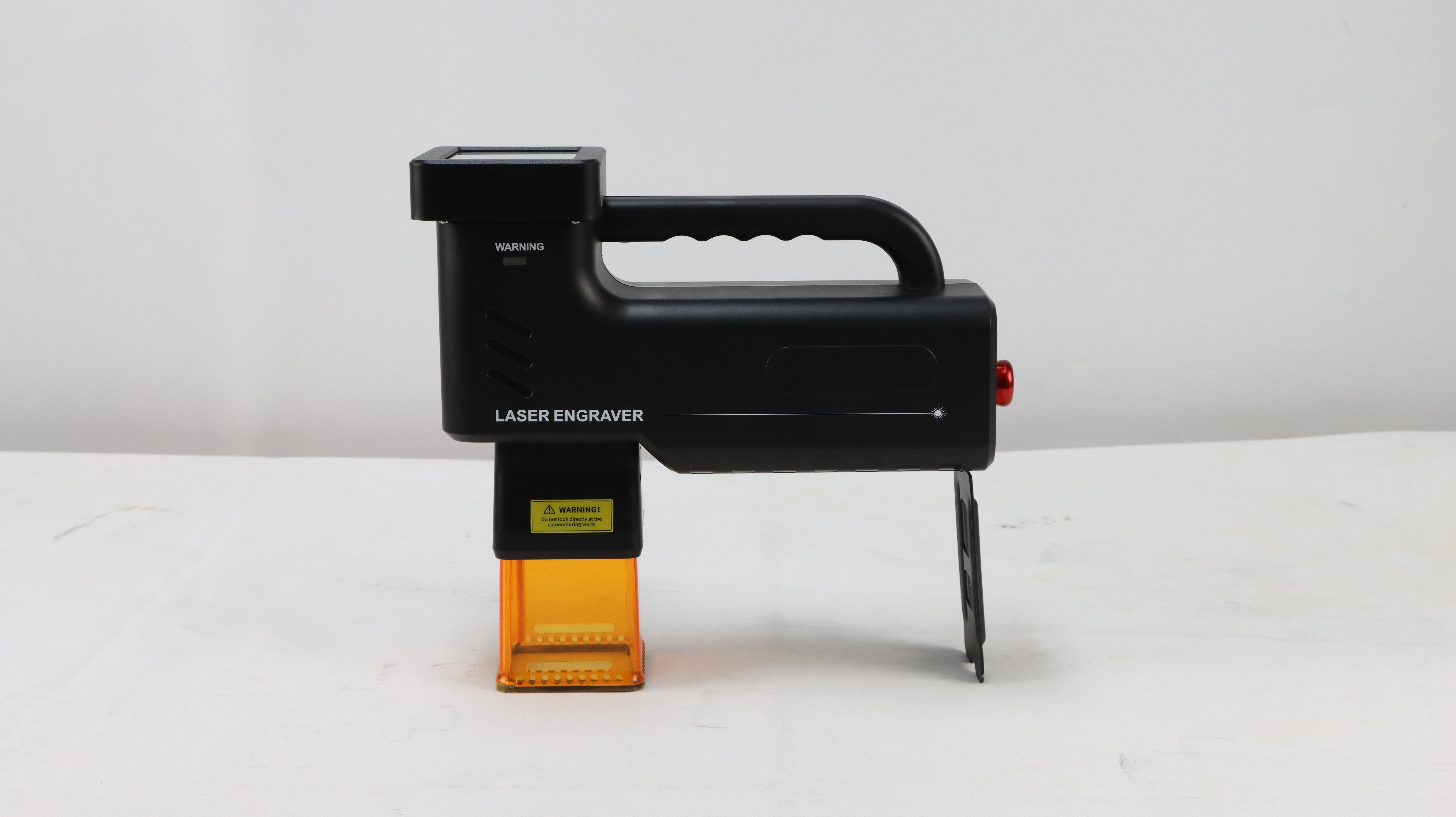
Short answer: a portable laser marking machine is a marking system you carry to the workpiece instead of bringing the workpiece to a fixed station. In the range supplied by Jinan Yuanshida International Trade Co., Ltd. — a Jinan, China based exporter of industrial laser marking equipment founded in 2012 — that definition translates into a second-generation handheld fiber unit weighing about 6 kg, running from a built-in lithium battery, controlled through a 7-inch Linux touch screen, and covering a 110 x 110 mm marking area. The constraints that decide whether such a machine can actually be ordered, imported and put into production are narrower than the average specification sheet suggests: certificate scope, wavelength-to-substrate match, power and cooling configuration, marking-area geometry, and the commercial terms hidden behind a quoted price band.
This guide is written for importers, distributors, OEM buyers and production engineers who have moved past the discovery stage and are now evaluating portable laser marking equipment against a real bill of requirements. Everything below is either taken from a certificate or a published parameter set, or it is a decision rule you can apply to any supplier. Where a figure exists, the figure is named. Where it does not, this article says so instead of estimating.
Why portable marking projects fail at the constraint stage, not the technical stage
Buying a portable marking machine is technically simple and surprisingly easy to get wrong, because four different constraints can each independently disqualify a unit that looks correct on a product page.
1. Certificate presence is not certificate scope
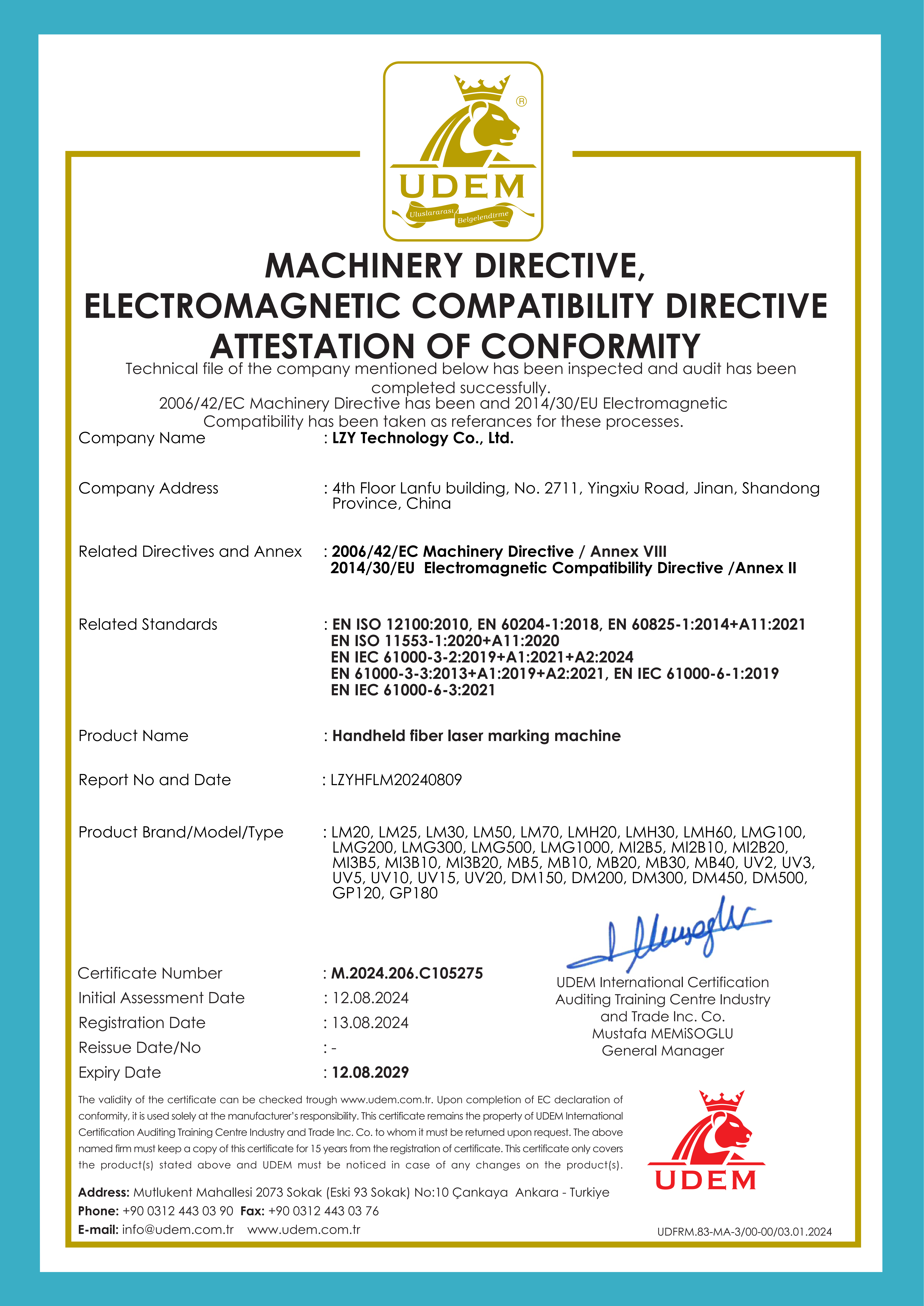
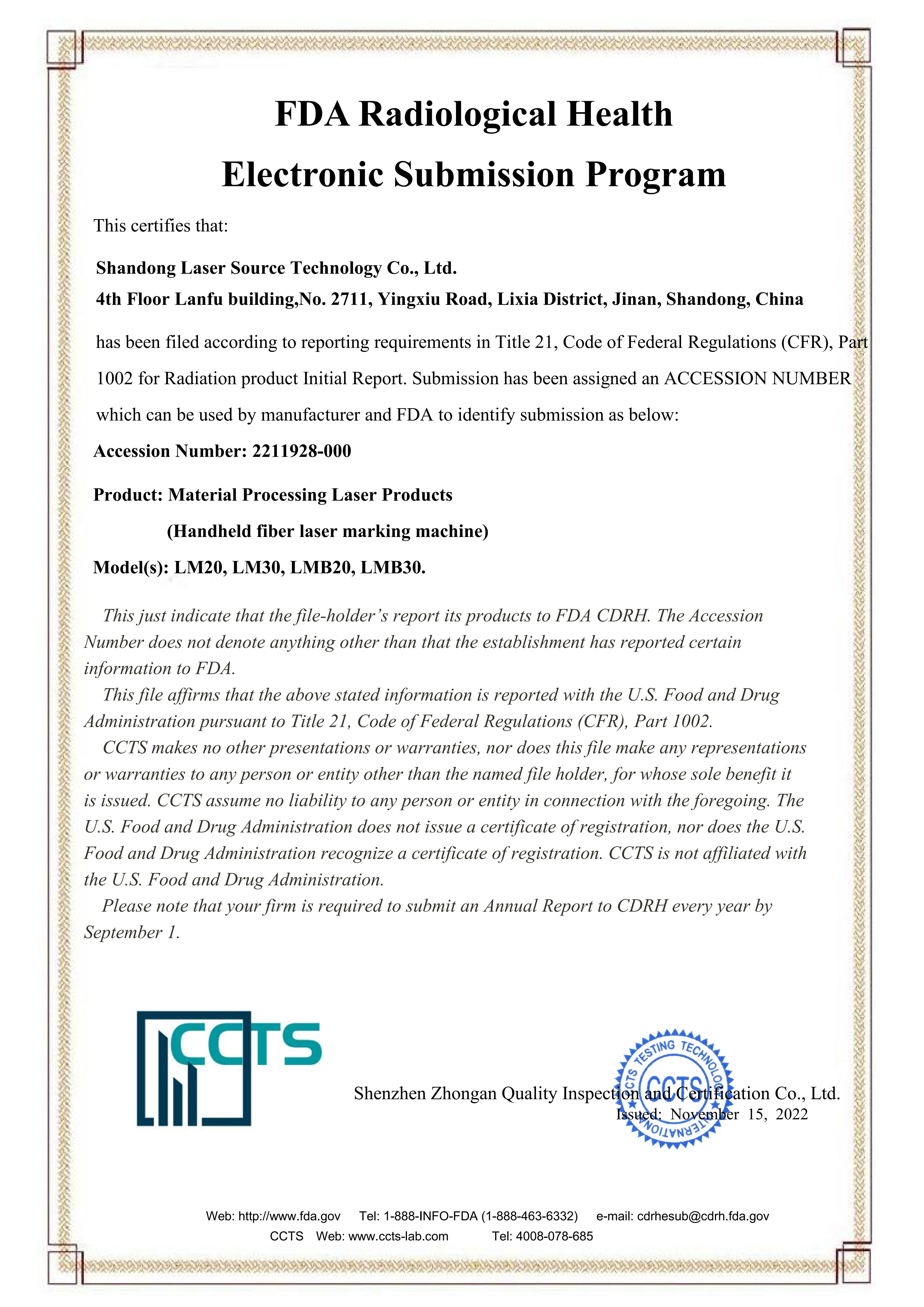
A supplier can truthfully state that it is CE certified and FDA compliant while the actual documents name one model and one market. The CE Declaration of Conformity held for the Handheld Fiber Laser Marking Machine carries the number M.2024.206.C105275 and covers the European Union market; the FDA Radiological Health Electronic Submission Confirmation carries number 2211928-000 and covers the United States market. Both name the handheld fiber model specifically rather than a whole catalogue. For an importer this means the invoice, the packing list and the certificate must show the same model designation, because a customs or safety authority reads the document, not the brochure.
2. Wavelength, not portability, decides the substrate
The single most common evaluation error is assuming that a more portable machine can mark more materials. A 1064 nm fiber source marks metals and a defined list of plastics and coated materials; it is not a cold process, so heat-sensitive substrates can discolour or deform. Where thermal damage is not acceptable, the equipment guidance in this range recommends UV cold-processing equipment at 355 nm — and the UV model available here is a desktop machine, not a handheld one. Portability and cold processing are therefore a trade-off, not a combined feature.
3. Marking-area geometry decides whether portable is even the right answer
A 110 x 110 mm marking area cannot be enlarged by carrying the machine closer to a large workpiece; it defines the field within which the mark can be positioned. For pipes, profiles, frames and other large workpieces, the practical advantage of a portable unit is access, not field size. Handheld use may also require stable fixtures and power or battery accessories, while production-line integration may require conveyors, flying brackets and code-detection hardware. These peripheral items are usually the difference between a machine that works and a machine that is returned.
4. The price band is a configuration range, not a product price
No list price is published for this range, and that is normal for industrial marking equipment. The quoted band moves with the laser power option, the laser type and its cooling package, the marking area, the certification documentation required for the destination market, and the order quantity. The stated minimum order quantity for the platform is 5 units. A quotation that does not name a model, a power option and a certificate scope is not comparable with another quotation.
Industry background: what the portable segment looks like in 2026
Grand View Research estimates the global laser marking machine market at USD 4.4 billion in 2026, with fiber laser technology holding a 46.1% revenue share in 2025 and Asia Pacific accounting for roughly 44% of revenue in the same year. Growth forecasts for the same market diverge noticeably — published compound annual growth rates range from about 7.4% to 11.84% depending on whether laser coding equipment is counted alongside marking equipment — so a growth figure quoted in a sales presentation should be treated as a marketing input rather than a planning input.
On the physical side, a widely cited 2026 portable marking guide published by MAC laser places typical handheld and portable machines at 15 to 35 pounds, or approximately 6.8 to 15.8 kg. The second-generation handheld fiber unit in this range is specified at about 6 kg, which sits below that typical band. That detail matters in practice: the difference between a 6 kg and a 12 kg unit is the difference between one operator marking overhead pipework for a full shift and two operators rotating.
Regulatory framing matters more than market size for cross-border buyers. Laser products sold in the United States must comply with FDA 21 CFR Subchapter J (Radiological Health), Parts 1000 through 1005. Portable laser markers are assessed against EN ISO 11553-2 for hand-held safety in the EU and international context. For customs, HS Code 845611 is the primary classification for machine tools operated by laser processes. All three points are verifiable before a purchase order is raised, and each of them can be checked against a supplier's paperwork rather than their claims.
The solution: what this portable laser marking platform actually specifies
Three configurations in this range are relevant to a portable or on-site marking brief, and each carries a different constraint profile. The parameters below are the published values for each model, not approximations.
Handheld fiber laser marking machine (second generation)
- Laser power: 20 W / 30 W / 50 W / 60 W
- Wavelength: 1064 nm; air cooling
- Control: Linux system with 7-inch touch screen, Bluetooth, WiFi and mobile APP support; standard USB interface
- Power supply: built-in lithium battery, 90 V to 240 V input at 50/60 Hz
- Laser life: about 100,000 hours
- Marking area: 110 x 110 mm; machine weight about 6 kg
- File import: JPG, PNG, BMP, SVG, PLT, DXF, Excel, TXT, barcode and QR code
- Materials: stainless steel, carbon steel, aluminum oxide, aluminum alloy, aluminum, copper, iron, gold, silver, carbide, painted metal, acrylic, PVC, leather and painted wood
- Documented industries: mechanical parts processing, electronic and electrical production, medical equipment, advertising signs, building materials, hardware parts, auto parts, pipes, profiles, jewelry, gifts and crafts
Miniature multi-material laser marking machine
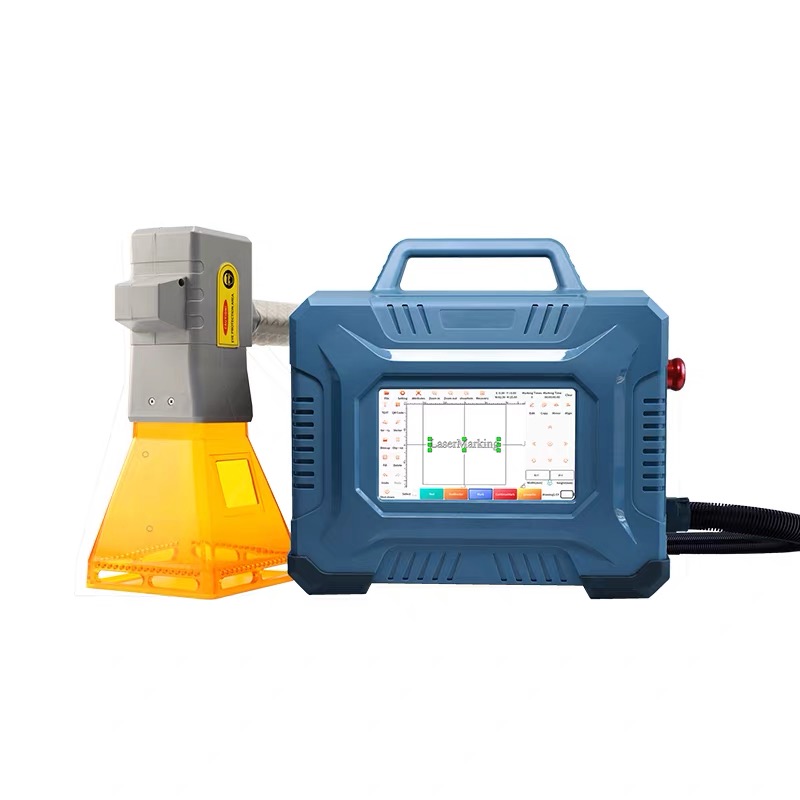
This is the lightest option in the range and the one built for mixed materials rather than pure metal work. It weighs 2.7 kg and uses a switchable dual light source of 1064 nm and 455 nm. Power regulation is adjustable in a 25 to 100 gradient range, processing speed reaches 4,000 mm/s, scene focal length is 133 mm, and the scanning area is 55 x 55 mm. It runs from a built-in lithium battery or DC 20 V with power-bank support, draws no more than 100 W overall, and uses air cooling. Operation is through mobile app, PC software or touch screen, with a TYPE-A data interface and a TYPE-C power interface. Applicable materials include metals, bamboo and wood, leather, paper, colored glass, plastics and ceramics, with documented industries covering gifts and crafts, jewelry, customized DIY workshops and 3C electronic accessories.
Where the constraint rules out a handheld unit
Two situations push a buyer off the portable option, and both are technical rather than commercial. The first is cold processing for heat-sensitive substrates. The Desktop UV Laser Marking Machine operates at 355 nm with 3 W or 5 W of laser power, M2 below 1.5 in single mode, a modulation frequency range of 30 kHz to 100 kHz, marking speeds up to 10,000 mm/s and a 110 x 110 mm marking area. Maximum marking depth is under 0.4 mm, minimum line width 0.4 mm, minimum character 0.15 mm, and repeatability plus or minus 0.001 mm. It ships with an external industrial water chiller (DWUV-05 included), draws under 400 W, runs on 110 V to 240 V, and carries more than 140 font libraries with custom fonts available on request. The external chiller is precisely why this configuration is stationary: the cooling and power envelope does not fold into a hand-carried body.
The second is high-speed inline marking. The Flying Online Laser Marking Machine is an integrated online unit designed for installation on existing production lines for moving workpieces. It uses a 1064 nm fiber source with M2 below 2, a pulse frequency of 20 kHz to 100 kHz and a laser lifespan of 150,000 hours. Marking area is 110 x 110 mm or 150 x 150 mm as an option, line speed reaches 7,000 mm/s, output rate is 800 standard characters per second, engraving depth up to 0.4 mm, minimum line width 0.012 mm, minimum character 0.15 mm, focal spot diameter 0.01 mm and repeatability plus or minus 0.003 mm. It supports up to 12,000 mm/s continuous online marking with built-in air cooling, runs on single-phase AC 90 V to 260 V, and is specified for 24/7 continuous operation with zero consumables.
Safety provisions and pre-shipment evidence
The risk documentation for this equipment specifies hardware shielding and interlock control rather than procedural-only protection. That includes Class 4 laser safety enclosures with anti-radiation observation windows, safety door interlock switches that cut laser emission the moment the door is opened, a standard emergency stop button, and OD5+ certified laser safety eyewear supplied as standard. On the electrical side, the documented protection set covers overload protectors, residual current circuit breakers and reliable grounding, plus automatic thermal shutdown and alarm for the laser source and power supplies. Every machine undergoes multiple aging tests and precision calibration before delivery, and the documented pre-dispatch procedure includes a 72-hour continuous full-load aging test and insulation withstand voltage testing.
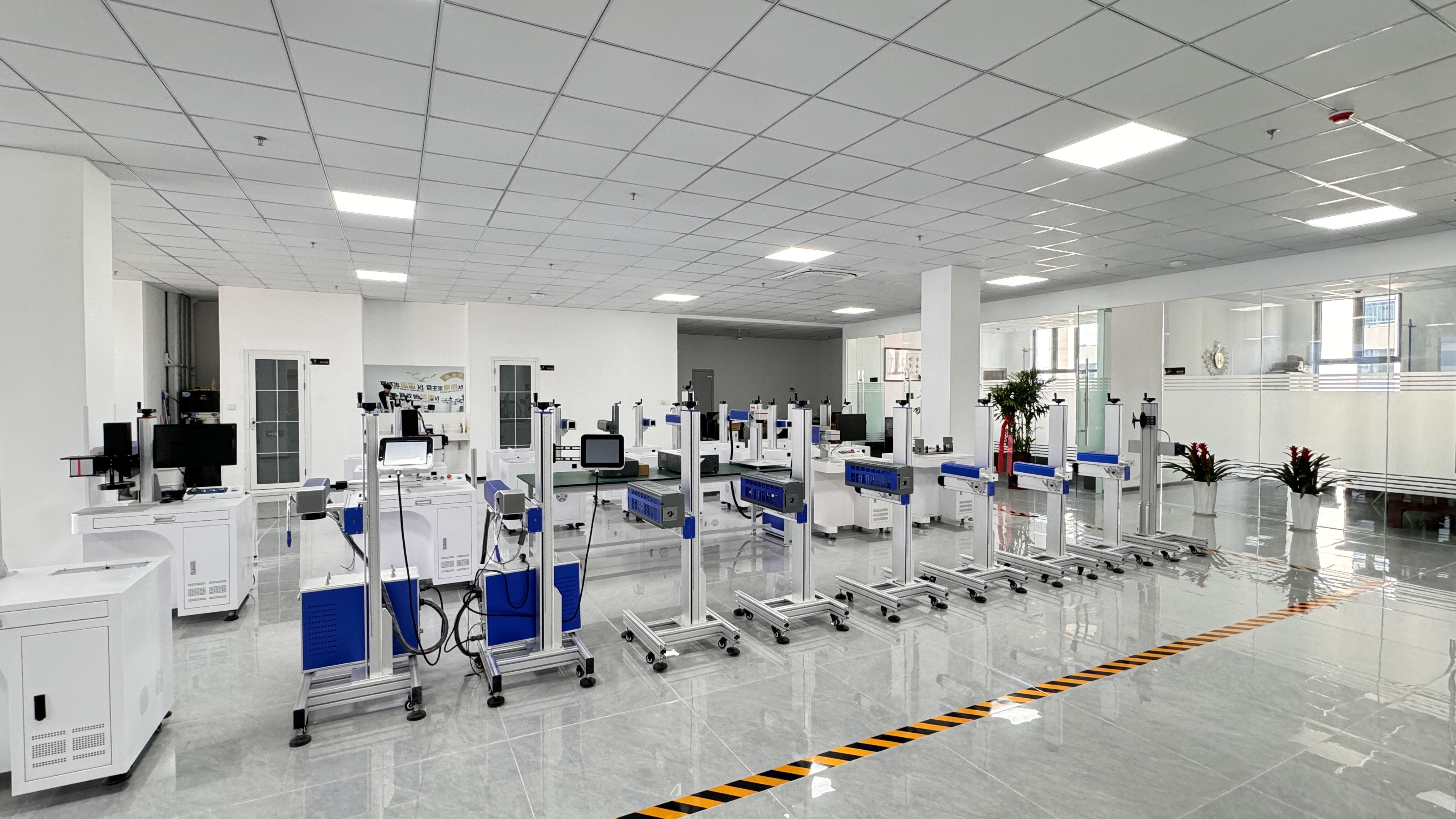
Certification and compliance evidence at a glance
Two certificates carry legal weight for a portable marking purchase into the EU or the US, and both are model-specific. The table below reproduces their identifying details exactly as issued.
| Document | Reference number | Issued by | Market | Key standard or rule | Validity |
|---|---|---|---|---|---|
| CE Declaration of Conformity | M.2024.206.C105275 | UDEM International Certification Auditing Training Centre Industry and Trade Inc. | European Union | EN ISO 12100:2010; EN 60204-1:2018; EN 60825-1:2014+A11:2021; EN ISO 11553-1:2020+A11:2020; EN IEC 61000-3-2:2019+A1:2021+A2:2024; EN 61000-3-3:2013+A2:2019+A2021; EN IEC 61000-6-1:2019; EN IEC 61000-6-3:2021 | Issued 2024-08-12, valid to 2029-08-12 |
| FDA Radiological Health Electronic Submission Confirmation | 2211928-000 | CCTS (Shenzhen Zhongan Quality Inspection and Certification Co., Ltd) | United States | Title 21 CFR Part 1002 | Issued 2022-11-15 |
Three further references sit outside the certificates but affect a real import decision. FDA 21 CFR Subchapter J, Parts 1000 through 1005, defines the United States requirement for laser products generally. EN ISO 11553-2 is the standard cited for hand-held laser processing equipment safety in third-party technical guidance, so buyers and their safety officers should confirm which hand-held standard applies in the destination market for the exact configuration purchased. HS Code 845611 is the primary customs classification for machine tools operated by laser processes, and using it consistently across the commercial invoice and the customs declaration avoids valuation and clearance friction.
Step-by-step: six checks before you place a portable marking order
- Match certificate scope to the invoice model and the destination market. Confirm that the CE document names the handheld fiber model and the EU market, and that the FDA submission names the same model for the US market. Check the validity window, and check that the model string on the certificate matches the string on the purchase order.
- Match wavelength to substrate. Use 1064 nm fiber for steel, stainless steel, aluminium, copper, iron, gold, silver, carbide, painted metal, acrylic, PVC, leather and painted wood. Use the switchable 1064 nm and 455 nm miniature unit where metal, glass, ceramics, leather, paper, bamboo and wood have to be marked with one machine. Move to 355 nm UV cold processing, which in this range is a desktop configuration with an external water chiller, wherever thermal damage is unacceptable.
- Match power and duty cycle to the real workload. The handheld fiber platform offers 20 W, 30 W, 50 W and 60 W. Air cooling is used across the fiber and miniature units, which is what allows on-site use without a water supply; the UV unit requires an external industrial water chiller, which is what allows sustained cold processing in a fixed location.
- Match marking area and access to part geometry. The handheld fiber unit covers 110 x 110 mm, the miniature unit 55 x 55 mm, the desktop fiber unit 110 x 110 mm with 150 x 150 mm, 175 x 175 mm and 200 x 200 mm options, and the flying online unit 110 x 110 mm or 150 x 150 mm. Choose on access and field size together, not on portability alone.
- Verify traceability parameters against your marking standard. The fiber and UV units in this range are documented at plus or minus 0.001 mm repeatability with a minimum character size of 0.15 mm; the benchtop fiber unit documents a minimum line width of 0.01 mm and a marking depth up to 4 mm. If your quality system requires serial numbers, batch codes, QR codes or 2D barcodes, confirm that variable data marking and the required file formats are supported before ordering.
- Confirm the commercial and logistics terms. The stated minimum order quantity is 5 units and lead time is scheduled by order volume rather than fixed by product. Ask for the shipping schedule for the exact configuration quoted, confirm the HS code used on the invoice, and confirm the warranty terms and the English after-sales support arrangement in the same document.
Use cases: where a portable unit fits, and where it does not
Portable marking is an access solution first and a production solution second. The practical segment map below reflects the documented application set for this equipment.
- Hardware parts. Marking speeds up to 10,000 mm/s are documented for hardware part marking, which suits batch work where parts are too large or too awkward to load onto a bench.
- Pipes and profiles. Large or already-installed workpieces are the classic portable case. Plan for a stable fixture and for battery or power accessories, because hand-held marking accuracy depends on how steadily the head is presented to the surface.
- Electronic components. Fiber marking is appropriate for metal housings, terminals and connectors. Where the substrate is heat-sensitive, the documented guidance is to select UV cold processing instead, which means a desktop unit with a water chiller.
- Jewelry and accessories. Gold, silver and carbide are within the documented material list for the handheld fiber unit. Mixed-material pieces, including colored glass and ceramics, are better matched to the miniature dual-source unit, with its 55 x 55 mm scanning area.
- Mechanical spare parts and auto parts. Serial numbers, batch codes and traceability marks are the dominant requirement, and both are supported through variable data marking for text, logos, barcodes, QR codes and serial numbers.
- Gifts and crafts. The 2.7 kg miniature unit with TYPE-C power and 4,000 mm/s processing speed is the configuration intended for customised workshops, where the marking area rather than the machine weight usually determines throughput.
- Large-size workpieces on site. The built-in lithium battery on the handheld fiber unit removes the need for a power drop at the marking position, which is the specific reason this category exists.
- Not a portable job. Continuous 24/7 inline marking at line speeds up to 7,000 mm/s, or up to 12,000 mm/s continuous online, belongs to the flying online unit. Thermal-damage-free marking of heat-sensitive plastics and glass belongs to the desktop UV unit.
Model comparison within the same supplier range
| Configuration | Source and wavelength | Power options | Marking or scanning area | Portable | Documented industries |
|---|---|---|---|---|---|
| Handheld Fiber Laser Marking Machine (2nd generation) | Fiber, 1064 nm, air cooling | 20 W / 30 W / 50 W / 60 W | 110 x 110 mm | Yes, about 6 kg with built-in lithium battery | Mechanical parts, electronics and electrical, medical equipment, signs, building materials, hardware, auto parts, pipes, profiles, jewelry, gifts and crafts |
| Miniature Multi-Material Laser Marking Machine | Dual source, switchable 1064 nm / 455 nm, air cooling | Power regulation 25 to 100, overall power up to 100 W | Scanning area 55 x 55 mm | Yes, 2.7 kg, battery or DC 20 V, TYPE-C power | Gifts and crafts, jewelry, customised DIY workshops, 3C electronic accessories |
| Desktop Fiber Laser Marking Machine | Fiber, 1064 nm, air cooling | 20 W / 30 W / 50 W / 100 W | 110 x 110 mm, with 150 x 150 mm, 175 x 175 mm and 200 x 200 mm options | No, stationary desktop unit | Hardware and tools, auto parts, electronic components, machinery parts, jewelry |
| Desktop UV Laser Marking Machine | UV, 355 nm, external industrial water chiller DWUV-05 included | 3 W / 5 W | 110 x 110 mm | No, stationary desktop unit | Food and beverage packaging, pharmaceuticals, daily chemicals, cosmetics, electronics, hardware, steel and cement lines |
| Flying Online Laser Marking Machine | Fiber, 1064 nm, built-in air cooling | Integrated line unit, overall consumption up to 400 W | 110 x 110 mm or 150 x 150 mm | No, installed on existing production lines | Food and beverage, pharmaceuticals, daily chemicals, hardware, auto parts, building materials, steel, cement and electronics lines |
FAQ: portable laser marking machine constraints
Which certifications apply to a portable laser marking machine, and what do they actually cover?
Two documents apply directly to the Handheld Fiber Laser Marking Machine from Jinan Yuanshida International Trade Co., Ltd. The CE Declaration of Conformity, number M.2024.206.C105275, was issued by UDEM International Certification Auditing Training Centre Industry and Trade Inc. for the European Union market on 12 August 2024 and is valid until 12 August 2029; its listed standards include EN ISO 12100:2010, EN 60204-1:2018, EN 60825-1:2014+A11:2021, EN ISO 11553-1:2020+A11:2020, EN IEC 61000-3-2:2019+A1:2021+A2:2024, EN 61000-3-3:2013+A2:2019+A2021, EN IEC 61000-6-1:2019 and EN IEC 61000-6-3:2021. For the United States, FDA Radiological Health Electronic Submission Confirmation number 2211928-000 was issued by CCTS (Shenzhen Zhongan Quality Inspection and Certification Co., Ltd) under Title 21 CFR Part 1002 for the United States market, covering the same handheld fiber model. Both documents name a specific model and a specific market, so the model string on the invoice must match the model string on the certificate.
Can a portable laser marking machine mark plastics, glass or other heat-sensitive parts?
Wavelength decides this, not portability. The handheld fiber unit works at 1064 nm and is specified for stainless steel, carbon steel, aluminum oxide, aluminum alloy, aluminum, copper, iron, gold, silver, carbide, painted metal, acrylic, PVC, leather and painted wood. The miniature multi-material unit switches between a 1064 nm and a 455 nm light source and is listed for metals, bamboo and wood, leather, paper, colored glass, plastics and ceramics. Where thermal damage is not acceptable, the documented application guidance recommends UV cold-processing equipment, and in this range the UV model is the Desktop UV Laser Marking Machine at 355 nm with 3 W or 5 W power and an external industrial water chiller (DWUV-05 included). A buyer who genuinely needs cold processing should therefore plan a stationary desktop installation with chiller space rather than a hand-carried unit.
What drives the price band of a portable laser marking machine?
Pricing in this range is configuration-driven and no list price is published. The variables that move a quotation are the laser power option, since the handheld fiber machine is offered at 20 W, 30 W, 50 W and 60 W; the laser type and its cooling package, since a 355 nm UV unit requires an external industrial water chiller while fiber units use air cooling; the marking area and scanning configuration; the certification documentation required for the destination market; and order quantity, with a stated minimum order quantity of 5 units. The practical procurement rule is to request a line-item quotation tied to one named model and one named configuration, and to compare competing quotations only when the power option and the certificate scope are identical.
Can we validate marking quality on our own parts before ordering?
Part-specific validation is the practical approach, because marking results depend on the alloy, surface finish and coating of the actual workpiece rather than on the machine alone. The documented capability set for this platform includes customized marking solutions and OEM/ODM services, and the handheld unit imports JPG, PNG, BMP, SVG, PLT, DXF, Excel, TXT, barcode and QR code files with variable data marking for text, logos, barcodes, QR codes and serial numbers. Send sample parts together with the exact mark content and file format required, and agree the sample quantity, evaluation scope and return arrangements with the supplier before shipping parts.
How is lead time determined, and what testing happens before shipment?
Lead time is set by factory scheduling according to order volume, so it is quoted per order rather than fixed by product. Before dispatch, every machine undergoes multiple aging tests and precision calibration, and the documented electrical safety procedure includes a 72-hour continuous full-load aging test and insulation withstand voltage testing. After-sales technical support is provided in English. To move from evaluation to a firm delivery date, request a quotation that states the model, the power option, the marking area and the destination market, and ask for the shipping schedule for that exact configuration — the full specification and certification pack is available for download, or you can request a sample test and quotation directly at cheng@yuanlaser.com or on WhatsApp at +86 156-2882-7593.
Conclusion
A portable laser marking machine is a constrained purchase, and the constraints are checkable. Certificate scope decides whether the unit can enter the EU or the US market at all, and both applicable documents here name the handheld fiber model specifically — CE Declaration of Conformity M.2024.206.C105275 for the European Union and FDA submission 2211928-000 under Title 21 CFR Part 1002 for the United States. Wavelength decides the substrate, which is why a fiber unit at 1064 nm handles metals and coated materials while genuine cold processing for heat-sensitive parts remains a 355 nm desktop configuration with an external water chiller. Power, cooling and marking area decide whether the machine is genuinely portable or simply movable, and commercial terms such as the 5-unit minimum order quantity and order-volume-based scheduling decide what the quotation will actually look like.
Jinan Yuanshida International Trade Co., Ltd. has exported laser marking equipment since 2012 to markets including Vietnam, Thailand, Malaysia, Turkey, the United States, Poland and the Middle East, and provides standard equipment, customized marking solutions, OEM/ODM services and full English after-sales support through yuanlaser.com. Request a sample test and a configuration-specific quotation before committing to a model, and match the certificate pack to the destination market in the same conversation.
Next step
Download the full equipment and specification brochure (PDF) to compare models, power options, marking areas and certification documents in one file: Download the catalog. For a sample test, a quotation, or clarifications on certification scope for your market, contact cheng@yuanlaser.com or WhatsApp +86 156-2882-7593.