Borosilicate Glass 3.3: Why It Matters for Lighting and Lab Buyers
Borosilicate glass 3.3 is the designation for a borosilicate glass with a nominal coefficient of linear thermal expansion of about 3.3 × 10⁻⁶/°C, roughly one-third that of soda-lime glass. That single number explains why borosilicate components survive on-off cycling in high-heat fixtures and repeated autoclave cycles in a laboratory, while ordinary decorative glass cracks. For B2B buyers, the material decision sets the failure rate, the compliance file and the supply plan before a single unit is produced.
This guide is written for lighting component buyers, OEM and ODM programme managers, and laboratory procurement teams who specify glass in volume. It explains what the 3.3 designation actually describes, where thermal shock damage originates in lighting and laboratory duty, how to specify the material without over-buying or under-buying, and which documents should be in hand before a container ships. Product references come from Jingxin Glassware (Yancheng Jingxin Glassware Co., Ltd.), a glass manufacturer based in Yancheng, Jiangsu, China that produces custom glassware for lighting, laboratory, candle, home décor and food and beverage packaging buyers, and exports to more than 100 countries.
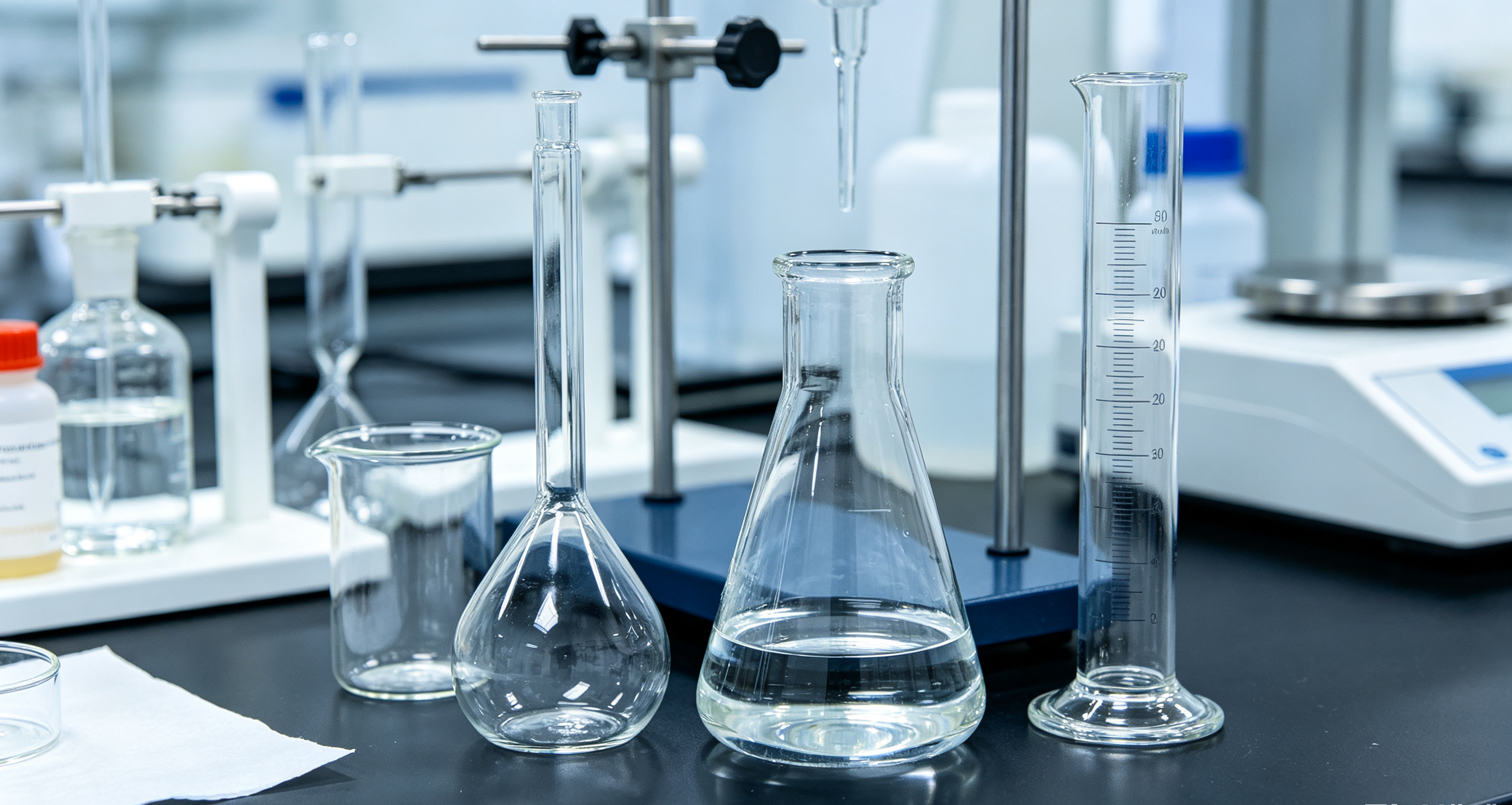
Borosilicate 3.3 is the common material foundation for duty lighting glass and laboratory glassware programmes.
Problem definition: the failures a product photo never shows
Glass components rarely fail because a supplier did something indefinable wrong. They fail because a duty envelope was never written down, so the material was selected by appearance and unit cost rather than by temperature, chemistry and mechanical load. Three patterns account for most of the damage reported by buyers of lighting glass and lab glassware.
1. Thermal shock at the fitter neck and wall
Thermal shock occurs when two areas of the same glass body sit at different temperatures and try to expand at different rates. The internal stress that builds up scales with the temperature difference and with the material's coefficient of thermal expansion. In a lamp shade, the hottest zone sits directly above the lamp source while the cooler zone is at the metal fitter. In a beaker or flask, the heated base and the cooler upper wall do the same thing. Soda-lime glass, with a coefficient of about 9 × 10⁻⁶/°C, commonly tolerates a temperature difference of only around 40 °C before stress exceeds strength. Borosilicate 3.3 tolerates far more because it expands roughly one-third as much.
2. Sustained temperature plus mechanical load
Continuous heat is a slower failure mode. A glass shade clamped to a holder and held at elevated temperature will creep and stress-crack over time, especially in thick-wall pressed parts where wall sections are uneven and stress concentrates. This is why industrial and hazardous-location fixtures use pressed borosilicate shades with 5-10 mm walls and annealed structures rather than thin decorative glass.
3. Specification and documentation gaps
The third failure is commercial rather than physical: a shipment arrives with the right shape and the wrong evidence. Buyers selling into the EU need CE documentation for lighting products, RoHS evidence on restricted substances and REACH information on substances of very high concern. Without those documents, material choice stops mattering because the goods cannot be listed. The practical fix is to treat compliance documents as a line item in the purchase specification rather than an afterthought.
Industry background: why the duty envelope keeps tightening
Both ends of this market, lighting glass and laboratory glass, have moved toward more demanding operating conditions.
In lighting, high-output LED engines, halogen and metal-halide sources, enclosed fixtures and industrial or hazardous-area housings all raise the temperature seen by the lighting glass shade. Downlights and pendants are installed in unheated warehouses, cold storage and outdoor canopies, so the glass may be cold at switch-on and hot minutes later. Pressed glass lamp cover designs for signal and explosion-protection duty add impact requirements on top of the thermal ones.
In laboratories, glassware is autoclaved, heated on hot plates, cooled under running water and exposed to acids, alkalis and solvents, often within the same working day. Volume calibration and uniform wall thickness matter as much as thermal survival, because a cracked or deformed vessel invalidates the work it was used for.
Commercially, most decorative hand blown glass lamp shade and opal globe production still runs on soda-lime glass, and that remains a rational choice: soda-lime provides optical clarity at a cost-effective position for decorative and general lighting. Borosilicate is specified where duty, not appearance, is the deciding factor. Jingxin Glassware maintains production lines for both soda-lime and borosilicate, so the material can be matched to the application rather than to whatever a single line happens to run.
Detailed solution: what borosilicate 3.3 delivers, and what it does not
What the 3.3 designation describes
Borosilicate glass is made from silica with boron trioxide (B₂O₃) added to the melt. The boron creates a tighter, more stable network that resists expansion. The 3.3 refers to the nominal coefficient of linear thermal expansion, approximately 3.3 × 10⁻⁶/°C. Because thermal stress scales with that coefficient, the same temperature difference produces roughly one-third the stress it would produce in soda-lime glass. Industry descriptions commonly place borosilicate at 3-5 times the thermal shock resistance of soda-lime.
Product-level evidence rather than a generic claim
Material claims are only useful when they appear as specifications attached to a part number. In the Jingxin borosilicate range, the numbers look like this:
- JX1830 explosion-proof borosilicate glass lamp shade: dome cover, 118 mm diameter, 132 mm height, 867 g, press-moulded 6.0-10.0 mm wall, rated for rapid fluctuation from -40 °C to +260 °C, IK10 mechanical impact resistance, and over 90% light transmittance in clear glass.
- JX1832 pressed borosilicate signal glass lamp shade: 11 cm diameter, 13 cm height, uniform 5 mm pressed wall, continuous working range from -60 °C to +450 °C, annealed to remove internal stress.
- JX1407 borosilicate glass globe lamp shade: 150 mm globe, 2 mm hand-blown wall, threaded bottom fitter for E26 and E27 holders.
- JX1416 double-wall glass G9 light globe: 100 mm globe with a G9 thread, 1.5-2 mm wall, clear outer layer with a frosted inner layer, described as tolerating sharp temperature changes up to 550 °C.
- Laboratory programme: borosilicate 3.3 beakers from 5 ml to 10,000 ml, handled beakers, Erlenmeyer flasks, round-bottom test tubes and GL45 reagent bottles, with thermal shock resistance quoted at a temperature difference of up to 180 °C and autoclave compatibility.
Optical performance is a finish decision, not a material decision
Buyers often assume borosilicate automatically means clear. It does not. Clear borosilicate delivers high transmission, over 90% in the JX1830 clear variant, while pressed frosted variants diffuse at roughly 40-60%. Where a soft, glare-free opal glow is required, that effect generally comes from opal soda-lime bodies such as the JX1004 or the G9-threaded JX1184, because opacifying agents are formulated into the soda-lime batch. Specifying the right combination of body material and surface finish is the difference between a component that performs and one that merely looks correct in a sample photo.
Compliance and end-of-life
Borosilicate parts in the Jingxin range are described as 100% lead-free and 100% recyclable. The documented evidence base includes 19+ professional certifications, among them a RoHS test report issued by Intertek under number 251016112GZU-001 on 24 October 2025 for glass lamp shades, tested to IEC 62321-5:2013 for cadmium and lead, IEC 62321-4:2013+AMD1:2017 for mercury and IEC 62321-7-2:2017 for hexavalent chromium, plus a SMETA-4P social compliance audit by TUV Rheinland under number ZAA600149732 issued on 12 August 2025 covering labour standards, health and safety, environment and business ethics. For custom orders, CE, RoHS and REACH compliance documentation and material reports can be supplied with the shipment, and third-party inspection by SGS is available on request.
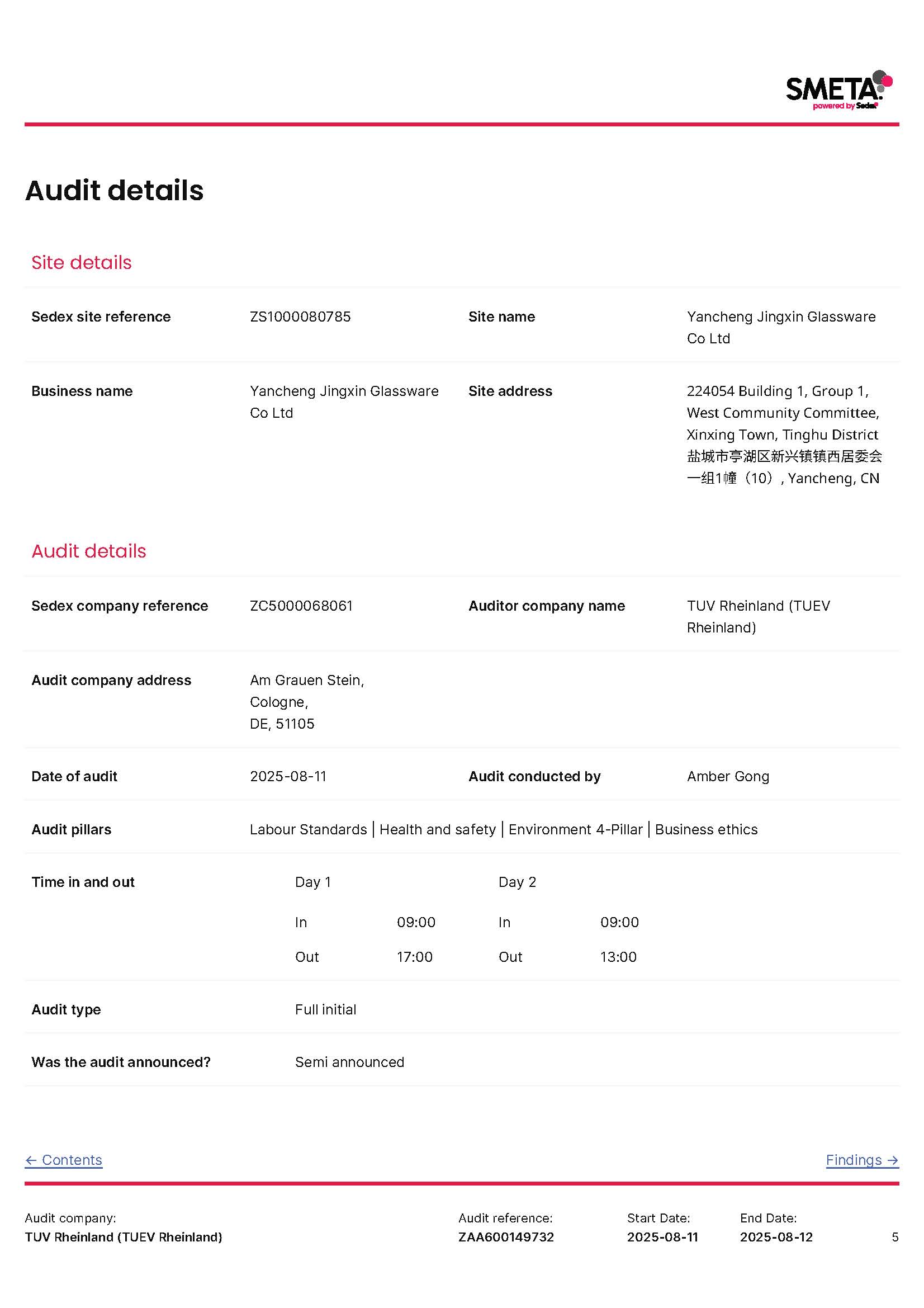
Social compliance evidence: SMETA-4P audit ZAA600149732 issued by TUV Rheinland, covering labour standards, health and safety, environment and business ethics.
Step-by-step breakdown: specifying borosilicate 3.3 without over-buying
Step 1: write the duty envelope
Record the maximum surface temperature at the hottest point, the maximum temperature difference the part will see in one cycle, the number of cycles per year, the chemical agents in contact, the cleaning method and any impact risk. A pendant in a heated retail ceiling and a shade in a chemical workshop can share a shape but not a material.
Step 2: select the material against the envelope
If the application stays within the temperature change range typical of soda-lime lighting glass, commonly quoted at up to about 120 °C, and sees no large temperature step, soda-lime remains the cost-effective choice with excellent clarity. If the part sees rapid cycling, cold installation followed by heat, hazardous-area duty or laboratory protocols, specify borosilicate 3.3.
Step 3: fix geometry and interface
Confirm the fitter type (E27, E14, G9 or a custom opening), wall thickness and tolerance. Pressed parts hold tighter dimensional consistency than hand-blown parts, which is why signal and explosion-protection shades are pressed. A hand-blown glass light globe carries natural variation that is acceptable, and often desirable, in decorative fixtures but not in a calibrated vessel.
Step 4: choose the finish
Decide between clear, frosted, opal, ribbed, coloured or printed surfaces, and confirm which finishes are available on the chosen body material. Jingxin surface capabilities include acid pickling and etching, sandblasting, silk-screen printing, stamping, decalcomania and spray painting, and multiple techniques can be combined on one product. Surface quality is inspected in-process and again on finished goods for adhesion, colour accuracy and durability.
Step 5: validate on a sample, not on a catalogue page
Samples are available on request; sample cost may apply and freight is collect. Sample lead time is typically 5-7 days after artwork and specification confirmation for most lighting items, and 15-20 days for technical parts such as the JX1830 where drawing and specification review are required. Prototype testing and validation are completed before mass production.
Step 6: lock the inspection and documentation plan
Agree 100% pre-shipment inspection at the factory, third-party inspection where required, and the document pack: RoHS and REACH material reports, CE declarations where applicable, and a certificate of analysis for the raw glass batch. Jingxin runs 100% pre-shipment inspection supported by third-party testing on request.
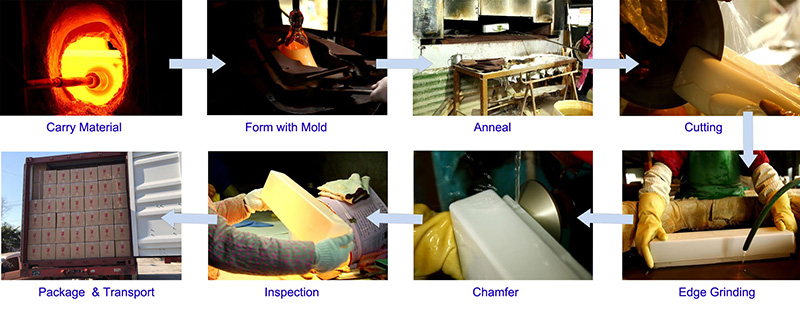
Forming, annealing and in-process inspection: wall thickness and internal stress control are what turn a material claim into a repeatable component.
Step 7: scale with a realistic schedule
Mass production typically runs 20-30 days after sample approval for lighting glass, and 25-35 days for technical press-moulded parts. Minimum order quantity is 500 pieces for hand-made items and 2,000 pieces for machine-made items, with custom quantities negotiable for trial orders. Standard terms are FOB Shanghai with a 30% T/T deposit and 70% balance before shipment; CIF and EXW are available on request.
Use cases: where borosilicate 3.3 earns its place
Industrial and hazardous-location lighting
Refineries, chemical plants, mine tunnels, offshore platforms and flammable-solvent workshops combine heat, impact and corrosive atmosphere. A pressed glass lamp cover such as the JX1830 addresses all three at once: a 6-10 mm wall, IK10 impact resistance and a -40 °C to +260 °C thermal envelope, with the material also meeting RoHS and REACH expectations for industrial equipment.
Enclosed decorative fixtures and G9 programmes
G9 halogen and high-output LED capsules inside small globes create concentrated heat in a small volume. A borosilicate globe with a G9 thread, such as the JX1416, or the threaded-fit JX1407 globe, keeps the fitter interface stable through repeated switching while retaining the visual character the fixture needs.
Laboratory glassware programmes
Borosilicate 3.3 lab glassware covers measuring, mixing, heating and storage: graduated glass beaker ranges, handled beakers for hot liquid, conical glass flask bodies for titration and mixing, round-bottom glass tube formats for sample work, and GL45 reagent bottles for sealed storage. The relevant specifications are thermal shock resistance to a temperature difference of 180 °C, autoclave compatibility, chemical inertness and dimensional accuracy for volume calibration.
One supplier across lamp shade and lab programmes
Buyers running both a lighting line and a laboratory or scientific channel often consolidate. A single supplier running both soda-lime and borosilicate lines can hold one compliance file, one inspection standard and one logistics schedule across lamp shades, G9 globes and lab glassware, with OEM and ODM support spanning drawing-based and concept-based customisation and custom mould creation for unique shapes. Jingxin Glassware reports 16 national patents for in-house custom product development and serves more than 1,000 clients across 100+ countries.
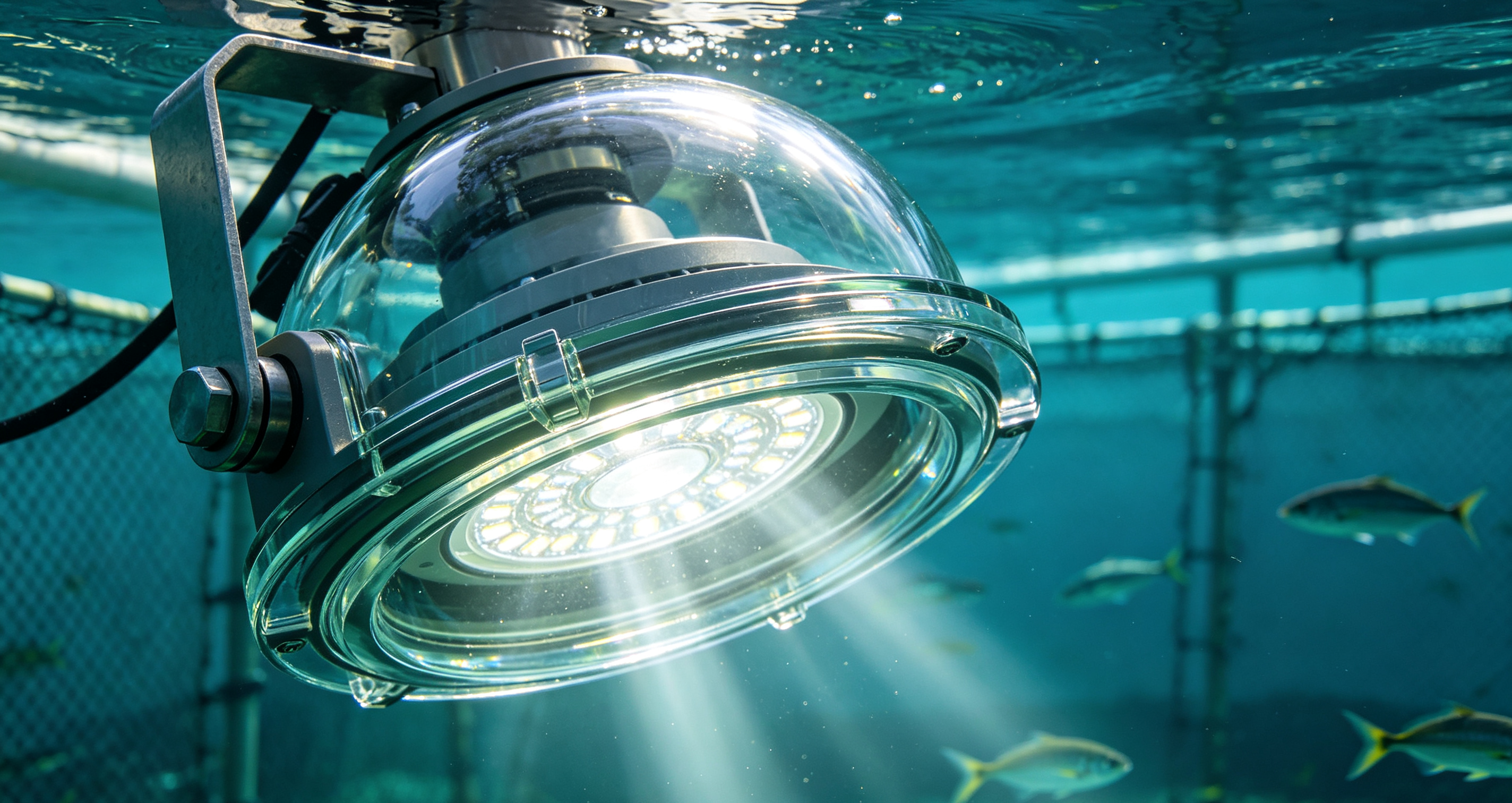
Beyond the standard 3.3 range, custom formulations can be engineered for pressure and sea-water exposure, as in this deep-sea fish farming lamp shade project supplied to a Chilean customer since 2018.
Comparison table: borosilicate 3.3 versus soda-lime
The table uses only specifications and descriptions verified in the product and technical data referenced above. Use it as a screening tool, then confirm final values against the drawing for your part.
| Property | Borosilicate 3.3 | Soda-lime | What it means for the buyer |
|---|---|---|---|
| Coefficient of linear thermal expansion | About 3.3 × 10⁻⁶/°C | About 9 × 10⁻⁶/°C | Borosilicate expands roughly one-third as much, so the same temperature step generates far less internal stress. |
| Thermal shock resistance | Typically 3-5 times that of soda-lime | Baseline; commonly tolerates a temperature difference of about 40 °C | Sets whether the part survives cold installation, fast switching and wash-down cooling. |
| Documented working ranges (examples) | JX1830: -40 °C to +260 °C. JX1832: -60 °C to +450 °C. Lab programme: up to 180 °C temperature difference, autoclave compatible. | Lighting grades commonly rated to temperature changes of about 120 °C. | Match the part to the fixture or protocol; do not extrapolate from a similar-looking product. |
| Chemical durability | Inert to most acids, alkalis and solvents in the laboratory programme | Specified for lighting and decorative duty | Reagent contact, disinfectants and cleaning agents decide the material in lab and medical settings. |
| Optical options | Clear (JX1407, JX1416 clear outer), pressed clear or frosted (JX1830) | Opal white, ribbed, marble swirl, milk frosted finishes | Opal diffusion is a soda-lime strength; confirm the effect you need before switching material. |
| Lead and end-of-life | 100% lead-free, 100% recyclable | 100% lead-free, 100% recyclable | Both streams need RoHS and REACH documentation; the material choice does not remove the paperwork. |
| Typical role in a programme | Duty glass: industrial, hazardous-area, high-heat lighting, laboratory | Decorative and general lighting, cost-sensitive volumes | Downgrading a duty part to soda-lime saves unit cost and moves the risk to your warranty line. |
Frequently asked questions
1. Is borosilicate 3.3 glass from a Chinese supplier RoHS and REACH compliant, and what documentation should a buyer request?
Compliance is documented per shipment, not per brochure. Jingxin Glassware holds 19+ professional certifications, including a RoHS test report issued by Intertek (report 251016112GZU-001, 24 October 2025) for glass lamp shades tested to IEC 62321-5:2013, IEC 62321-4:2013+AMD1:2017 and IEC 62321-7-2:2017, and a SMETA-4P audit by TUV Rheinland (ZAA600149732, 12 August 2025). RoHS limits are cadmium at 100 mg/kg or less and lead, mercury and hexavalent chromium at 1,000 mg/kg or less. Borosilicate products are 100% lead-free and 100% recyclable, and CE, RoHS and REACH documentation plus material reports can be supplied for custom orders. Request the certificate numbers, the test standards and the scope line, and confirm they name your product family rather than a different item.
2. Can one OEM manufacturer supply both borosilicate lamp shades and laboratory glassware?
Yes, where the factory runs both material streams. Jingxin Glassware maintains production lines for soda-lime and borosilicate glass and produces borosilicate glass lamp shade formats (JX1407, JX1416, JX1830, JX1832) alongside laboratory instruments (JX6109 beakers, JX6102 handled beakers, JX6207 flasks, JX6402 test tubes, JX6703 reagent bottles). OEM and ODM services cover concept and drawing-based customisation, custom mould creation, and in-house surface finishing including acid etching, sandblasting, silk-screen printing, stamping, decalcomania and spray painting. The company reports 16 national patents for custom product development and 100% pre-shipment inspection with third-party testing available on request.
3. What order quantities and commercial terms apply to custom borosilicate 3.3 parts?
Minimum order quantity is 500 pieces for hand-made items and 2,000 pieces for machine-made items, with custom quantities negotiable for trial orders and smaller projects. Technical pressed parts such as the JX1830 explosion-proof shade start from 1,000 pieces. Standard delivery terms are FOB Shanghai, with CIF and EXW available on request; payment terms are a 30% T/T deposit on order confirmation and 70% balance before shipment. Because MOQ, tooling approach and unit price all depend on geometry and finish, the practical route is to confirm the drawing first and treat quantity as a negotiated variable rather than a fixed gate.
4. How does a buyer validate a borosilicate sample before committing to mass production?
Samples are available on request; sample cost may apply and freight is collect. Sample lead time is typically 5-7 days after artwork and specification confirmation for most lighting items, and 15-20 days for technical press-moulded parts such as the JX1830. Validation should cover fitter fit, wall thickness, optical result, thermal cycling at the extremes of your duty envelope and, for lab items, volume calibration and autoclave cycling. Prototype testing and validation are completed before mass production, and third-party laboratory inspection can be arranged on request.
5. What are the production lead times and inspection terms for bulk orders?
Mass production typically runs 20-30 days after sample approval for lighting glass, and 25-35 days for technical press-moulded parts; laboratory glassware programmes run on comparable schedules that vary with capacity and decoration. Every order is subject to 100% pre-shipment inspection at the factory, with SGS third-party inspection available on request and the buyer's own inspection on arrival handled under the agreed warranty terms. Shipping is arranged by sea, air, rail, truck or express to match cost and timeline, with export documentation including FORM E and CO handled by the export team.
Conclusion: the material decision is the supply decision
Borosilicate 3.3 is not a premium badge; it is a specification with a measurable consequence. Its coefficient of thermal expansion, roughly one-third that of soda-lime, is what allows a pressed glass lamp cover to hold together from -40 °C to +260 °C, a signal shade to run from -60 °C to +450 °C, and a lab beaker to survive a 180 °C temperature difference and an autoclave cycle. Where the duty envelope stays inside the range of lighting-grade soda-lime and the priority is opal diffusion or unit cost, soda-lime remains the correct answer.
For buyers, the reliable sequence stays consistent: write the duty envelope, select the material against it, fix the geometry and finish, validate on a sample, and lock the inspection and documentation plan before scaling. A supplier that runs both material streams, and can show RoHS, REACH and CE documentation alongside 100% pre-shipment inspection, turns that sequence into a repeatable programme rather than a one-off project.
Jingxin Glassware produces custom borosilicate and soda-lime glassware for lighting, laboratory, candle, home décor and food and beverage packaging buyers, and exports to 100+ countries. If you are sourcing a borosilicate lamp shade, a G9 globe or a laboratory glassware range, the next step is a specification review against your duty envelope.
Request a sample, quotation or the lamp shade catalogue
Send your drawing, target specification and annual volume, and the team will confirm material, MOQ and lead time. Catalogue (PDF): Glass Lamp Shades Catalogue, Yancheng Jingxin Glassware Co., Ltd.
Yancheng Jingxin Glassware Co., Ltd. · No.268 South Jiefang Road, Yancheng, Jiangsu, China · Tel +86 515-8822 9059 · WhatsApp +86 180 1962 7905 · www.cn-glassware.com
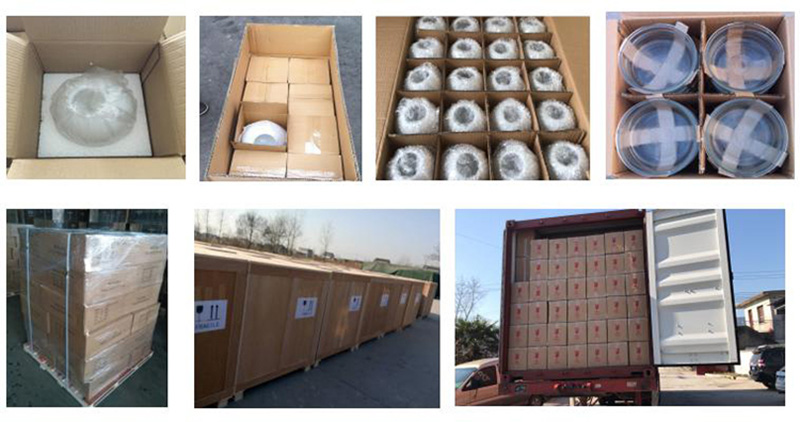
Bulk borosilicate orders ship with multi-layer protective packing; pre-shipment inspection is completed before dispatch and third-party inspection can be arranged on request.
Have Questions or Need More Details?
Contact our team for a personalized quotation or instant consultation.
Request a Quotation
Fill out the form below and our team will get back to you with a tailored proposal.
WhatsApp Direct Chat
Prefer to chat in real-time? Message us on WhatsApp for instant assistance & quick answers.
- Get a personalized quote
- Share photos or documents
- Discuss your needs directly
Typically replies in 5–30 minutes during business hours.