Custom Glassware Compliance Guide: CE, RoHS & REACH for Lighting Glass
Custom Glassware Compliance Guide: CE, RoHS & REACH for Lighting Glass
When a lighting buyer approves a custom glass lamp shade order, the glass itself is only half of what arrives in the container. The other half is paperwork — and in practice the paperwork is where most cross-border lighting glass orders quietly stall. A carton of opal white globes or double-wall G9 shades can be dimensionally perfect and still fail a retail or customs review if the CE, RoHS or REACH documents do not match the product, the material grade, or the destination market.
This guide is written for lighting buyers, importers, specifiers and procurement teams who are evaluating a custom glassware supplier at the documentation stage. It is a document-review framework, not legal advice. Its purpose is narrower and more practical: to show what CE, RoHS and REACH paperwork normally looks like for custom glass lamp shades and other borosilicate lighting glass, how to match that paperwork to verified material claims such as borosilicate 3.3, 100% lead-free glass and 100% recyclable glass material, and how to check the documents against the actual geometry being ordered — globe, cylinder, opal white, or double-wall G9.
The supplier referenced throughout is Yancheng Jingxin Glassware Co., Ltd. (Jingxin Glassware) — a custom glassware manufacturer based in Yancheng, Jiangsu Province, China, founded in 1999, producing glass lamp shades, candle vessels, drinkware, home décor glassware and laboratory glassware, and exporting to 100+ countries across the USA, UK, Europe, Asia and the Middle East.
Why Compliance Documentation Is the Real Order Risk in Custom Lighting Glass
Most failed glass orders are not failed because the glass is wrong. They fail because a compliance document does not line up with what was actually shipped.
In practice, three mismatch patterns account for most documentation problems:
- Scope mismatch. A RoHS or REACH statement covers "glass products" in general but never names the lighting glass shade you ordered — or it covers soda-lime glass while your order is borosilicate 3.3.
- Material-claim mismatch. The catalogue describes the product as lead-free and recyclable, but the compliance file does not restate those same material claims in a form a reviewer, retailer or customs broker can accept.
- Geography mismatch. The document was issued against one market's requirement while the shipment is going somewhere else.
There is also a role-confusion problem. CE, RoHS, REACH and SMETA are frequently listed together as if they were the same kind of document. They are not.
- RoHS and REACH are product and chemical compliance documents.
- CE is a conformity marking attached to a product before it is placed on the market — a declaration-based system, not a test report.
- SMETA-4P is a social and ethical audit of a manufacturing site, not a product document.
A supplier that can explain the difference — and can produce the right document for the right question — is a different supplier from one that simply lists acronyms on a homepage.
Industry Background: How Lighting Glass Sits in Trade and Compliance Systems
Lighting glass is not a compliance grey zone. It has a defined place in customs and trade classification. Glass parts for electric lighting — including glass envelopes and glass components used in lighting applications — are formally recognised within the glass and glassware chapter of customs schedules, which means there is an established customs-trade pathway for the exact product category that custom glass lamp shade buyers import.
At the market-data level, trade in glass and glassware is tracked at scale. The United Nations Comtrade database stores more than one billion trade records from 1962 onward, with annual international trade statistics supplied by over 140 reporter countries. On the supplier side, the industry has moved toward multi-certification manufacturing: a lighting-glass manufacturer today is expected to hold not one certificate but a pack — product-compliance documents (RoHS, REACH), site-level social-compliance audits (such as SMETA-4P), and quality-management evidence covering raw material through finished goods.
That is the environment in which a custom lighting glass order is placed. The buyer's job is to check that the pack actually maps onto the product.
The Document Set — What Each Piece Covers for Lighting Glass
RoHS — Restriction of Hazardous Substances
RoHS is a chemical-restriction requirement. For lighting glass it is normally evidenced by a laboratory test report that states which restricted substances were tested and by which method.
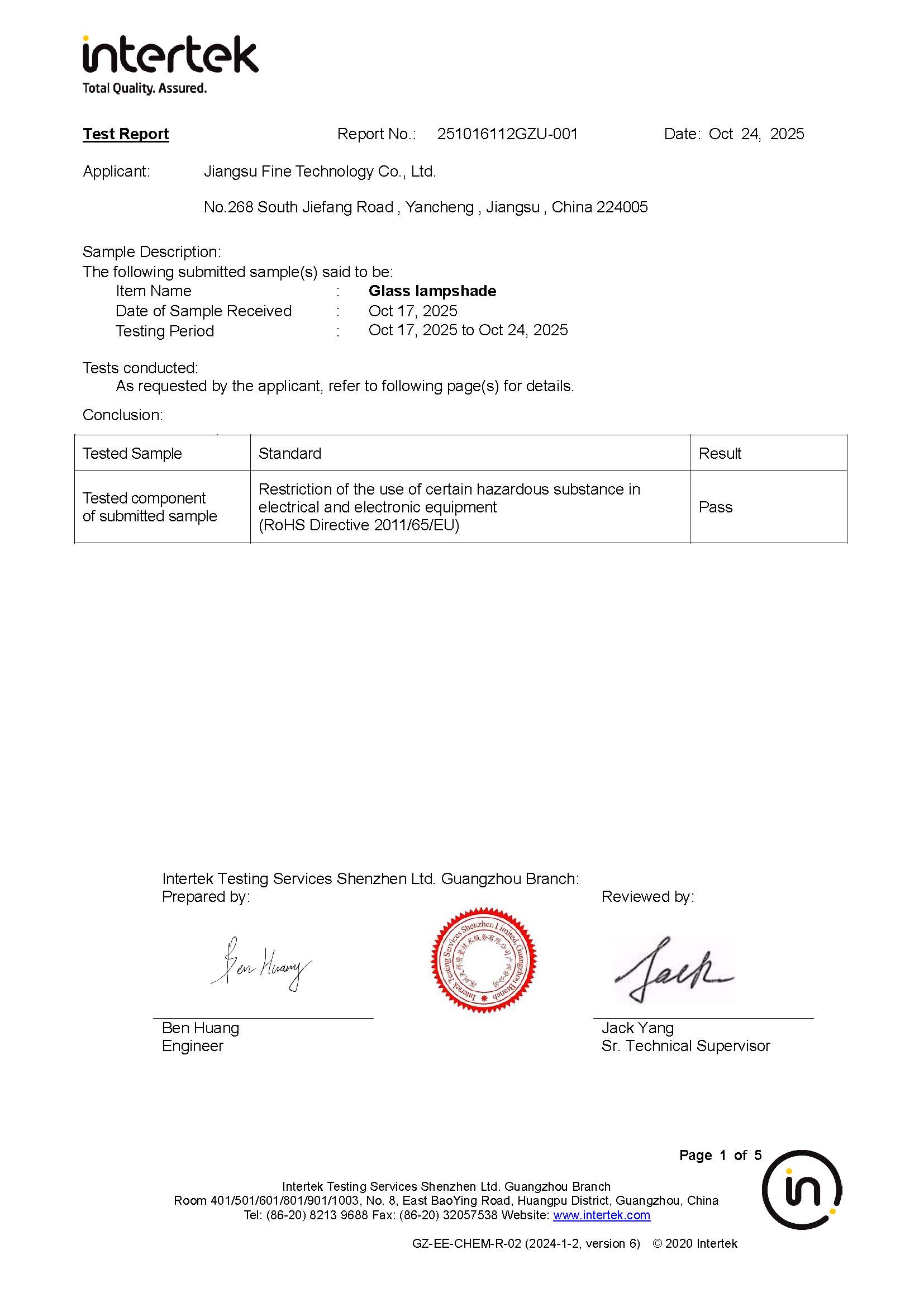
A concrete example from a working compliance file: RoHS test report No. 251016112GZU-001, issued by Intertek on 2025-10-24 for glass lamp shades — explicitly covering soda-lime and borosilicate glass products for lighting applications. The stated test standards are IEC 62321-5 Edition 1.0:2013 (Cd & Pb), IEC 62321-4:2013+AMD1:2017 CSV (Hg), and IEC 62321-7-2 Edition 1.0:2017 (Cr6+).
What a buyer should take from this:
- The document names the product scope: glass lamp shades (soda-lime and borosilicate).
- It names a testing laboratory: Intertek.
- It names the specific test methods.
- It names the date of issue.
If a supplier's RoHS document does not name the product scope, or covers a product family your order does not belong to, the paper has limited value for your file.
REACH — Chemical Registration and SVHC Communication
REACH governs chemical substances on the EU market. For a glass lamp shade buyer, the practical question is narrower than the regulation's full scope: are restricted substances or substances of very high concern (SVHC) present at levels that require communication, and does the supplier stand behind its "lead-free" claim in writing?
This is where a material claim becomes a document question. If a product is described as 100% lead-free glass, the compliance file should restate that claim — not leave it in a sales brochure. And the claim should be consistent across the catalogue, the product specification and the compliance statement.
CE — Conformity Marking, Not a Test Report
CE is the most commonly misread item in glass sourcing. CE marking is a declaration-based conformity system for products placed on the EU market. Whether it applies to a specific lighting glass component, and under which directive, depends on the product and its intended use. A glass lamp shade shipping to a fixture maker is normally one input into that fixture maker's own conformity file.
In practice, a lighting glass supplier supports a buyer's CE file by providing product-compliance evidence — RoHS test reports, REACH statements and material declarations — rather than a standalone "CE certificate" for a shade. Buyers should be explicit about which of the two is being provided.
SMETA-4P — Site-Level Social and Ethical Audit
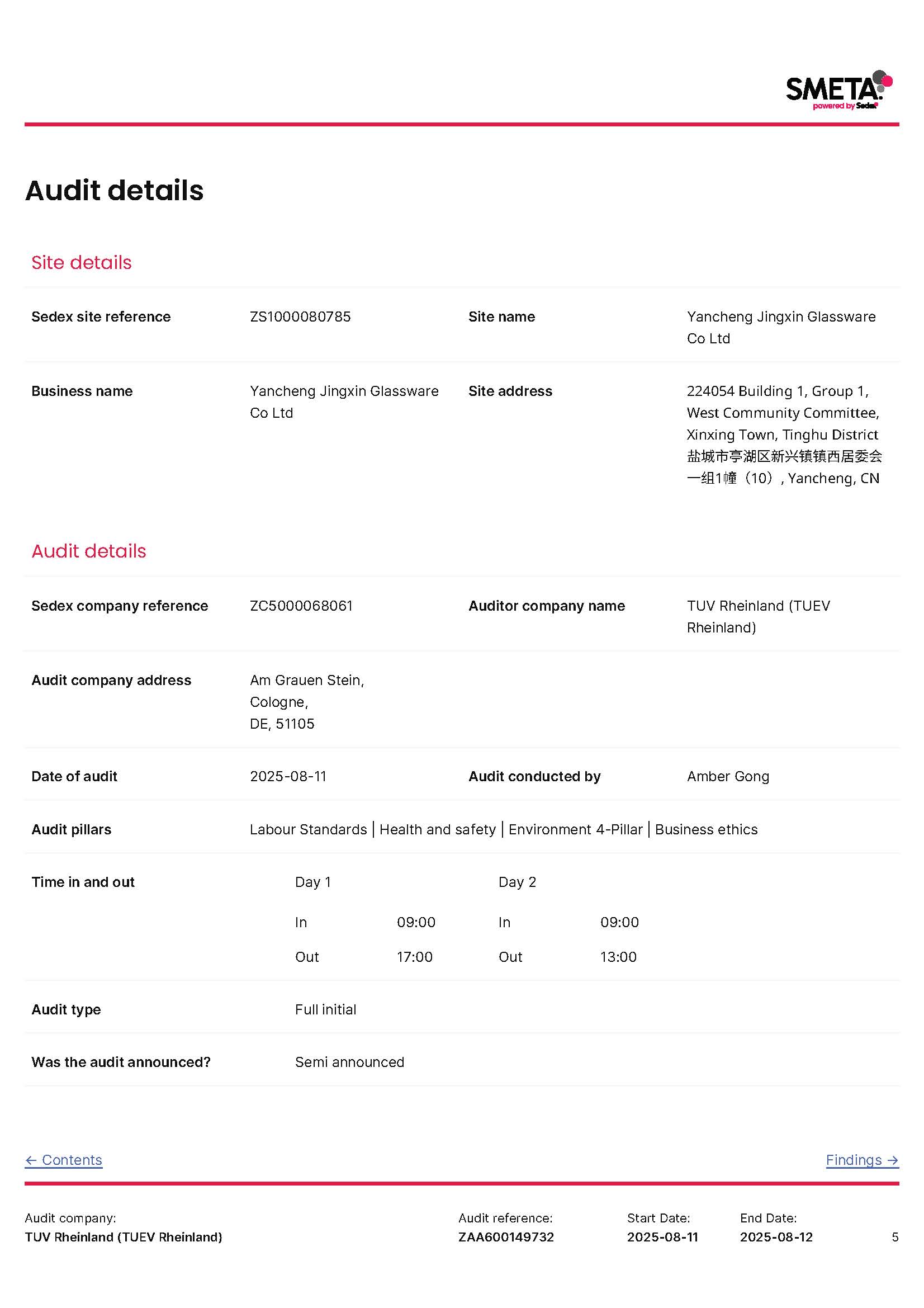
SMETA is not a product document. It is an audit of the manufacturing site. A concrete example: SMETA-4P certificate No. ZAA600149732, issued by TUV Rheinland on 2025-08-12, with a global market scope covering all glass products and the manufacturing site (Yancheng Jingxin Glassware Co., Ltd.). The stated methodology is the SMETA 4-Pillar framework — labour standards, health & safety, environment, and business ethics — under Sedex Platform requirements.
For a buyer, SMETA answers a different question from RoHS. RoHS asks whether the glass is restricted-substance compliant. SMETA asks whether the factory is audited on ethics, safety and environment. Both are useful; they are not interchangeable.
From Raw Material to Compliance File — How the Documents Should Connect
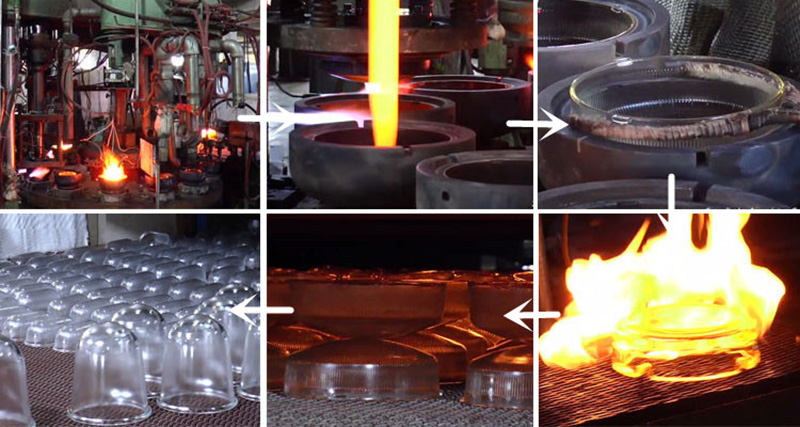
The documents should tell a single story a buyer can trace end to end. On the operational side, a glass manufacturer runs continuous inspection from raw material to finished goods, performs 100% pre-shipment inspection, and can provide a Certificate of Analysis (COA) for each batch. Third-party inspection is available on request.
The compliance file sits on top of that operational layer. Seen end to end, the chain is:
raw material intake → batch COA → in-process checks → pre-shipment 100% inspection → product compliance documents (RoHS / REACH) → site compliance (SMETA-4P) → shipment.
For a buyer the logic is simple: if the operational test-and-inspection trail exists, the compliance documents are the documented output of that trail. If it does not, the compliance documents stand alone with nothing behind them.
Step-by-Step — How to Review a Custom Lighting Glass Compliance Pack
Step 1 — Separate the documents by type. Split the pack into product-compliance documents (RoHS report, REACH statement), site documents (SMETA-4P), quality evidence (COA, inspection records), and any conformity-mark declarations.
Step 2 — Check the certificate or report number and the issuing authority. A verifiable reference — a certificate number, a report number, a named lab — is the difference between a document and a marketing line. Working example: RoHS report No. 251016112GZU-001 from Intertek; SMETA-4P certificate No. ZAA600149732 from TUV Rheinland.
Step 3 — Match the scope to your order. Confirm the document scope names lighting glass, and where relevant names both soda-lime and borosilicate glass. A scope that says only "glassware" without naming lighting is worth questioning.
Step 4 — Match the document to the material claim. If your order uses a borosilicate 3.3 shade, the material declaration should say borosilicate. If the product is described as 100% lead-free, that statement should appear in the compliance file, not only in the catalogue.
Step 5 — Match the document to the product geometry. Globe, cylinder, straight-tube, double-wall, opal white and ribbed shades are different production methods. The compliance file should correspond to the products actually on the order.
Step 6 — Check renewal and dates. Note the issue date of each document and confirm nothing is stale for your project timeline. Where an expiry date is not stated, ask the supplier for their renewal policy.
Step 7 — Check the destination-market requirement. Confirm with your own regulatory or customs adviser which documents your destination market requires, then verify the pack covers them.
Step 8 — File the pack with the order, not after it. The pack should be assembled before mass production, not retrieved after a customs or retail query.
Documentation-to-Product Mapping for Lighting Glass
The tables below show the internal logic a buyer can use to check that paperwork matches product. Every row is drawn from documentation and product specifications already on file — nothing here is estimated.
Table 1 — Document review matrix
| Document | Document type | Issuing / referencing body | What a buyer verifies |
|---|---|---|---|
| RoHS test report No. 251016112GZU-001 | Product chemical compliance | Intertek | Scope names glass lamp shades in soda-lime and borosilicate; IEC 62321 series methods cited; issue date 2025-10-24 |
| REACH statement | Product chemical compliance | Supplier-declared, supported by raw-material COA | Restates material claims such as 100% lead-free glass; SVHC communication where applicable |
| CE conformity support | Market conformity marking (declaration-based) | Determined by the finished fixture | Which directive applies is product-specific; supplier typically provides product-compliance evidence, not a standalone shade certificate |
| SMETA-4P No. ZAA600149732 | Site social & ethical audit | TUV Rheinland | Covers all glass products and the manufacturing site; 4-pillar methodology; issue date 2025-08-12 |
| COA / batch inspection record | Quality evidence | Manufacturer | Batch-level raw-material and finished-goods checks; 100% pre-shipment inspection |
Table 2 — Lighting glass models named within the RoHS report scope
The RoHS report explicitly identifies the following lighting glass products as falling inside its tested scope. A buyer can use this list to check whether their own order models are covered.
| Model | Product | Type | Glass & finish |
|---|---|---|---|
| JX1004 | Opal White Glass Globe Lamp Shade | Glass Light Globe | Solid opal white soda-lime |
| JX1416 | Double Wall Glass G9 Light Globe | Glass Lamp Shade | Borosilicate; clear outer, frosted inner |
| JX1830 | Explosion-Proof Borosilicate Glass Lamp Shade | Glass Lamp Cover | High borosilicate; clear |
| JX1832 | Pressed Borosilicate Signal Glass Lamp Shade | Glass Lamp Cover | Type 3.3 borosilicate |
| JXHB-002 | Clear Ribbed Glass Pendant Shade | Hand-blown lamp shade | Clear soda-lime; ribbed |
| JX1184 | Blown Glass Lampshade with G9 Thread | Glass Light Globe | Solid opal white soda-lime |
| JX1188 | Glass Globe Lamp Shade | Glass Light Globe | Soda-lime; marble swirl |
| JX1407 | Borosilicate Glass Globe Lamp Shade | Glass Lamp Shade | Borosilicate 3.3; clear |
| JXHB-010 | Cylinder Glass Tube Light Shade | Lighting glass shade | Mouth-blown; milk frosted |
Use Cases: When the Document Pack Decides the Order
Use case 1 — EU retail lighting programme
A lighting brand sourcing opal white globes (JX1004) and double-wall G9 shades (JX1416) for an EU retail range needs a product compliance file that names both soda-lime and borosilicate lighting glass. Both models sit within the RoHS report scope, and the catalogue's lead-free and recyclable claims are exactly the material statements the file should restate.
Use case 2 — High-temperature and industrial lighting
For high-heat or hazardous-site projects, the material question (borosilicate 3.3 versus soda-lime) comes first and the paperwork follows. Industrial models such as JX1830 and JX1832 are borosilicate and state RoHS and REACH material compliance; a buyer's document pack should show borosilicate as the tested material, not generic "glass".
Use case 3 — Hospitality and retail buyers with social-compliance requirements
Some retail and hospitality buyers add a social-compliance requirement on top of product compliance. This is where a site-level audit such as SMETA-4P applies — it covers the manufacturing site rather than a specific shade, so it is filed alongside product documents, not instead of them.
Use case 4 — Compliance check at the sampling stage
Compliance is easiest to verify before mass production. Sample lead time for lighting glass runs from 5–7 working days after specification confirmation, and documents should be requested inside that window, so the paperwork and the physical sample are reviewed together.

FAQ
Which compliance documents should a custom glass lamp shade order include for EU delivery?
For EU-bound lighting glass, a product-compliance pack normally centres on RoHS and REACH documentation. A RoHS test report should name the product scope — for example glass lamp shades in soda-lime and borosilicate — the testing laboratory and the test methods. A working example is Intertek RoHS report No. 251016112GZU-001, which references IEC 62321 series methods and covers soda-lime and borosilicate lighting glass. REACH documentation should restate the material claims being made, such as 100% lead-free glass. CE is a conformity marking rather than a test report, so a supplier typically supports a buyer's CE file with product-compliance evidence instead of issuing a standalone CE certificate for a shade. Site-level audits such as SMETA-4P are separate from product documents. Confirm the exact document list with your own regulatory or customs adviser for your destination market.
Can a manufacturer document both soda-lime and borosilicate lighting glass?
Yes. Jingxin Glassware maintains fully equipped production lines for both soda-lime and borosilicate glass, and its RoHS documentation scope explicitly covers glass lamp shades in both material types. The documented models span soda-lime opal white globes (JX1004), soda-lime G9 shades (JX1184), clear soda-lime shades (JXHB-002, JX1188) and borosilicate shades (JX1416, JX1407, JX1830, JX1832, JXHB-010). For buyers, a supplier that can document both material families is easier to work with than one that can document only one.
Does obtaining compliance documentation add cost to a custom glassware order?
The main cost variable in a compliance process is third-party testing and inspection, not paperwork generation. Jingxin Glassware performs 100% pre-shipment inspection as standard and provides COA documentation for each batch; third-party inspection is available upon request. When a buyer needs a specific new test — for example a destination-market-specific report — that is a requested service and should be quoted stage by stage. Ask for the cost of any required third-party test as a separate line item rather than assuming it is bundled into the unit price.
Can I verify compliance documentation before mass production?
Yes, and the sample stage is the right time to do it. Lighting glass samples are typically delivered in 5–7 working days after artwork and specification confirmation, and documents can be shared in parallel. Buyers should match the document scope to the sampled product — checking that the material (borosilicate 3.3 or soda-lime), the glass type (clear, opal white, frosted) and the model family all appear in the paperwork before mass production is approved. Requesting the compliance file with the sample is the single most efficient step in the whole review.
How quickly can a documented custom glass order ship?
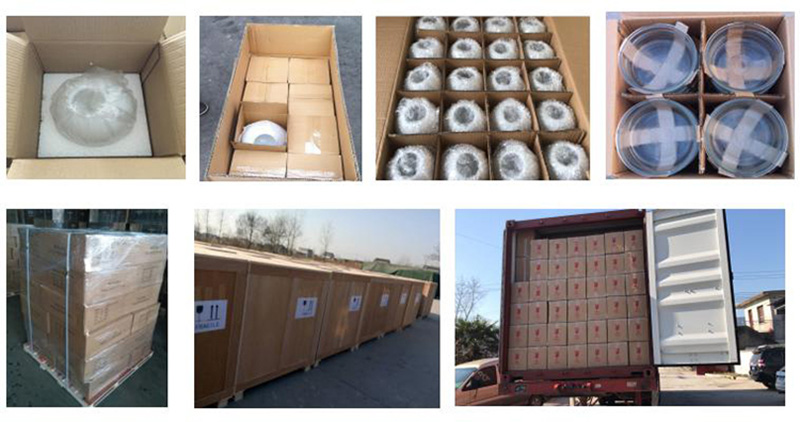
For lighting glass, sample lead time runs from 5–7 working days after craft and specification confirmation; mass production lead time runs from 20–30 working days after sample approval. Documents are assembled before shipment rather than after. Because 100% pre-shipment inspection and batch COA are part of the standard process, the compliance file is produced as a by-product of normal production rather than as an added stage. If your project requires third-party inspection, allow separate time for that. To start, request a sample together with the compliance documents, and confirm the model list against the report scope.
Conclusion
Compliance documents are not a formality at the end of a custom lighting glass order — they are a test of the supplier. A document pack that names the product scope, names the testing laboratory, matches the material claims, and corresponds to the actual models on the order (globe, cylinder, opal white, double-wall G9, borosilicate or soda-lime) is a reliable signal. A pack of acronyms is not.
Jingxin Glassware is a Yancheng-based custom glassware manufacturer founded in 1999, with a 4,500 m² production and office base, 100+ employees and a stated certification set that includes RoHS, REACH and SMETA-4P, alongside 16 national patents. Its lighting-glass documentation covers glass lamp shades in both soda-lime and borosilicate, which is the practical starting point for a buyer evaluating any supplier at the documentation stage: ask for the document numbers, check the scope against your models, and match the material claims to the glass you are ordering.
This article is a document-review guide, not legal advice. Always confirm market-specific obligations with your own compliance or customs adviser.
Next step: review the documents against your own models
If you are evaluating a custom glass lamp shade order and want to check whether your models already sit inside a live RoHS / REACH document scope, start with a sample request and ask for the compliance file to be sent with it. Sample lead time is 5–7 working days after specification confirmation; mass production runs 20–30 working days after sample approval.
Download the full lighting glass catalogue — Glass Lamp Shades Catalogue — Yancheng Jingxin Glassware Co., Ltd.
Yancheng Jingxin Glassware Co., Ltd. · No. 268 South Jiefang Road, Yancheng, Jiangsu, China · jerry@cn-glassware.com · www.cn-glassware.com
Have Questions or Need More Details?
Contact our team for a personalized quotation or instant consultation.
Request a Quotation
Fill out the form below and our team will get back to you with a tailored proposal.
WhatsApp Direct Chat
Prefer to chat in real-time? Message us on WhatsApp for instant assistance & quick answers.
- Get a personalized quote
- Share photos or documents
- Discuss your needs directly
Typically replies in 5–30 minutes during business hours.