Explosion-Proof Borosilicate Glass Lamp Shade: Custom Glassware Technical Guide
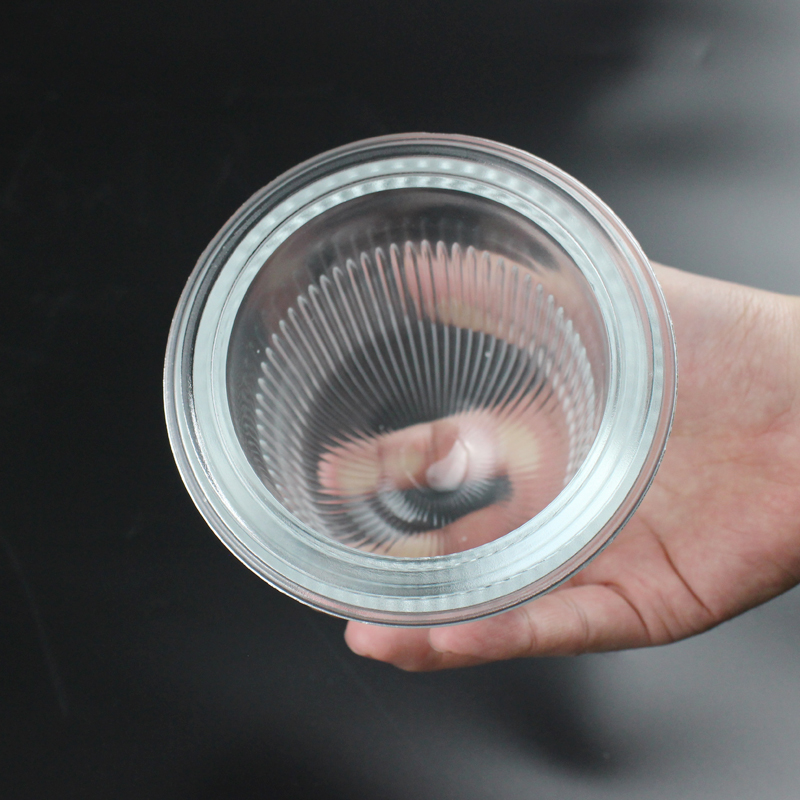
Pressed explosion-proof borosilicate glass lamp shade — the reference geometry for safety-critical lighting fixtures.
An explosion-proof borosilicate glass lamp shade is a safety glass cover engineered to contain lamp heat, resist mechanical impact, and maintain optical output in hazardous or high-temperature fixtures. It is not a decorative shade with a stronger-sounding name. The differences sit in the glass formulation, the forming process, the wall thickness, and the fitter interface — and each of those variables is a specification you can verify before you place an order.
This technical guide explains how to select explosion-proof borosilicate glass lamp shades for high-heat or safety-critical lighting fixtures. It covers borosilicate glass and thermal shock resistance, the difference between pressed and blown lamp shade construction, and G9 thread fit constraints. It also sets out the acceptance checks — cracks, fit, and cleaning — that determine whether a delivered batch is usable. Reference products used throughout are the JX1830 Explosion-Proof Borosilicate Glass Lamp Shade, the JX1832 Pressed Borosilicate Signal Glass Lamp Shade, and the JX1184 Blown Glass Lampshade with G9 Thread, all manufactured by Yancheng Jingxin Glassware Co., Ltd.
Problem Definition: Why Standard Glass Shades Fail in Safety-Critical Fixtures
Most lamp shade failures in high-heat or hazardous-location fixtures trace back to four causes. Naming them precisely is the first step in writing a purchase specification that prevents them.
- Thermal shock. A shade experiences rapid temperature change — lamp startup, ambient shift, or a cleaning operation — and cracks because the glass cannot absorb the differential expansion.
- Wrong glass type. Soda-lime glass is used where borosilicate is required. Soda-lime tolerates limited temperature change; borosilicate is formulated for it.
- Mechanical impact. Flying debris, tool contact, or vibration in an industrial or transport environment chips or shatters the shade.
- Fit error. The shade is forced onto an incompatible lamp holder, creating stress at the opening that later becomes a crack origin.
Each cause maps to a controllable specification: material type, wall thickness and impact rating, forming process, and fitter opening diameter. A purchase order that does not state these four items is relying on the supplier's default — which may not match the fixture.
Industry Background: Where Explosion-Proof Glass Shades Are Specified
Explosion-proof and high-temperature glass lamp shades appear in applications where a lamp failure carries consequences beyond a dark room. The relevant environments include petroleum and chemical sites, mining and heavy manufacturing, marine and offshore installations, hazardous-zone warehousing, and food or pharmaceutical workshops that use flammable organic solvents.
In these settings, the glass cover is part of a flame-proof enclosure assembly rather than a cosmetic accessory. It must hold its optical performance under continuous heat, resist impact from the surrounding process environment, and — where the fixture is outdoors or coastal — resist salt mist and UV exposure over years of service.
From a trade and classification perspective, glass parts for electric lighting sit within the glass and glassware customs chapter, which means lighting glass components travel through a defined import/export pathway rather than being treated as generic glassware. For buyers, that formal pathway matters because it links the product to testable material and compliance documentation.
Compliance documentation is where many sourcing projects stall. A supplier may state that a shade is "RoHS compliant" without being able to point to a test report. The verifiable position is different: RoHS certification issued by Intertek under certificate number 251016112GZU-001 covers soda-lime and borosilicate glass products for lighting applications. The applicable test standards are IEC 62321-5 Edition 1.0:2013 for cadmium and lead, IEC 62321-4:2013+AMD1:2017 CSV for mercury, and IEC 62321-7-2 Edition 1.0:2017 for hexavalent chromium. This certification applies to the EU and global markets.
Social compliance is a separate verification layer. Yancheng Jingxin Glassware Co., Ltd. is certified to SMETA-4P (Sedex Members Ethical Trade Audit, 4-Pillar) under certification number ZAA600149732, issued by TUV Rheinland on 2025-08-12. The SMETA 4-Pillar methodology covers Labour Standards, Health & Safety, Environment, and Business Ethics, and the certification covers all glass products and the manufacturing site.
For the JX1830 specifically: the borosilicate glass material is stated to comply with RoHS, REACH, and ATEX material requirements for hazardous-site equipment. If your project requires ATEX-linked material documentation, this is the reference to request from the supplier before ordering.
Borosilicate Glass and Thermal Shock Resistance
Thermal shock resistance is the ability of a material to withstand sudden temperature changes without cracking. It matters for lamp shades because a fixture switches on, the glass heats, the room is cold, the shade is later cleaned, and the cycle repeats. Each cycle imposes internal stress. If the stress exceeds the glass's strength, the shade fails.
Borosilicate glass is a high-performance glass type made from silica and boron trioxide. The boron trioxide content creates a more stable molecular structure that expands and contracts less during temperature change, which is why borosilicate glass resists thermal stress that would crack ordinary soda-lime glass. In the products relevant to this guide, the JX1830 is made of high borosilicate glass, and the JX1832 is constructed from Type-3.3 borosilicate pressed glass, mainly composed of silica and boron trioxide.
The practical consequence is a working temperature range. The JX1832 Pressed Borosilicate Signal Glass Lamp Shade has a continuous working range from -60°C up to +450°C and survives sharp hot-cold temperature alternation. The JX1830 Explosion-Proof Borosilicate Glass Lamp Shade withstands rapid temperature fluctuation from -40°C up to 260°C.
For comparison, soda-lime glass has a higher thermal expansion coefficient and limited thermal shock tolerance. The JX1184 Blown Glass Lampshade with G9 Thread — a solid opal white soda-lime glass globe — is rated to tolerate temperature fluctuations up to 120°C. That is appropriate for LED, halogen, and CFL sources in residential and hospitality fixtures, but it is not the material to specify for a hazardous-location enclosure.
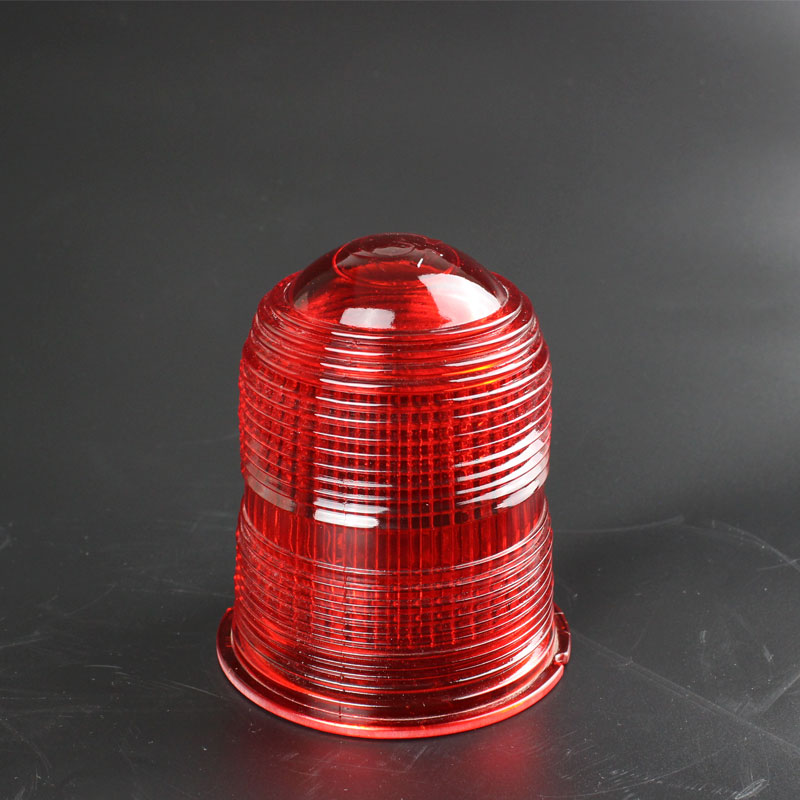
Thick-wall explosion-proof borosilicate glass domes — wall thickness is a safety specification, not a styling detail.
Why the Wall Thickness Matters as Much as the Glass Type
Material selection answers the thermal question. Wall thickness answers the mechanical one. The JX1830 uses a 6.0–10.0mm press-molded high borosilicate wall and carries a IK10 impact resistance rating. IK10 corresponds to high mechanical impact resistance, which is the specification level relevant to collision, flying debris, and vibration in heavy-duty hazardous-zone sites.
A thicker wall is not automatically better for every fixture. It adds weight — the JX1830 weighs 867 g — and it changes the light distribution. The selection logic is: choose the wall thickness that matches the mechanical risk in the installation environment, then confirm the fixture's mounting hardware can carry the weight.
Pressed vs. Blown Lamp Shade Construction
The forming process determines dimensional consistency, which in turn determines whether a batch of shades will fit the same fixtures. This is one of the most frequently misunderstood decisions in custom glassware sourcing.
Pressed (Press-Molded) Construction
In pressed construction, the glass is formed in a mold under high pressure. The JX1830 is manufactured by high-precision press-molding rather than hand-blowing. The JX1832 is produced by precision hot pressing of premium Type-3.3 borosilicate glass.
The consequences for buyers are dimensional and structural:
- Tight dimensional tolerance and high batch-to-batch consistency. Mold-based pressing produces repeatable dimensions, which is what standardized industrial signal lamp projects require.
- Uniform wall thickness. The JX1832 has a 5mm uniform pressed wall thickness for enhanced impact resistance; the JX1830 has a 6.0–10.0mm uniform wall thickness.
- Annealing to remove internal stress. Automated hot-press forming is followed by annealing, which minimizes spontaneous breakage risk in service.
- Stable production efficiency and lead-time control. Pressing is more suitable than hand-blowing for standardized signal lamp programs.
Pressed construction is the recommended choice for industrial, signalling, and hazardous-location fixtures where dimensional repeatability is a hard requirement.
Blown (Hand-Blown) Construction
In blown construction, each piece is individually mouth-blown by a craftsperson. The JX1184 Blown Glass Lampshade with G9 Thread is made by traditional mouth-blown techniques, with a wall thickness of 2.5–3.5mm.
The consequences are different in kind:
- Unique artistic texture per piece. Minor natural bubbles and flow marks are authentic hallmarks of handcrafted glassware, not defects.
- Wider dimensional tolerance than pressing. This is acceptable for decorative and hospitality fixtures, less so for standardized industrial assemblies.
- Consistent wall thickness within the hand-blown range. The JX1184 is specified with consistent wall thickness within 2.5–3.5mm.
- Lower tooling cost for new shapes. No mold is required for a new silhouette.
The right question is not "which process is better" but "which process matches the fixture's tolerance requirement." A hazardous-location enclosure that must accept replacement shades across batches needs pressed construction. A boutique hospitality project that values hand-made variation can specify blown construction and accept the tolerance band.
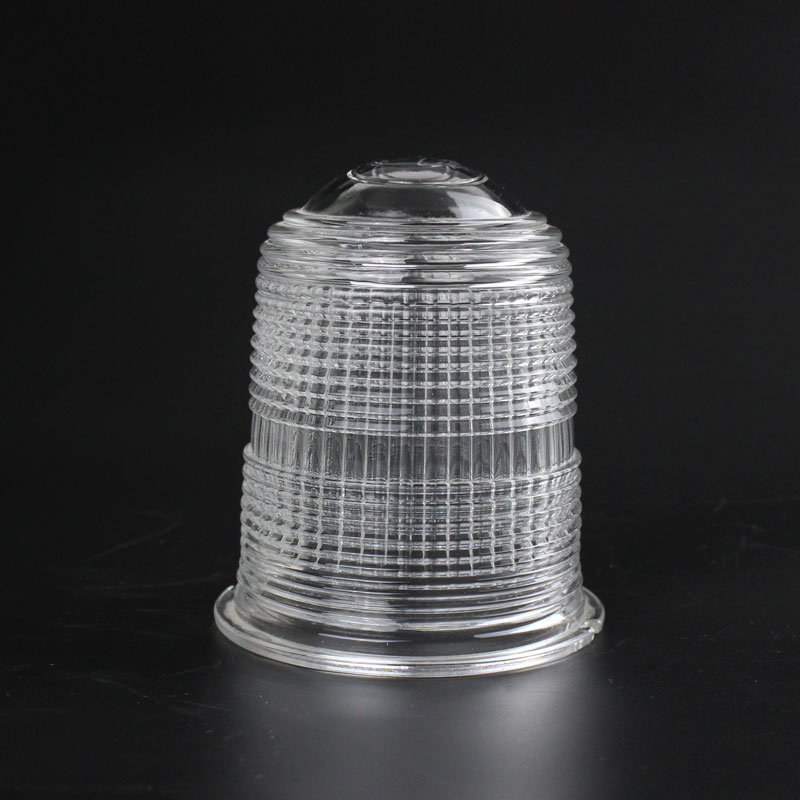
Clear borosilicate pressed glass lamp shades — dimensional consistency is what pressed construction buys you.
G9 Thread Fit Constraints
Fitter opening diameter is the specification most often left off a purchase order, and it is the most common cause of a returned batch. A shade that does not seat correctly creates installation stress that later presents as a crack.
The G9 interface is defined by its opening diameter. The JX1184 Blown Glass Lampshade with G9 Thread has a 20mm (2cm) fitter opening that fits standard G9 lamp holders, with an outer diameter range of 60–200mm. It uses a built-in G9 metal internal thread insert, which locks the shade firmly and avoids loosening or falling risk during long-term use.
For other interfaces, the reference dimensions differ. The JX1407 Borosilicate Glass Globe Lamp Shade uses a 4.5cm (45mm) opening for standard E27 lamp holders with a threaded bottom fitter. The JXHB-010 Cylinder Glass Tube Light Shade uses a 4.2cm fitter opening for E27 lamp holders. The point is that "E27 shade" and "G9 shade" are not interchangeable, and neither is a substitute for a measured opening diameter.
- Measure the lamp holder's actual mating feature — not the holder model name.
- Confirm the opening diameter in writing on the specification sheet.
- Confirm whether the shade uses a metal internal thread insert or a pressure-seated opening.
- For G9: confirm the 20 mm opening and the presence of the internal thread insert.
- For E27 threaded fitter: confirm the opening diameter and thread type.
One further constraint applies to blown G9 shades: because the opening is formed by hand, confirm that the supplier controls opening diameter as a measured dimension rather than an approximate one. The JX1184 is specified at 20 mm, and dimensional inspection of the opening is part of the controlled dimension set.
Step-by-Step Breakdown: Selecting an Explosion-Proof Borosilicate Glass Lamp Shade
Step 1 — Define the Environment Before the Product
Write down the installation environment first: indoor or outdoor, ambient temperature range, humidity or salt exposure, presence of flammable gas or combustible dust, and whether the fixture is in a high-vibration area. This determines whether you need borosilicate at all, and which impact rating applies.
Step 2 — Match the Glass Type to the Thermal Load
If the fixture runs hot, experiences rapid temperature change, or sits in a location with wide ambient swings, specify borosilicate. If the fixture is a residential LED pendant with stable ambient conditions, soda-lime opal glass may be sufficient and more economical. Use the working temperature range as the deciding number: borosilicate shades in this guide cover -40°C to 260°C (JX1830) and -60°C to +450°C (JX1832); soda-lime opal glass tolerates up to 120°C.
Step 3 — Choose the Forming Process by Tolerance Requirement
If the project requires replacement shades to fit existing fixtures across multiple batches, specify pressed construction. If the project values hand-formed variation and the fixture tolerance is loose, specify blown construction.
Step 4 — Specify Wall Thickness and Impact Rating
Match wall thickness to mechanical risk. For hazardous-location or heavy-duty installations, 6.0–10.0mm with IK10 impact resistance is the reference specification (JX1830). For signal fixtures, a uniform 5mm pressed wall is the reference (JX1832).
Step 5 — Confirm the Fitter Interface in Writing
State the opening diameter, the lamp holder standard, and the connection type (threaded insert vs. pressure-seated) on the purchase order. Do not accept "standard fit" as a specification.
Step 6 — Confirm Surface Finish and Optical Requirement
Clear glass maximizes light transmission — the JX1830 clear glass achieves over 90% light transmittance. A frosted variant provides 40–60% light diffusion and cuts harsh glare. Choose based on whether the application needs maximum output or controlled glare.
Step 7 — Request the Compliance Documents Before Production
Ask for the RoHS certificate number, the applicable IEC test standards, and — where relevant — the ATEX material compliance statement. For Jingxin products this is RoHS certificate 251016112GZU-001 issued by Intertek, with test standards IEC 62321-5:2013, IEC 62321-4:2013+AMD1:2017 CSV, and IEC 62321-7-2:2017.
Step 8 — Approve a Sample Before Mass Production
Sample lead time for the JX1830 is 15–20 days after technical drawing and specification confirmation. Mass production lead time is 25–35 days after sample approval. For the JX1832, sample lead time is 5–7 working days after artwork and specification confirmation, with mass production in 20–30 days after sample approval. Approving a physical sample is the only reliable way to confirm opening diameter, wall thickness, and surface finish.
Acceptance Checks: Cracks, Fit, and Cleaning
These three checks are the ones that decide whether a delivered batch can be released to the fixture line. Each has a defined method.
Crack Inspection on Receipt
Inspect every shade under bright, angled light and look for cracks, chips, and edge damage. Check the opening rim specifically, because that is where installation stress concentrates. Borosilicate glass avoids thermal cracking under frequent temperature changes, but that property does not protect against damage caused before or during shipment. Report any breakage or surface damage with photographs immediately upon arrival, before the packaging is discarded.
The supplier-side quality system for these products includes 100% pre-shipment visual and dimension inspection, plus sampling thermal-shock and mechanical-impact testing for every production batch. Third-party laboratory inspection is available on request. Those controls reduce the probability of a defective arrival, but they do not replace your own incoming inspection.
Fit Verification
Measure the actual fitter opening of the received shade and compare it to the specification on the purchase order. If a shade does not seat without force, do not force it. Verify the model number and specifications on the product label, then contact the supplier with photographs and measured values. For small deviations, evaluate whether an adapter resolves the issue; for significant mismatches, request replacement under the agreed warranty terms.
Cleaning Without Damaging the Glass
The dense, non-stick glass surface of borosilicate shades resists oil stain and dust accumulation and can be cleaned with a regular industrial or household glass cleaner. The procedure matters more than the product:
- Switch off the fixture and allow the shade to cool completely to room temperature before handling.
- Remove the shade carefully, supporting it with both hands.
- Use warm water with a mild dish soap. Avoid abrasive or alcohol-based cleaners on painted, printed, or decal finishes.
- Wipe with a soft microfiber cloth. Avoid scouring pads, which scratch the surface.
- For frosted or opal surfaces, use gentle pressure only — abrasives damage the matte finish.
- Do not immerse a glass shade in hot water. Thermal shock may still crack glass if the temperature differential is extreme.
- Rinse with clean water and dry immediately with a lint-free cloth to avoid water spots.
- Reinstall only after the shade is completely dry, and inspect for hidden cracks or chips before reinstallation.
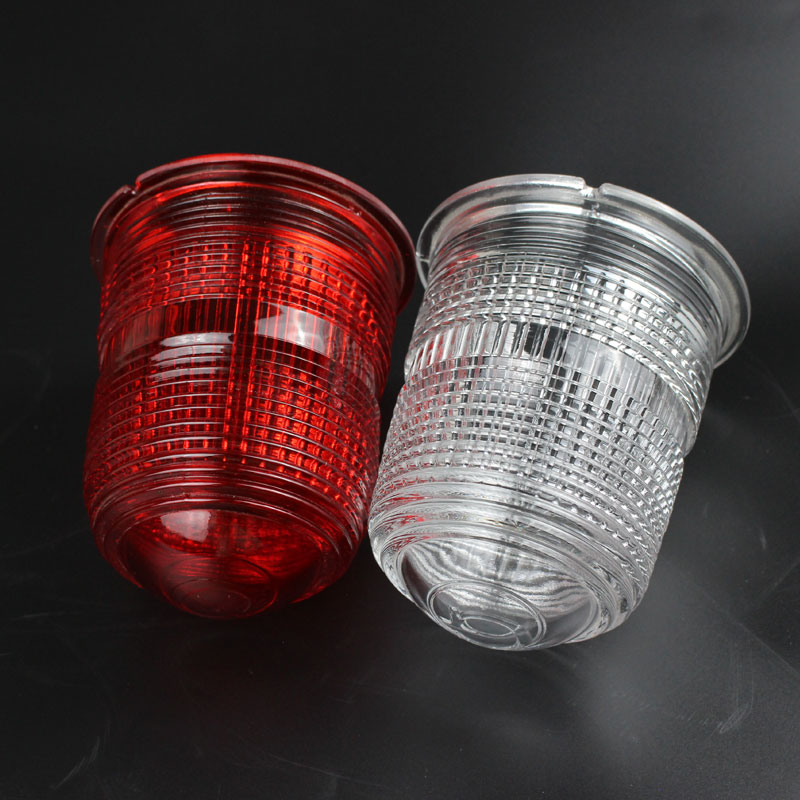
Borosilicate high-temperature lamp shades — inspect the opening rim first on receipt.
Use Cases
Petroleum, Chemical, and Hazardous-Zone Lighting
Refinery workshop pendants, chemical-plant wall-mount lamps, and fuel-storage-area high-bay lighting require a shade that holds optical performance under heat and resists impact. The JX1830, with IK10 impact resistance and a -40°C to 260°C thermal range, is specified for these environments. It is adaptable to LED, high-pressure sodium, metal-halide, and incandescent industrial lamp sources, which matters when a facility is mid-conversion from legacy lamps to LED.
Industrial Signal Lighting
Aviation, railway, and marine signal fixtures require stable signal colour rendering and long-term anti-aging performance. The JX1832, with a continuous working range from -60°C to +450°C and resistance to UV degradation and salt-spray corrosion, is specified for runway edge lights, railway signal machine covers, and ship navigation signal lamps. Its pressed construction delivers the tight dimensional tolerance that standardised signal lamp programs depend on.
Marine and Offshore Installations
Offshore platforms and ship-hold lighting face salt mist, UV exposure, and temperature variation. Borosilicate glass with thick construction resists these conditions; the JX1830 is specified for offshore platform lamp components and ship-hold explosion-proof lighting housings. Separately, Jingxin produced ultra-thick transparent lamp shades with pressure and sea water resistance for deep-sea fish farming in Chile, a project that demonstrates the ability to engineer glass for immersion and pressure environments.
Hospitality and Decorative G9 Fixtures
For hotel guest-room lamps, restaurant ambient lighting, and retail display fixtures with G9 holders, the JX1184 provides soft, glare-free illumination at 45–65% light transmission. Its built-in G9 metal internal thread insert locks the shade firmly, which reduces the loosening risk that plagues pressure-seated decorative shades.
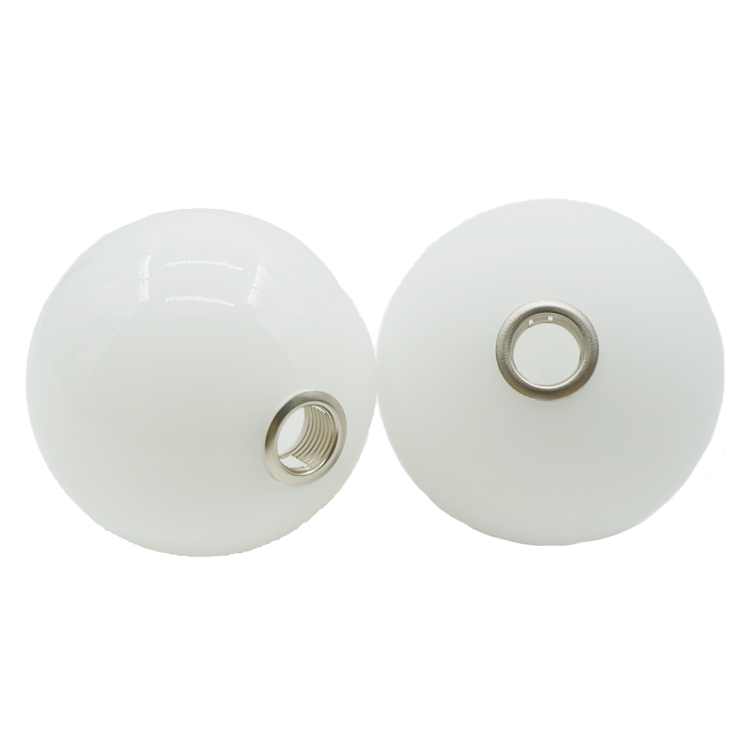
Blown glass lampshade with G9 thread — the internal metal thread insert is the fit-reliability feature.
Comparison Table
The table below compares the three reference products using only specifications stated in the product documentation. It is intended as a selection starting point, not a substitute for confirming the fitter interface against your fixture.
| Specification | JX1830 Explosion-Proof Borosilicate Glass Lamp Shade | JX1832 Pressed Borosilicate Signal Glass Lamp Shade | JX1184 Blown Glass Lampshade with G9 Thread |
|---|---|---|---|
| Glass type | High borosilicate glass | Type-3.3 borosilicate pressed glass (silica and boron trioxide) | Solid opal white soda-lime glass |
| Forming process | High-precision press-molding | Precision hot pressing | Hand-blown (mouth-blown) |
| Wall thickness | 6.0–10.0mm, uniform | 5mm, uniform | 2.5–3.5mm, consistent |
| Thermal range | -40°C to 260°C | -60°C to +450°C | Up to 120°C |
| Impact rating | IK10 | Pressed construction for enhanced impact resistance | Not specified as an impact rating |
| Dimensions | Diameter 118mm, height 132mm, weight 867g | Diameter 11cm, height 13cm | Outer diameter 60–200mm; opening 20mm |
| Fitter interface | Custom opening per project | Custom opening, flange, or mounting interface | 20mm opening; fits standard G9 lamp holders; built-in metal internal thread insert |
| Optical performance | Clear: over 90% light transmittance; frosted: 40–60% diffusion | Stable light transmittance; custom colour filter options | 45–65% light transmission, glare-free |
| Lead-free / recyclable | 100% lead-free; 100% recyclable | 100% lead-free; 100% recyclable | 100% lead-free; 100% recyclable |
| Sample lead time | 15–20 days after drawing and spec confirmation | 5–7 working days after artwork and spec confirmation | 5–7 working days after artwork and spec confirmation |
| Mass production lead time | 25–35 days after sample approval | 20–30 days after sample approval | 20–30 days after sample approval |
| Typical applications | Petroleum and chemical sites, mining, marine and offshore, hazardous-zone warehousing | Airport aviation, railway and rail transit, marine and shipping signal fixtures | Residential lighting, hotel guest-room lamps, restaurant ambient lighting, retail display |
FAQ
Are China custom glassware manufacturers with REACH-compliant materials able to supply documentation for lighting glass?
Yes, but the documentation must be specific and traceable. For glass lamp shades, the relevant compliance layers are RoHS for restricted substances and REACH for material compliance. Yancheng Jingxin Glassware Co., Ltd. holds RoHS certification 251016112GZU-001 issued by Intertek on 2025-10-24, covering soda-lime and borosilicate glass products for lighting applications, with test standards IEC 62321-5 Edition 1.0:2013 (cadmium and lead), IEC 62321-4:2013+AMD1:2017 CSV (mercury), and IEC 62321-7-2 Edition 1.0:2017 (hexavalent chromium). This certification applies to the EU and global markets. For hazardous-location equipment, the JX1830 borosilicate glass material is additionally stated to comply with RoHS, REACH, and ATEX material requirements. Buyers should request the certificate number and the applicable test standards rather than accepting a general compliance statement.
What is the difference between pressed and blown borosilicate glass lamp shades, and which should I specify?
Pressed shades are formed in a mold under pressure, which produces tight dimensional tolerance, uniform wall thickness, and high batch-to-batch consistency. The JX1830 is press-molded with a 6.0–10.0mm uniform wall and IK10 impact rating; the JX1832 is hot-pressed with a 5mm uniform wall. Blown shades are individually mouth-blown, which produces unique artistic texture per piece and wider dimensional tolerance. The JX1184 is hand-blown with a 2.5–3.5mm wall. Specify pressed construction when replacement shades must fit existing fixtures across multiple batches, or when the fixture is an industrial, signalling, or hazardous-location assembly. Specify blown construction when the project values hand-formed variation and the fixture tolerance is loose.
How do I confirm a G9 thread fit before ordering, and what should the opening diameter be?
The G9 interface is defined by its opening diameter. The JX1184 Blown Glass Lampshade with G9 Thread has a 20mm (2cm) fitter opening that fits standard G9 lamp holders, and it uses a built-in G9 metal internal thread insert that locks the shade firmly. Before ordering, measure the lamp holder's actual mating feature rather than relying on the holder model name, confirm the opening diameter in writing on the specification sheet, and confirm whether the shade uses a metal internal thread insert or a pressure-seated opening. Do not force a shade onto a holder — fit error creates stress at the opening that later becomes a crack origin.
What acceptance checks should I run when an explosion-proof glass lamp shade batch arrives?
Run three checks. First, crack inspection: examine every shade under bright, angled light for cracks, chips, and edge damage, paying particular attention to the opening rim where installation stress concentrates. Second, fit verification: measure the actual fitter opening and compare it to the purchase order specification; if the shade does not seat without force, stop and contact the supplier with photographs and measured values. Third, confirm the shipment matches the approved sample in wall thickness and surface finish. The supplier-side quality system includes 100% pre-shipment visual and dimension inspection plus sampling thermal-shock and mechanical-impact testing per batch, with third-party laboratory inspection available on request, but incoming inspection remains the buyer's control point.
What are the sample and mass production lead times for these lamp shades?
Lead times differ by forming process. The JX1830 Explosion-Proof Borosilicate Glass Lamp Shade has a sample lead time of 15–20 days after technical drawing and specification confirmation, with mass production in 25–35 days after sample approval. The JX1832 Pressed Borosilicate Signal Glass Lamp Shade has a sample lead time of 5–7 working days after artwork and specification confirmation, with mass production in 20–30 days after sample approval. The JX1184 Blown Glass Lampshade with G9 Thread also runs at 5–7 working days for samples and 20–30 days for mass production after sample approval. For custom projects, lead time should always be confirmed against the specific drawing rather than assumed from a product family.
Next Step: Request a Sample and the Current Lamp Shade Catalogue
Before committing a safety-critical fixture to production, validate the glass type, wall thickness, impact rating, and fitter opening on a physical sample. Jingxin Glassware manufactures explosion-proof and high-temperature borosilicate glass lamp shades with OEM and ODM support, and provides RoHS and SMETA-4P documentation for buyer verification.
Download the Glass Lamp Shades Catalogue
Contact: Mr. Jerry Zhou | Email: jerry@cn-glassware.com | WhatsApp: +8618019627905 | Website: www.cn-glassware.com
Conclusion
Selecting an explosion-proof borosilicate glass lamp shade is a specification exercise, not a styling decision. The glass type determines the thermal envelope — borosilicate covers -40°C to 260°C on the JX1830 and -60°C to +450°C on the JX1832, while soda-lime opal glass covers up to 120°C. The forming process determines dimensional consistency — pressed for repeatable industrial fit, blown for hand-formed variation. The wall thickness and impact rating determine mechanical survival — 6.0–10.0mm with IK10 for hazardous-zone environments, uniform 5mm for signal fixtures. The fitter opening determines whether the shade installs without stress. And the compliance documentation — RoHS certificate 251016112GZU-001 under IEC 62321 test standards, with SMETA-4P certification ZAA600149732 covering the manufacturing site — determines whether the batch clears your own compliance review.
State all four items on the purchase order, approve a physical sample, and run the crack and fit acceptance checks on arrival. Those four steps are what turn a glass lamp shade specification into a fixture that stays lit.
Have Questions or Need More Details?
Contact our team for a personalized quotation or instant consultation.
Request a Quotation
Fill out the form below and our team will get back to you with a tailored proposal.
WhatsApp Direct Chat
Prefer to chat in real-time? Message us on WhatsApp for instant assistance & quick answers.
- Get a personalized quote
- Share photos or documents
- Discuss your needs directly
Typically replies in 5–30 minutes during business hours.