How Custom Glassware OEM Works for Lighting Component Buyers
How Custom Glassware OEM Works for Lighting Component Buyers
Custom glassware OEM is a specification-driven manufacturing process, not a catalogue purchase. For a lighting component buyer, the decisive work starts after a supplier has been shortlisted: material system, fitter interface, wall thickness, surface finish, inspection criteria and packaging all have to be defined and agreed before production is committed. Teams that move from evaluation to execution without closing those variables typically lose weeks to sample revisions.
Yancheng Jingxin Glassware Co., Ltd., trading as Jingxin Glassware, is a glass manufacturer based in Yancheng, Jiangsu Province, China. Founded in 1999, the company designs, manufactures and exports glass products for the lighting, home décor, candle, drinkware, laboratory and food & beverage packaging sectors, and works with more than 1,000 global clients across 100+ countries. This article explains what a custom glassware OEM programme actually contains, how the execution sequence runs, and which specification decisions determine whether a lighting glass component ships correctly the first time.
Problem Definition: Why Custom Glassware Projects Stall Between Evaluation and Execution
"Custom glassware" describes a manufacturing capability, not a single product. Two buyers can use the same phrase and mean completely different things — one an opal sphere lamp shade with a 60 mm fitter opening, the other a 500 ml borosilicate storage jar with a bamboo lid. Because the category label carries no specification, the gap between supplier shortlisting and purchase order is where most lighting glass projects slow down.
In practice, five variables have to be closed before production can be scheduled:
- Material system. Soda-lime glass and borosilicate glass behave differently under heat. Choosing the wrong one for a fixture's operating temperature creates a durability problem that only appears in the field.
- Geometry and interface. The fitter opening must match the lamp holder — E27, E14, G9 or a custom thread — and hand-blown parts carry wider dimensional tolerance than machine-pressed parts.
- Wall thickness and thermal duty. A decorative pendant shade and an explosion-proof industrial cover are not the same engineering problem, even when both are loosely described as "glass lamp covers".
- Surface finish. Frosted or acid-etched, sandblasted, silk-screened, stamped, decal-printed and spray-painted surfaces each carry their own process control requirements.
- Inspection, documentation and packaging. Acceptance criteria, test reports, export paperwork and cushioning design all determine whether the shipment is usable on arrival.
The classic execution failure is a fitter opening mismatch — a shade whose opening is slightly too large or too small for the lamp holder. Documented causes are dimensional tolerance deviation during manufacturing, specifications that were confirmed incorrectly (a sample-versus-mass-production mismatch), or a model mix-up during packing or shipping. Each of these is preventable at the specification stage, which is why buyers evaluating a custom glassware OEM partner should examine the specification workflow rather than unit price alone.
Industry Background: Lighting Glass Is a Defined, Traceable Trade Category
Custom glassware for lighting is not an informal category. The U.S. Census Bureau's 2025 trade schedule classifies "glass envelopes (including bulbs and tubes); open, and glass parts thereof, without fittings, for electric lighting" inside Chapter 70, glass and glassware. That classification text confirms a formal customs pathway for lighting-related glass components, which means buyers can map their sourcing to declared tariff lines instead of treating glass shades as generic decorative goods.
Broad trade-level reference data exists as well. The United Nations Commodity Trade Statistics Database (UN Comtrade) covers glass and glassware trade, including glass envelopes and parts for electric lighting, and stores more than 1 billion trade records going back to 1962, with annual statistics supplied by over 140 reporter countries. For a procurement team, this is mainly useful for benchmarking and country-level supply analysis; it does not by itself define which supplier can hold a dimensional tolerance.
What trade data cannot describe is the shift happening inside the product itself. Glass has become the preferred material where light quality and long-term optical stability matter, because glass does not yellow, haze or degrade the way plastic and acrylic alternatives can — those materials may lose 20–30% of light output within 10 years. That is a durability argument, and it pushes purchasing decisions toward material specification and finishing control rather than simple shape matching.
Detailed Solution: The Capability Stack Behind a Custom Glassware OEM Programme
A supplier's ability to run a custom glassware OEM programme for lighting components rests on six connected capabilities. Jingxin Glassware operates all six in-house, which is what allows a single order to move from concept drawing to export carton without being handed between third parties.
1. Multi-material glass manufacturing on dedicated lines
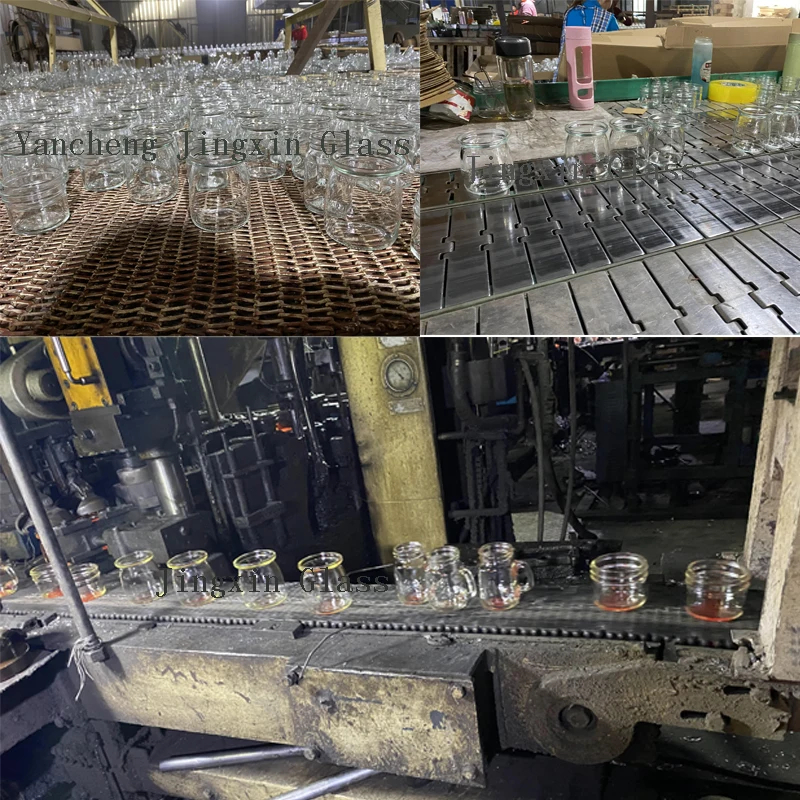
The company maintains fully equipped production lines for both soda-lime and borosilicate glass. Custom soda-lime manufacturing covers lamp shades, candle vessels, drinkware, bottles and storage containers. Custom borosilicate manufacturing covers lamp shades, laboratory instruments, high-temperature glassware, teapots, cups and home decoration glassware. Because both material systems are produced in-house, material optimization — selecting soda-lime or borosilicate for a specific use case — is a technical decision rather than a sourcing constraint.
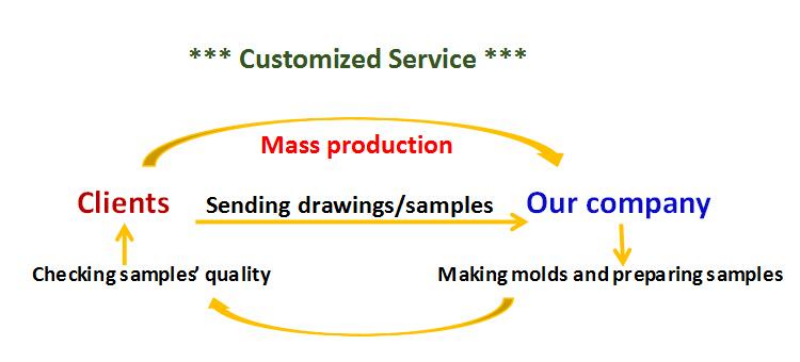
2. OEM and ODM engineering from concept to production
OEM production is available from concept development through finished production, and ODM design and production services are supported by professional in-house designers who work with clients from initial concept to final production. The company supports both drawing-based and concept-based customization, including custom mould creation for unique glass shapes and patent-pending product development conducted jointly with clients. For a lighting buyer, that means an unusual shade profile or a new fitter configuration does not have to be forced into an existing catalogue shape.
3. Seven in-house surface finishing processes — combinable on one component
Surface finishing covers acid pickling and acid etching for matte or frosted effects, sandblasting for opaque textured surfaces, silk-screen printing for logos, patterns and text, stamping for decorative embossing, decalcomania for complex multi-colour patterns, and spray painting for custom colours and finishes. Finishing is available as a standalone service or as part of a full OEM/ODM package, and it applies to both soda-lime and borosilicate products. Multiple techniques can be combined on a single product to achieve complex decorative effects — for example, an acid-etched shade carrying a silk-screened brand mark.
4. R&D, prototyping and in-house IP
The company holds 16 national patents covering product design, manufacturing processes and functional improvements, and registered its "Jingxin" trademark in 2016. Prototype development allows clients to test and validate designs before committing to large-scale production, and prototype testing and validation are performed before mass production begins. An in-house R&D team supports new product design based on client briefs, along with ongoing improvement support driven by customer feedback.
5. Compliance and quality control under an audited system
Quality control runs from raw material to finished goods, with 100% pre-shipment inspection and third-party inspection available on request. The company holds 19+ professional certifications. Two are directly relevant to lighting glass buyers in Europe and North America:
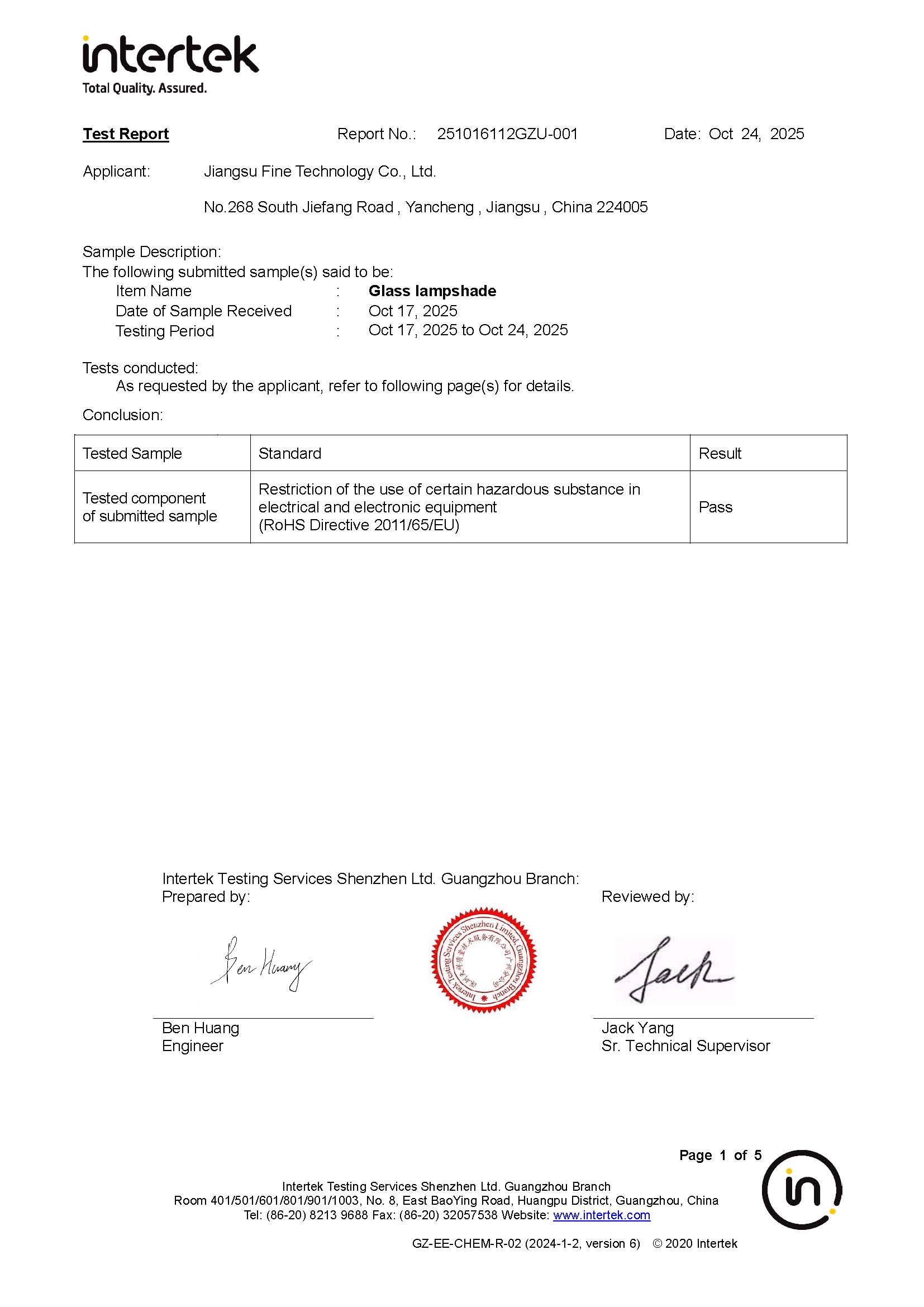
- RoHS — certificate 251016112GZU-001, issued by Intertek, covering glass lamp shades (soda-lime and borosilicate glass products for lighting applications) for the EU and global markets, tested against IEC 62321-5, IEC 62321-4 and IEC 62321-7-2 for cadmium, lead, mercury and chromium VI.
- SMETA-4P — certificate ZAA600149732, issued by TUV Rheinland, a social compliance audit covering labour standards, health & safety, environment and business ethics across the manufacturing site.
6. Integrated supply chain and export delivery
Production services are delivered under an integrated supply chain model with a single point of contact for international buyers, consolidating procurement steps. Order management information is systematized, which enables real-time order tracking and transparent communication through the supply chain. Logistics methods include sea, air, rail, truck and express, selected against each order's cost and timeline requirements, and the export team handles documentation including customs clearance, shipping marks, FORM E and Certificates of Origin.
Step-by-Step Breakdown: From Brief to Container
The following sequence is how a lighting glass component moves from a buyer's brief to a delivered shipment. The lead times below are the project-level figures published for specific product families and vary with complexity and order volume.
- Brief intake and material consultation. The buyer supplies the application, fixture type, operating temperature, target market and any compliance requirements. Technical consultation on material selection takes place at this stage — this is where a decorative pendant and a high-heat industrial cover are separated onto different material paths.
- Technical drawing and interface verification. Geometry, fitter opening, wall thickness and surface treatment are frozen into a specification. For lighting components the fitter interface is the single most important dimension to confirm in writing: published models in the range use a 60 mm opening for E27 holders (JX1004), a 20 mm opening for G9 holders (JX1184), a G9 thread fitter (JX1416) and a 42 mm opening for E27 holders (JXHB-010).
- Prototype or sample development. Samples are produced by experienced technicians against the confirmed drawing and artwork. Standard sample lead time is 5–7 working days after artwork and specification confirmation. More complex parts take longer: the thick-wall explosion-proof borosilicate shade (JX1830) runs 15–20 days after technical drawing and specification confirmation.
- Sample approval. The buyer inspects the sample for fit, finish, light behaviour and dimensional accuracy. Approval at this stage is what prevents the sample-versus-mass-production mismatch that produces fitter opening failures.
- Mass production. Standard mass production lead time is 20–30 working days after sample approval. Product-specific examples range from 15–25 days for the hand-blown glass oil candle lamp (JX34008) to 25–35 days for the explosion-proof borosilicate shade (JX1830), the double-wall reed diffuser bottle (JX1722) and the borosilicate Erlenmeyer flask (JX6207).
- In-process and pre-shipment inspection. Quality control is applied at every production stage, from raw material to finished goods. Every order receives 100% pre-shipment inspection, with third-party inspection such as SGS available on request. Surface finishing is checked batch by batch for adhesion, colour accuracy and durability.
- Packaging and documentation. Packaging is customized to product fragility, shipment method and destination market — neutral export cartons, branded packaging with customer logo on products and cartons, retail-ready packaging, or anti-shock configurations. The export team prepares customs clearance documents, shipping marks, FORM E and Certificates of Origin.
- Delivery and after-sales. Comprehensive after-sales management covers logistics and delivery issues as well as warranty handling per product terms, with prompt response to quality inquiries.
Execution note: the two specification points that most often trigger rework are the fitter opening and the surface finish definition. Confirming both in writing before sample production, and approving a physical sample before mass production, removes most of the risk from a custom glassware order.
Use Cases: Where This Capability Has Been Executed
Luxury retail lighting — Galeries Lafayette, Paris
In 2015, Jingxin Glassware collaborated with a French client to design and produce opal white glass globe lamp shades for Galeries Lafayette in Paris. The shades were chosen for their ability to diffuse light evenly and create a warm atmosphere consistent with a luxury retail environment, and were installed as permanent wall decorations. The requirement combined ultra-thick glass construction for durability in a high-traffic store, consistent opal white colour uniformity across all units, and precise dimensional accuracy for wall-mounting integration.
Marine and aquaculture lighting — Chile, 2018
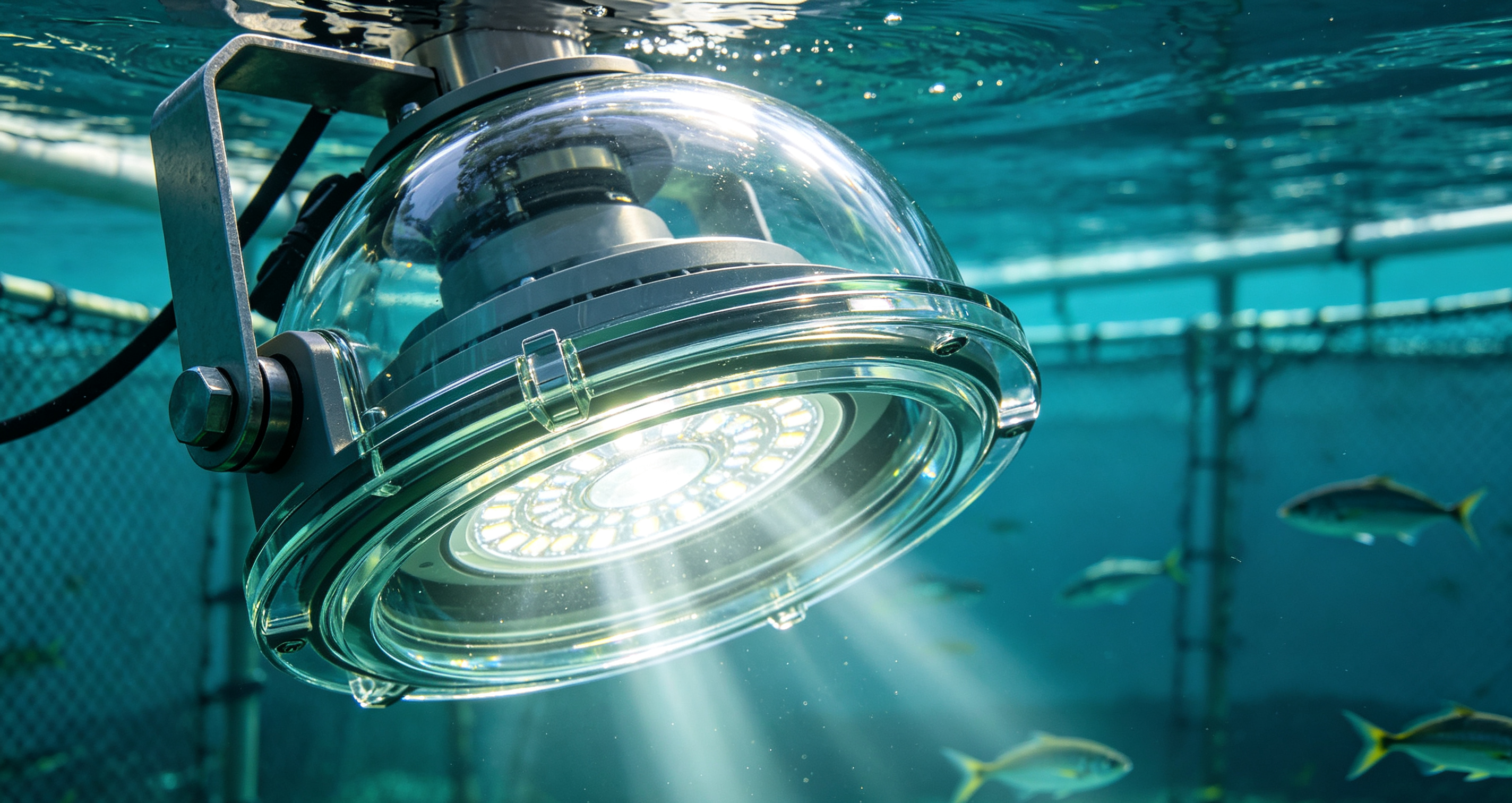
In 2018, the company produced a batch of ultra-thick transparent lamp shades with pressure and seawater resistance for a Chilean customer, designed for deep-sea fish farming where lighting equipment must withstand high pressure, saltwater corrosion and continuous immersion. The specification combined pressure resistance, seawater resistance and optical clarity in a single component — a combination that requires custom glass formulation rather than a standard catalogue part.
Beverage packaging — United States
A large U.S. winery required glass bottles with an authentic cobalt blue colour that would distinguish its products on shelf, and — beyond aesthetics — bottles that could pass pressure tests for carbonated or sparkling wine applications. Solid coloured glass, where the colour is integral to the glass body rather than a surface coating, combined with food-grade lead-free material and consistent colour across large production runs, formed the specification. The customer has continued purchasing from the supplier since.
Laboratory and research glassware
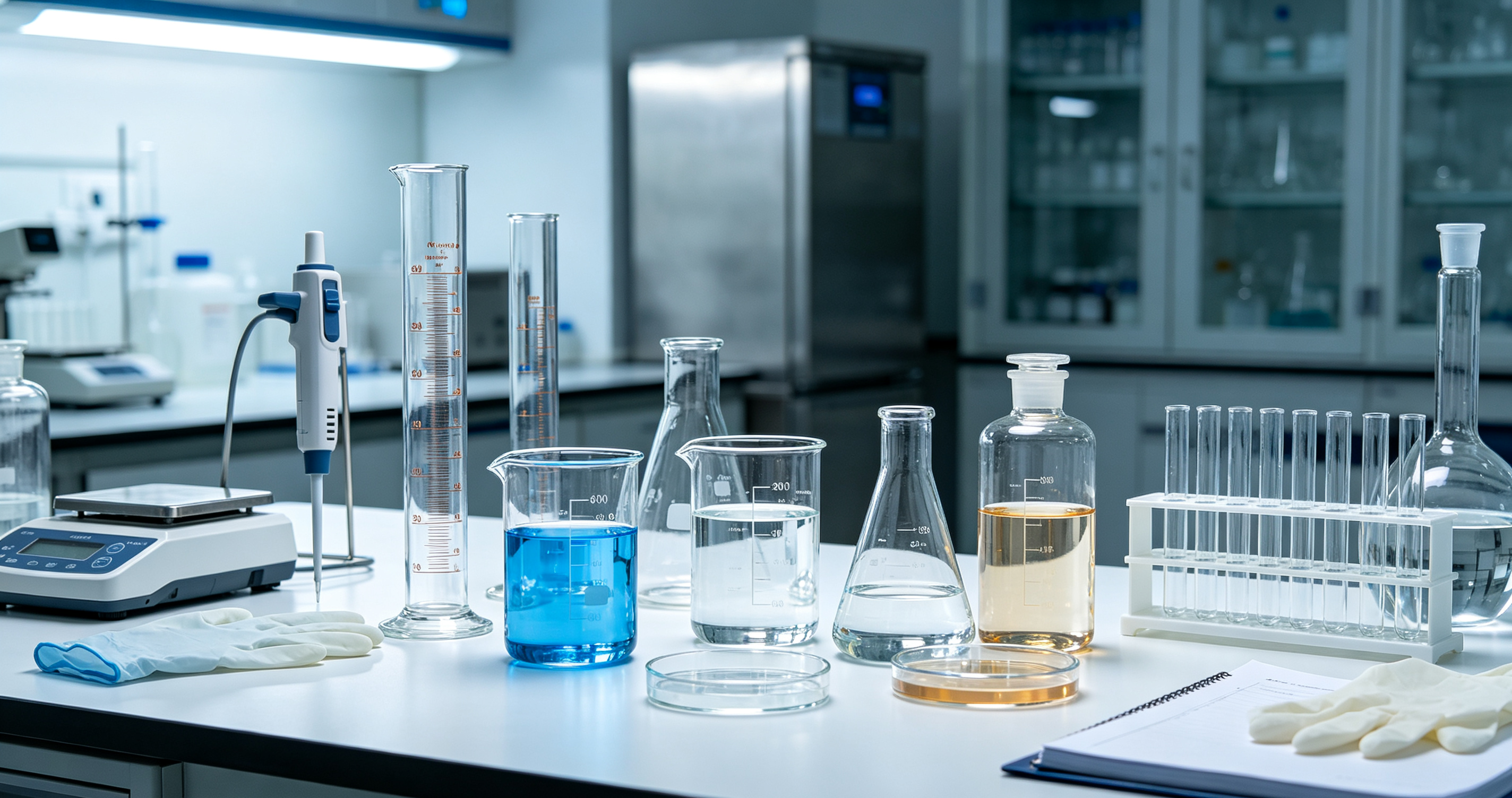
Borosilicate laboratory glassware is supplied to research institutions, pharmaceutical laboratories and universities for chemical measurement, mixing, storage and precision experimentation. The defining specification points are dimensional accuracy for volume calibration, thermal shock resistance (ΔT up to 180°C in documented laboratory projects), chemical stability in acids, alkalis and solvents, and autoclave compatibility for sterilization.
Hospitality, home décor and event customization
Custom glass vases are supplied to hotel groups for lobby and guest-room floral display, where crystal-clear transparency, a stable wobble-free base and custom etching or logo engraving are the defining requirements. At the other end of the order-size spectrum, the company produced a set of transparent glass candle cups in different sizes for a private customer's wedding in Estonia — evidence that the same customization workflow applies to small, one-off orders as to large hospitality rollouts.
Comparison Table: Material Selection for Custom Glassware
The table below summarizes the documented differences between the two glass systems the manufacturer runs in parallel. The values shown are taken from published product specifications and should be read as documented examples rather than universal constants for every part.
| Selection factor | Soda-lime glass | Borosilicate glass |
|---|---|---|
| Custom product scope | Lamp shades, candle vessels, drinkware, bottles, storage containers | Lamp shades, laboratory instruments, high-temperature glassware, teapots, cups, home decoration glassware |
| Thermal shock resistance | Reference level | Typically 3–5 times that of soda-lime glass |
| Documented service temperature | Withstands temperature changes up to 120°C (JX1004, JX1184, JXHB-002) | Withstands −40°C to +260°C (JX1830); continuous working range −60°C to +450°C (JX1832) |
| Optical role | Optical clarity for lighting and decorative items | Clear glass achieves over 90% light transmittance (JX1830); frosted variants 40–60% diffusion |
| Example lighting models | JX1004 opal globe, JX1184 G9 globe, JX1188 marble swirl globe, JXHB-002 ribbed pendant | JX1416 G9 globe, JX1407 globe shade, JX1830 explosion-proof shade, JX1832 signal shade |
| Typical fit | Decorative and standard indoor lighting, candle and drinkware programmes | High-heat, industrial, outdoor, marine and laboratory applications |
A second decision runs alongside material choice: the forming method. Hand-blown parts are individually mouth-blown and carry subtle variations, bubbles and swirls characteristic of handcrafted glass, with wider dimensional tolerance. Machine-pressed parts are produced in precision moulds and deliver consistent dimensions, uniform wall thickness and lower unit cost, which suits industrial and high-volume programmes.
| Forming method | Hand-blown | Machine-pressed |
|---|---|---|
| Character | Individually crafted; unique variations and natural bubbles | Consistent dimensional accuracy and uniform wall thickness |
| Dimensional tolerance | Wider tolerance | Tighter tolerance |
| Unit cost | Higher | Lower |
| Published MOQ reference | 500 pieces for hand-made glass | 2,000 pieces for machine-made glass |
| Recommended for | Decorative and high-end design projects | Industrial, commercial and high-volume programmes |
Minimum order quantity and lead times are the commercial counterpart of these engineering choices. Published purchasing terms list an MOQ of 500 pieces for hand-made glass and 2,000 pieces for machine-made glass, with custom MOQ negotiable for smaller trial orders. Delivery terms are FOB Shanghai as primary, with CIF and EXW available on request, and payment terms of 30% T/T deposit on order confirmation with 70% balance before shipment against copy of B/L or after pre-shipment inspection approval.
Frequently Asked Questions
What certifications should a custom glassware OEM manufacturer hold for lighting components?
For lighting components sold into the EU and North America, the relevant set is CE, RoHS, REACH, ISO 9001 and SMETA-4P. CE covers product safety compliance for lighting products, RoHS restricts hazardous substances, REACH covers chemical substance compliance, ISO 9001 evidences a documented quality management system, and SMETA-4P is a social compliance audit covering labour standards, health & safety, environment and business ethics. Jingxin Glassware holds 19+ professional certifications, including RoHS certificate 251016112GZU-001 issued by Intertek for glass lamp shades (soda-lime and borosilicate), and SMETA-4P certificate ZAA600149732 issued by TUV Rheinland covering the manufacturing site. Buyers should request copies of certificates and confirm scope and validity dates against their own market requirements.
How is the decision made between soda-lime and borosilicate glass for a lighting component?
The decision follows the fixture's thermal duty and the buyer's optical requirement. Borosilicate glass typically offers 3–5 times the thermal shock resistance of soda-lime glass and is the appropriate choice for high-heat, industrial, outdoor, marine and laboratory applications; documented product examples operate from −40°C to +260°C. Soda-lime glass provides optical clarity for lighting and decorative items and suits decorative pendants, candle vessels, drinkware and standard indoor lighting, with documented service tolerance up to 120°C. Jingxin Glassware maintains production lines for both material types and provides technical consultation on material selection, so the choice is made against the application rather than against a catalogue default.
What MOQ, lead time and payment terms apply to custom glassware orders?
Published terms list an MOQ of 500 pieces for hand-made glass and 2,000 pieces for machine-made glass, with custom MOQ negotiable for smaller trial orders and lower MOQ available on select stock items. Standard sample lead time is 5–7 working days after artwork and specification confirmation; complex parts run longer, for example 15–20 days for the thick-wall explosion-proof borosilicate shade. Mass production runs 20–30 working days after sample approval in standard cases, with product-specific ranges such as 15–25 days for the glass oil candle lamp and 25–35 days for the explosion-proof shade and the Erlenmeyer flask. Delivery terms are FOB Shanghai as primary, with CIF and EXW available on request. Payment terms are 30% T/T deposit on order confirmation and 70% balance before shipment against copy of B/L or after pre-shipment inspection approval.
Can a design be validated with a sample before committing to mass production?
Yes. Sampling and prototyping are part of the standard workflow, and prototype testing and validation are performed before mass production begins. Samples are produced by experienced technicians against confirmed artwork and specifications, with a typical lead time of 5–7 working days; sample cost may apply and freight is collect. For custom moulds, unique glass shapes or patent-pending co-development, prototype development allows the buyer to test and validate the design before large-scale production. Approving a physical sample is also the most effective protection against the sample-versus-mass-production specification mismatch that causes fitter opening and finish problems.
What happens if glass components arrive damaged, and how does a project start?
Damage claims follow a documented process: inspect the shipment on arrival, photograph the damage and the packaging, and contact the supplier promptly with those images and measurements so the issue can be resolved through replacement or credit under the agreed warranty terms. Prevention is addressed at the packaging stage — cushioning is designed around product fragility, shipment method and destination market — and pre-shipment packaging verification, enhanced foam and divider configurations, and third-party loading supervision such as SGS are available for high-value shipments. To start a project, send the application details, target dimensions or drawings, fitter interface, finish requirement and target market to Jingxin Glassware at jerry@cn-glassware.com or through the company website at www.cn-glassware.com. The glass lamp shade catalogue, including model-level specifications, can be downloaded from the link in the section below.
Conclusion
Custom glassware OEM for lighting components is decided by specification control, not by catalogue breadth. Suppliers that ship correctly the first time are the ones that can hold both soda-lime and borosilicate production in-house, engineer drawings and moulds to a buyer's interface rather than to a generic shape, apply and combine multiple surface finishes under batch-level inspection, and document compliance before the container leaves the yard.
Jingxin Glassware has run that workflow since 1999, serving 1,000+ global clients across 100+ countries from a production base in Yancheng, Jiangsu Province, with 16 national patents, 19+ professional certifications and 100% pre-shipment inspection. For buyers moving from evaluation to execution, the practical next step is a specification review followed by a physical sample.
Request a Sample or Quotation
Send your drawing, target dimensions, fitter interface, material preference and surface finish requirement. Samples are typically produced within 5–7 working days after specification confirmation.
Email: jerry@cn-glassware.com
WhatsApp: +86 180 1962 7905
Website: www.cn-glassware.com
Download the glass lamp shade catalogue: Glass Lamp Shades Catalogue — Yancheng Jingxin Glassware Co., Ltd. (PDF)