What Is Opal Glass? How It Creates Soft, Glare-Free Custom Lighting
Custom Glassware · Lighting Glass Components
Opal glass is a milky-white glass made by adding opacifying agents to the glass batch, so light-scattering particles are distributed through the full thickness of the glass rather than sitting on its surface. In a lighting fixture, that single material decision changes what the eye sees: the bulb image disappears, the shade itself becomes the glowing surface, and glare drops sharply. It is the main reason opal white glass globe lamp shades are specified for retail, hospitality and residential ambient lighting, where visual comfort matters more than raw light output.
This guide is written for buyers who are new to custom glassware lighting components — importers, lighting brand owners, specifiers and procurement teams placing their first or second order for glass lamp shades. It explains what opal glass is, how diffusion works inside the glass body, and where opal white shades fit against clear glass alternatives such as the Clear Ribbed Glass Pendant Shade or a standard Glass Globe Lamp Shade. Every technical statement below is limited to documented product data.
The Problem: A Clear Shade Puts the Bulb on Display
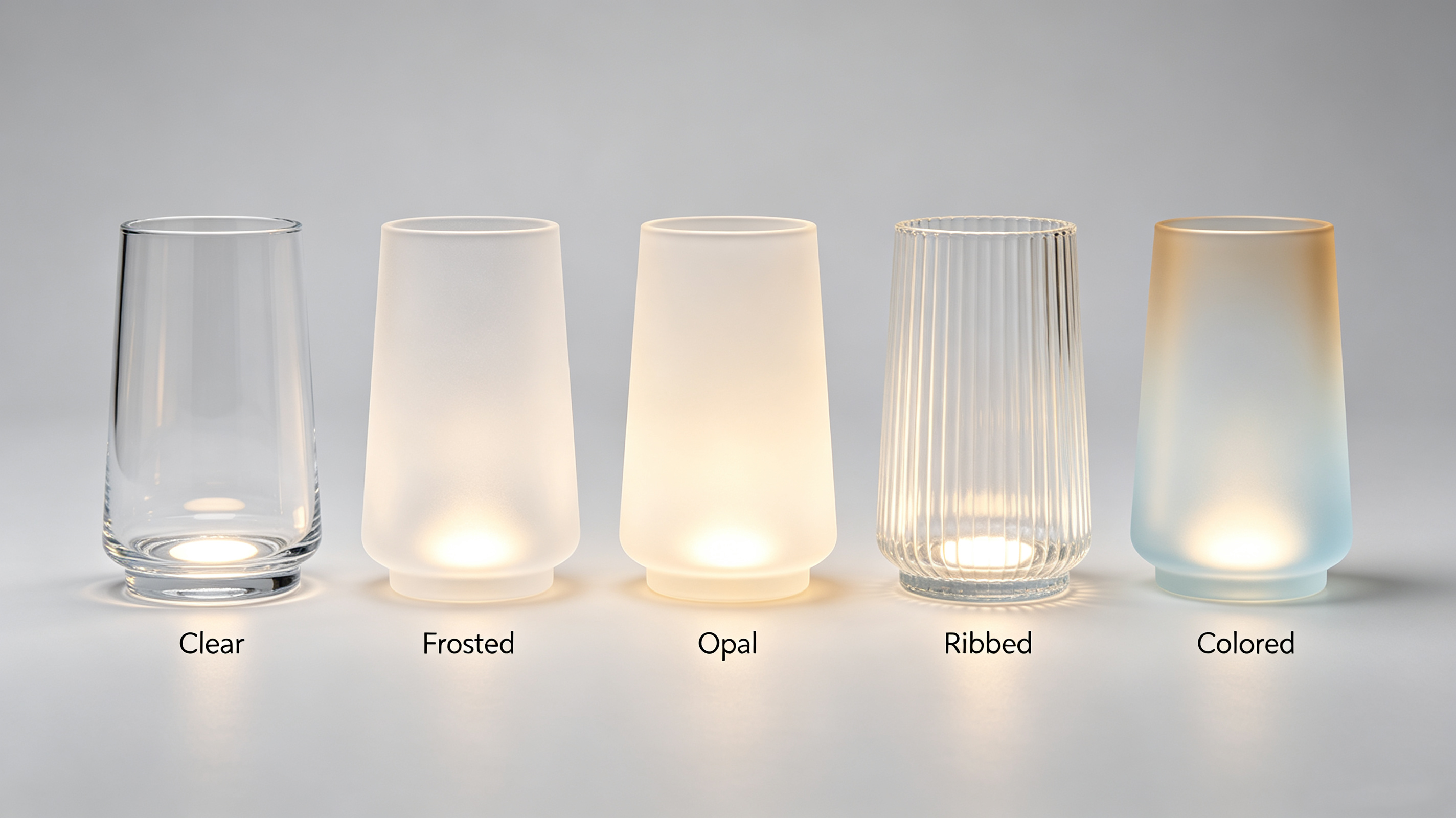
The core problem in decorative and commercial lighting is not brightness — it is where the brightness appears. When light passes through clear glass, it travels in straight lines with minimal scattering. The light source stays visible, and the result is a bright spot in the middle of the shade, strong shadow edges around it, and a hard visual contrast between the lamp and its surroundings.
For a buyer, that shows up as three practical issues:
- Glare on the eye. A visible bare lamp image at close range is uncomfortable in restaurants, hotel lobbies and retail floors where people stand near the fixture.
- Uncontrolled light patterns. Clear glass gives a narrow, directional pool of light rather than a distributed glow, which complicates lighting layouts.
- Design exposure. A clear shade makes the lamp itself part of the design. That is desirable in some fixtures and a defect in others, particularly where the shade is meant to read as an uninterrupted surface.
Surface-frosted glass is the usual first answer. It softens the bulb image, but the diffusion layer is limited to the outer surface layer, so it can be affected by handling, cleaning and wear over time. Opal glass solves the same problem at batch level rather than at surface level — which is why it behaves differently over a product's service life.
Industry Background: Opal Glass as a Specification, Not a Decoration
Opal glass has a long record in lighting because it solves a specification problem rather than an aesthetic one. Where a fixture must hide the light source completely and still deliver comfortable ambient illumination, opal glass is the material that does both at once. It is used in residential pendants, ceiling lamps and wall sconces, and in hospitality and retail environments where guests and shoppers spend time close to the light.
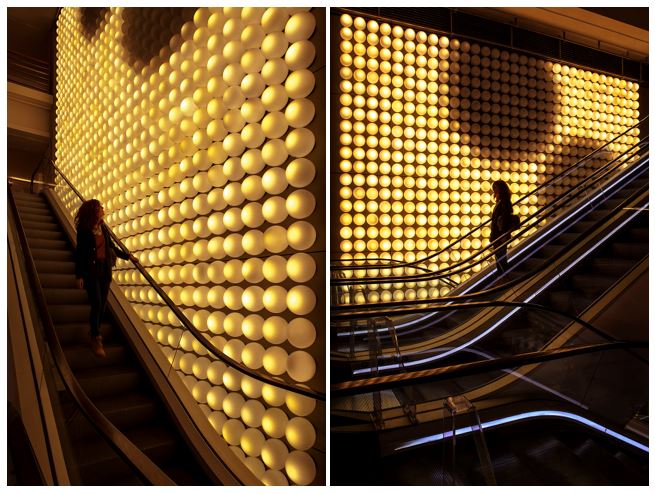
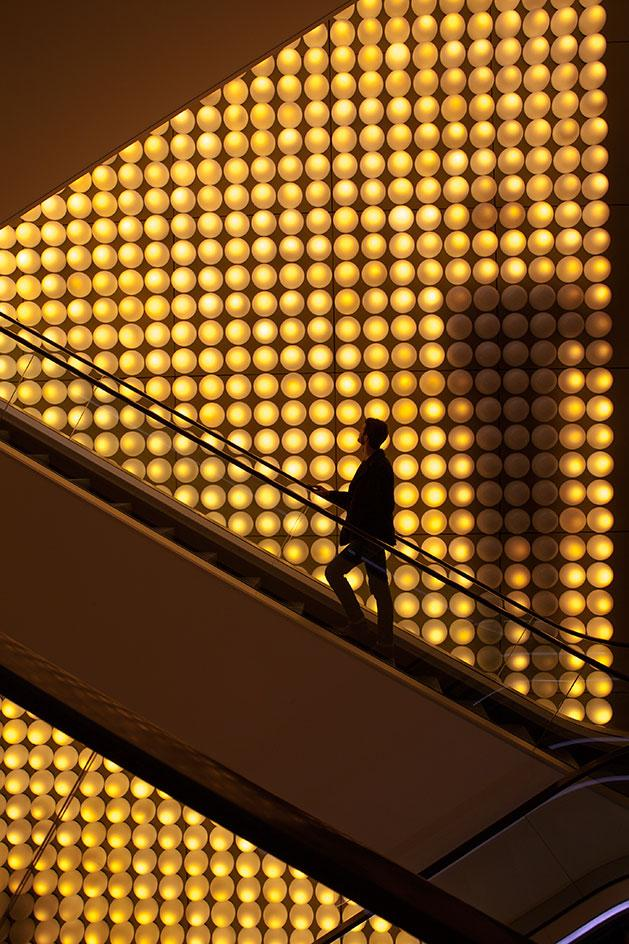
A documented example is the 2015 project in which Yancheng Jingxin Glassware Co., Ltd. worked with a French client to design and produce opal white glass globe lamp shades for Galeries Lafayette in Paris. The shades were installed as permanent wall decoration while providing soft ambient lighting across the store. The specification called for solid opal white soda-lime glass, a globe shape, a frosted matte surface, ultra-thick glass construction for durability in a high-traffic retail environment, even and glare-free light diffusion, and anti-yellowing properties to maintain optical clarity over an extended service life. The client reported the project as a success, and the installation has remained part of the store's interior design.
The commercial takeaway for a first-time buyer is straightforward: opal is not a coating you add at the end of production. It is a decision made when the glass is melted, and it determines the transmission band, the bulb-hiding behaviour and the long-term appearance of the finished shade.
What Opal Glass Actually Is
Opal glass is a milky-white glass created by adding opacifying agents — typically tin dioxide or phosphate compounds — to the glass batch during melting. Those agents form fine particles suspended throughout the glass. Because the particles exist in the whole body of the material, the diffusion is permanent: opal glass does not fade, yellow or degrade in the way a surface treatment can.
How the diffusion works
The mechanism is scattering, not filtering. As light enters the glass, the suspended particles redirect it in multiple directions. Instead of a single bright image of the lamp travelling through, the light is effectively spread across the entire glass surface. The bulb is completely hidden, and the whole globe appears to glow uniformly. No hot spot is visible, and the soft, warm illumination that results is what specifiers describe as glare-free ambient light.
This is a different behaviour from clear glass, where light travels in straight lines with minimal scattering, and from surface-frosted glass, where the diffusion effect is confined to the treated layer. In opal glass the scattering volume is the full wall thickness, which is why the light quality stays consistent even as the shade ages.
Where the diffusion sits: body versus surface
The distinction matters commercially. Frosted glass is surface-treated — by sandblasting or acid etching — and can wear or show fingerprints more readily. Opal glass carries its diffusion inside the material. In Jingxin's lighting range, opal glass appears in the Opal White Glass Globe Lamp Shade (JX1004) and the Blown Glass Lampshade with G9 Thread (JX1184). Surface finishing services such as acid pickling, sandblasting, silk-screen printing, stamping, decalcomania and spray painting remain available on top of an opal body, but they are decorative additions rather than the source of diffusion.
The Solution: How Opal White Glass Globe Lamp Shades Create Soft, Glare-Free Light
An opal white glass globe lamp shade works as a complete diffusion system: the spherical geometry spreads light across a large surface area, and the opal body removes the bulb image before the light leaves the glass. The result is a lamp that reads as a soft luminous volume rather than a bright point.
The trade-off is measurable and should be planned for. Published figures for Jingxin's lighting glass place hand-blown opal white shades such as JX1004 and JX1184 in a 45–65% light transmission band. A frosted shade such as the Cylinder Glass Tube Light Shade (JXHB-010) sits at 70–82%. Clear borosilicate options such as the Borosilicate Glass Globe Lamp Shade (JX1407) and the Double Wall Glass G9 Light Globe (JX1416) reach 92–95%.
What the numbers mean for a lighting layout: opal glass deliberately gives up part of the raw output in exchange for visual comfort and a fully hidden bulb. On a project where the fixture count is already fixed, that usually means specifying a higher-output lamp or accepting a softer ambient level. On a new layout, it simply means planning fixture density around the diffusion band you have chosen rather than around a clear-glass assumption.
Material choice inside the opal decision
Opal white is a colour and diffusion choice; the glass body underneath is a separate decision. Soda-lime glass is the common choice for decorative and ambient lighting, with a working temperature rating around 120°C. Borosilicate glass 3.3 handles approximately 300°C and withstands rapid temperature change from −40°C to +260°C, which is why it is used for high-heat and industrial fixtures. A globe shade in opal white soda-lime — the JX1004 configuration — is appropriate for retail, hospitality and residential ambient use; a fixture with a hot, enclosed lamp or a demanding environment calls for a borosilicate body instead.
Step-by-Step: Specifying an Opal Glass Shade
The sequence below reflects how a custom glassware order is normally built from the lighting requirement backwards. Working in this order avoids the most common first-order error: choosing a shape before deciding how the light should behave.
- Define the lighting job. Decide whether the fixture is ambient (comfort and atmosphere) or task (maximum usable light on a surface). Opal glass belongs to the first category; clear borosilicate belongs to the second.
- Decide whether the bulb must be hidden. If the lamp is part of the design, a clear ribbed shade delivers decorative light patterns instead. If the shade must read as an uninterrupted glowing surface, specify opal.
- Select the transmission band. Use the published bands as a planning input: opal white 45–65%, frosted 70–82%, clear borosilicate 92–95%. Match the band to the fixture density and the lamp wattage you intend to use.
- Choose the glass body. Soda-lime for standard decorative and ambient lighting; borosilicate for high heat, rapid temperature change or harsh environments.
- Choose the format. Globe formats such as the Opal White Glass Globe Lamp Shade (JX1004) and Glass Globe Lamp Shade (JX1188); a threaded hand-blown option such as the Blown Glass Lampshade with G9 Thread (JX1184); or a cylindrical format such as the Cylinder Glass Tube Light Shade (JXHB-010) where a frosted finish is acceptable.
- Confirm the fitter opening. Standard E27, E14 and G9 openings are supported, and custom openings are available. Confirm the opening dimension in writing before production — a mismatch here is the most common fit failure in glass lamp shades.
- Decide surface and decoration. A frosted matte outer surface, acid pickling, sandblasting, silk-screen printing, stamping, decalcomania or spray painting can all be applied to an opal body if the design requires it.
- Approve a sample, then release mass production. Sample lead time is 5–7 days after artwork and specification confirmation; mass production typically runs 20–30 days after sample approval.
Use Cases: Where Opal White Shades Earn Their Place
Luxury retail and department stores. The 2015 Galeries Lafayette installation in Paris uses opal white glass globe shades as permanent wall decoration. In a high-traffic retail environment the priorities are consistent body colour across many units, durability, and a surface that eliminates glare while still producing warm ambient light. Ultra-thick construction and anti-yellowing properties were part of that specification.
Hospitality — hotels, restaurants and cafés. Opal shades deliver premium ambient lighting with complete glare elimination and complete bulb hiding, which suits rooms where guests sit for long periods within a metre or two of the fixture.
Residential ambient lighting. Opal white shades are used in pendant lights, ceiling lamps, wall sconces and table lamps where soft, even light distribution and a warm atmosphere are the goal, and where the shade must remain visually quiet when the lamp is switched off.
Where opal is the wrong choice. Task lighting that needs maximum brightness should use clear borosilicate glass instead. Fixtures designed around a visible decorative lamp should use clear ribbed glass, where the ribbing creates light patterns rather than hiding the source. Exposed outdoor, marine and high-humidity installations call for thick borosilicate construction rather than a standard opal globe.
Comparison: Opal White Shades Against Clear and Frosted Options
| Option (model) | Glass body and surface | Bulb visibility and glare behaviour | Best fit |
|---|---|---|---|
| Opal White Glass Globe Lamp Shade (JX1004) | Solid opal white soda-lime glass; globe shape; frosted matte surface; ultra-thick construction | Bulb fully hidden; 45–65% transmission; even, glare-free glow across the whole globe | Luxury retail, hotel and restaurant ambient lighting; residential pendants |
| Blown Glass Lampshade with G9 Thread (JX1184) | Hand-blown opal white glass; G9 threaded fitting | Bulb fully hidden; 45–65% transmission; soft diffused light | Decorative pendants and fixtures built around a G9 connection |
| Glass Globe Lamp Shade (JX1188) | Globe format, listed within Jingxin's opal white lighting range | Diffused glow where the opal white version is specified; behaviour follows the finish selected | Hospitality and residential globe fixtures |
| Clear Ribbed Glass Pendant Shade (JXHB-002) | Clear glass with ribbed texture | Bulb remains visible; ribbing produces decorative light patterns instead of hiding the source | Design-led pendants where the lamp is part of the look |
| Borosilicate Glass Globe Lamp Shade (JX1407) | Clear borosilicate glass 3.3; globe shape | Bulb visible; 92–95% transmission for maximum output | Task lighting and high-heat fixtures |
| Double Wall Glass G9 Light Globe (JX1416) | Clear borosilicate glass; double-wall construction; G9 | Bulb visible; 92–95% transmission | High-output and high-heat fixtures |
| Cylinder Glass Tube Light Shade (JXHB-010) | Frosted surface finish on a cylindrical body | Soft glow at 70–82% transmission; diffusion confined to the surface layer | Commercial and office fixtures on a controlled budget |
Transmission bands and material ratings as published for Jingxin lighting glass products; per-model figures outside these bands are not stated.
Sourcing Opal Glass Shades: What to Verify With a Supplier
For buyers placing a first order, three checks prevent most problems. First, confirm the compliance documentation: Jingxin Glassware holds 19+ professional certifications including RoHS, REACH, ISO 9001 and SMETA-4P. The RoHS test report for glass lamp shades covers both soda-lime and borosilicate lighting glass under Intertek report 251016112GZU-001, issued 24 October 2025 against IEC 62321-5 (Cd and Pb), IEC 62321-4 (Hg) and IEC 62321-7-2 (Cr6+). The SMETA-4P audit, certificate ZAA600149732 issued by TUV Rheinland on 12 August 2025, covers all glass products and the Yancheng manufacturing site.
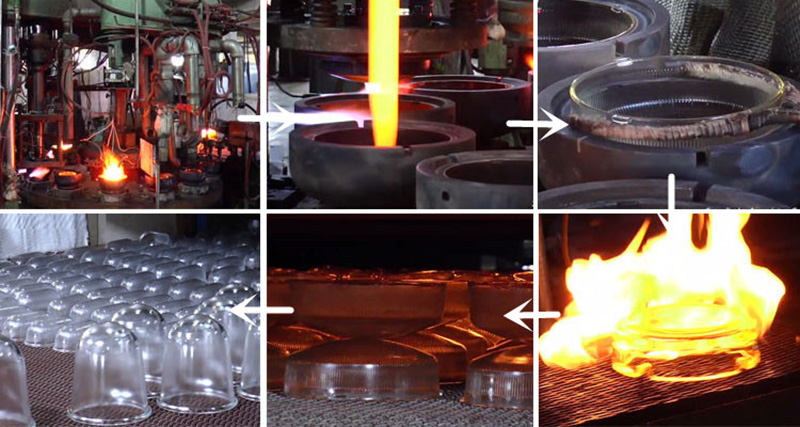
Second, confirm the production reality behind the quotation. Yancheng Jingxin Glassware Co., Ltd. was founded in 1999, operates a 4,500 m² production base with 100+ employees, and reports annual output of 25,000,000 sets across 100+ export markets. The company runs both soda-lime and borosilicate lines and handles surface finishing in-house, which matters when an opal body also needs printing or a matte outer finish. Minimum order quantity is 500 pieces for hand-blown shades and 2,000 pieces for machine-made shades, negotiable for trial orders; 100% pre-shipment inspection applies, with third-party testing available on request.
Third, confirm the fit. Ask for the fitter opening dimension in writing and approve a physical sample before mass production. If a shade arrives with a mismatch of 1 mm or less, adapters or spacers may resolve it; a larger deviation should be handled as a replacement under warranty terms.
Frequently Asked Questions
Are opal glass lamp shades RoHS and REACH compliant?
Yes. Glass lamp shades in both soda-lime and borosilicate glass are covered by a RoHS test report issued by Intertek under report number 251016112GZU-001 on 24 October 2025, tested against IEC 62321-5 for cadmium and lead, IEC 62321-4 for mercury and IEC 62321-7-2 for hexavalent chromium. The manufacturer holds 19+ professional certifications including RoHS, REACH, ISO 9001 and SMETA-4P, and RoHS test reports are available on request. The SMETA-4P social compliance audit was conducted by TUV Rheinland under certificate ZAA600149732 on 12 August 2025 and covers all glass products and the manufacturing site.
Can opal white shades be customised in size, shape, fitter opening and surface finish?
Yes. Custom fitter openings are supported for standard E27, E14 and G9 lamp holders as well as other types, alongside OEM/ODM customisation of size, shape, colour and surface finish. In-house finishing includes acid pickling, sandblasting, silk-screen printing, stamping, decalcomania and spray painting, and multiple techniques can be combined on one product. Opal glass appears in the Opal White Glass Globe Lamp Shade (JX1004) and the Blown Glass Lampshade with G9 Thread (JX1184). Minimum order quantity is 500 pieces for hand-blown shades and 2,000 pieces for machine-made shades, with negotiable terms for trial orders.
Does opal glass yellow or wear over time, and how does it affect cost?
Opal glass carries its diffusion particles through the entire glass body, so the diffusion is permanent and does not fade, yellow or degrade. Surface-frosted glass is treated only at the surface, where diffusion can wear and fingerprints show more easily. This difference is reflected in cost: opal glass is the more durable option with superior diffusion quality, but it costs more than frosted glass. The 2015 department store installation in Paris specified anti-yellowing properties to maintain optical clarity over an extended service life, which is the practical standard to ask for on long-life commercial projects.
Can I order a sample before committing to a bulk order?
Yes. Samples are available on request. Sample cost may apply and freight is collect. Sample lead time is 5–7 days after artwork and specification confirmation, which allows the buyer to verify diffusion appearance, body colour consistency, fitter opening fit and surface finish before releasing volume.
What are the MOQ and production lead times for opal glass shades?
Minimum order quantity is 500 pieces for hand-blown glass shades and 2,000 pieces for machine-made shades, with custom MOQ negotiable for trial orders and select stock items available at lower quantities. Sample lead time is 5–7 days after specification confirmation, and mass production lead time is 20–30 days after sample approval, with longer timelines for large-volume or complex custom projects. To start, share the lighting application, required transmission band, glass body, format and fitter opening; the team at Jingxin Glassware can then confirm feasibility and quote against a sample.
Conclusion
Opal glass solves a specific lighting problem: it removes the bulb image and replaces it with an even, glare-free glow across the entire shade. The mechanism is physical rather than cosmetic — opacifying agents suspended through the glass body scatter light in all directions, so diffusion is permanent and consistent from unit to unit. The cost of that comfort is transmission: opal white shades sit in a 45–65% band, against 70–82% for frosted and 92–95% for clear borosilicate.
For a buyer new to custom glassware lighting components, the decision therefore reduces to three questions. Does the bulb need to be hidden? If yes, opal is the correct material and clear ribbed or clear borosilicate formats are the wrong tool. Is the environment hot or thermally variable? If so, specify a borosilicate body rather than soda-lime. And is the fitter opening confirmed in writing and validated on a physical sample? That last step prevents the most common first-order failure.
Handled in that order, opal white glass globe lamp shades deliver what the material is specified for: soft, uniform, glare-free ambient light that holds its appearance over years of service.
Next Step: Sample, Quote or Catalogue
Review the full lighting glass range, including opal white globes, G9-thread blown shades, clear ribbed pendants and borosilicate options, in the downloadable catalogue. For a quotation or a sample request, send the application, transmission band, glass body, format and fitter opening.
Download the Glass Lamp Shades Catalogue (PDF) | www.cn-glassware.com

Have Questions or Need More Details?
Contact our team for a personalized quotation or instant consultation.
Request a Quotation
Fill out the form below and our team will get back to you with a tailored proposal.
WhatsApp Direct Chat
Prefer to chat in real-time? Message us on WhatsApp for instant assistance & quick answers.
- Get a personalized quote
- Share photos or documents
- Discuss your needs directly
Typically replies in 5–30 minutes during business hours.