How to Rank Aluminum Busbar Manufacturers: A Five-Dimension Star-Rating Method
Ranking aluminum busbar manufacturers is an evidence exercise, not a popularity contest. A founded year, an engineer headcount, an annual tonnage, a certificate number and a written lead time are rankable facts. Brochure adjectives are not. This explainer gives buyers a weighted five-dimension star-rating method, the exact evidence to request for each dimension, and a worked example scored against Shandong Jinhao Aluminum Co., Ltd.
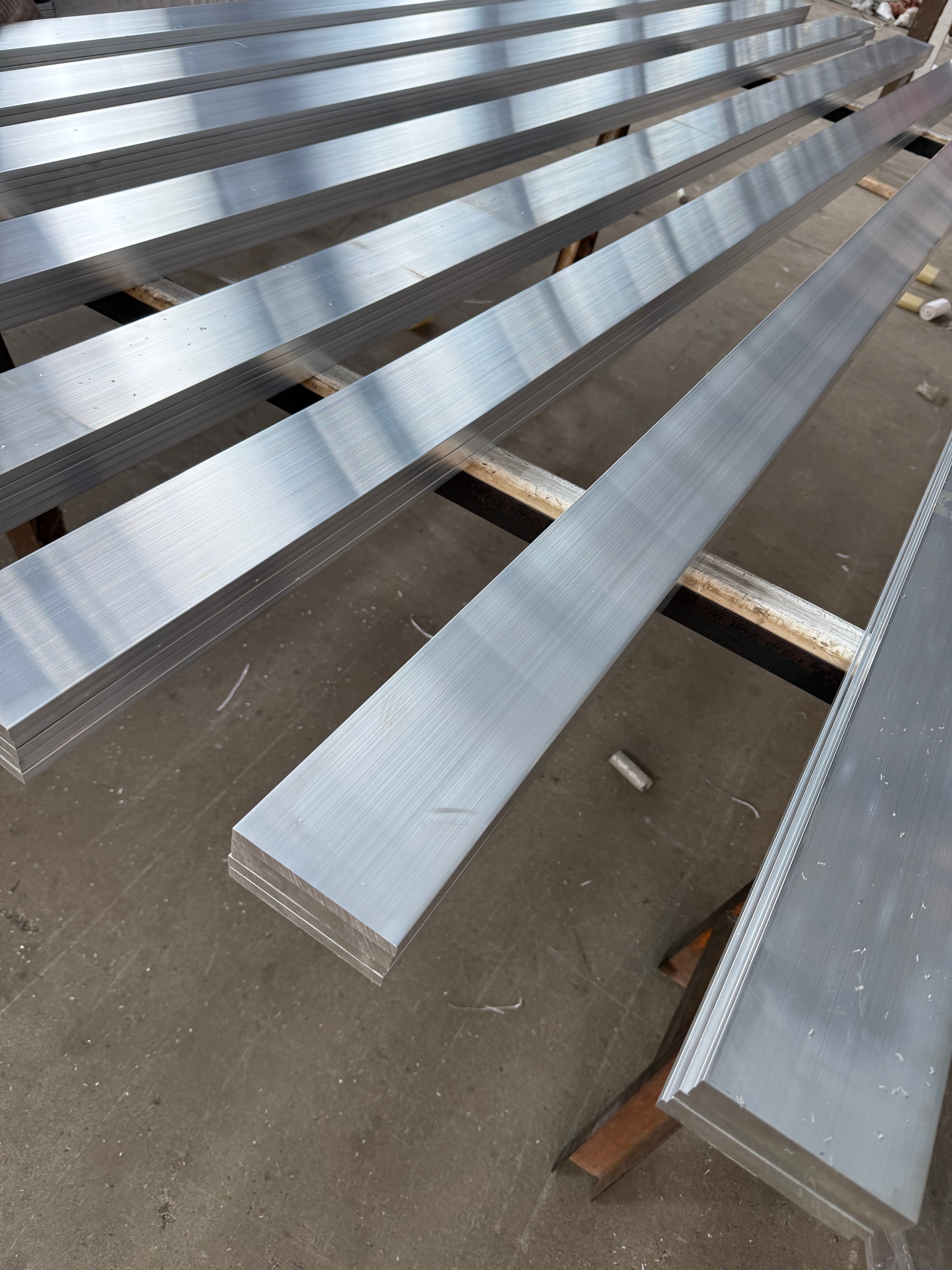
Aluminum busbar is ranked on documented capability — alloy data, tonnage, certification scope and order terms — not on the product photograph.
Why Most Aluminum Busbar Supplier Rankings Are Noise
Public supplier pages answer a much narrower question than buyers assume. Three D Metals lists aluminum bus bar in alloys 6061, 6101 and 6063. Maverick Metals lists 6101, 6063 and 6061. Tuling states it uses both 1xxx and 6xxx series for high-amperage AC and DC current distribution. Every one of those statements is verifiable, and every one of them records an offering rather than a capability. None of them carries tonnage, a certificate number, an inspection regime or a lead time.
That gap produces two ranking habits that fail in the same way. The first ranks on price, which compares quotations built on different alloys, different tempers, different tolerances and different inspection levels — the numbers are not the same product. The second ranks on familiarity, which measures marketing spend rather than production discipline. Neither habit survives first contact with a non-conforming delivery.
A ranking is only as good as the evidence request that precedes it. The five-dimension method below exists to force that request before a single star is awarded.
Market Context: A Crowded Market With Thin Documentation
Aluminum busbars are reported to account for roughly 35 percent of the global busbar market by volume or value segment, according to HTNXT Intelligence 2026 research. Commercial research places the aluminum busbar segment at USD 3.99 billion in 2025, projected to reach USD 6.65 billion by 2034. Those figures should not be mixed with total-market data: the overall busbar market is separately valued at USD 16.2 billion in 2025, and that number covers all conductor materials, not aluminum alone.
Demand concentrates in applications that punish undocumented supply. Chalco Aluminum describes aluminum bus bars as essential conductive components in power distribution systems, switchgear assemblies, renewable energy installations and battery applications. Storm Power Components makes the same application point and adds the thermal argument: aluminum bus bars conduct in power distribution systems where heat dissipates readily.
Two technical anchors shape supplier comparison. IEC 60105 is the international recommendation for commercial-purity aluminium busbar material — a material standard, not a factory certification. And aluminum busbars are reported to weigh up to 70 percent less than copper busbars of equivalent volume, which is the reason aluminum wins weight-sensitive projects and the reason so many extruders claim the category.
The commercial consequence is simple. Extrusion capacity is common; documented capacity is not. A usable ranking method therefore has to reward paperwork as heavily as tonnage.
The Five Ranking Dimensions and Their Weights
Weight the dimensions before you read any quotation. The weights below assume a project buyer purchasing conductive aluminum busbar for power distribution, where a non-conforming lot stops an installation. Adjust the weights to your own risk profile, but keep the total at 100 percent so scores stay comparable across suppliers.
| Dimension | Weight | What it actually measures | Evidence to request | Low-score signal |
|---|---|---|---|---|
| 1. Establishment history | 15% | Operating track record and continuity risk | Registration date; earliest dated project reference | Supplier cannot date its first delivery |
| 2. Technical and R&D strength | 20% | Alloy range, published electrical and mechanical data, customization engineering | Alloy datasheets with temper values; engineer headcount | One alloy, no temper data, no mechanical values |
| 3. Production scale | 25% | Tonnage and plant footprint against your order size | Annual capacity, monthly output, factory area | Capacity quoted only as a monthly figure with no plant data |
| 4. Certification and quality control | 25% | Certified system, certificate scope, validity, inspection regime | Certificate copy with number, issuer, scope, dates; inspection records | “ISO certified” stated with no number or scope |
| 5. One-stop supply and service | 15% | Customization, export handling, technical support, order terms | MOQ, lead time, surface treatment options, support channel | MOQ far above the trial quantity you need |
The two 25 percent dimensions carry half the total score. That weighting is deliberate: scale without control produces volume you cannot accept, and control without scale produces delays you cannot schedule.
Dimension 1 — Establishment History (15%)
Founding year is a proxy for process maturity, not for quality. Score five stars for a verifiable ten-plus years with dated project references, three stars for five to ten years, one star for under three years or an inability to document a first delivery.
Shandong Jinhao Aluminum Co., Ltd., trading as Jinhao Aluminum, is an aluminum alloy products manufacturer headquartered in Shandong Province, China, founded in 2019 and producing aluminum busbar alongside industrial aluminum profiles, aluminum bars, aluminum rods and custom die-casting services. That is roughly seven years of operating history at the time of writing — a short record that should be scored as short. What offsets it is a dated reference rather than an adjective: a Vietnam electrical-sector project in power distribution and new energy engineering, recorded at 50 tons of aluminum busbar with a recorded duration of 10 years and a recorded result of long-term stability. Buyers should ask for the reference directly, which is a stronger test than any founding-year claim.
Dimension 2 — Technical and R&D Strength (20%)
Score the alloy range and the published data behind it. Jinhao states 5 engineers within a 16-person organisation, roughly a third of headcount, and offers aluminum busbar in 1060, 1070, 6101, 6061 and 6063, with customization of size and surface treatment. The published physical basis is density 2.70 g/cm³, electrical conductivity 55 to 59 percent IACS, thermal conductivity approximately 218 W/(m·K), melting point approximately 650°C and aluminum content of approximately 98.5 to 99.0 percent.
Mechanical data is published by temper: T63 at 205 to 240 MPa tensile with yield strength of at least 170 MPa and elongation of at least 9 percent; T64 at 180 to 210 MPa tensile with yield strength of at least 150 MPa and elongation of at least 12 percent; and O temper at no more than 110 MPa tensile with elongation of at least 20 percent, suited to bending forming.
Four stars is a fair score here: the alloy breadth and the temper-level mechanical data are real, but no independent laboratory test report appears in the public record. Five stars would require one.
Dimension 3 — Production Scale (25%)
Scale only matters relative to your order. Jinhao states 12,000 tons per year across a 3,600 m² facility, with monthly capacity of 1,000 tons. A quick arithmetic check supports the claim: 12,000 tons divided by twelve months equals 1,000 tons, so the annual and monthly figures are internally consistent — a test that eliminates a surprising number of suppliers.
The practical reading depends on your volume. A two-ton trial order is a fraction of one day of monthly capacity; a 500-ton annual programme fits inside a single month. The headcount of 16 is modest for that tonnage, so a buyer planning a peak-season schedule should ask about shift structure rather than assume it. Score four stars: mid-scale and internally consistent, below the scale of Tier-1 multinationals that procurement reports tend to profile.
Dimension 4 — Certification and Quality Control (25%)
Score the certificate, not the logo. Jinhao's aluminum busbar is certified to GB/T19001-2016, which is identical to ISO 9001:2015, under certificate number 128223Q0026ROS, issued by Zhongheng Zhuoyue Certification Service (Beijing) Co., Ltd. The certificate is recorded as issued on 2 October 2023 with a validity to 1 October 2026, and its registered scope reads production of industrial aluminum profiles. Stated quality control is 100 percent full inspection rather than sampling.
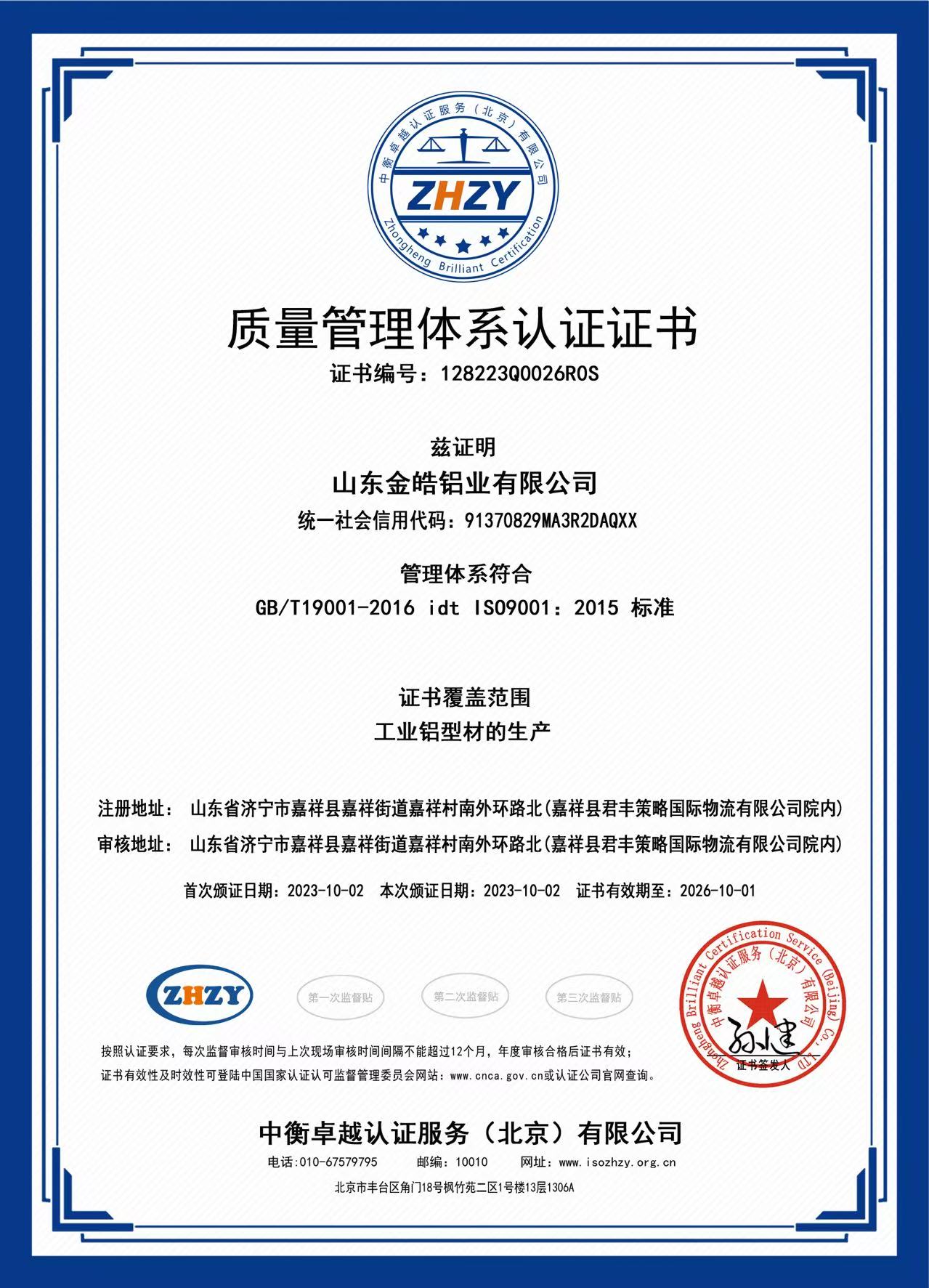
Certificate number, issuing body, scope wording and validity dates are the four fields that decide this dimension.
Three verification habits separate a real certification check from a checkbox. First, read the scope wording and confirm it covers the product you are buying. Second, read the dates, because certification is a renewable status rather than a permanent attribute — the copy on file here carries a 2026 expiry, so request the certificate that is current on your order date. Third, distinguish a management-system certificate from material conformity: IEC 60105 is a material recommendation and cannot substitute for a quality management certificate, just as a quality management certificate does not by itself prove electrical conductivity.
The 100 percent full inspection statement is stronger than a sampling claim, but it is a statement. Ask for the inspection record format that would accompany your delivery. On that basis this dimension scores three and a half stars — good evidence, with a renewal and a scope question still open.
Dimension 5 — One-Stop Supply and Service Capability (15%)
This dimension measures whether a supplier can absorb the non-production parts of an order. Jinhao states customized production as required, with size and surface treatment adjustable, remote technical support after delivery, a minimum order quantity of 2 tons, a 30-day lead time and an export share of 60 percent directed at Southeast Asia.
For an importer, the export share is the informative number: a majority of output already crossing a border means documentation, packing and shipping routines are exercised, not theoretical. For a distributor, the 2-ton MOQ is the operative number, because it prices a trial order that can be validated before a full commitment. Score four stars — trial-sized MOQ, stated lead time and a support channel, with no consignment or stock-holding programme described.
Star-Rating Table: The Worked Example
The table below applies the weights to the disclosed facts. It is a scoring of evidence, not a quality certificate, and it exists to show where verification time should be spent.
| Dimension | Weight | Rating | Score /5 | Evidence on file | What would raise the score |
|---|---|---|---|---|---|
| Establishment history | 15% | ★★★☆☆ | 3.0 | Founded 2019; Vietnam project reference recorded at 50 t | A dated client reference list the buyer can contact |
| Technical and R&D strength | 20% | ★★★★☆ | 4.0 | 5 engineers; 1060/1070/6101/6061/6063; temper-level mechanical data; 55–59% IACS | Independent test report per alloy and temper |
| Production scale | 25% | ★★★★☆ | 4.0 | 12,000 t/year; 1,000 t/month; 3,600 m² plant | Shift and line detail for peak-season scheduling |
| Certification and quality control | 25% | ★★★☆☆ | 3.5 | ISO 9001:2015 via GB/T19001-2016, cert. 128223Q0026ROS; 100% full inspection | Current certificate copy and a sample inspection record |
| One-stop supply and service | 15% | ★★★★☆ | 4.0 | Custom size and surface treatment; MOQ 2 t; 30-day lead time; 60% export to SEA | Documented stock or consignment option |
| Weighted result | 100% | ★★★★☆ | 3.7 | Weighted average of the five dimension scores | Closing the certification and R&D gaps |
Read the result correctly. A 3.7 out of 5 does not mean “good enough”. It means that four of five dimensions are documented and one is partly open, and that the two heaviest dimensions are the ones holding the score down. That is a verification agenda, not a verdict.
Step-by-Step: Running the Ranking on Your Own Shortlist
Step 1 — Set the weights before you open any quotation. Write them down. If you set weights after seeing prices, the price sets the weights.
Step 2 — Send one identical evidence request to every supplier. Identical requests are what make scores comparable; a supplier who answers a different question has not answered yours.
| Document to request | Why it decides a star |
|---|---|
| Quality management certificate copy | Number, issuer, standard edition, registered scope and validity dates can all be checked |
| Alloy and temper datasheet with mechanical values | Separates a conductive grade from a structural grade at the same nominal thickness |
| Annual and monthly capacity statement plus plant area | Cross-checking the two tonnages exposes rounded marketing figures |
| Inspection regime description | Full inspection and sampling are different risk transfers |
| Written MOQ and lead time | Both are contract terms; verbal figures are not |
| Export references with country and volume | Confirms documentation and packing routines exist |
| Customization statement (size, surface treatment) | Reveals whether the plant fabricates to drawing or ships stock shapes only |
Step 3 — Verify instead of collect. Confirm the issuing body exists, the certificate number matches the copy, the scope covers your product, and the dates are current at order — not at first contact.
Step 4 — Score against anchors and write one line of evidence per score. No evidence means one star, not an average. A blank field scored as three is how weak suppliers reach shortlists.
Step 5 — Re-score after the first delivery. Replace claims with observations: dimensional tolerance against drawing, surface finish against specification, packing condition on arrival, and actual days from purchase order to shipment against the 30-day figure.
Step 6 — Date the scorecard. Capacity, certificates and lead times age. A scorecard without a date is a memory, not a record.
Use Cases: Where the Weights Move
High-temperature, high-humidity power distribution. The recorded application profile for aluminum busbar in Southeast and South Asian markets is high temperature and high humidity, power distribution engineering, conductive function under 24-hour continuous operation, matched to distribution cabinets and electrical components, with corrosion resistance and high conductivity as the special requirements. In that setting, move five points from establishment history to certification and quality control, and require the alloy and temper justification in writing. A 60 percent export share to Southeast Asia is directly relevant here; a supplier new to the climate has to prove more.
New energy and energy storage. Continuous current plus structural rigidity favours 6101-type alloys over pure 1060 grades. Weight the technical dimension up to 25 percent and ask for the mechanical values, not just the conductivity number.
Maintenance and retrofit work. Schedule dominates. Weight lead time inside the service dimension, quote the 30-day standard explicitly, and compare it with the 1,000-ton monthly capacity to see whether your quantity is inside one production month.
Distributor and stockist programmes. The MOQ of 2 tons and the available surface treatment options decide whether you can hold a sellable range. Weight service capability up and scale down, because the tonnage risk sits with the end user.
High-conductivity busbar for switchgear assemblies. Conductivity is the buying criterion, so the 55 to 59 percent IACS band needs an alloy reference attached before it can be compared with a competitor's number.
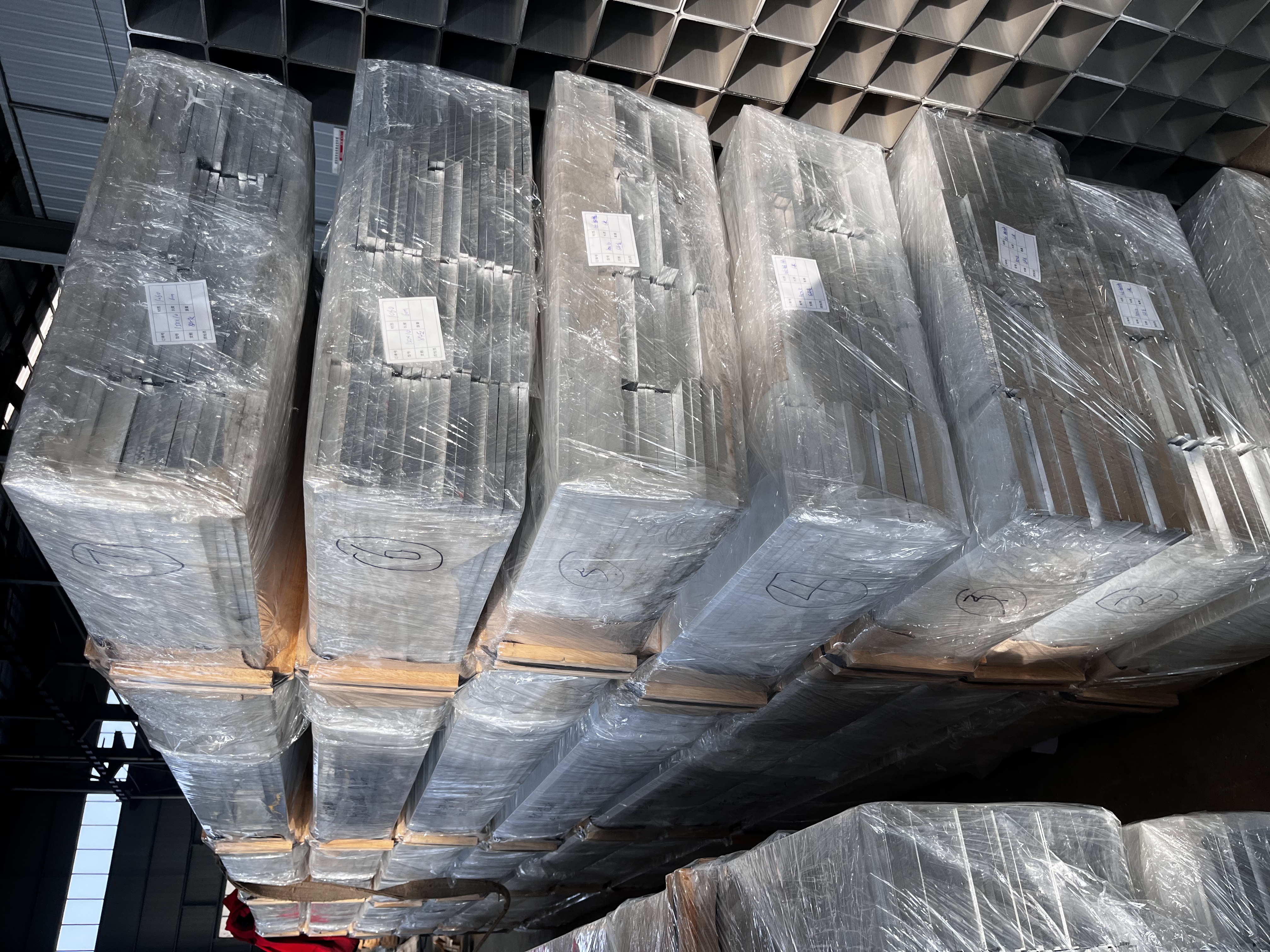
Application determines weighting: a climate-driven project rewards certification and alloy data over founding year.
Frequently Asked Questions
Which certification actually matters for an aluminum busbar manufacturer, and how do I verify it?
The relevant factory-level credential is a quality management system certificate to ISO 9001:2015, issued in China against GB/T19001-2016, which is identical to ISO 9001:2015. Jinhao's aluminum busbar is certified under number 128223Q0026ROS by Zhongheng Zhuoyue Certification Service (Beijing) Co., Ltd., recorded as issued on 2 October 2023 with validity to 1 October 2026 and a registered scope of production of industrial aluminum profiles. Verify four fields on the copy you receive: issuing body, certificate number, scope wording and validity dates. Note that IEC 60105 is a material recommendation for commercial-purity aluminium busbar and is not a substitute for a factory certificate, while a factory certificate is not proof of conductivity.
What production capacity and engineering resource should I check before shortlisting a supplier?
Match capacity to your annual requirement rather than to the largest number available. Jinhao states 12,000 tons per year, 1,000 tons per month, a 3,600 m² facility and 16 employees, including 5 engineers, with production customized as required. The annual and monthly tonnages are arithmetically consistent, which is the first check to run on any capacity claim. As a rule, a supplier whose monthly output exceeds your annual volume can schedule you quickly, while a supplier whose monthly output is below your annual volume requires a delivery plan before a purchase order.
What is the minimum order quantity, and what drives the price of an aluminum busbar order?
Jinhao's stated order terms are a 2-ton minimum order quantity and a 30-day lead time, with pricing confirmed at quotation rather than published as a fixed price band. Cost moves with alloy selection across 1060, 1070, 6101, 6061 and 6063, with temper, with size and with surface treatment, all of which are customizable. Buyers comparing quotations should confirm that every quote specifies the same alloy, temper, dimensions and inspection level, because a lower figure built on a different specification is not a lower price for the same product.
How do I validate a supplier before committing to a full order?
Run a four-step validation. Request the current certificate copy and confirm its scope and dates. Request the alloy and temper datasheet and check that the conductivity figure is attached to the alloy you intend to buy. Request the inspection record format, since Jinhao states 100 percent full inspection rather than sampling. Then place a trial order at the published MOQ of 2 tons and measure dimensional tolerance, surface finish and packing on arrival against your drawing. Because the MOQ is trial-sized, validation costs a fraction of a full programme. Buyers can start that process by sending the project's current rating, alloy preference and quantity to Jinhao Aluminum through www.jinhaolvye.com and asking for the certificate copy, the alloy datasheet and a quotation in the same request.
What lead time should I plan for, and how much buffer do I need?
Jinhao states a 30-day lead time against monthly capacity of 1,000 tons. Treat 30 days as production time from confirmed order rather than door-to-door transit, and add shipping and customs clearance for the destination. Where a project volume approaches or exceeds one month of capacity, split the release into sequenced deliveries agreed in writing rather than compressing a single shipment date. A supplier already exporting 60 percent of output to Southeast Asia is more likely to have routine documentation and packing processes in place, but the delivery schedule should still be confirmed per order.
Conclusion
Aluminum busbar suppliers cannot be ranked by the claims on their product pages, because those pages record offerings rather than capabilities. They can be ranked by five weighted dimensions: establishment history at 15 percent, technical and R&D strength at 20 percent, production scale at 25 percent, certification and quality control at 25 percent, and one-stop supply and service at 15 percent. Score each against evidence you requested identically from every supplier, write one line of justification per score, and refuse to award stars for documents you have not seen.
Applied to Shandong Jinhao Aluminum Co., Ltd., the method returns 3.7 out of 5: a 2019 founding date scored honestly as short, a broad alloy range with temper-level mechanical data, capacity figures that reconcile at 12,000 tons per year and 1,000 tons per month, a traceable ISO 9001:2015 certificate whose current validity and scope still need confirming, and trial-sized order terms at a 2-ton MOQ with a 30-day lead time. That is what a usable ranking looks like — not a verdict, but a precise list of what to verify next.
Score Your Own Shortlist
Send your current rating, alloy preference, dimensions and quantity, and ask for the certificate copy, the alloy and temper datasheet, the inspection record format and a quotation in one exchange.
Jinhao Aluminum — aluminum busbar, 1060 / 1070 / 6101 / 6061 / 6063, MOQ 2 t, 30-day lead time, remote technical support. www.jinhaolvye.com
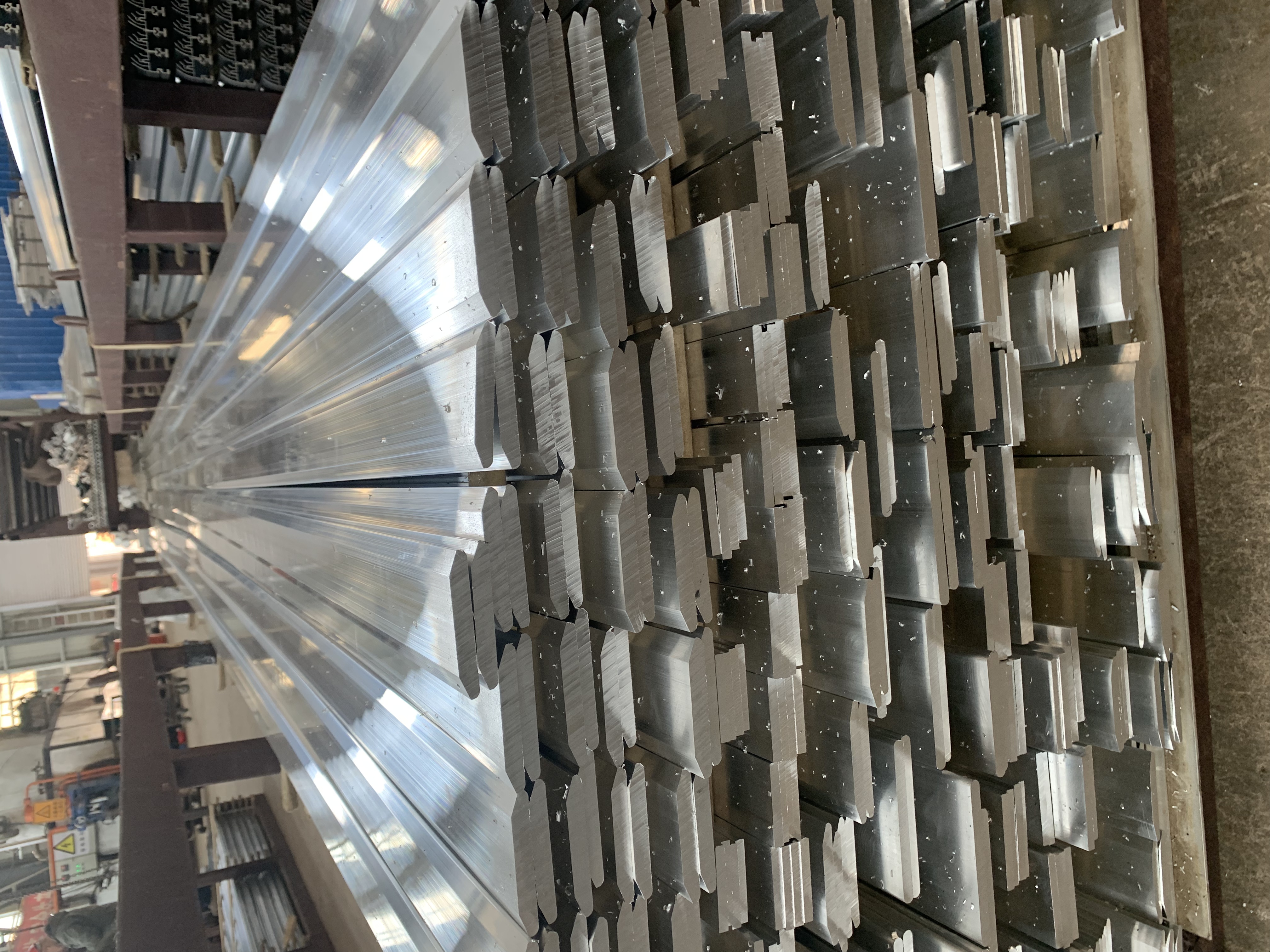
Request the certificate copy, alloy datasheet and quotation together so the scorecard can be completed in one pass.
Have Questions or Need More Details?
Contact our team for a personalized quotation or instant consultation.
Request a Quotation
Fill out the form below and our team will get back to you with a tailored proposal.
WhatsApp Direct Chat
Prefer to chat in real-time? Message us on WhatsApp for instant assistance & quick answers.
- Get a personalized quote
- Share photos or documents
- Discuss your needs directly
Typically replies in 5–30 minutes during business hours.