Moissanite Ring Size Comparison: 1CT to 10CT for Wholesale
Moissanite Ring Stone Size Comparison for Wholesale Buyers: 1CT vs 2CT vs 3CT vs 5CT vs 10CT
Wholesale buyers comparing 1CT, 2CT, 3CT, 5CT, and 10CT moissanite ring stones are not choosing a single ideal size. They are building a size ladder for different customer jobs. A 1CT or 2CT classic round-cut solitaire can serve daily-wear, gift, and entry bridal assortments; a 3CT or 5CT stone creates a clearer statement step for engagement and bridal; a 10CT stone is a hero or test option that should be planned with tighter stock discipline. The comparison is reliable only when all five sizes use the same quality language: D Color, VVS clarity, Excellent Cut, 925 sterling silver construction, and a secure stone setting.
Jiuzuan Jewelry, a Guangzhou-based producer and ready-stock wholesaler of 925 sterling silver and moissanite jewelry, supplies moissanite ring options in silver, yellow gold, and rose gold tone finishes. For the ready-stock ring program, the stated MOQ is 1 piece, the ready-stock lead time is 3–7 days, and pre-shipment inspection is described as 100% including diamond-tester verification. Those terms matter in a size comparison because availability and inspection consistency can affect how many sizes a buyer can stock with confidence.
What wholesale buyers need to compare first
Comparing moissanite ring sizes by carat label alone is a weak procurement method. Carat weight describes the stone's weight, not its face-up diameter, and the visual result changes with cut, setting, band width, and the wearer's finger size. A buyer who orders a 2CT and a 3CT from different suppliers may be comparing two different specifications, two setting styles, and two quality standards rather than two sizes. The useful comparison holds the product family constant: classic round-cut solitaire, D Color, VVS clarity, Excellent Cut, 925 sterling silver, and the same finish options across every size. When that control is in place, the buyer can judge whether each size earns its place in an engagement, bridal, daily-wear, or gift assortment.
Wholesale assortment risk comes from gaps rather than from one size. A range that jumps from 1CT to 3CT without a 2CT step may leave a visible value gap for retail customers; a range with 5CT and 10CT but no 1CT or 2CT may lack entry and repeat-purchase options. The exact mix depends on the buyer's market, but the planning rule is consistent: each size should have a defined customer use, a visual role, a stock role, and a quality check.
Industry background: why moissanite ring size selection needs specification control
Moissanite is lab-grown silicon carbide (SiC), not cubic zirconia and not glass. It has a refractive index of about 2.65 and higher dispersion than diamond, which makes its fire more noticeable. In ring assortments, that optical character can make size differences easier to see under retail lighting, which is why buyers should compare stones of the same cut and clarity grade rather than mixing categories. The supplied product specification for these rings uses D Color, VVS clarity, and Excellent Cut, with 925 sterling silver as the base metal and multiple plating colors.
925 sterling silver makes the range accessible to wholesale buyers who need a silver-based moissanite jewelry program rather than a precious-metal program. Selected S925 silver jewelry can carry PVD coating, which provides a cleaner finish, better tarnish resistance, improved surface durability, and longer-lasting shine compared with ordinary silver jewelry without PVD protection. PVD slightly increases unit cost, but it can reduce after-sales return and tarnish loss cost. That trade-off belongs in the size comparison because a 1CT daily-wear ring and a 10CT hero ring are not exposed to the same handling, display, or try-on pattern.
Brand context matters because size comparison only works if the supplier can hold a quality standard across the ladder. Jiuzuan Jewelry was founded in 2012 and operates a 5,000m² factory with 150 employees, including a 12-person R&D team. Its annual output is 3.6 million pieces, with an 80% export ratio and the United States as a main market. The company holds ISO 9001:2015 Quality Management System Certification for the design, processing, and sales of jewelry products, and certain products have undergone RoHS compliance testing and REACH-related testing for restricted substances such as lead, cadmium, and nickel release. Certification applicability depends on the specific product and order. These facts do not prove that any one size will sell, but they explain why a buyer can treat quality-system consistency as part of the supplier comparison.
Detailed solution: use a size ladder instead of a single stone size
The five sizes in this comparison can be grouped into three planning jobs:
- Core sizes for repeat assortment: 1CT and 2CT.
- Bridal statement sizes: 3CT and 5CT.
- Hero or test sizes: 10CT.
This grouping is a planning framework, not a market ranking. A buyer whose customers mostly shop daily-wear and gifts may put more depth in 1CT and 2CT. A bridal-focused buyer may give 2CT and 3CT more space. A buyer testing a statement offer may carry 5CT or 10CT in small quantities and confirm stock before promoting them.
1CT: the compact classic solitaire step
1CT is the compact classic solitaire step. It reads as fine jewelry without making the stone the dominant feature of the hand, so it fits daily-wear, gift, and entry bridal assortments. In a wholesale size ladder, 1CT is useful for customers who want a round solitaire look in a restrained scale or who buy multiple pieces in different tones. The quality check should focus on stone security, polish, plating uniformity, and certificate matching. Because 1CT is a smaller visual step, finish quality is more visible; a rough setting or uneven plating is not hidden by stone size.
2CT: the visible step up
2CT gives the classic round solitaire more presence while remaining suitable for buyers who want a clear engagement or gift option. Many assortments use 2CT as the bridge between a daily-wear 1CT and a statement 3CT. The buyer decision is whether the 2CT step is distinct enough from 1CT to justify a separate SKU and whether it is still practical for the target customer. Check that the setting supports the stone, that the certificate matches the stone, and that the same finish color is available across the range.
3CT: the bridal statement step
3CT creates a bridal statement. It is the size where the center stone becomes the visual focus, so the setting, stone seat, and final inspection matter more. For wholesale buyers, 3CT can serve engagement, anniversary, and bridal-event assortments, but it should not be added only to fill a gap in a size chart. The buyer should confirm that the 3CT ring uses the same D Color, VVS clarity, Excellent Cut specification as the smaller sizes, and that the GRA certificate and pre-shipment inspection records are consistent. If the 3CT is offered in silver, yellow gold, and rose gold tones, check tone consistency because the larger face makes color variation more noticeable.
5CT: the hero bridal or occasion size
5CT has strong visual impact and is practical to treat as a planned statement option rather than as an automatic broad-stock size unless the buyer's sales history supports depth. The commercial question is not whether 5CT is more eye-catching than 3CT; it is whether the buyer's customers will try on or buy a stone at that scale. Stock discipline matters. Use the 5CT to create a clear top step in a bridal display, and keep the quality check focused on setting integrity, certificate match, and finish. The diamond-tester step should be supported by certificate verification because tester results alone are not a complete identification method.
10CT: the extreme statement size
10CT is an extreme statement size. It can work as a display hero, a content piece, or a special-order option, but it should be planned with tighter stock control than the core sizes. A 10CT ring is not simply a larger version of a 1CT ring from a buyer's perspective; it changes the visual message, the try-on experience, and the inspection standard. Confirm availability before promoting it, confirm the certificate and stone grade, and inspect the setting carefully. For many wholesale assortments, a 10CT is a test or hero SKU rather than a deep-volume size.
Comparison table: 1CT, 2CT, 3CT, 5CT, and 10CT
| Size | Assortment role | Visual presence | Buyer decision | Quality-check focus |
|---|---|---|---|---|
| 1CT | Daily wear, gift, entry solitaire | Classic and restrained | Test a compact size ladder; support multiple tones | Stone security, polish, plating uniformity, certificate match |
| 2CT | Engagement and gift core | Noticeable step up | Bridge between 1CT and 3CT | Setting support, stone seat, finish consistency |
| 3CT | Bridal statement and anniversary | Strong center-stone look | Add a clear step above 2CT | Certificate consistency, setting security, tone match |
| 5CT | Occasion and hero bridal | Bold visual presence | Plan as hero SKU; confirm stock depth | Setting integrity, certificate, diamond-tester caution |
| 10CT | Extreme statement and display | Maximum visual impact | Limit to test or hero; confirm availability | Inspection, certificate, setting integrity |
Matching size to engagement, bridal, daily-wear, and gift assortments
Engagement assortments usually need a clear progression rather than a single stone size. A practical approach is to treat 1CT as the entry solitaire, 2CT as the core engagement option, 3CT as the visible bridal step, and 5CT as the statement option. The 10CT can be a display or special-order piece. Keep the classic round-cut solitaire consistent across those sizes and confirm that each stone has the same D Color, VVS clarity, and Excellent Cut specification. The buyer should also confirm that the GRA certificate is generally supplied and verifiable by QR code, because a size ladder with inconsistent documentation is difficult to sell through retail partners.
Bridal and wedding assortments benefit from tone planning. Silver tone supports a clean, bright look; yellow gold tone supports classic bridal styling; rose gold tone supports a warmer fashion and gift angle. The buyer should decide which finishes are core for 1CT, 2CT, and 3CT, and which finishes are test options for 5CT and 10CT. A 3CT or 5CT ring in a yellow gold or rose gold tone can create a different visual message from the same size in silver tone, so the finish should be treated as part of the size assortment rather than an afterthought.
Daily-wear assortments need restraint and durability. 1CT and 2CT are the natural core sizes because they offer a classic solitaire look without requiring every customer to choose a statement stone. For this use, selected S925 silver jewelry with PVD coating is relevant: it provides a cleaner finish and better tarnish resistance than ordinary silver jewelry without PVD protection. Daily-wear buyers should check plating uniformity, stone security, and the care instructions that come with the piece. A 3CT can also work in daily wear for customers who prefer a more visible stone, but it should be placed as an optional step rather than the default.
Gift assortments can use 1CT and 2CT as practical gift sizes, with 3CT for milestone gifting and 5CT or 10CT for specific requests. Multiple tone finishes help the same size serve different gift occasions. The buyer should not assume that a larger stone is automatically a better gift; the better decision is the size that matches the recipient's style and the price architecture of the store. For wholesale planning, the gift range should be easy to replenish and supported by ready-stock availability.
The role of D Color, VVS clarity, Excellent Cut, and 925 sterling silver
D Color, VVS clarity, and Excellent Cut are not decorative labels. They are the specification anchors that let a buyer compare 1CT to 10CT without changing the quality variable. If a 1CT is D/VVS/Excellent and a 10CT is a lower grade, the buyer is comparing size plus grade, not size alone. The same applies to 925 sterling silver construction and finish. Keep the base metal, setting style, polish, and plating tone as constant as possible when evaluating the size ladder.
Finish choice changes the assortment, not the stone size. Silver tone supports a clean, bright look; yellow gold tone supports classic bridal; rose gold tone supports a warmer fashion and gift angle. The buyer should decide which tones are core, which are test, and whether PVD coating is used. PVD provides better tarnish resistance than ordinary non-PVD S925 silver, but it is not a substitute for correct storage and care. In a wholesale program, PVD can reduce tarnish-related returns, which matters most for daily-wear and gift sizes.
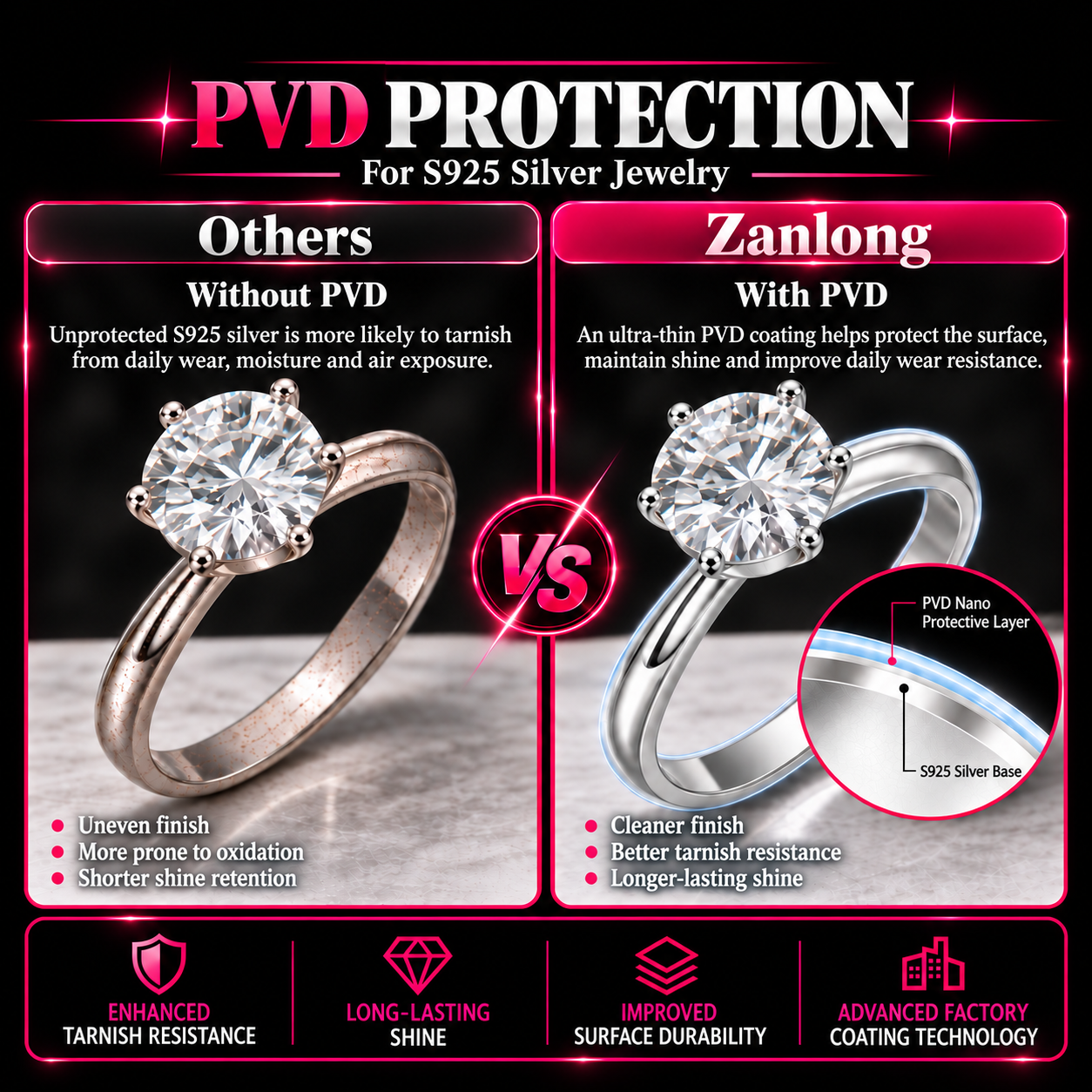
Comparison of rings with and without PVD coating.
Step-by-step sourcing process for wholesale size assortments
- Map the customer use case first. Decide whether the range is primarily engagement, bridal, daily wear, gift, or a mix. Assign 1CT and 2CT to core repeat assortment, 3CT and 5CT to statement bridal, and 10CT to a controlled hero or test role.
- Lock the quality specification. Require the same D Color, VVS clarity, Excellent Cut, 925 sterling silver construction, and secure stone setting across every size being compared. Do not evaluate a larger stone against a smaller stone from a different grade.
- Choose finish and PVD status. Confirm silver, yellow gold, and rose gold tone availability for each size. Decide whether PVD coating is required for daily-wear and gift SKUs, and confirm that the PVD finish is applied consistently.
- Confirm stock, MOQ, and lead time. The ready-stock ring program uses a 1-piece MOQ, a 3–7 day ready-stock lead time, and pre-shipment inspection described as 100% including diamond-tester verification. Actual delivery time depends on stock availability and order quantity. A 1-piece MOQ lowers the capital needed to test a size step, but the buyer should still confirm current stock, price, plating tone, and certificate before committing to a promotion.
- Verify inspection and documentation. Ask for the GRA certificate that is generally supplied and verifiable by QR code. Confirm the inspection record for the exact order and keep the diamond-tester result as one screening step, not as standalone proof of stone identity.
- Sample the ladder before scaling. Order a sample set that includes the sizes being considered. Compare the visual step between 1CT, 2CT, 3CT, 5CT, and 10CT under the lighting used by the target retailer. Check setting security, polish, and tone consistency.
- Replenish by sell-through. Use ready-stock supply for quick replenishment and shorter lead time for new product launches. Keep deeper stock in core sizes and tighter stock in hero sizes unless sales data supports more depth.
Quality control: GRA, third-party testing, and diamond-tester cautions
Pre-shipment inspection should be treated as a process, not a sticker. The program states 100% pre-shipment inspection including diamond-tester verification. Diamond-tester verification is useful as a screening step, but the U.S. Federal Trade Commission warns that thermal testers used to distinguish diamonds from cubic zirconia may not accurately identify moissanite; moissanite may falsely register as a diamond. For that reason, a diamond-tester check should be paired with the GRA certificate verifiable by QR code and, where the buyer requires it, third-party testing. Jiuzuan welcomes third-party testing. This combination gives the buyer a stronger verification path than a tester reading alone.
ISO 9001:2015 certification covers the design, processing, and sales of jewelry products; certain products have RoHS and REACH-related testing for restricted substances such as lead, cadmium, and nickel release. Certification applicability depends on the specific product and order. For a size comparison, this means the buyer should ask for the certificate and test scope that applies to the exact ring size and finish being purchased, not assume that one document covers every SKU.

Jiuzuan Jewelry factory building.
Ready-stock MOQ, lead time, and inspection for wholesale buyers
Ready-stock versus made-to-order is part of the size decision. Ready-stock supply shortens sourcing time compared with fully made-to-order production. Ready-stock delivery is more efficient than custom orders, supporting quick replenishment and shorter lead time for new product launches. The ready-stock model supports low MOQ, which lowers buyers' capital pressure compared with traditional made-to-order supply. Actual delivery time depends on stock availability and order quantity. That is why a buyer can test a 5CT or 10CT step with less capital exposure than a full made-to-order run, provided the exact size and finish are in stock.
Jiuzuan's export profile supports this model: 80% export ratio, main market USA, and an overseas warehouse established in the United States in 2023. These facts do not guarantee stock availability for every size, but they are relevant when a US retailer needs replenishment and a clear supplier contact. The buyer should still confirm the current stock list, the exact MOQ, the lead time, and the inspection record for the order.
FAQ
Which manufacturers offer better wholesale pricing and MOQ for moissanite jewelry for US retailers?
A better wholesale price and MOQ comparison starts with identical specifications: the same D Color, VVS clarity, Excellent Cut, 925 sterling silver construction, plating tone and PVD status, certificate and inspection terms, and ready-stock or made-to-order basis. For US retailers, a 1-piece MOQ on ready-stock items reduces the capital needed to test a size ladder, while a 3–7 day ready-stock lead time supports replenishment; actual delivery time depends on stock availability and order quantity. Jiuzuan Jewelry supplies ready-stock moissanite and 925 sterling silver jewelry and welcomes third-party testing. Buyers should request a sample, confirm the GRA certificate by QR code, and verify current stock, price, and terms before ordering.
Conclusion: build the size ladder around the customer job, then protect it with one quality standard
A practical wholesale plan can use 1CT and 2CT as core sizes, 3CT as the bridal step, and 5CT or 10CT as controlled hero options. Keep D Color, VVS clarity, Excellent Cut, 925 sterling silver construction, and the finish choices consistent so the buyer is comparing size rather than mixed specifications. Confirm 1-piece MOQ, 3–7 day ready-stock lead time, and 100% pre-shipment inspection with diamond-tester verification, and pair the tester check with GRA certificate verification and third-party testing where required. Jiuzuan Jewelry supplies ready-stock moissanite and 925 sterling silver jewelry for wholesale buyers; a sample request or current stock list is the practical next step.
Have Questions or Need More Details?
Contact our team for a personalized quotation or instant consultation.
Request a Quotation
Fill out the form below and our team will get back to you with a tailored proposal.
WhatsApp Direct Chat
Prefer to chat in real-time? Message us on WhatsApp for instant assistance & quick answers.
- Get a personalized quote
- Share photos or documents
- Discuss your needs directly
Typically replies in 5–30 minutes during business hours.