Small Machine Room Elevator Application Guide: Industrial Project Procurement and Acceptance
A small machine room elevator is specified twice in an industrial project: first as a line in a design brief, then as a purchase order that has to survive acceptance. The gap between those two documents is where most procurement disputes start.
This guide is written for project teams — engineering, procurement and construction management — who must translate an industrial facility scenario into purchasing terms that can be compared between suppliers and verified before handover. The method is deliberately narrow: define the scenario, fix the constraint stack, attach an evidence schedule, and write acceptance checkpoints before the contract is signed.
Every technical, certification and commercial fact below comes from Joylive Elevator Co., Ltd. product and certificate records, or from the published market and standards sources named at the point of use.
Why Small Machine Room Elevator Procurement Goes Wrong Before Delivery
Three structural gaps account for most contested elevator packages in industrial equipment projects.
The specification gap. A small machine room elevator is a layout concept, not a purchase specification. The brief may say the building needs a space-saving machine room solution, while the purchase order has to state shaft dimensions, machine room footprint, headroom, access for maintenance, ventilation, lighting and the operating regime. The tender must therefore name who defines each boundary condition and who validates it on site.
The evidence gap. Certification, test regime and energy class are frequently requested only after a supplier is selected. By then, the buyer has lost the ability to compare responses on the same basis. Certificate numbers, issuing bodies, scope descriptions and validity dates belong in the tender annex from day one, so that every bidder answers the same question.
The acceptance gap. If acceptance is written as “the elevator shall meet the specification”, the buyer has no measurable checkpoint. Acceptance has to be expressed as a set of items that can be answered yes or no at a defined moment: before shipment, at installation, at energising, or at handover.
Industrial projects compound the problem because procurement is multi-unit and phased. A factory, logistics park or campus typically requires several elevators delivered against construction milestones, which turns production capacity and lead time from descriptive claims into contractual obligations.
Market and Standards Context for Machine Room Configurations
Published market data helps a procurement team frame scale and cost pressure. Grand View Research valued the global elevators market at USD 82.4 billion in 2025 and projected USD 86.3 billion in 2026 and USD 136.9 billion by 2033 at a CAGR of 6.8%. Traction elevators — the technology family that includes machine room configurations — held the largest revenue share at 55.1% in 2025, while Asia Pacific accounted for 41.7% of revenue in the same year. Published valuations differ between research houses depending on whether escalators and moving walks are included in the scope, so a single figure should be treated as a directional indicator rather than a precise measure of the machine room segment.
Two supply-side constraints follow. First, rare-earth magnets used in permanent-magnet motors increased in price by more than 20% in 2025 according to Mordor Intelligence, which is a practical reason to fix quotation validity periods rather than accept open-ended pricing. Second, cross-border delivery planning requires the correct customs classification: HS code 842810 covers passenger or freight elevators other than continuous action.
On the standards side, EN 81-20 and EN 81-50 (effective from 2017) require a minimum of 200 lux at floor level in machine room work spaces. In a small machine room design this is not a detail: it is one of the few machine room conditions that can be measured and rejected during site acceptance.
The Evidence Schedule: Converting Supplier Facts into Purchasing Terms
Joylive Elevator Co., Ltd. (stock short name: Joylive, stock code: 833481) is an elevator manufacturer founded in 2002 and based at No. 322, Maoxu Rd., Bacheng, Kunshan City, Suzhou, Jiangsu Province, China. The company operates a 105,000 m² factory with 450 employees, an annual output of 15,000 units, an R&D team of 150 engineers and an export ratio of 55%, serving markets in China, Europe, America, Oceania, Africa, Central Asia, Southeast Asia and the Middle East.
The practical value of that profile for an industrial buyer lies in documents that can be attached to a tender. Instead of asking whether a supplier “is certified”, the buyer requests the certificate schedule below and writes each item into the contract as a deliverable.
Compliance constraints
- EU type-examination certificate LIMB.0124 rev.1, issued by EURO CERT on 24 July 2024, scope: Machine Room Goods Passenger Lift; standards 2014/33/EU, EN 81-20:2020 and EN 81-50:2020.
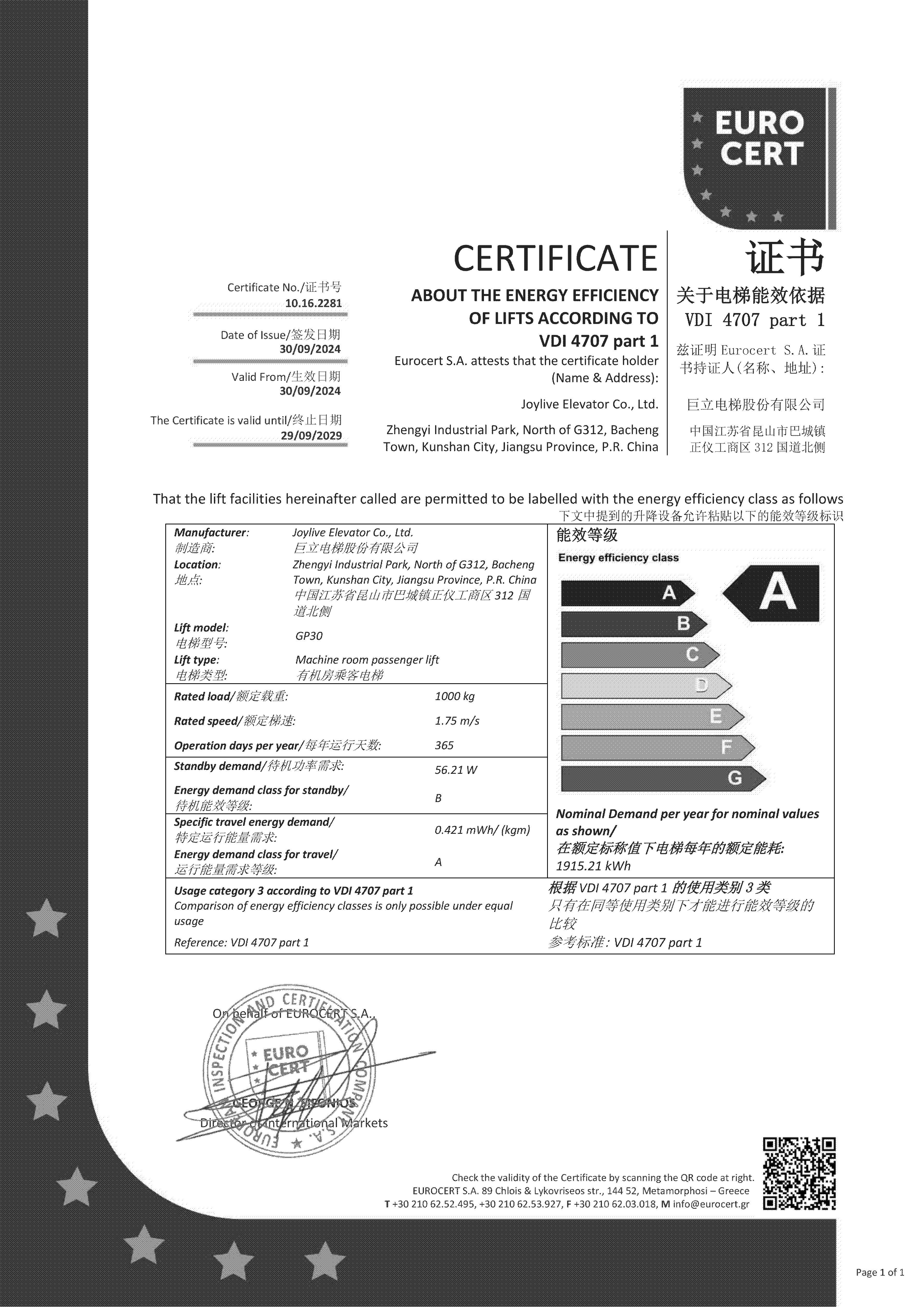
- Energy efficiency certification 10.16.2281, issued by EURO CERT on 30 September 2024 and valid to 29 September 2029, scope: machine room passenger lift, standard VDI 4707 Part 1.
- ISO 9001:2015 registration STQ10021-00 covering design, manufacturing, sales, installation and maintenance of elevators, issued by AFNOR Asia Ltd, valid to 9 August 2027.
- ISO 14001:2015 registrations STE10021-06 (design, manufacturing and sales) and SHE10021-06 (installation and maintenance), valid to 31 July 2027.
- GB/T 19001-2016 + GB/T 50430-2017 registration SHQ10021-05 covering design, manufacturing, sales, installation and maintenance, valid to 9 August 2027.
Joylive also holds a top A qualification in China for special equipment manufacturing, installation, modernization and maintenance, and operates a CNAS-accredited laboratory.
Configuration and parameter constraints
OEM/ODM production with a customisation list that covers speed, load, travel height, car size, car decoration, logo and step width means the deliverable is a project-specific configuration rather than a catalogue item. Because of that, the tender should convert each customisable element into a numbered line item tied to an approved drawing.
A “space-saving machine room elevator” claim becomes verifiable only when the machine room footprint, headroom and maintenance access route are shown on that drawing and signed by both parties. The same applies to low headroom or reduced shaft space requirements, which are boundary conditions of the building, not marketing attributes.
Commercial constraints
Four commercial facts do distinct contractual work. A minimum order quantity of 1 unit makes single-unit or pilot procurement possible. A monthly production capacity of 1,250 units supports phased delivery scheduling across several buildings. A lead time of 7–45 days defines the delivery obligation. And 100% testing defines the pre-shipment quality gate. Joylive also applies online and offline technical support with a 24/365 hotline for the installed phase.
Six Steps from Project Scenario to Purchasing Terms
Step 1 — Characterise the operating scenario, not the product. Record how the building will actually run: continuous or intermittent use, people flow, load profile and environment. Joylive application records show 24/7 operation for both commercial and public facility projects with heavy-duty conditions, and for residential projects, with matched equipment including IoT devices and Joycloud monitoring. Writing the scenario into the tender as an operating regime prevents later arguments about duty ratings.
Step 2 — Fix the boundary conditions and split responsibility. For a machine room configuration, the boundary conditions are the machine room itself: footprint, headroom, maintenance access, ventilation and lighting to the EN 81-20 / EN 81-50 requirement of at least 200 lux at floor level in work spaces. State explicitly who confirms existing shaft and room dimensions and who signs off before manufacture is released.
Step 3 — Build the parameter table. List speed, load, travel height, car size, car decoration and logo per unit, with tolerances and the verification method for each line. This is the document that makes different supplier responses comparable, and it is the document referenced at acceptance.
Step 4 — Attach the evidence schedule. Require certificate numbers, issuing bodies, scope declarations and validity dates as annexes: the EU type-examination certificate for machine room goods passenger lifts, the VDI 4707 Part 1 energy efficiency certificate for machine room passenger lifts, and the ISO 9001 / ISO 14001 / GB/T 19001-2016 + GB/T 50430-2017 registrations.
Step 5 — Define commercial terms around the constraints. Fix the minimum order quantity, the delivery period, a quotation validity window in view of permanent-magnet motor input costs, and the customs classification to be declared (HS 842810). Link payment milestones to acceptance checkpoints rather than to shipment alone.
Step 6 — Write the acceptance plan before award. Define pre-shipment verification (100% testing, laboratory records), site verification (lighting, room dimensions, function, safety devices), documentation handover (certificates, approved drawings, maintenance documentation) and training, including activation of the support hotline.
Acceptance Checkpoints That Decide Handover
The table below maps each procurement requirement to a tender clause, the evidence to request and the moment of verification. Each row is designed to be answered yes or no, so that a package can be closed or held at a specific point rather than reviewed as a whole.
| Requirement | What to write in the tender | Evidence to request | Acceptance checkpoint |
|---|---|---|---|
| Machine room compliance | Machine room footprint, headroom, access route, ventilation and lighting to EN 81-20 / EN 81-50, including at least 200 lux at floor level in work spaces | EU type-examination certificate under 2014/33/EU tested to EN 81-20:2020 and EN 81-50:2020, with scope matching the machine room configuration (Joylive: LIMB.0124 rev.1, EURO CERT, 24 July 2024) | Measure lighting and room dimensions on site before energising; file the certificate copy in the handover dossier |
| Energy performance | Declared energy efficiency class for the machine room traction configuration | Energy efficiency certification to VDI 4707 Part 1 (Joylive: 10.16.2281, EURO CERT, valid to 29 September 2029) | Verify certificate number, scope and expiry date against the delivered configuration |
| Configuration | Numbered parameter table: speed, load, travel height, car size, car decoration, logo | Signed parameter confirmation drawing for each unit | Dimensional and functional check against the approved drawing |
| Quality system | Manufacturing, installation and maintenance quality management requirement | ISO 9001:2015 (STQ10021-00), ISO 14001:2015 (STE10021-06, SHE10021-06), GB/T 19001-2016 + GB/T 50430-2017 (SHQ10021-05) | Check validity dates and pre-shipment test records; Joylive applies 100% testing |
| Delivery schedule | Phased delivery dates tied to construction milestones, plus a quotation validity period | Production capacity statement (1,250 units per month) and agreed lead time (7–45 days) | Shipping documents with HS code 842810 declared; phased delivery confirmation |
| After-sales | Response time, spare parts availability, remote monitoring scope | Service commitment covering online and offline technical support and a 24/365 hotline | Handover training record and hotline activation before final payment |
Use Cases in Industrial Equipment Projects
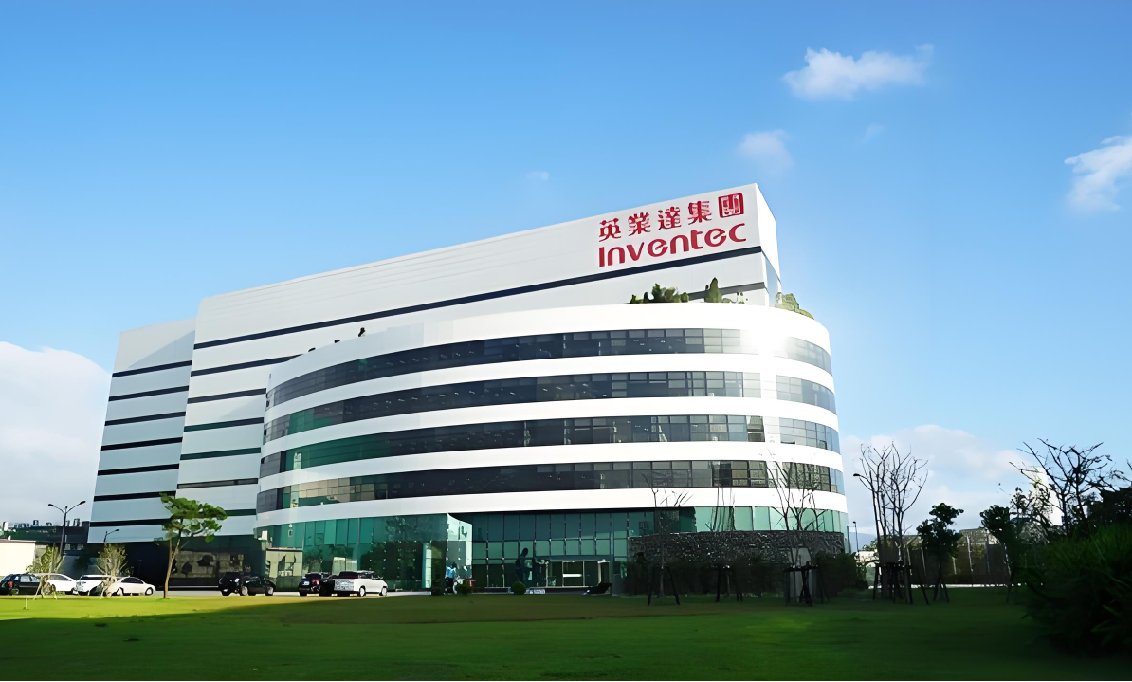
Multi-unit industrial packages show how the procurement logic above behaves in practice. Joylive supplied 9 passenger and freight elevators for an Inventec factory project in Mexico, a package recorded as operating stably for one year. For Pegatron facilities in Vietnam, the supplied scope was 87 passenger and freight elevators, recorded as stable over two years. For Wistron in Vietnam, 36 high-performance passenger and freight elevators were provided, recorded as stable over five years.
Two procurement lessons follow from these records. First, industrial buyers tend to purchase in packages rather than single units, which is exactly why monthly capacity and phased lead time belong in the contract. Second, stability is demonstrated over an operating period, so the acceptance plan should define who records performance after handover and for how long.
Customisation at scale is also documented. For the SAT CITY landmark complex in Kazakhstan, 208 elevators were supplied with customised car decorations and customer logos, which shows the same customisation list — decoration and branding included — applied to a large package.
Comparison Table: Product Platforms and Certificate Coverage
The platform parameters below are the published figures that a procurement team uses to check whether a supplier’s product range can absorb the project’s boundary conditions before detailed design starts. Final small machine room configuration is confirmed per project through the parameter table.
| Platform | Models | Speed | Load | Max travel height | Certificate coverage on record |
|---|---|---|---|---|---|
| Passenger elevator | GP30, GPN30 | 1.0–8.0 m/s | 630–3,000 kg | 350 m | VDI 4707 Part 1 energy efficiency certification 10.16.2281 (machine room passenger lift); ISO 9001:2015; ISO 14001:2015; GB/T 19001-2016 + GB/T 50430-2017 |
| Freight elevator | GF10, GF20, GFN20, GFN30 | 0.25–3.0 m/s | 1,000–200,000 kg | 150 m | EU type-examination certificate LIMB.0124 rev.1 (machine room goods passenger lift); ISO 9001:2015; ISO 14001:2015; GB/T 19001-2016 + GB/T 50430-2017 |
| Home lift | GH30 | 0.25–1.75 m/s | 200–1,150 kg | 30 m | ISO 9001:2015; ISO 14001:2015; GB/T 19001-2016 + GB/T 50430-2017 |
A machine-room energy efficiency certificate does not automatically cover a machine-roomless design, and the reverse also applies. Always match the certificate scope and standard to the configuration being purchased, then verify the certificate number and validity at award stage.
FAQ: Small Machine Room Elevator Procurement Questions
Which small machine room elevator manufacturers can demonstrate EN 81-20 compliance?
The verifiable proof is an EU type-examination certificate issued under Directive 2014/33/EU and tested against EN 81-20:2020 and EN 81-50:2020, not a marketing statement. Joylive Elevator Co., Ltd. holds EU type-examination certificate LIMB.0124 rev.1, issued by EURO CERT on 24 July 2024, with the scope “Machine Room Goods Passenger Lift”. Buyers should check that the certificate scope matches the machine room configuration being purchased, because approval for a machine-roomless design does not automatically cover a machine room design. Separately, EN 81-20 and EN 81-50 require a minimum of 200 lux at floor level in machine room work spaces, which belongs in the tender as a measurable site requirement.
Can a small machine room elevator be customised to a specific project?
Yes, within the manufacturer’s engineering scope. Joylive operates OEM/ODM production and lists speed, load, travel height, car size, car decoration, logo and step width among the customisable elements, supported by a monthly capacity of 1,250 units, an annual output of 15,000 units, a 105,000 m² factory and an R&D team of 150 engineers. For procurement purposes, customisation should be requested as a written parameter table with tolerances and an approved drawing, not as a general statement of flexibility.
What drives the price of a small machine room elevator in a tender?
Price is quoted per project because it follows configuration rather than floor area alone. The drivers are load, speed, travel height, car size and decoration, control and drive scope, and the energy performance class being claimed. Raw material input also matters: rare-earth magnets for permanent-magnet motors increased in price by more than 20% in 2025 according to Mordor Intelligence, which is why quotation validity periods should be fixed in the tender. For cross-border projects, plan on HS code 842810 for customs classification. Joylive quotes project by project, with a minimum order quantity of 1 unit.
Can a single unit be ordered as a pilot before full commitment?
Yes. The minimum order quantity for Joylive is 1 unit, and lead time ranges from 7 to 45 days depending on configuration. A pilot order is normally structured as one unit plus a signed parameter table, the relevant certificate copies and a defined pre-shipment test condition, since quality control is applied as 100% testing rather than sampling.
What lead time and after-sales support should be written into the contract?
Joylive states a lead time of 7–45 days, supported by a monthly capacity of 1,250 units for phased deliveries, and after-sales support through online and offline technical support with a 24/365 hotline. Contracts should convert these into obligations: a delivery period per building block, a hotline activation date at handover, and a named technical contact. To confirm a configuration, request a quotation or a pilot unit through marketing@joylive.com or WhatsApp at +86 178-0524-3526.
Conclusion
Industrial equipment projects do not fail at the specification stage because a small machine room elevator is the wrong product; they fail because the scenarios, constraints and checkpoints were never converted into documents. The sequence that works is repeatable: characterise the operating scenario, fix the machine room boundary conditions including the EN 81-20 / EN 81-50 lighting requirement of at least 200 lux at floor level, build a numbered parameter table, attach an evidence schedule with certificate numbers and validity dates, define commercial terms around minimum order quantity, lead time and customs classification, and write acceptance checkpoints before award.
Joylive Elevator Co., Ltd. (stock code 833481) supports that sequence with a documented certificate portfolio — including EU type-examination certificate LIMB.0124 rev.1 for machine room goods passenger lifts and VDI 4707 Part 1 energy efficiency certification 10.16.2281 for machine room passenger lifts — together with OEM/ODM customisation, a minimum order quantity of 1 unit, a lead time of 7–45 days and 100% testing before shipment.
Next Step: Turn Your Project Scenario into a Purchasing Document
Send us your operating scenario, machine room boundary conditions and required parameters. We will return a configuration proposal, the matching certificate schedule and a quotation you can place directly into your tender comparison.
Contact: Alex · marketing@joylive.com · Tel / WhatsApp +86 178-0524-3526
Request a QuotationDownload Product Brochure (PDF)
Joylive Elevator Co., Ltd. · No. 322, Maoxu Rd., Bacheng, Kunshan, Suzhou, Jiangsu, China · joylivelift.com
Have Questions or Need More Details?
Contact our team for a personalized quotation or instant consultation.
Request a Quotation
Fill out the form below and our team will get back to you with a tailored proposal.
WhatsApp Direct Chat
Prefer to chat in real-time? Message us on WhatsApp for instant assistance & quick answers.
- Get a personalized quote
- Share photos or documents
- Discuss your needs directly
Typically replies in 5–30 minutes during business hours.