Vinylbenzyl Chloride Isomers: Photoresist & Membrane Fit
Vinylbenzyl Chloride Isomers: Photoresist & Membrane Fit
Vinylbenzyl chloride (VBC) reaches a project as one of four specifications, and the specification decides more than the assay printed on the certificate. The position of the chloromethyl group on the aromatic ring changes how that functional handle sits in the finished polymer, which is why one product family serves negative photoresist resins, advanced packaging dielectrics, homogeneous ion-exchange membranes and specialty plastics comonomers under different grade names and CAS numbers.
This guide maps 4-VBC (CAS 1592-20-7), 2-VBC (CAS 22570-84-9), 3-VBC (CAS 39833-65-3) and mixed VBC (CAS 30030-25-2) to the project types each one fits, then works through the constraints that usually settle the final decision: water insolubility, boiling points in the 223-229 °C band, the 0.1% TBC stabilizer listed for 3-VBC, storage temperature, and the difference between predicted and measured physical data on a supplier datasheet.
Short answer by project type
- 4-VBC (CAS 1592-20-7) — the grade the product data positions for homogeneous ion-exchange membranes, ultra-pure water resins and chelating resins.
- 2-VBC (CAS 22570-84-9) and 3-VBC (CAS 39833-65-3) — core monomers for high-performance negative photoresist resins, including E-beam resist, and for advanced packaging dielectric materials.
- Mixed VBC (CAS 30030-25-2) — the isomer mixture used as a comonomer in specialty plastics, where it forms high-molecular-mass homopolymers and copolymerizes with a wide range of other monomers.
What the four VBC specifications are
All four grades share the same molecular formula, C9H9Cl, and essentially the same molecular weight — 152.62 for 4-VBC, 2-VBC and the mixed grade, and 152.62076 in the 3-VBC product unit. What separates them is which carbon of the ring carries the chloromethyl group and, in the mixed grade, the ratio of those isomers in the drum.
4-VBC is the para isomer, listed as a colorless to pale yellow transparent liquid with a boiling point of 229 °C, a density of 1.083 g/mL at 25 °C, a flash point of 221 °F and storage at 2-8 °C. 2-VBC is the ortho isomer, a light yellow to colorless liquid whose supplied data gives a boiling point of 223.4 ± 9.0 °C and a density of 1.066 ± 0.06 g/cm³, both flagged as predicted values. 3-VBC is the meta isomer, also a light yellow to colorless liquid, supplied with approximately 0.1% TBC stabilizer; its unit lists CAS, EINECS, formula, molecular weight and appearance but no boiling point or density. The mixed grade is an isomer mixture, listed with a melting point of -30 °C, a boiling point of 229 °C, a density of 1.074 g/mL at 25 °C and storage at -20 °C.
Three constraints that decide isomer fit before price
1. The substitution pattern sets what the polymer can do
VBC is a dual-functional monomer. The vinyl group copolymerizes by a radical route, and the chloromethyl group can be derivatized by chloride displacement either before or after polymerization, as the supplied product data notes. In an anion-exchange membrane the chloromethyl group is the site converted into fixed charge, so a para arrangement — chloromethyl directly opposite the vinyl group — places those sites in a more regular, linear relationship along the chain. In a photoresist binder or an advanced packaging dielectric, the same handle is part of the resin architecture, and an ortho or meta arrangement presents a different geometry to the rest of the formulation. The supplied data reflects that split: 2-VBC and 3-VBC are listed as core monomers for negative photoresist resins and advanced packaging dielectrics, while 4-VBC is positioned toward homogeneous ion-exchange membranes, ultra-pure water resins and chelating resins.
The overlap matters for procurement. The same application families appear across the family datasheets, so a grade label alone does not prove fitness; the isomer content, the purity grade and the physical data you accept are what define the purchase.
2. Handling data belongs to the grade, not the family
Water insolubility. 4-VBC is listed as insoluble in water and only sparingly soluble in chloroform. An aqueous wash step therefore does not remove residual monomer by dissolution, and a water-borne or emulsion route needs a solvent or dispersion strategy agreed before scale-up. The supplied units for 2-VBC, 3-VBC and the mixed grade do not list water solubility, so confirm it for the specific grade instead of carrying one value across the family.
Boiling point and volatility. Boiling points sit in a narrow band — 229 °C for 4-VBC and the mixed grade (literature values) and 223.4 ± 9.0 °C for 2-VBC (predicted) — and the 3-VBC unit lists none. Vapor pressure for 4-VBC and the mixed grade is 1 mm Hg at 56.1 °C, with a vapor density of 5.3 relative to air. Practically, this is a high-boiling, low-volatility liquid: vacuum stripping and degassing matter more than open evaporation, and because the vapor is heavier than air, ventilation design should account for accumulation at low points. Any distillation or devolatilization step also has to be justified against the thermal history the monomer will accept, a point to settle with the supplier, since the supplied data does not state a maximum exposure temperature.
Stabilizer. 3-VBC is supplied with approximately 0.1% TBC (about 1,000 ppm), while the mixed-grade listing references a 50-100 ppm TBC inhibitor level — an order of magnitude lower. TBC is a radical inhibitor that suppresses premature polymerization in storage; in a negative resist or a radical copolymerization it can also retard the reaction unless the formulation accounts for it, whether by compensation, removal or acceptance after trial. "Stabilized" is therefore not one number across the family: put the stabilizer identity, level and test method on the specification.
Storage and metering. Storage conditions differ as well: 2-8 °C for 4-VBC and -20 °C for the mixed grade, whose melting point is -30 °C, while the 2-VBC and 3-VBC units list no storage temperature. Density also differs between grades (1.083, 1.066 and 1.074 g/mL in the supplied data), so confirm density at your handling temperature before calibrating drum metering or pump doses.
3. Predicted values are not release specifications
The 2-VBC unit states a predicted boiling point and a predicted density; the 3-VBC unit carries no boiling point or density at all; 4-VBC and the mixed grade carry literature values. That difference has a consequence for a qualification file: predicted figures orient the process design, but the specification should be built on measured values with a named method. Ask for the measured boiling point, density and assay on the certificate of analysis for the grade you will actually run, and treat a datasheet that offers only predicted values as incomplete rather than reassuring.
Industry background: why projects specify at isomer level
Photoresist and membrane chemistry both depend on where a functional group sits. In a resist binder, the monomer becomes part of a copolymer whose dissolution behavior, imaging response and dielectric performance are set during synthesis; in a membrane, the chloromethyl group is converted into the charged site that does the separation work. Neither application is well served by a specification that names only "vinylbenzyl chloride".
The demand context behind that specification is large. Fortune Business Insights, in a report published in October 2026, values the global photoresist chemicals market at USD 40.30 billion for 2026 and projects USD 63.77 billion by 2034; that report defines the market to include monomers and resins, so the figure describes the demand environment around isomer-grade monomers rather than the size of any single isomer segment, which the available data does not break out.
Electronic-grade supply adds a second layer of constraints. Once a project moves into resist or dielectric qualification, metal-ion and particle control shift from a preference to a purchasing condition, and the isomer decision is always paired with a purity decision. That is why 4-VBC, 2-VBC and 3-VBC are bought against different specifications even when they arrive in the same drum format.
The fit map: which VBC grade for which project
4-VBC (CAS 1592-20-7) for homogeneous ion-exchange membranes and ultra-pure water resins
4-VBC is the para isomer, and the supplied data positions it for homogeneous ion-exchange membranes, ultra-pure water resins and chelating resins; it is also listed as a component of ion exchange resins, photoresist polymers, cross-linkable fibers, coupling agents and electroconducting polymers, and as a starter for copolymer preparations. The reason is structural: with the chloromethyl group opposite the vinyl group, functionalization along the chain is more regular, which is the property a homogeneous membrane needs when charge sites must be distributed evenly rather than clustered.
What to lock on the specification: para-isomer content (a ≥99% p-VBC grade is available), metal-ion limits for the electronic-grade route, the stabilizer level, and a density check for metering. Handling notes: water insolubility, a 229 °C boiling point, storage at 2-8 °C and, for electronic-grade lots, packaging and filling conditions that keep the monomer away from moisture and metal contact.

2-VBC (CAS 22570-84-9) and 3-VBC (CAS 39833-65-3) for negative photoresist resins and advanced packaging dielectrics
Both isomers are listed as core monomers for high-performance negative photoresist resins, including E-beam resist, and for advanced packaging dielectric materials. They are not interchangeable by default: the ortho and meta arrangements present the chloromethyl handle differently to the growing chain, and the supplier data itself is not symmetrical. The 2-VBC unit offers a predicted boiling point (223.4 ± 9.0 °C) and predicted density (1.066 ± 0.06 g/cm³); the 3-VBC unit offers neither, but does state approximately 0.1% TBC stabilizer.
What to lock on the specification: measured boiling point and density with method, isomer content (≥98% o-VBC or ≥98% m-VBC grades are available), stabilizer identity and level, metal-ion limits and the batch traceability reference. For a resist project the stabilizer question deserves its own trial, because an inhibitor that protects the drum can also change cure kinetics on the coater.
Mixed VBC (CAS 30030-25-2) for specialty plastics
The mixed grade is the broad-composition route. The supplied data describes it as forming a high-molecular-mass homopolymer, copolymerizing with many other monomers as a comonomer in specialty plastics, and being open to reactions on the chloromethyl group either before or after polymerization; the listing also names acrylic emulsion pressure-sensitive adhesive compositions and use as an organic synthesis intermediate. Its handling profile differs from the pure isomers: a melting point of -30 °C, a boiling point of 229 °C, a density of 1.074 g/mL at 25 °C and storage at -20 °C.
What to lock on the specification: an isomer ratio window rather than a single number, because a mixture grade moves lot-to-lot composition into the purchase specification. If the formulation is sensitive to substitution pattern, as resist and membrane work usually is, specify a pure isomer or a custom o/m/p ratio instead. Custom ratios are available, which makes the ratio a negotiable specification item rather than a fixed catalogue property.
Step by step: qualifying a VBC grade for a project
- Define the job of the chloromethyl group. Is it converted into a fixed charge (membrane), built into a binder architecture (resist, dielectric), or used as a general derivatization handle (specialty plastics)? That answer selects the isomer before any commercial discussion starts.
- Write the isomer content into the specification. Available grades are ≥99% p-VBC, ≥98% o-VBC, ≥98% m-VBC and any custom o/m/p mixture ratio. An isomer number without a test method is not a specification.
- Set the purity grade and metal-ion limits. Industrial, high-purity and electronic grades are offered, with electronic grade defined by ppb-level metal-ion control; sodium, iron, copper and other limits can be set to the customer's specification, and the company states a ppb≤10 purification capability. Because that figure is a capability statement, convert it into a release limit with a named method on the COA.
- Design the handling envelope. Water insolubility, boiling point, stabilizer level, storage temperature and vapor density each drive equipment choices. The stated electronic-grade operating conditions include inert-gas-protected reactors, ISO 6 GMP cleanroom filling and 316L VIM/VAR or PFA/PVDF contact materials — items to verify in an audit rather than accept from a brochure.
- Fix the documentation set. COA with custom test items and format, MSDS in English or other required languages, optional third-party reports from SGS, BV or Intertek, batch traceability coding and retained samples. Third-party re-inspection is the normal way to close the gap between a supplier claim and your own incoming specification.
- Sample, then scale. The stated terms are a 1 kg minimum order quantity, pre-shipment sample confirmation and a 7-30 day lead time, with 100% testing and remote technical support. Liquid grades ship in 25 kg HDPE drums, 200 kg steel-plastic composite drums or 1000 L IBCs, with temperature-controlled packaging for hot-climate routes and UN-certified dangerous goods packaging on request. No public price band is published in the supplied material; commercial terms are quoted against the finished specification, so the work above is also the fastest route to a comparable quotation.
Use cases: three project profiles
Negative photoresist resin project
A formulator building a negative resist around 2-VBC or 3-VBC should start from measured physical data and the stabilizer level, not from the assay alone. The grade decision then moves to metal-ion limits and batch consistency, because a resist line notices lot-to-lot variation in cure behavior before it notices a small assay difference. A practical sequence is a 1 kg evaluation sample, a pilot batch with a full COA, then a supply agreement that names isomer content, stabilizer level and metal-ion limits as release items.
Homogeneous ion-exchange membrane or ultra-pure water resin
Here the para content is the first specification item and the electronic-grade route is the second. Because 4-VBC is water-insoluble, the process design has to define how the monomer is dispersed or dissolved before functionalization, and how residual monomer is handled afterwards. Storage at 2-8 °C and the 229 °C boiling point shape the tank farm and any stripping step; both belong in the scale-up review, not only in the purchase order.
Specialty plastics comonomer
For a comonomer application, the mixed grade offers the widest composition flexibility and the simplest supply position, but it moves the isomer-ratio question into your specification. If the polymer property you care about tracks substitution pattern, buy a pure isomer or a custom blend; if it does not, define an acceptable ratio window and test incoming lots against it.
Comparison table: VBC isomer parameters
The table below uses only values from the supplied product data. "Not listed" means the supplied unit for that grade does not state the value, not that the property is absent.
| Parameter | 4-VBC (1592-20-7) | 2-VBC (22570-84-9) | 3-VBC (39833-65-3) | Mixed VBC (30030-25-2) |
|---|---|---|---|---|
| EINECS | 216-471-2 | 245-092-5 | 254-649-1 | 250-005-9 |
| Formula / MW | C9H9Cl / 152.62 | C9H9Cl / 152.62 | C9H9Cl / 152.62076 | C9H9Cl / 152.62 |
| Appearance | Colorless to pale yellow transparent liquid | Light yellow to colorless liquid | Light yellow to colorless liquid | Light yellow to colorless liquid |
| Boiling point | 229 °C (lit.) | 223.4 ± 9.0 °C (predicted) | Not listed | 229 °C (lit.) |
| Density | 1.083 g/mL at 25 °C (lit.) | 1.066 ± 0.06 g/cm³ (predicted) | Not listed | 1.074 g/mL at 25 °C (lit.) |
| Vapor pressure / vapor density | 1 mm Hg at 56.1 °C / 5.3 (vs air) | Not listed | Not listed | 1 mm Hg at 56.1 °C / 5.3 (vs air) |
| Flash point | 221 °F | Not listed | Not listed | 221 °F |
| Storage | 2-8 °C | Not listed | Not listed | -20 °C |
| Stabilizer | Listed as stabilized; level not stated | Not listed | Approx. 0.1% TBC | Listing references 50-100 ppm TBC |
| Water solubility | Insoluble in water; chloroform (sparingly) | Not listed | Not listed | Not listed |
The second table converts the same facts into purchasing decisions.
| Project type | Primary grade | Lock these on the specification |
|---|---|---|
| Homogeneous ion-exchange membrane, ultra-pure water resin | 4-VBC (1592-20-7) | Para-isomer content, metal-ion limits, stabilizer level, storage at 2-8 °C, dispersion route for a water-insoluble monomer |
| Negative photoresist resin | 2-VBC (22570-84-9) or 3-VBC (39833-65-3) | Measured boiling point and density with method, isomer content, stabilizer identity and level, metal-ion limits |
| Advanced packaging dielectric | 2-VBC or 3-VBC | Same as resist, plus batch traceability and retained sample retention |
| Specialty plastics comonomer | Mixed VBC (30030-25-2) | Isomer ratio window, stabilizer level, assay, cold-storage handling to -20 °C |
Documentation, compliance and supplier checks
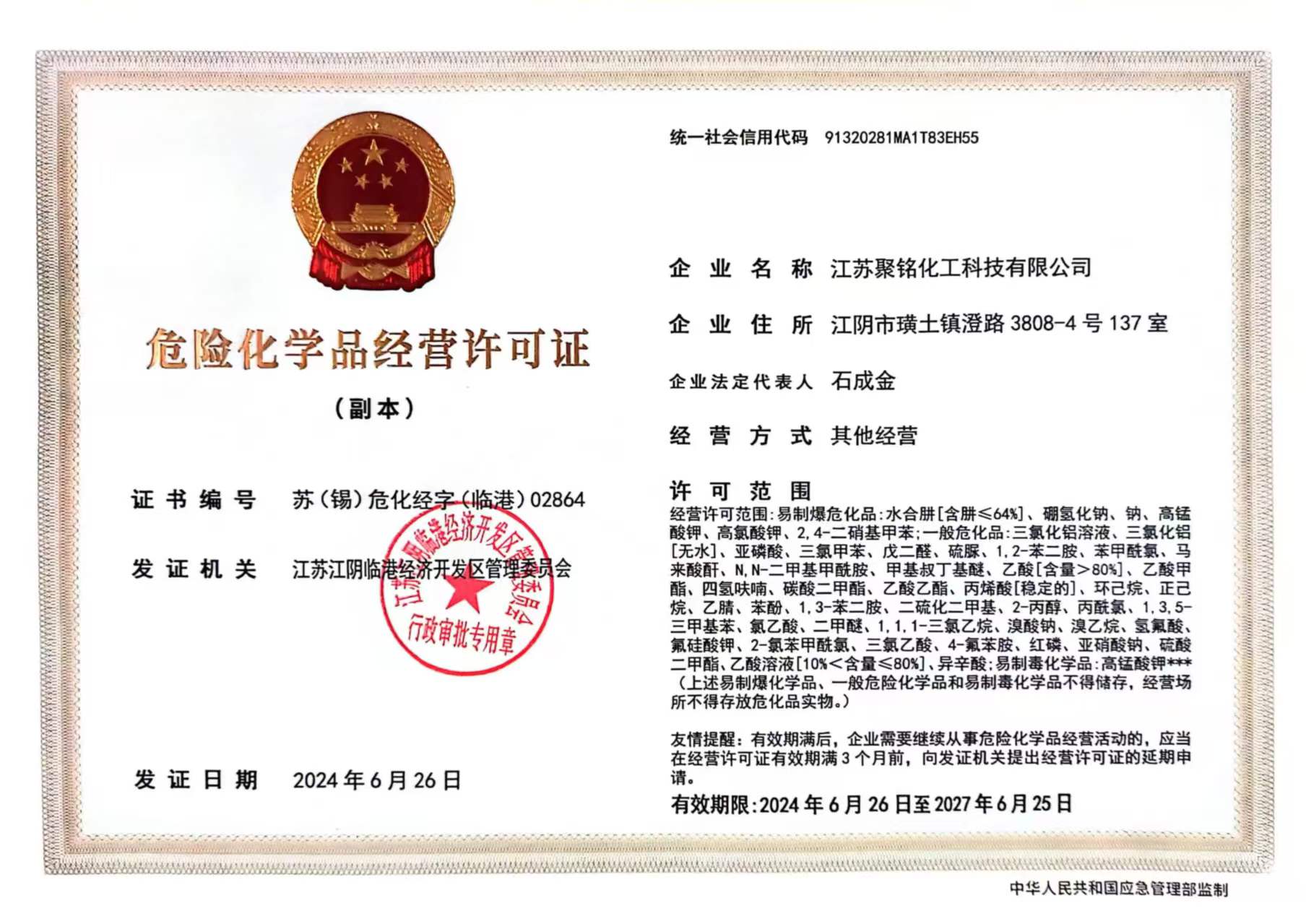
Compliance documentation for VBC supply should be read with its scope attached. Jiangsu Juming Chemical Technology Co., Ltd. (Jumingchem), established in 2017 in Jiangyin, Wuxi City, Jiangsu, holds ISO 9001 quality management system certification (NOA2505548, issued 25 July 2025, valid to 24 July 2028), a Hazardous Chemicals Operation License (Su(Xi)WHJJZ(Lingang)02864, issued 26 June 2024, valid to 25 June 2027, scope: sale of hazardous chemicals within the permitted scope, excluding storage) and a Non-pharmaceutical Precursor Chemicals Filing Certificate ((Su) 3J32028100536, issued 17 February 2025, valid to 16 February 2028, covering Category III non-pharmaceutical precursor chemicals business).
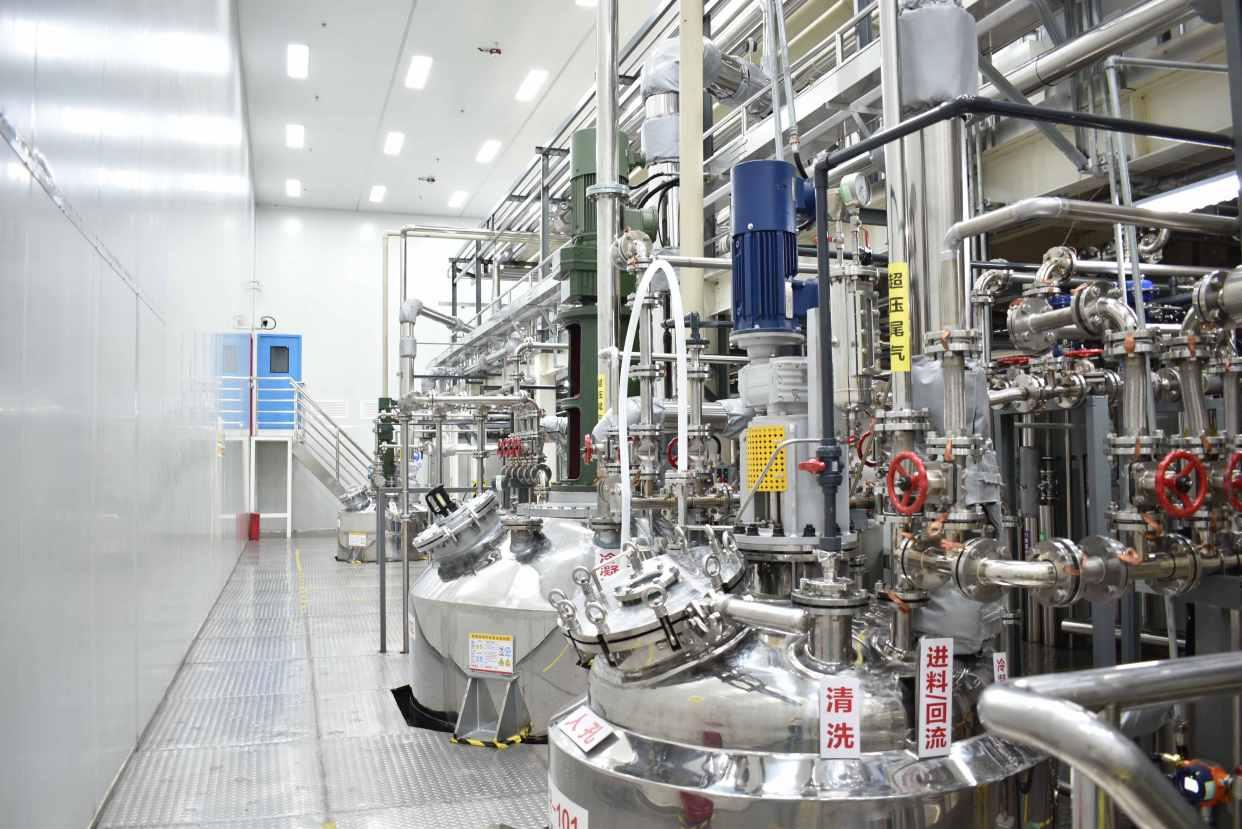
Two scope notes are worth carrying into a supplier file. First, the RoHS certificate in the supplied compliance set (CKEYS250724006, issued 24 July 2025) covers tolyltriazole, not VBC — if your project needs RoHS documentation for a VBC grade, request it per order rather than assuming the existing certificate extends to the monomer. Second, the ISO 9001 scope is stated as the sale of hazardous chemicals within the permitted scope, so a site audit remains the way to verify production conditions; the company's stated footprint covers a 78,000 m² factory area, a 3,000 m² R&D center, a 300 m² pilot plant and a 600 m² GMP workshop, with 180 employees, 25 engineers and 60,000 tons of annual output, of which about 70% is exported to markets including the USA, Korea, Japan, Germany and Southeast Asia.
FAQ
How do buyers verify COA traceability from high-purity electronic-grade chemicals suppliers?
Ask for three things and check each against the drum you receive. First, the COA should carry the batch number that matches the drum label and the retained sample, with test items and limits written to your specification rather than a generic template; Jumingchem offers COA formats with custom test items, batch traceability coding and retained samples. Second, each value should name the analytical method, so a metal-ion figure can be compared with your own incoming test; the company cites ICP-MS, HPLC and GC systems in its quality control. Third, any capability claim — such as the stated ppb≤10 metal-ion purification level — should appear as a release limit on the COA, and if it appears only in a brochure it remains a claim to be verified. Third-party reports from SGS, BV or Intertek can be requested as an additional check.
Which purity grades and metal-ion limits can be specified for VBC?
Industrial grade, high-purity grade and electronic grade are offered, with electronic grade defined by ppb-level metal-ion control. Metal-ion content for sodium, iron, copper and other elements can be set to the customer's specification, and the company states a ppb≤10 purification capability for electronic-grade products. Isomer purity can be specified as well: ≥99% para, ≥98% ortho, ≥98% meta or a custom o/m/p ratio. Because the ppb figure is a capability statement rather than a published product release limit, the limit, test method and reporting basis should be written into the purchase specification and confirmed on the COA.
Which grade fits a negative photoresist project — 2-VBC or 3-VBC?
Both are listed as core monomers for high-performance negative photoresist resins, including E-beam resist, and for advanced packaging dielectric materials, so the choice is formulation-specific rather than a ranking. Two items separate them in practice: data quality and stabilizer. The supplied 2-VBC data gives a boiling point of 223.4 ± 9.0 °C and a density of 1.066 ± 0.06 g/cm³, both marked as predicted, while the 3-VBC unit lists approximately 0.1% TBC stabilizer and no boiling point or density. A resist project should request measured physical data and the exact stabilizer level before fixing the grade, then confirm both on the trial batch.
Does 4-VBC fit homogeneous ion-exchange membranes and ultra-pure water resins?
Yes. 4-VBC (CAS 1592-20-7) is the grade the supplied product data positions for homogeneous ion-exchange membranes, ultra-pure water resins and chelating resins, and it is also listed as a component of ion exchange resins, photoresist polymers, cross-linkable fibers, coupling agents and electroconducting polymers. The para arrangement places the chloromethyl handle in a regular position along the chain, which suits membranes where the charge site should be evenly distributed. Practical constraints apply: it is listed as insoluble in water and only sparingly soluble in chloroform, its boiling point is 229 °C, and storage is specified at 2-8 °C.
What sample, MOQ and lead time terms apply to VBC orders?
The stated terms are a 1 kg minimum order quantity, pre-shipment sample confirmation and a lead time of 7-30 days, with 100% testing and remote technical support after delivery. Liquid grades are packed in 25 kg HDPE drums, 200 kg steel-plastic composite drums or 1000 L IBCs, with temperature-controlled packaging for hot-climate shipping and UN-certified dangerous goods packaging available on request. For a project moving from trial to routine supply, the practical next step is to send the isomer, purity grade, metal-ion limits and pack size you need for a sample and quotation; the catalogue linked below lists the full product range.
Conclusion
Isomer fit becomes a short list once the project type is fixed: 4-VBC for homogeneous ion-exchange membranes and ultra-pure water resins, 2-VBC or 3-VBC for negative photoresist resins and advanced packaging dielectrics, and mixed VBC for specialty plastics where a ratio window is acceptable. What takes longer is the constraint work behind the choice — water insolubility, a 223-229 °C boiling band, the 0.1% TBC level in 3-VBC, grade-specific storage temperatures, and the difference between predicted and measured physical data.
Settling those items before the first drum arrives turns the isomer question into a specification, and a specification is what makes quotations comparable. Jumingchem supplies all four VBC grades with custom isomer ratios, industrial to electronic-grade purity, COA documentation and sample quantities from 1 kg. The full product list is available in the Jumingchem product catalogue (PDF), and project details can be sent to sales@jumingchem.com for a specification-based sample and quotation.
Have Questions or Need More Details?
Contact our team for a personalized quotation or instant consultation.
Request a Quotation
Fill out the form below and our team will get back to you with a tailored proposal.
WhatsApp Direct Chat
Prefer to chat in real-time? Message us on WhatsApp for instant assistance & quick answers.
- Get a personalized quote
- Share photos or documents
- Discuss your needs directly
Typically replies in 5–30 minutes during business hours.