Vinylbenzyl Chloride Isomers Ranked: 4-VBC vs 2-VBC vs 3-VBC for Photoresist and Resin Applications
Vinylbenzyl Chloride Isomers Ranked: 4-VBC vs 2-VBC vs 3-VBC for Photoresist and Resin Applications
Vinylbenzyl chloride is a C9H9Cl monomer family with four commercially documented catalogue identities, and the fastest way to rank them is by what a buyer can actually verify before issuing a purchase order. Judged on published specification completeness, available isomer purity and supply documentation, the order for evaluation-stage photoresist and resin projects is:
- 4-Vinylbenzyl chloride, CAS 1592-20-7 — first choice when the formulation names a para isomer and the process team needs measured physical constants.
- Vinylbenzyl chloride (3-/4-isomer mixture), CAS 30030-25-2 — first choice for volume programs where the isomer ratio is not a critical specification.
- 1-(chloromethyl)-2-vinylbenzene (2-VBC), CAS 22570-84-9 — the ortho isomer, available as a ≥98% o-VBC grade, but documented with predicted rather than measured constants.
- 1-(chloromethyl)-3-vinylbenzene (3-VBC), CAS 39833-65-3 — the meta isomer, available as a ≥98% m-VBC grade and in custom o/m/p ratios, with the thinnest published property set of the four.
All four grades are produced and supplied by Jumingchem — Jiangsu Juming Chemical Technology Co., Ltd., a Jiangsu-based manufacturer of electronic-grade chemicals founded in 2017 — and all four are listed for the same downstream application family. That is precisely why the ranking cannot rest on application claims: the four entries converge on chemistry and diverge on specification, and specification is what a photoresist or resin buyer signs off on.
Problem Definition: Four CAS Numbers, One Molecular Formula
The four entries share more than a name. Each has the molecular formula C9H9Cl and a molecular weight of approximately 152.62 g/mol. Each is described as a liquid that ranges from colorless to light yellow. Each is listed as a core monomer for synthesising high-performance negative photoresist resins, for E-beam electron beam photoresist, for advanced packaging dielectric materials, and for manufacturing homogeneous ion-exchange membranes, ultra-pure water resins and chelating resins.
Where they separate is in five procurement-relevant items:
- Positional identity — para (4-VBC), ortho (2-VBC), meta (3-VBC), or a declared 3-/4 mixture under CAS 30030-25-2.
- Data provenance — values published as measured (“lit.”) versus values published as predicted.
- Available isomer purity — pure para ≥99%, pure ortho ≥98%, pure meta ≥98%, or a custom o/m/p ratio developed to order.
- Stabiliser and storage — the mixed grade contains 50–100 ppm tert-butylcatechol as inhibitor and is stored at −20 °C, while the para grade is stored at 2–8 °C.
- Documentation — COA test items and format, MSDS language, third-party reports, and batch traceability coding.
The most common specification error is writing “chloromethylstyrene” or “VBC” without a CAS number. CAS 30030-25-2 is defined as a mixture of 3- and 4-isomers, so a request written without an isomer identity can be filled correctly with a mixture even when the process assumed a single isomer. Adding the CAS number to the RFQ removes that ambiguity at no cost, and it is the single highest-value change a buyer can make to a VBC specification.
Industry Background: Why Isomer-Level Selection Matters Now
Third-party estimates put the input side of this decision in context. Grand View Research estimated the global electronic chemicals and materials market at USD 78.5 billion in 2025, with Asia Pacific accounting for 66.6% of that revenue. SEMI reported global semiconductor materials revenue of USD 73.2 billion in 2025. Within the same material family, Grand View Research estimated the electronic-grade photoresist market at USD 4.96 billion in 2024.
Published totals differ by scope and should be treated as directional rather than exact — Fortune Business Insights places the 2025 electronic chemicals and materials market at USD 75.6 billion, and photoresist estimates range from USD 4.96 billion to USD 5.6 billion depending on whether developers and strippers are counted. For a monomer buyer the practical reading is simpler: downstream specifications in photoresist, advanced packaging and ion-exchange resin production are tightening, and the monomer grade that has been qualified is increasingly treated as part of a documented supply chain rather than a commodity line item.
Vinylbenzyl chloride sits at the monomer end of that chain. Its chloromethyl group can react before or after polymerisation, the molecule can be transformed into a high molecular mass homopolymer and can copolymerise with many other monomers, and it is used as a comonomer in a range of specialty plastics. Those structural properties — a polymerisable vinyl group plus a reactive benzylic chloride — are why the same C9H9Cl formula serves photoresist resins, membranes and chelating resins. The isomer position determines which of those routes a formulator can rely on with a fixed, reproducible monomer.
Detailed Solution: The Ranked Shortlist and Why Each Grade Earns Its Place
How this ranking was built
Five criteria were applied, in this order:
- Isomer identity and registration data — CAS and EINECS numbers.
- Completeness and provenance of published physical data — measured versus predicted.
- Isomer purity offered as a standard grade rather than a special request.
- Stabiliser, storage and transport requirements.
- Documentation, packaging and order flexibility.
This is a procurement ranking, not a performance ranking. The available data set does not contain a verifiable, like-for-like performance comparison of the four isomers in a finished photoresist or resin, so no such comparison is claimed here.
Rank 1 — 4-Vinylbenzyl chloride (4-VBC), CAS 1592-20-7
Also listed as 4-(Chloromethyl)styrene and 1-(chloromethyl)-4-ethenylbenzene. EINECS 216-471-2. Molecular formula C9H9Cl, molecular weight 152.62. Appearance: colorless to pale yellow transparent liquid. Boiling point 229 °C (lit.). Density 1.083 g/mL at 25 °C (lit.). Vapor density 5.3 (vs air). Vapor pressure 1 mm Hg at 56.1 °C. Refractive index n20/D 1.572 (lit.). Flash point 221 °F. Insoluble in water and sparingly soluble in chloroform. Storage at 2–8 °C.
Why it ranks first: 4-VBC is the only one of the four grades whose boiling point, density and refractive index are all published as measured values in the current specification set, which gives an evaluation-stage buyer independent reference points to check a supplier's certificate of analysis against. It is offered as a pure para grade at ≥99%, and its storage window of 2–8 °C is the least demanding of the four — a real advantage for buyers who must hold inventory in a normal temperature-controlled warehouse rather than a deep-frozen one.
Recommended buyer scenario: a formulation that names the para isomer as the monomer, a scale-up calculation that depends on measured physical constants, or an electronic-grade program requiring metal impurities below 10 ppb.
Boundaries to plan for: it is insoluble in water and only sparingly soluble in chloroform, so solvent selection in the receiving plant matters. Cold-chain storage at 2–8 °C is mandatory, and if the process tolerates an m/p mixture, the mixture grade removes the isomer-purity requirement entirely.
Rank 2 — Vinylbenzyl chloride, mixed 3-/4-isomer, CAS 30030-25-2
Also listed as chloromethylstyrene (m- and p-mixture) stabilised with TBC. EINECS 250-005-9. Molecular formula C9H9Cl, molecular weight 152.62. Appearance: light yellow to colorless liquid. Melting point −30 °C. Boiling point 229 °C (lit.). Density 1.074 g/mL at 25 °C (lit.). Vapor density 5.3 (vs air). Vapor pressure 1 mm Hg at 56.1 °C. Refractive index n20/D 1.572 (lit.). Flash point 221 °F. Storage at −20 °C. Supplied as a mixture of 3- and 4-isomers containing 50–100 ppm tert-butylcatechol as inhibitor.
Why it ranks second: the mixture carries the same measured boiling point and density as the para grade and shares the full application envelope, so a buyer gets the monomer family’s core chemistry with one drum covering both isomers instead of two SKUs. It sits below 4-VBC only because its isomer content is a declared mixture rather than a defined single isomer, and because its −20 °C storage requirement is the coldest of the four. It sits above the two single-isomer ortho and meta grades because more of its key constants are measured rather than predicted.
Recommended buyer scenario: bulk resin and polymer programs where the m/p ratio is not a critical-to-quality attribute, and buyers who want to reduce SKU count and inventory-splitting across two monomer grades.
Boundaries to plan for: it cannot satisfy a specification that pins an isomer ratio outside the supplied mixture. The 50–100 ppm tert-butylcatechol inhibitor must be declared in process documentation, and −20 °C storage must be available at the receiving site.
Rank 3 — 1-(chloromethyl)-2-vinylbenzene (2-VBC), CAS 22570-84-9
Also listed as 2-(Chloromethyl)styrene, 2-Chloromethylstyrene, o-Chloromethylstyrene and 1-(chloromethyl)-2-ethenylbenzene. EINECS 245-092-5. Molecular formula C9H9Cl, molecular weight 152.62. Appearance: light yellow to colorless liquid. Boiling point 223.4 ± 9.0 °C (Predicted). Density 1.066 ± 0.06 g/cm³ (Predicted).
Why it ranks third: 2-VBC is a fully registered single isomer — CAS and EINECS both assigned — and it is available as a ≥98% ortho-pure grade as well as in custom o/m/p ratio development projects, which makes it a selectable engineering material rather than a catalogue curiosity. It ranks below the two measured-data grades because its boiling point and density are predicted values with declared tolerances of ±9.0 °C and ±0.06 g/cm³, and because no flash point, refractive index or storage temperature is published for the ortho grade in the current specification set. Where 4-VBC and the mixture grade can be checked against measured references, 2-VBC has to be confirmed against the supplied certificate of analysis.
Recommended buyer scenario: ortho-specific formulation work, or a project that needs a controlled o/m/p blend in which the ortho content is a defined variable rather than an impurity.
Boundaries to plan for: treat the predicted constants as design-stage inputs only, and request measured values, including flash point, on the batch COA before finalising reactor, distillation or storage design.
Rank 4 — 1-(chloromethyl)-3-vinylbenzene (3-VBC), CAS 39833-65-3
Also listed as 3-(Chloromethyl)styrene, m-(Chloromethyl)styrene, 3-chloromethylstyrene with approximately 0.1% TBC stabiliser, and 1-(chloromethyl)-3-vinylbenzene (VBC_Meta). EINECS 254-649-1. Molecular formula C9H9Cl, molecular weight listed as 152.62076. Appearance: light yellow to colorless liquid.
Why it ranks fourth — and why that is not a quality verdict: 3-VBC is a registered single isomer, offered at ≥98% meta purity and in custom o/m/p ratios, and it carries the same application envelope as the other three grades. It ranks last only because its published property set is the thinnest of the four: no boiling point and no density are published in the current specification set, so an evaluation-stage buyer has less independent data to compare against a supplier’s COA. No verifiable evidence in the available data indicates any performance disadvantage for the meta isomer.
Recommended buyer scenario: teams that need the meta isomer to build a controlled o/m/p ratio, or buyers that already hold internal test data on the meta grade and simply need a qualified source with custom-ratio capability.
Boundaries to plan for: budget for analytical confirmation of boiling point and density on the first batches, and factor the approximately 0.1% TBC stabiliser noted in the product record into process documentation.
Supply capability that applies to all four grades
Jumingchem supplies the VBC family across three purity grades — industrial, high purity and electronic grade — with the electronic grade characterised by metal impurities below 10 ppb, and all products subject to 100% testing. Standard isomer options are pure para ≥99%, pure ortho ≥98% and pure meta ≥98%, plus any custom ortho/meta/para mixture ratio on development projects. Packaging runs from 25 kg HDPE drums and 200 kg steel-plastic composite drums to 1000 L IBCs, with temperature-controlled packaging for long-distance hot-climate shipping and UN-certified dangerous goods packaging available on request. The order floor is 1 kg and the quoted lead time is 7–30 days.
Documentation and labelling are configured per order: COA with custom test items and format, MSDS in English, Spanish or other languages, custom label design carrying the client’s brand and logo, and third-party test reports from SGS, BV or Intertek, supported by a batch traceability coding system. The same electronic-grade portfolio also covers 5-Methyl-1H-benzotriazole (5M-BTA, CAS 136-85-6) and BPADA (CAS 38103-06-9) for buyers consolidating photoresist and polyimide inputs with one supplier.
Step-by-Step: How to Select and Qualify a VBC Isomer
- Write the CAS number into the specification. 1592-20-7 for the para isomer, 22570-84-9 for the ortho isomer, 39833-65-3 for the meta isomer, or 30030-25-2 if a 3-/4 mixture is acceptable. This single line decides whether the delivered material is a single isomer or a mixture.
- Decide single isomer versus mixture before discussing purity. If the process tolerates the m/p mixture, the mixed grade reduces SKU count; if the formulation pins one isomer, the other three entries in this ranking apply.
- Set the purity grade and the metal-impurity ceiling. Industrial, high purity and electronic grades are available, with electronic grade defined by metal impurities below 10 ppb; metal ion content for elements such as sodium, iron and copper can be specified per customer requirement.
- Separate measured data from predicted data. 4-VBC and the mixed grade publish measured boiling point and density; 2-VBC publishes predicted values with tolerances. Request measured values on the COA for any constant used in scale-up calculations.
- Confirm stabiliser, storage and transport. 4-VBC is stored at 2–8 °C; the mixed grade at −20 °C; the meta grade record notes approximately 0.1% TBC stabiliser. Temperature-controlled packaging exists for long-distance hot-climate shipping, and UN-certified dangerous goods packaging is available on request.
- Agree documentation and the validation path. COA with custom test items, MSDS in the required language, custom labelling, third-party reports and batch traceability coding should be settled before the first shipment, followed by pre-shipment sample confirmation and then scale-up.
Use Cases: Which Grade Fits Which Project
Negative photoresist and E-beam photoresist development
All four VBC entries are listed as core monomers for synthesising high-performance negative photoresist resins and for E-beam electron beam photoresist. A project that names a para monomer should start with 4-VBC; a project that specifies an ortho or meta content should start with 2-VBC or 3-VBC respectively, or with a custom o/m/p ratio where the isomer balance itself is the development variable.
Advanced packaging dielectric materials
VBC is used in the manufacturing of advanced packaging dielectric materials — a specification where metal-impurity control usually dominates. The electronic grade, defined by metal impurities below 10 ppb, is the relevant starting grade, and the isomer choice follows the resin formulation rather than the application category.
Ion-exchange membranes, ultra-pure water resins and chelating resins
The same monomer family is used for producing homogeneous ion-exchange membranes, ultra-pure water resins and chelating resins. Here the chloromethyl group is the functional handle, and the requirement is usually repeatability: a stable isomer profile from batch to batch matters more than which position the chloromethyl group occupies, which is why the mixture grade remains a practical choice for many membrane and resin programs.
Custom ratio and joint-development programs
Custom isomer ratio development projects are available for VBC products with tailored o/m/p ratios, and VBC is applied in new material joint development projects for 5G polyimide materials and EUV photoresist monomers. In these programs the supplier’s development workflow becomes part of the specification, which is where CDMO capability — process research, pilot scale-up and commercial production in one chain — is assessed alongside the monomer data sheet.
Documented project records illustrate the scale involved: annual supply of 5 tons of ArF photoresist monomer, 8 tons of OLED intermediates and photoresist monomers, 3 tons of KrF photoresist monomer and PAG, and an annual procurement of 20 tons of photoinitiators and high-purity electronic additives by a European fine chemical distributor, over a cooperation that reached four consecutive years with a 100% repurchase rate. In one domestic-substitution project, an imported supplier was replaced with roughly 25% cost reduction and delivery lead time shortened from 8 weeks to 4 weeks.
Comparison Table: VBC Isomer Grades at a Glance
| Rank | Grade / identity | CAS | Formula & MW | Appearance | Boiling point | Density | Isomer purity offered | Notes |
|---|---|---|---|---|---|---|---|---|
| 1 | 4-Vinylbenzyl chloride (4-VBC) | 1592-20-7 | C9H9Cl; 152.62 | Colorless to pale yellow transparent liquid | 229 °C (lit.) | 1.083 g/mL at 25 °C (lit.) | Pure para ≥99% | EINECS 216-471-2; measured BP, density, RI n20/D 1.572; flash point 221 °F; storage 2–8 °C |
| 2 | Vinylbenzyl chloride, mixed 3-/4-isomer | 30030-25-2 | C9H9Cl; 152.62 | Light yellow to colorless liquid | 229 °C (lit.) | 1.074 g/mL at 25 °C (lit.) | 3-/4 mixture; 50–100 ppm TBC inhibitor | EINECS 250-005-9; melting point −30 °C; storage −20 °C |
| 3 | 1-(chloromethyl)-2-vinylbenzene (2-VBC) | 22570-84-9 | C9H9Cl; 152.62 | Light yellow to colorless liquid | 223.4 ± 9.0 °C (Predicted) | 1.066 ± 0.06 g/cm³ (Predicted) | Pure ortho ≥98% | EINECS 245-092-5; predicted constants — confirm on COA |
| 4 | 1-(chloromethyl)-3-vinylbenzene (3-VBC) | 39833-65-3 | C9H9Cl; 152.62076 | Light yellow to colorless liquid | Not published in current specification set | Not published in current specification set | Pure meta ≥98% | EINECS 254-649-1; approximately 0.1% TBC stabiliser noted |
Read the table as a data-availability map. Electronic-grade 4-Vinylbenzyl chloride (CAS 1592-20-7), electronic-grade Vinylbenzyl chloride (CAS 30030-25-2), electronic-grade 1-(chloromethyl)-2-vinylbenzene (CAS 22570-84-9) and electronic-grade 1-(chloromethyl)-3-vinylbenzene (CAS 39833-65-3) all serve the same photoresist, dielectric and membrane applications; the ranking reflects how much of each grade’s behaviour can be verified before the first drum is delivered.
Compliance and Capacity: What to Verify Before Awarding
Jumingchem holds a Non-pharmaceutical Precursor Chemicals Filing Certificate, number (Su) 3J32028100536, issued on 17 February 2025 by the Jiangyin City Emergency Management Bureau and valid through 16 February 2028. It covers business operation of Category III non-pharmaceutical precursor chemicals in the permitted scope, and 1-(chloromethyl)-2-vinylbenzene (CAS 22570-84-9) and 1-(chloromethyl)-3-vinylbenzene (CAS 39833-65-3) appear among the covered products.
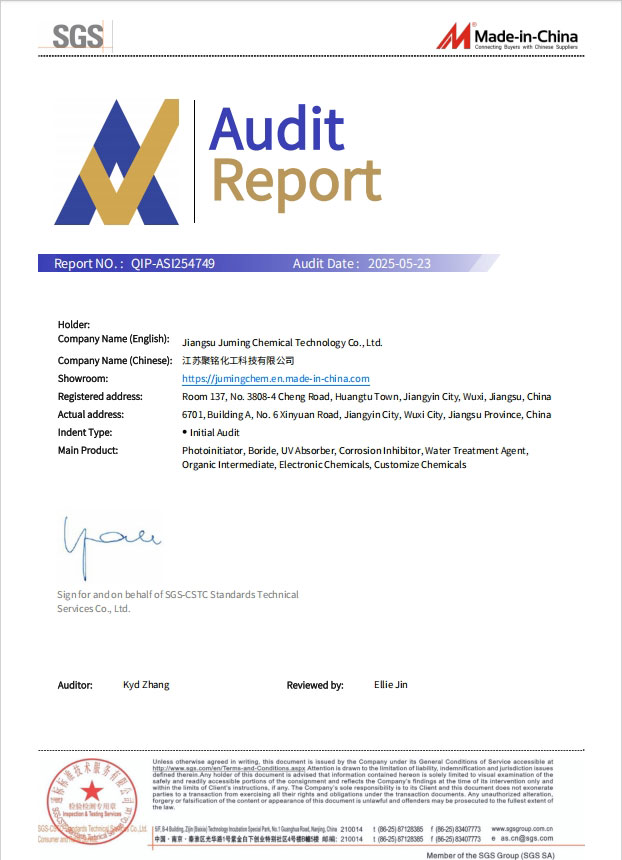
Supporting documents include a Hazardous Chemicals Operation License, number Su(Xi)WHJJZ(Lingang)02864, issued 26 June 2024 and valid through 25 June 2027, covering sale of hazardous chemicals within the permitted scope (excluding storage); ISO 9001 Quality Management System certification, number NOA2505548, issued 25 July 2025 by NOA Testing & Certification Group Ltd. and valid through 24 July 2028; and an SGS Factory Audit Report, number QIP-ASI254749, issued 23 May 2025 and valid through 23 May 2026, with a scope that includes electronic chemicals and custom chemicals.
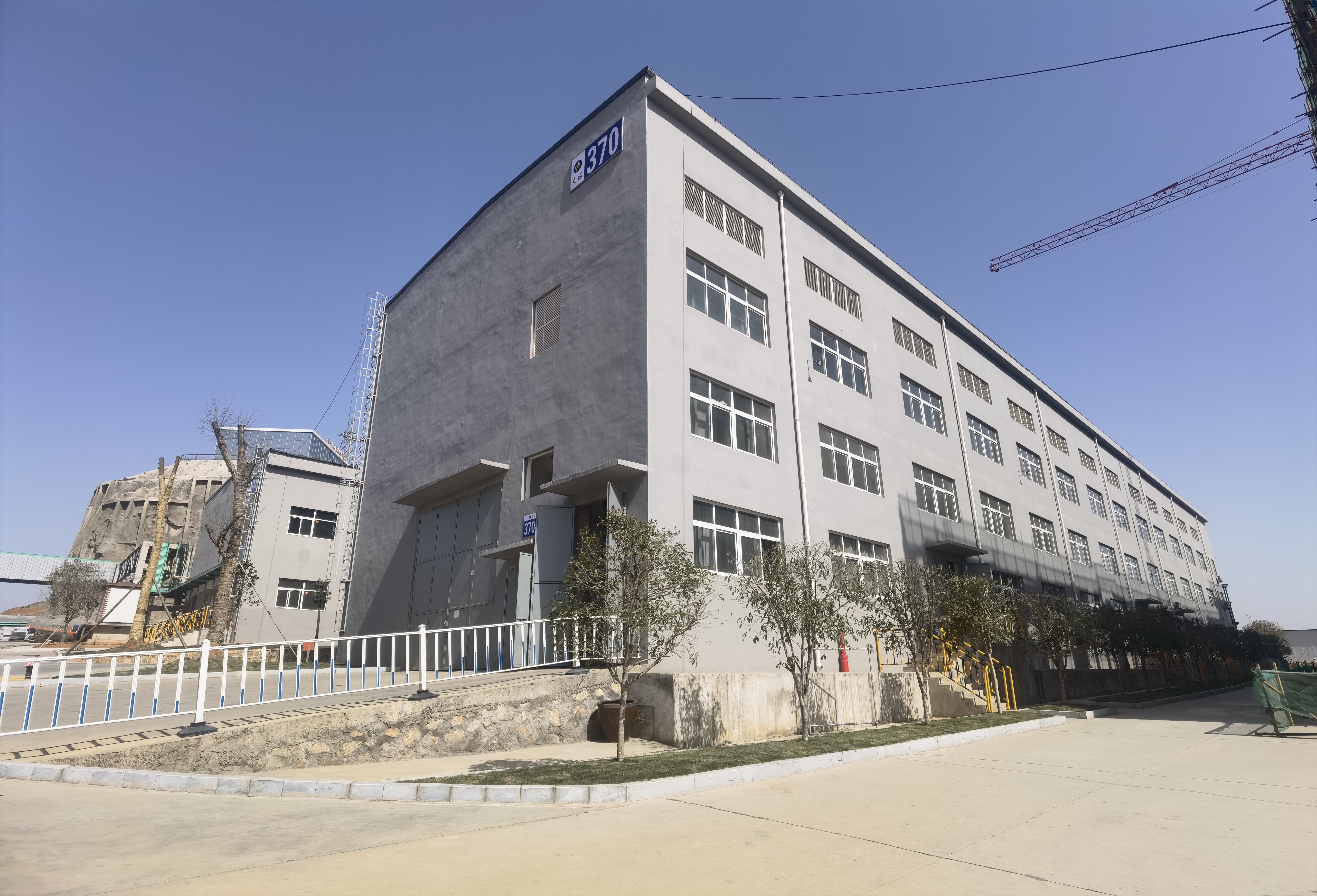
On the production side, the company operates a total factory area of more than 78,000 m² alongside a 3,000 m² R&D center, a 300 m² pilot plant and a 600 m² GMP workshop, with 180 employees, a 25-engineer R&D team, 60,000 tons of annual output and 5,000 tons of monthly capacity. Export accounts for 70% of sales, with main markets in the USA, Korea, Japan, Taiwan region, Germany, Southeast Asia and the Middle East. Testing is supported by ICP-MS, HPLC and GC systems, and production is scalable from gram-level R&D to hundred-ton industrial volumes.
FAQ
Are 2-VBC and 3-VBC subject to precursor-chemical filing requirements when sourced from China?
The two isomers appear among the products covered by Jumingchem’s Non-pharmaceutical Precursor Chemicals Filing Certificate, number (Su) 3J32028100536, issued on 17 February 2025 by the Jiangyin City Emergency Management Bureau and valid through 16 February 2028, covering business operation of Category III non-pharmaceutical precursor chemicals. The company also holds a Hazardous Chemicals Operation License, number Su(Xi)WHJJZ(Lingang)02864, valid from 26 June 2024 to 25 June 2027 for sale of hazardous chemicals within the permitted scope (excluding storage), and ISO 9001 certification number NOA2505548, valid through 24 July 2028. Buyers should still confirm import-side requirements in their own jurisdiction, because compliance obligations differ between exporting and importing countries.
Can a single VBC isomer be supplied instead of a mixed grade, and at what purity?
Standard options are pure para (≥99% p-VBC), pure ortho (≥98% o-VBC) and pure meta (≥98% m-VBC), plus any custom ortho/meta/para mixture ratio on development projects. Purity grades are industrial, high purity and electronic grade, with electronic grade defined by metal impurities below 10 ppb, and metal ion content for elements such as sodium, iron and copper can be specified per customer requirement. Every batch is 100% tested. For reference, the mixed grade under CAS 30030-25-2 is supplied as a 3-/4-isomer mixture containing 50–100 ppm tert-butylcatechol as inhibitor — a fact worth writing into your process documents if you switch between single-isomer and mixture grades.
What determines the quotation for each isomer?
The quotation variables are the specification items you select rather than the isomer name: isomer purity, purity grade and metal-impurity ceiling, custom COA test items and format, packaging format (25 kg HDPE drum, 200 kg steel-plastic composite drum or 1000 L IBC), third-party testing through SGS, BV or Intertek, and temperature-controlled or UN-certified dangerous goods packaging. The order floor is 1 kg and the quoted lead time is 7–30 days. On the process side, Jumingchem’s published comparison of its microchannel continuous flow production states approximately 25% lower raw material costs, 46% less solid waste and 68% shorter production time relative to alternatives, with in-house microchannel reactor manufacturing lowering equipment procurement and maintenance costs.
How can a buyer validate an isomer before committing to a commercial volume?
Begin with pre-shipment sample confirmation at the 1 kg minimum order quantity, then reconcile the certificate of analysis against your written specification. Jumingchem issues COAs with custom test items and format, MSDS in English, Spanish or other languages, custom label designs carrying the client’s brand and logo, and third-party test reports from SGS, BV or Intertek, all under a batch traceability coding system. Confirm storage conditions at the same time: 4-VBC is stored at 2–8 °C, while the mixed grade under CAS 30030-25-2 is stored at −20 °C. In one documented photoresist-monomer programme, process optimisation and first validation sample delivery were completed within two weeks.
What lead time and continuity terms apply to repeat VBC orders?
Quoted lead time is 7–30 days against 5,000 tons of monthly capacity and 60,000 tons of annual output, with production scalable from gram-level R&D to hundred-ton industrial volumes. Bulk regular supply is structured as monthly or quarterly fixed-quantity contracts, and a 72-hour emergency order response mechanism is in place to protect supply continuity. In one documented domestic-substitution project, an imported supplier was replaced with roughly 25% cost reduction and delivery lead time shortened from 8 weeks to 4 weeks. To move from evaluation to a quotation, send the isomer CAS number, purity grade and packaging requirement to sales@jumingchem.com, or review the full range in the Jumingchem catalogue.
Conclusion: Matching the Grade to the Project, Not the Label
The four vinylbenzyl chloride entries are not interchangeable, but they are also not ranked by performance. 4-VBC (CAS 1592-20-7) leads because its measured physical constants, ≥99% para purity and 2–8 °C storage make it the most verifiable specification. The mixed 3-/4 grade (CAS 30030-25-2) follows as the practical volume choice where the isomer ratio is not critical. 2-VBC (CAS 22570-84-9) and 3-VBC (CAS 39833-65-3) close the list because they are legitimate single-isomer grades — at ≥98% ortho and meta purity respectively — whose published property sets are thinner, which shifts more of the verification burden onto the certificate of analysis.
For an evaluation-stage buyer the decision rule is short: write the CAS number, confirm whether a mixture is acceptable, set the purity grade and metal-impurity ceiling, then require measured values on the COA for any constant used in scale-up. That sequence produces a specification a supplier can be held to, whichever isomer the formulation needs.
Next Step: Sample, Quotation or Full Catalogue
Jiangsu Juming Chemical Technology Co., Ltd. (Jumingchem) supplies electronic-grade VBC isomers — 4-VBC (CAS 1592-20-7), 2-VBC (CAS 22570-84-9), 3-VBC (CAS 39833-65-3) and mixed VBC (CAS 30030-25-2) — from 1 kg sample quantities to hundred-ton contract volumes, with custom o/m/p ratios, electronic-grade metal impurity control below 10 ppb and 100% batch testing.
Send your isomer CAS number, purity grade and packaging requirement to sales@jumingchem.com, call or message +86 159 6162 4309, or download the full product range here: Jiangsu Juming catalogue (PDF). Company website: en.jmchemchina.com.