Custom Paper Bags vs. Rigid Gift Boxes: A Buyer’s Comparison Guide
Custom paper bags and rigid gift boxes solve different packaging jobs. A paper bag is usually the outer carry-out or promotional layer; a rigid gift box is usually the presentation and protection layer around the product itself. The practical decision is not which format is universally better, but which format matches the product, retail channel, unboxing moment, compliance route and order economics. This guide compares both options for retail, boutique and promotional buyers, using the material and construction choices named in the brief: kraft, art cardboard, white cardstock and specialty textured paper; cotton rope, ribbon, twisted paper and die-cut handles; 120–300 GSM paper bags with reinforced bottoms; rigid boxes made with 1.5–3.0 mm board, magnetic or drawer closures, and EVA, velvet, sponge or foam inserts. It also compares offset printing, foil stamping, embossing and lamination.
Problem definition: the two formats are not interchangeable
The comparison is difficult because paper bags and rigid gift boxes sit at different points in the purchase journey. A custom paper bag may never enter the product pack; it carries the product after purchase, supports brand visibility on the street, and can be reused by the customer. A custom rigid box usually contains the product, controls how the item is seen and protected, and carries much more of the unboxing experience. Comparing them on unit price alone can therefore produce the wrong decision.
The buyer’s real problem is to match format to function. If the product needs a staged reveal, an insert, a magnetic close or a drawer action, a paper bag cannot replace a rigid box. If the need is a lightweight carry-out bag for a boutique, a promotional event or a retail campaign, a rigid box may add cost and pack-out time without improving the customer’s carry experience. The comparison should be made on the same brief: product dimensions and weight, journey, presentation goal, protection requirement, finishing, order quantity and destination market.
Industry background: why paper-based packaging is under both demand and scrutiny
Custom paper packaging sits inside a larger custom packaging market. Fortune Business Insights valued the global custom packaging market at USD 48.17 billion in 2025. Grand View Research reports that the paper and paperboard segment held the largest revenue share at 47.2% in 2025. These figures describe the wider custom packaging market, not the paper bag or rigid gift box sub-segment, so they should be read as context rather than as a forecast for either format.
Regulation is now part of the buying brief in the European Union. Regulation (EU) 2025/40, the Packaging and Packaging Waste Regulation, applies from 12 August 2026. It requires all packaging to be recyclable by 1 January 2030 and caps empty space at a maximum ratio of 50% for transport and e-commerce packaging by 2030. The same regulation notes that packaging represents 36% of municipal solid waste in the EU. For buyers, this shifts attention toward right-sized structures, material declarations, recyclability documentation and supplier evidence. A paper bag or a rigid box is not automatically compliant because it is paper-based; the substrate, coating, lamination, adhesive, insert and printing system all form part of the assessment.
Detailed comparison: how to judge paper bags and rigid gift boxes
The following criteria are the ones that change the choice most often in retail, boutique and promotional packaging. Use them as a decision framework, then convert the chosen option into a specification sheet before requesting samples or quotes.
1. Primary function and product protection
Custom paper bags are best treated as secondary or carry packaging unless the product is already protected inside its own box or container. In the 120–300 GSM band, the paper grade, bag dimensions, bottom reinforcement, handle attachment and expected load determine whether the bag is suitable. GSM alone is not a load rating. A heavier paper does not automatically make a safer bag if the bottom or handle is poorly specified. Buyers should ask for a sample with the actual product inside and check the handle, top edge and reinforced bottom under realistic load.
Custom rigid boxes are structural packaging. The 1.5–3.0 mm board thickness gives the box its shape and rigidity, while the closure and insert control how the product sits inside. Magnetic closures and drawer structures change both the opening action and the pack-out process. EVA, velvet, sponge and foam inserts can hold a product in place and separate items in a set, but the insert material, fit and tolerance should be tested with the real product. Board thickness alone does not prove drop protection; the complete pack-out, including the insert and any outer shipper, should be validated.
2. Presentation and unboxing
A rigid gift box usually carries more presentation weight because it can control the first view of the product. A magnetic closure creates a book-like opening; a drawer box creates a sliding reveal; a fitted insert keeps the product centred. These are structural presentation choices, not just surface decoration. They matter for cosmetics, skincare, spirits, premium food, gift sets and promotional kits where the box is part of the product experience.
A custom paper bag presents the brand before and after purchase. It is visible in the street, at the counter and during the customer’s journey home. Handles change the feel: cotton rope and ribbon handles can support a softer or more premium handle experience; twisted paper handles can suit a more paper-forward look; die-cut handles can reduce added components. The bag’s presentation is flatter and more exterior-led than a rigid box. If the brief needs a reveal, the bag is the wrong primary structure; if the brief needs a branded carry layer, the bag is the natural format.
3. Material and handle choices for paper bags
Paper bag buyers usually choose among kraft, art cardboard, white cardstock and specialty textured paper. Kraft can support a natural or uncoated look; art cardboard and white cardstock can provide a smoother print surface; specialty textured paper can add tactile differentiation. The right choice depends on print coverage, colour expectation, desired hand-feel and the product load. The specified 120–300 GSM range should be treated as a starting band for discussion, not as a universal recommendation.
Handle choice is part of the structural brief. Cotton rope, ribbon, twisted paper and die-cut handles each change the material list, attachment method and visual character. The buyer should confirm handle attachment strength, the reinforced bottom construction and the expected load with a physical sample. For promotional use, the bag may also need to fold flat for storage and transport; confirm the shipping state and any crease behaviour before approving the design.
4. Structure, closure and insert choices for rigid boxes
Rigid gift boxes are specified by board thickness, box style, closure and insert. The comparison brief uses a 1.5–3.0 mm board range. Within that range, the exact board grade, wrap paper, corner construction and closure should be confirmed on a sample. Magnetic closures and drawer closures are different user experiences and different pack-out processes; they should not be treated as interchangeable options. A drawer box may need a ribbon pull or finger notch; a magnetic box may need a precise lid fit and hinge behaviour.
Inserts are often the difference between a box that looks good and a box that protects the product. EVA, velvet, sponge and foam inserts can be shaped for single items or sets. The buyer should test insertion and removal with the real product, including any secondary wrapping. If the product is heavy or fragile, the insert and outer shipper should be reviewed together; the rigid box is not a substitute for transport testing.
5. Finishing options and print quality
Both formats can use offset printing, foil stamping, embossing and lamination, but the substrate and structure affect the result. Offset printing is well suited to high-resolution graphics and consistent brand colours when the paper and press conditions are controlled. Foil stamping adds a metallic or reflective area; embossing raises a surface; lamination adds a film layer that changes touch and surface protection. The buyer should approve a physical proof on the actual substrate, not only a digital file.
Finishing also affects compliance and recyclability. A laminated or foil-stamped paper may need different end-of-life documentation from an uncoated paper. The buyer should ask the supplier to identify the substrate, coating, film and adhesive used, and to explain how the finished pack should be described in the destination market. This is especially important for EU-bound packaging under Regulation (EU) 2025/40.
6. Pack-out, logistics and storage
Paper bags and rigid boxes have different logistics profiles. Paper bags can often be supplied flat or nested, which can reduce storage volume before use. Rigid boxes can take more space because they are structured; the exact shipping state should be confirmed with the supplier. A rigid box may also add pack-out labour because the product must be inserted, centred and closed. A paper bag may add less pack-out time but may require separate protection for the product. The comparison should include the full pack-out, not just the unit price of the bag or box.
For e-commerce and transport packaging, the EU empty-space cap of 50% by 2030 makes right-sizing a design requirement. A box that is visually impressive but mostly empty may create compliance and freight problems. A bag that is too large for the product may also fail the right-sizing principle. The buyer should review dimensions, fill rate and outer shipper together.
7. Order economics and supplier capability
Unit price is only one part of the comparison. The cost drivers differ: paper bags are affected by paper grade, GSM, handle type, printing coverage, reinforcement and packing method; rigid boxes are affected by board thickness, box style, closure, insert, wrap paper, finishing and assembly time. Quotes should be compared at the same quantity, dimensions, material, finishing, insert and delivery basis. Otherwise the comparison is not like-for-like.
Supplier capability matters because both formats can look similar in a sample and diverge in mass production. A supplier’s finishing equipment, inspection system and capacity determine whether the approved sample can be repeated at scale. This is where the supplied Junming facts become relevant to the buyer’s evaluation, not as a universal ranking but as a capability reference.
Step-by-step buyer decision process
Step 1: Define the product and the journey
Record the product dimensions, weight, fragility, whether it is already boxed, and how the customer will carry it. Separate the primary pack from the carry pack. A paper bag may be the carry layer; a rigid box may be the primary presentation layer. Do not ask one format to do both jobs unless the product and pack-out have been tested.
Step 2: Choose the format by protection need
If the product needs an insert, a fixed position or a staged reveal, start with a rigid box. If the product is already protected and the need is a branded carry-out or promotional bag, start with a paper bag. If both are needed, design them as a system: the bag should fit the box, and the box should fit the product.
Step 3: Specify the material system
For paper bags, select kraft, art cardboard, white cardstock or specialty textured paper, then set the GSM band, handle type and reinforced bottom. For rigid boxes, select the 1.5–3.0 mm board, wrap paper, closure and insert. Write the specification in measurable terms and keep a physical reference sample.
Step 4: Select closure and insert
For rigid boxes, choose magnetic or drawer closure only after testing the opening action and pack-out. Choose EVA, velvet, sponge or foam insert after testing product fit. For paper bags, choose cotton rope, ribbon, twisted paper or die-cut handles after checking load and hand-feel.
Step 5: Choose finishing and approve a proof
Decide whether offset printing, foil stamping, embossing or lamination is necessary, and which surface is functional rather than decorative. Approve a physical proof on the production substrate. Check small text, barcodes, regulatory panels and colour consistency under the intended light.
Step 6: Test pack-out and compliance
Run a pack-out trial with the real product. Check insertion, removal, closure, handle load, outer shipper and storage. For EU-bound packaging, request material and recyclability documentation and review the empty-space calculation. For regulated products, confirm the applicable food-contact, pharmaceutical or medical requirements with the supplier and a qualified testing provider.
Step 7: Compare quotes on identical scope and validate capacity
Send the same specification to every supplier: dimensions, material, GSM or board, closure, insert, finishing, quantity, packing method, documentation and delivery basis. Then check the supplier’s equipment, inspection and capacity for that exact configuration. A low quote without a capacity check is not a reliable comparison.
Use cases: where each format fits
Boutique retail and carry-out. A custom paper bag is usually the natural choice when the customer needs to carry a purchased item and the brand wants a visible exterior. Kraft, white cardstock or specialty textured paper can set the tone, while cotton rope, ribbon, twisted paper or die-cut handles define the handle experience. The bag should be tested with the actual product, especially if the product is heavy or the bag is expected to be reused.
Premium gift sets and promotional kits. A rigid gift box is usually the better primary structure when the product needs a reveal, an insert or a set layout. Magnetic and drawer closures create different opening actions; EVA, velvet, sponge or foam inserts hold the components. The box can be paired with a paper bag for carry-out, but the two should be designed together so the bag fits the box.
Cosmetics and skincare. A rigid box can support a premium unboxing moment and protect a glass bottle or set with a fitted insert. A paper bag can serve the retail carry-out layer. Buyers should confirm the surface finish, smudge resistance and any material-contact requirements. Foil stamping and embossing can add brand detail, but they should be approved on the actual substrate.
Pharmaceutical, medical and supplement secondary packaging. Paper bags are not a substitute for the primary product pack. Where custom paperboard boxes are used for pharmaceutical packaging, the supplied Junming content states that they can meet international pharmaceutical packaging standards and accommodate mandatory drug serialization data, high-precision CMYK printing, Braille embossing and anti-counterfeiting features. Buyers still need to confirm the exact product-contact, child-resistance, serialization and market-specific requirements for their own project.
Food, beverage and wine. Rigid boxes are often used for wine, spirits and premium food gift packs where the product needs structure and an insert. Paper bags can support retail carry-out and promotional events. Both formats should be checked for the intended food-contact layer and for the destination market’s packaging and labelling rules.
E-commerce and promotional mailers. Right-sizing is the first test. A rigid box that is mostly empty can add freight and conflict with the EU empty-space direction; a paper bag that is too large can do the same. The buyer should compare the packed volume, outer shipper and customer experience, not only the printed surface.
Comparison table: paper bags vs rigid gift boxes
| Decision factor | Custom paper bags | Custom rigid gift boxes | What to verify |
|---|---|---|---|
| Primary role | Carry-out, retail and promotional layer; can be reused by the customer | Presentation and protection structure around the product | Whether the product is already protected before it enters the bag |
| Material brief in this guide | Kraft, art cardboard, white cardstock or specialty textured paper; 120–300 GSM | Rigid board at 1.5–3.0 mm, wrap paper and insert | Exact grade, tolerance and physical sample |
| Structural options | Cotton rope, ribbon, twisted paper or die-cut handles; reinforced bottom | Magnetic or drawer closure; EVA, velvet, sponge or foam insert | Handle load, closure action and insert fit with the real product |
| Presentation | Exterior brand visibility; flatter carry experience | Controlled reveal; stronger unboxing sequence | Brand priority: street visibility or in-hand reveal |
| Protection | Secondary protection; depends on paper, bottom and handle | Structural protection; depends on board, closure, insert and shipper | Pack-out trial and transport test, not GSM or board alone |
| Finishing | Offset printing, foil stamping, embossing, lamination as applicable | Offset printing, foil stamping, embossing, lamination as applicable | Physical proof on the actual substrate and finish compatibility |
| Pack-out and logistics | Can often ship flat or nested; confirm storage and crease behaviour | Can take more space and pack-out time; confirm shipping state | Packed volume, fill rate and outer shipper |
| Compliance focus | Material, coating, handle and recyclability documentation | Board, wrap, insert, adhesive and recyclability documentation | EU PPWR documentation and product-specific requirements |
| Cost drivers | Paper grade, GSM, handle, print coverage, reinforcement, packing | Board, style, closure, insert, wrap, finishing, assembly | Same quantity, dimensions, finishing and delivery basis |
| Typical fit | Boutique carry-out, promotional events, retail campaigns, lighter boxed goods | Premium gift sets, cosmetics, spirits, food gifts, sets needing inserts | Product journey and pack-out test |
The specification bands above reflect the comparison brief. They are not a universal performance rating. Confirm the exact paper grade, board grade, handle or closure, insert and test requirements with the converter before production.
Production capability: what the supplied Junming facts add to the comparison
The company profile supplied for Junming Custom Paper Packaging identifies Zhejiang Junming Import and Export Co., Ltd., founded in 2010 and headquartered in Hangzhou, China. The listed product range includes carrier bags, high-end gift boxes, cosmetic boxes, pharmaceutical cartons, food boxes, toothpaste cartons and self-adhesive labels. Its facilities cover 40,000 m² with 187 employees and a 25-engineer in-house design and structural engineering team. The company reports more than 50 advanced machines, including Heidelberg 4-up and 2-up 5/6-colour offset presses, automatic image inspection systems, automatic stripping die-cutters, full-automatic laminators, integrated coding and coating units, and gluer-inspection combo lines, across 8 fully automated production lines with a daily capacity of 1 million units.
For order economics, the supplied comparison states that Junming supports a monthly output of millions of pieces, while traditional small print shops can produce thousands of pieces per month. It also states that for orders above 100,000 pieces, automated production provides a 20% to 30% unit-cost reduction compared with traditional manual small print shops. Those figures are company-provided comparison facts, not an independent market benchmark. A buyer should still compare quotes on the same specification and confirm the assumptions behind the quantity break.
The capability difference matters most when the approved sample must be repeated at volume with complex finishing. Automated lines and inspection systems support high-volume consistency and complex finishing; traditional small print shops are described as better suited to small-batch prototyping and local quick samples. That does not make one model universally better. It means the buyer should match the supplier model to the order: prototype locally if speed is the priority, then move to a production partner with the required capacity, inspection and finishing controls when the design is approved.

Offset printing press in the supplied production environment. Image source: Junming company profile.
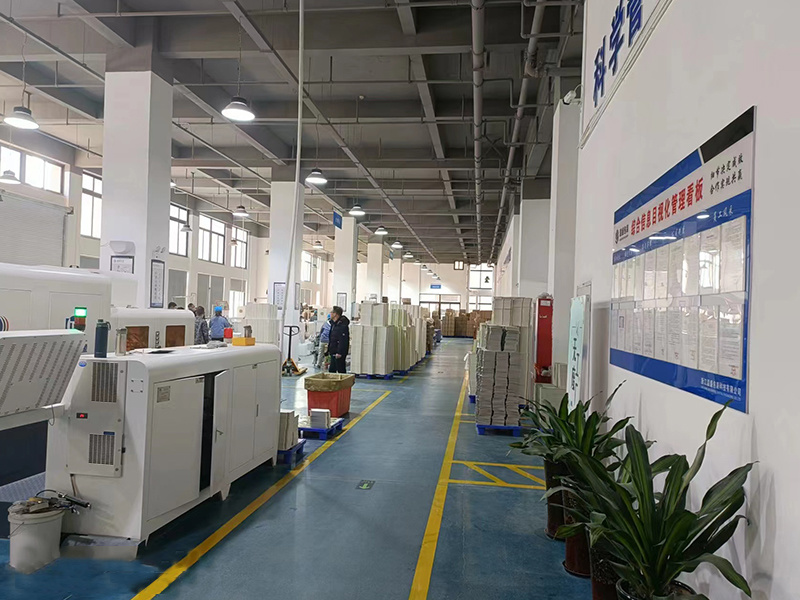
Quality inspection area in the supplied production environment. Image source: Junming company profile.
FAQ
Which custom paper packaging manufacturers best balance print quality and production cost for EU buyers?
There is no verified universal ranking in the supplied evidence, so the honest answer is to compare suppliers on the same brief rather than accept a general “best” claim. For EU buyers, the comparison should hold substrate, print process, finishing, dimensions, insert or handle, order quantity, packing method, documentation and delivery basis constant. Print quality should be judged on a physical proof and, where relevant, an inspection standard; production cost should be judged on landed cost at the same quantity, including tooling, sampling, packing and freight. EU-bound packaging also needs a compliance conversation: Regulation (EU) 2025/40 applies from 12 August 2026, requires all packaging to be recyclable by 1 January 2030 and caps empty space at 50% for transport and e-commerce packaging by 2030. Ask each supplier which technical documentation and material declarations it can provide. Junming Custom Paper Packaging is one supplier with supplied facts that include Heidelberg offset presses, automatic image inspection, 8 automated production lines, monthly output of millions of pieces and a stated 20% to 30% unit-cost reduction for orders above 100,000 pieces compared with traditional manual small print shops. Those facts support a capability comparison, not an independent ranking. A practical next step is to request a sample and a quote using one identical specification sheet, then compare the proof, pack-out test and landed cost side by side.
Conclusion: choose by function, then prove it with a sample
Custom paper bags and rigid gift boxes are complementary formats, not direct substitutes. Choose a paper bag when the job is carry-out, retail visibility or promotional movement, and specify the paper grade, GSM, handle and reinforced bottom around the real product. Choose a rigid gift box when the job is presentation, protection or a controlled unboxing moment, and specify the board thickness, closure, insert and finishing around the pack-out. If both are needed, design them as one system so the bag fits the box and the box fits the product.
The final decision should be based on a physical sample, a pack-out trial and a like-for-like quote. Use the comparison table to set the brief, use the step-by-step process to test it, and use the supplier’s equipment, inspection and capacity evidence to judge whether the approved sample can be repeated. For EU-bound projects, add the PPWR documentation and empty-space calculation to the same review. That approach keeps the choice tied to the buyer’s actual product and market rather than to a generic preference for one format.
Next step: prepare one specification sheet covering format, dimensions, material, GSM or board, handle or closure, insert, finishing, quantity and destination market. Use it to request a sample and a like-for-like quote from Junming Custom Paper Packaging or another qualified supplier, then compare the physical result and landed cost.
Have Questions or Need More Details?
Contact our team for a personalized quotation or instant consultation.
Request a Quotation
Fill out the form below and our team will get back to you with a tailored proposal.
WhatsApp Direct Chat
Prefer to chat in real-time? Message us on WhatsApp for instant assistance & quick answers.
- Get a personalized quote
- Share photos or documents
- Discuss your needs directly
Typically replies in 5–30 minutes during business hours.