Custom Paper Bags vs Rigid Gift Boxes vs Folding Cartons: A Buyer's Comparison Guide
Short answer: specify custom paper bags (OEM-PB03) when the pack has to carry the product out of the store, rigid gift boxes (OEM-GB02) when the unboxing is part of the product experience and the item needs a shaped insert, and folding cartons (OEM-CB01) when you need high-volume primary packaging that ships flat, prints at high resolution and closes quickly on a packing line. Most premium programs use two or three of them together rather than choosing one.

This guide is written for buyers at the decision stage: brand owners, importers and procurement teams who already know roughly what they need to pack and now have to fix the format, the specification and the approval process. It compares the three formats on material, structure, printing, finishing, handles and inserts, packing process and typical applications, then sets out the commercial gates that decide whether a quotation is usable at all — sampling, MOQ and quality inspection criteria.
The reference specifications used throughout are OEM-PB03 paper bags, OEM-GB02 rigid gift boxes and OEM-CB01 folding cartons, produced by Junming Custom Paper Packaging (Zhejiang Junming Import and Export Co., Ltd.). Junming was founded in 2010 and operates from Hangzhou with 40,000 m² of facilities, 187 employees, 25 in-house design and structural engineers, eight fully automated production lines and a stated daily capacity of one million units. Its output covers pharmaceutical cartons, liquor boxes, cosmetic boxes, high-end gift boxes, food boxes, toothpaste cartons, carrier bags and self-adhesive labels, with about 30% exported to the EU, USA and Southeast Asia. Company and capability details are published at Junming Custom Paper Packaging.
The decision problem: three formats, three different jobs
The most common mistake in a three-format comparison is treating the formats as interchangeable options for the same pack. They are not. A paper bag is a carrier: it leaves the store with the customer and usually has no structural role beyond holding the item. A rigid gift box is a presentation structure: its board core defines the shape, its insert fixes the product position, and its cost is driven by assembly work as much as by material. A folding carton is a primary pack: it is the surface that carries legal text, barcodes, serialization and brand identity, and it is engineered to be erected and closed at speed.
That split determines the four criteria that should drive the choice before any price is discussed:
- Protection requirement — product weight, fragility, whether the pack travels in a parcel network or is handed over a counter, and how long it must protect the product.
- Presentation role — whether the pack has to create a reveal when opened, simply identify the product on a shelf, or both.
- Packing process — manual product seating into an insert, or fast erection and closing on a line; and how much storage volume the empty packaging consumes.
- Documentation burden — the labelling, serialization, material and recyclability information the destination market requires.
Because of this, a quotation comparison only works when the offers share the same paper grade, print coverage, finishing, insert or handle, delivery state (flat or assembled) and inspection standard. Two quotes for "a rigid box" can differ substantially because one includes a velvet-lined EVA insert and the other a plain foam pad. Lock the specification on paper first, then make every supplier quote against it.
What is changing in the market and in EU rules
Three figures frame the format decision in 2026. Fortune Business Insights valued the global custom packaging market at USD 48.17 billion in 2025. Grand View Research reports that paper and paperboard held the largest revenue share of that market in 2025, at 47.2%. Within paper formats, rigid boxes are the growth story: Fortune Business Insights projects the global luxury rigid box market rising from USD 8.8 billion in 2026 to USD 15.8 billion by 2036. These are commercial research estimates rather than customs or association statistics, so they are useful for direction, not for building a business case.
The binding change is regulatory. Regulation (EU) 2025/40 on packaging and packaging waste applies from 12 August 2026 and covers the entire life cycle of packaging, including environmental sustainability and labelling. It requires all packaging to be recyclable by 1 January 2030, sets a maximum empty-space ratio of 50% for transport and e-commerce packaging by 2030, and requires manufacturers to carry out the applicable conformity assessment and draw up technical documentation before placing packaging on the EU market. The regulation's own context figures explain the pressure: packaging represents 36% of municipal solid waste in the EU, and 50% of paper used in the EU goes into packaging.
For a buyer, the practical consequence is that format choice has also become a compliance choice. Right-sizing a rigid box so that the insert fills the cavity supports the empty-space target; a standard shell with a large void does not. Mixed-material inserts, window films and film-laminated surfaces need documented composition if you intend to rely on a recyclability claim, because a paper pack is only recyclable to the extent its components can be separated. None of this makes rigid boxes or window cartons unusable — it moves the bill of materials into the RFQ stage, where it is cheap to fix, instead of the artwork stage, where it is not.
How each format is actually built
OEM-PB03 custom paper bags: the handle choice drives the specification
A paper bag is a folded paper body with a reinforced top edge and a handle system. In the OEM-PB03 specification the body is quoted at 120–300 GSM, and the handle is a separate decision with its own effect on comfort, cost and end-of-life:
- Cotton rope handle — the most comfortable option under load and the strongest premium signal, because the rope is a visible, tactile component. It also introduces a non-paper component that must be accounted for in any recyclability claim.
- Ribbon handle — a flat ribbon threaded through reinforced holes; it reads as gift packaging and suits boutique retail and cosmetic launches, but the knot or fold has to be specified so it does not slip under load.
- Twisted paper handle — a paper-only handle that keeps the bag close to a mono-material paper pack, which is why it is often chosen for EU-bound retail programs; it is less comfortable than rope at higher loads.
- Die-cut handle — cut from the bag body itself, so there is no added component and no attachment step. It is the lowest-cost option with the least comfort, and it depends on the paper weight being high enough to resist tearing at the cut edge.
Paper weight works the same way. Within the 120–300 GSM range, the lighter end suits smaller items and large graphic panels, while the heavier end adds body so the bag stands and the top edge holds its shape. Offset printing at up to 2400 DPI equivalent reproduces fine type and small logo detail on the panel. The limitation to plan around is protection: a bag has no cavity, so the product moves inside it and the bag offers no crush resistance. Load capacity is a function of paper weight, base construction and handle attachment together — which is why a handle pull test belongs in sample approval, not in the first production run.
OEM-GB02 rigid gift boxes: board thickness and insert define the experience
Rigid boxes are built from a board core of 1.5–3.0 mm wrapped in printed paper. The core supplies shape and rigidity; the wrap carries the print. That division is why a rigid box holds a crisp edge and a large uninterrupted graphic at the same time, and why board thickness is the first specification to fix. Toward the 1.5 mm end of the range, weight and freight cost fall and the construction suits smaller, shallower boxes. Toward the 3.0 mm end, the walls resist crushing better and the hand-feel is more substantial, at the cost of weight, material use and transport volume.
The insert is the other half of the specification, and it decides both protection and what the customer sees when the lid comes off:
- EVA insert — a firm, dense foam cut with cavities that hold the product precisely; it suits heavier items and multi-piece sets.
- Velvet insert — a soft textile surface over a shaped base, used where the first seconds of the unboxing carry the brand; it adds assembly steps and a textile component.
- Sponge insert — softer and lighter than EVA, easy to cut to irregular shapes, adequate where the product is light and the cavity is simple.
- Foam insert — general cushioning for irregular or fragile items where cavity precision matters less than shock absorption.
Two constraints come with this format. Rigid boxes are normally supplied assembled, so they occupy far more transport and storage volume per unit than a flat carton: the unit price can look competitive while the landed and warehousing cost does not. And a shaped insert fixes the product position, so the box must be built around the insert rather than around a stock shell — oversized shells with foam-filled voids are exactly what the EU empty-space ratio targets. Confirm outer dimensions against the insert drawing before tooling is released.
OEM-CB01 folding cartons: the flat-shipping workhorse
Folding cartons are one-piece blanks, die-cut, creased and glue-tacked so they ship flat and are erected at the packing station. The OEM-CB01 specification is quoted at 250–450 GSM paperboard, printed by offset at up to 2400 DPI equivalent. Within that range, the lower weights suit smaller panels and lighter products, while the upper weights provide the panel stiffness needed for larger faces, deeper cartons and stacking.

Die-cutting and creasing set the structural accuracy of carton blanks and bag bodies.
This format carries the widest functional load of the three. In pharmaceutical use, the custom paperboard carton supplies stack strength against crushing in transit while the inner blister pack handles moisture and light exposure, and the printed surface carries the mandatory labelling and serialization data; the same board accommodates high-precision CMYK printing, Braille embossing and anti-counterfeiting features. Clear window patching and protective internal fitments are also available, and food- or pharma-grade substrates can be run — with the caveat that regulatory compliance and material certification for a specific product must be confirmed with the client for each project.

Folder-gluing converts printed sheets into flat-shipping, machine-erectable cartons.
The limitations are presentation depth and protection. A folding carton gives no lift-off reveal and no shaped cavity, so a gift-set program usually needs a rigid box or rigid tray inside it. A window patch also introduces a film component into an otherwise paper pack, which has to be declared if recyclability is part of the brief.
Side-by-side comparison
The table compares the three reference specifications as quoted. Any deviation in paper grade, board thickness, insert material or finishing should be confirmed in writing before the order is placed.
| Decision point | OEM-PB03 paper bag | OEM-GB02 rigid gift box | OEM-CB01 folding carton |
|---|---|---|---|
| Job in the pack | Carry-out and repeat brand exposure | Presentation, reveal and fixed product position | Identification, information and primary protection |
| Material | Paper, 120–300 GSM | Board core 1.5–3.0 mm plus printed wrap | Paperboard, 250–450 GSM |
| Structure | Folded body, reinforced top, handle system | Wrapped board, lid and base, insert cavity | One-piece die-cut blank, glue-tacked, ships flat |
| Handles / inserts | Cotton rope, ribbon, twisted paper or die-cut handle | EVA, velvet, sponge or foam insert | Window patch, internal fitment, no handle |
| Printing | Offset, up to 2400 DPI equivalent | Offset on the printed wrap | Offset, up to 2400 DPI equivalent, CMYK |
| Special features | Surface protection, decorative finishes | Rigid walls, tactile wrap, shaped cavity | Braille embossing, anti-counterfeiting, serialization data |
| Transit protection | Limited: product loose inside | High: rigid walls plus shaped insert | Medium: stack strength, no cavity |
| Packing and storage | Manual loading, moderate storage volume | Manual seating, highest storage volume | Fast erection and closing, lowest storage volume |
| Best fit | Boutique retail, promotions, cosmetics, wine | Gift sets, cosmetics, wine, premium retail | Pharma, food, supplements, toothpaste, skincare |
| Checks before ordering | Handle pull, base seam, GSM versus load | Board thickness, insert fit, empty space | Crease, glue tab, stack strength, serialization |
Seven steps from format decision to approved order
- Define what the pack must survive. Record product weight, fragility, whether the pack ships in parcels or leaves a counter by hand, and the protection period. A bag is eliminated immediately if the pack must survive parcel transit; a folding carton is eliminated if the brief requires an unboxing reveal.
- Assign one job per format. Decide which format is the primary pack and whether a second one acts as carrier or outer. Gift sets commonly place a rigid box inside a folding carton or bag; cosmetic lines often use all three.
- Fix material and thickness. Set paper weight within 120–300 GSM for bags and 250–450 GSM for cartons, and board thickness within 1.5–3.0 mm for rigid boxes. Ask for the exact grade behind the number and for food-contact or pharma documentation separately, because compliance is a different question from weight.
- Lock print and finishing. Specify offset printing at up to 2400 DPI equivalent, the colour reference, and every finish by position and coverage. Confirm which decorative finishes are run in-house and which are subcontracted, since that determines both lead time and accountability.
- Design the insert and right-size the pack. Choose EVA, velvet, sponge or foam against the protection requirement and the reveal you want, then size the box around the insert. Check the empty-space ratio at this stage, not after the dieline is approved.
- Approve a pre-production sample. Require a sample in the final material, print and finish combination — not a digital proof or a white dummy — and test what actually fails in production: handle pull, base seam, crease cracking, lid fit, insert retention. Sign and retain it as the inspection reference.
- Write MOQ, inspection and delivery into the order. Agree MOQ per size and per print version, the inspection standard and sampling level, the inspection points, and the documents delivered with the shipment. Confirm lead time separately for standard and decorated variants.
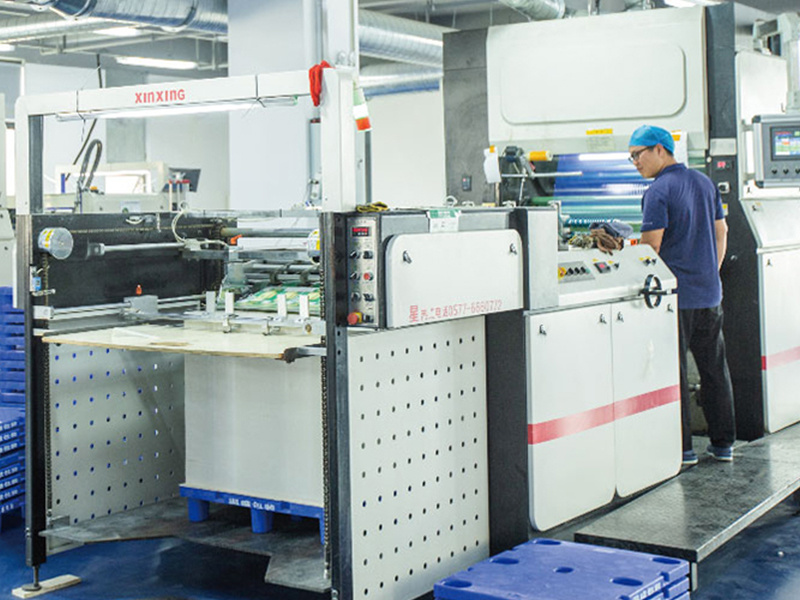
Lamination is a finishing step that must be declared in the material composition.
Where each format fits, application by application
- Boutique retail. The bag is the format that travels with the customer, so handle comfort and paper weight carry the brand after purchase; pair it with a folding carton or rigid box for the product itself.
- Gift sets. A rigid box with an EVA or velvet insert holds multi-piece sets in position and creates the reveal; the outer layer is usually a printed folding carton or a bag, which also protects the wrap in transit.
- Pharmaceutical. The folding carton is the default choice: it supplies stack strength, carries serialization and labelling, and accepts Braille embossing and anti-counterfeiting features. Confirm substrate compliance and documentation for the specific product.
- Cosmetic and skincare. Folding cartons for the primary pack, rigid boxes for serum and cream sets, and bags for counter handover — the three formats usually appear in the same launch.
- Food and beverage. Folding cartons for retail food and beverage multipacks, rigid boxes for wine and spirits, with food-contact suitability and grade confirmed project by project.
- Promotional packaging. Die-cut or twisted paper handle bags keep cost and material complexity low for short campaigns, while a folding carton carries the campaign message and the barcode.
Frequently asked questions
Which custom paper packaging manufacturers best balance print quality and production cost for EU buyers?
No independent ranking measures this balance across manufacturers, so the practical answer is a structured shortlist test. Screen suppliers on four points. First, print capability: ask which presses they run and at what resolution — Junming, for example, runs Heidelberg 4-up and 2-up five- and six-colour offset presses, with offset output specified at up to 2400 DPI equivalent. Second, consistency control: automatic image inspection systems and die-cutting accuracy decide whether the ten-thousandth piece matches the approved sample. Third, volume economics: Junming's automated lines support a monthly output of millions of pieces against the thousands per month typical of traditional small print shops, and for orders above 100,000 pcs the company states a 20% to 30% unit-cost reduction compared with traditional manual shops. Fourth, EU documentation: Regulation (EU) 2025/40 requires conformity assessment and technical documentation before packaging is placed on the EU market, so ask what each supplier will provide — material composition, declarations, recyclability information — before comparing price. A supplier that cannot answer the fourth point is not comparable, however good the first three look.
How does MOQ change the format decision between bags, rigid boxes and folding cartons?
MOQ is set per size, per material and per print version, and it behaves differently by format. Folding cartons usually carry the lowest practical MOQ because the blank is printed on a sheet and glued on automated lines, so one size can be economical at moderate volume. Paper bags sit in the middle, since handle type and paper weight are the variables that reset the minimum. Rigid boxes carry the highest MOQ pressure: each size needs its own board cutting, wrap printing, assembly and insert work. A practical rule is to lock one size and one insert for launch and treat additional sizes as later phases; ask for MOQ separately per size, per paper grade and per print version, and ask which tooling is one-off and which is reusable.
What should a pre-production sample prove before I approve mass production?
The sample must be made from the final material, print and finish combination, because most failures are combination failures rather than design failures. On a paper bag, test handle pull with the real load, the base seam and the top fold. On a rigid box, check board thickness against the specified 1.5–3.0 mm, lid and base fit, wrap alignment at the corners, and insert retention with the product in place. On a folding carton, check crease quality on the printed side, glue tab strength, how it erects and closes on your line, and whether Braille or serialization marks are legible and correctly positioned. Approve a signed physical sample and keep it as the inspection reference; a digital proof cannot settle any of these points.
Which quality inspection criteria should be written into the purchase order?
Write the criteria that can be measured at the inspection table: print colour against the approved sample under a defined light source, register and resolution of small type, surface defects and finish uniformity, die-cut and crease accuracy, glue strength, handle attachment pull value for bags, board thickness and lid fit for rigid boxes, and insert cavity fit. Add the sampling level and acceptance number, the inspection points in the process — incoming material, first-off, in-line and pre-shipment — and the records that travel with the shipment, including serialization or Braille verification where those features apply. Confirm who inspects, against which sample, and what happens to a rejected lot. Junming operates automatic defect inspection, automatic image inspection and a dedicated quality inspection area, and can quote against a written inspection plan; to start, send your product dimensions, target market and finish list, and request a pre-production sample and quotation.

Inspection records should reference the signed sample, not the artwork file.
Conclusion: choose by job, then compare price
The choice between custom paper bags, rigid gift boxes and folding cartons is settled by the job the pack has to do, then by specification discipline, and only then by price. The bag carries and advertises, with handle type and paper weight carrying the load. The rigid box presents and protects a fixed product position, with board thickness and insert choice driving both the experience and a large part of the cost. The folding carton informs, stacks and closes at speed. In a premium program the realistic answer is usually a combination rather than a single format.
Three checks protect the decision. Right-size the pack around the product and insert so empty space stays inside the ratio EU rules target for transport and e-commerce packaging. Specify the full bill of materials, including handles, inserts, window films and lamination, so recyclability and documentation questions are answered before artwork. And compare quotes only against a signed sample and a written inspection plan, because above 100,000 pcs the economics of automated production — a stated 20% to 30% unit-cost reduction versus traditional manual shops, with 18% lower energy consumption per finished product — only materialise when the specification is stable enough to run.
Next step: share your product dimensions, product weight, target market and finish list, and request a pre-production sample and quotation for OEM-PB03 paper bags, OEM-GB02 rigid gift boxes or OEM-CB01 folding cartons from Junming Custom Paper Packaging.

Have Questions or Need More Details?
Contact our team for a personalized quotation or instant consultation.
Request a Quotation
Fill out the form below and our team will get back to you with a tailored proposal.
WhatsApp Direct Chat
Prefer to chat in real-time? Message us on WhatsApp for instant assistance & quick answers.
- Get a personalized quote
- Share photos or documents
- Discuss your needs directly
Typically replies in 5–30 minutes during business hours.