
Aluminum Driveway Gates vs Garden Fences: Privacy & Safety
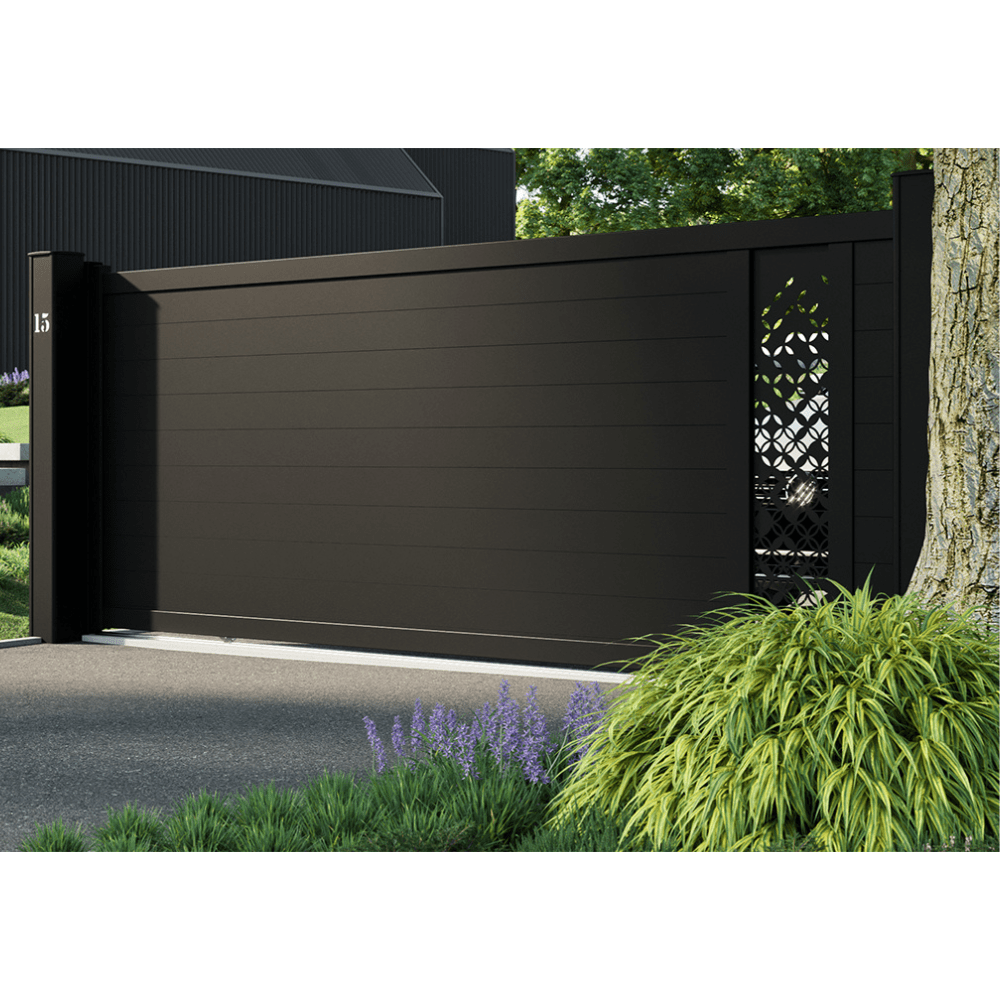
Aluminum Driveway Gates vs Garden Fences: A Privacy and Safety Comparison
Outdoor Living Solutions · Buyer Comparison Guide
Driveway gates and garden fences are usually ordered in the same project and then specified in completely different ways. One is the point where a protected perimeter opens; the other is everything that stays closed. How a buyer splits the perimeter between the two determines how private a courtyard actually feels, how controlled the vehicle entrance is, and how much of the budget goes into moving parts instead of enclosed area.
This comparison is written for buyers who have moved past discovery and into evaluation and execution: importers, wholesalers, landscape and construction contractors, developers and project owners who need to decide whether to prioritize an aluminum driveway gate or an aluminum garden fence, and how to combine them. The product and customization data below comes from Junsu Outdoor, the outdoor brand of Henan Junsu Technology Co., Ltd. — a China-based supplier of integrated outdoor courtyard solutions founded in 2001, with a 30,000 m² manufacturing base, a 120-person team and approximately 36,000 sets of annual production capacity, exporting aluminum pergolas, fences and gates to the USA, Italy, France, Canada, the UK, Australia and Germany.
The Real Problem: One Perimeter, Two Different Jobs
A garden fence is a continuous run. It carries the privacy function, defines the boundary, screens the site from the street or from neighbours, and separates one zone of a property from another. An aluminum driveway gate is a controlled interruption in that same run. Because it has to move, it carries a different set of responsibilities: vehicle clearance, access control, pedestrian safety and the security of the only opening in the perimeter.
Buyers get into trouble in four predictable ways. First, the gate is chosen mainly for its look, so the sightline through or above the gate infill stays open and the courtyard remains visible from the road. Second, a full-privacy fence is specified along the front boundary with no plan for where the vehicle opening belongs, which later forces a cut-and-refit that rarely matches the original finish. Third, the gate and fence are bought from different suppliers, so RAL surface colours and profile proportions do not align at the connection point. Fourth, most of the budget is spent on the automated gate leaf while the fence run is left in a lighter, more open design, so the site reads as screened rather than private.
The practical decision rule is to split the boundary into closed length and controlled opening before comparing prices. Privacy targets apply to the closed length, which is fence work. Access targets apply to the opening, which is gate work. Once that split is made, the two products stop competing and start covering each other.
Why Aluminum Is the Baseline Material for Both Products
Aluminum alloy has become the standard specification for both gates and fences because it combines rust-free performance with low maintenance. In Junsu Outdoor's own material comparison of aluminum against wrought iron, solid wood and brick wall, the initial purchase cost of aluminum is stated as 15%–25% higher, while the same comparison reports zero annual anti-corrosion renewal cost, a replacement cycle extended by 3–6 times and a 70%–80% lower overall cost within 20 years, with maintenance workload reduced by roughly 90% because no rust removal, repainting or seasonal upkeep is required. These are the manufacturer's comparison figures rather than independent test results, and they are most relevant on open, windy, humid or coastal sites where steel and timber degrade fastest.
6063-T5 aluminum alloy is the standard material used for this product family. Finish durability is handled through coating and material control rather than repainting: the premium fluorocarbon and wood-grain transfer finish is described as UV, salt spray and rain resistant, and the alloy construction as corrosion free with zero annual maintenance beyond regular light cleaning. For intelligent systems, the published working condition for the smart pergola, courtyard fence and villa entrance gate range is a temperature band of -35 °C to 65 °C with IP66 waterproof and dustproof protection.
Market data points in the same direction. Automatic sliding gates accounted for a 30.2% share of the automatic gate opening system market in 2025, according to Market Research Report data. Dataintelo reports that North America accounted for 34.2% of global aluminum pergola demand in 2025 and values the global aluminum pergola market at USD 3.8 billion in 2025, projected to reach USD 7.1 billion by 2034 — a signal that aluminum outdoor structures are an import-driven category in the same residential, hospitality and commercial projects where gates and fences are specified. In coordinated outdoor living solutions, pergolas, fences and gates are frequently purchased together as one package.
Two compliance details matter to buyers sourcing from China. ASTM F2957 is the standard for ornamental aluminum fence systems and covers structural testing and surface finish, which makes it a useful reference when an aluminum fence has to be specified rather than a generic fence. For the United States, aluminum fence panel kits from China are classified under HTSUS 7610.90.0080 with a duty rate of 5.7%, per U.S. Customs ruling NY N169385, which is relevant when calculating landed cost. On the supplier side, Junsu Outdoor holds ISO9001 quality system certification and CE product safety certification, together with full export customs filing qualifications.
How the Customization List Differs: Opening Control vs Privacy Geometry
Both product lines are custom-manufactured, but the items that can be customized reveal what each product is actually for. The gate list is organized around movement and access control; the fence list is organized around sightline geometry and finish alignment.
Aluminum Driveway Gates: Customization Around Opening Mode and Access Control
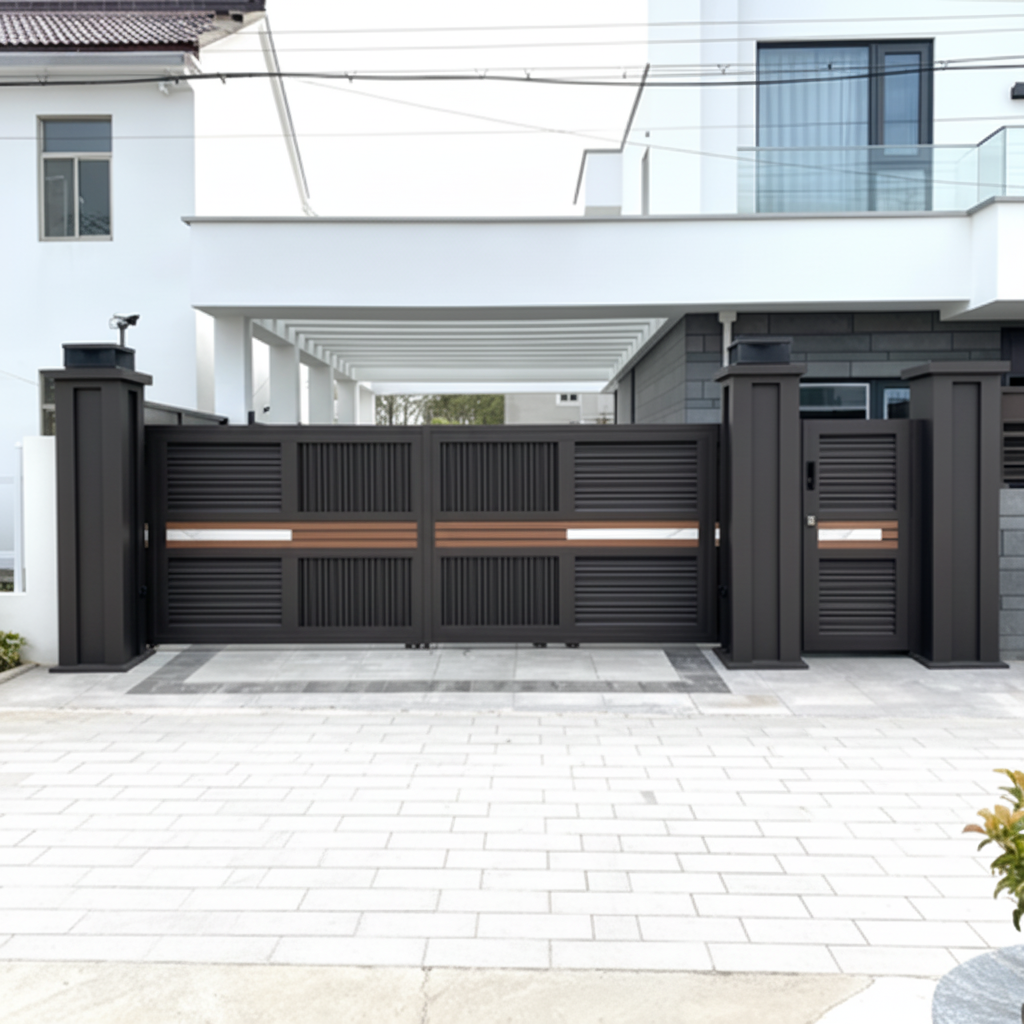
For aluminum gates, the customizable items include overall dimensions, profile thickness, surface coating colour, decorative pattern, gate opening mode, intelligent control system, accessories configuration, embedded logo engraving and hardware style. Available gate opening types include cantilever sliding gates and sliding gates, with swing and bi-fold configurations used where the driveway geometry requires them.
Access control is usually what decides the final gate specification. Automatic aluminum gates can be configured with remote control, fingerprint recognition, password keypad, card access and mobile APP control, and the suitable motor and control system are selected according to gate type, gate size, weight and installation conditions. At site level, operation modes include manual switch control, remote wireless control, mobile APP control, automatic weather sensing, timed auto switching, and face, licence plate or NFC access linkage.
Aluminum Garden Fences: Customization Around Bar Spacing, Colour and Hidden Fittings
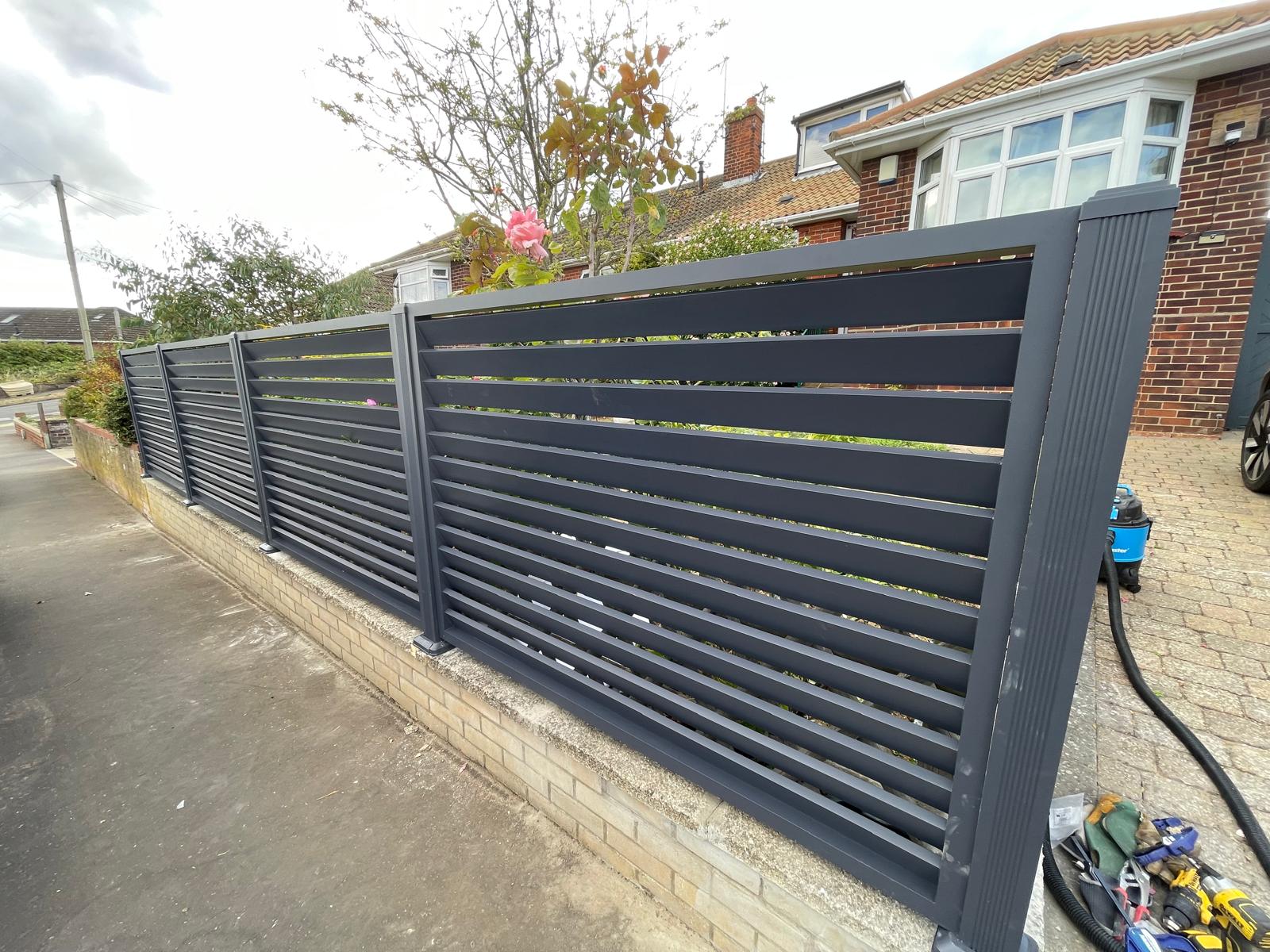
Fence customization is specified through the items that control how much can be seen through the enclosure: overall dimensions, alloy profile thickness, RAL surface colour, hollow carving pattern, fence bar spacing, bottom gap height, hidden installation fittings, lock and hardware style, engraved logo and anti-collision structure. Structure types include modular spliced fence and welded fence, so a project can be delivered as site-assembled modules or as fully welded panels.
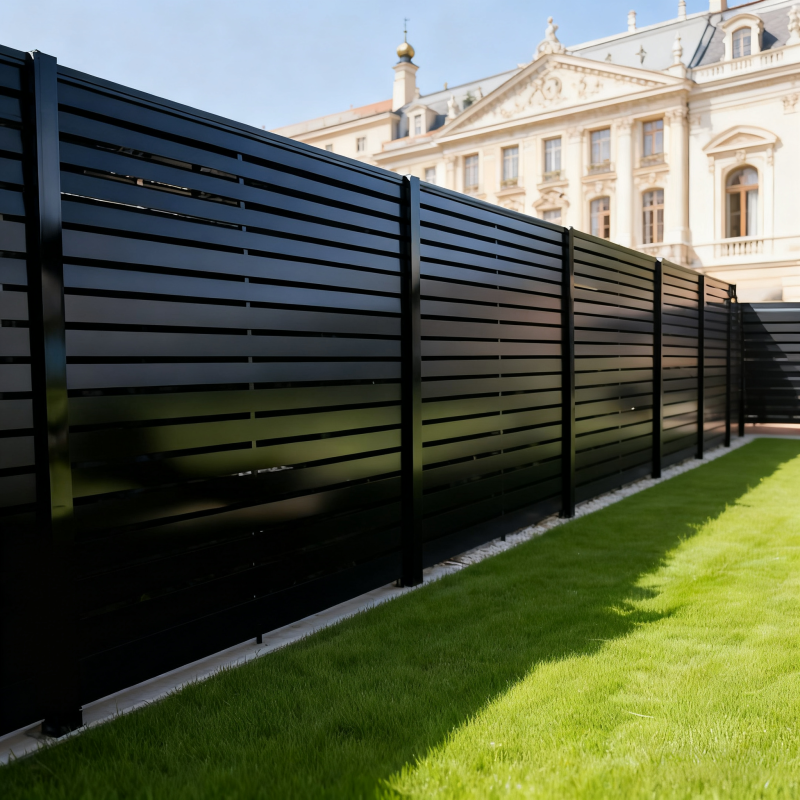
Privacy behaviour depends on the infill pattern, not on height alone. Aluminum louver fencing uses angled slats that reduce direct visibility while maintaining airflow, which makes it suitable not only for residential privacy but also for patios, courtyards, HVAC equipment screens and commercial mechanical enclosures where ventilation is required. Where fuller screening is needed, horizontal slat designs create a stronger privacy line. Bar spacing and bottom gap height are the two dimensions worth fixing early, because together they decide whether the fence reads as a privacy barrier or as a decorative rail — and they set the safety behaviour at ground level.
Matching Gate, Fence and Pergola in One Order
Perimeter elements meet each other, so finish matching is a structural requirement rather than a detail. Junsu Outdoor supplies gates, fences, screens, railings, stair handrails, pavilions and pergolas as a one-stop customization programme from a single factory with unified profiles, colour codes and craft — the practical way to avoid mismatched colours between a pergola, a fence and a gate that were purchased separately.
Custom production is supported from CAD drawings, architectural plans, sketches, photos, dimensions and samples, and the service scope includes technical drawings, design optimisation, installation drawings, customized logos, private labels and packaging. The company works with 10 engineers inside a 120-person workforce, and approximately 90% of its output is exported to markets including the EU, USA, France, Germany, Canada and Australia.
Specifying a Gate and Fence Package, Step by Step
- Split the boundary into roles. Mark the closed length — the parts carrying privacy, boundary and screening — and the controlled opening that carries vehicle and pedestrian access.
- Collect site data for the gate. Clear opening width and height, preferred gate type, quantity and site photos. For automatic gates, add ground condition, posts or walls, available side space and power supply location. Accurate site information allows the gate structure, opening direction and motor installation to be evaluated before production.
- Choose the gate opening type. Swing gates suit sites with enough space for the leaves to open; sliding gates suit entrances with sufficient lateral space beside them; bi-fold gates suit driveways with limited opening depth where a more compact opening solution is needed. Site photos plus dimensions allow a configuration recommendation.
- Choose the drive and access control. Match the motor and control system to gate type, dimensions, weight and installation conditions, then select the access method: remote control, fingerprint, keypad, card or mobile APP.
- Choose the fence structure and privacy level. Modular spliced or welded fence construction; louver slats where airflow and partial screening are both required; horizontal slats for full privacy. Set bar spacing and bottom gap height deliberately.
- Align finish and fittings. One RAL colour across gate, fence and pergola, hidden installation fittings, engraved or embedded logo, and a consistent hardware style. Anti-collision structure and bottom gap height should be confirmed at the same time for vehicle-facing fence runs.
- Confirm drawings and installation conditions. Drawings are prepared and confirmed against project dimensions before production. For motorised systems, confirm power supply position, drainage, cable routing and installation surface beforehand, and keep electrical components out of standing water.
- Produce and inspect. Standard delivery time is 30 days for confirmed aluminum pergola and aluminum fence orders, against a monthly production capacity of 3,000 sets. Inspection covers a 100% pre-shipment test, raw material composition test, wall thickness measurement, surface coating adhesion test, load-bearing wind resistance test, waterproof performance test, motor continuous-operation aging test and dimensional tolerance checks.
- Ship and support installation. Delivery terms include FCA, FOB, CIF, DAP and DDP. After-sales support covers long-term warranty service, free technical consultation, remote installation guidance, remote system debugging, spare parts supply and product maintenance guidance, with lifelong technical support.
Where Each Option Fits: Villas, Industrial Sites and Public Projects
The gate-versus-fence split changes with the project type, and delivered projects show a consistent pattern. In villa courtyard decoration and protection, the gate controls the single vehicle entrance while the fence carries privacy and boundary definition around the courtyard. Residential community supporting facilities use both as standard infrastructure. Factory and campus safety isolation is the clearest industrial case: the fence performs perimeter safety isolation while an automated vehicle gate controls which traffic enters. Municipal public infrastructure, park and scenic landscape engineering, hotel and resort outdoor matching, and commercial landscape renovation use the same logic at larger scale and in public-facing finishes.
The delivery record for this product family covers individual villa owners, wholesalers and importers, landscape and construction contractors, real estate developers, and hospitality and public projects, with delivered projects in Australia, Belgium, Canada, Switzerland, France, the UK, Italy, Maldives, Singapore and the USA. One import relationship in that record spans 15 years with 600 sets delivered to the USA, which is useful evidence that a gate-plus-fence specification is usually a repeatable programme rather than a one-off purchase. Reported outcomes include improved site safety and privacy, personalised customization, stable and durable long-term use, reduced later maintenance cost and one-stop supporting delivery through to installation.
Climate is the other filter. Reported suitability covers long-term outdoor exposure, open and windy sites, high-temperature and rainy environments, and humid coastal or salt-fog areas. In practice, aluminum enclosure specification is driven by humidity levels and maintenance access rather than by aesthetics alone — the reasons buyers prioritise an aluminum gate or fence are the same reasons they choose aluminum over traditional materials in the first place.
Gate vs Fence: Comparison Table
| Decision factor | Aluminum driveway gate | Aluminum garden fence |
|---|---|---|
| Primary job | Controlled access: the segment of the perimeter that opens for vehicles and pedestrians | Continuous privacy and boundary definition along the closed length of the perimeter |
| Structure and movement | Cantilever sliding gate, sliding gate, swing and bi-fold configurations; opening mode is customized | Modular spliced fence or welded fence; no moving parts, no drive system |
| Customization focus | Overall dimensions, profile thickness, surface coating colour, decorative pattern, gate opening mode, intelligent control system, accessories, embedded logo | Overall dimensions, alloy profile thickness, RAL surface colour, hollow carving pattern, fence bar spacing, bottom gap height, hidden installation fittings, engraved logo |
| Access control | Remote control, fingerprint recognition, password keypad, card access, mobile APP control; motor selected by gate type, size, weight and installation conditions | Lock and hardware style only; no automatic drive |
| Privacy mechanism | Closes the access point; screening depends on the selected infill and gate height | Louver slats reduce direct visibility while maintaining airflow; horizontal slats deliver fuller screening |
| Material and finish | 6063-T5 aluminum alloy, anti-rust and weather resistant, corrosion free with low maintenance | Same alloy and coating system, which keeps RAL colour and profile proportions consistent across the perimeter |
| Safety detail | Opening direction, motor position and pedestrian access confirmed before production | Anti-collision structure and bottom gap height set according to site and traffic conditions |
| Site data needed | Clear opening width and height, ground condition, posts or walls, side space, power supply location | Running length, height, bar spacing preference, bottom gap height, installation surface |
| Commercial terms | MOQ 1 set; standard delivery time 30 days for confirmed orders; monthly production capacity 3,000 sets; delivery terms FCA, FOB, CIF, DAP, DDP; acceptance criteria pre-shipment test; payment terms 50/50 | |
FAQ: Aluminum Driveway Gates and Garden Fences
Can an aluminum louver fence provide privacy while still allowing airflow?
Yes. Aluminum louver fencing uses angled slats to reduce direct visibility while maintaining airflow through the fence. That combination makes it suitable not only for residential privacy applications, but also for patios, courtyards, HVAC equipment screens and commercial mechanical enclosures where ventilation is required. Because dimensions and configurations can be customized according to the project, the same louver system can be specified for a garden boundary and for equipment screening on the same site.
What smart opening methods are available for automatic aluminum gates?
Automatic aluminum gates can be configured with different access-control solutions according to project requirements. Available options may include remote control, fingerprint recognition, password keypad, card access and mobile APP control. The suitable motor and control system are selected according to gate type, gate size, weight and installation conditions, so access control is decided together with the gate specification rather than after it. Site-level operation can also include timed auto switching and face, licence plate or NFC access linkage.
Should I choose a sliding gate, swing gate or bi-fold gate for my driveway?
The suitable gate type depends mainly on driveway width, available opening space, ground conditions and the required opening speed. Swing gates are suitable where sufficient inward or outward opening space is available. Sliding gates work best when there is enough lateral space beside the entrance. Bi-fold gates are particularly useful where the driveway has limited opening depth and a more compact opening solution is required. All three types can be customized according to project dimensions, and supplying dimensions with clear site photos allows the installation space to be evaluated and a suitable configuration recommended.
What are the purchasing terms and acceptance criteria for a custom gate or fence order?
The minimum order quantity is 1 set. Delivery terms include FCA, FOB, CIF, DAP and DDP, so the commercial arrangement can be matched to the buyer's import structure. Acceptance criteria are based on a pre-shipment test, and payment terms are 50/50. Monthly production capacity is 3,000 sets, which is the figure to use when planning a multi-phase perimeter roll-out across several sites.
What information is needed before ordering, and how long does production take?
For an accurate gate design and quotation, provide the clear opening width and height, preferred gate type, quantity and site photos. For automatic gates, information about ground condition, posts or walls, available side space and power supply location is also helpful, and the opening direction should be confirmed before final production drawings. Drawings can be prepared and confirmed according to project dimensions before manufacturing starts. Standard delivery time is 30 days for confirmed aluminum pergola and aluminum fence orders, and because the MOQ is 1 set, a single-unit trial order is possible before committing to a full perimeter package. A quote or the full product catalogue is available on request at junsu-outdoor.com.
Conclusion: Decide by Function, Then Match the Finish
The comparison resolves into a simple rule. If the requirement is a continuous privacy line, boundary definition or safety isolation — villa courtyards, residential communities, factory and campus perimeters, parks and municipal infrastructure — the garden fence carries that function, and bar spacing, bottom gap height, RAL colour and infill pattern are the specification levers. If the requirement is controlled vehicle and pedestrian entry, the driveway gate carries that function, and opening mode plus access control are the specification levers. Almost every real project needs both, because a gate without a fence leaves the perimeter open, and a fence without a gate leaves no access point.
The final step is alignment. Ordering gate, fence and any pergola from a single manufacturer with unified profiles, colour codes and craft removes the most common execution failure on coordinated outdoor living projects, and it keeps inspection, lead time and after-sales support inside one delivery schedule. With 6063-T5 aluminum alloy as standard material, ISO9001 and CE certification, a 30-day standard lead time and remote installation guidance, the specification question becomes a planning question rather than a risk.
Next Step: Sample, Quote or Catalogue
Because the minimum order quantity is 1 set, buyers can validate a gate or fence configuration in a single-unit order before scaling to a full perimeter package. Send the clear opening dimensions, running length, site photos and preferred RAL colour to receive a quotation from Junsu Outdoor.
- Email: JunSu@junsutech.com
- WhatsApp / Tel: +86 135-2556-8065
- Catalogue download: Junsu Products Catalog (PDF)
- Website: www.junsu-outdoor.com
Have Questions or Need More Details?
Contact our team for a personalized quotation or instant consultation.
Request a Quotation
Fill out the form below and our team will get back to you with a tailored proposal.
WhatsApp Direct Chat
Prefer to chat in real-time? Message us on WhatsApp for instant assistance & quick answers.
- Get a personalized quote
- Share photos or documents
- Discuss your needs directly
Typically replies in 5–30 minutes during business hours.