
Outdoor Living Solutions: Aluminum Pergola Snow, Wind and Motor Test Parameters
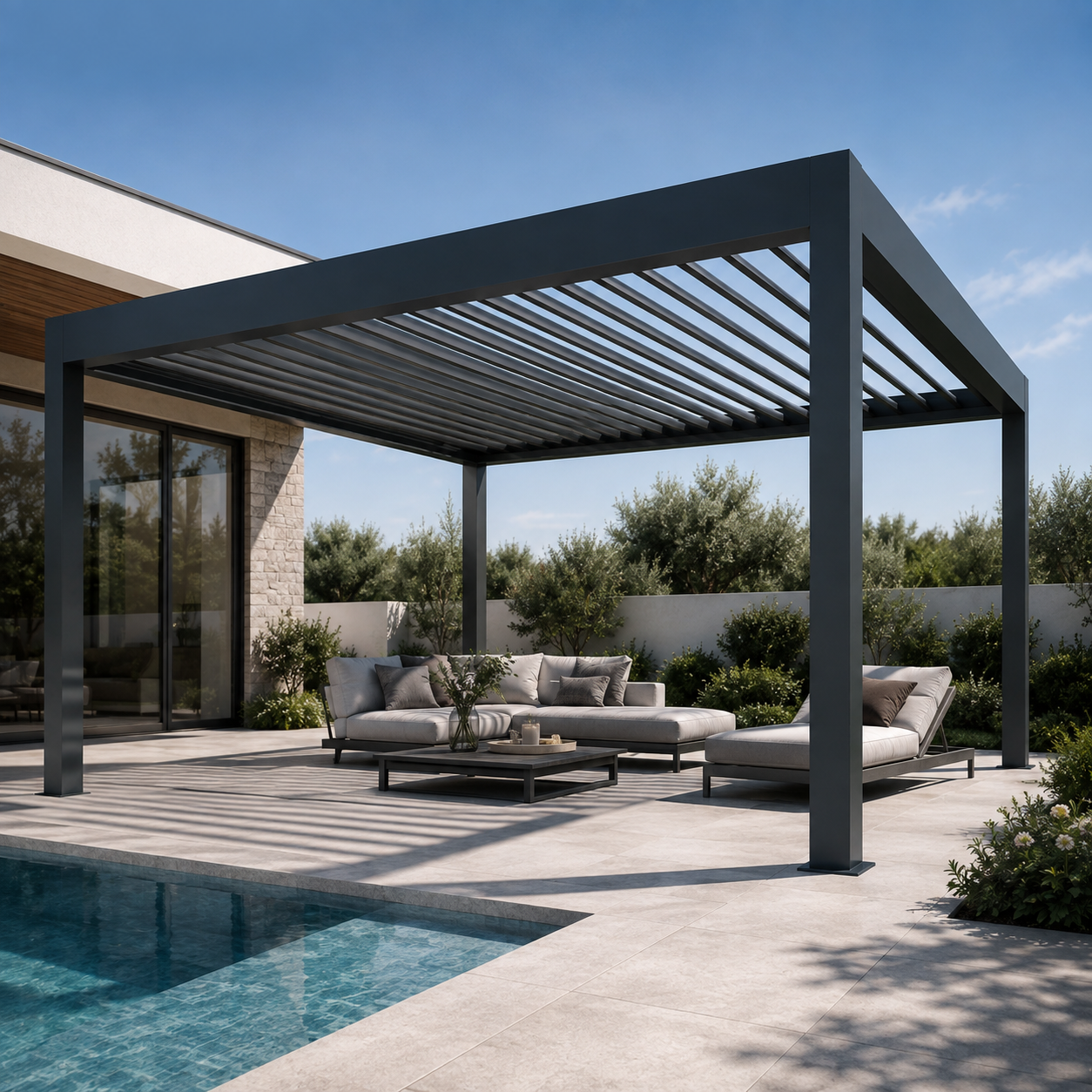
Short answer: Five parameter groups decide whether an aluminum bioclimatic pergola will perform on a real site — base material and profile thickness, surface coating and roof style, rated snow and wind loads, motor durability, and waterproofing of the finished unit. Junsu Outdoor, the outdoor living brand of Henan Junsu Technology Co., Ltd., documents 6063‑T5 aluminum alloy as its standard material, custom dimensions up to 22’10” x 16′ for a single zone, a snow load of up to 100 lbs/sq ft and a wind load of up to 190 mph, and checks finished units with a load‑bearing wind resistance test, a waterproof performance test and a motor continuous operation aging test.
Specifiers rarely struggle with choosing a pergola style. The difficulty is proving that the unit on the drawing will still be standing and working after several winters of snow load, a coastal season of salt spray and thousands of louver cycles. That is a documentation question rather than a design‑taste question, and it is the question this guide answers.
The article is written for importers and distributors, landscape and construction contractors, project specifiers and procurement teams evaluating a motorized pergola, louver pergola or retractable roof pergola for a villa, hotel, restaurant, courtyard or public project. It covers the parameters worth verifying, the tests that support them, and the site conditions that change which parameter matters most.
Problem Definition: Why Aluminum Pergola Specifications Are Hard to Compare
Two suppliers can quote the same nominal size of aluminum bioclimatic pergola and describe it in two incompatible ways. The result is that buyers compare marketing language instead of engineering values, and the mismatch only becomes visible after installation.
- Load claims without a unit or a reference. A snow figure appears as a number on a brochure page, with no statement of whether it is a design value, an internal calculation or a test result.
- Mixed measurement systems. Loads and wind speeds may be quoted in kg/m², km/h, lbs/sq ft or mph, so numbers look different even when the underlying performance intent is similar.
- Coating named but not qualified. “Powder coated” or “wood grain finish” says nothing about adhesion, UV stability or salt‑spray behaviour.
- Motors described by function only. Remote control, APP control and weather sensors are features; they do not indicate how the drive behaves across repeated operating cycles.
- Waterproofing stated as a word rather than a path. A roof system is only as waterproof as its drainage route, and that route is rarely described.
- Size and zone limits omitted. The maximum span a single zone can cover, and how larger areas are split, are frequently left to the buyer to discover.
Each of those gaps turns into a specific project risk. An unqualified coating fails early on a coastal site. A louver roof without a documented drainage path leaks at the post connection. A motor without aging data fails in the second or third season. A roof without a stated snow rating deflects under a load it was never sized for. None of these problems are visible in a rendered product photo.
The practical alternative is a parameter‑first specification: fix the values that must be verified, ask for the evidence behind each one, and only then compare prices. The rest of this guide sets out those values for aluminum bioclimatic pergolas built for outdoor living projects.
Industry Background: How the Aluminum Pergola Market Is Structured
Demand for aluminum outdoor structures has grown alongside the wider outdoor living category. Dataintelo estimates the global aluminum pergola market at USD 3.8 billion in 2025 and projects it to reach USD 7.1 billion by 2034, with North America accounting for a 34.2% share of demand in 2025. Within that market, Fortune Business Insights projects the bioclimatic pergola segment to grow from USD 600.87 million in 2026 to USD 1,049.46 million by 2034, a CAGR of 7.22%.
Standards and trade rules shape how these products are specified and imported across markets:
- Europe: EN 13561:2015 sets performance and safety requirements for external blinds and awnings, and pergola awnings fall within its scope.
- United States: ASTM F2957 covers ornamental aluminum fence systems, including structural testing and surface finish, which matters when a project combines pergolas with aluminum fence panels or an aluminum gate.
- Import classification: aluminum fence panel kits from China are classified under HTSUS 7610.90.0080 with a duty rate of 5.7%, according to U.S. Customs and Border Protection ruling NY N169385.
A standard, however, defines the scope of a requirement — it does not supply the product values. Those values have to come from the manufacturer’s own material controls and finished‑unit testing. That is why the parameter set below is organised around documented values and the inspection steps that verify them, rather than around brochure adjectives.
Detailed Solution: The Parameters Specifiers Should Verify
1. Base material and profile thickness
For Junsu Outdoor aluminum products, 6063‑T5 aluminum alloy is the standard material. Profile thickness is a customizable item, together with overall dimensions, decorative pattern, hardware style and installation fittings, so the thickness is set per project rather than taken from a single stock catalogue value.
Thickness governs stiffness under snow and wind load, and the alloy grade governs how the profile behaves in humid or salt‑laden air. Two inspections confirm what was actually supplied: a raw material composition test and a wall thickness measurement.
2. Surface coating color and finish options
Surface coating color is a configurable parameter, offered with RAL surface color options, decorative patterning and alternatives such as fluorocarbon and wood grain transfer finishes. Junsu Outdoor documents these finishes as resistant to UV, salt spray and rain, with 20‑year color stability, and verifies them with a surface coating adhesion test.
Color consistency is a separate issue on combined projects. When pergolas, fencing and gates are sourced separately, profiles, color codes and craft details often differ. Sourcing them as a one‑stop package from a single factory keeps profiles, color codes and surface craft aligned.
3. Roof style and configuration options
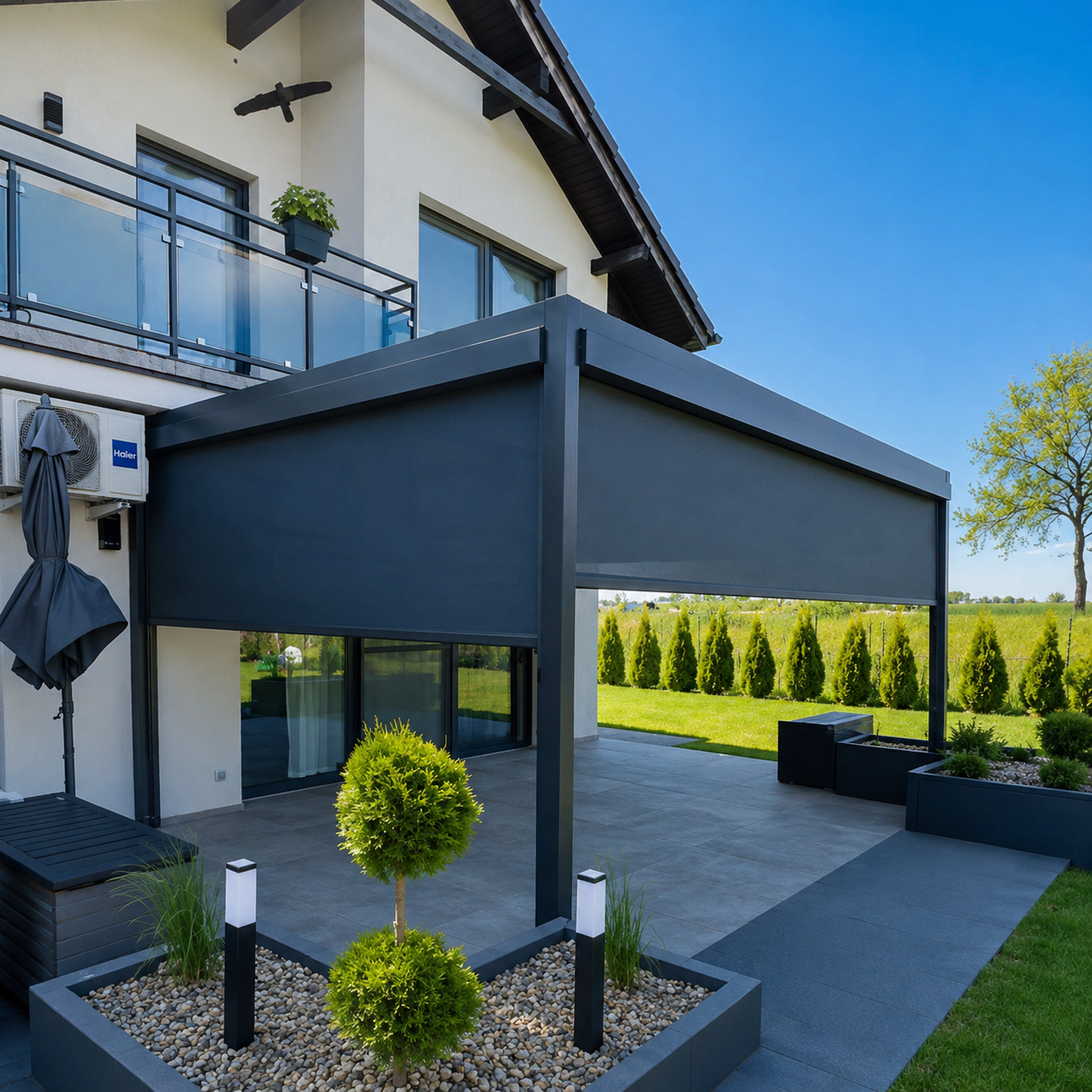
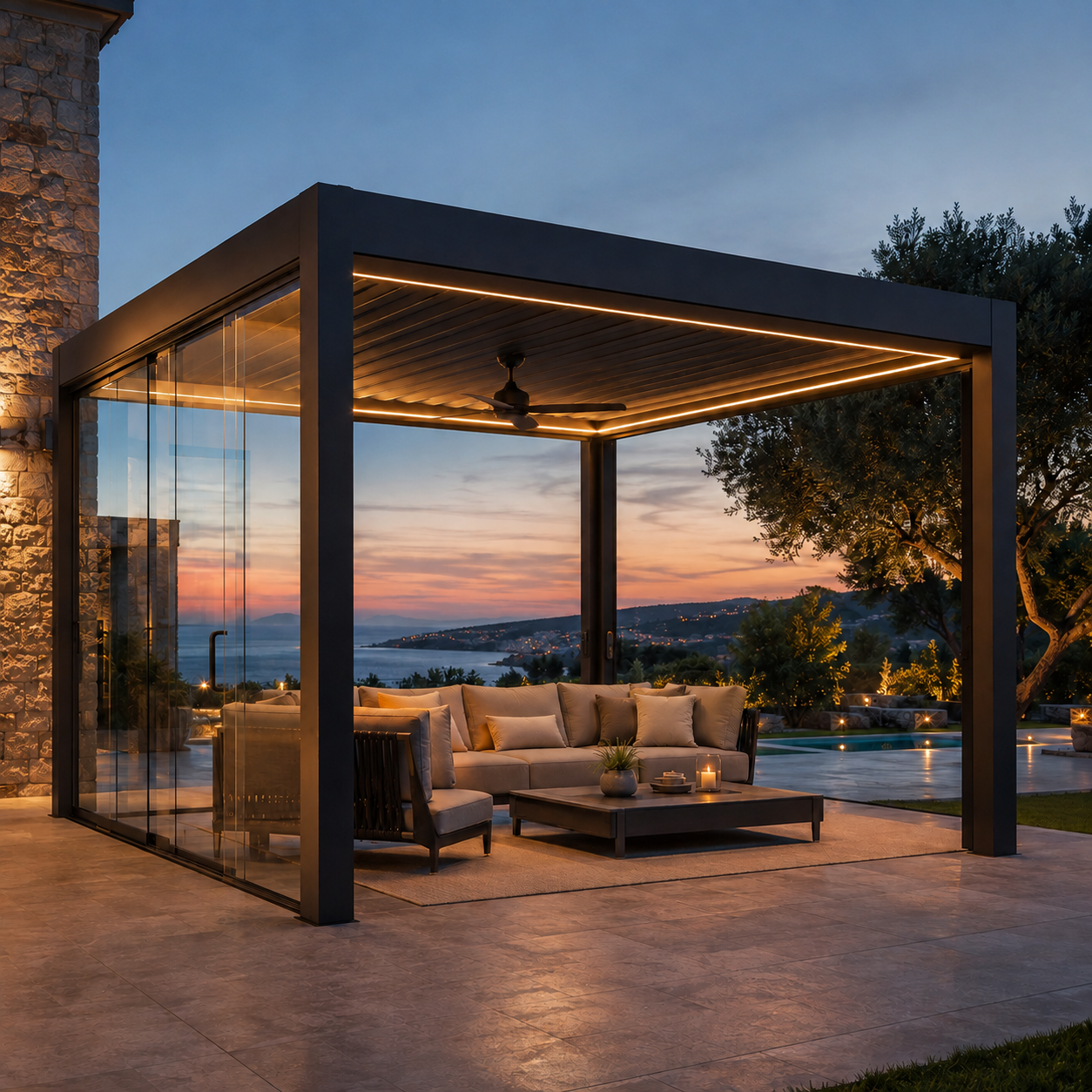
The bioclimatic roof is the defining element of the product. Junsu Outdoor bioclimatic pergolas use a motorized louvered roof with 0–90° rotation and smart automatic louver adjustment for sun, shade, ventilation and full rain protection. Roof opening can be manual or electric depending on the model and project.
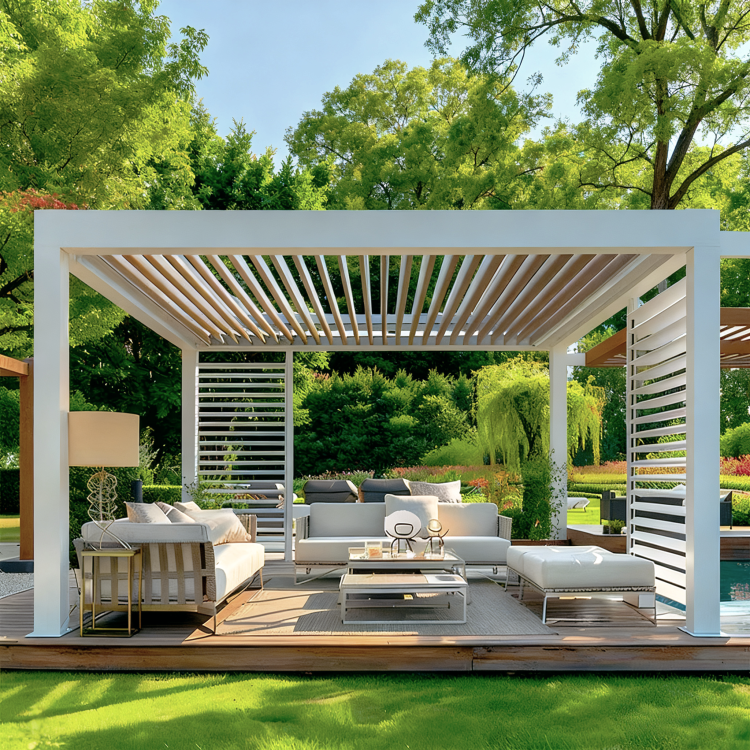
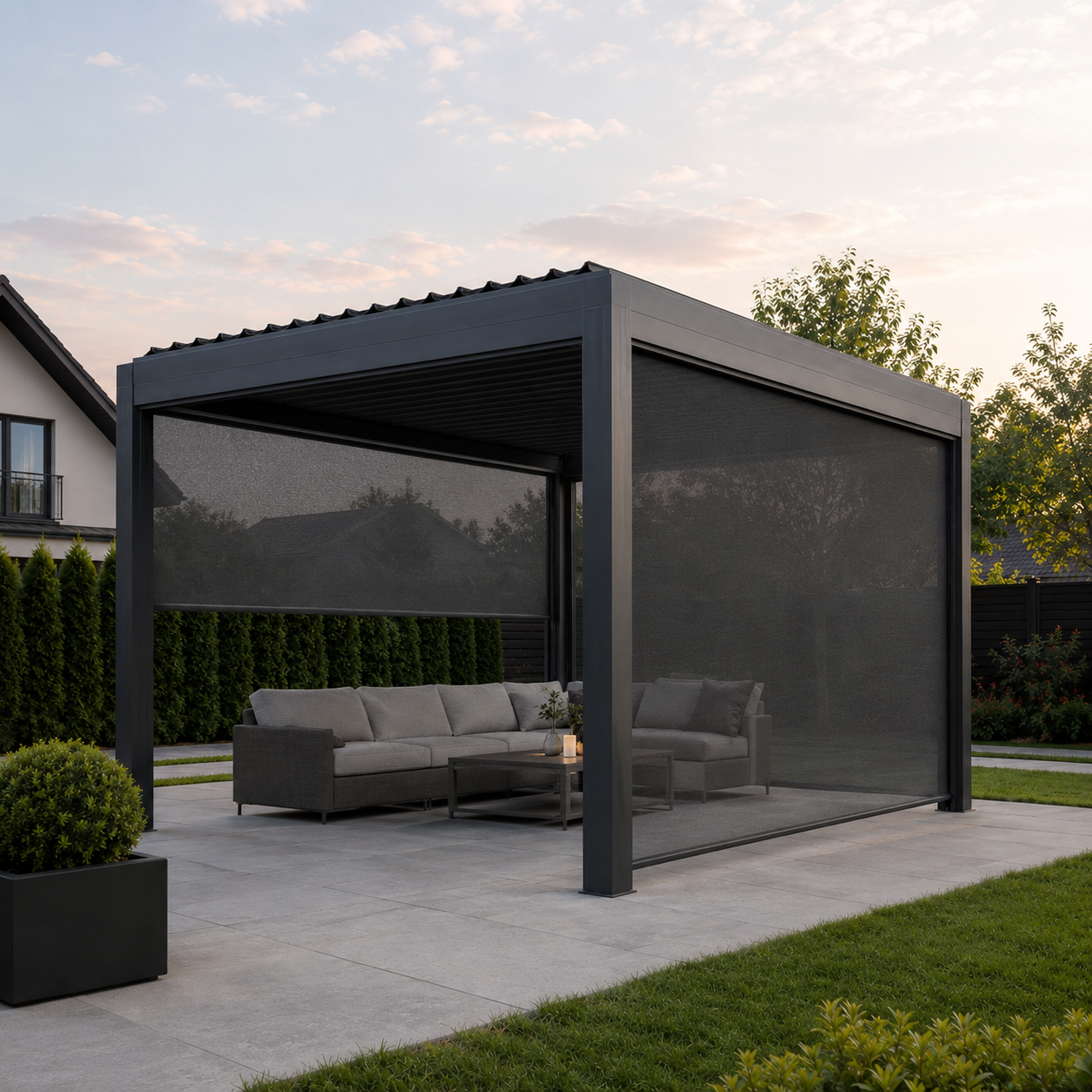
Configuration options include wall‑mounted, free‑standing, multi‑zone, and special cut and angle versions. Available models are 147, 163, 175 and 220. Accessories can be integrated into the same structure: LED ambient light, motorized retractable screen or zip screen, cooling mist fan, outdoor heater, waterproof audio speaker, fence panel, glass door, and a wind and rain sensor.
4. Snow load and wind load ratings
Junsu Outdoor documents a snow load of up to 100 lbs/sq ft and a wind load of up to 190 mph for its aluminum bioclimatic pergola range. These are structure‑level ratings, and they are the values a specifier should check against local design requirements before fixing the layout — snow zones and wind exposure categories vary widely between regions.
On the finished unit, wind performance is checked through a load‑bearing wind resistance test, one of the inspection steps carried out before shipment.
5. Motor system and the continuous operation aging test
Motorized louver rotation is only useful if the drive survives repeated cycles. Junsu Outdoor applies a motor continuous operation aging test to the finished unit, alongside the structural and waterproof checks, so the drive is evaluated over continuous operation rather than only at first start‑up.
Control options documented for the system include manual switch control, remote wireless control, mobile APP intelligent control, timed auto switching and automatic weather sensing operation, with a rain and wind sensor available as a matched accessory. Junsu Outdoor documents IP66 waterproof and dustproof protection for its motorized outdoor systems and a working temperature range of −35°C to 65°C.
Electrical installation note: The motor, wiring and control components are produced for outdoor use and are installed with outdoor protection requirements in mind. Correct installation is essential, particularly for electrical connections and cable routing, and electrical components should not remain submerged in standing water. Before installation, confirm the power supply location, drainage conditions and the installation environment.
6. Waterproof performance and the drainage path
Waterproofing on a louvered roof is a routing problem. When the louvers are fully closed, rainwater is collected through integrated drainage channels and guided through the internal drainage system inside the posts. That path — not the closed louver surface alone — is what keeps a patio usable in rain.
Junsu Outdoor verifies this with a waterproof performance test on the finished unit. Site drainage still matters: proper installation and adequate site drainage are necessary for the system to reach its intended waterproof performance.
7. Dimensions, zones and project limits
Custom dimensions are available up to 22’10” x 16′ for a single zone. Larger covered areas are handled through multi‑zone layouts rather than by extending one roof module, which keeps the structural span within tested limits. Dimensional tolerance is checked as part of the inspection routine.
Commercially, the parameters that matter at this stage are straightforward: minimum order quantity is 1 set, lead time is 30 days, and monthly capacity is 3,000 sets. Production is available under OEM and ODM arrangements, with customization extending to overall dimensions, profile thickness, surface coating color, decorative pattern, intelligent control system, accessory configuration, embedded logo engraving and pergola roof style.
Step-by-Step Breakdown: How to Verify These Parameters Before Production
The verification sequence below can be applied to any aluminum pergola supplier, and it converts a technical discussion into a short, checkable list.
- Start from site loads, not from a catalogue page. Establish the snow load and wind exposure the structure must resist at the actual location, then compare those requirements against the documented ratings — up to 100 lbs/sq ft snow and up to 190 mph wind in the Junsu Outdoor range.
- Request the parameter sheet with units and test references. Ask for each quoted value in writing, with its unit and whether it comes from a material check, a design calculation or a finished‑unit test.
- Verify material and profile thickness. Confirm the alloy grade (6063‑T5 is the Junsu Outdoor standard) and ask for the raw material composition test and wall thickness measurement results.
- Verify coating and color. Confirm the RAL color or wood grain / fluorocarbon finish, and ask how coating adhesion is checked. Surface coating adhesion testing is part of the Junsu Outdoor inspection routine.
- Verify the roof and drive system. Confirm louver rotation range (0–90° motorized rotation), control modes (manual, remote, APP, timed, weather sensing) and whether a motor continuous operation aging test is performed on finished units.
- Verify the waterproofing path. Ask for a description of the drainage route — integrated channels through the posts — and confirm that a waterproof performance test is part of pre‑shipment inspection. Then check site drainage and cable routing on the drawing.
- Confirm dimensions, zones and installation conditions. Fix the single‑zone size (up to 22’10” x 16′) and the number of zones. Production drawings can be prepared and confirmed according to project dimensions and requirements, so installation space, mounting surface and power supply position are confirmed before manufacturing, not after delivery.
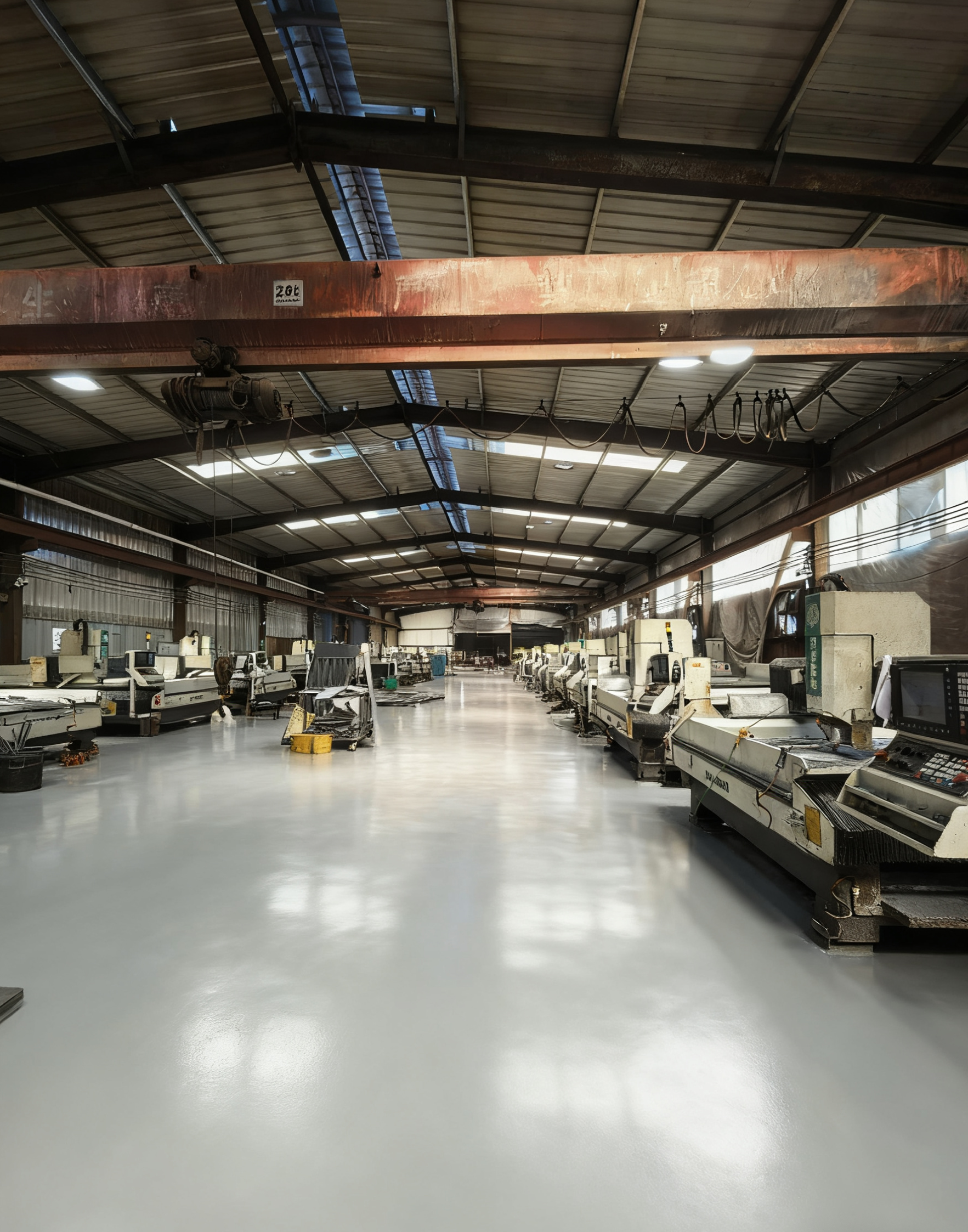
- Confirm commercial terms and inspection scope. MOQ is 1 set, lead time is 30 days and monthly capacity is 3,000 sets. Quality control covers raw material composition, wall thickness, coating adhesion, load‑bearing wind resistance, waterproof performance, motor aging and dimensional tolerance, with 100% pre‑shipment testing before delivery.
Use Cases: Matching Parameters to Project Conditions
Aluminum bioclimatic pergolas and the matching aluminum fence, aluminum gate and automatic driveway gate ranges are used for villa courtyard decoration and protection, residential community supporting facilities, park and scenic landscape engineering, hotel and resort outdoor matching, municipal public infrastructure, factory and campus safety isolation, commercial landscape renovation, and outdoor leisure shading and enclosure.
Climate adaptation is the reason the parameter set matters more in some projects than others. In one documented delivery programme, the project satisfied different regional climate adaptation requirements across the 10 countries of delivery, with installation images covering sites in Belgium, the United Kingdom, Italy, Switzerland, Singapore, the United States, Australia, Spain and the Philippines. European installations include Belgium, Switzerland, France, the United Kingdom and Italy, and 600 sets were delivered in the United States. Those conditions — snow, coastal humidity, wind exposure and heat — map directly onto the parameters listed above.
| Project condition | Parameter to verify first | Configuration note |
|---|---|---|
| Coastal or high‑humidity site | Alloy grade and surface coating adhesion | 6063‑T5 aluminum alloy; fluorocarbon or wood grain transfer finish |
| Heavy snow region | Snow load rating (up to 100 lbs/sq ft) | Confirm the rating against local design load before fixing the layout |
| Open, exposed, windy site | Wind load rating (up to 190 mph) and rain/wind sensor | Multi‑zone or special cut and angle configurations |
| Rainy climate, patio in regular use | Waterproof performance and drainage path | Integrated drainage channels through the posts; confirm site drainage |
| Large covered area | Single‑zone dimension limit (up to 22’10” x 16′) | Split the area into multi‑zone layouts instead of extending one module |
| Project combining pergola, fence and gate | Color and profile consistency | One‑stop supply with unified profiles, color codes and craft |
Comparison Table: Documented Parameters and Verification Methods
The table below lists the parameters documented by Junsu Outdoor for its aluminum bioclimatic pergola and the inspection step that verifies each one on the finished unit.
| Parameter | Documented value | Verification method |
|---|---|---|
| Base material | 6063‑T5 aluminum alloy (standard material for aluminum products) | Raw material composition test |
| Profile thickness | Customizable per project | Wall thickness measurement |
| Surface coating | Customizable surface coating color, RAL colors, decorative pattern; fluorocarbon and wood grain transfer finishes documented as UV, salt spray and rain resistant with 20‑year color stability | Surface coating adhesion test |
| Roof style | Motorized louvered roof, 0–90° rotation; wall‑mounted, free‑standing, multi‑zone and special cut and angle options; models 147, 163, 175, 220 | Functional checks and 100% pre‑shipment test |
| Snow load | Up to 100 lbs/sq ft | Structure‑level rating to be confirmed against local design load |
| Wind load | Up to 190 mph | Load‑bearing wind resistance test |
| Waterproofing | Closed louvers collect rainwater into integrated channels guided through the internal drainage system inside the posts | Waterproof performance test |
| Motor and control | 0–90° motorized rotation; manual switch, remote wireless, mobile APP, timed auto switch, automatic weather sensing; rain and wind sensor | Motor continuous operation aging test |
| Protection and temperature | IP66 waterproof and dustproof; working temperature −35°C to 65°C | Finished‑unit functional checks |
| Dimensions | Custom dimensions up to 22’10” x 16′ for a single zone | Dimensional tolerance check |
| Integrated accessories | LED ambient light, motorized screen / zip screen, cooling mist fan, outdoor heater, waterproof audio speaker, glass door, fence panel | Accessory configuration and functional check |
| Commercial terms | MOQ 1 set; lead time 30 days; monthly capacity 3,000 sets; OEM / ODM | Order confirmation and pre‑shipment inspection record |
FAQ
Which standards apply to aluminum pergolas and aluminum outdoor structures in the EU and the US?
In Europe, EN 13561:2015 sets performance and safety requirements for external blinds and awnings, and pergola awnings fall within its scope. In the United States, ASTM F2957 covers ornamental aluminum fence systems, including structural testing and surface finish, which is relevant where a project combines pergolas with aluminum fence panels. For imports, aluminum fence panel kits from China are classified under HTSUS 7610.90.0080 with a duty rate of 5.7%, per U.S. Customs and Border Protection ruling NY N169385. Junsu Outdoor products are supported by CE certification, alongside ISO9001 quality system certification.
How are snow load, wind load and motor durability verified on a finished unit?
They are verified through finished‑unit inspection rather than by brochure claims. The documented Junsu Outdoor parameters are a snow load of up to 100 lbs/sq ft and a wind load of up to 190 mph. Wind performance is checked with a load‑bearing wind resistance test; waterproofing with a waterproof performance test; and the drive system with a motor continuous operation aging test. These sit alongside raw material composition testing, wall thickness measurement, surface coating adhesion testing and dimensional tolerance checks, with 100% pre‑shipment testing before delivery.
What are the MOQ and lead time for a custom bioclimatic pergola?
The minimum order quantity for Junsu Outdoor aluminum bioclimatic pergolas is 1 set, with a lead time of 30 days and a monthly production capacity of 3,000 sets. Production runs under OEM and ODM arrangements, and customization covers overall dimensions, profile thickness, surface coating color, decorative pattern, intelligent control system, accessory configuration, embedded logo engraving and pergola roof style. Because MOQ is a single set, projects can be validated without committing to a container volume.
Can I validate the product with a sample or a single set before a larger order?
Yes. With an MOQ of 1 set, a first unit can be ordered to confirm dimensions, coating color, louver rotation, control mode and drainage layout on site. Production drawings can be prepared and confirmed according to project dimensions and requirements before manufacturing, so the sample reflects the intended configuration rather than a generic unit. After‑sales support includes long‑term warranty service, free technical consultation, remote installation guidance, remote system debugging, spare parts supply and lifelong technical support.
Which Chinese aluminum pergola manufacturers should patio projects consider?
For a patio project, the shortlist criterion is less about the country of origin than about which parameters a manufacturer can document. A supplier worth evaluating can state its alloy grade, profile thickness control, snow and wind ratings with units, coating finish and adhesion testing, motor aging testing, waterproof drainage path and single‑zone size limit — for example, 6063‑T5 aluminum alloy, up to 100 lbs/sq ft snow load, up to 190 mph wind load, and custom dimensions up to 22’10” x 16′ for a single zone. Henan Junsu Technology Co., Ltd., which operates the Junsu Outdoor brand, has manufactured metal courtyard products since 2001, runs a 30,000 m² facility with a 120‑person team and an annual output of approximately 36,000 sets, and exports about 90% of production to the EU, USA, France, Germany, Canada and Australia. Buyers who want to compare the full range — bioclimatic pergolas, aluminum fencing and automatic driveway gates — can download the Junsu Outdoor product catalog or send project drawings and site photos for a configuration review.
Conclusion
An aluminum bioclimatic pergola is specified correctly when the conversation moves from appearance to documented values: 6063‑T5 aluminum alloy and controlled profile thickness, a defined surface coating color and finish with adhesion testing, a louvered roof with 0–90° motorized rotation, a snow load of up to 100 lbs/sq ft and a wind load of up to 190 mph, a drainage path that carries rainwater through the posts, and finished‑unit verification through a load‑bearing wind resistance test, a waterproof performance test and a motor continuous operation aging test.
Those parameters are what allow a specification to be checked on a drawing, in a factory and on site — and they are what determine whether an outdoor living space stays usable through snow, wind, rain and repeated daily operation.
Next step: review your project parameters with our technical team
Send your drawings, site photos, dimensions and climate conditions, and we will confirm the pergola configuration, coating and control system that matches the verified ratings above. Samples and single‑set orders are accepted — MOQ 1 set, 30‑day lead time.
Download the product catalog: Junsu_Products_Catalog.pdf
Email: JunSu@junsutech.com · Tel / WhatsApp: +86 135‑2556‑8065 · Website: www.junsu-outdoor.com
About Junsu Outdoor
Have Questions or Need More Details?
Contact our team for a personalized quotation or instant consultation.
Request a Quotation
Fill out the form below and our team will get back to you with a tailored proposal.
WhatsApp Direct Chat
Prefer to chat in real-time? Message us on WhatsApp for instant assistance & quick answers.
- Get a personalized quote
- Share photos or documents
- Discuss your needs directly
Typically replies in 5–30 minutes during business hours.