
Outdoor Living Solutions Compliance: Tests, Tolerances and Pre-Shipment Checks
Pre-shipment compliance for outdoor living products comes down to one question: what can be measured, recorded and shown to a buyer before the container is sealed? For Junsu Outdoor — the outdoor living brand of Henan Junsu Technology Co., Ltd., a Henan-based manufacturer of aluminum pergolas, aluminum fences and automatic driveway gates — the answer covers seven documented checks: raw material composition testing, wall thickness measurement, surface coating adhesion testing, dimensional tolerance inspection, load-bearing wind resistance testing, waterproof performance testing, and 100% pre-shipment testing of finished goods. This guide explains what each check verifies, where it actually fails in practice, and how one evidence set supports projects across ten delivery markets.
Incoming 6063-T5 aluminum stock at the Junsu Outdoor manufacturing base — the first checkpoint in the pre-shipment sequence.
What Buyers Are Really Asking For When They Ask About Compliance
Most compliance conversations in outdoor living projects begin with a vague request for "certification" and end with an argument about a container. The two are different subjects. Compliance evidence in this category splits into three layers, and suppliers who blur them together are usually the ones who cannot produce order-level records.
Layer one: system and market certification
This is the factory-level layer. Junsu Outdoor operates under ISO 9001 quality system certification and holds CE certification, together with full export customs filing qualifications. These documents describe how a manufacturer is organised, audited and qualified to ship into a market. They are necessary, and they are not order-specific.
Layer two: per-order performance evidence
This is the layer that decides whether a pergola, fence or gate installation succeeds. The seven inspection checks listed in this article sit here. They are executed against the specific order, against the confirmed production drawings, and against the agreed acceptance criterion.
Layer three: trade and customs documentation
Product quality and customs classification are separate obligations. For reference, aluminum fence panel kits imported into the United States from China are classified under HTSUS 7610.90.0080 with a duty rate of 5.7%, as set out in U.S. Customs and Border Protection ruling NY N169385. A technically compliant fence can still sit at the port if the classification and documentation are wrong.
Where outdoor living orders usually go wrong
The recurring failure pattern in this category is not a dramatic defect. It is drift between the sample and the batch:
- Material drift. The approved sample uses the specified alloy grade and temper; production introduces a different profile source. Performance differences appear months later, not on delivery.
- Thickness drift. Outer dimensions stay identical while internal wall thickness changes. The product looks the same and behaves differently under wind and snow load.
- Fit drift. Fabricated components deviate from the confirmed drawings. On a single-zone pergola this is a small problem; on a multi-zone or wall-mounted layout it becomes an installation problem that no site adjustment fully solves.
Why Test Evidence Has Become a Buying Criterion, Not a Formality
Three published data points explain why inspection evidence now sits inside the buying decision rather than after it. The global aluminum pergola market was valued at USD 3.8 billion in 2025 and is projected to reach USD 7.1 billion by 2034, according to Dataintelo's Aluminum Pergola Market Research Report 2034. North America accounted for 34.2% of that demand in 2025. Within the category, the bioclimatic pergola segment is forecast to grow from USD 600.87 million in 2026 to USD 1,049.46 million by 2034 — a 7.22% CAGR reported by Fortune Business Insights. On the entrance side, automatic sliding gates held a 30.2% share of the automatic gate opening system market in 2025.
Faster category growth produces two effects for buyers. First, it multiplies the number of suppliers publishing near-identical specification sheets. Second, it raises the cost of a failed container: a pergola system that has to be reworked after arrival disrupts the whole installation schedule, not just one line item.
Two standards frameworks are commonly cited in project documentation for this product family. EN 13561:2015 sets European performance and safety requirements for external blinds and awnings, including pergola awnings. ASTM F2957 defines the requirements for ornamental aluminum fence systems, covering structural testing and surface finish. Both are third-party references. Citing them in a specification tells a supplier which framework to report against; holding a test record for a delivered batch is a separate matter. Buyers should ask for both — the standard reference and the per-order record — instead of treating one as the other.
The Seven Checks Behind a Junsu Outdoor Pre-Shipment Approval
The list below reflects the inspection methods applied across the pergola, fence and gate programs: 100% pre-shipment test, raw material composition test, wall thickness measurement, surface coating adhesion test, load-bearing wind resistance test, waterproof performance test, motor continuous operation aging test, and dimensional tolerance inspection.
1. Raw material composition testing
Composition testing happens before a single profile is cut. Its purpose is to confirm that the incoming alloy matches the grade and temper the order was quoted against, because the downstream behaviour of the product — coating performance, weld quality, structural stiffness — is decided at the material stage. Junsu Outdoor uses 6063-T5 aluminum alloy as the standard material for its pergola, fence and gate lines. A deviation found here is inexpensive to correct; the same deviation found after coating, assembly and loading is not.
2. Wall thickness measurement
Wall thickness is where specification and reality separate most often. Two beams with the same external dimension can behave very differently depending on internal wall thickness. Measurement is taken on the profile itself, and it feeds directly into three things a buyer cares about: deflection under wind and snow load, the holding strength of anchor and connection points, and the long-term behaviour of moving parts such as louver blades and gate frames. Profile thickness is an explicitly customizable item in the Junsu Outdoor pergola and fence programs, which means wall thickness can be written into the order as a parameter rather than inherited from a default profile.
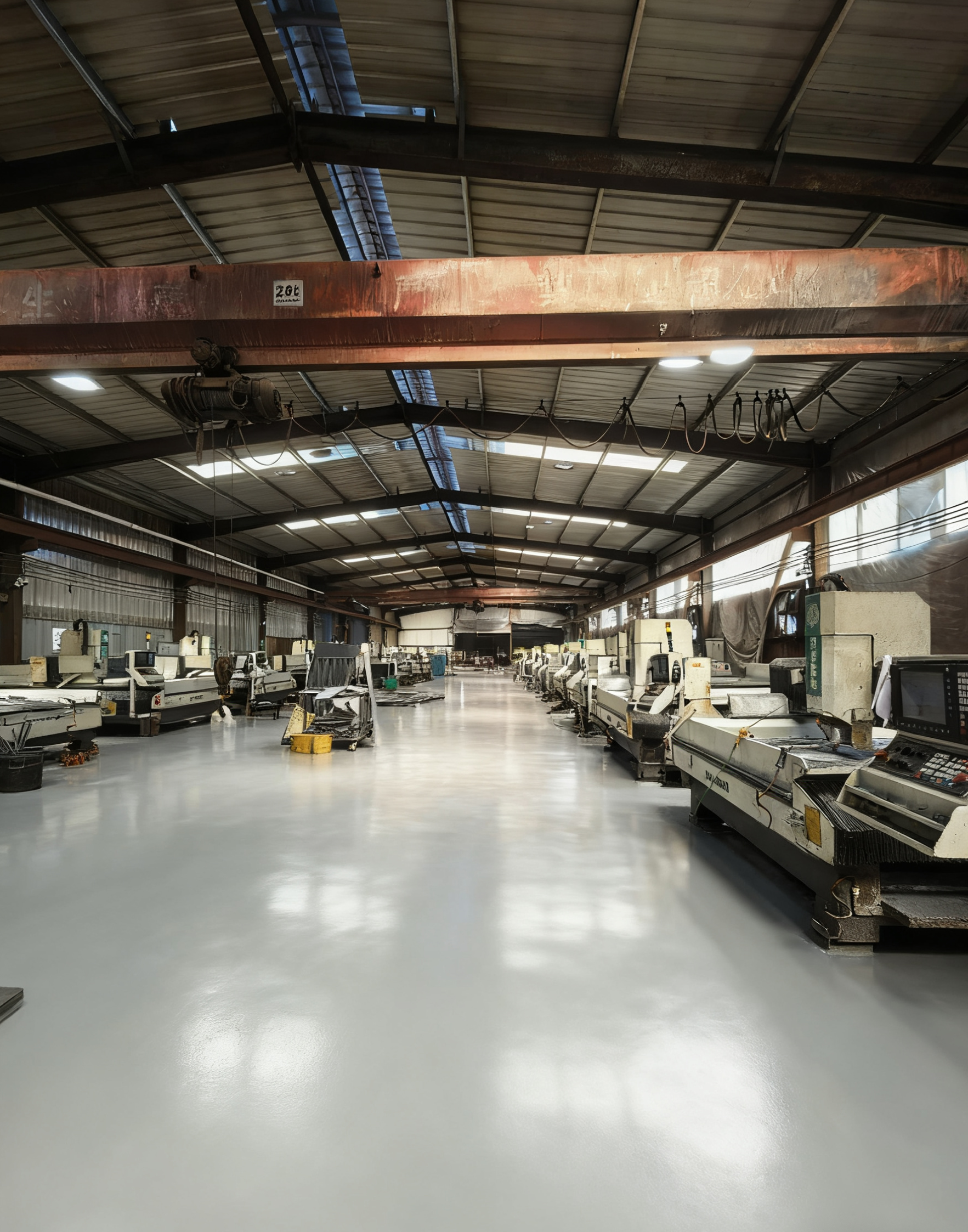
Profile machining centres cut pergola, fence and gate components to drawing dimensions — the stage where wall thickness and tolerance are held.
3. Surface coating adhesion testing
Adhesion testing checks the bond between the aluminum surface and the finish after pre-treatment. The failure it prevents is invisible on delivery day: a coating with poor adhesion can look flawless in a warehouse and then chalk, blister or flake after a season of UV, salt spray and rain. The Junsu Outdoor surface program includes powder coating, RAL colour matching and wood-grain transfer finishes applied over pre-treated profiles. Adhesion testing is the reason surface finish should be treated as a tested specification rather than a colour swatch.
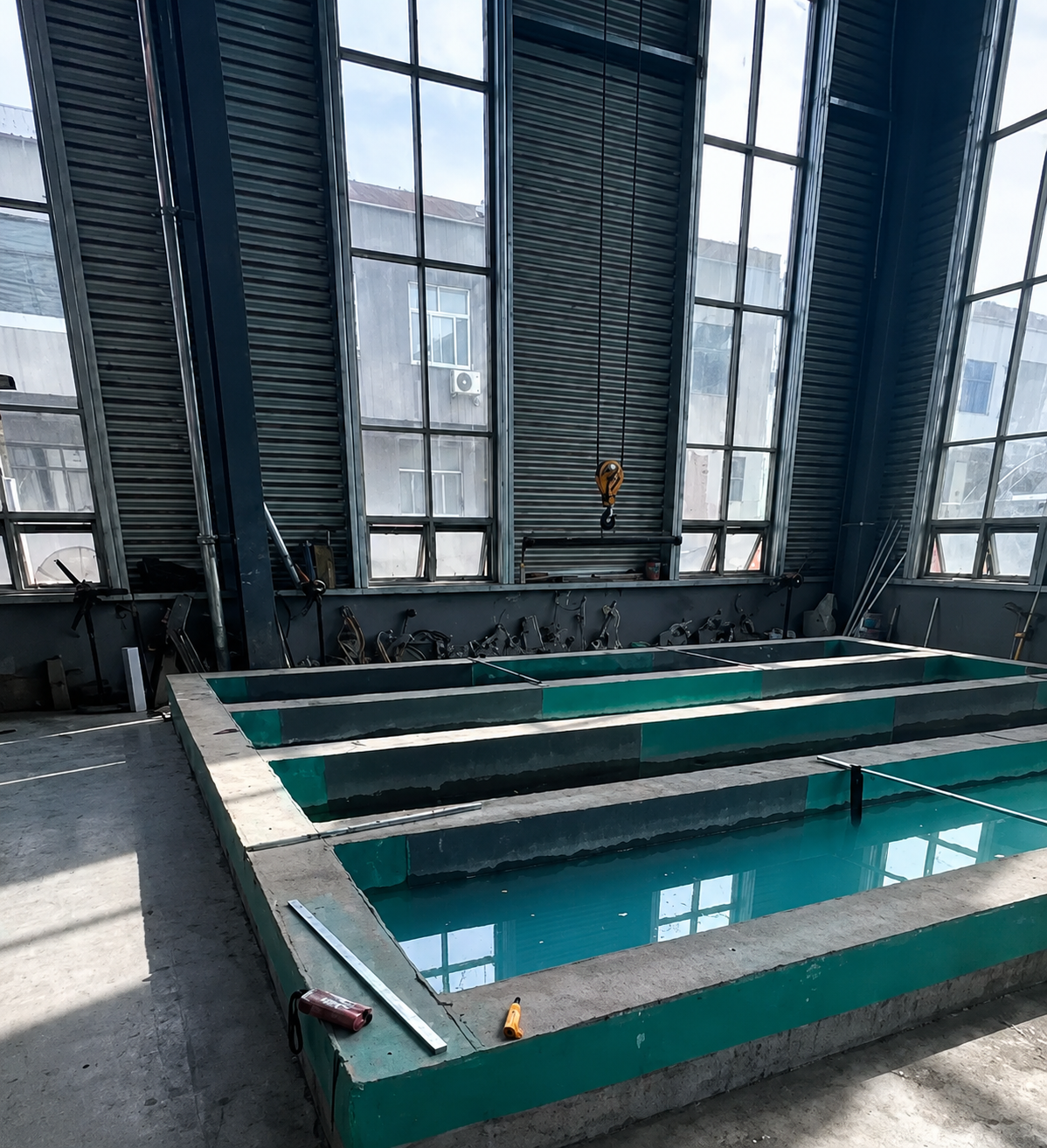
Pre-treatment before finishing. Adhesion performance is decided here, long before the colour is visible.
4. Dimensional tolerance inspection
Outdoor living products are installed, not displayed, so tolerance is an installation issue rather than a cosmetic one. Dimensional inspection compares finished components against the confirmed production drawings: overall dimensions, post positions, louver spans, fence bar spacing, gate clear opening, bottom gap height and hardware placement.
Tolerances matter most in multi-zone pergola layouts and wall-mounted installations, where small deviations accumulate across zones and appear on site as misaligned beams or uneven interfaces at the wall. For gate projects, clear opening width and height, gate type, quantity and site photos are confirmed first, together with ground condition, posts or walls, available side space and power supply location for automatic gates. Published custom dimensions for the pergola platform extend up to 22'10" x 16' for a single zone — so during inspection, the drawing is the reference, not the catalogue.
5. Load-bearing wind resistance testing
Load testing evaluates the assembled structure rather than the profile alone: beam-to-post connections, louver mechanisms and roof-to-frame interfaces under load. Junsu Outdoor publishes snow load up to 100 lb/sq ft and wind load up to 190 mph for pergola models 147, 163, 175 and 220, alongside working conditions of −35°C to 65°C and IP66 waterproof and dustproof protection for the motorised control system.
These are configuration-linked parameters. A larger span, a wall-mounted layout or an added retractable screen changes the load picture, which is why published figures should always be read together with span, mounting type and accessory configuration for the specific build.
6. Waterproof performance testing
Waterproof verification for a louvered pergola is a system test, not a material test. When the louvers are fully closed, rainwater is collected and guided into integrated drainage channels, then routed through the internal drainage system inside the posts. Three things are checked: that the louver blades close to a consistent plane, that the drainage path is clear along its full length, and that water exits at the post base instead of pooling on the structure.
Two variables sit outside any factory test and must be handled at installation. Electrical components should not remain submerged in standing water, and cable routing plus site drainage should be confirmed before commissioning. The IP66 rating on the motorised control system describes enclosure protection; it does not replace correct site drainage.
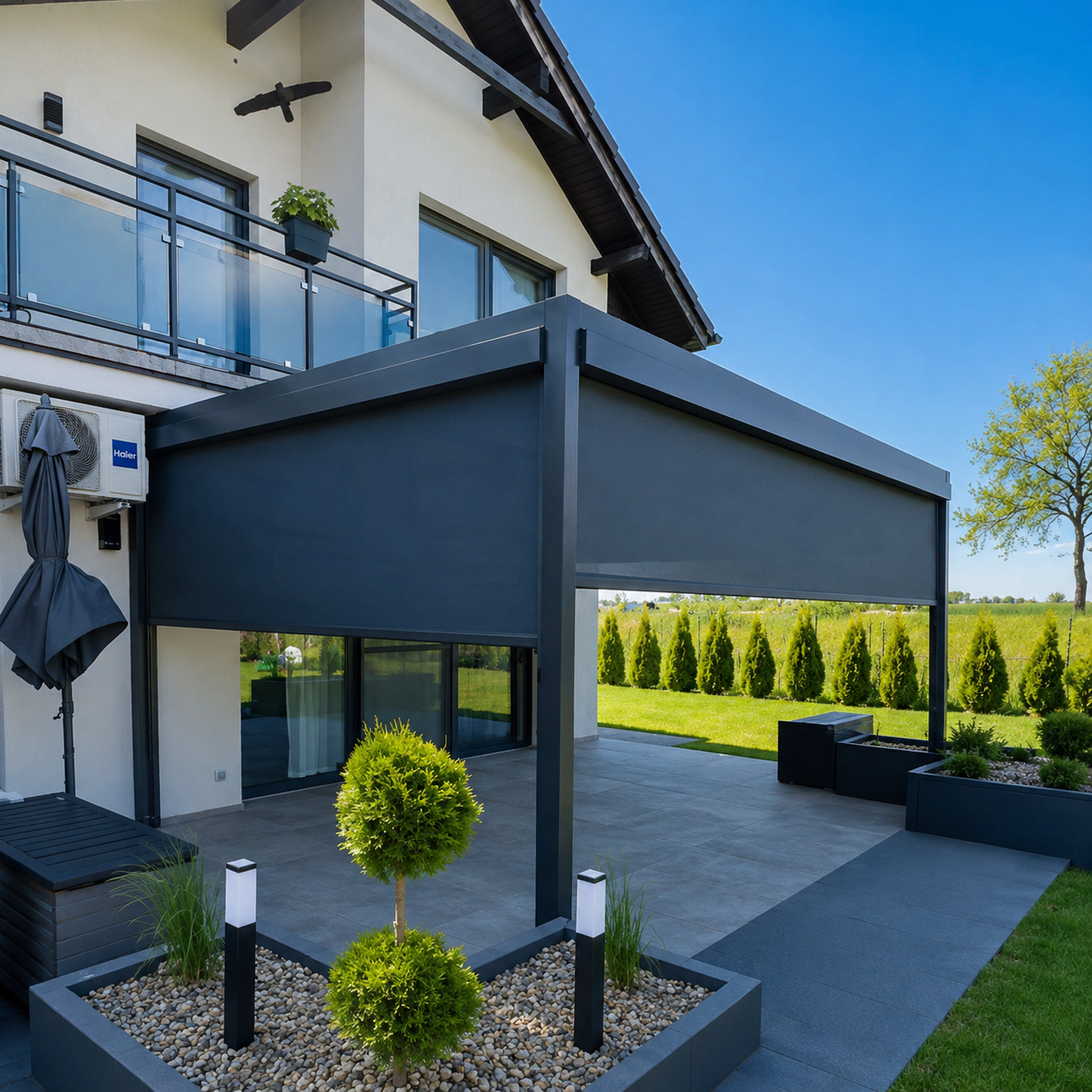
A windproof and waterproof motorised pergola delivered for a Swiss project — drainage and load behaviour weighted for snow and wind exposure.
7. 100% pre-shipment testing
The final gate is the one that turns inspection from a sampling exercise into an order-level commitment. Every finished unit — not a statistical sample — is checked before packing, covering functional operation, motor continuous operation aging for automated products, dimensional verification against drawings, waterproof verification, and packaging inspection. Raw materials and finished goods additionally undergo layer-by-layer sampling inspection in cooperation with authorised third-party testing institutions.
In commercial terms, this is also the formal acceptance criterion on the order: the pre-shipment test. That is the practical difference between "the factory has a quality system" and "this container was checked".
Step-by-Step: The Pre-Shipment Sequence From Drawing to Loading
- Confirm the customization sheet. Pergola parameters include overall dimensions, profile thickness, surface coating colour, decorative pattern, gate opening mode, intelligent control system, accessory configuration, embedded logo engraving, roof style and fence spacing. Fence parameters include overall dimensions, alloy profile thickness, RAL surface colour, hollow carving pattern, bar spacing, gate opening type, intelligent access system, lock and hardware style, engraved logo, anti-collision structure, bottom gap height and hidden installation fittings.
- Fix the commercial frame. MOQ is 1 set, delivery terms are FCA, FOB, CIF, DAP or DDP, payment terms are 50/50, and the acceptance criterion is the pre-shipment test. Agreeing the test scope and the trade terms in the same conversation avoids disputes later.
- Incoming material check. Composition testing and wall thickness measurement on the raw profiles, before cutting begins.
- In-process checks. Cutting, welding, CNC engraving and pre-treatment are monitored as production stages rather than inspected only at the end.
- Assembly and functional testing. Louver operation, gate travel, control system response, and continuous operation aging for motors on automated pergolas and driveway gates.
- Dimensional and waterproof verification. Finished components are compared against the confirmed drawings, and closed-roof drainage behaviour is verified across the full water path.
- 100% pre-shipment inspection and packaging check. Every unit is inspected, then packing is verified before the goods move to the warehouse.
- Documentation and dispatch. Installation drawings and technical support accompany the shipment; the standard lead time for confirmed aluminum pergola and fence orders is 30 days, against a monthly production capacity of 3,000 sets.
Use Case: One Evidence Set, Ten Delivery Markets
The delivery record for Junsu Outdoor's outdoor living programs currently spans ten markets — Australia, Belgium, Canada, Switzerland, France, the United Kingdom, Italy, the Maldives, Singapore and the United States — including a single US reference of 600 sets and a customer relationship running 15 years. Those deliveries cover villa courtyard decoration and protection, residential community facilities, park and scenic landscape works, hotel and resort outdoor areas, municipal public infrastructure, factory and campus safety isolation, commercial landscape renovation, and outdoor leisure shading and enclosure. The manufacturer exports aluminum pergolas, fences and gates to the USA, Italy, France, Canada, the UK, Australia and Germany.
What changes between those markets is not the product family. It is the weighting of the seven checks:
- Snow and ice loading (Canada, Switzerland). Wall thickness measurement and load-bearing testing carry the most weight, because snow is a static load that stays on the roof. The post-to-beam interface and the connection design become the critical evidence in the file.
- Wind-driven rain and coastal exposure (United Kingdom, Belgium, Australia). Surface coating adhesion and waterproof performance testing move to the front of the review, since rain arrives at an angle and pooling at the post base is a realistic risk.
- High humidity and monsoon rainfall (Singapore, Maldives). Waterproof performance and drainage-path verification dominate, together with adhesion testing of the finish system.
- High UV (Australia, Maldives). Coating adhesion and finish specification matter as much as structure, because colour stability and surface integrity are what the client sees in year three.
- Mixed rain, wind and temperature variation (France, Italy). Dimensional tolerance inspection, coating adhesion and motor aging testing are typically prioritised, since automated systems operate year-round across a wide temperature band.
The takeaway is not that each market needs a different product. It is that the same seven checks are weighted differently per project, and that weighting should be agreed with the supplier before production starts rather than discovered after delivery.
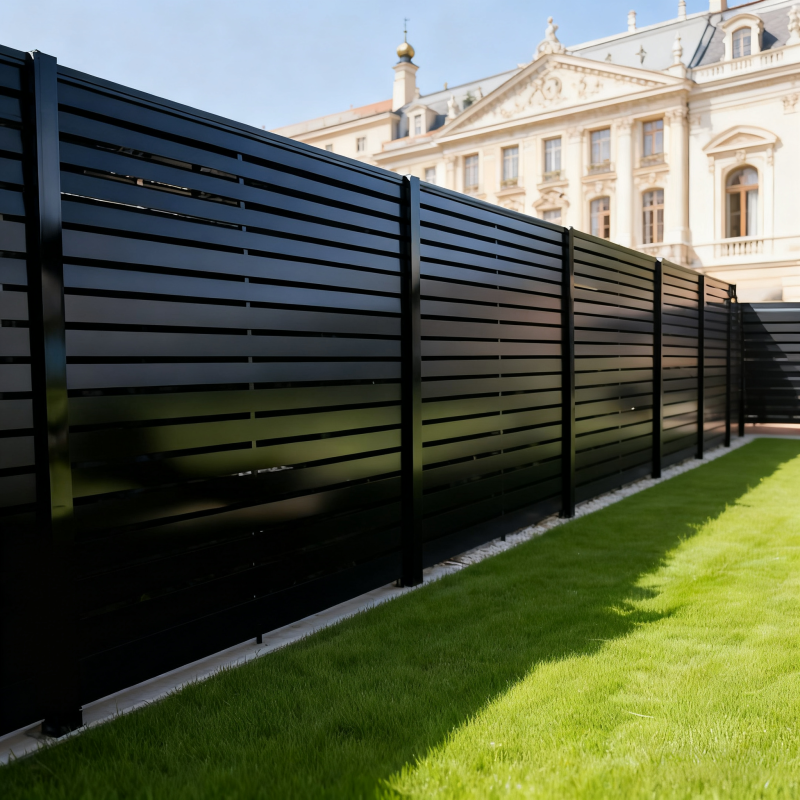
Full privacy horizontal slat aluminum fence delivered in the USA — dimensional tolerance and coating adhesion are the highest-weight checks for this configuration.
Inspection Evidence Map: What Each Check Proves
The table below maps each inspection method to what it verifies and which buyer decision it supports. It is deliberately limited to checks that are documented in the manufacturer's quality-control scope, so it can be used as a checklist against a supplier's own inspection list.
| Inspection check | What it verifies | Product scope | Buyer decision it supports |
|---|---|---|---|
| Raw material composition test | That the incoming alloy matches the specified grade and temper before cutting | Pergola, fence and gate profile stock | Confirms the material basis for every downstream performance claim |
| Wall thickness measurement | That internal profile walls meet the specified thickness, not just the nominal outer dimension | Pergola beams and posts, fence rails and pickets, gate frames | Predicts deflection under wind and snow load and the strength of anchor points |
| Surface coating adhesion test | That the finish bonds to pre-treated aluminum instead of sitting on the surface | Powder-coated, RAL and wood-grain transfer finishes | Reduces the risk of flaking, chalking and colour drift in coastal or high-UV sites |
| Dimensional tolerance inspection | That finished components match the confirmed production drawings | Custom pergola zones, fence panels, gate frames | Protects on-site installation fit, especially for multi-zone and wall-mounted layouts |
| Load-bearing wind resistance test | That the assembled structure holds the published load targets | Pergola models 147, 163, 175 and 220 | Supports the wind and snow figures used in project submittals |
| Waterproof performance test | That closed louvers and the internal drainage path move water away from the structure | Louvered and retractable-roof pergolas | Determines suitability for monsoon, coastal and high-rainfall markets |
| Motor continuous operation aging test | That drive motors and control components survive repeated operating cycles | Motorised pergolas and automatic driveway gates | Reduces failure risk on automated entrances and smart shading systems |
| 100% pre-shipment inspection | That every finished unit, not a sample, is checked before packing | All pergola, fence and gate orders | Makes pre-shipment testing the formal acceptance criterion of the order |
Standards and Trade References Buyers Commonly Cite
Inspection records and standards references answer different questions. The records describe what happened to this order; the standards describe the framework the order can be reported against. Both belong in a project file.
| Reference | Jurisdiction | What it covers | Why buyers cite it |
|---|---|---|---|
| EN 13561:2015 | European Union | Performance and safety requirements for external blinds and awnings, including pergola awnings | Gives EU project buyers a common performance vocabulary when reviewing awning-type shading systems |
| ASTM F2957 | USA | Ornamental aluminum fence systems, covering structural testing and surface finish | Provides a recognised test framework for US fence specifications and submittals |
| HTSUS 7610.90.0080 | USA (imports from China) | Classification of aluminum fence panel kits, with a duty rate of 5.7% | Feeds directly into landed-cost calculation and customs documentation planning |
On the manufacturer side, the system-level documents are ISO 9001 quality system certification, CE certification and full export customs filing qualifications, supported by authorised third-party testing institutions for raw material and finished goods sampling.
FAQ: Pre-Shipment Compliance for Outdoor Living Solutions
What pre-shipment test evidence can I request before an outdoor living order ships?
The pre-shipment test is the acceptance criterion, so the request should be written into the order. The inspection scope covers raw material composition testing, wall thickness measurement, surface coating adhesion testing, dimensional tolerance inspection, load-bearing wind resistance testing, waterproof performance testing, and 100% pre-shipment testing of finished goods, with a motor continuous operation aging test added for automated pergolas and driveway gates. Raw materials and finished goods also pass layer-by-layer sampling inspection in cooperation with authorised third-party testing institutions. These are per-order inspection records; they complement, and do not replace, company-level documents such as ISO 9001 and CE certification.
Can Chinese OEM aluminum pergola manufacturers support fully customized project requirements?
Where OEM and ODM production services are offered across aluminum pergola, aluminum fence and aluminum gate lines, the pergola platform covers models 147, 163, 175 and 220 in wall-mounted, free-standing, multi-zone, and special cut and angle configurations. Customizable pergola items include overall dimensions, profile thickness, surface coating colour, decorative pattern, gate opening mode, intelligent control system, accessory configuration, embedded logo engraving, roof style and fence spacing. Fence customization covers overall dimensions, alloy profile thickness, RAL surface colour, hollow carving patterns, bar spacing, gate opening type, intelligent access system, lock and hardware style, engraved logo, anti-collision structure, bottom gap height and hidden installation fittings. Custom dimensions are published up to 22'10" x 16' for a single zone, and input can be supplied as CAD drawings, architectural plans, sketches, photos, dimensions or samples.
What purchasing terms apply — MOQ, delivery terms and payment?
The minimum order quantity is 1 set. Delivery terms offered are FCA, FOB, CIF, DAP and DDP. Payment terms are 50/50, and the acceptance criterion is the pre-shipment test. Because these terms are the commercial frame around the inspection sequence, they are best confirmed together with the test scope rather than after production has started.
How can I validate design, dimensions and fit before committing to a larger batch?
Validation runs through the drawings first. Drawings are prepared and confirmed according to project dimensions and requirements before production. For gate projects that means providing clear opening width and height, preferred gate type, quantity and site photos, plus ground condition, posts or walls, available side space and power supply location for automatic gates. Because the minimum order quantity is 1 set, a single unit can also be ordered and checked against the confirmed drawings before a larger project batch is released.
What is the lead time, and when does the pre-shipment test take place?
Standard delivery time is 30 days for confirmed aluminum pergola and fence orders, supported by a monthly production capacity of 3,000 sets. The pre-shipment test is the final production gate: it runs after assembly and functional testing and before packing and loading, covering motor aging where applicable, dimensional verification, waterproof verification and packaging inspection. Buyers who want the inspection record, installation drawings and technical support documents bundled with the shipment should confirm that arrangement at order stage — the Junsu Outdoor product catalog and specification overview can be reviewed before that conversation at Junsu Products Catalog (PDF).
Conclusion: Compliance Is a Document Trail, Not a Badge
Outdoor living solutions compliance is not a logo printed on a brochure. It is a sequence of measurements that produces records. Raw material composition testing fixes the material basis. Wall thickness measurement protects structural behaviour. Coating adhesion testing protects appearance after years of UV and salt spray. Dimensional tolerance inspection protects installation. Load-bearing wind resistance testing supports the wind and snow figures a project is signed off against. Waterproof performance testing protects the drainage promise. And 100% pre-shipment testing makes all of it order-specific instead of sample-specific.
For buyers in the evaluation and execution stage, the practical move is to write the inspection scope into the order before production begins — next to MOQ, delivery terms and payment terms — and to request the records for the specific order rather than a generic catalogue. Junsu Outdoor operates from a 30,000 m² manufacturing base with a 120-person team including ten R&D engineers, a monthly capacity of 3,000 sets, and an annual output of approximately 36,000 sets, serving export markets that include the USA, Italy, France, Canada, the UK, Australia and Germany.
Next Step
Send your project drawings, dimensions or site photos for a pre-production review, or request the full product catalog and specification overview before placing an order.
Catalog: Download the Junsu Outdoor Products Catalog (PDF)
Website: www.junsu-outdoor.com
Email: JunSu@junsutech.com | Tel / WhatsApp: +86 135-2556-8065
Address: Room 1355, 38th Floor, Building 2, No.70 Dianchang Road, High-tech Industrial Development Zone, Zhengzhou City, Henan Province, China
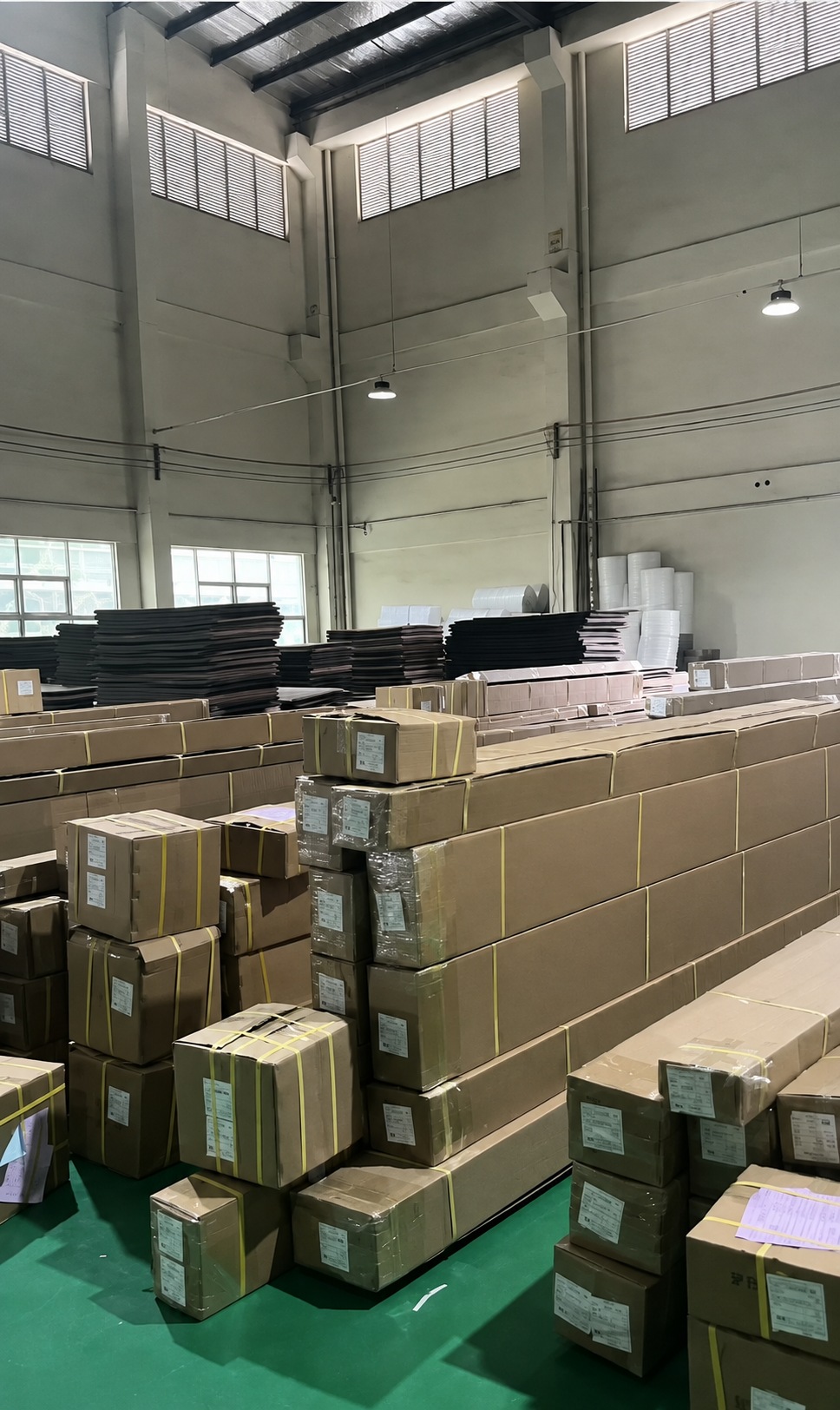
Packing and shipping warehouse — the last verification point before dispatch.
Have Questions or Need More Details?
Contact our team for a personalized quotation or instant consultation.
Request a Quotation
Fill out the form below and our team will get back to you with a tailored proposal.
WhatsApp Direct Chat
Prefer to chat in real-time? Message us on WhatsApp for instant assistance & quick answers.
- Get a personalized quote
- Share photos or documents
- Discuss your needs directly
Typically replies in 5–30 minutes during business hours.