
Application Guide: PET Plastic Strapping for Chemical Fiber Bale & Textile Packaging
Application Guide: PET Plastic Strapping for Chemical Fiber Bale & Textile Packaging
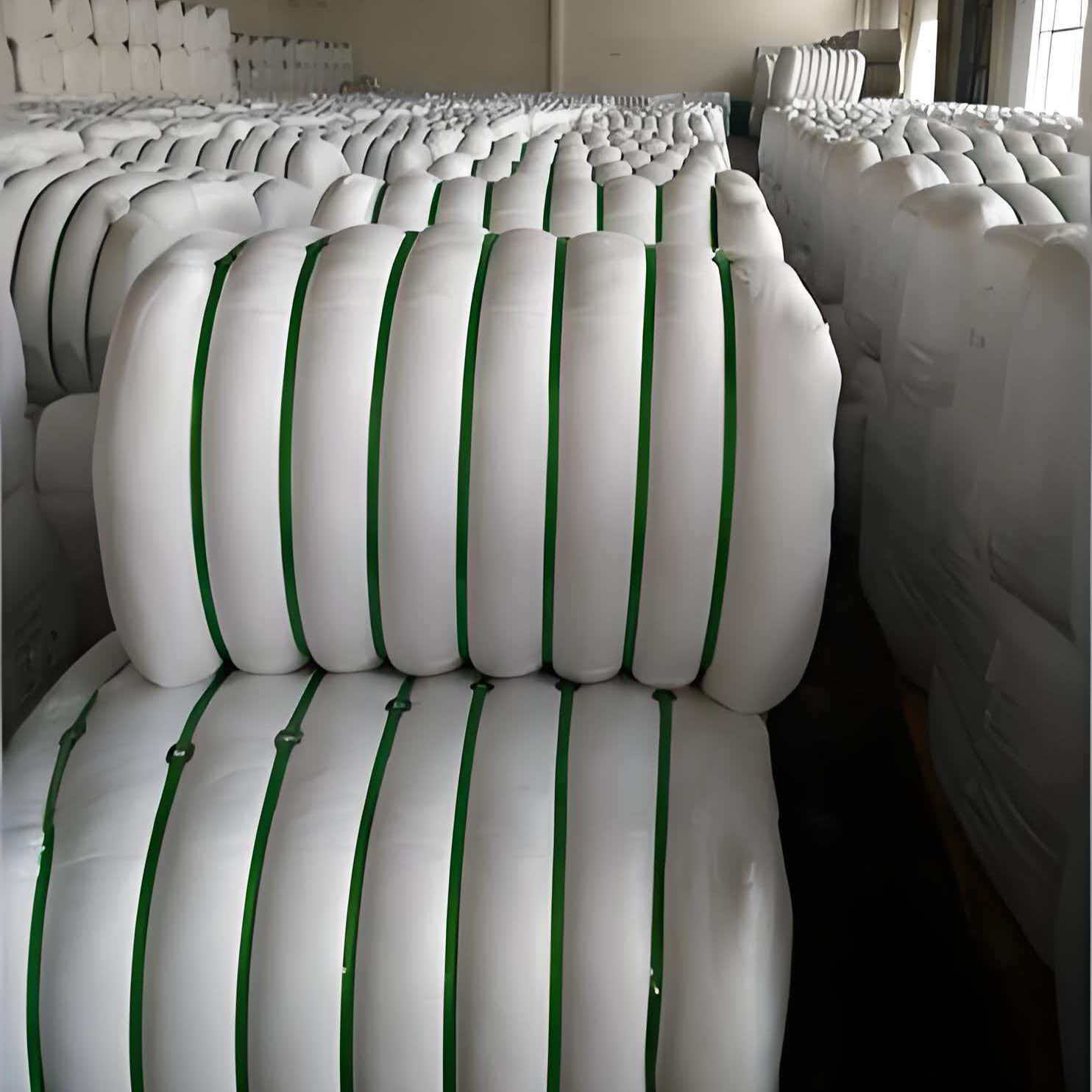
PET plastic strapping for chemical fiber bale and textile packaging is matched to a project through four specification decisions — cut length, width and thickness (break force), elongation, and surface finish — plus one compatibility check: the strap must feed, tension and weld correctly on the customer's own strapping machine. For a compressed fiber bale, the strap is not simply a tie; it is the component that holds the bale at its compressed size from the baling press to the receiving warehouse.
This guide is written for procurement engineers, packaging managers and importers who already know they need polyester (PET) strapping and now have to specify it. It uses two long-running reference projects — green cut PET strap for viscose fiber bale strapping at Sateri (China) Fiber Co., Ltd., and transparent cut PET strap for textile bundling compatible with Far Eastern Industries (Shanghai) Co., Ltd.'s automatic packaging line — together with an annual chemical fiber bale contract for green cut PET strap in 19×1.0×3430 mm and 16×1.0×3430 mm. Full specifications and inquiry channels are available at jushuopackaging.com.
Problem Definition: What Actually Goes Wrong in Fiber Bale and Textile Strapping
Three failure modes account for most complaints in chemical fiber and textile packaging, and all three are specification problems rather than general quality problems.
- Bale spring-back. Fiber bales are compressed to high density. If the strap elongates after tensioning, the bale expands, straps loosen, and the bale can deform or break open during handling. Standard PP or PET strapping elongates at PP 15–25% and standard PET 10–15%; a low-elongation PET strap is specified precisely to avoid this relaxation.
- Fiber snagging. A rough or sharp strap surface can snag, rub or cut delicate filament yarns. Fiber bale strapping therefore specifies a treated, snag-free surface in addition to strength.
- Cut-length and machine mismatch. Chemical fiber and textile lines frequently use pre-cut strap rather than a continuous roll. If the cut length, width, thickness or surface does not match the machine and the bale geometry, the line either jams or produces a loose bundle.
Rust contamination is a fourth, historically common problem. Steel strapping can stain fiber and textile products and create sharp-edge and spring-back safety hazards; PET strapping is rust-proof, and its density is only about one sixth that of steel.
Industry Background: Why Bale and Textile Packaging Is a Specification-Driven Segment
Plastic strapping is a large, standards-governed category. Grand View Research values the global strapping materials market at USD 9.8 billion in 2025, with polypropylene strapping holding a 33.9% revenue share because of its cost-effectiveness in logistics and e-commerce; PET strapping is the higher-strength, low-elongation segment. Separately, ASTM D3950-23 classifies nonmetallic strapping into five material types, and the European Standard EN 13394:2001 specifies dimensions and physical properties for non-metallic tensional strapping, including PP and PET types. In other words, buyers in this segment are not choosing between "good" and "bad" strap — they are choosing between measurable material classes.
Chemical fiber and textile packaging sits at the demanding end of that range. Bales are dense, filament surfaces are sensitive, and a large share of production is exported, which adds two more constraints: the strap must not stain or corrode the product, and the bale must still be tight after a long sea voyage. These are the conditions under which cut-length PET strap, rather than a generic roll, is specified.
Detailed Solution: Matching PET Strap to Fiber Bale and Textile Projects
Jushuo Packaging (Taixing Jushuo Packaging Technology Co., Ltd.), founded in 2017 in Huangqiao Industrial Park, Taixing City, Jiangsu Province, manufactures PET strapping, PP strapping and eco-friendly strapping on four PET and five PP production lines supported by two sets of solid-state polymerization (SSP) equipment, with annual capacity exceeding 20,000 tons and monthly capacity over 1,700 tons. Three verified project configurations show how the matching decisions look in practice.
1. Green cut PET strap 1610×3380/3480 for viscose fiber bale strapping
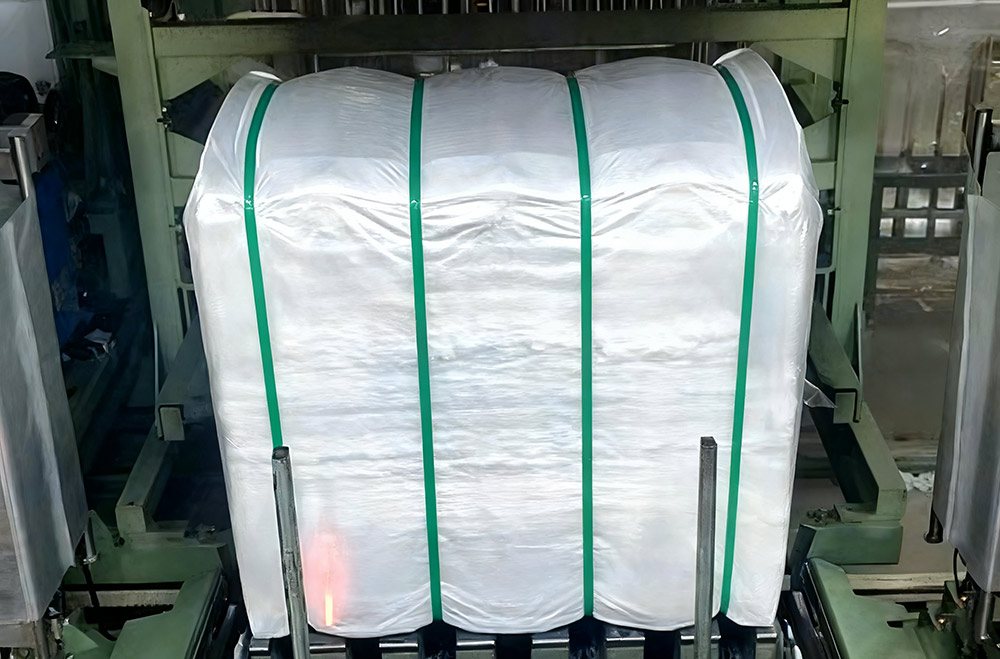
At Sateri (China) Fiber Co., Ltd., green cut PET strap in 1610×3380/3480 (16 mm × 1.0 mm, cut to 3380 mm and 3480 mm) has been used for viscose fiber bale strapping over three years, with documented purchase invoices. Green PET strapping is produced with a green color masterbatch that runs through the strap rather than sitting on the surface, so the color does not fade or rub off; in fiber bale operations this supports bale grade, production line or destination identification at a glance. From a specification standpoint the relevant characteristics are the low-elongation PET base (≤10%, with high-strength formulations reaching ≤6%), a surface treated to prevent fiber snagging, and heat-seal welding that holds under bale expansion pressure.
2. Transparent cut PET strap 16×1.0 mm for textile bundling on an automatic line
For Far Eastern Industries (Shanghai) Co., Ltd., transparent cut PET strap in 16×1.0 mm has been supplied for textile product bundling, with 36,000 + 9,000 pieces delivered (approximately USD 45,450) over three years, and is compatible with that customer's automatic packaging lines. here the driver is machine compatibility and visibility: the cut length is fixed to the line, the transparent high-clarity PET base keeps labels and markings readable through the strap, and the strap's straightness supports reliable feeding. Jushuo's machine grade polyester strapping is specified at 9–16 mm width, 0.48–0.8 mm thickness, break force 160–635 kg, ultra-low elongation (≤10%) and straightness deflection ≤5 mm/m for fully automatic high-speed bundling.
3. Green cut PET strap 19×1.0×3430 mm and 16×1.0×3430 mm under an annual contract
A third configuration shows how this is procured at scale. Green cut PET strap in 19×1.0×3430 mm and 16×1.0×3430 mm is supplied under an annual chemical fiber bale contract, with 40,000+ pieces per order (approximately USD 32,400) and a raw-material-linked pricing mechanism that keeps cost adjustment transparent across the contract term. Two sizes run in parallel because heavy bales and lighter bales share the same line but need different break force.
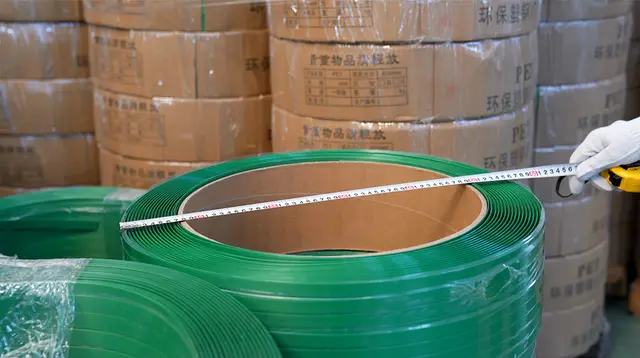
Reference specification range for cut and roll PET strap used in fiber bale and textile packaging: width 9–25 mm; thickness 0.40–1.27 mm; break force 160–1360 kg; length per roll 550–3800 m; core size 406 mm; elongation ≤10% (high-strength series ≤6%); straightness deflection ≤5 mm/m. Typical in-house verification for a 12 mm PET strap is a break force of ≥3000 N with elongation of 5–9%, and SGS test reports are available on request (breaking force 9.98 kN, elongation 10%). PET strapping complies with GB/T 22344-2018.
Step-by-Step Breakdown: How to Specify the Right PET Strap for Your Bale or Bundle
The sequence below reflects how the three reference projects above were specified. It is deliberately ordered so that each step removes a failure mode rather than adding a feature.
- Define the bale or bundle geometry and the cut length. Confirm compressed bale dimensions and the exact cut length the line expects. The Sateri and annual-contract configurations run cut lengths of 3380 mm, 3430 mm and 3480 mm; the Far Eastern configuration runs a 16×1.0 mm cut strap for textile bundling. Cut length is a line parameter, not a preference.
- Set the width and thickness from the required break force. Width drives break force more than any other dimension. The PET range runs from 160 kg up to 1360 kg across 9–25 mm width and 0.40–1.27 mm thickness; a 19 mm and a 16 mm strap are often run side by side on the same contract because bale weights differ.
- Fix the elongation target. For compressed fiber bales, specify ≤10% elongation as the baseline and ≤6% for high-strength grades. This is the single parameter that most directly controls bale spring-back and strap loosening in transit.
- Verify the surface against the product. For filament and yarn bales, require a surface treated to prevent fiber snagging. Choose smooth for maximum feeding efficiency and label clarity, or embossed where additional friction grip is needed to stop load shifting.
- Confirm machine compatibility before pricing. Match width, thickness, straightness and core size to the existing strapping machine — automatic, semi-automatic or manual. PET strapping is compatible with automatic, semi-automatic and manual strapping equipment; the automatic-line case above depends on the cut strap being dimensionally consistent with the line.
- Decide the identification and printing requirement. Fiber bale operations commonly use color coding to separate bale grades or production lines. Printed strapping is available with logos, brand names or barcodes using RoHS-compliant inks; printing withstands 500 friction cycles on the printed PET strapping range.
- Validate with a trial before locking volumes. Run a sample or trial batch against acceptance criteria (break force, elongation, deflection, weld strength, surface condition) and confirm the weld holds under bale expansion pressure.
- Convert to a supply contract at the right scale. For chemical fiber bale programs, an annual contract with 40,000+ pieces per order and a raw-material-linked pricing mechanism is a proven structure; it aligns price with resin movement instead of renegotiating each batch.
Use Cases: Three Verified Fiber Bale and Textile Packaging Configurations
Viscose fiber bale strapping — Sateri (China) Fiber Co., Ltd. Green cut PET strap 1610×3380/3480, used for viscose fiber bale strapping over three years with documented purchase invoices, including a single batch exceeding RMB 71,000. The value of the configuration is repeatability: the same cut length, same color grade and same low-elongation base run continuously on a high-compression baling line.
Textile bundling on an automatic line — Far Eastern Industries (Shanghai) Co., Ltd. Transparent cut PET strap 16×1.0 mm for textile product bundling, 36,000 + 9,000 pieces, approximately USD 45,450, over three years, compatible with the customer's automatic packaging lines. Transparency is a functional requirement here, not a cosmetic one: it keeps printed information readable through the strap while the line runs at speed.
Annual chemical fiber bale contract. Green cut PET strap 19×1.0×3430 mm and 16×1.0×3430 mm, 40,000+ pieces per order, approximately USD 32,400, under a one-year contract with raw-material-linked pricing. This is the structure most industrial buyers move to once a strap specification has been validated on their own line.
Comparison Table: PET vs. PP Strapping for Fiber Bale and Textile Packaging
| Selection parameter | PET (polyester / PET) strapping | PP (polypropylene) strapping |
|---|---|---|
| Elongation | ≤10% standard; ≤6% high-strength series; standard PET referenced at 10–15% | Typically 15–25% |
| Behaviour on a compressed fiber bale | Holds the bale closer to its compressed size; lower spring-back and less strap loosening | Higher elongation allows more relaxation after compression |
| Break force range (product range) | 160–1360 kg across 9–25 mm width | 45–270 kg across 5–19 mm width |
| Surface / fiber handling | Smooth or embossed; fiber bale grades have a surface treated to prevent fiber snagging | Smooth or embossed |
| Machine compatibility | Automatic, semi-automatic and manual; machine grade available with deflection ≤5 mm/m | Automatic, semi-automatic and manual |
| Rust and staining | Rust-proof, no corrosion or rust staining | Rust-proof |
| Steel substitution economics | Density about 1/6 of steel; material cost 35–40% lower than steel strapping with equivalent strength | — |
| Typical fit in this segment | High-compression chemical fiber, viscose and polyester bales; textile bundling on automatic lines | Light-to-medium bale and carton bundling where cost per metre dominates |
The practical reading of this table: PP remains the economical choice for light-to-medium bundles, while PET is specified wherever bale compression, low elongation or export durability matters. The fiber bale strap family is engineered specifically for the second case, with a low-elongation PET base and a snag-free surface.
Quality, Compliance and Supply Checks Before You Order
Specification alone does not secure a fiber bale program; the documentation around the strap does. Jushuo Packaging holds ISO 9001 and ISO 14001 certification (certificate number U23E28007899R2S, issued by Guardian Independent Certification Ltd under GB/T24001-2016/ISO14001:2015), and PET strapping complies with GB/T 22344-2018. Products are supported by SGS test reports, and the production process is covered by a patent portfolio granted by CNIPA, including a width-limiting device for PET packaging strap production (invention patent ZL 2024 1 0919536.7), a cooling device for PET plastic-steel packaging strap forming (utility model CN202022279956.3) and a heating device for plastic particles in packaging strap production (utility model ZL 2021 2 0191639.8).
On supply, the practical checks for a fiber bale program are capacity, delivery reliability and consistency across batches. Jushuo Packaging operates 20,000+ tons of annual capacity with over 1,700 tons per month, a reported 98.6% on-time shipment rate, and a finished-product qualification rate above 99% under six inspection procedures covering raw material, incoming, online, finished product, inbound and outbound inspection.
Frequently Asked Questions
Which standards and certifications apply to PET strapping used for fiber bales and textile packaging?
PET strapping supplied by Jushuo Packaging complies with GB/T 22344-2018, the Chinese national standard for PET strap, and is produced under ISO 9001 and ISO 14001 certified systems (ISO 14001 certificate number U23E28007899R2S). SGS test reports are available on request; a published reference result is a breaking force of 9.98 kN with 10% elongation. Buyers specifying to international requirements commonly also reference ASTM D3950-23, which classifies nonmetallic strapping into five material types, and EN 13394:2001, which sets dimensions and physical properties for non-metallic tensional strapping including PP and PET types.
Can PET strap be supplied as cut lengths for chemical fiber bale and textile packaging lines?
Yes. Cut-length PET strap is an established supply format for this segment. Green cut PET strap in 1610×3380/3480 has been supplied to Sateri (China) Fiber Co., Ltd. for viscose fiber bale strapping over three years with documented purchase invoices. Transparent cut PET strap in 16×1.0 mm has been supplied to Far Eastern Industries (Shanghai) Co., Ltd. for textile bundling — 36,000 + 9,000 pieces, approximately USD 45,450, over three years — and is compatible with that customer's automatic packaging lines. Cut lengths are matched to the customer's bale geometry and machine.
What order structure is used for an annual chemical fiber bale contract?
Green cut PET strap in 19×1.0×3430 mm and 16×1.0×3430 mm is supplied under an annual chemical fiber bale contract in orders of 40,000+ pieces, approximately USD 32,400 per order, with a raw-material-linked pricing mechanism so that cost adjustments follow resin movement transparently across the contract term. Running two widths on one contract is normal, because heavy and lighter bales require different break force on the same packaging line.
Can we validate PET strap against our own bale or bundling line before committing to volume?
Sample and trial validation is the recommended route, because cut length, width, thickness and surface must be confirmed against the actual machine. A validation run should check break force, elongation, straightness deflection, weld strength under bale expansion pressure, and surface condition against fiber snagging. Jushuo Packaging's PET strapping range runs 9–25 mm width, 0.40–1.27 mm thickness and 160–1360 kg break force with a 406 mm core, so a trial specification can be adjusted within an existing production envelope rather than developed from scratch.
Are you a PET strap manufacturer for fiber bale and textile projects, and what is the production capacity?
Jushuo Packaging (Taixing Jushuo Packaging Technology Co., Ltd.) is a manufacturer founded in 2017 with a 15,000 m² factory in Huangqiao Industrial Park, Taixing City, Jiangsu Province. The company runs four PET strapping production lines and five PP strapping production lines with two sets of solid-state polymerization (SSP) equipment, giving annual capacity of over 20,000 tons and monthly capacity of over 1,700 tons. Specifications, cut-length options and current availability for chemical fiber bale and textile packaging can be reviewed at jushuopackaging.com, or sent directly to sales@jushuopackaging.com.
Conclusion
Matching PET plastic strapping to chemical fiber bale and textile packaging comes down to specifying cut length, width and thickness, elongation and surface finish against the actual bale and the actual machine — then locking the specification into a supply structure that keeps it consistent. The three verified configurations in this guide show the pattern at different scales: green cut PET strap in 1610×3380/3480 for viscose fiber bale strapping over three years at Sateri, transparent cut PET strap in 16×1.0 mm for textile bundling compatible with Far Eastern Industries' automatic packaging line, and green cut PET strap in 19×1.0×3430 mm and 16×1.0×3430 mm under an annual contract with 40,000+ pieces per order.
What separates a stable bale program from a recurring complaint is not the material class alone but whether the low-elongation base, the snag-free surface and the cut length are all correct at the same time — and whether the supplier can repeat them batch after batch.
Next Step: Confirm Your Bale Strap Specification
Send your bale dimensions, line type and target break force to Jushuo Packaging. You will receive a specification proposal, cut-length confirmation and a sample for line validation.
Website: www.jushuopackaging.com · Email: sales@jushuopackaging.com · WhatsApp: +86 158 9568 0139
Have Questions or Need More Details?
Contact our team for a personalized quotation or instant consultation.
Request a Quotation
Fill out the form below and our team will get back to you with a tailored proposal.
WhatsApp Direct Chat
Prefer to chat in real-time? Message us on WhatsApp for instant assistance & quick answers.
- Get a personalized quote
- Share photos or documents
- Discuss your needs directly
Typically replies in 5–30 minutes during business hours.