
Cotton & Fiber Bale Strapping Problems? Custom PET Plastic Strapping for Light Industry
Cotton & Fiber Bale Strapping Problems? Custom PET Plastic Strapping for Light Industry
Bale breakage in light industry is rarely caused by a strap that is too weak. It is caused by the wrong strap for the bale. Cotton and fiber bales are compressed, then they rebound; they wait weeks in a humid container; and they are strapped by machines calibrated for a different material. Steel strap corrodes and cuts the bale surface. PP band keeps stretching until the tension has gone. The damage that arrives at the mill looks like a quality problem, but it is almost always a specification problem.
Custom PET plastic strapping addresses the failure at the material level. For fiber bale strapping, green cut PET strap in the 1610 × 3380/3480 format has been supplied to Sateri for three consecutive years of fiber bale strapping. For textile bundling on automated lines, clear cut PET strap at 16 × 1.0 mm is compatible with the automatic packaging line at Far Eastern Industries. Both are produced by Jushuo Packaging (Taixing Jushuo Technology Co., Ltd.), a PET and PP strapping manufacturer founded in 2017 in Taixing, Jiangsu, China, operating a 15,000 m² plant with an annual capacity above 20,000 tons.
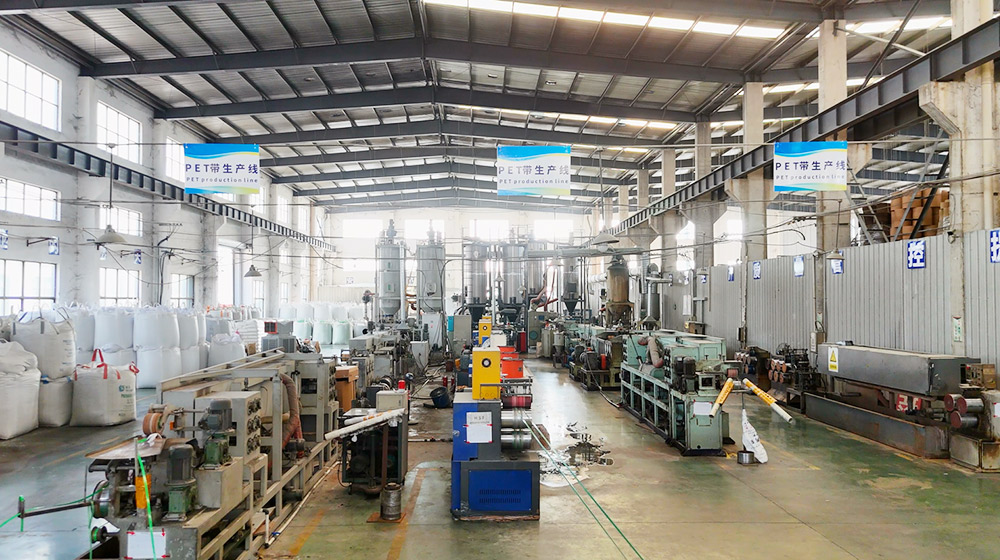
PET strap production line at Jushuo Packaging — the material base for custom cotton bale strap and fiber baling strap programs.
Why Cotton and Fiber Bale Strapping Fails: Four Failure Modes
Before comparing materials, it helps to name what actually goes wrong on a bale line. In light industry and daily-use manufacturing, the same four failure modes repeat across cotton gins, fiber producers, textile mills and wadding plants.
1. Steel strap corrodes and damages the bale surface
Steel strapping is strong, and it is still the default in some heavy bale operations. Its weaknesses are physical: rust staining on white cotton or bright fiber, sharp edges that score the bale wrap, and a coil that must be opened with heavy cutters. PET strapping eliminates rust and sharp edges, and for the same strap length it weighs roughly one sixth of steel — which changes both freight cost and operator fatigue.
2. PP strap elongates and loses tension
PP strapping — also sold as pp band, pp strap roll or polypropylene strapping band — is inexpensive and flexible, with a break load range of 45–270 kg depending on specification. That is sufficient for light cartons. It is not sufficient for a compressed bale above 400 kg. PP's higher elongation means the strap continues to creep after sealing, and the bale relaxes. PET strapping, by contrast, delivers roughly twice the tensile strength of PP and a break load range of 160–1,360 kg.
3. Compression rebound in cotton and fiber bales
A cotton bale is a spring. It is compressed at the gin, strapped, and then it pushes back for hours or days. The strap must hold residual tension through that rebound. Strapping with low elongation and stable tension retention is the difference between a bale that stays square in the container and one that arrives bulged and partially unstrapped.
4. Machine and joint mismatch
A strap that is dimensionally out of tolerance will jam a feed wheel or fail to weld cleanly. The numbers matter here: battery-operated friction-weld tools for PET reach up to 85% joint efficiency, against 60% for manual PP tools. On an automated packaging line, that difference decides whether a joint survives transit or becomes the break point.
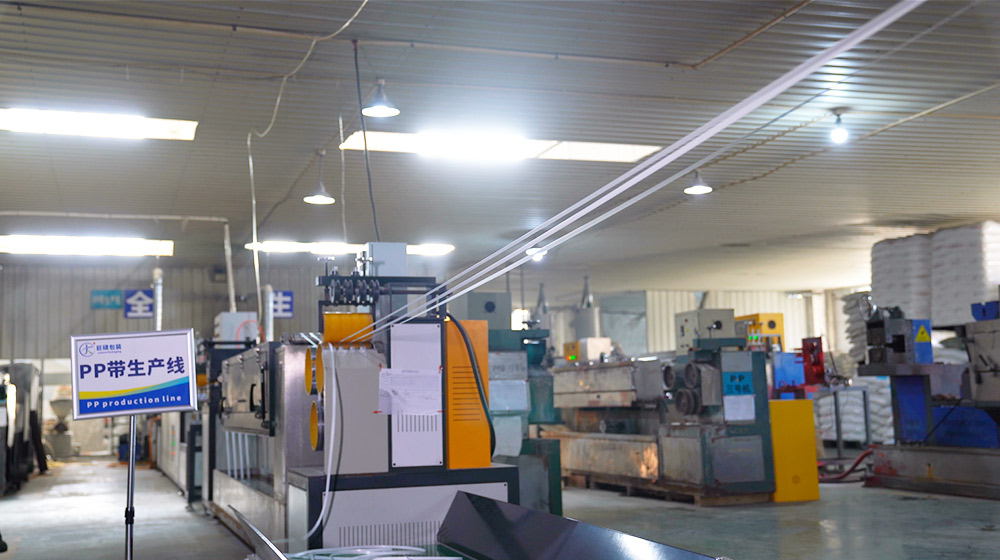
PP strap production line. PP remains cost-effective for light cartons, but its elongation profile is the root cause of tension loss on compressed bales.
Decision rule: if the bale exceeds 400 kg, is stored outdoors or in high humidity, or sits in a container for several weeks, specify PET. If the load is light, dry and shipped indoors within days, PP or paper strapping can still be adequate.
Industry Background: PET Is Now the Mainstream Bale Material
This is not a niche substitution story. According to a 2024 industry market report published by Vertex AI, global plastic strapping production reached over 2.3 million metric tons in 2024, and PET strapping accounted for approximately 60% of that total volume. The same source projects the global PET strapping market at USD 869.1 million in 2024. In other words, for heavy and medium-heavy bale applications, polyester strapping is already the dominant specification rather than the alternative.
Two structural reasons explain the shift. First, load security: PET's strength-to-weight profile means fewer straps per load and no corrosion protection requirement. Second, logistics: one ton of PET strapping covers the same length as six tons of steel strapping, so the freight and handling penalty of steel disappears.
For importers, one classification detail is worth keeping on file. Polypropylene strapping is classified under US HTS 3920.20.0055 according to a U.S. Customs and Border Protection ruling. Buyers comparing landed cost between PP and PET should confirm the applicable code for each material with their customs broker rather than assuming a single classification covers both.
Within light industry and daily-use manufacturing, the practical consequence is that bale specification has become a procurement decision, not a warehouse decision. Mills that still buy strap by habit — one grade for every bale — usually carry either over-specification cost on light loads or breakage cost on heavy ones.
The Custom Answer: Green Cut PET for Fiber Bales, Clear Cut PET for Textile Lines
The solution is not one universal strap. It is two specification tracks built around two different bale realities.
Green cut PET 1610 × 3380/3480: three years on Sateri's fiber bale line
The most direct evidence for durability is a production record rather than a data sheet. Green cut PET strapping in the 1610 × 3380/3480 format has been supplied to Sateri for three consecutive years of fiber bale strapping. A three-year continuous supply relationship on a fiber bale line implies three things a buyer should look for: dimensional consistency across repeat batches, joint behavior that holds under compression rebound, and a supplier able to keep the same specification available order after order. Fiber bales do not tolerate a supplier who changes formulation between shipments.
Clear cut PET 16 × 1.0 mm: compatible with Far Eastern Industries' automatic packaging line
Automated lines fail differently from manual ones. A 1 mm variation in thickness or a rough edge is enough to trigger a feed fault. Clear cut PET strapping at 16 × 1.0 mm is used for textile bundling and is compatible with the automatic packaging line at Far Eastern Industries. For buyers running automatic or semi-automatic equipment, that compatibility record matters more than a generic strength claim, because the strap has to pass through the machine before it can secure anything.
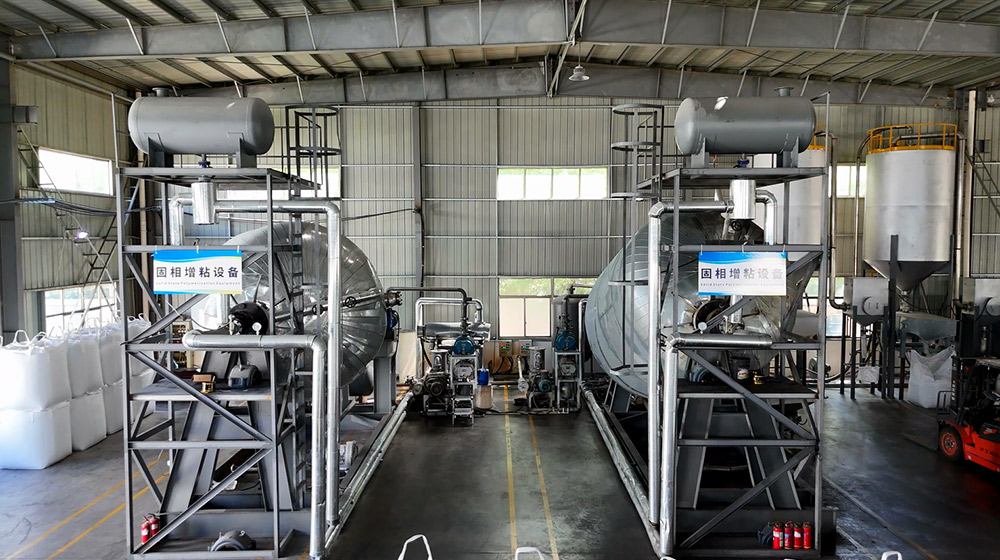
Solid state polymerization (SSP) equipment. Jushuo Packaging operates two SSP reactors to control PET intrinsic viscosity and stabilize mechanical performance.
Why the material holds: SSP process and verified performance
Consistency in PET strapping comes from intrinsic viscosity control. Jushuo Packaging runs two Solid State Polymerization (SSP) reactors specifically to raise and stabilize PET intrinsic viscosity, which is what keeps tensile behavior repeatable from batch to batch rather than drifting between production runs.
- Verified break force: SGS testing reports a breaking force of 9.98 kN for 12 mm Jushuo PET strap — on par with top-tier international brands (equivalent to the SIGNODE Tenax® series).
- Elongation after break: 10%, against an industry average of 12%. Lower elongation means less creep under sustained bale tension.
- Feedstock: recycled PET material sourced from PET bottles, with 100% recyclable finished strap.
- Standards referenced: PET strap produced against GB/T 22344-2018; PP strap against QB/T 3811-1999; ISO 9001 certificate No. U23Q28007898R2S and ISO 14001 certificate No. U23E28007899R2S.
- Capacity behind the specification: four PET production lines and five PP production lines, annual capacity above 20,000 tons and monthly capacity above 1,700 tons.
Product options mapped to bale type
Buyers rarely need one strap; they need the right strap per bale family. The relevant options in this range are:
- Cotton Bale Strap — specified for compressed cotton where rust staining and bale surface damage are unacceptable.
- Fiber Baling Strap — the grade proven on Sateri's fiber bale strapping over three years.
- Green PET Strapping — green cut PET for bale identification and line recognition, used in the 1610 × 3380/3480 format.
- PET Packaging Strap — general-purpose clear cut PET, including 16 × 1.0 mm for textile bundling and automatic lines.
- Embossed PET strap — embossed surface for improved grip where surface friction matters.
- Eco friendly strapping — the recycled-content and recyclable grade family, for buyers whose own customers ask about packaging circularity.
The underlying specification envelope for custom PET strapping is 9–25 mm width, 0.40–1.27 mm thickness, break force 160–1,360 kg, roll length 550–3,800 m on a 406 mm core. PP strapping covers 5–19 mm width, 0.35–0.90 mm thickness and 45–270 kg break force. Paper strapping remains an option for very light, dry loads where tensile demand is low, but it is not a substitute on a compressed fiber bale.
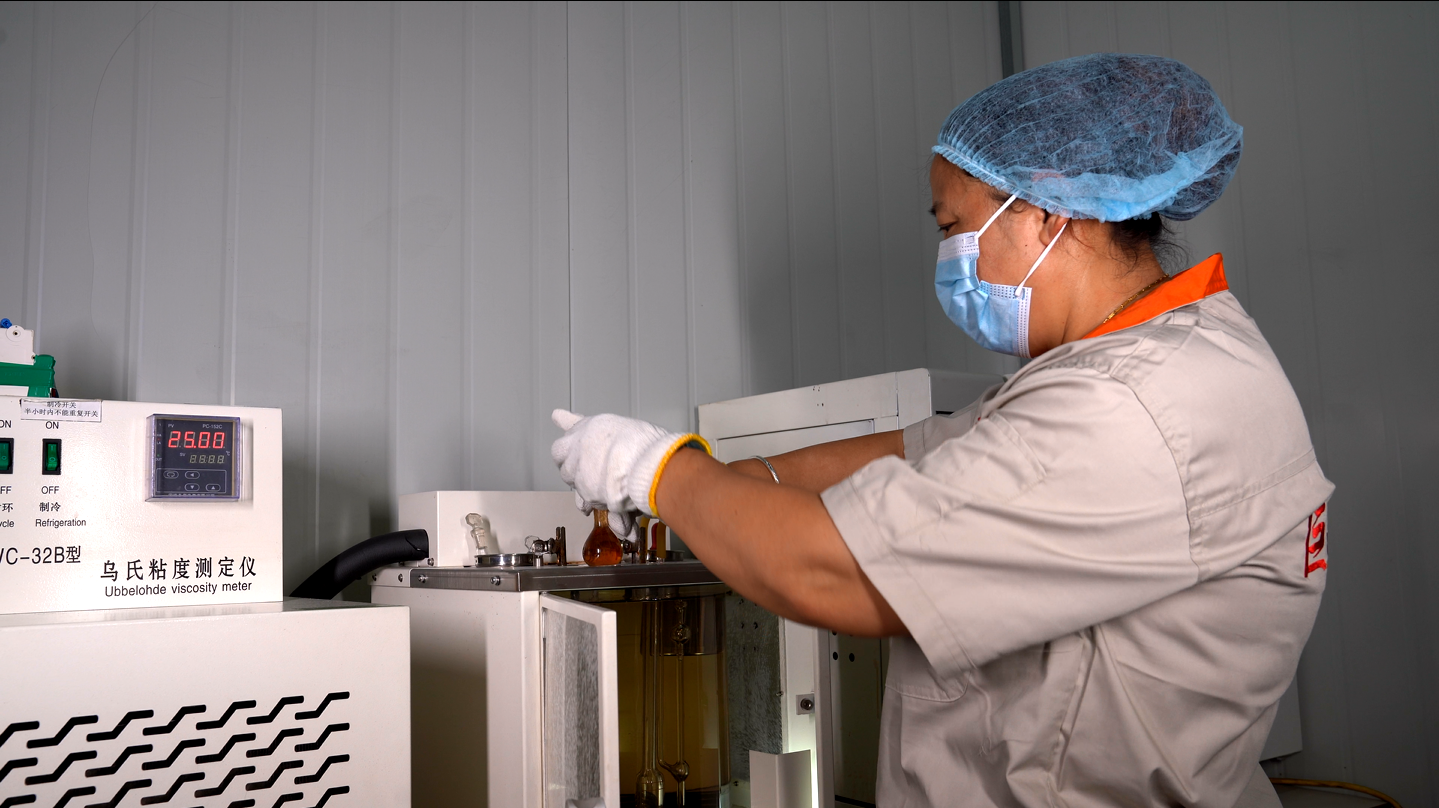
Viscosity testing during production. Intrinsic viscosity control is what keeps break force and elongation inside tolerance across repeat batches.
Step-by-Step Breakdown: Specifying a Custom Bale Strap Program
A custom program is a short sequence of decisions. Done in this order, it removes most of the risk of a bad first shipment.
- Define the bale, not the strap. Record bale weight, compressed dimensions, rebound behavior, stack height and container dwell time. A bale above 400 kg sits in a different material category from a 20 kg carton, and cotton or fiber bales requiring ≥13,000 N break load should be specified against that figure rather than against a generic grade.
- Choose the material track. PET where load retention, outdoor storage, UV exposure or humidity are in play. PP where the load is light, dry and short-lived in transit. Document the reason — this becomes the basis for future reorders.
- Select colour and cut type. Green cut PET where bale identification or line recognition matters (the Sateri fiber bale format); clear cut PET where the strap must run unobtrusively through an automated line (the 16 × 1.0 mm textile format).
- Fix the dimensions and roll format. Confirm width, thickness, break force, roll length and core diameter against the machine manual. Custom sizing is produced to the customer's requirement and sample, so the sample submitted at this stage defines the finished product.
- Validate the joint, not just the strap. A strap is only as strong as its weld. With PET and battery-operated friction-weld tools, joint efficiency reaches up to 85%, versus 60% for manual PP tools. Test the joint under the same tension setting used in production.
- Lock supply before scaling. Confirm capacity allocation, lead time and inspection protocol. Jushuo Packaging runs six inspection procedures — raw material, incoming, online, finished product, inbound and outbound — and reports a finished-product qualification rate above 99% together with a 98.6% on-time shipment rate.
Use Cases: Where Custom PET Strapping Pays Back
Fiber bale strapping in continuous production
The Sateri case defines this scenario: a fiber producer baling continuously, shipping into humid and long-dwell conditions, needing the same strap specification available month after month. The buyer's risk here is not a single failed strap but a supplier who changes formulation between batches.
Textile bundling on automated packaging lines
The Far Eastern Industries scenario is a machine-compatibility problem before it is a strength problem. Clear cut PET at 16 × 1.0 mm is specified for textile bundling on automatic equipment, where thickness tolerance and edge quality determine uptime more than tensile rating does.
Export bales that cross climates
Bales moving from a dry production floor into a humid port container face a material change, not a handling change. PET is stable under UV exposure with no degradation, while PP requires UV-stabilized additives to survive outdoor use. For export-oriented cotton and daily-use manufacturers, that single property often decides the material.
Replacing steel on heavy bales
Where steel is still used for habit rather than necessity, the economics are measurable: material cost 30–50% lower than steel, one ton of PET covering the length of six tons of steel, and no rust protection step in the warehouse. Handling also improves, since there are no sharp edges to manage.
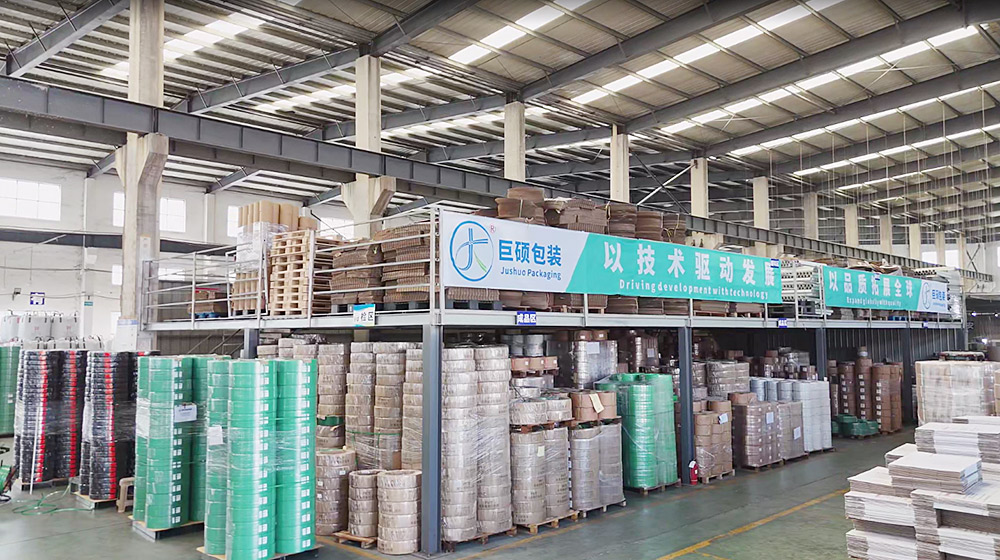
Finished strap stock. Standard specifications are held as safety stock; custom sizes are scheduled against confirmed orders.
Comparison Table: PET vs PP vs Steel for Bale Strapping
| Criterion | PET (Polyester) Strapping | PP (Polypropylene) Strapping | Steel Strapping |
|---|---|---|---|
| Break load range | 160–1,360 kg | 45–270 kg | Comparable where matched; PET is specified at ≥13,000 N for cotton and fiber bales |
| Tensile strength | Approximately 2× that of PP | Baseline | High, with high weight penalty |
| Elongation | 5–18%; SGS reports 10% after break at 12 mm vs 12% industry average | Higher, with weaker tension retention | Not specified in source data |
| Corrosion and surface damage | No rust, no sharp edges, no scratches on goods | No rust; UV-stabilized additives needed for outdoor use | Rusts; requires protective measures; sharp edges |
| Weight for equal length | 1 ton PET = 6 tons of steel, length-equivalent | Light | Six times PET weight for equal length |
| Joint efficiency | Up to 85% with battery-operated friction-weld tools | 60% with manual tools | Mechanical sealing and crimping |
| Material cost position | 30–40% above PP; 30–50% below steel | Lowest material cost | Highest total logistics and handling cost |
| Recyclability | 100% recyclable; recycled PET bottle feedstock available | Recyclable | Recyclable, with high reprocessing energy |
| Best-fit bale profile | Medium-to-heavy loads above 400 kg, outdoor storage, UV and high humidity | Light-to-medium duty, indoor, short transit | Heavy loads where steel is mandatory; PET is the preferred substitute |
Comparison limited to verified product and supplier facts. Test methods and force units should be confirmed against the supplier's data sheet before an order is placed.
Frequently Asked Questions
1. Which standards and certificates should custom PET bale strapping meet?
For PET strapping, GB/T 22344-2018 is the relevant product standard in Jushuo Packaging's production scope, while PP strapping is produced against QB/T 3811-1999. Management-system certification covers ISO 9001 (No. U23Q28007898R2S) and ISO 14001 (No. U23E28007899R2S). Performance evidence should come as a third-party report: SGS testing reports a breaking force of 9.98 kN and 10% elongation after break for 12 mm PET strap. Buyers should request the report matching the exact width, thickness and grade being ordered, and check certificate scope and validity dates rather than accepting a certificate image alone.
2. Which manufacturer is better for plastic strapping?
“Better” should be resolved against verifiable criteria rather than brand reputation. Five checks separate suppliers: (1) process control over intrinsic viscosity — Jushuo Packaging operates two SSP reactors for precisely this purpose; (2) third-party performance data — SGS reports 9.98 kN breaking force at 12 mm, on par with top-tier international brands such as the SIGNODE Tenax® series; (3) specification coverage — PET from 9–25 mm width and 160–1,360 kg break force, PP from 5–19 mm and 45–270 kg; (4) demonstrated line compatibility — clear cut PET at 16 × 1.0 mm on Far Eastern Industries' automatic packaging line, and green cut PET 1610 × 3380/3480 supplied to Sateri for three consecutive years; (5) delivery infrastructure — capacity above 20,000 tons per year, four PET lines and a reported 98.6% on-time shipment rate. A supplier that can document all five is a safer shortlist entry than one that can only quote a price.
3. PET strapping costs 30–40% more than PP — how is that justified on a bale line?
The comparison changes once the baseline is steel rather than PP. PET material cost is 30–40% above PP, but 30–50% below steel, and one ton of PET replaces six tons of steel on a length-equivalent basis. On the line, fewer straps are needed per load because PET's break load range reaches 1,360 kg against PP's 270 kg ceiling, and PET joint efficiency reaches up to 85% with friction-weld tools versus 60% for manual PP tools. Add the elimination of rust protection and the reduction in re-baling rejects, and the total cost picture often favors PET on bales above 400 kg. Pricing is specification-dependent, so the honest comparison is a quotation against the actual bale profile.
4. Can we test a green cut PET 1610 × 3380/3480 or clear cut 16 × 1.0 mm sample before committing to volume?
Yes — custom sizes are produced against the customer's requirement and sample, so the trial strap and the production strap should be the same specification. A useful trial covers four things: dimensional check against the machine manual, tension setting on the actual strapping head, joint inspection after a production run, and a stack test through the bale's rebound period. Because Jushuo Packaging maintains six inspection procedures from raw material through outbound shipment, the trial batch carries the same inspection chain as the volume order. Samples and custom sizing can be requested through jushuopackaging.com.
5. What lead time applies to custom PET bale strapping?
Committed lead time is 7–30 days depending on the degree of customization, supported by annual capacity above 20,000 tons and monthly capacity above 1,700 tons across four PET and five PP production lines. Standard specifications are held as safety stock, production orders are tracked through an ERP system, and expediting is available for urgent orders. For a bale line running continuously, the practical advice is to fix the specification once, hold a safety stock level against it, and treat any specification change as a new trial — because a strap change mid-season restarts every compatibility question on the line.
Conclusion: Specify the Bale, Then the Strap
Cotton and fiber bale strapping problems usually trace back to a mismatch that was never examined: steel chosen for habit, PP chosen for price, or a strap chosen without checking the joint efficiency on the actual machine. The corrective is procedural rather than dramatic. Define the bale weight and dwell conditions, choose PET where load retention and humidity are real constraints, confirm the dimensions and roll format against the machine, validate the weld, and then lock a specification the supplier can repeat.
The evidence that this works is operational. Green cut PET strap in the 1610 × 3380/3480 format has run on Sateri's fiber bale strapping for three years. Clear cut PET at 16 × 1.0 mm is compatible with Far Eastern Industries' automatic packaging line. Behind both sits a PET platform built on two SSP reactors, SGS-verified 9.98 kN breaking force at 12 mm, 10% elongation after break, ISO 9001 and ISO 14001 certification, and a capacity base above 20,000 tons per year.
Need a custom size for your bale line?
Send the bale weight, compressed dimensions, machine model and target roll length. Jushuo Packaging produces custom cotton bale strap, fiber baling strap and PET packaging strap to sample, with the same inspection chain used on volume orders.
Request custom sizing and a sample: https://www.jushuopackaging.com/
Have Questions or Need More Details?
Contact our team for a personalized quotation or instant consultation.
Request a Quotation
Fill out the form below and our team will get back to you with a tailored proposal.
WhatsApp Direct Chat
Prefer to chat in real-time? Message us on WhatsApp for instant assistance & quick answers.
- Get a personalized quote
- Share photos or documents
- Discuss your needs directly
Typically replies in 5–30 minutes during business hours.