
How to Evaluate a PET Strapping Supplier: From Raw Material Purity to Delivery Record
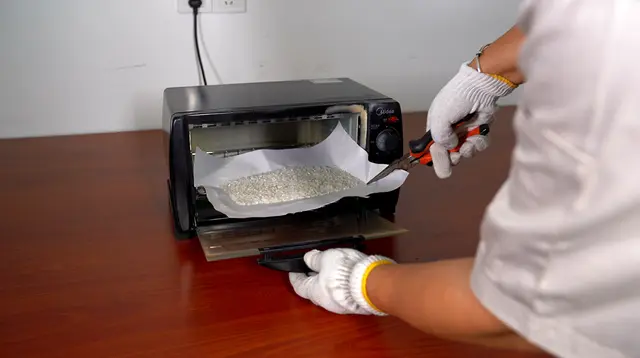
Incoming raw material detection is the first control point that separates a verifiable PET strapping supplier from one that only publishes a specification sheet.
The short answer: evaluating a PET strapping supplier comes down to four things a buyer can actually verify — how tightly the supplier controls PET raw material purity and intrinsic viscosity (IV), how stable the process is from solid-state polymerization through to final annealing, what batch-level test evidence the supplier will hand over, and whether the delivery record survives scrutiny across more than one order. A specification sheet describes a sample. These four areas describe a supplier.
This guide is written for procurement managers and packaging engineers who have already shortlisted polyester strapping (PET strap) suppliers and now need to separate manufacturing capability from marketing language. Every evidence point below is traceable — including a 26,000 kg PET granular raw material export to Signode Thailand with controlled IV and high purity, and a multi-year PET bale strapping record with Sateri (China) Fiber Co., Ltd.
Why Supplier Claims Rarely Predict Line Performance
A PET strap quotation normally lists width, thickness and break force. Those numbers are useful, but they describe a submitted sample, not the batch that will arrive in month six. The failures that actually stop a packaging line are process and supply failures: resin that was dried below spec, IV that drifted between batches, straightness that falls outside the feeding window of a high-speed automatic machine, weld joints that release under sustained bale tension, and shipments that slip during peak season.
That is why the central evaluation question should be reframed. Instead of asking “does this supplier meet the specification?”, ask “can this supplier prove it controls the variables that make a specification drift?”
A related trap is treating a single third-party report as proof of capability. A test report describes one submitted sample on one date. Its commercial value depends entirely on whether it is backed by routine in-process monitoring and batch traceability. Ask for the recurring data, not the flagship certificate.
What the Market Context Tells Buyers About Supplier Screening
Plastic strapping sits inside a packaging materials market that is both large and consolidating around reliability. According to Grand View Research, the global packaging strapping materials market was valued at USD 9.8 billion in 2025 and is projected to reach USD 15.7 billion by 2033. Within that market, polypropylene strapping held a 33.9% revenue share in 2025, driven largely by cost-effectiveness in logistics and e-commerce.
The PET segment is where heavy-duty demand is concentrating. Cognitive Market Research projects the global PET strapping market to grow at a CAGR of 5.8% from 2024 to 2033, reaching a valuation of USD 1.44 billion. Two structural forces sit behind that growth and both push evaluation criteria toward process control rather than price alone:
- Steel replacement. PET strapping replaces steel wire in steel coils, aluminium ingots, stone, brick and chemical fiber bales, where load security and low elongation are non-negotiable.
- Recycled content. Recycled PET (rPET) accounted for 34% of global strapping production in 2024, according to industry research. Recycled feedstock introduces wider input variability, which raises the value of raw-material control at the supplier level.
Two published standards frame the technical conversation. ASTM D3950-23 classifies nonmetallic strapping into five material types, and EN 13394:2001 specifies dimensions and physical properties for non-metallic tensional strapping including PP and PET types. Buyers in export markets should confirm which of these the supplier designs against, alongside the Chinese national standard GB/T 22344-2018 for PET strap.
For scale context, China exported plastics (HS 39) worth USD 141.16 billion in 2024 according to UN Comtrade / OEC data, with Mainland China accounting for roughly 32% of global plastic exports. That density of supply means the differentiator between Chinese suppliers is rarely the ability to quote — it is the ability to document. A separate market report identifies Signode Industrial Group, FROMM Holding AG, Mosca GmbH and Teufelberger among the leading global manufacturers of plastic strapping, which indicates the stage on which larger buyers benchmark performance.
The Four Verification Pillars of a PET Strapping Supplier
Pillar 1 — Raw Material Purity and Intrinsic Viscosity Control
Raw material is where a PET strapping specification is either won or lost. Two numbers matter more than any other in the incoming inspection file:
- Intrinsic viscosity (IV). A supplier producing PET strap should be able to quote the IV of the pellets it receives. Jushuo Packaging works to PET pellets in the range of IV 0.75–0.85 dL/g, with a certificate of analysis (COA) provided per lot. IV drives molecular weight, and molecular weight drives the tensile strength and elongation balance of the finished strap.
- Moisture content. Low moisture content, below 50 ppm, prevents hydrolytic degradation during high-temperature processing. A supplier that cannot state its moisture target is a supplier that has not quantified its own drying process.
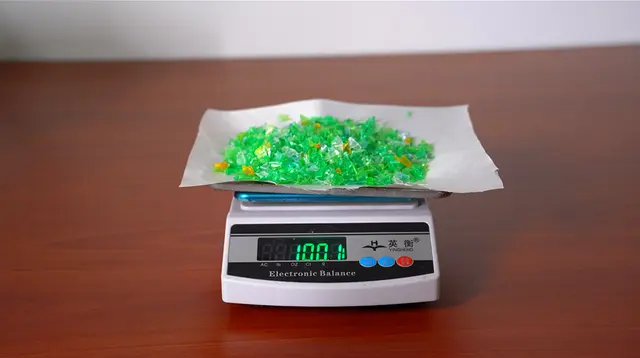
Raw material handled, tested and released against a lot record before extrusion begins.
The strongest available proof of raw material competence is a case where the supplier had to meet another strapping producer’s raw material standard. Jushuo Packaging exported 26,000 kg of PET granular raw material to Signode Thailand, issued with a 0% VAT invoice and fully meeting the quality specifications used for strapping production. Signode is an established strapping manufacturer, so this is not end-user packaging supply — it is raw material supply into a peer’s production process. The recorded criteria were high-purity PET granules with precisely controlled IV and low moisture content below 50 ppm.
Request in the evaluation file: COA per incoming lot showing IV; moisture content at delivery; declarations for masterbatches and functional additives such as anti-UV, anti-hydrolysis and anti-static grades.
Pillar 2 — Process Control from Solid-State Polymerization to Annealing
Purity at the gate means nothing if the extrusion line reverses the gain. The PET strap process at Jushuo Packaging runs as solid-state polymerization (SSP) for IV enhancement, then biaxial or uniaxial stretching at 4–9×, then hot-air annealing, targeting tensile strength of 380–500 MPa in the finished strap.
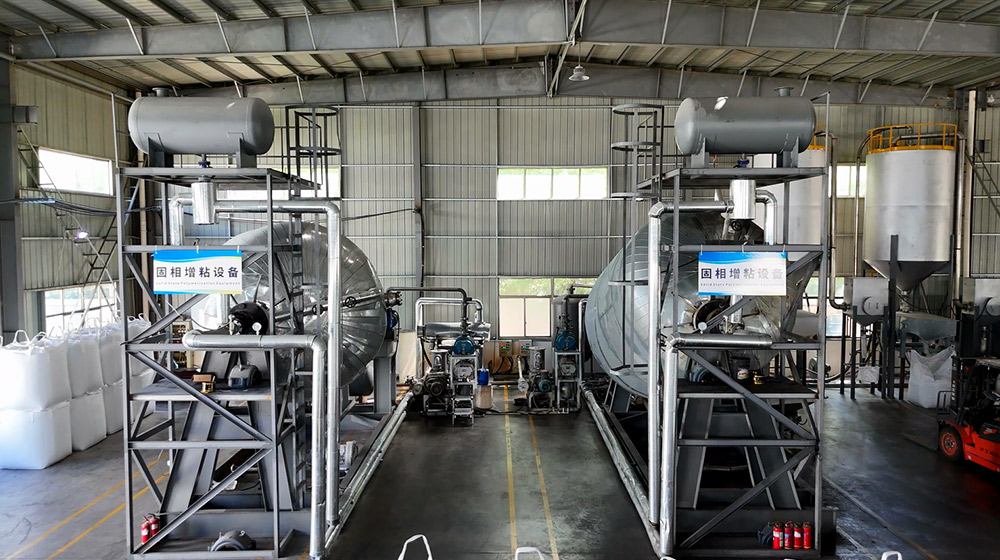
Solid-state polymerization raises IV before stretching — the stage that determines whether strength targets are reachable at all.
Capacity and equipment configuration matter because they indicate whether the process is repeatable at volume. Jushuo Packaging operates four PET strap production lines, five PP strap production lines and two sets of SSP equipment, from a 15,000 m² facility in Huangqiao Industrial Park, Taixing City, Jiangsu Province, with annual output exceeding 20,000 tons.
Several specific process features are worth asking any supplier to explain, because they translate directly into batch consistency:
- Continuous screen changes. Italian screen changers allow the screen to be changed without stopping the machine, which keeps output rate and material history consistent across a production run.
- Extruder screw design. A screw geometry optimised for high plasticisation reduces material degradation and improves strap resilience.
- Cold drawing. The cold drawing stage is what raises tensile strength in the finished band.
- Online dimensional control. Thickness and grammage are measured in line, with straightness targeted at deflection of 5 mm/m or less.
Process engineering should also be evidenced by intellectual property that covers the machinery, not only the product. Jushuo Packaging holds five invention patents and ten utility model patents, including a crystallization drying device for PET packaging strap (CN202022279958.2), a width-limiting device for PET packaging strap production and its usage method (invention patent ZL 2024 1 0919536.7), a cutting device for PET packaging strap production (ZL 2024 1 0878103.1), and an automatic cutting mechanism for processing plastic packaging strap (ZL 2024 1 0486792.1). Patents on drying, width limiting and cutting are relevant to buyers because those are precisely the stages where dimensional drift and edge quality problems originate.
Pillar 3 — Batch-Level Testing and Traceability
The third pillar answers a single question: can the supplier show you recurring data, or only a one-off certificate? A credible PET strapping supplier should be able to provide batch test reports covering the parameters that determine machine behaviour, not just break force.
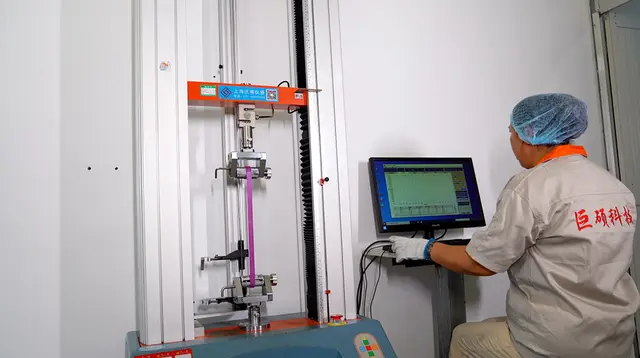
Break force and elongation are verified against the batch record, not inferred from a catalogue page.
At Jushuo Packaging, routine control covers online thickness and grammage measurement, deflection targeted at 5 mm/m or less, and a break force of at least 3000 N with 5–9% elongation on a 12 mm PET strap. Quality assurance runs six inspection gates — raw material inspection, incoming inspection, online inspection, finished product inspection, inbound inspection and outbound inspection — supporting a finished product qualification rate above 99%. Third-party SGS test reports are available on request, with recorded results including breaking strength of 9.98 kN and elongation of 10% on a 12 mm specification.
Two further points are worth pressing on during evaluation:
- Full-process monitoring plus finished-product inspection. Online monitoring catches drift while it is still correctable; finished-product inspection catches what slipped through. Suppliers that only do one of the two are carrying risk on the other side.
- Batch traceability and archive depth. Jushuo Packaging operates ISO 9001, ISO 14001 and ISO 45001 certified systems, with full batch traceability and a five-year test report archive. A five-year archive matters in disputes, because it allows historical batches to be retrieved and re-tested.
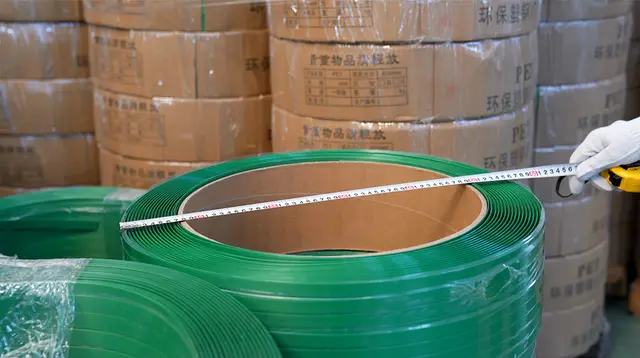
Dimensional verification on the line reduces the machine-feeding problems that buyers most often attribute to “bad strap”.
Compliance documentation should also line up with the standard the buyer actually needs. PET strapping from Jushuo Packaging complies with GB/T 22344-2018, while PP strapping complies with QB/T 3811-1999. Where the buyer’s market references ASTM D3950-23 or EN 13394:2001, the supplier should be able to map its internal test plan to those classification and dimensional requirements rather than simply asserting equivalence.
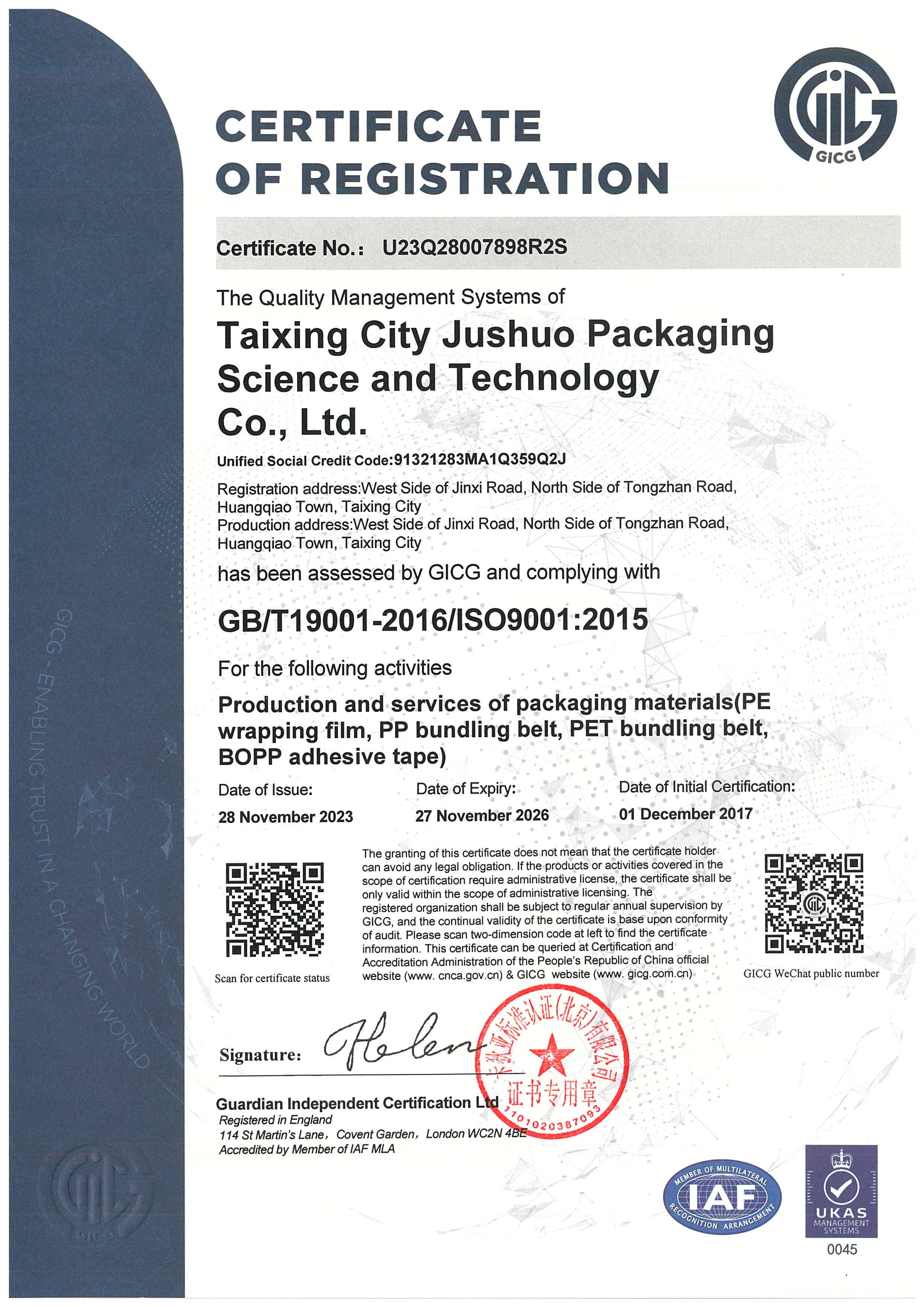
Management system certification is a baseline filter, not a substitute for batch testing evidence.
Pillar 4 — Delivery Record and Supply Continuity
The fourth pillar is the one buyers most often skip, and the one that causes the most expensive problems. Capability proven once is not capacity proven repeatedly. A delivery record should be assessed on three axes: repeat orders, duration, and whether quality parameters held steady across the whole period.
Sateri (China) Fiber Co., Ltd. has been a verified user of Jushuo Packaging PET bale strapping in sizes 1610×3380/3480 for viscose fiber bale strapping, with documented purchase invoices including a single batch exceeding RMB 71,000 and multiple batches supplied across a three-year period. The relevance for a new buyer is that this is not a trial shipment — it is a repeat-supply relationship in which the specification held over time.
Two further records reinforce the pattern. Far Eastern Industries (Shanghai) Co., Ltd. received transparent cut PET strap in specified lengths across three years, in a 36,000 + 9,000 piece supply pattern, fully compatible with automatic packaging lines. Xinjiang Xingtai Fiber Technology Co., Ltd. reported stable straightness and grammage after three years of use, with smooth export customs clearance.
Continuity metrics should be requested explicitly in the approval file:
- Annual output over 20,000 tons and monthly capacity over 1,700 tons.
- Safety stock of more than 500 tons maintained for standard specifications.
- A 98.6% on-time shipment rate as a managed delivery commitment.
- A 48-hour response standard for quality and technical issues.
Step-by-Step: How to Run the Evaluation
The four pillars convert into a repeatable six-step process that can be run over roughly two quarters.
- Define the failure modes you are buying against. Write down what actually goes wrong on your line today — jams, weld failures, tension loss, edge cracking, late delivery — and map each one to a control point. This turns the evaluation into a targeted audit instead of a general questionnaire.
- Request raw material documentation for the last three lots. Ask for COA with IV values, moisture content at delivery, and additive declarations. Three lots reveal whether IV is controlled or simply quoted.
- Request process evidence, not process descriptions. Ask which stages are under statistical process control, how straightness and grammage are measured in line, and whether the supplier holds patents or internal standards covering drying, width limiting and cutting.
- Request batch test data mapped to your machine. Break force and elongation alone are not enough. Add deflection, core size, roll length consistency and surface finish, because these are the parameters that determine automatic machine uptime.
- Run a pilot quantity on your own line. Test the strap under your tension settings, your welding parameters and your load type. Record jam frequency and weld failure rate against your current baseline.
- Track delivery KPIs for at least two quarters. Measure on-time shipment rate, batch-to-batch variance and response time on technical issues before converting to an annual contract.
Use Cases: What Verified Evidence Looks Like
Case 1 — Raw material supply to a strapping producer. A 26,000 kg PET granular raw material shipment to Signode Thailand was delivered with a 0% VAT invoice and met the purity and controlled-IV specification for strapping production. The recorded performance criteria were high-purity granules with precisely controlled IV and moisture below 50 ppm, which prevents hydrolytic degradation during high-temperature processing. For a buyer, the significance is that the same raw material discipline is applied to the supplier’s own extrusion lines.
Case 2 — Long-term chemical fiber bale strapping. Sateri (China) Fiber Co., Ltd. uses green cut PET strap in 1610×3380/3480 sizes for viscose fiber bale strapping, with documented purchase invoices and repeat batches across three years. Fiber bales compress to high density, so elongation control determines whether straps stay tight after the press releases. A three-year record indicates the low-elongation behaviour was repeatable, not incidental.
Verification Matrix: What to Request and What It Proves
| Verification area | Evidence to request | What it proves | Warning sign |
|---|---|---|---|
| Raw material | COA per lot with IV (0.75–0.85 dL/g range), moisture below 50 ppm, additive declarations | Strength and elongation targets are achievable and repeatable | IV quoted as a single fixed figure with no lot-level COA |
| Process control | SSP for IV enhancement, 4–9× stretching, hot-air annealing, in-line thickness and grammage control | Batch-to-batch consistency rather than sample-level performance | No measurable target for deflection or grammage tolerance |
| Batch testing | Batch test reports covering break force, elongation, deflection; SGS/CMA reports; five-year archive | Recurring data exists, and historical disputes can be re-tested | Only a one-off type-test certificate is available |
| Certification | ISO 9001, ISO 14001 and ISO 45001 certification; GB/T 22344-2018 conformity for PET strap | The management system behind the product is independently audited | Certification claimed but not scoped to the strapping product |
| Delivery record | Repeat-customer references with duration and volumes; 98.6% on-time shipment rate; 500+ tons safety stock | Capability converts into supply continuity under load | References are single trials with no repeat order history |
| Commercial terms | MOQ of 1 ton (200 kg for small trial orders), free samples on freight-collect, 30% TT deposit with 70% balance before delivery | The commercial structure supports a controlled pilot before commitment | Large minimum order with no trial pathway |
Frequently Asked Questions
Which certifications and standards should a PET strapping supplier be able to evidence?
A supplier should be able to produce current ISO 9001, ISO 14001 and ISO 45001 certification, plus product conformity against the applicable standard — GB/T 22344-2018 for PET strap and QB/T 3811-1999 for PP strap. Jushuo Packaging holds these management system certifications and can supply third-party SGS or CMA test reports on request, with recorded results including breaking strength of 9.98 kN and elongation of 10%. Where an export buyer references ASTM D3950-23 or EN 13394:2001, the supplier should be able to map its internal test plan to those requirements rather than simply asserting equivalence.
How can I verify that a supplier actually controls PET raw material purity and intrinsic viscosity?
Ask for a certificate of analysis per incoming lot, showing the IV value and the moisture content at delivery, and ask for the tolerance band the supplier works to. Jushuo Packaging works to PET pellets in the 0.75–0.85 dL/g IV range with COA provided, and targets moisture below 50 ppm to prevent hydrolytic degradation during high-temperature processing. A useful cross-check is whether the supplier has been trusted with raw material supply rather than only finished strap: Jushuo Packaging exported 26,000 kg of PET granular raw material to Signode Thailand under a 0% VAT invoice, meeting the purity and controlled-IV specification used for strapping production. Supplying a peer manufacturer is a stricter test of raw material control than supplying an end user.
What purchasing terms, minimum order quantity and payment structure apply?
For Jushuo Packaging, the minimum order quantity is 1 ton, with 200 kg accepted for small trial orders. Delivery terms are FOB China port for export shipments, or ex-works / delivered to the buyer’s warehouse for domestic orders. Payment terms are 30% TT deposit with 70% balance TT before delivery. Acceptance is based on buyer inspection upon arrival, third-party SGS reports are available, and non-conforming goods are replaced within five working days. Custom packaging is available, including customer logos on cartons and either neutral or branded packaging.
Can I test the material on my own line before committing to a bulk order?
Yes. Jushuo Packaging provides free samples on a freight-collect basis, and trial straps are available for batch orders. For custom formulations, pilot trials are typically scheduled over 45–90 days, which allows the supplier to adjust formulation or process settings before the first commercial run. Running a pilot on your own machine is the only reliable way to test jam frequency, weld performance and tension retention against your existing baseline — and because customization covers width (12–19 mm), thickness (0.6–1.2 mm), surface finish, anti-slip pattern, core size and logo printing, the pilot can be configured to your exact line requirements.
What lead times and delivery guarantees apply once a supplier is approved?
Lead time depends on whether the specification is stock or custom. Stock specifications ship in about 7 days, while custom formulations run 30–60 days. Behind those commitments sits production capacity of over 1,700 tons per month and more than 20,000 tons per year, with safety stock of more than 500 tons maintained for standard specifications and a managed on-time shipment rate of 98.6%. Technical issues are handled on a 48-hour response standard, with quality-related replacement for consumables and remote or on-site guidance where required. Buyers who want to move from evaluation to execution can request a sample or a quotation, including a free sample for line testing, from Jushuo Packaging at sales@jushuopackaging.com.
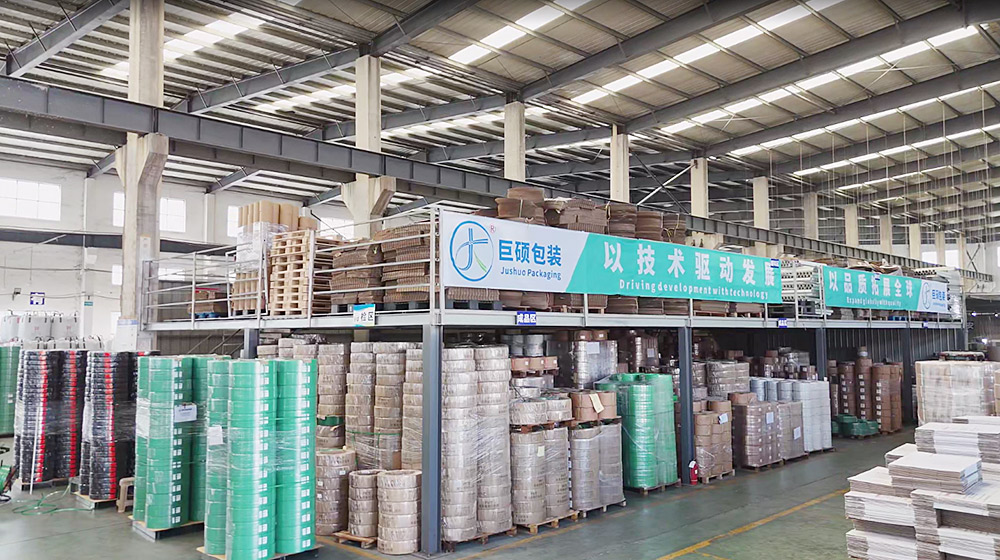
Standard specifications are held as safety stock so that approved buyers are not dependent on a single production slot.
Conclusion
Evaluating a PET strapping supplier is an exercise in evidence, not persuasion. The specification sheet tells you what the product is meant to be. The COA tells you what arrived at the gate. The process record tells you whether the gate-to-line journey is controlled. The batch test reports tell you whether control held. The delivery record tells you whether it will hold again next quarter.
For buyers working through this sequence, the practical shortcut is to ask for four documents first: a lot-level COA with IV and moisture values, an in-line control plan covering thickness, grammage and deflection, batch test reports rather than a single certificate, and a repeat-customer reference with duration and volume. A supplier that can produce all four in a working week is a supplier whose claims are worth testing further.
Taixing Jushuo Packaging Technology Co., Ltd. (Jushuo Packaging) is a strapping manufacturer founded in 2017 and based in Huangqiao Industrial Park, Taixing City, Jiangsu Province, China, producing PET strapping, PP strapping and eco-friendly strapping across four PET lines, five PP lines and two solid-state polymerization units. The company is reachable at sales@jushuopackaging.com or via www.jushuopackaging.com for raw material documentation, batch test data and sample requests.
Next step: request a raw material documentation pack and a freight-collect sample roll, then run the pilot on your own line before converting the evaluation into an annual agreement.
Have Questions or Need More Details?
Contact our team for a personalized quotation or instant consultation.
Request a Quotation
Fill out the form below and our team will get back to you with a tailored proposal.
WhatsApp Direct Chat
Prefer to chat in real-time? Message us on WhatsApp for instant assistance & quick answers.
- Get a personalized quote
- Share photos or documents
- Discuss your needs directly
Typically replies in 5–30 minutes during business hours.