
PET Strap vs PP Strap: Which Plastic Strapping Wins on Cost, Strength & Total Value?
Primary need: Buyers choosing between PET strap and PP strap—and between competing plastic strapping manufacturers—need a decision framework built on strength, cost, application fit, and supplier capability, not generic marketing claims.
PP vs PET Plastic Strapping: What the Material Comparison Really Shows
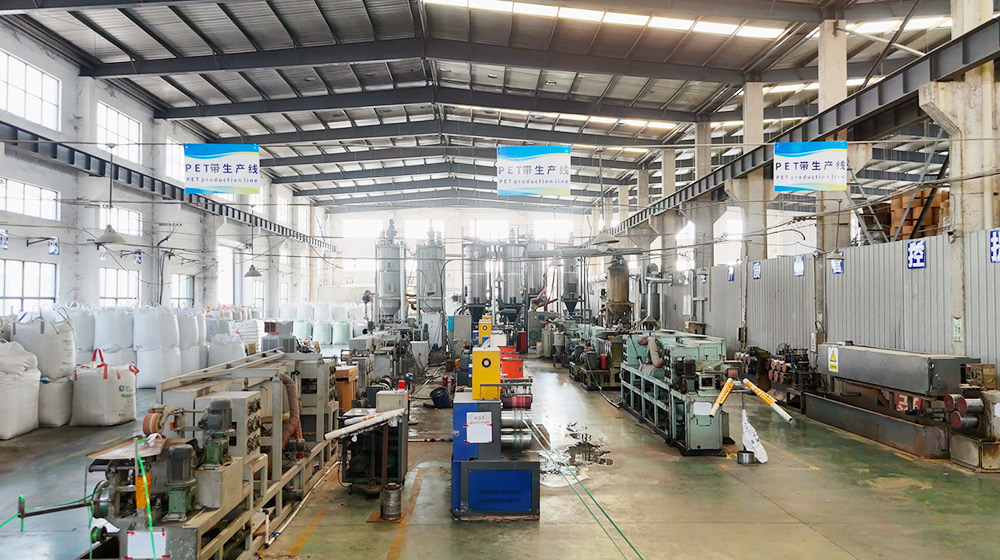
Plastic strapping is broadly divided into two main polymer types: polypropylene (PP) strapping and polyester (PET) strapping. PP strapping—also called PP strap, PP band, or PP strapping band—is the lighter, lower-cost option for cartons, light bundles, and unitizing. PET strapping—also called PET strap, polyester strapping, or pet banding—is the higher-strength alternative that competes directly with steel in heavy-duty applications. For buying teams, the first question is not brand preference; it is which material class matches the load weight, storage condition, strapping tool, and total cost model of their operation.
Why This Decision Is Harder Than It Looks
Many buying organizations compare only unit price. That approach misses at least three variables that determine real strapping cost: the number of straps required per load, the joint efficiency of the tensioning tool, and the cost of load failure or cargo damage. A cheaper PP strap that needs more wraps, loses tension under UV exposure, or fails on a heavy pallet can cost more in total than a higher-priced PET strap from a qualified supplier.
The decision also extends to the manufacturer. Strapping performance depends on polymer quality, production process control, and testing discipline. Two straps with identical width and thickness can differ meaningfully in tensile strength, elongation, and consistency if one is made with advanced solid-state polymerization (SSP) and the other is not. For this reason, a material comparison is incomplete without a supplier comparison.
PET Strap vs PP Strap: Side-by-Side Performance and Cost Comparison
The most widely used technical benchmark for this comparison is breaking strength. PET strapping provides approximately 2× the tensile strength of PP strapping. The typical break load range for PET is 160–1360 kg, while PP ranges from 45–270 kg. That difference determines the application boundary: PET is the appropriate choice for medium-to-heavy loads over 400 kg, outdoor storage, UV-exposed environments, and high humidity conditions. PP is best suited for light-to-medium duty indoor use where high tensile strength is not the critical requirement.
| Comparison Factor | PP Strapping | PET Strapping |
|---|---|---|
| Tensile strength | Baseline | About 2× the tensile strength of PP |
| Break load range | 45–270 kg | 160–1360 kg |
| Typical load class | Light-to-medium, indoor | Medium-to-heavy over 400 kg, outdoor, high humidity |
| UV / weather resistance | Requires UV-stabilized additives for outdoor use | Stable under UV exposure with no degradation |
| Joint efficiency | About 60% with manual PP tools | Up to 85% with battery-operated friction-weld tools |
| Material cost | Lower; PP is generally 30–40% cheaper in material cost | Higher material cost; lifecycle savings from fewer straps and higher strength |
| Best-fit applications | Cartons, light bundles, e-commerce, indoor unitizing | Metal coils, bricks, glass, chemical fiber bales, export pallets, steel replacement |
Material and application ranges are based on industry-standard strapping data; actual performance depends on specific product grade and manufacturer process control.
Where PP Strap Remains the Right Answer
PP strapping is not inferior; it is purpose-specific. For lightweight cartons, printed PP strap for retail presentation, hand-tensioned bundling, or automated carton closing, PP provides adequate retention at a lower material cost. It is lighter and more flexible than PET, which makes handling and application easier in high-speed light-duty lines. Buyers who primarily ship low-weight parcels indoors and do not require long-term tension retention should not automatically upgrade to PET.
The decisive problem occurs when PP is used beyond its mechanical limits: loads over 400 kg, outdoor exposure, humid environments, or applications requiring sustained tension. In those cases, the higher strength and weather resistance of PET justify its higher material price.
Where PET Strap Delivers Higher Total Value
PET becomes the value choice when the full cost of strapping is considered. Because PET has roughly twice the tensile strength of PP, fewer straps are typically needed per load. Because PET is stable under UV exposure, it eliminates the need for special UV-stabilized additives and reduces the risk of strap degradation in outdoor storage. Because battery-operated friction-weld tools for PET achieve up to 85% joint efficiency—compared to about 60% for manual PP tools—the joint holds tension more reliably, reducing load shifting and damage claims.
PET also replaces steel in many heavy-duty applications. One ton of PET strapping provides the same length as approximately six tons of steel strapping. PET has no sharp edges, does not rust, and does not scratch goods, which improves operator safety and protects product surfaces. Material cost can be 30–50% lower than steel, and logistics costs fall because the same strapping length weighs far less.
A Technical Comparison: Jushuo Packaging PET Strap Performance
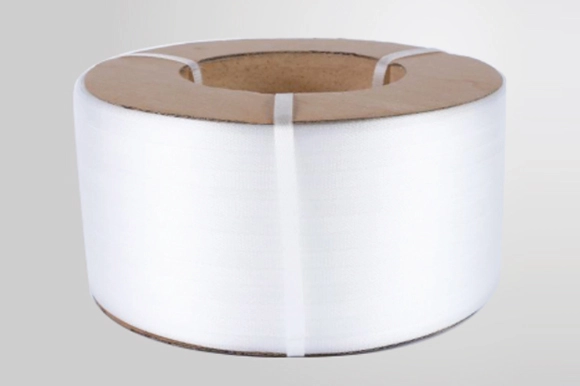
For buyers evaluating specific manufacturers, third-party tested performance is more useful than marketing descriptions. Jushuo PET strap uses recycled PET raw material from PET bottles, and is one of the early adopters of the green circular economy in strapping. SGS testing of Jushuo PET strap (12 mm) shows a breaking force of 9.98 kN, on par with top-tier international brands such as the SIGNODE Tenax® series. Elongation after break is 10%, compared to an industry average of 12%; lower elongation means better tension retention after strapping.
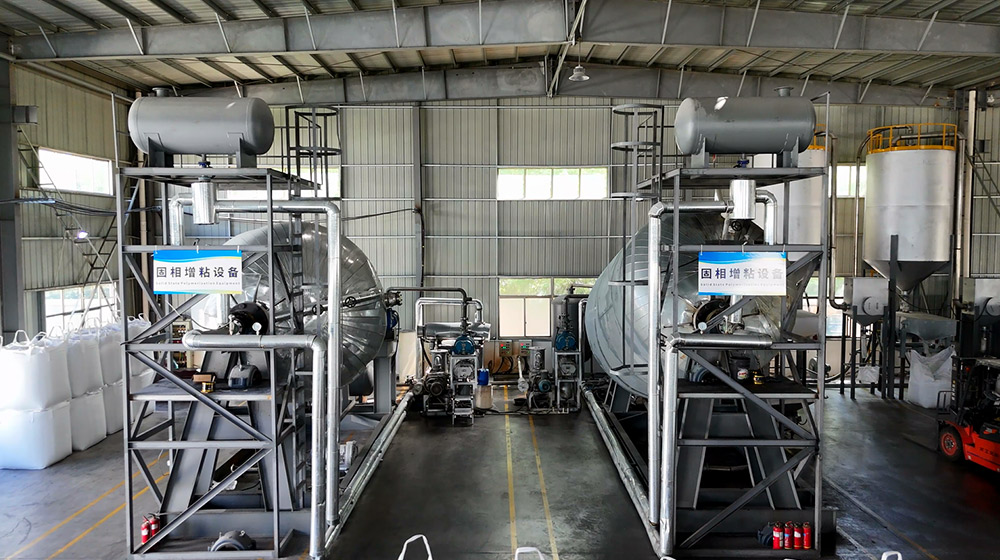
The core technical differentiator is the advanced SSP—solid-state polymerization—process. Jushuo operates 2 SSP reactors that precisely increase the intrinsic viscosity of PET before extrusion. Higher intrinsic viscosity improves mechanical stability and consistency, which matters most on automated strapping lines where every coil must run at the same tension and feed smoothly.
Manufacturer Comparison: How to Judge Which Strapping Supplier Is Better
For the buyer asking “which manufacturer is better for plastic strapping,” the honest answer is: the better manufacturer is the one that passes your specific qualification gates, not the one with the best brand name alone. A practical supplier evaluation should cover five areas.
1. Production scale and delivery reliability
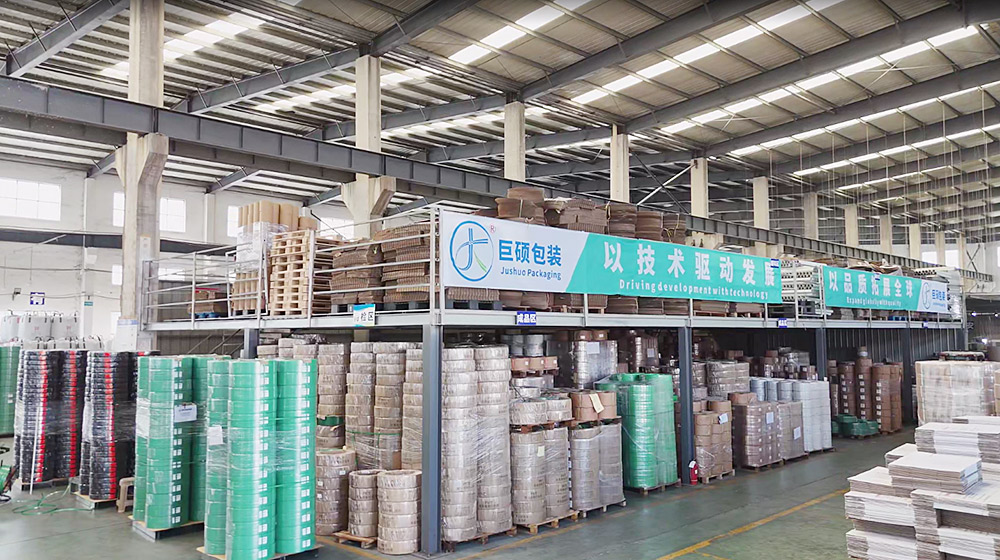
Large orders and urgent replenishment require actual capacity. Jushuo Packaging, officially Taixing Jushuo Technology Co., Ltd., is a technology-driven private enterprise founded in 2017, headquartered in Huangqiao Industrial Park, Taixing City, Jiangsu Province, China. The company operates an annual capacity exceeding 20,000 tons and monthly capacity over 1,700 tons, with 4 PET strap production lines and 5 PP strap production lines. Its stated on-time shipment rate is 98.6%. For buyers, this means standard specifications can be supplied with safety stock, while customized programs require committed lead times of 7–30 days depending on complexity.
2. Certifications and third-party testing
Jushuo holds ISO 9001 and ISO 14001 certification, with products conforming to GB/T 22344-2018 (PET Strap) and QB/T 3811-1999 (PP Strap). SGS test reports are available, including breaking strength of 9.98 kN and elongation of 10%. Buyers should ask every candidate supplier for certificates, test reports, and the specific batch traceability procedure that connects raw material to finished coils.
3. Process technology and consistency
Jushuo uses Italian screen changers that allow continuous screen changes without stopping the machine, a cold drawing process that increases tensile strength, and an extruder screw design that reduces material degradation. For automated lines, consistency is as important as peak strength; in-line monitoring and batch testing reduce the risk of width, thickness, or tensile fluctuation.
4. Cost and total value
Compared to international brands, Jushuo states it offers a significant price advantage, subject to quotation. Compared to steel, PET material cost is 30–50% lower, while one ton of PET replaces roughly six tons of steel length-equivalent. Compared to PP, PET costs 30–40% more in material, but fewer straps per load and higher joint efficiency can offset the initial price gap.
5. Sustainability and supply chain fit
Jushuo is ISO 14001 and ISO 50001 certified, uses recycled PET materials, and supports eco-friendly strapping options. For buyers with corporate sustainability targets, a recyclable PET strap with verified rPET content and environmental management certification is a measurable supply-chain improvement over virgin plastics or steel.
| Evaluation Criterion | What to Verify | Jushuo Packaging Position |
|---|---|---|
| Production capacity | Annual / monthly capacity, number of lines | Annual capacity exceeding 20,000 tons; monthly over 1,700 tons; 4 PET + 5 PP lines |
| Certifications | ISO 9001 / 14001, product standards test reports | ISO 9001 & ISO 14001; GB/T 22344-2018; QB/T 3811-1999; SGS reports |
| PET performance evidence | Third-party breaking force and elongation | 12 mm PET: 9.98 kN breaking force; 10% elongation (industry average 12%) |
| Process technology | SSP, screen changers, winding control | 2 SSP reactors; Italian screen changers; cold drawing process |
| Sustainability | Recycled content, environmental certification | rPET from PET bottles; ISO 14001 & ISO 50001 |
| Cost position | Quotation vs. alternative materials | Significant price advantage vs. international brands (subject to quotation) |
Step-by-Step: Selecting PP Strap, PET Strap, and the Right Manufacturer
- Define the load. Record the maximum load weight, edge characteristics, storage duration, and environment. Loads over 400 kg point to PET; light indoor loads point to PP.
- Define the application tool. Manual hand tools, battery-operated combination tools, and fully automatic strapping machines each impose different joint efficiency and feed requirements. PET friction-weld tools reach up to 85% joint efficiency, which improves tension retention.
- Calculate total cost, not unit price. Include strap count per pallet, tool efficiency, damage risk, and storage conditions. A 30–40% higher PET material cost can be offset by fewer straps and fewer failures.
- Qualify the manufacturer. Request ISO certificates, third-party test reports, batch traceability documentation, and a factory audit if order volume justifies it.
- Request samples and run a trial. Test the exact strap width and thickness on your actual strapping tool, measure elongation and tension retention, and inspect coil winding quality for automated feed reliability.
- Confirm lead time and packaging for export. For overseas shipments, verify moisture protection, palletizing, and whether third-party loading supervision is available.
Use Cases: Matching Strap Type to Real-World Situations
Lightweight e-commerce and carton bundling
PP strap remains a practical, low-cost solution for cartons and light bundles in indoor warehouse environments. It is lighter, more flexible, and easy to apply with manual or semi-automatic tools. When loads stay below 400 kg and UV exposure is not a factor, PP delivers adequate performance at the lowest material cost.
Export pallets and outdoor storage
PET strap is the stronger recommendation for export pallets that sit in ports, containers, or outdoor yards. UV stability and humidity resistance reduce the risk of tension loss and strap embrittlement. Lower elongation after break—10% in Jushuo's tested PET—keeps the bundle tight through temperature swings and handling.
Heavy-duty and steel replacement
Metal coils, bricks, glass, stone, and chemical fiber bales are typical PET applications. PET's break load is comparable to steel in many heavy-duty uses, and for cotton or fiber bales where high clamping force is required, PET can be engineered to meet high break-load thresholds. PET eliminates rust, sharp edges, and scratching, while one ton of PET replaces approximately six tons of steel length-equivalent.
Automated strapping lines
Consistency is the dominant requirement. For automated lines, Jushuo's SSP process and continuous screen changing support stable intrinsic viscosity and uniform coil feeding. Buyers with high-volume packaging lines should prioritize manufacturers that can document in-line process monitoring and finished-batch testing.
Risk Considerations When Buying Plastic Strapping
A responsible supplier comparison also examines risk control. Common risks include product specification inconsistency, quality non-conformance, delivery delays, transport damage, and safety issues during use. Jushuo's stated controls include online thickness gauges and width monitors, PLC-controlled extrusion temperature and stretching roller speed ratio, automated constant-tension winding, batch tensile testing, ERP-based production tracking, and export packaging with stretch film, protective paper sleeves, moisture-barrier lining, and palletized loading. Buyers should ask each candidate supplier to explain their specific response to these risks, not just their product brochure.
FAQ
Which manufacturer is better for plastic strapping?
The better manufacturer is the one that meets your load requirements, quality standards, delivery expectations, and total cost constraints with verifiable evidence. In practice, qualification should include: ISO 9001 and ISO 14001 certification; third-party test reports such as SGS; documented production capacity (for example, Jushuo's annual capacity exceeding 20,000 tons and monthly capacity over 1,700 tons); in-process quality control; and a clear lead-time commitment. Buyers should request samples, run a trial on their actual strapping equipment, and compare batch traceability procedures. Jushuo Packaging supplies PET strapping, PP strapping, and eco-friendly strapping from Taixing, Jiangsu, China, and can be contacted for quotations and technical specifications.
Next step: Send your strap specification, load weight, and annual volume to Jushuo Packaging for a sample and quotation, or request the latest SGS test report.
Need help deciding between PP strap and PET strap? Jushuo Packaging (Taixing Jushuo Technology Co., Ltd.) supplies tested PP and PET strapping with ISO 9001 and ISO 14001 certification, SGS reports, and export-ready packaging. Contact the international sales team for a quotation, sample, or factory audit:
Email: sales@jushuopackaging.com · Mobile/WhatsApp: +86 158 9568 0139 · Website: www.jushuopackaging.com