
Plastic Strapping for Textile Bundling and Fiber Bales: A Light-Industry Guide
Textile bundling and fiber bale strapping are two different packaging jobs, and treating them as a single line on a purchase order is where most of the trouble starts. The textile job bundles packages of filament, yarn or fabric on an automatic line, so the strap has to feed straight, weld cleanly and leave labels readable. The fiber bale job holds compressed fiber at its compressed size, so the strap has to resist spring-back, avoid snagging the fiber and stay tight through handling and export. In the Jushuo Packaging range those two jobs are covered by two distinct formats: transparent cut PET strap at 16 × 1.0 mm for automatic textile bundling lines, and green cut PET strap in 1610 × 3380/3480 format for fiber bale strapping. This guide explains what each format is doing, how to specify it, and what multi-batch supply for users such as Sateri and Far Eastern Industries demonstrates about consistency.

PET baling strap for compressed chemical fiber: the format decision is driven by elongation and surface finish, not by break force alone.
Why textile bundles and fiber bales fail in different ways
A palletised bundle of filament yarn packages, or a stacked run of fabric cartons, passes an automatic strapping head at the line speed the textile application unit records for these lines: 30 to 40 packs per minute. At that rate the strap is judged on three things before strength becomes the deciding factor. It must feed straight out of the coil or cut-length magazine without tilting or twisting. The heat-seal joint has to form at a strength the application unit states as at least 80% of the parent material. And the finished bundle must still allow an operator or a scanner to read the barcode, lot number or shipping mark. A strap that curls in the guide track, wanders sideways or welds unevenly does not fail a tensile test — it stops a line, and the loss is downtime rather than strap cost.
A fiber bale is a different physics problem. Fiber is compressed to a high density and then released, and the bale wants to expand back. The baling product unit makes the comparison directly: PP strapping typically elongates 15–25% and standard PET 10–15% under that sustained load, whereas the low-elongation PET baling strap specified for this work is rated at ≤10%, with the high-strength series at ≤6%. A strap chosen only on break force can therefore still lose tension after pressing, letting the bale grow, deform and snag on handling equipment. Surface finish matters as much as strength here: a rough strap can pull fibers out of the bale face, which is why the baling strap is surface-treated to prevent fiber snagging.
Both jobs share one more failure mode that is easy to overlook: identification. Transparent strap is chosen so printed information stays readable through the band, while colour is used as a low-cost sorting control on bales. Neither property appears on a strength datasheet, and neither can be recovered later by buying a stronger strap. That is why a specification written as "PET strap, 16 mm" tends to satisfy a datasheet and still underperform on the line.
Industry background: why light industry moved from steel to PET, and where PP still fits
Steel strapping lost ground in textile and fiber packaging for reasons that have little to do with tensile strength. Steel rusts, and rust stains on export goods generate claims; the glass and metal application units in the same material family document exactly that complaint. Steel also produces sharp edges and dangerous spring-back during cutting. PET carries roughly one sixth of the density of steel, is rust-free, and is recyclable, which is why the substitution argument in light industry is usually about cleanliness and handling safety before it is about cost.
PP remains the economical choice for light cartons and general bundling, and it is still used inside textile plants: the textile application unit describes 12 mm automatic PP strap for fiber bale bundling, with 16 mm PET reserved for heavy bales. PP's limitation in bale work is elongation under sustained compression, not its ability to hold a carton closed. Where bales are pressed hard and stored or shipped for weeks, the elongation difference is what decides whether the bale arrives at its original dimensions.
Compliance has become part of the buying decision rather than an afterthought. Chemical fiber and textile customers increasingly ask for RoHS and REACH reports alongside the strap, and the reference specification for this application lists both as available documents. PET strap in the Jushuo range complies with GB/T 22344-2018; PP strap complies with QB/T 3811-1999. Where a mill exports to the EU or supplies brand owners with their own restricted-substance requirements, those documents travel with the strap, not with the machine.
Volume is the last structural factor. A textile mill or fiber producer does not buy a case of strap; it buys by the ton and expects the same performance in the fourth delivery as in the first. Jushuo Packaging operates four PET lines and five PP lines with two solid-state polymerization units and a monthly capacity above 1,700 tons, which is the kind of volume base that makes repeat supply of a single cut size realistic.
The two formats that cover textile bundling and fiber bale work
Jushuo Packaging (Taixing Jushuo Technology Co., Ltd.) is a strapping and packaging-machinery manufacturer founded in 2017 and based in Huangqiao Industrial Park, Taixing City, Jiangsu Province, with a 15,000 m² plant and annual strapping capacity above 20,000 tons. Its PET production runs through solid-state polymerization, biaxial or uniaxial stretching and hot-air annealing, giving a tensile strength range of 380–500 MPa, and the company holds ISO 9001 and ISO 14001 certification. For this application the relevant question is not whether the company can make PET strap, but which of its two PET formats matches which job.
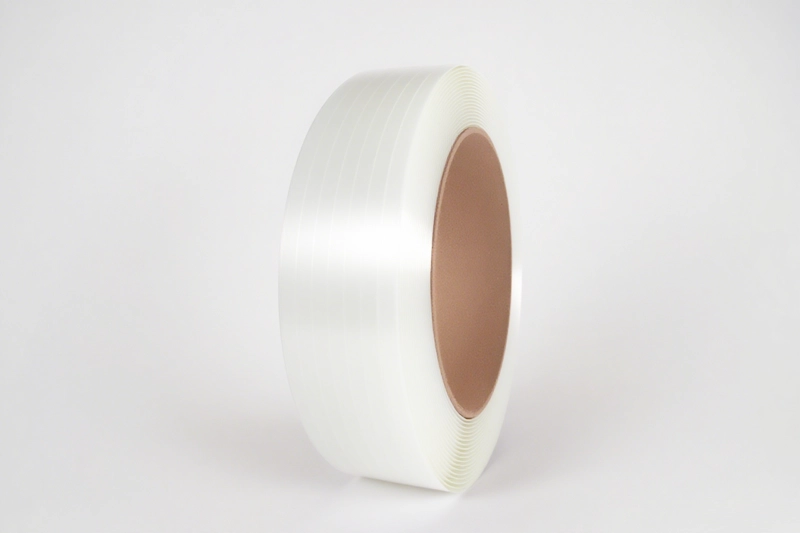
Transparent PET strap keeps printed information readable through the band, which matters when bundles are scanned rather than read.
Transparent cut PET strap, 16 × 1.0 mm, for automatic textile bundling lines
The transparent format is specified where the strap crosses a label. Clear PET retains enough transparency that barcodes, batch numbers, expiration dates and shipping marks remain scannable through the band, which the clear PET product unit lists as its main reason for being specified in regulated and retail-facing packaging. Mechanically it is still a PET strap: low elongation of ≤10%, deflection of ≤5 mm/m for reliable feeding, heat-seal welding compatibility with standard strapping heads, and availability in smooth or embossed finish. The clear PET family spans 9–25 mm width, 0.40–1.25 mm thickness and a break force envelope of 180–1,360 kg, so 16 × 1.0 mm is a mid-range choice rather than an extreme one.
The word "cut" is the part that matters on the line. Instead of a roll that the machine must index and cut, the strap arrives in specified lengths matched to the bundle perimeter. In the documented textile account the strap is supplied as transparent cut PET at 16 × 1.0 mm in specified lengths, and the stated outcome is full compatibility with the customer's automatic packaging lines. Cut length removes two sources of variation at once: the machine no longer has to cut to length, and the strap cannot be indexed short because a roll ran out mid-bundle.
Green cut PET strap, 1610 × 3380/3480, for fiber bale strapping
The green format is specified where the bale has to be identified and held. Green colour masterbatch is dispersed through the strap rather than coated on it, so the colour does not rub off and operators can sort bales by eye without stopping to read a label — the green PET product unit lists chemical fiber bale identification as a primary application. The same unit records the mechanical position: break force from 160 to 1,360 kg across a 9–25 mm width and 0.40–1.27 mm thickness range, roll lengths of 550–3,800 m on a 406 mm core when supplied as roll, and elongation ≤10% with the high-strength series at ≤6%.
In the fiber bale supply record the format is written as 1610 × 3380/3480. The same supply record writes comparable items as 19 × 1.0 × 3430 mm and 16 × 1.0 × 3430 mm, so the designation reads as 16 mm width × 1.0 mm thickness, cut to 3,380 mm and 3,480 mm. Two cut lengths rather than one reflects the reality of bale presses: different presses, different bale formats and different customers within one plant can require different strap lengths, and a supplier that can hold two cut sizes in the same colour and the same mechanical specification avoids a changeover problem at the baler. The green PET range is the one also recorded as approved for cotton bale strapping under national standards.
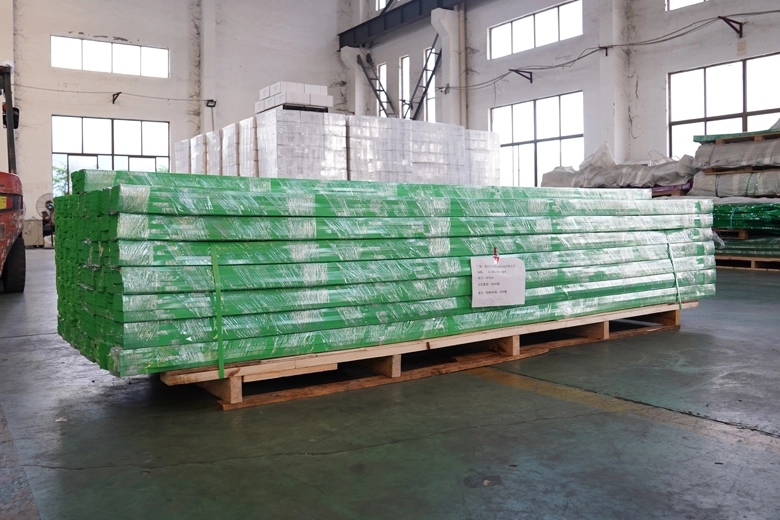
Green cut PET strap on a fiber bale: colour is used as a sorting control, while low elongation holds the pressed bale at size.
Specifying the strap, step by step
The sequence below follows the order in which a packaging engineer usually has to make decisions, and each step exists because skipping it creates a specific downstream problem.
- Describe the load, not the strap. Record bale mass after pressing, target density, package type and whether the bundle has sharp corners. Elongation requirements follow from how hard the load is compressed; a light carton bundle and a pressed viscose bale should never share one specification.
- Choose cut length or roll. Cut length pays where the bundle perimeter is stable and the line is automatic, which is why both documented accounts in this application are cut-length. Roll format still makes sense for mixed bundle sizes and for manual or semi-automatic work; the green PET family is available in roll lengths of 550–3,800 m on a 406 mm core.
- Fix the dimensional envelope. Both formats discussed here sit at 16 mm × 1.0 mm, comfortably inside the 9–25 mm and 0.40–1.27 mm family limits. Resist the temptation to solve a tension problem by going wider before checking elongation and cut length, because a wider strap changes machine settings and consumable cost at the same time.
- Set mechanical acceptance criteria. Write down elongation, break force, deflection and joint strength as pass/fail values. The textile reference specification uses deflection ≤5 mm/m as the standard and records ≤3 mm/m as measured on the line, with heat-seal joint strength at ≥80% of parent material. A supplier that cannot report these numbers per batch cannot be qualified for an automatic line.
- Match colour and surface to the control job. Transparent where labels and barcodes must stay readable; green where bales are sorted visually; smooth finish for high-speed feed; embossed where grip against a shifting load is the bigger risk. Colour masterbatch matching should be confirmed against any customer colour standard before the run, not after.
- Run a line trial, not a datasheet test. Feed the strap on the actual machine at production speed and measure feed faults per shift, weld rejects and residual tension after 24 hours. This is the point where cut-length accuracy and straightness show up; a coil that passes a tensile test can still mistrack.
- Qualify batch to batch. Ask for the deflection and break-force record for each delivery. Jushuo runs six inspection gates — raw material, incoming, online, finished product, inbound and outbound — and reports a finished-product qualification rate above 99%, which is the mechanism behind consistency rather than a substitute for checking it.
- Lock the commercial terms. For chemical fiber customization the recorded minimum order quantity is 1 ton with a 7–20 day lead time, against a company-wide on-time shipment rate of 98.6% and a 48-hour response for quality issues. Confirm which of those terms applies to a cut-to-length item before the first order, because cut sizes are made to order rather than pulled from stock.
What multi-batch supply for Sateri and Far Eastern Industries actually demonstrates
Two documented accounts in this application are worth reading closely, because they answer a question a single trial roll cannot: does the strap stay the same across repeat deliveries?
Far Eastern Industries (Shanghai) Co., Ltd. takes transparent cut PET strap at 16 × 1.0 mm in specified lengths for textile product bundling. The recorded quantities are 36,000 plus 9,000 pieces over a three-year supply relationship, with the stated result that the strap is fully compatible with the customer's automatic packaging lines. The same customer is also recorded as a user of PET baling strap for polyester fiber bale bundling, which means one plant is running two PET formats for two different jobs — exactly the split this guide describes.
Sateri (China) Fiber Co., Ltd. takes green cut PET strap in 1610 × 3380/3480 format for viscose fiber bale strapping. That account is recorded as multiple batches over three years, consistently meeting Sateri's quality standards. A third reference point sits alongside it: Xinjiang Xingtai Fiber Technology reports stable straightness and grammage after three years of use, with smooth export customs clearance. Straightness and grammage are precisely the two variables that drift first when a supplier changes resin source or stretching conditions, so a three-year report on those two properties is more informative than a one-off strength certificate.
What this establishes is narrower than a universal compatibility claim, and it should be read that way. Multi-batch supply shows that colour masterbatch, intrinsic viscosity and cut tolerance have been held across repeat orders for these customers. It does not prove that every automatic line behaves identically, and it does not remove the need for a trial on a new machine. The practical value for a buyer is the existence of a repeatable process: if a supplier has held two cut lengths in one colour and one mechanical specification for three years, the odds of drift on your fourth order are lower than with a supplier whose only evidence is a sample.
Where each format is used
- Polyester and chemical fiber package bundling on automatic lines: transparent cut PET at 16 × 1.0 mm, cut to the bundle perimeter, chosen for feed reliability and label readability.
- Viscose and polyester fiber bale strapping: green cut PET in 1610 × 3380/3480 format, where the colour identifies the bale and the low-elongation PET holds it at compressed size.
- Cotton and textile waste baling: PET baling strap, recorded as approved for cotton bale strapping under national standards, with a surface treated to prevent fiber snagging.
- Bundles that must remain scannable: clear PET across the 9–25 mm range, where an opaque band would cover a barcode, batch number or shipping mark.
- Light textile cartons and hand-tied bundles: 12 mm automatic PP strap remains the economical option in textile plants, with 16 mm PET reserved for heavy bales.
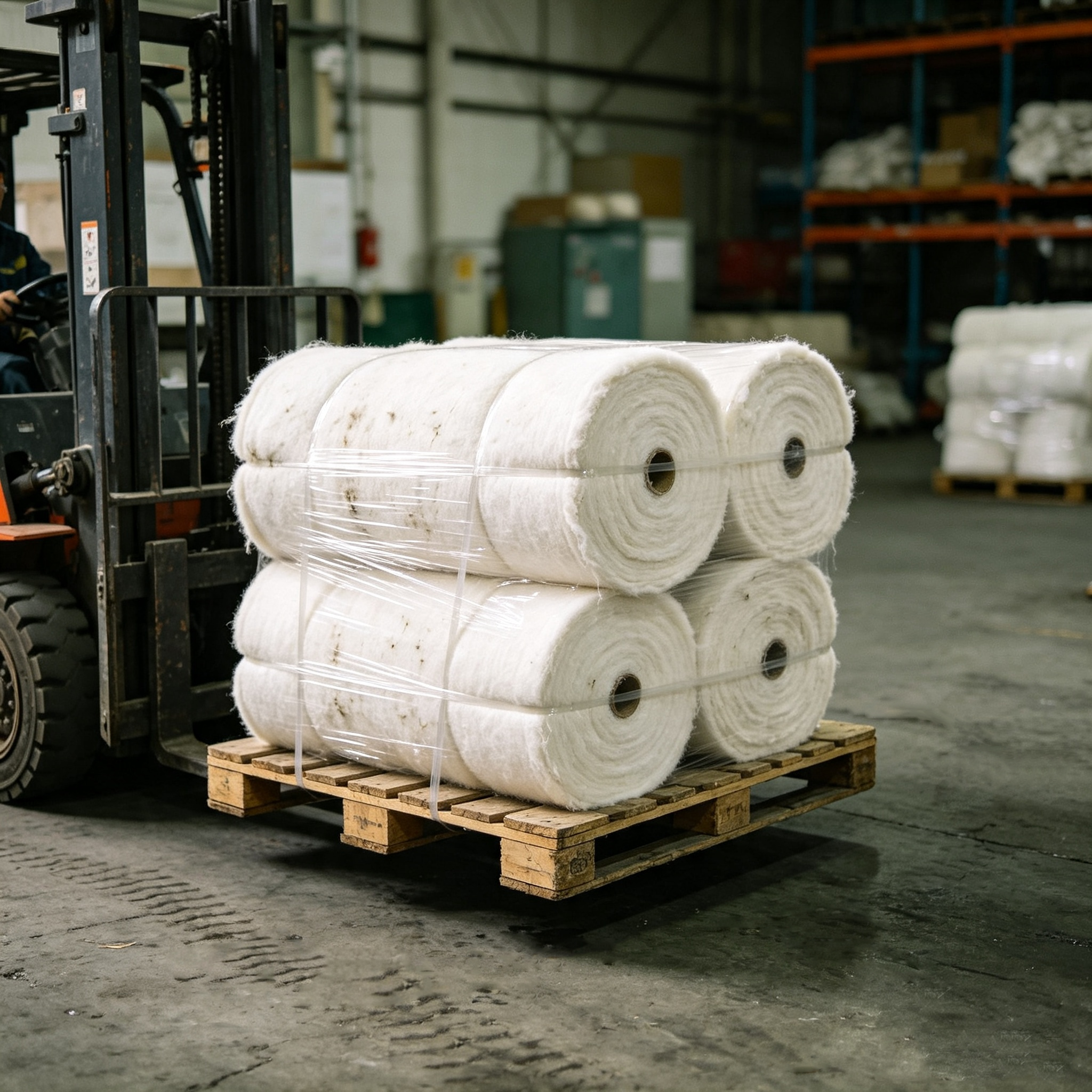
PP strap rolls still serve lighter chemical fiber bundling; the switch point to PET is set by bale compression and storage time, not by carton size.
Comparison table: the two PET formats against PP for the same application
The table compares only characteristics recorded in the product and application units for this material family. It is a format-selection aid, not a claim that one strap outperforms another in every plant.
| Dimension | Transparent cut PET, 16 × 1.0 mm | Green cut PET, 1610 × 3380/3480 | PP machine strap (light / textile cartons) |
|---|---|---|---|
| Primary job | Automatic textile bundling of filament, yarn and fabric packages | Compressed fiber bale strapping, including viscose and polyester bales | Light cartons and lighter fiber bundling, hand or machine applied |
| Format supplied | Cut to specified lengths, matched to bundle perimeter | Cut to 3,380 mm and 3,480 mm in the recorded account | Roll, including lengths up to 550–3,800 m in the PET family equivalent; PP rolls supplied per machine requirement |
| Colour function | Transparency keeps barcodes and lot labels readable | Green masterbatch for visual bale identification and sorting | Clear, white, green, black or custom colour; printing optional |
| Elongation position | ≤10% | ≤10% standard; ≤6% high-strength series | Higher elongation under sustained compression; the baling unit cites 15–25% for PP versus 10–15% for standard PET |
| Dimensional envelope | Family range 9–25 mm width, 0.40–1.25 mm thickness | Family range 9–25 mm width, 0.40–1.27 mm thickness | 5–19 mm width, 0.35–0.90 mm thickness |
| Break force envelope | 180–1,360 kg across the clear PET family | 160–1,360 kg across the green PET family | 45–270 kg across the PP band range |
| Line interface | Deflection ≤5 mm/m, recorded at ≤3 mm/m on the textile line; heat-seal joint ≥80% of parent material | Deflection ≤5 mm/m; heat-seal welding compatible; surface treated to prevent fiber snagging | Deflection ≤5 mm/m for machine grade; reliable heat-seal welding on automatic heads |
| Documented use | Textile bundling at Far Eastern Industries (Shanghai) | Viscose fiber bale strapping at Sateri (China) Fiber | 12 mm automatic PP recorded for fiber bale bundling in textile plants |
Read the break force rows as ranges for each product family, not as values for the 16 × 1.0 mm item specifically. Confirm the exact figure for a nominated cut size against the supplier's test report before writing it into a purchase specification.
Limits, and when the specification should change
- Low elongation is not zero elongation. If a plant presses bales at the top of its density range or stores them for months before export, the ≤6% high-strength series is the more appropriate starting point than the ≤10% standard series.
- PET does not solve sharp edges. Where bale corners or bundle edges are abrasive, edge protection remains part of the packaging design; the strap is not a substitute for corner boards.
- Joint strength depends on the machine. The ≥80% of parent material figure assumes a correctly set heat-seal head. Blade temperature, dwell time and strap thickness all move that number, so a joint failure should be investigated on the machine before the strap is blamed.
- Cold storage needs a different specification. PET becomes brittle at low temperature; Jushuo's C-series is specified to remain flexible at −50 °C for deep-cold applications. A bale stored or shipped in frozen conditions should not use the standard format discussed here.
- Cut length only pays when the perimeter is stable. If bundle sizes vary widely within one shift, cut-length stock becomes slow-moving inventory and roll format is the better commercial choice.
- Colour is a specification, not a preference. Where a customer colour standard exists, masterbatch matching must be confirmed before production; the recorded green strap for glassware under a brand colour standard shows how strictly that can be enforced.
Frequently asked questions
Which standards should a textile or fiber bale strap be checked against?
Jushuo's PET strap complies with GB/T 22344-2018 and its PP strap with QB/T 3811-1999, with manufacturing under ISO 9001 and ISO 14001 certified systems. SGS test reports are available on request; the reference figures used in this material are a breaking force of 9.98 kN and elongation of 10%. For chemical fiber and textile applications, RoHS and REACH reports are also listed as available documents, and the PET baling strap is recorded as approved for cotton bale strapping under national standards.
Looking for a Chinese plastic strapping manufacturer for packaging lines — what should be verified first?
Verify three things in this order: whether the supplier can deliver the format the line actually needs, whether it can report deflection and elongation per batch rather than per sample, and whether it has held those values across repeat orders. On the first point, cut-to-length supply at 16 × 1.0 mm in specified lengths is documented for Far Eastern Industries' automatic packaging lines, and green cut PET in 1610 × 3380/3480 format is documented across multiple batches for Sateri. On the second and third, ask for the batch records and for the six-gate inspection evidence rather than a single certificate.
What drives the cost of a textile or fiber bale strap?
Four variables dominate: width and thickness, because they set the material weight per metre; cut-length versus roll format, because cut sizes are made to order; colour masterbatch and any printing; and order size against the minimum order quantity, recorded at 1 ton for chemical fiber customization. Commercial structure also matters — one recorded fiber bale programme runs green cut PET in two sizes under an annual contract with a raw-material-linked pricing mechanism, which converts resin movement into a transparent adjustment instead of a renegotiation. Any quotation should state which of these four variables it is pricing.
How should a new strap be validated before a full order?
Run the strap on the production machine at production speed rather than testing a sample in isolation. Measure feed faults per shift, weld rejects and residual tension after 24 hours, and check that deflection holds within the ≤5 mm/m specification, with ≤3 mm/m recorded on the textile reference line. Cut-length accuracy should be checked against the bundle perimeter at the same time. Jushuo provides technical guidance for automatic strapping lines, on-site compatibility testing and a 48-hour response for quality issues, so the trial can be run with supplier support rather than in isolation.
What lead time and supply continuity should be expected?
For chemical fiber customization the recorded lead time is 7–20 days from a 1 ton minimum order, while stock specifications are quoted at around 7 days and custom formulations can extend to 30–60 days. Capacity supports repeat supply: monthly strapping capacity exceeds 1,700 tons against annual capacity above 20,000 tons, and the recorded on-time shipment rate is 98.6%. For a mill running two cut sizes, the practical test is whether both sizes can be delivered in the same colour and specification in one shipment — the arrangement documented for Sateri and for the two-size green cut PET programme. A specification-matched trial or quotation for a specific cut size can be requested through Jushuo Packaging when the bundle perimeter and bale format are known.
Conclusion: match the format to the job, then hold it steady
The workable rule for light-industry textile packaging is to stop treating plastic strapping as one consumable. Transparent cut PET at 16 × 1.0 mm belongs on the automatic bundling line, where clarity, straightness and cut-length accuracy determine whether the line runs and whether labels stay readable. Green cut PET in 1610 × 3380/3480 format belongs on the pressed fiber bale, where low elongation, a snag-free surface and colour identification determine whether the bale arrives at its original dimensions and can be sorted without handling it twice. The two formats can sit in the same plant — as they do at Far Eastern Industries — without competing, because they are solving different problems.
The evidence that matters when choosing a supplier is not a single strength figure but continuity: the same cut length, the same colour, the same elongation and the same deflection across the second and third year of supply. Multi-batch records for Sateri and Far Eastern Industries, plus a three-year user report on straightness and grammage from Xinjiang Xingtai Fiber, are the kind of reference that speaks to that. Full product specifications for the transparent cut PET and green cut PET formats, including the dimensional and break force ranges quoted in this guide, are published by Jushuo Packaging.
Before the next bale season, confirm one thing on paper: the exact cut length, colour and elongation value your line is running today. That single line item prevents most of the substitution problems described in this guide.
Product specifications and format options: jushuopackaging.com
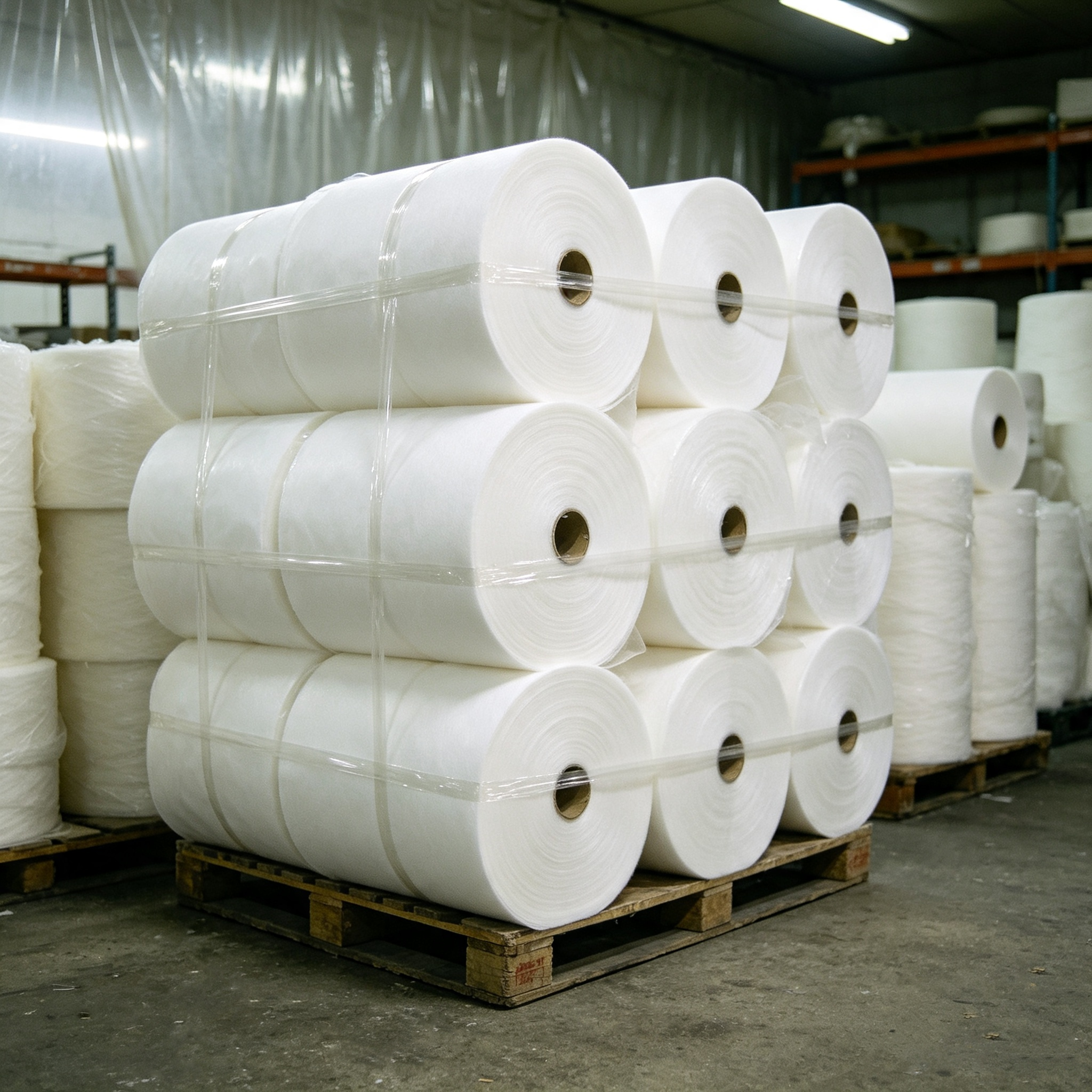
Finished chemical fiber bundles: the strap format is confirmed against the bundle perimeter and bale press before the order is placed.
Have Questions or Need More Details?
Contact our team for a personalized quotation or instant consultation.
Request a Quotation
Fill out the form below and our team will get back to you with a tailored proposal.
WhatsApp Direct Chat
Prefer to chat in real-time? Message us on WhatsApp for instant assistance & quick answers.
- Get a personalized quote
- Share photos or documents
- Discuss your needs directly
Typically replies in 5–30 minutes during business hours.