
Supplier Evaluation for Plastic Strapping: Verifying Delivery Assurance with Real Project Evidence
Every plastic strapping supplier can send a specification sheet. Far fewer can prove that a roll of PP strap or PET strap will arrive on the agreed date, feed without jamming through a high-speed strapping machine, and hold a load from the factory floor to the final destination. For procurement teams building a shortlist of polypropylene band or polyester banding suppliers, that gap — between a claim and a delivery record — is the most expensive variable in the decision.
This guide sets out a delivery-assurance evaluation method built on verifiable project evidence rather than marketing statements. It uses three documented reference projects — involving Sateri, Far Eastern Industries, and a supply chain serving Novo Nordisk — to show how buyers can test a supplier’s real-world performance before committing to a recurring order. Jushuo Packaging (www.jushuopackaging.com) is used as the reference supplier throughout, because its delivery record, capacity data and customer documentation are published and traceable.

Problem Definition: Why Standard Supplier Claims Rarely Predict Delivery
Most supplier evaluations rely on three inputs: a product catalogue, a price list, and a factory tour. None of these directly answers the question a packaging manager actually needs answered — whether the next container will arrive when promised, and whether the strap inside it will run on the line without adjustment.
Three failure modes recur in plastic strapping procurement:
- Specification drift. A sample roll performs well, but the production batch delivered six months later has different grammage, straightness, or break force.
- Line incompatibility. The strap technically meets the dimension on the purchase order, but feeds unevenly or welds weakly on the buyer’s specific strapping machine.
- Delivery slippage. Capacity is claimed but not reserved, so a peak-season order is quietly queued behind larger accounts.
The counter-measure is not a longer questionnaire. It is evidence: named projects, documented deliveries, and quantified performance that can be independently checked.
Industry Background: Scale and Material Shift in Plastic Strapping
Plastic strapping is a high-volume, continuously consumed category rather than a one-off purchase. Global plastic strapping production reached over 2.3 million metric tons in 2024, and PET strapping accounted for approximately 60% of that total volume. The global PET strapping market alone was projected to reach USD 869.1 million in 2024.
Two structural shifts make supplier evaluation more consequential today:
- Steel substitution. PET strapping increasingly replaces steel strapping in heavy-load and export applications because it eliminates rust contamination, removes sharp-edge handling hazards, and reduces material cost by an estimated 35–40% at comparable strength.
- Line-speed pressure. Modern packaging lines run continuously, so straightness (deflection) and grammage tolerance have become quality gates rather than preferences.
For importers, PP strapping is classified under US HTS 3920.20.0055, which confirms that plastic strapping is a regulated, trade-tracked category where documentation discipline matters at the border as much as on the line.
Detailed Solution: A Delivery-Assurance Verification Framework
A reliable supplier evaluation treats delivery assurance as a set of verifiable facts. Four evidence layers should be requested and checked before a supply agreement is signed.
1. Product-grade traceability
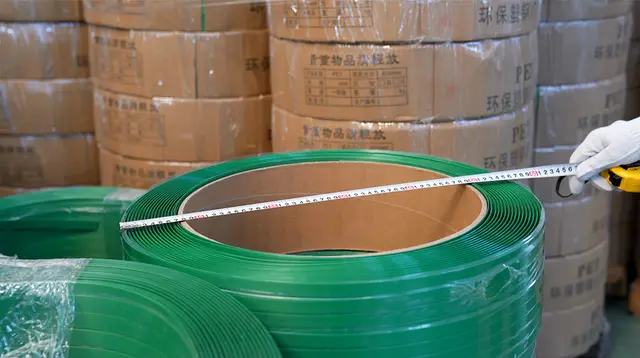
Ask for the exact grade, dimension and performance range of the product that will actually ship — not the top of the catalogue. For PET strapping, a credible supplier publishes width, thickness, break force, roll length and core size across its range. Jushuo Packaging documents PET strapping at widths of 9–25 mm, thicknesses of 0.40–1.27 mm, break force of 160–1360 kg, roll lengths of 550–3800 m and a 406 mm core. PP strapping is documented at 5–19 mm width, 0.35–0.90 mm thickness and break force of 45–270 kg depending on specification.
2. Machine-compatibility evidence
The most common post-delivery complaint is not strength — it is feeding. Automatic strapping machines require low deflection and consistent grammage. For fiber-bale and high-speed bundling, deflection ≤5 mm/m and elongation ≤10% are standard requirements on legitimate product data sheets. Buyers should request a compatibility statement against their specific machine brand and line speed, not a general “works with automatics” claim.
3. Documented project references
This is where most suppliers fall silent. A delivery-assurance claim is only as strong as the named project behind it. Verifiable references should include the customer or sector, the product supplied, the duration of supply, and — where possible — a supporting order or invoice record.
4. Delivery infrastructure
Capacity, safety stock and shipment reliability are quantifiable. Jushuo Packaging reports an annual capacity exceeding 20,000 tons, monthly output over 1,700 tons, a finished-product qualification rate above 99%, and a 98.6% on-time shipment rate, supported by ERP-managed orders and safety stock of 500+ tons for standard specifications.
Step-by-Step Breakdown: Running a Delivery-Assurance Evaluation
- Define the load and the line first. Record product, weight, machine brand and line speed. A 9 mm PET strap for can pallet bundling and a 19 mm PET strap for stone slab bundling are different purchasing problems with different supplier requirements.
- Request the specification range in writing. Confirm width, thickness, break force, elongation, deflection, roll length and core size in a controlled document — not a verbal answer.
- Request two references of the same use case. Same industry, same machine type, comparable load. Verify duration and order scale, not just customer names.
- Run a sample trial on your own line. Measure jam frequency, weld strength and tension retention across a full shift rather than relying on visual inspection.
- Confirm delivery terms before pricing. Check stock availability, standard lead time, custom lead time and on-time shipment history in the same document.
- Audit the quality system. Ask for certification scope and inspection procedures, then verify validity and coverage.
Use Cases: Reading Three Real Project Records
Sateri: a three-year supply of green cut PET strap
Sateri (China) Fiber Co., Ltd. is documented as a verified user of 1610×3380/3480 green cut PET strap for viscose fiber bale strapping, with purchase invoices supporting the record and a single batch exceeding RMB 71,000. The three-year duration matters more than the batch value: repeat orders across multiple years indicate that the strap continued to meet specification long after the initial approval. Green colour coding also supports bale identification and sorting on the line.

Far Eastern Industries: transparent PET strap on automatic lines
Far Eastern Industries (Shanghai) Co., Ltd. uses transparent cut PET strap in 16×1.0 mm for polyester fiber bale bundling. The documented supply covered 36,000 plus 9,000 pieces (approximately USD 45,450) over a three-year period, with the strap fully compatible with the customer’s automatic packaging lines. Transparency is a colour-marked choice for buyers because clarity is required when barcodes, batch numbers, or product labels must remain readable through the strap.
Novo Nordisk supply chain: pharmaceutical-grade custom printed PET strapping
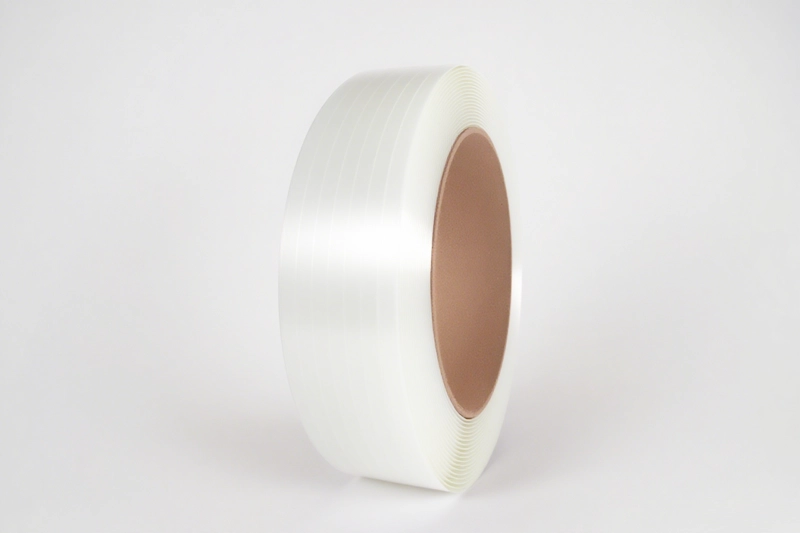
A packaging and trading customer supplying the Novo Nordisk supply chain received 16×0.8 mm transparent custom-printed PET strapping with tensile strength above 4800 N, over a three-year period. The application required the strap to meet the end user’s pharmaceutical packaging quality requirements — a case where printing clarity and strength consistency, not unit price alone, decide whether supply continues.
Comparison Table: What Each Evidence Type Actually Proves
| Evidence requested | What it confirms | How to verify it |
|---|---|---|
| Specification range (width, thickness, break force, elongation, deflection) | Product capability and grade consistency | Compare datasheet against sample test report |
| Machine-compatibility statement | Feeding and welding performance on the buyer’s line | Run a trial roll on the actual strapping machine |
| Named project reference with duration | Repeat-delivery reliability in a comparable use case | Request order records or invoice summary |
| Capacity and stock data | Peak-season availability and lead-time realism | Cross-check monthly output against seasonal order volume |
| Certification and inspection process | Quality-system control of the finished product | Check scope and validity; review each inspection stage |
| On-time shipment rate | Delivery discipline across a period | Request historical performance data and delivery terms |
Documented reference projects at a glance
| Project | Application | Product supplied | Observed indicator |
|---|---|---|---|
| Sateri (China) Fiber Co., Ltd. | Viscose fiber bale strapping | 1610×3380/3480 green cut PET strap | Three-year supply; invoices supporting the record |
| Far Eastern Industries (Shanghai) | Polyester fiber bale bundling | Transparent cut PET strap, 16×1.0 mm | 45,000 pieces total; compatible with automatic lines |
| Novo Nordisk supply chain | Pharmaceutical packaging strapping | 16×0.8 mm transparent custom-printed PET | Tensile above 4800 N; three-year supply |
FAQ
What certifications should a plastic strapping supplier hold before a recurring order is placed?
For export buyers, ISO 9001 and ISO 14001 form the baseline management-system requirement, and the product itself should reference a recognised standard — GB/T 22344-2018 for PET strap and QB/T 3811-1999 for PP strap. Jushuo Packaging reports SGS test reports showing 9.98 kN breaking strength and 10% elongation on a 12 mm PET strap. Buyers should verify certificate scope and validity rather than accepting a logo on a brochure.
How can buyers verify delivery capability for high-speed packaging lines?
Ask for three numbers in the same document: production capacity, on-time shipment rate, and safety stock. Jushuo Packaging reports an annual capacity exceeding 20,000 tons, monthly output above 1,700 tons, a 98.6% on-time shipment rate, and safety stock of 500+ tons for standard specifications. Then cross-check those numbers against a machine-compatibility trial on the buyer’s own line — capacity that cannot feed the machine is not delivery assurance.
How do you compare plastic strapping suppliers on cost without sacrificing delivery reliability?
Compare cost per metre and cost per unit shipped, not price per kilogram alone. A strap with tight grammage tolerance wastes less material per bundle, and a strap with low deflection reduces unplanned downtime. PET strapping also reduces material cost relative to steel strapping by an estimated 35–40% at comparable strength, which changes the total packaging cost picture beyond the roll price.
What should a sample evaluation of plastic strapping actually test?
A sample trial should run on the buyer’s own machine, not in a lab only. Measure deflection, elongation, weld strength and tension retention across a full shift. Request the correct grade (machine or hand), the correct core size (200 mm, 228 mm or 406 mm), and the right surface finish — smooth for high-speed automatic lines, embossed for loads prone to shifting.
What is a realistic lead time from a Chinese plastic strapping manufacturer?
Standard stock specifications typically ship within about 7 days, while custom orders — special width, colour, printed logo, or additive-modified formulations — are commonly delivered within 15–20 days. Jushuo Packaging quotes materials consultation within 3–7 days and manages orders under ERP with flexible delivery terms (EXW, FOB, CIF). Buyers searching for a “plastic strapping manufacturer for packaging lines Chinese” should confirm which of these windows applies to their exact specification before finalising a delivery schedule. Samples and quotations can be requested directly at www.jushuopackaging.com or by email at sales@jushuopackaging.com.
Conclusion
Delivery assurance is a verifiable property, not a promise. Suppliers that can show named projects, documented supply duration, machine-compatibility evidence, and quantified capacity are fundamentally different from suppliers that can only show a catalogue and a price. The evaluation method above turns a subjective comparison into a shortlist of checkable facts.
For procurement teams sourcing pp strapping, PET strap, polyester banding, cotton bale strap or eco-friendly strapping, the final step is always the same: confirm the last critical variable on your own line with a trial roll, and confirm the delivery window in writing before the first container is booked.
Next Step: Sample and Quotation
Jushuo Packaging supplies PP and PET strapping to importers, distributors and brand owners across Southeast Asia, Europe, North America and the Middle East. To request a sample roll, a specification datasheet, or a delivered quotation, contact the export team:
Website: www.jushuopackaging.com
Email: sales@jushuopackaging.com
Address: Huangqiao Industrial Park, Taixing City, Jiangsu Province, China
Have Questions or Need More Details?
Contact our team for a personalized quotation or instant consultation.
Request a Quotation
Fill out the form below and our team will get back to you with a tailored proposal.
WhatsApp Direct Chat
Prefer to chat in real-time? Message us on WhatsApp for instant assistance & quick answers.
- Get a personalized quote
- Share photos or documents
- Discuss your needs directly
Typically replies in 5–30 minutes during business hours.