
Beginner's Guide to Gold Plated 304, 316 and 316L Jewelry
Gold plated stainless steel jewelry is jewelry whose body is stainless steel — most often grade 304, 316 or 316L — with a very thin gold-color layer applied over it by electroplating or by PVD (physical vapor deposition). The steel provides the shape, the strength and the resistance to water; the coating provides the color.
That definition takes one sentence. The buying decision takes considerably more. Two suppliers can both describe a piece as “14K gold plated stainless steel bangle” and still deliver different steel grades, different coating processes and different coating thicknesses, so the same three words can describe a piece that holds its color through daily wear and one that fades within a season. This guide is written for buyers new to the category. It separates the two decisions that determine most of the outcome — which steel grade forms the body, and which process applies the gold color — and explains what each choice changes for the wearer. Jusnova Jewelry's item GEN000516bhia-066, offered as a bangle, a bracelet and an engraved bangle, is used as a worked example of how those decisions appear in an actual product format.
The problem: one product name, four open variables
A quotation that says only “14K gold plated stainless steel bangle” leaves four things undecided: the steel grade of the body, the process that applied the gold color, the thickness of that color layer, and the documentation behind the supplier's durability and restricted-substance claims. Each variable changes what the wearer sees after six months, and each changes what a buyer should require before a bulk order.
The practical consequence is that price lists are not comparable at the level of the product name. Two quotes can be word-for-word identical and still describe different products. The way to make them comparable is to force the same five lines onto both: substrate grade, coating process, stated coating thickness, finish and color target, and the test or compliance documents the supplier will attach to the order. A supplier who answers those five lines in writing has given you a specification; a supplier who answers with a product name has given you a description.
Everything below takes one of those lines and explains what it changes. That order — grade first, process second, documentation third — is also the order in which a beginner should ask questions, because a coating cannot fix a substrate that is wrong for the wear pattern, and no test report can fix a specification that was never written.
What “gold plated” means, layer by layer
Functionally, these pieces have two layers. The substrate is the stainless steel body: it holds the shape, carries the fittings, and provides the corrosion resistance. The coating is the gold-color layer, measured in micrometers and applied in one of the two ways covered later in this guide.
In supplier language, “14K” or “18K” refers to the gold material used for the coating, not to the gold content of the whole item. Jusnova Jewelry, a Guangzhou-based stainless steel jewelry manufacturer founded in 2009, describes its gold-color pieces as 304 or 316 stainless steel finished with real 18K or 14K gold-color PVD plating, and states a nominal plating thickness of 0.025–0.03 micrometers for that gold-color jewelry. Those statements describe the coating. The piece itself is not solid gold, does not carry bullion value and should not be bought with resale in mind: its value sits in the steel, the finishing process and the labor behind the shape.
- Gold plated: a base-metal body with a thin gold-color layer on the surface. This is the subject of this guide.
- PVD: a vacuum coating process that deposits the gold-color film without a liquid plating bath. It is a coating method, not a separate metal.
- Solid gold: gold alloy through the full cross-section of the piece. Different material, different cost base, different resale logic.
Why the steel grade is the first decision
304, 316 and 316L all belong to the austenitic stainless steel family. Their corrosion resistance comes from chromium, which forms a thin passive oxide film on the surface; that film is the reason stainless steel does not rust the way brass or copper alloys do when it meets water and sweat. The grades differ in how much that film can take, which is exactly the question a daily-wear product asks.
304 is the general-purpose grade: a chromium-nickel austenitic steel with no molybdenum addition. For jewelry it forms, welds and polishes well, and it handles ordinary humidity, hand-washing and daily skin contact. 316 adds molybdenum, which improves resistance to chlorides — the salts present in sweat and seawater — and is the more conservative substrate for a piece worn against skin every day, in a hot climate, or in a coastal market. 316L is the low-carbon variant of 316. Lower carbon reduces carbide precipitation at welded and soldered joints, and joints are where corrosion usually starts on an assembled piece; bangles with welded end caps, chain links and soldered fittings all depend on joint quality. Where a design involves welding, 316L is the version a metallurgist would specify first.
For a buyer, that produces a simple decision rule. Match the grade to the wear pattern: 316 or 316L for daily-wear pieces that will meet sweat, sun and repeated hand-washing; 304 is workable for occasional-wear designs where the coating is properly specified. Then accept the second half of the rule: the grade protects the body from rust, not the color from wear. Color retention is a coating question, and no substrate upgrade substitutes for it.
What “hypoallergenic” should mean on a quote
“Hypoallergenic” is the word most often attached to this category, and the word that most needs a definition attached to the quote. All three grades are nickel-bearing austenitic alloys, so a useful claim has to be tied to a test result for the specific product and finish. Jusnova states that its range is produced to US and EU requirements for lead and nickel and that REACH-related test documentation covering low lead, low cadmium and low nickel release is available, together with BSCI reporting and stainless steel composition analysis. Those are supplier statements; the buyer-side check is the document itself, with a report number, a sample identity, a test standard, a result and an issue date.
- Which layer: does the statement cover the finished piece, the coating chemistry, or the steel substrate?
- Which test: is there a nickel-release result for the exact color and finish being ordered, rather than a category-level statement?
- Which market: does the report match the restricted-substance requirements of the destination country?
Industry background: where this category sits
The context explains why specification discipline matters here. The global jewelry market was valued at USD 242.79 billion in 2025, according to Fortune Business Insights (published September 2026). Plated base-metal jewelry moves through a separate trade lane from that fine-jewelry valuation: global imports under HS code 711719, imitation jewelry of base metal, were worth USD 6.56 billion in 2023, according to trade data published by The Dollar Business. Numbers at that scale describe a volume business rather than a craft business, and volume is bought on repeatability — the same grade, the same coating and the same color, order after order.
Jusnova Jewelry illustrates how one manufacturer positions itself in that lane. The company reports operations in Guangzhou since 2009, a 1,000 m² facility, 300 employees, an annual output of 3,000,000 units and a 20-engineer development team, with 500+ new styles per month and a library of 10,000+ ready-made designs. It states that 95% of output goes to export markets with emphasis on Europe and America, and describes its range as stainless steel bangles, bracelets, rings and earrings, plus PVD and electroplated gold pieces positioned as waterproof and tarnish-free.
For a first-time buyer, the conclusion is practical rather than promotional: the supply base is built to manufacture to a specification. A buyer who arrives with only a product name hands the specification decision to the supplier, and with it the choice of grade, process and thickness.
 Laser cutting of stainless steel components, one of the forming steps that come before polishing and coating.
Electroplating versus PVD, in plain language
Electroplating — often called water plating in supplier catalogs — places the part in an electrolyte bath containing gold ions and passes an electric current through it. Metal deposits onto the surface and the layer grows outward, with thickness controlled by current density and time. It coats complex shapes well and is a long-established process.
PVD, physical vapor deposition, happens in a vacuum chamber. The coating material is vaporized and deposited onto the steel as a thin film, atom by atom, without a liquid bath. Because the film forms in vacuum and bonds to a prepared surface, PVD coatings are described as denser and more firmly bonded than conventional plating.
The comparison most buyers hear comes from the supplier side. Jusnova describes its PVD vacuum coating as denser and more firmly bonded than traditional water plating and as more resistant to water, sweat, scratching and wear, with a stated life of 2–5 years under normal wear conditions, potentially longer. Those are supplier claims rather than independent test results, and they are best read as a basis for shortlisting a process, not as a guarantee for a specific order. The thickness figure deserves the same treatment: a reported 0.025–0.03 micrometers sounds precise, but one micrometer is one-thousandth of a millimeter, so the range describes a very thin film, and whether it is nominal or measured per batch changes what the number is worth.
| Buyer question | Electroplating (water plating) | PVD (vacuum coating) |
|---|---|---|
| How the color layer is applied | Part immersed in electrolyte; gold ions deposit under electric current | Part placed in a vacuum chamber; coating material vaporized and deposited as a thin film |
| Color options in this category | Gold-color deposits, described by the supplier as 14K or 18K gold-color plating | Gold-color, rose-gold-color, black and gunmetal finishes |
| Durability as described by the supplier | Thinner layer, less resistant to water, sweat and wear in the supplier's own comparison | Denser, more firmly bonded, more resistant to water, sweat, scratching and wear |
| Service life | Depends on layer thickness and wear; ask for a figure and its test basis | 2–5 years under normal wear, potentially longer (supplier statement) |
| What to put in the specification | Stated thickness, finish, wear trial on a sample | Process confirmation, stated thickness, finish, test report identifiers |
Finishes, colors and engraved details
Color comes from the coating; how that color reads comes from the finish beneath it. PVD lines commonly offer gold-color, rose-gold-color, black and gunmetal targets, and the same substrate can look warm yellow, pale rose or dark metallic depending on the target. Surface preparation then sets the character: a mirror-polished surface reflects light evenly, so small changes in the coating are easier to see, while a brushed or matte surface breaks up reflections and looks more forgiving in daily use. Buyers should specify polish level as part of the finish, alongside the color.
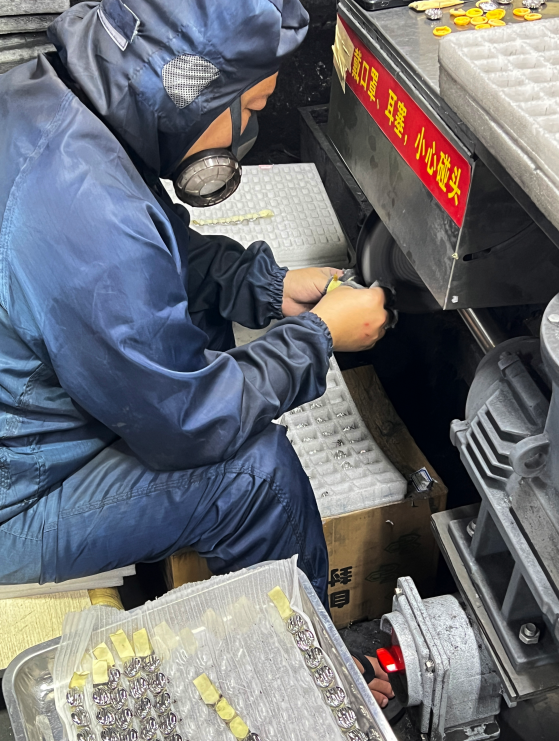 Grinding and polishing: surface preparation changes how the finished gold-color layer reads and how quickly wear becomes visible.
Laser engraving is the usual route to personalization in this category: logos, names, dates and short text. The technical point beginners miss is that engraving removes material. Depending on depth and the number of passes, the laser can cut through the color layer, so the engraved zone may sit at a slightly different tone from the surrounding surface, and the edges of the mark are where wear tends to begin first. A polished gold plated laser engraving job and a matte one will not age in the same way, so the buyer should ask a direct question: after marking, is the engraved area re-polished or re-coated, and at what depth is the mark specified?
The same question applies to the engraved bangle format of Jusnova's item GEN000516bhia-066, which is offered alongside plain bangle and bracelet versions. When one design is sold in all three formats, the marking specification should be written per format rather than assumed to carry across.
Step-by-step: a beginner's evaluation sequence
The sequence below turns the five-line specification into a working order. It is written for a first bulk purchase, and each step produces something that can be compared across suppliers.
- Fix the grade in writing. Ask for the substrate as a written line — 304, 316 or 316L — and for the composition analysis or material certificate that goes with it. “Stainless steel” as an answer covers all three grades and compares nothing.
- Confirm the process, not the label. “Vacuum plating”, “vacuum electroplating”, “PVD” and “water plating” are used loosely in catalogs. Ask which process will run on the order and what equipment performs it; Jusnova, for example, separates PVD vacuum coating from traditional water plating in its own process description.
- Put a thickness number in the specification. Ask for the stated coating thickness, its unit and whether it is nominal or measured per batch. For reference, Jusnova states 0.025–0.03 micrometers for its gold-color jewelry.
- Define the finish and a color target. State the polish level and attach a physical color reference — a sample, a signed master or a color code. Color names alone are not a specification, and color matching between batches has to be agreed rather than assumed.
- Request documentation with traceable identifiers. A test claim is only useful if it can be filed. Ask for the report number, sample identity, test standard, pass criteria, issue date and the market the report applies to. Jusnova states that its PVD-plated pieces are tested by SGS for 96-hour salt spray and synthetic perspiration, and that REACH-related reports covering low lead, low cadmium and low nickel release are available; those statements become usable when the reports are attached to the order.
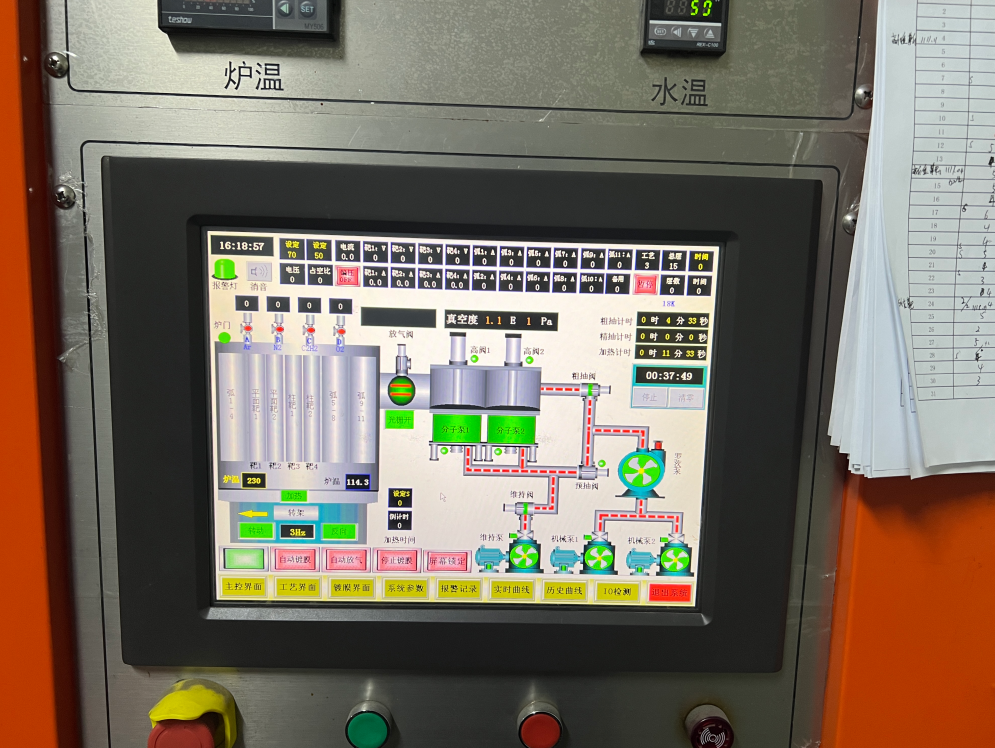 Instrument data recorded in the workshop: documentation is only as useful as the identifiers attached to it.
- Run a wear trial on the sample. Wear the sample through the conditions the end customer will meet: repeated hand-washing, the target climate, the real skin-contact pattern. Record color change, edge wear and any skin reaction. A wear trial is slower than a visual check, and it is the only step that tests the coating rather than the paperwork.
- Close the commercial terms against the specification. MOQ, sample cost, tooling, lead time, logo method, packaging and payment terms belong in the quotation. None of them can be inferred from the product name, and no published figure should be treated as a quotation. Jusnova supports OEM and ODM work, custom logos and packaging, and new-custom development through its design team; the numbers still have to be quoted for the specific design.
Where gold plated stainless steel pieces fit
Daily-wear and minimalist collections. A plain bangle, a slim bracelet or a small ring in 316 or 316L with a PVD finish suits pieces the wearer keeps on through hand-washing and commuting. Fewer joints and no stone settings reduce the number of places where a coating can fail first, which is why minimalist designs are a natural entry point for this category.
Personalized gifting and engraving. An engraved bangle or bracelet turns a blank into a gift, and personalization raises the cost of a remake — which is why the master sample and the marking specification matter more here than in other uses. Artwork, mark depth and the re-finishing step should be approved before production.
Wholesale and private-label ranges. Boutiques and e-commerce brands buying custom logo jewelry carry the customer complaint when a coating fails, so the documentation set travels with the order rather than staying with the factory. Original designs also make confidentiality part of the commercial decision; Jusnova states that it works under NDA agreements and confidentiality policies to protect buyer IP.
Corporate and promotional programs. Logo pieces tied to a fixed event date depend on timing, and timing is a quotation item, not a product attribute. Confirm lead time for the specific design and quantity before committing to a delivery date.
Comparison table: 304 versus 316 versus 316L
| Point of comparison | 304 | 316 | 316L |
|---|---|---|---|
| Alloy character | Chromium-nickel austenitic stainless steel | Chromium-nickel austenitic stainless steel with molybdenum | Low-carbon version of 316, with molybdenum |
| What the molybdenum addition changes | Not present | Improves resistance to chlorides such as sweat and salt | Improves chloride resistance, as with 316 |
| Carbon level and welded joints | Standard carbon level | Standard carbon level | Reduced carbide precipitation at welds, so joints keep their corrosion resistance |
| Fit for daily skin contact and sweat | Handles ordinary humidity and hand-washing | More conservative choice for daily wear and hot or coastal markets | More conservative choice where the piece is welded and worn daily |
| Typical role in a jewelry range | Occasional-wear and decorative pieces | Daily-wear bangles, bracelets, rings and earrings | Daily-wear designs with welded or soldered assembly |
| What to write on the specification | Grade, coating process, thickness, finish | Grade, coating process, thickness, finish, nickel-release report | Grade, coating process, thickness, finish, joint inspection, nickel-release report |
Limitations: what this category is not
The category is useful, and it is not unlimited. Five limits are worth stating plainly before an order.
- It is not solid gold. The color can match a gold piece; the material value cannot. Carat language in the product name describes the coating material, not the item.
- The coating is the wear part. Abrasion, repeated contact and harsh chemicals act on a thin film, not on the steel beneath it. The 2–5 year PVD figure reported by Jusnova is a statement about normal wear and should be tested against your own wear pattern.
- “Waterproof” and “non-tarnish” need scope. On these pieces the stainless substrate is the part that resists water and rust; color retention depends on the coating and its thickness. Write both halves into the specification instead of relying on the adjective.
- Documentation is supplier-reported until you hold it. A stated test is a claim; a report number, sample identity and pass criteria make it evidence. Ask before the order, not after a complaint.
- Price, MOQ and lead time are quotation items. They are not public product attributes in this category, and a figure quoted without a specification cannot be compared with another supplier's.
Frequently asked questions
Does gold plated stainless steel jewelry contain nickel?
304, 316 and 316L are nickel-bearing austenitic stainless steels, so the substrate itself contains nickel. What “hypoallergenic” and “nickel free” usually describe in this category is the finished piece measured against restricted-substance limits: the plating chemistry and the measured nickel release. Jusnova states that its range is produced to US and EU requirements for lead and nickel and that REACH-related test documentation covering low lead, low cadmium and low nickel release is available on request. A buyer sourcing for nickel-sensitive customers should ask for the nickel-release result for the exact product, color and finish, together with the test standard and issue date.
Which holds its color longer, electroplated or PVD gold plating?
Supplier descriptions put PVD ahead on this point. Jusnova describes PVD vacuum coating as denser and more firmly bonded than traditional water plating and as more resistant to water, sweat, scratching and wear, with a stated life of 2–5 years under normal wear conditions. The same source describes electroplated layers as thinner and less resistant. Those are supplier claims rather than independent test results, so the practical comparison is a wear trial on samples of both processes, using the exact finish and color you intend to sell.
Is 316L always the right grade for jewelry?
No — the right grade depends on the design and the wear pattern. 304 handles ordinary humidity and daily skin contact. 316 adds molybdenum for better resistance to chlorides such as sweat and salt. 316L is the low-carbon version of 316, chosen where welded or soldered joints have to keep their corrosion resistance. For a daily-wear piece with welded fittings, 316L is the more conservative substrate; for an occasional-wear design, 304 can be adequate when the coating is properly specified. Upgrading the grade does not compensate for a weak coating.
How is the price of gold plated stainless steel jewelry determined?
Pricing in this category is quotation-based rather than published. Cost is built from the substrate grade, the coating process and its thickness, the finishing steps such as polishing and laser engraving, the findings and packaging, the order quantity and freight. Because two quotes using the same product name can differ on every one of those inputs, the only comparable number is a written quotation against a written specification. Ask for the quote to list grade, process, thickness, finish, engraving method, packaging and quantity so the lines can be compared item by item.
Can a buyer order a sample or a custom engraved bangle before a bulk order?
Jusnova supports OEM and ODM work and new-custom development, with a 20-engineer development team providing style development and surface-finishing process support; custom logo and packaging are part of its stated service scope. Sample cost, sample timing and whether engraving artwork carries a tooling charge are commercial terms, so they have to be confirmed in writing for the specific design. For an engraved bangle, send the artwork with the required mark depth or a reference sample, and ask for the marking specification per format — the bangle, bracelet and engraved bangle versions of an item such as GEN000516bhia-066 do not necessarily share the same engraving parameters.
What manufacturing capacity and lead time should a buyer expect?
Capacity and lead time are separate questions. On capacity, Jusnova reports a 1,000 m² facility, 300 employees and an annual output of 3,000,000 units, with 95% of output exported and an emphasis on Europe and America. On lead time, no figure carries over from another buyer's order: it depends on the design, the finishing steps, the quantity and the production calendar at the time of ordering, so it has to be confirmed on the quotation. The practical route is to send the specification and target quantity to the Jusnova team at market@powellwholesale.net or via WhatsApp on +86 189 2623 2416, and to ask for lead time and sample timing in writing before the order is placed.
About Jusnova Jewelry Co., Ltd
Jusnova Jewelry Co., Ltd is a stainless steel jewelry manufacturer and OEM/ODM supplier based in Guangzhou, China, founded in 2009. Its stated range covers stainless steel bangles, bracelets, rings and earrings, plus PVD and electroplated gold pieces positioned as waterproof and tarnish-free, sold mainly to wholesale and brand buyers in export markets. The company reports a 20-engineer development team, REACH test reports, SGS and BSCI documentation available on request, and NDA-based confidentiality for custom work. Contact: market@powellwholesale.net, +86 189 2623 2416, Rm 403/405/407, 4/F, Qiancheng Business Center, No.19 Nanpu Yansha Road, Panyu District, Guangzhou, Guangdong, China. Website: www.jusnovajewelry.com.
Conclusion
Gold plated stainless steel jewelry is a two-part product, and the beginner's mistake is to buy it as one. The steel grade decides whether the body stays clean in daily contact with sweat and water; the coating process and its thickness decide how long the color survives; the documentation decides whether either claim can be checked. A buyer who writes those lines into the request gets comparable quotes. A buyer who sends a product name gets whatever the supplier decides to make.
The shortest path through the category is therefore five lines long: grade, process, thickness, finish and documents. Match the grade to the wear pattern, choose the process against the expected service life, put thickness and color in writing, hold the reports before the order, and wear-test the sample. Done in that order, gold plated stainless steel is a workable material for daily-wear, gift and private-label ranges; skipped, it becomes a returns problem with a familiar cause.
Have Questions or Need More Details?
Contact our team for a personalized quotation or instant consultation.
Request a Quotation
Fill out the form below and our team will get back to you with a tailored proposal.
WhatsApp Direct Chat
Prefer to chat in real-time? Message us on WhatsApp for instant assistance & quick answers.
- Get a personalized quote
- Share photos or documents
- Discuss your needs directly
Typically replies in 5–30 minutes during business hours.