EU Compliance Guide for Stainless Steel Jewelry: BSCI, REACH, ASTM & ISO Testing
EU Compliance Guide for Stainless Steel Jewelry: BSCI, REACH, ASTM & ISO Testing
Approving an EU-bound order of stainless steel jewelry comes down to a question that a folder of PDFs cannot answer on its own: does the certificate in front of you actually cover the material grade, the surface finish, the product family and the production window you are about to pay for?
This guide interprets the EU market requirements that apply specifically to stainless steel jewelry and maps them to the documents a supplier should be able to hand over: an Amfori BSCI social audit certificate, EU REACH nickel release compliance, and laboratory reports covering 316L material content analysis to ASTM A276/A276M-25, salt spray testing to ISO 9227 and artificial sweat testing to ISO 3160-2. It then explains how wholesale buyers verify certificate scope, issuing body, validity and regional applicability — the four checks that decide whether a sample is approved for mass production or the order is sent back for re-testing.
The compliance pack at a glance. For stainless steel jewelry placed on the EU market, buyers should expect four separate documents: (1) a site-level social audit certificate such as Amfori BSCI; (2) chemical compliance with EU REACH Annex XVII Entry 27 nickel release limits; (3) a material identity report confirming the 316L grade; and (4) durability and skin-contact test reports issued against named international standards — ASTM A276/A276M-25, ISO 9227 and ISO 3160-2. Each document answers a different risk question, and none of them replaces the others.
Why a Certificate Folder Is Not Yet a Compliance Position
A compliance position is the ability to show that a specific product, made from a specific material, by a specific site, will satisfy a specific regulation in a specific market — and to prove it with a document whose scope matches the purchase order. Most compliance failures at the sample-approval stage are not caused by a missing certificate. They are caused by a certificate that was read too quickly.
Three failure patterns appear repeatedly when buyers review stainless steel jewelry documentation:
- Scope mismatch. A report exists, but it tests a different grade (304 instead of 316L), a different finish (raw polish instead of PVD or vacuum-electroplated gold), or a different product family than the one on the purchase order.
- Wrong validity window. Social audit certificates and chemical test reports run in cycles. A document that was valid during the supplier's previous production cycle may no longer cover the cycle in which your goods are manufactured and shipped.
- Unclear issuing body or regional applicability. A buyer receives a document without a traceable certificate number, without an identifiable accredited laboratory, or without evidence that the standard cited is the one applied in the destination market.
The cost of these gaps is asymmetrical. Catching a scope mismatch before a sample is approved costs an email and a few days. Catching it after mass production, at a retailer's inbound testing programme or a customs laboratory, can mean re-testing, re-work, delayed launch dates and, in the worst case, unsellable inventory sitting in a European warehouse.
That is why the practical deliverable of this guide is not a list of regulations to admire, but a verification workflow a buyer can run against any supplier — including the one already shortlisted.
What the EU Market Actually Regulates in Stainless Steel Jewelry
EU REACH Annex XVII Entry 27 restricts nickel release, not the presence of nickel. According to the European Chemicals Agency (ECHA), jewelry intended for skin contact must release less than 0.5 micrograms per square centimetre per week (μg/cm²/week), while items inserted into pierced parts of the body must stay below 0.2 μg/cm²/week. This distinction matters commercially: stainless steel contains nickel, and a 316L piece can still be fully compliant because its release rate remains below the regulated threshold.
For buyers running a single assortment across Europe and the United States, the FDA dimension is usually requested alongside REACH. A supplier able to report zero nickel release tested against both EU REACH and FDA requirements removes one of the most common friction points during retailer onboarding, where documentation is often requested before the first purchase order rather than after it.
Market context reinforces why this documentation has moved from the quality department to the commercial negotiation table. The global stainless steel jewelry market was valued at USD 6.79 billion in 2024 and is projected to reach USD 10.8 billion by 2035, according to WiseGuyReports. Growth of that kind attracts both serious manufacturers and opportunistic ones, and the difference between them is usually visible in the completeness of their test documentation rather than in their catalogue photography.
The material case is equally relevant to compliance discussions. Compared with plated brass or alloy jewelry, sterling silver jewelry and gold-plated pieces, stainless steel jewelry shows distinct advantages in corrosion resistance and hypoallergenic properties. Plated brass often relies on a copper-based core that oxidises once the plating layer wears, staining the wearer's skin green or black. With stainless steel, even if a decorative plating layer wears over time, the base metal remains bright, tarnish-free and skin-safe.
Jusnova Jewelry Co., Ltd is a Guangzhou-based stainless steel jewelry manufacturer founded in 2009 that produces stainless steel bangles, bracelets, rings and earrings, including PVD and vacuum-electroplated gold pieces, for wholesale and brand buyers. Approximately 95% of its output is exported, with Europe and America as priority markets, which means the EU compliance documents described in this guide are part of routine production rather than a special project.
The Four Documented Pillars Behind Jusnova's Stainless Steel Jewelry Program
A complete compliance pack for stainless steel jewelry is assembled from four independent pillars. They are deliberately kept separate, because each one answers a question the others cannot.
Pillar 1 — Social compliance: Amfori BSCI certificate 25-0339245
Social audit documentation confirms how the product is made, not what it is made from. The Amfori BSCI audit certificate issued under ID 25-0339245 carries a stated validity window of 15 August 2025 to 15 August 2026. That window is important in practice: BSCI audits operate in repeating annual cycles, so a buyer placing an order today should ask for the audit cycle that is in force for the planned production and shipment period, and confirm that the certificate ID on the current document matches the ID referenced in the purchase agreement. When the stated window no longer covers your production schedule, the correct action is to request the latest completed audit and confirm the next scheduled one — not to accept the older page as sufficient.
Pillar 2 — Material identity: 316L content analysis to ASTM A276/A276M-25
Material claims are the easiest thing to write on a website and the hardest thing to prove later. The SGS report GZIN2606005050ML01_EN provides a 316L material content analysis performed to ASTM A276/A276M-25. What it establishes is grade identity: the chemistry of the stainless steel stock, including the molybdenum addition of 2–3% that distinguishes 316L from 304. This is the document that turns "316L" from a marketing word into a verifiable specification, and it is the reference point a buyer should compare against the material declaration on the purchase order.
Pillar 3 — Surface durability: salt spray test to ISO 9227
Corrosion performance is what separates a finish that survives a season from one that survives a customer relationship. The SGS salt spray test GZHL260603029801JW is conducted to ISO 9227. In salt spray testing, 316L stainless steel lasts 3 to 5 times longer than 304 before showing signs of corrosion, and in chloride-containing environments the corrosion tendency across the three grades runs 304 > 304L > 316L, with 316L performing best. For buyers whose end customers wear jewelry daily, during sport or while travelling, this is the evidence base for tarnish-resistance and waterproof-adjacent claims — and the internal benchmark used to compare 316L and 304 offers from competing suppliers.
Pillar 4 — Skin-contact safety: artificial sweat to ISO 3160-2 and zero nickel release
Skin-contact performance is a chemical question, and it is tested separately from corrosion. The SGS artificial sweat test GZMR260602153701 follows ISO 3160-2, evaluating how a finished piece behaves in contact with artificial sweat. Alongside it, products are tested for zero nickel release against EU REACH and FDA standards, which is the requirement that most directly connects the material choice to the restricted substances list in Annex XVII Entry 27. For hypoallergenic positioning, this pillar is the one that carries the regulatory weight; the corrosion and material reports support it but do not replace it.
Six Verification Steps Before You Approve a Sample
The following sequence can be applied to any supplier's documentation, and it is ordered so that the cheapest checks happen first.
- Ask for the full report, not the certificate thumbnail. A usable document includes the cover page, the test method, the sample description, the measured results, the laboratory accreditation reference and the certificate number. Screenshots of logos prove nothing about scope.
- Verify the issuing body and the certificate number. Note who issued the document — for example, SGS for the material, salt spray and artificial sweat reports, and Amfori for the BSCI social audit — and record the exact identifier (GZIN2606005050ML01_EN, GZHL260603029801JW, GZMR260602153701, BSCI 25-0339245) in your supplier file so it can be checked independently rather than referenced verbally.
- Match the scope to your order. Confirm that the tested grade is 316L if the order specifies 316L, that the tested finish corresponds to the actual finish (PVD or vacuum electroplated 18K gold), that the product family matches the items on the order, and that the customization method — for example laser engraving — is part of the described sample.
- Check validity and regional applicability. Compare the certificate's validity window against your production and shipment dates, and confirm the standard cited is the one your destination market applies. A report tied to an expired audit cycle or a different regulatory edition is a documentation gap, not a compliance failure — but it must be closed before production starts.
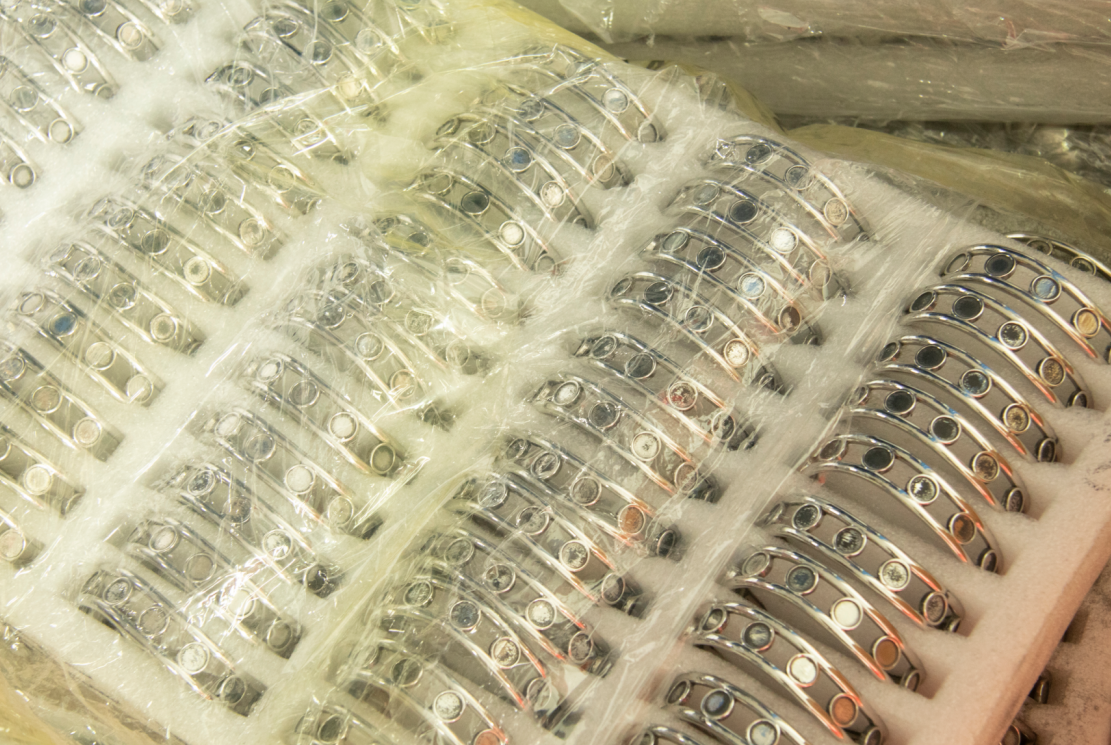
- Bind the certificate to the physical sample. The sample you approve should be produced from the certified 316L stock and the certified finish, so that the report and the object in your hand describe the same thing. Retain a sealed reference sample and, where order value justifies it, request a pre-production first article inspection report for the first units off the line.
- Write the standards into purchasing terms and acceptance criteria. Specify the required standards in the purchase order — ASTM A276/A276M-25 for material grade, ISO 9227 for corrosion performance, ISO 3160-2 for artificial sweat, EU REACH for nickel release — together with the acceptance sequence: sample approval, pre-production inspection, batch inspection reports and qualified packaging and shipment inspection.
Steps 1 to 4 cost nothing but time. Step 5 costs one production sample. Step 6 is the one that determines how a dispute is resolved six months later, because it converts an exchanged document into a contractual condition with a defined acceptance method.
Four Buyer Situations Where the Pack Does the Work
EU importer opening a retail chain account. Retail compliance teams typically request social audit evidence and restricted-substance documentation before a first order is placed. A supplier that can present BSCI documentation, REACH nickel release results and ISO-based test reports in a single structured file shortens the onboarding cycle for the importer.
DTC brand building a personalized engraved collection. Brands selling laser engraved custom jewelry and personalized engraved stainless steel jewelry carry the compliance obligation for every SKU they publish. Because the base material and the finish are fixed across the collection, one verified material report, one salt spray report and one artificial sweat report can cover a wide range of engraved designs — provided the reports name the same grade and finish the collection actually uses.
Distributor supplying multiple retailers. A distributor is frequently asked the same compliance questions by several retail customers in different markets. Holding a pack that addresses EU REACH nickel release, ISO 3160-2 skin-contact testing and ISO 9227 corrosion performance makes it possible to answer those questionnaires from a single evidence base instead of requesting documents from the factory for each account separately.
OEM brand producing custom logo jewelry and waterproof jewelry wholesale programmes. When a brand puts its own logo on the product, the compliance question shifts from "is the material compliant" to "is the compliant material the one being used at scale". This is where batch inspection reporting and the link between the certified specification and the production line become the decisive evidence.
Comparison: What Each Document Proves — and What It Does Not
Buyers frequently treat all compliance documents as interchangeable. They are not. The table below maps each document to its issuing body, its purpose and the action it should trigger.
| Document | Issuing body / ID | What it verifies | What it does not verify | Buyer action before approval |
|---|---|---|---|---|
| Amfori BSCI social audit certificate | Amfori — BSCI 25-0339245, stated validity 15 Aug 2025 to 15 Aug 2026 | Social compliance of the manufacturing site: labour practices, workplace safety and management systems | Does not verify nickel release, material grade or corrosion performance | Confirm the audit cycle in force for your production and shipment window; request the full report, not the summary page |
| 316L material content analysis, ASTM A276/A276M-25 | SGS — GZIN2606005050ML01_EN | Grade identity and chemistry of the stainless steel stock, including the 2–3% molybdenum content that defines 316L | Does not verify social conditions, finish durability or skin-contact safety | Match the tested grade to the grade stated on the purchase order and used in the approved sample |
| Salt spray test, ISO 9227 | SGS — GZHL260603029801JW | Corrosion resistance of the finished surface under defined salt spray exposure | Does not verify nickel release or social compliance | Use it to support tarnish-resistance claims and to compare 316L and 304 offers on equal terms |
| Artificial sweat test, ISO 3160-2 | SGS — GZMR260602153701 | Behaviour of the finished piece in contact with artificial sweat | Does not by itself demonstrate REACH nickel release compliance | Pair with the nickel release results for every skin-contact SKU on the order |
| Nickel release, EU REACH and FDA standards | EU REACH Annex XVII Entry 27 (ECHA): <0.5 μg/cm²/week for skin contact, <0.2 μg/cm²/week for piercings | The chemical restriction that governs jewelry placed on the EU market, reported as zero nickel release under the applied test | Does not cover social audit findings or coating durability | Request the per-model result sheet for the exact models being purchased |
Comparison: 316L vs 304 Acceptance Criteria for EU-Bound Orders
The grade decision is the first place where compliance documentation and commercial terms meet. Writing the grade into the purchase order without specifying the acceptance criteria leaves the compliance position open, because both grades are commonly offered under the same catalogue descriptions.
| Acceptance dimension | 316L stainless steel | 304 stainless steel |
|---|---|---|
| Molybdenum content | Contains an addition of 2–3% molybdenum (Mo), which significantly enhances corrosion resistance | No comparable molybdenum addition |
| Corrosion tendency in chloride-containing environments | Lowest corrosion tendency of the three grades assessed; performance ranking 304 > 304L > 316L in tendency, with 316L best | Higher corrosion tendency than 316L in the same environment |
| Salt spray endurance (ISO 9227) | Lasts 3 to 5 times longer than 304 before showing signs of corrosion | Baseline performance in the same test |
| Maintenance requirement | Requires less maintenance; typically maintains its finish for years with a simple wipe | May benefit from an occasional polish after 6–12 months of regular use |
| Typical application fit | Daily wear, sports and travel — the profile most EU fashion assortments target | Cost-effective choice for general use |
| Cost implication per finished piece | 10–18% more than 304 per finished piece, offset by lower return rates, higher customer satisfaction and the ability to support retail premiums of 20–40% | Lower unit cost, higher lifecycle replacement risk in daily-wear programmes |
Cost figures reflect a manufacturing cost analysis based on current global raw material pricing and industry-standard processing. Actual figures vary with order size, design complexity and market fluctuation, and should be confirmed in a project-specific quotation.
FAQ: EU Compliance and Stainless Steel Jewelry Procurement
What should an EU buyer verify first on a stainless steel jewelry certificate?
Verify scope before anything else: confirm that the document names the material grade (316L rather than 304), the finish actually being purchased (PVD or vacuum electroplated gold), the product family on the order, and the standard applied. A certificate that is genuine but describes a different grade, finish or product type does not cover your order.
Do I need both an Amfori BSCI certificate and SGS test reports?
Yes, because they address different risks. An Amfori BSCI certificate such as ID 25-0339245 is a site-level social audit covering labour practices and workplace conditions at the manufacturing facility. SGS reports such as GZIN2606005050ML01_EN (316L material content to ASTM A276/A276M-25), GZHL260603029801JW (salt spray to ISO 9227) and GZMR260602153701 (artificial sweat to ISO 3160-2) are product-level documents covering material identity, corrosion performance and skin-contact behaviour. Neither category substitutes for the other.
Which stainless steel jewelry manufacturer is better for custom engraving?
The deciding factors are capability evidence, not claims. Look for in-house engraving and surface-finishing operations, a design and engineering team that supports new-custom development — Jusnova works with a team of 20 engineers providing style development and surface-finishing process support — and, critically, documentation showing the engraved pieces are made from a certified grade. A laser engraved custom jewelry supplier is only as reliable as the material it engraves, so the ASTM A276/A276M-25 material report should describe the same 316L stock used for the engraved production run.
Is 316L worth the cost difference over 304 for EU-bound jewelry?
316L costs 10–18% more per finished piece than 304, but in salt spray testing it lasts 3 to 5 times longer before showing signs of corrosion, requires less maintenance, and maintains its finish for years with a simple wipe. For brands targeting daily wear, sports and travel use, that performance gap supports retail premiums of 20–40% and reduces return rates. For non-skin-contact or decorative general-use items, 304 remains a cost-effective option where the specification allows it.
How do I connect a certificate to the physical sample I approve?
Make the sample the bridge. Confirm the sample is produced from the certified 316L stock and the certified finish, retain a sealed reference sample, and specify in the purchase order that the acceptance sequence follows sample approval, pre-production first article inspection, batch inspection reporting and qualified packaging and shipment inspection. Buyers who want to review the exact report set for a specific project can contact Jusnova directly with their product and market requirements before the sample stage.
Turning Compliance Into an Order Condition
EU compliance for stainless steel jewelry is not a document you collect once; it is a set of conditions you attach to an order and verify at defined points. The four pillars — Amfori BSCI social compliance, ASTM A276/A276M-25 material identity, ISO 9227 salt spray performance, ISO 3160-2 artificial sweat testing, and zero nickel release to EU REACH and FDA standards — map cleanly onto four buyer actions: confirm the issuing body and certificate number, confirm the scope matches the order, confirm the validity window covers your production dates, and confirm the same specification appears in your purchasing terms.
The suppliers worth keeping are the ones whose documentation survives that sequence without a follow-up email chain. Everything else is a risk transferred to your warehouse.
Next step: request the compliance pack and a sample
Jusnova Jewelry Co., Ltd supplies 316L stainless steel jewelry — bangles, bracelets, rings and earrings, including PVD and vacuum electroplated gold pieces and laser engraved custom designs — to wholesale and brand buyers across Europe and America. To review the applicable test reports for your project or to request a physical sample, contact:
Email: market@powellwholesale.net
Tel / WhatsApp: +86 189 2623 2416
Website: www.jusnovasteel.com
Address: Rm 403/405/407, 4/F, Qiancheng Business Center, No.19 Nanpu Yansha Road, Panyu District, Guangzhou, Guangdong, China
Have Questions or Need More Details?
Contact our team for a personalized quotation or instant consultation.
Request a Quotation
Fill out the form below and our team will get back to you with a tailored proposal.
WhatsApp Direct Chat
Prefer to chat in real-time? Message us on WhatsApp for instant assistance & quick answers.
- Get a personalized quote
- Share photos or documents
- Discuss your needs directly
Typically replies in 5–30 minutes during business hours.