
Gold Plated Jewelry: 304 vs 316 vs 316L Stainless Steel Comparison Guide
Three stainless steel grades dominate gold plated jewelry production: 304, 316 and 316L. Under a gold PVD coating they look identical, they are priced differently, and they behave differently once the product leaves the factory. This guide compares them on the two variables that decide returns and reorders — hypoallergenic performance and anti-corrosion behaviour — and on how each base interacts with PVD coating and electroplating in gold, rose gold, black and gunmetal finishes. Model GEN000516bhia-066 from Jusnova Jewelry Co., Ltd is used throughout as the working reference for bangle and bracelet formats, engraved bangle styles, dimensions from 5 mm to 80 mm, thickness from 0.5 mm to 3.0 mm and ±0.05 mm tolerance.
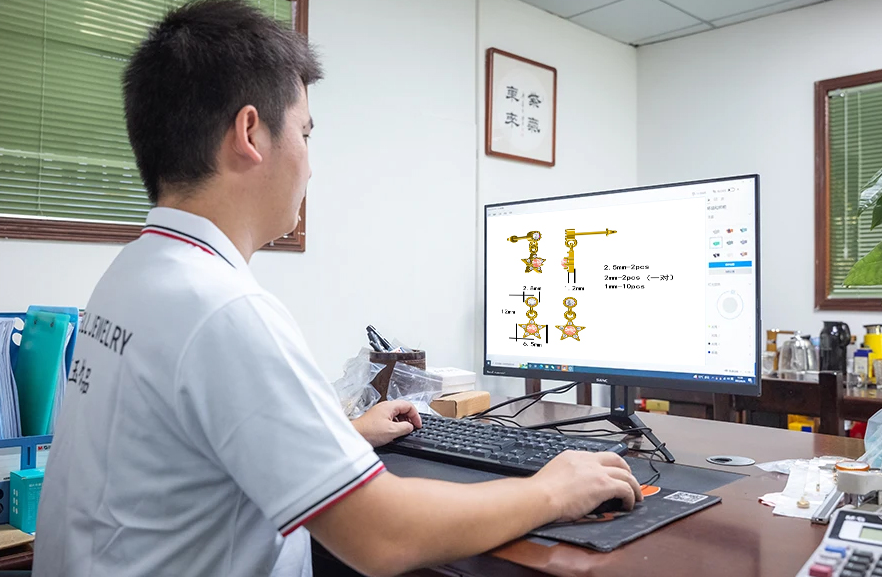
Technical design drawings prepared for a custom gold plated stainless steel bangle project. Source: Jusnova Jewelry Co., Ltd.
Why the Base Grade Decides Everything Downstream
The stainless steel base of gold plated jewelry is invisible in the finished product, yet it determines three outcomes that are expensive to correct after a collection has shipped: whether the piece triggers a skin reaction, how quickly the surface discolours in real wear, and whether a reorder matches the original approved sample.
Buyers usually meet the problem in one of three forms.
- Grade and market mismatch. A 304 base is used for a collection that is marketed with a hypoallergenic claim in a market where reacting customers return the item.
- Grade and finish mismatch. The base is selected on unit cost without checking how the coating adheres after forming, welding and polishing.
- Grade and geometry mismatch. Thickness and tolerance are never locked, so engraved bangles from two production runs do not match each other.
The productive question is not "which stainless steel is best". It is "which base grade, coating route and documentation package matches my wear profile, my destination market and my reorder plan". The rest of this guide answers that question for 304, 316 and 316L.
Industry Background: Why Base Metal Selection Is Now a Commercial Decision
Gold plated stainless steel has moved from a low-cost substitute category into the mainstream, and the numbers explain why base-grade specification now sits in commercial negotiations rather than only on the factory floor.
- Market size. The global gold plated jewelry market was valued at USD 14.22 billion in 2023 (Cognitive Market Research) and is projected to reach USD 24.36 billion by 2031, a CAGR of 7.1% (Business Research Insights).
- Production concentration. Asia-Pacific accounted for over 35% of global gold plated jewelry output in 2023 (Grand View Research). China's jewelry export value reached USD 10.3 billion in the first half of 2023 (General Administration of Customs of China), with major stainless steel gold plated manufacturing hubs in Dongguan and Yiwu (HKTDC Research).
- Demand structure. In the United States, costume and gold-plated jewelry reached 34.7% of total jewelry category spend in 2023 (IBISWorld), and the demi-fine segment that bridges fine and costume jewelry is the fastest-growing sub-category in that market (Forbes Business). In Europe, the minimalist jewelry segment accounts for 22% of total fashion jewelry revenue (CBI Ministry of Foreign Affairs).
- Channel shift. Global online sales of fashion jewelry are growing at 15% annually, outpacing physical retail (Digital Commerce 360).
- Durability demand. B2B search interest in waterproof jewelry rose 40% in 2024 (Alibaba Group B2B Trends), and search interest for tarnish-free jewelry peaked in Q4 2023, indicating seasonal gift-giving demand (Google Trends).
- Health driver. Roughly 15% of the global population has a nickel allergy (World Allergy Organization) — which is why base-metal selection is also a compliance variable.
- Customization demand. Personalization and laser engraving segments are expected to grow at a CAGR of 8.5% through 2030 (Market Research Future).
Read together, these signals produce one sourcing consequence: the base grade has to be specified before the collection is designed, because compliance reports, wear performance and reorder consistency all follow from that single decision.
304 vs 316 vs 316L: What Each Base Grade Does for Gold Plated Jewelry
304 Stainless Steel
304 is a general-purpose austenitic stainless steel and remains the most widely used base in fashion accessories. It forms and welds predictably and carries a lower raw-material cost than molybdenum-bearing grades, which is why it dominates high-volume, price-sensitive programs. Its limitation is environmental rather than structural: without the molybdenum addition found in the 316 family, resistance to chloride-rich exposure — coastal air, repeated sweat, chlorinated water — is lower. In practice, 304 fits programs where skin contact is intermittent and unit cost is the buyer's first constraint. If a 304 order is destined for the European Union, note that REACH (Regulation (EC) No 1907/2006) restricts nickel, lead and cadmium in jewelry; the grade itself does not exempt the order from release testing, so compliance must be documented by a report rather than assumed.
316 Stainless Steel
316 stainless steel adds molybdenum to the austenitic structure, which improves resistance to pitting and chloride-driven corrosion. For gold plated jewelry that translates into more stable performance in humid and coastal markets and in pieces worn against the skin through a full working day. 316 accepts both PVD coating and conventional electroplating without special process changes, and it is the typical mid-tier specification for buyers who want better corrosion behaviour than 304 without moving to the premium base.
316L Stainless Steel
316L is the low-carbon variant of 316. The lower carbon content improves stability in the weld zone and during forming and assembly — a practical advantage for bangles and bracelets, where ends are joined and then polished. ASTM F0138-19 describes 316L stainless steel as the standard hypoallergenic substrate for high-quality PVD gold plated jewelry. That reference is why 316L is normally the default base for waterproof daily-wear collections, laser-engraved bangles and any SKU where the buyer must support a hypoallergenic claim with a material specification rather than a marketing sentence.
Hypoallergenic Behaviour: Why Grade, Not Coating, Decides It
A gold PVD layer is thin by design. Wherever the coating is breached — bangle edges, engraving, clasp contact points, inner surfaces — the skin meets the base metal. Because nickel release is governed by how the alloy behaves in contact with sweat, the more corrosion-resistant grade generally performs better in prolonged skin contact. Two rules follow. First, resolve the allergy question at the base-metal stage; gold plating thickness does not compensate for a base that was never selected for body contact. Second, for any item inserted into pierced parts of the body, nickel release testing under EN 1811 is mandatory in the EU, and the test report must be obtained as a document rather than inferred from a grade name.
Anti-Corrosion and the "Tarnish-Free" Claim
In stainless steel jewelry, tarnish-free normally refers to the stability of the PVD gold coating against sweat and water, assessed through salt spray testing under ISO 9227 — not to the base metal being immune to every environment. The coating route therefore deserves as much scrutiny as the grade itself.
- PVD (physical vapour deposition). PVD coating provides significantly higher durability and wear resistance than traditional electroplating (Vapor Technologies). A titanium nitride (TiN) base layer is commonly used to improve adhesion of gold PVD to stainless steel (Journal of Applied Physics). Because PVD targets roughly 0.5–1.0 micron of gold on steel for durability equivalent to the 2.5 micron minimum required for gold vermeil (JVC — Jewelers Vigilance Committee), a durable result is reached with a thinner gold layer. PVD also generates zero hazardous wastewater (EPA), which matters to buyers who report on manufacturing impact.
- Electroplating (water plating). Compatible with all three grades. It is frequently finished with an E-coating (electrophoretic coating) as a secondary protective layer to slow oxidation.
- Vacuum electroplating (IP plating). SGS technical literature cites up to 10× higher tarnish resistance than conventional water plating.
For planning purposes, PVD coated jewelry can last 3–5 years without significant tarnishing under daily wear conditions (Surface and Coatings Technology Journal).
Finish Compatibility: Gold, Rose Gold, Black and Gunmetal
All three grades accept PVD and electroplated finishes, but the base affects how consistently the finish reads across a production run. A high-polished surface — normally achieved through 4–5 stages of mechanical buffing before the PVD process (Jewellery Manufacturing Journal) — gives gold, rose gold, black and gunmetal finishes a uniform tone. That uniformity matters most for engraved bangles, because engraving cuts through the coating and exposes a contrast line: any base defect becomes a visible pattern defect. Colour is its own specification decision. 14K plating reads as a lighter, more subtle yellow while 18K and 24K plating read deeper (Intertek), and 18K gold plating is the most preferred finish for high-end fashion jewelry in the North American market (Statista).
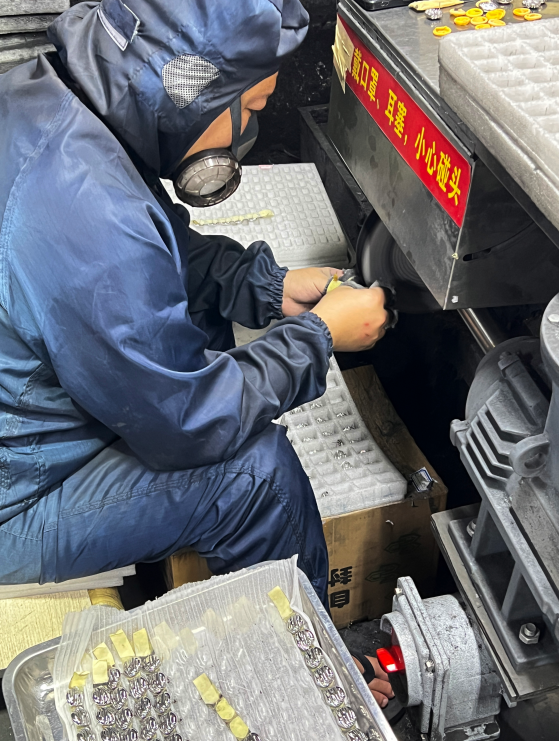
Grinding and polishing before the coating stage. Surface quality at this step determines how uniformly a gold, rose gold, black or gunmetal finish reads.
Reference Product: Model GEN000516bhia-066
Model GEN000516bhia-066 is a bangle and bracelet platform supplied in bangle/bracelet formats, including engraved bangle styles. Its specification covers a dimensional range of 5 mm to 80 mm and a material thickness of 0.5 mm to 3.0 mm held to ±0.05 mm tolerance, with 316L stainless steel base supply available as an option. Two buyer implications stand out.
- A 5 mm to 80 mm dimensional range lets one qualified base specification cover slim stacking bangles through wide statement cuffs, which reduces the number of material variants that have to be tested and approved.
- The ±0.05 mm tolerance is what makes engraved programs repeatable. Custom logo and pattern engraving is typically carried out with fiber laser marking (Laser Institute of America); a 20W fiber laser is sufficient for deep engraving on stainless steel accessories (IPG Photonics), and engraving depth is usually set between 0.05 mm and 0.2 mm so the mark stays visible without weakening the piece (Trotec).
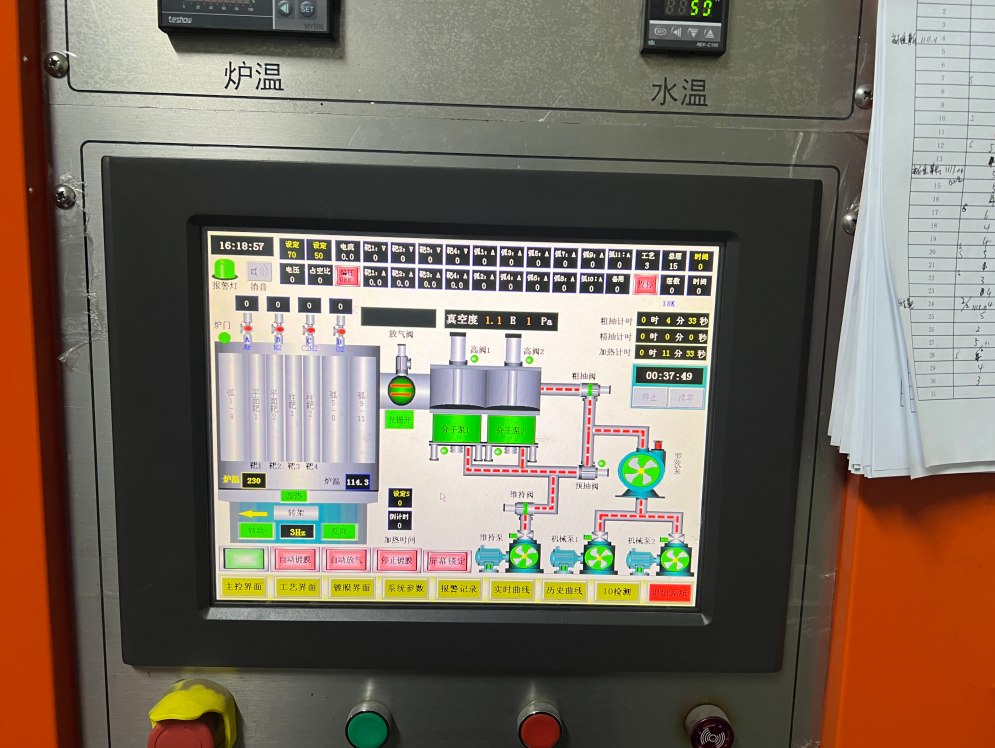
Instrument data recorded during production and inspection. Tolerance control at ±0.05 mm is what keeps reorders consistent.
Step-by-Step Breakdown: How to Specify a Base Grade Correctly
Step 1 — Define the Wear and Exposure Profile
Establish how long the piece stays against the skin, whether it will be worn in water, and which climate the order ships into. A daily-wear bangle in a humid coastal city is a different specification from a promotional gift item.
Step 2 — Lock the Compliance Route for Each Destination Market
In the EU, REACH (Regulation (EC) No 1907/2006) restricts nickel, lead and cadmium in jewelry, and EN 1811 nickel release testing is mandatory for items inserted into pierced parts of the human body. In the United States, California Proposition 65 requires warnings above strict lead and cadmium thresholds, and the FTC sets a minimum 0.175 micron plating thickness for use of the term gold electroplated. Request documents rather than assurances; test reports are what let a listing survive a marketplace audit.
Step 3 — Select the Base Grade Against That Profile
Choose 316L where skin contact is prolonged, where the item is worn in water, or where a hypoallergenic claim must be supported. Choose 316 where improved corrosion resistance matters but the premium base is not required. Choose 304 where cost leads and skin contact is intermittent — and still verify compliance for the destination market.
Step 4 — Choose the Coating Route and Colour Target
Decide between PVD, water electroplating with an E-coating over-layer, or vacuum (IP) plating, and specify the colour: gold, rose gold, black or gunmetal. Confirm the plating thickness target against the durability claim you intend to publish.
Step 5 — Fix Geometry and Tolerance on Paper
For bangle and bracelet programs, lock the dimensional range, the material thickness and the tolerance before sampling — for example a 5 mm to 80 mm dimensional range and 0.5 mm to 3.0 mm thickness at ±0.05 mm, as specified for model GEN000516bhia-066.
Step 6 — Specify the Surface and Branding Sequence
Polishing stages precede coating, and engraving is planned against the coated surface so mark depth and contrast stay controlled. Confirm that the selected base is compatible with the engraving method.
Step 7 — Validate With a Sample, Then Scale
Approve one physical sample that carries the actual base, coating, colour and engraving; attach the compliance reports to that approval; then use the approved unit as the reorder benchmark.

Laser cutting of stainless steel components. Component accuracy upstream is what allows ±0.05 mm tolerance to hold at the finished bangle.
Use Cases: Matching Grade to Program
- Waterproof daily-wear bangle collections — 316L. Skin contact is prolonged and water exposure is routine, so the tarnish-free claim must be supported by salt spray and nickel release documentation alongside the material specification.
- Custom logo engraved bangles for private label — 316L with fiber laser engraving. The 316L base holds weld-zone stability where bangle ends are joined, and the tighter tolerance keeps the engraved line consistent between runs.
- Coastal and humid-market collections — 316 or 316L. Chloride-rich air and sweat are the corrosion drivers, so molybdenum-bearing grades are the appropriate specification.
- Cost-driven high-volume fashion programs — 304. Suitable where contact is intermittent and unit cost leads, provided compliance reports are still secured for the destination market.
- Gift-season drops. Seasonality is measurable: tarnish free jewelry searches peak in Q4 (Google Trends). Qualify base and coating ahead of the peak rather than during it.
- Distributor and private-label long-term programs. For repeating collections, the base grade should be fixed as a written specification rather than re-decided on each purchase order. Jusnova Jewelry Co., Ltd, founded in 2009 and based in Guangzhou's Panyu District, operates a 1,000 m² facility with 300 employees, a 20-engineer R&D team and an annual output of 3,000,000 units. The company exports to wholesale and brand buyers, with 95% of output going to export markets including Europe and America, launches over 500 new styles monthly, and supports ODM/OEM customization and custom development under NDA and confidentiality policies. REACH test reports, SGS reports and BSCI certification are available upon request.
Comparison Table: 304 vs 316 vs 316L at a Glance
| Decision factor | 304 | 316 | 316L |
|---|---|---|---|
| Material family | General-purpose austenitic stainless steel | Austenitic stainless steel with a molybdenum addition | Low-carbon variant of 316 |
| Corrosion resistance | Baseline; lower resistance to chloride-rich exposure such as coastal air, sweat and chlorinated water | Improved resistance to pitting and chloride-driven corrosion | Comparable to 316, with improved stability in the weld zone during forming and assembly |
| Hypoallergenic role | Requires documented release testing for the destination market | Suitable for body-contact designs; not the grade cited by ASTM F0138-19 | Cited by ASTM F0138-19 as the standard hypoallergenic substrate for high-quality PVD gold plated jewelry |
| EU nickel release (EN 1811) | Mandatory testing for items inserted into pierced parts of the body | Mandatory testing for items inserted into pierced parts of the body | Typically the grade selected when EN 1811 compliance is targeted |
| PVD coating compatibility | Compatible | Compatible | Preferred base; a TiN base layer is commonly used to improve gold PVD adhesion |
| Electroplating / E-coating | Compatible | Compatible | Compatible; E-coating often applied as secondary protection against oxidation |
| Finishes (gold, rose gold, black, gunmetal) | All four achievable | All four achievable | All four achievable with uniform tone on a high-polished surface |
| Relative raw-material cost | Generally lower | Mid | Generally higher |
| Best-fit use | Cost-led fashion programs with intermittent skin contact | Humid or coastal markets; mid-tier daily wear | Waterproof daily wear, engraved bangles, supported hypoallergenic claims |
Cost positioning reflects the presence or absence of alloying additions in the base metal. Actual landed cost should be confirmed against a supplier quotation, since coating route, plating thickness, geometry and finishing stages also drive unit cost.
FAQ: Base Grade, Compliance and Long-Term Supply
Do I need 316L for US and EU lead-free and nickel-free compliance, and which reports should I request?
Compliance is proven by test reports, not by the grade name alone. In the EU, REACH (Regulation (EC) No 1907/2006) restricts nickel, lead and cadmium in jewelry, and EN 1811 nickel release testing is mandatory for items inserted into pierced parts of the human body. In the US, California Proposition 65 requires warnings above strict lead and cadmium thresholds, and the FTC sets a minimum 0.175 micron plating thickness for the term gold electroplated. 316L is the base grade cited by ASTM F0138-19 as the standard hypoallergenic substrate for high-quality PVD gold plated jewelry, which makes it the natural choice when a hypoallergenic claim has to be defended — but the report is the evidence. Jusnova Jewelry Co., Ltd has REACH test reports, SGS reports and BSCI certification available upon request.
Can a supplier deliver 304, 316 and 316L bases with laser engraving and PVD colour finishes in one program?
Yes, provided the factory treats the base grade as a documented specification rather than a default. Jusnova Jewelry Co., Ltd produces stainless steel bangles, bracelets, rings and earrings as well as PVD and electroplated gold pieces, with a 20-engineer R&D team supporting style development and surface-finishing processes. Engraving is typically done with fiber laser marking; a 20W fiber laser is sufficient for deep engraving on stainless steel accessories, and engraving depth is usually set between 0.05 mm and 0.2 mm. Gold, rose gold, black and gunmetal finishes are achievable on all three bases, and model GEN000516bhia-066 covers bangle/bracelet formats including engraved bangle styles, a 5 mm to 80 mm dimensional range, 0.5 mm to 3.0 mm thickness and ±0.05 mm tolerance.
How does base grade affect cost, and where can I save without breaking compliance?
The base grade is one of several cost drivers: coating route, plating thickness, geometry, engraving and finishing stages all contribute. On the base itself, 304 generally carries a lower raw-material cost than molybdenum-bearing 316 grades because it does not include the molybdenum addition, while 316L sits at the higher end. The larger saving usually comes from the coating route rather than the base: PVD on steel targets roughly 0.5–1.0 micron of gold for equivalent durability, compared with the 2.5 micron minimum required for gold vermeil, and PVD produces zero hazardous wastewater. Savings should not come from compliance documentation — the REACH, SGS and BSCI reports are what allow a listing to withstand a marketplace audit.
How do I validate a 316L base and PVD finish before committing to a bulk order?
Validate on a physical sample that carries the actual base grade, the actual coating colour and the actual engraving, not on a catalogue image. Measure the sample against the written specification: for a bangle platform such as GEN000516bhia-066 that means confirming the dimensional range, the 0.5 mm to 3.0 mm thickness and the ±0.05 mm tolerance, then checking engraving depth and edge contrast. Attach the compliance reports to the approved sample so the reorder benchmark includes both the physical unit and the documentation.
What should a long-term gold plated jewelry supplier for waterproof daily-wear collections provide?
A long-term supply relationship should rest on four deliverables that outlast a single purchase order: a fixed base-metal specification — for waterproof daily-wear collections, normally 316L — a documented compliance file with REACH test reports, SGS reports and BSCI certification available upon request, a stable geometry and tolerance standard so reorders match the approved sample, and design continuity, which at Jusnova Jewelry Co., Ltd means over 500 new styles launched monthly plus ODM/OEM customization under NDA and confidentiality policies. For scheduling, industry lead times for wholesale custom gold plated stainless steel jewelry orders are typically 15–25 days (Panjiva supply chain data), so a repeat program should be planned against the selling season rather than against a single production run. To begin, request a sample or a quotation by emailing market@powellwholesale.net or sending a WhatsApp message to +86 189 2623 2416.
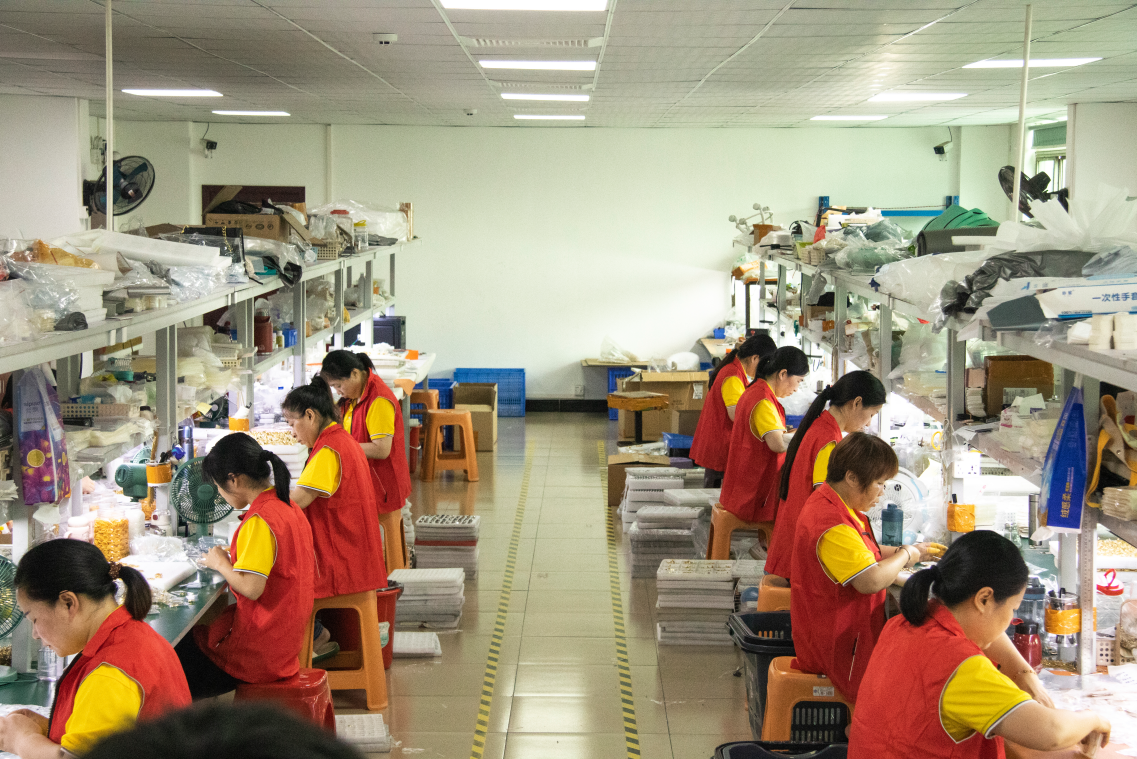
Jewelry accessory assembly and bagging. Every approved sample becomes the physical benchmark for the next production run.
Conclusion: Choose the Base First, Then the Coating
The 304 vs 316 vs 316L decision for gold plated jewelry is a wear-profile decision expressed as a material specification. 304 is the cost-led option for programs with intermittent skin contact. 316 is the mid-tier option for humid and coastal markets and everyday body-contact designs. 316L is the default for waterproof daily-wear collections, engraved bangles and any product where a hypoallergenic claim must be backed by documents — a role reinforced by ASTM F0138-19 describing 316L stainless steel as the standard hypoallergenic substrate for high-quality PVD gold plated jewelry.
Base metal is only half of the specification. The other half is the coating route and its thickness target, the geometry and tolerance standard that makes reorders repeatable, and the compliance file that keeps the listing defensible under REACH, EN 1811, California Proposition 65 and the FTC plating threshold. Buyers who lock all four before sampling spend less on returns and less on re-qualifying material mid-season.
Next Step: Sample or Quotation
Build the specification around model GEN000516bhia-066 — bangle and bracelet formats, engraved bangle styles, a 5 mm to 80 mm dimensional range, 0.5 mm to 3.0 mm thickness, ±0.05 mm tolerance and 316L stainless steel base supply. Jusnova Jewelry Co., Ltd supports ODM/OEM customization with over 500 new styles monthly, and REACH test reports, SGS reports and BSCI certification are available upon request.
Contact: Bessie Zhou | Email: market@powellwholesale.net | Tel / WhatsApp: +86 189 2623 2416 | Chat on WhatsApp
Website: www.jusnovasteel.com | www.jusnovajewelry.com
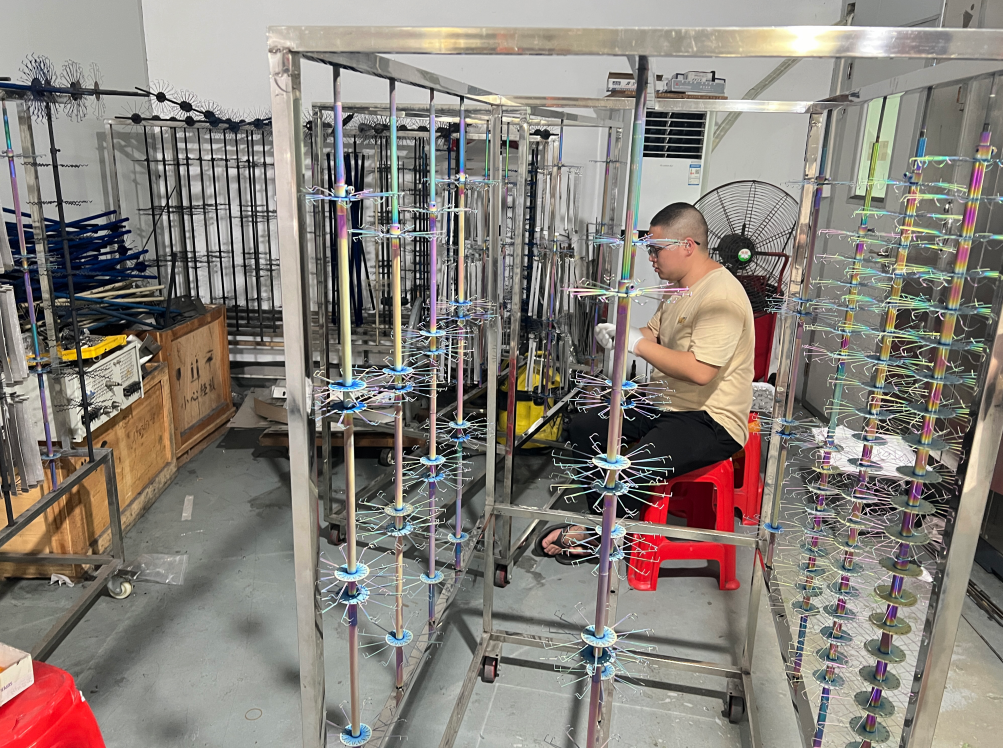
Daily workshop production at Jusnova Jewelry Co., Ltd, Guangzhou.
Third-party figures and standards cited in this guide are attributed to their listed sources (Cognitive Market Research, Business Research Insights, Grand View Research, IBISWorld, Forbes Business, CBI, Digital Commerce 360, Alibaba Group B2B Trends, Google Trends, World Allergy Organization, Market Research Future, HKTDC Research, General Administration of Customs of China, ASTM International, ECHA, OEHHA, FTC, ISO, EN/CEN, Vapor Technologies, SGS, EPA, Intertek, Statista, JVC, Jewellery Manufacturing Journal, Laser Institute of America, IPG Photonics, Trotec, Journal of Applied Physics, Surface and Coatings Technology Journal, Panjiva). Product, capability and certification statements refer to Jusnova Jewelry Co., Ltd as provided.