Gold Plated Jewelry Supplier Evaluation: Verifying 3,000,000-Unit Capacity and Delivery Assurance
A 3,000,000-unit annual output claim only becomes useful to a wholesale buyer when it can be traced back to workforce, floor space, equipment ownership and process steps — and when the supplier can prove the same process chain will repeat on the promised shipment date. This evaluation framework converts headline capacity numbers into verifiable indicators (establishment year, staff count, facility size, annual production, in-house R&D engineers, monthly new-style output, export share) and pairs them with delivery-assurance checks covering NDA and IP protection, US/EU lead- and nickel-free compliance, REACH/SGS/BSCI documentation, ODM/OEM and custom-logo workflows, and product-level specifications such as the GEN000516bhia-066 stainless steel bangle with PVD or electroplated gold finishes.
Jusnova Jewelry Co., Ltd — a Guangzhou-based manufacturer of stainless steel bangles, bracelets, rings and earrings founded in 2009 — is used as the reference case throughout. Its published figures (300 employees, a 1,000 m² facility, 20 in-house engineers, 3,000,000 units per year, 95% export share) are specific enough to be tested one indicator at a time, which is exactly what a buyer between evaluation and execution stage needs.
Why a 3,000,000-Unit Claim Is Not Yet a Capacity Verification
An annual production figure is an aggregate, and aggregates hide the four things buyers actually depend on: which process steps run in-house, how many lines are dedicated to the requested finish, how much of the annual total is already committed to existing accounts, and how the number changes during a peak season. A supplier can therefore quote a real annual output and still fail a new programme, because the number was never a delivery promise.
For a buyer moving from evaluation into execution, unverified capacity typically fails in one of four ways:
- Finish mismatch. The plant can produce the unit volume, but the plating capacity behind a durable PVD coated gold plated jewelry line is the real bottleneck, not the assembly floor.
- Date mismatch. The quoted lead time came from a best-case baseline with no reserved slot behind it.
- Document mismatch. Compliance paperwork exists but is expired, or is scoped to a different product than the one being purchased.
- IP exposure. Custom design files and engraving artwork circulate between factories because no enforceable confidentiality agreement was signed before sampling.
In this framework, capacity verification means reconciling a claimed annual volume against observable inputs — headcount, floor space, equipment and process ownership — and then confirming that the same process chain that produced the approved sample can repeat at volume on the contracted date.
The Gold Plated Jewelry Supply Base in 2026
The global gold plated jewelry market was valued at USD 14.22 billion in 2023 and is projected to reach USD 24.36 billion by 2031, a CAGR of 7.1%, according to Cognitive Market Research and Business Research Insights respectively. Production remains concentrated: Asia-Pacific accounted for over 35% of global output in 2023 according to Grand View Research, and China alone recorded USD 10.3 billion in jewelry export value in the first half of 2023, based on General Administration of Customs of China data.
The technical baseline has also shifted. PVD (physical vapor deposition) coating provides significantly higher durability and wear resistance than traditional electroplating for jewelry, per Vapor Technologies, and 316L stainless steel is the standard hypoallergenic substrate for high-quality PVD gold plated jewelry according to ASTM International. That shift is why the phrase tarnish free gold plated wholesale jewelry now usually refers to a tested coating system rather than a sales adjective: the ISO 9227 salt spray test is the reference method behind most non-tarnish claims.
For evaluators, the practical consequence is that capacity numbers are not comparable across suppliers until process scope is normalised. A plant that outsources plating and a plant that runs vacuum electroplated gold plated ornaments in-house can report the same annual unit figure while offering completely different delivery reliability. Waterproof, hypoallergenic and anti-rust claims follow the same logic — they depend on substrate grade, coating method and finishing discipline, not on catalog copy.

The Seven Capability Indicators Worth Verifying
The indicators below are listed in the order a buyer should use them. Each one should be checked against a document or an observable, never against a sales statement alone.
1. Establishment Year: Operating Continuity, Not Age Marketing
Jusnova Jewelry Co., Ltd was founded in 2009 and operates from Guangzhou, Guangdong. Establishment year matters for a specific reason: tooling libraries, written finish specifications and trained polishing staff accumulate over time, and those are the assets that keep a gold colour consistent across repeat orders. Ask for the business licence, then ask a harder question — which product families were already in production three years ago, and which are new.
Age on its own proves nothing. It should be read together with export share and in-house engineering headcount, because a long-established plant that outsources plating carries different risk from a younger plant that owns the full chain.
2. Workforce: 300 Employees
Jusnova lists 300 employees. In a facility of 1,000 m², that headcount implies a labour-intensive operation with several process stages staffed in-house rather than a trading office relaying orders. Buyers should request a departmental breakdown — mould and casting, trimming, grinding and polishing, plating, assembly, quality control, packaging — and check it against the process steps the supplier claims to control.
A workforce figure is also a delivery indicator. If the department split shows no plating or polishing staff, the finish is being subcontracted, and every subcontracted step adds a handoff that can slip.
3. Facility Size: 1,000 m²
A 1,000 m² footprint is compact for a 3,000,000-unit annual output, which is not a contradiction but a signal to look at density. Buyers can run a simple sanity test: divide the annual output by the floor area and compare the result with other suppliers of a similar product mix. If the implied density looks implausible, ask for per-line or per-shift output rather than arguing about the total.
When visiting or auditing, confirm what share of that 1,000 m² is production floor versus storage and inspection. A small QC area relative to output volume is a warning sign for a line that depends on customer complaints instead of internal inspection.
4. Annual Production Capacity: 3,000,000 Units
This is the number under evaluation, so it deserves the most scrutiny. Reconcile it arithmetically: line count × shifts × daily output × working days. Then request monthly output records for the last six months and the split by product type — stainless steel bangles, bracelets, rings and earrings carry different cycle times and should not be pooled into one figure without explanation.
Ask the sequencing question too. For a PVD gold plated waterproof jewelry programme, plating capacity usually governs the schedule, so the annual unit figure is only meaningful when the supplier states how many units of that total can pass through the coating step per day.
5. In-House R&D: 20 Engineers
Jusnova reports 20 in-house engineers providing style development and surface-finishing process support, including new-custom development. Engineering depth changes the delivery timeline in a way buyers often miss: when a finish drifts or a colour target is missed, an in-house team corrects the process instead of sending the problem to a third party.
For 14K gold plated stainless steel jewelry programmes, ask which engineer signs off a new finish specification, how many sampling rounds are included, and whether surface-finishing adjustments are handled on site. Custom design gold plated fashion jewelry projects live or die on that feedback loop.
6. Monthly New-Style Output: 500+ Styles
Jusnova launches more than 500 new styles per month. For a wholesale buyer building a trendy gold plated bulk wholesale jewelry assortment, that cadence is a genuine sourcing advantage. For a private-label buyer, the useful question is different: how much of that monthly pipeline is production-ready versus concept-stage, and how is a custom slot resourced against it?
Ask to see the last three months of released styles with their production status marked. A pipeline you can audit is worth more than a larger number you cannot.
7. Export Share: 95%
A 95% export ratio, with stated emphasis on Europe and America, tells a buyer that documentation practice is routine rather than exceptional. Gold-plated stainless steel jewelry is classified under HS Code 7117.19 in international trade per the World Customs Organization, and suppliers shipping predominantly to the US and EU are more likely to have the labeling, declaration and test-report habits that destination-market importers require.
Verify this with references rather than assumption: ask for two buyers in your destination market and confirm what documentation accompanied the shipment.
Delivery Assurance: Five Checks Between Approval and Shipment
Capacity answers the question of whether a supplier can produce the volume. Delivery assurance answers whether the order will arrive compliant, on schedule and without exposing your designs. These five checks close that gap.
1. NDA and IP Protection
Jusnova operates under strict NDA agreements and confidentiality policies. For buyers commissioning personalized engraved gold plated jewelry or exclusive moulds, the NDA should be signed before CAD files or artwork are shared, not after a quotation is issued. Three clauses deserve attention: ownership of moulds and engraving files, a restriction on reproducing your design for other buyers, and a defined return or destruction process for tooling if the relationship ends.
2. US and EU Compliance: Lead- and Nickel-Free
Jusnova states that its output is compliant with US/EU standards on lead and nickel content. The regulatory framework behind that claim is specific. REACH Regulation (EC) No 1907/2006 restricts nickel, lead and cadmium in jewelry imported into the EU, per the European Chemicals Agency; EN 1811 nickel release testing is mandatory for any item inserted into pierced parts of the body, per CEN; and California Proposition 65 requires warnings for jewelry containing lead or cadmium above strict thresholds, per OEHHA.
Nickel matters commercially as well as legally: roughly 15% of the global population has a nickel allergy according to the World Allergy Organization, which is why hypoallergenic gold plated women jewelry claims should always be supported by a test report rather than a material description. For the US market, the Federal Trade Commission sets the minimum gold plating thickness for a Gold Electroplated designation at 0.175 microns, so plating claims are measurable, not subjective.
3. The Report Set: SGS and BSCI
Jusnova makes REACH test reports, SGS reports and BSCI certification available on request. The document set includes:
- SGS Artificial Sweat Test, certificate GZMR260602153701, standard ISO 3160-2, issued 2026-06-30 and valid to 2027-06-30, EU market.
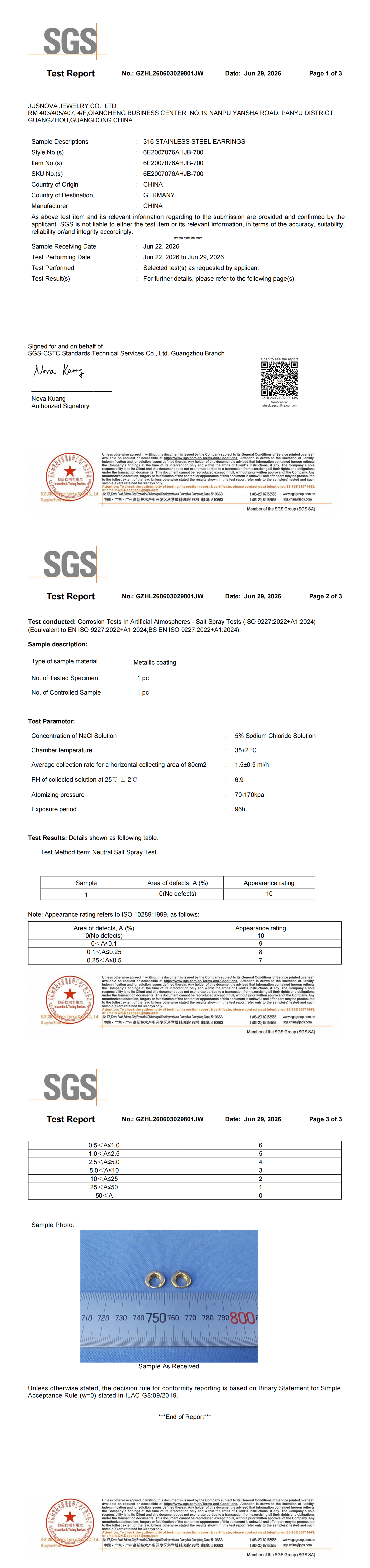
- SGS Salt Spray Test, certificate GZHL260603029801JW, standard ISO 9227, issued 2026-06-29 and valid to 2027-06-29, EU market, linked to product GEN000516bhia-066.
- BSCI Certification, Amfori, certificate 25-0339245, issued 2025-08-15, EU scope.
Read every report on three dimensions: scope, expiry and sample identity. A salt spray report naming your specific product model is stronger evidence than a factory-level certificate, and social compliance audits like BSCI run on renewal cycles, so confirm the current cycle before submitting the document to a retailer's vendor onboarding team.
4. ODM/OEM and Custom-Logo Workflow
Jusnova runs ODM/OEM programmes covering custom logo application, which is where many approvals stall. Custom logo laser engraving in the jewelry industry typically uses fiber laser technology for permanent marking, per the Laser Institute of America; laser engraving depth is usually set between 0.05 mm and 0.2 mm to keep the mark visible without compromising structural integrity, per Trotec; and a 20W fiber laser is sufficient for deep engraving on stainless steel accessories, per IPG Photonics.
Two questions separate a workable non tarnish gold plated custom logo jewelry programme from a risky one. First, is the logo engraved before or after the plating step — the sequence changes how the mark interacts with the gold layer. Second, what position tolerance is guaranteed on a curved bangle surface, since that determines how much of a polished gold plated laser engraving run will pass incoming inspection.
5. Product-Level Specification: GEN000516bhia-066
Jusnova produces GEN000516bhia-066 stainless steel bangles and bracelets with PVD or electroplated gold finishes; the SGS salt spray report above is linked to this model. Specification detail at product level is what turns a supplier evaluation into a purchase order. Buyers should confirm four items: substrate grade (316L is the standard hypoallergenic substrate for high-quality PVD gold plated jewelry per ASTM International), coating method, target thickness, and colour target.
On thickness, industry reference points help calibrate expectations: gold vermeil requires a minimum of 2.5 microns over silver per the Jewelers Vigilance Committee, while PVD on steel usually targets 0.5–1.0 micron for equivalent durability. On colour, 14K gold plating has a lighter, more subtle yellow hue than the deep yellow of 18K or 24K plating, per Intertek — a difference that matters when a buyer orders custom engraved 18K gold plated jewelry for one channel and 14K for another.
Step-by-Step Breakdown: From Claim to Confirmed Order
The sequence below is written for buyers at evaluation stage who intend to place an order within the same sourcing cycle. Each step names the evidence to request and the signal that should stop the process.
- Normalise the capacity claim. Ask for annual output split by product family and by coating method. Fail signal: one aggregate number with no breakdown.
- Reconcile the inputs. Request headcount by department, line count, shift pattern and six months of output records. Fail signal: headcount that cannot be mapped to the process steps claimed.
- Match the facility to the process. Confirm which steps run inside the 1,000 m² and which are subcontracted, with plating treated as the critical one. Fail signal: plating outsourced without a named partner and a stated handoff time.
- Test the engineering response. Send a custom design brief — an engraved logo on a 14K gold plated stainless steel bangle — and measure how many clarifying questions come back and how fast. Fail signal: a price returned before any technical question.
- Audit the document set. Check certificate numbers, standards, issue and expiry dates, and whether each report names your product model. Fail signal: reports valid for a different SKU or outside their validity window.
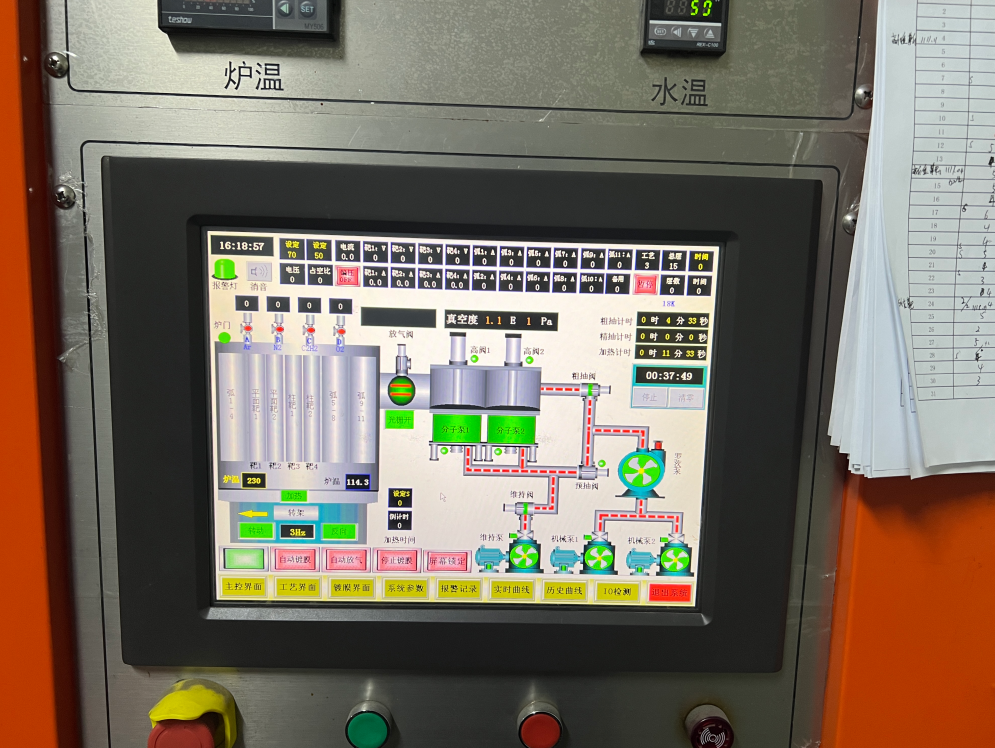
- Run the sample as a production rehearsal. Insist the sample uses the production coating method and the production engraving method, and ask which line ran it. Fail signal: a hand-finished sample that never touched the production line.
- Lock delivery terms. Put the milestone schedule, reserved capacity for your peak window, IP clauses and the reorder window in writing. Fail signal: a delivery date quoted without a capacity reservation.
Use Cases: Where Capacity Verification Changes the Buying Decision
The same seven indicators carry different weight depending on the programme. Four common scenarios show how to prioritise them.
- Reorder-driven wholesale programmes. For wholesale gold plated stainless steel accessories sold through distributors, annual capacity and monthly output records matter more than design cadence — a stock-out on a repeat SKU costs more than a missed trend.
- Private-label launches with engraving. For laser engraved gold plated jewelry and personalized engraved gold plated jewelry, the engraving workflow, position tolerance and NDA clauses outrank raw tonnage, because a design leak or an off-centre logo kills the launch.
- Daily-wear e-commerce ranges. For waterproof hypoallergenic gold plated jewelry and anti-rust gold plated daily wear jewelry, the decisive evidence is the SGS salt spray and artificial sweat reports matched to the specific model, plus substrate grade.
- Trend-led and seasonal assortments. For minimalist gold plated stainless steel jewelry and vintage gold plated non fade jewelry lines, the 500+ monthly style cadence and the 20-engineer team determine how quickly a trend can be converted into a shippable SKU, while 95% export share indicates documentation readiness for EU and US channels.
Comparison Tables
Table 1: Capacity and Delivery Claims Mapped to Verification Evidence
| Claim type | Typical statement | Verification method | Evidence to request |
|---|---|---|---|
| Operating continuity | Founded 2009, Guangzhou | Registry check plus production history | Business licence; product families in production 3 years ago |
| Workforce | 300 employees | Department split against claimed process steps | Headcount by department; payroll-period confirmation |
| Facility | 1,000 m² | Floor-area density test and site audit | Floor plan; production vs storage vs QC allocation |
| Annual capacity | 3,000,000 units | Line × shift × daily output × working days reconciliation | Six months of monthly output by product family |
| Engineering | 20 in-house engineers | Response test on a live custom brief | Named engineering contact; sampling rounds included |
| Design cadence | 500+ new styles monthly | Release records with production status | Three months of released styles with status |
| Export orientation | 95% export, EU/US emphasis | Reference calls in the destination market | Two buyer references; sample shipment documentation |
| Coating durability | PVD or electroplated gold finish | Report review against the specific model | SGS ISO 9227 salt spray report linked to the SKU |
Table 2: PVD Versus Electroplated Gold Finish — What Buyers Are Comparing
| Dimension | PVD (vacuum) coating | Electroplated gold finish | Reference |
|---|---|---|---|
| Wear resistance | Significantly higher durability and wear resistance than traditional electroplating | Lower wear resistance than PVD | Vapor Technologies |
| Typical service life | 3–5 years under daily wear without significant tarnishing | Not specified in the same reference | Surface and Coatings Technology Journal |
| Reference thickness | 0.5–1.0 micron on steel for equivalent durability | Vermeil comparison point: 2.5 microns minimum over silver | Jewelers Vigilance Committee |
| Process environment | Vacuum chambers typically operating at 10⁻³ to 10⁻⁵ mbar | Aqueous plating bath | Journal of Vacuum Science & Technology |
| Environmental profile | Zero hazardous wastewater in the coating step | Wastewater treatment required | EPA |
| Adhesion control | TiN base layer often used to improve adhesion to stainless steel | Depends on pre-treatment and strike layers | Journal of Applied Physics |
| Tarnish evidence | ISO 9227 salt spray test is the common verification route | Same test route applies | ISO |

Frequently Asked Questions
What compliance documents should a gold plated jewelry supplier provide for US and EU orders?
For the EU, the core requirement is REACH Regulation (EC) No 1907/2006, which restricts nickel, lead and cadmium in jewelry, plus EN 1811 nickel release testing for any item inserted into pierced parts of the body. For the US, California Proposition 65 requires warnings where lead or cadmium exceeds strict thresholds, and the Federal Trade Commission sets the minimum gold plating thickness for a Gold Electroplated designation at 0.175 microns. Jusnova Jewelry makes REACH test reports, SGS reports and BSCI certification available on request; the current SGS set includes certificate GZMR260602153701 (ISO 3160-2 artificial sweat, valid to 2027-06-30) and certificate GZHL260603029801JW (ISO 9227 salt spray, valid to 2027-06-29).
How do I verify an OEM 14K gold plated stainless steel jewelry supplier's real capacity?
Reconcile the annual figure against inputs rather than accepting it. At Jusnova Jewelry, 3,000,000 units per year should be read together with 300 employees, a 1,000 m² facility, 20 in-house engineers and 500+ new styles released monthly. Ask for six months of monthly output split by product family and by coating method, then ask how many of those units can pass through the plating step per day, because coating capacity usually governs the schedule on a 14K gold plated stainless steel jewelry programme. Colour is a separate check: 14K plating has a lighter, more subtle yellow hue than the deeper 18K tone per Intertek, so confirm which tone the capacity is actually tooled for.
What drives the unit price of custom gold plated stainless steel jewelry?
Six variables move the price most: substrate grade (316L is the standard hypoallergenic substrate for high-quality PVD gold plated jewelry per ASTM International), coating method (PVD versus electroplating), target coating thickness, engraving complexity, finishing stages, and order volume. Thickness is often misunderstood — PVD on steel usually targets 0.5–1.0 micron for durability equivalent to gold vermeil at 2.5 microns over silver, per the Jewelers Vigilance Committee — so a quote that lists thickness without naming the method is incomplete. A capable supplier should be able to explain which of these variables changed when a quote moves between two configurations.
Can buyers request a sample before committing to a bulk order?
Yes, and the sample should function as a production rehearsal rather than a presentation piece. Ask that it be produced with the production coating method and the production engraving method, and ask which line ran it. For a model such as GEN000516bhia-066 stainless steel bangle with PVD or electroplated gold finish, the sample should be checked against the same evidence used in bulk: substrate grade, coating method, target thickness, colour target, and whether an SGS report under ISO 9227 salt spray covers that product. A hand-finished sample that never touched the production line proves design intent, not delivery capability.
What lead time should be planned for a custom gold plated jewelry order?
Supply-chain data compiled by Panjiva indicates that the average lead time for wholesale custom gold plated stainless steel jewelry orders from China is 15–25 days, but buyers should treat that as a baseline rather than a commitment. Add time for sampling rounds on a new custom design, for engraving artwork approval, for compliance documentation if a retailer requires it, and for peak-season congestion — search interest in tarnish free jewelry has historically peaked in Q4, per Google Trends, which compresses factory calendars. The reliable approach is to ask for a milestone schedule with a reserved capacity slot, not a single delivery date. Buyers who want to start that process can request a sample and a current report pack from Jusnova Jewelry at market@powellwholesale.net or +86 189 2623 2416.
Conclusion: A Decision Rule for Capacity and Delivery Claims
Treat every capacity number as a hypothesis until the inputs reconcile. Establishment year, staff count, facility size, annual output, in-house engineering, monthly style output and export share form a single testable set: when the seven indicators align with each other and with the product-level specification, the annual figure becomes a planning input. When they do not, the number is marketing.
Delivery assurance then closes the loop. NDA and IP protection guard the design file, US/EU lead- and nickel-free compliance guards the import, the SGS and BSCI report set guards the claim, ODM/OEM and custom-logo workflow guards the launch date, and the product specification guards the repeat order. A supplier that can produce a certificate number issued to your exact model, valid on the date you ship, has demonstrated more than a factory tour ever will.
Next Step: Verify With Your Own Specification
Jusnova Jewelry Co., Ltd supplies stainless steel bangles, bracelets, rings and earrings with PVD or electroplated gold finishes to wholesale and brand buyers in Europe, America and other export markets, from a 1,000 m² facility in Panyu District, Guangzhou with 300 staff and 3,000,000 units of annual output.
Request a sample of GEN000516bhia-066, the current SGS and REACH report pack, and a capacity statement written against your own product family and coating method.
Contact: Bessie Zhou · market@powellwholesale.net · Tel / WhatsApp: +86 189 2623 2416 · www.jusnovasteel.com

Have Questions or Need More Details?
Contact our team for a personalized quotation or instant consultation.
Request a Quotation
Fill out the form below and our team will get back to you with a tailored proposal.
WhatsApp Direct Chat
Prefer to chat in real-time? Message us on WhatsApp for instant assistance & quick answers.
- Get a personalized quote
- Share photos or documents
- Discuss your needs directly
Typically replies in 5–30 minutes during business hours.