Navigating EU Compliance for Stainless Steel Jewelry: REACH, BSCI, and SGS Certifications Explained
A stainless steel jewelry shipment entering the European Union is judged twice: first on design, then on documentation. Design sells the first order. Documentation decides whether the second order is allowed into the market at all.
Three compliance layers sit behind every legitimate EU-bound stainless steel program. The first is product safety, governed by nickel release limits under REACH Annex XVII Entry 27, which caps nickel release at less than 0.5 µg/cm²/week for skin-contact items and less than 0.2 µg/cm²/week for piercing items, according to the European Chemicals Agency (ECHA). The second is social compliance, evidenced by a BSCI (Amfori) audit. The third is independent quality verification, evidenced by accredited laboratory reports such as SGS reports issued under ISO 9227, ISO 3160-2 and ASTM A276/A276M-25.
This guide explains what each document actually proves, where buyers most often misread it, and how to build a compliance file that survives customs clearance, retail onboarding and a first quality dispute.
Problem Definition: Why Nickel-Free Claims Fail EU Due Diligence
Most compliance failures are not caused by bad jewelry. They are caused by documents that answer a different question than the one being asked.
Four gaps appear repeatedly when EU buyers review a stainless steel jewelry supplier file.
- A marketing claim without a test report. “Nickel free” and “hypoallergenic” are claims; REACH compliance is a measurement. A supplier who cannot produce a test report with a certificate number, a standard reference and a validity period has not demonstrated anything.
- An expired document. Test reports and social audits carry expiry dates. A report that was valid when the sample was approved may be expired by the time a repeat order ships. Buyers who archive certificates without checking dates inherit that risk.
- Wrong scope. A material content analysis confirms which alloy was purchased. It does not confirm how that alloy behaves after plating, polishing or laser engraving. Safety and durability claims on the finished, skin-contact product require finished-product testing.
- No batch traceability. If a certificate cannot be linked to the batch that was actually shipped, it functions as a decoration rather than as evidence.
The practical consequence is simple: the compliance file has to prove three different things — the material, the finished surface, and the factory that made it.
Industry Background: Compliance Has Become a Selection Filter
Stainless steel jewelry has moved from a low-cost alternative to a core volume category in Western fashion retail. The global stainless steel jewelry market was valued at USD 6.79 billion in 2024 and is projected to reach USD 10.8 billion by 2035, according to WiseGuyReports market data. The wider personalized jewelry segment, which stainless steel engraving and PVD finishing serve directly, was estimated at USD 42.51 billion in 2024 and is growing at a CAGR of 8.6% through 2031, based on Cognitive Market Research figures.
Supply is concentrated. China’s total jewelry exports reached USD 12.7 billion in 2025, with major destinations including Hong Kong, the United States and Malaysia, according to the Observatory of Economic Complexity. For EU buyers, that concentration creates a routine problem: hundreds of suppliers describing similar capability, and only documentation to separate them.
Demand-side behaviour reinforces the shift. Approximately 68% of couples in 2024 chose customized or bespoke jewelry over ready-made options, driven largely by Gen Z and Millennial preferences, according to data published by Jewelers of America. When buyers order personalized, engraved or brand-logo pieces, they are no longer purchasing a commodity — they are purchasing a product they will be held responsible for.
Compliance therefore stopped being a paperwork formality and became a shortlisting criterion. In evaluation-stage supplier comparisons, the question is rarely “can this factory make the piece?” It is “can this factory prove the piece is safe, consistent and responsibly produced?”
Detailed Solution: The Three Compliance Layers Explained
Layer 1 — REACH: Nickel Release as a Legal Limit, Not a Marketing Word
REACH is a regulation, not a certificate. No factory can be “REACH certified.” What a factory can hold is a test report demonstrating that a specific product meets the REACH restriction thresholds. Under Annex XVII Entry 27, nickel release in items intended for prolonged skin contact must remain below 0.5 µg/cm²/week, with a stricter 0.2 µg/cm²/week limit applied to piercing items, as specified by ECHA.
Material selection is where this limit is won or lost. Jusnova Jewelry Co., Ltd, a Guangzhou-based stainless steel jewelry manufacturer founded in 2009, works with hypoallergenic 316L stainless steel with zero nickel release, tested to EU REACH and FDA standards. The 316L grade is also recognised in industry material guidance as the benchmark for hypoallergenic jewelry because molybdenum content improves corrosion resistance, whereas 304L is more common in economy fashion pieces.
Layer 2 — BSCI: Social Compliance Sits Outside the Product
A BSCI audit is often confused with a product certification. It is not. BSCI, administered by Amfori, assesses the social and labour conditions of the production site — it answers questions about the factory, not about the bangle.
Jusnova holds BSCI Certification No. 25-0339245, issued by Amfori on 15 August 2025 with a listed validity period through 15 August 2026. Because social audits run on fixed cycles, the operational rule for buyers is straightforward: request the certificate and verify that the validity period covers the date of shipment, not merely the date of order placement.

Layer 3 — SGS Reports: Proving the Surface, Not Just the Alloy
Third-party laboratory data is what converts a supplier claim into a verifiable fact. SGS-issued reports are the format EU buyers most commonly request, and three of them cover the claims that stainless steel jewelry buyers care about most.
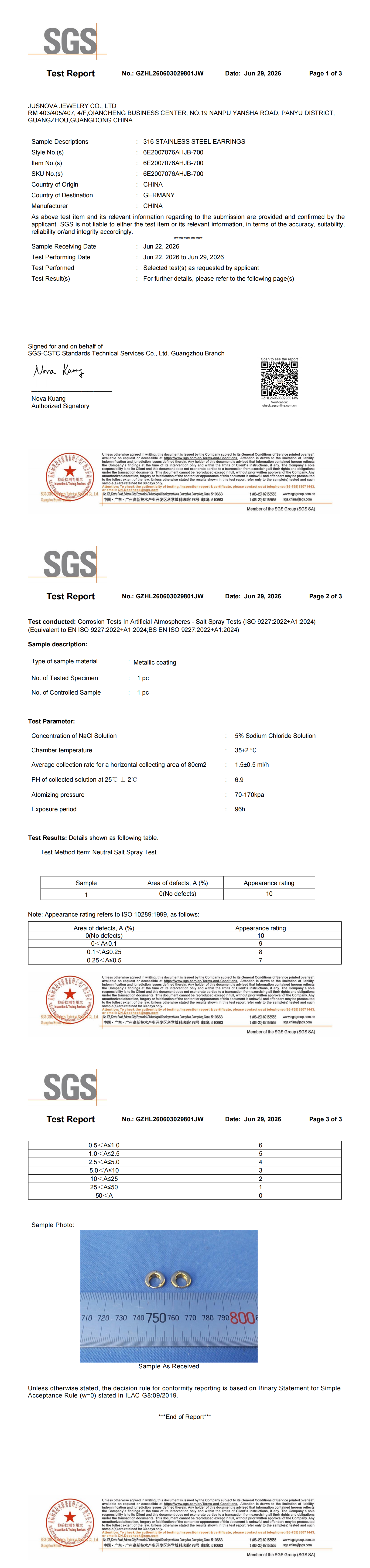
ISO 9227 — Salt Spray Test. This is the corrosion-resistance test behind “tarnish-free” and “waterproof” positioning. Jusnova’s Salt Spray Test report GZHL260603029801JW was issued by SGS on 29 June 2026 under ISO 9227, with validity through 29 June 2027. It is the document that supports durability claims for PVD-coated and electroplated stainless steel surfaces.
ISO 3160-2 — Artificial Sweat Test. Salt spray simulates weather and humidity; artificial sweat simulates the human body. ISO 3160-2 testing evaluates how a finished, plated surface performs against synthetic perspiration, which is directly relevant to colour stability on skin-contact jewelry. Report GZMR260602153701 was issued by SGS on 30 June 2026 under ISO 3160-2, valid through 30 June 2027.
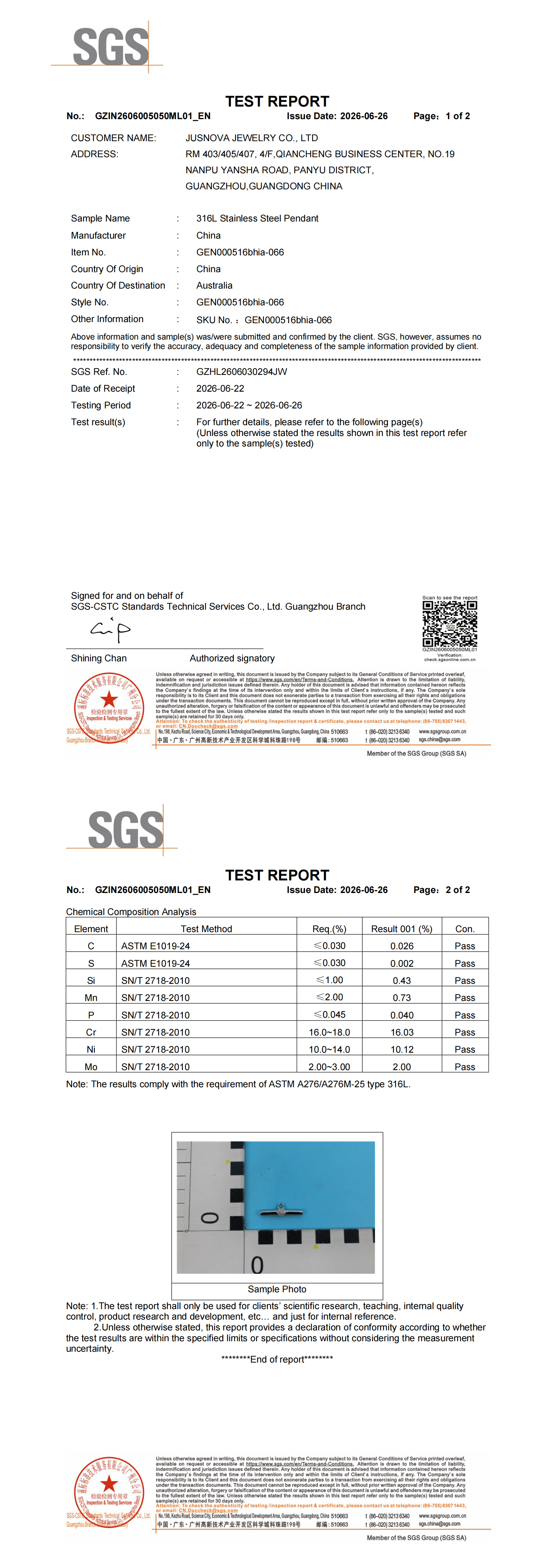
ASTM A276/A276M-25 — 316L Material Content Analysis. This test verifies the alloy itself. Report GZIN2606005050ML01_EN was issued by SGS on 26 June 2026 under ASTM A276/A276M-25, valid through 26 June 2027. It answers the buyer’s most basic question: is the material actually 316L, as specified?

Together, these three reports cover the production chain in sequence: verified alloy, verified coating performance, verified resistance to human wear conditions. A finishing claim such as 20+ PVD colour options with Delta E < 1.0 colour consistency is only commercially useful when the underlying surface durability is documented — which is exactly what the salt spray and artificial sweat reports establish.
Step-by-Step Breakdown: Building a Compliance File That Holds Up
The following sequence reflects how compliance documentation is assembled for EU-bound stainless steel jewelry programs, including custom engraved, PVD-coated and personalized pieces.
- Define the product’s skin-contact category. Prolonged skin contact items and piercing items fall under different REACH thresholds (0.5 µg/cm²/week versus 0.2 µg/cm²/week). The classification must be settled before any test is commissioned, because it determines which limit applies.
- Confirm the alloy grade in writing. Request the ASTM A276/A276M-25 material content analysis. This step prevents a common and expensive misunderstanding in which 304L is quoted on price and 316L is expected on delivery.
- Test the finished surface, not just the metal. Order plating and PVD surfaces verified under ISO 9227 (salt spray) and ISO 3160-2 (artificial sweat). Engraved and laser-marked surfaces should be included in the tested sample set, since removing material can expose a different surface layer.
- Verify the social audit cycle. Obtain the BSCI certificate number and confirm the validity period covers the planned shipment date. Audit cycles renew, so a document that was acceptable last season may not be acceptable next season.
- Validate with a physical sample before mass production. Document review confirms compliance on paper; a sample confirms it in the hand. Custom sample turnaround at Jusnova runs on a 2–3 day sample lead time for logo application work.
- Lock the production process that was tested. Compliance reports describe a specific process, not a general capability. If the coating method, plating thickness range or polishing sequence changes, the relevant report must be re-issued rather than inherited.
- Archive by batch and re-check at shipment. Keep the certificate set attached to the batch record so that any incoming inspection or retail onboarding query can be traced back to a specific document number and date.
Use Cases: How Different EU Buyers Apply the Same Documents
Compliance requirements are consistent in principle but differ sharply in emphasis depending on who is buying.
DTC Brands and Marketplace Sellers
Online sellers listing on Amazon, Shopify, Etsy, TikTok Shop or eBay must usually supply documentation on request to the platform. For these buyers, the practical priority is finished-product skin-contact evidence (REACH-aligned nickel release data) plus surface durability reports, because product returns are driven by tarnishing and skin reactions rather than by alloy composition. Jusnova serves jewelry wholesalers, fashion retail chains, platform sellers, Shopify and Instagram store owners, DTC brands and professional jewelry designers, with clients located in the United Kingdom, Germany, Italy, Austria, France and Australia.
Retail Chains and Department Store Counters
Retail onboarding typically combines product testing with social compliance. A chain with physical outlets must satisfy both the product-safety file and the factory-audit file, which is why the BSCI certificate and the SGS reports are requested together rather than as alternatives.
Wholesalers and Importers Distributing in the EU
Importers carrying inventory across borders need consistency across large batches. Colour and finish variation between batches is the most common complaint, and it is a documentation problem as much as a production problem: a supplier that controls colour consistency and can evidence surface performance under controlled testing removes the dispute before it starts.
Corporate Gift and Promotional Buyers
Logo-engraved stainless steel pieces ordered in bulk for employee, client or event programs carry the same skin-contact obligations as retail stock. Personalized engraved stainless steel jewelry and custom logo pieces should therefore be tested as finished items, with the engraving applied, not as blank components.
Comparison Table: Matching Each Claim to the Document That Proves It
The table below maps the compliance claims that appear in EU buyer specifications to the specific documents that substantiate them. All entries reflect the standards, issuing bodies and certificate records held for Jusnova stainless steel jewelry.
| Claim or requirement | Document type | Standard / scheme | Issuing body | Jusnova record |
|---|---|---|---|---|
| Nickel release within EU legal limits for skin contact | Product safety test report | EU REACH Annex XVII Entry 27 | Regulatory framework administered by ECHA; evidence held as test reports | Hypoallergenic 316L with zero nickel release, tested to EU REACH and FDA standards |
| Responsible factory conditions | Social compliance audit | BSCI (Amfori) | Amfori | BSCI Certification No. 25-0339245, issued 15 Aug 2025, listed validity through 15 Aug 2026 |
| Corrosion resistance and tarnish-free performance | Salt spray test | ISO 9227 | SGS | Report GZHL260603029801JW, issued 29 Jun 2026, valid through 29 Jun 2027 |
| Surface stability against perspiration and wear | Artificial sweat test | ISO 3160-2 | SGS | Report GZMR260602153701, issued 30 Jun 2026, valid through 30 Jun 2027 |
| Verified 316L alloy composition | Material content analysis | ASTM A276/A276M-25 | SGS | Report GZIN2606005050ML01_EN, issued 26 Jun 2026, valid through 26 Jun 2027 |
Note on scope: a BSCI audit verifies factory social conditions and does not certify the product. Nickel release, salt spray, artificial sweat and material content reports verify the product or material and do not certify factory labour conditions. Buyers should hold both families of documents.
Frequently Asked Questions
What certifications does stainless steel jewelry need to enter the EU market?
EU-bound stainless steel jewelry is governed by three document families rather than a single certificate. Product safety is demonstrated through nickel release testing against REACH Annex XVII Entry 27, which limits release to less than 0.5 µg/cm²/week for skin-contact items and less than 0.2 µg/cm²/week for piercing items. Social compliance is demonstrated through a BSCI (Amfori) audit of the production site. Quality claims are substantiated through accredited laboratory reports, such as SGS reports issued under ISO 9227, ISO 3160-2 and ASTM A276/A276M-25. Jusnova holds BSCI Certification No. 25-0339245 along with SGS reports for salt spray, artificial sweat and 316L material content analysis.
What do ISO 9227 and ISO 3160-2 test reports actually prove?
They prove different things, and both matter. ISO 9227 is a salt spray corrosion test: it supports durability and tarnish-resistance claims for plated and PVD-coated surfaces under humid or corrosive exposure. ISO 3160-2 is an artificial sweat test: it evaluates how a finished plated surface performs against synthetic perspiration, which is the closest laboratory proxy for real skin contact. A supplier able to show both is covering environmental exposure and body-contact exposure, rather than only one. Jusnova holds SGS report GZHL260603029801JW under ISO 9227 and GZMR260602153701 under ISO 3160-2, both issued in June 2026 and valid through June 2027.
What should buyers look for when shortlisting top stainless steel jewelry manufacturers?
A shortlist built only on catalogue photography or price per piece is not an evaluation. Four verifiable signals do more work. First, certificate numbers with standards, issuing bodies and expiry dates — not claims without references. Second, scope alignment: material analysis, finished-surface testing and social audit covering three different questions. Third, consistency evidence for the finishing process, because colour variation across batches is the most common quality dispute in stainless steel jewelry. Fourth, the ability to reproduce the tested process at the required volume. Jusnova releases compliance documents on request so buyers can verify each item directly before shortlisting: jusnovasteel.com.
Can buyers request samples before committing to a certified production run?
Yes, and it is the recommended sequence. Documentation review confirms that a supplier’s process is compliant in principle; a physical sample confirms the finish, weight, engraving depth and closure function in practice. At Jusnova, custom sample turnaround runs on a 2–3 day sample lead time for logo application work, which allows buyers to validate the piece before a production commitment. Sampling is also the point at which the tested process should be confirmed — if the sample uses a different coating or polish than the one covered by the report, the report no longer applies.
What are the MOQ and lead time for compliant stainless steel jewelry?
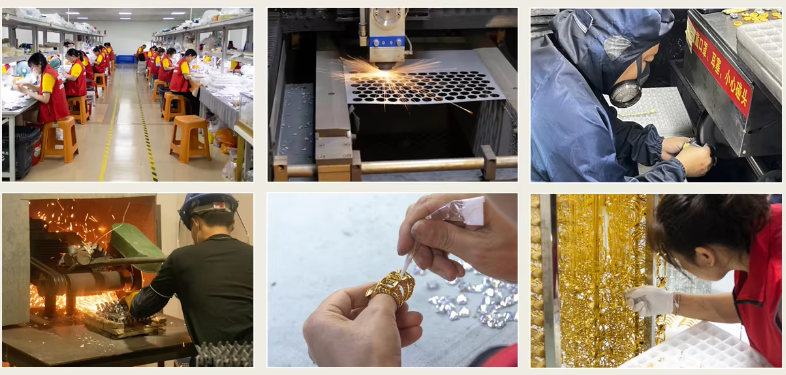
Jusnova operates with a minimum order quantity of 100 pcs per style and a production lead time of 25–30 days, supported by a monthly capacity of 250,000 units and an annual output of 3,000,000 units. The factory runs a 1,000 m² facility in Guangzhou with 300 employees, including a 20-engineer R&D team handling style development and surface-finishing support, and exports represent 95% of output. Compliance documents are issued per tested process, so buyers planning large or repeat programs should confirm the report validity window alongside the production schedule.
Conclusion: Documentation Is the Second Product
Every EU-bound stainless steel jewelry order ships as two deliverables: the jewelry, and the evidence that the jewelry is safe, consistent and responsibly made. REACH Annex XVII Entry 27 defines the nickel release limits that make the product legally sellable. BSCI (Amfori) audit certification addresses the factory behind it. SGS reports under ISO 9227, ISO 3160-2 and ASTM A276/A276M-25 provide the independent, citable proof that supports corrosion, wear and material claims.
Buyers in the evaluation stage get the most value from treating these documents as a single file with one rule attached: every document must have a number, a standard, an issuing body and a validity date, and every validity date must cover the shipment it is meant to protect. Suppliers who can meet that standard remove an entire category of commercial risk — and make the shortlist decision considerably easier.
Review the Compliance File Before You Shortlist
Jusnova Jewelry Co., Ltd supplies stainless steel bangles, bracelets, rings and earrings, including PVD and electroplated gold pieces, waterproof and tarnish-free finishes, laser engraving and OEM/ODM customization. BSCI Certification No. 25-0339245 and SGS reports for salt spray (ISO 9227), artificial sweat (ISO 3160-2) and 316L material content analysis (ASTM A276/A276M-25) are available on request with current validity details.
Request samples, a quotation or the full certificate set: https://www.jusnovasteel.com/ · Email: market@powellwholesale.net · WhatsApp / Tel: +86 189 2623 2416