PVD Coating vs. Gold Plating for Stainless Steel Jewelry: A Buyer's Comparison Guide
A finish is more than a color. For stainless steel jewelry, the finish controls the product's waterproof claim, skin compatibility, color consistency, and long-term appearance. PVD coating and gold plating are common options for gold-tone jewelry, but they are not the same process, and they are not always interchangeable in a wholesale program. This guide compares PVD coating and gold plating for stainless steel jewelry and gives buyers a practical sequence for moving from evaluation to execution.
Jusnova Jewelry Co., Ltd, founded in 2009 and based in Guangzhou, China, is used in this article as a real production example. The company manufactures stainless steel bangles, bracelets, rings, earrings, PVD or electroplated gold pieces, and waterproof, tarnish-free jewelry for global wholesale and brand buyers, mainly in Europe and America.
The Problem: When a Pretty Sample Does Not Predict a Good Finish
Retail buyers often choose a finish by looking at a polished sample under a showroom light. That moment does not reveal whether the color will shift between production batches, whether the surface will fade after weeks of wear, or whether the piece remains suitable for sensitive skin after the finishing process.
The real procurement problem is finish-system misalignment. If the product promise is waterproof and non-tarnish, the supplier needs a finish robust enough to support that claim. If the promise is a classic 18K gold look with engraved personalization, the finish must work with engraving without weakening the product. This is why PVD coating and gold plating should be compared against your retail promise, not only against the look of a sample.
Understanding the difference between PVD and electroplating helps buyers ask the right questions before they commit to a sample or a purchase order.
Industry Context: Stainless Steel Jewelry Is Growing on Long-Lasting Finishes
Stainless steel jewelry is an established category, and market research reflects its expansion. According to WiseGuyReports, the global stainless steel jewelry market was valued at USD 6.79 billion in 2024 and is projected to reach USD 10.8 billion by 2035. Personalized jewelry is also growing; Cognitive Market Research estimates the global personalized jewelry market at USD 42.51 billion in 2024, with a projected CAGR of 8.6% through 2031. Customization signals are visible across the industry, including a 2024 survey in which approximately 68% of couples chose customized or bespoke jewelry over ready-made options.
For wholesale buyers, this points to two outcomes. First, product reviews and returns decide online success, so the finish must keep a piece looking new over time. Second, personalization is no longer optional. Laser engraving, custom logos, and tailored finishes are central to many stainless steel jewelry programs.
PVD Coating vs Gold Plating: What Buyers Need to Know
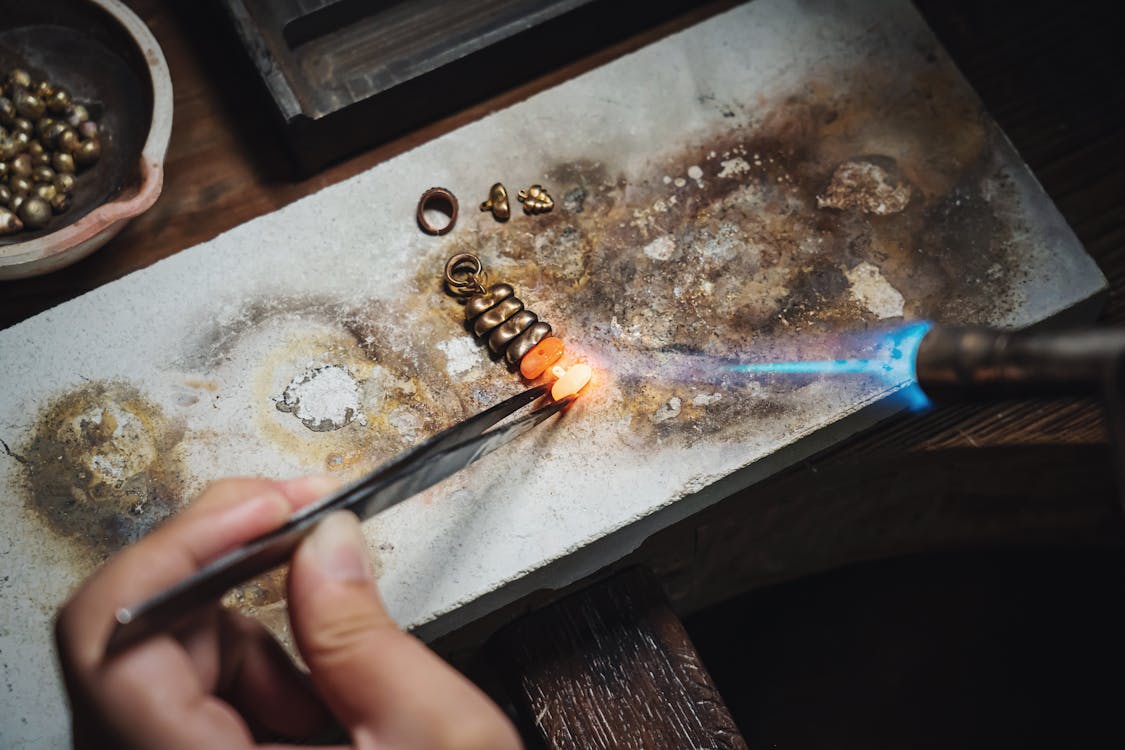
Both finishes can produce gold-toned stainless steel jewelry, but the manufacturing logic is different. PVD, or Physical Vapor Deposition, is a vacuum coating process that deposits a thin film onto the jewelry surface. It can create colors such as yellow gold, rose gold, black, gunmetal, and many other shades. Gold plating usually means electroplating, an electrochemical process that deposits a layer of gold onto the base metal. In wholesale product specifications, this is commonly described as 18K gold plating.
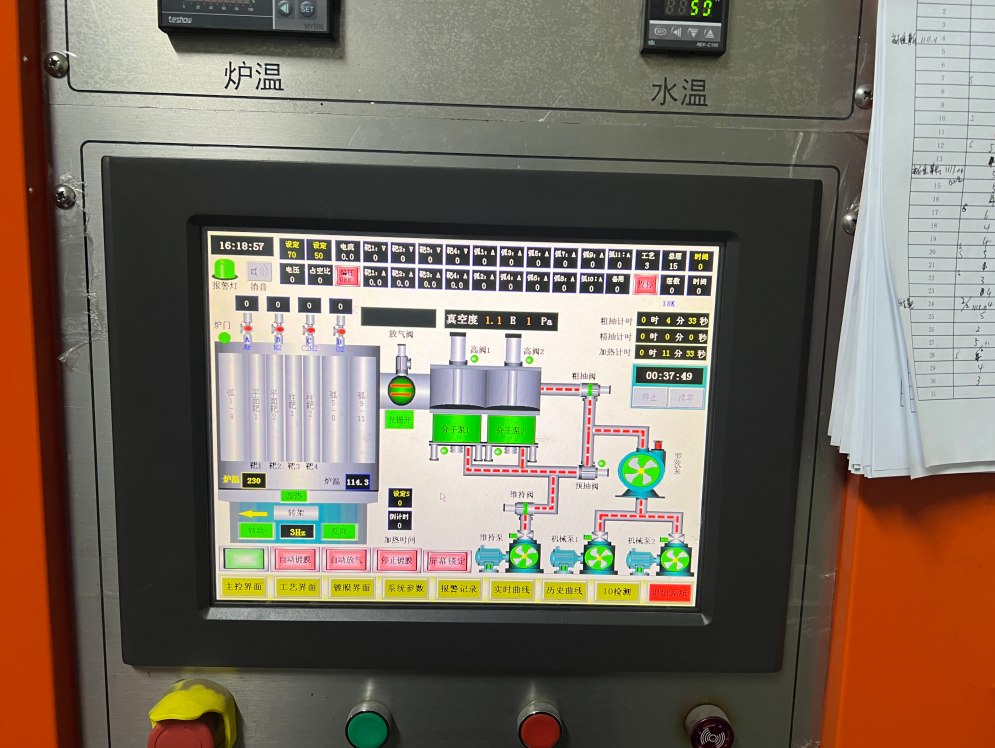
Jusnova Jewelry, as an example, operates both systems in-house. The factory performs precision stamping, casting, CNC engraving, polishing, PVD coating, and electroplating. Its in-house PVD unit has six machines and more than 20 colors. On the plating side, the factory also runs 18K gold electroplating. Controlling both surface systems under one roof makes it easier to manage quality checks, color records, and sample consistency.
Base Material: Start with 316L for Sensitive Skin and Long Service
Whether a piece receives PVD or gold plating, the base material remains the foundation of skin safety. Jusnova offers 304, 316, or 316L stainless steel. For jewelry marketed as hypoallergenic and non-tarnish, 316L surgical steel is widely treated as the industry benchmark because molybdenum improves corrosion resistance.
Jusnova's product line includes 316L stainless steel with PVD coating and stainless steel base with gold plating. For buyers, finish selection should not be separated from material verification. The material can be documented with SGS 316L content analysis, and this evidence is especially useful when a brand wants to make sensitivity claims.
Durability: PVD Coating Carries the Long-Wear Layer
Durability claims must come from the surface system, not from the base alone. In Jusnova's case documentation, the PVD vacuum plating finish maintains stable luster for 2 to 5 years under normal wear without fading or peeling, while the base stainless steel chain can be used for more than 10 years with proper daily maintenance.
Industry technical analysis commonly states that PVD coating on 316L stainless steel is about 10 times more durable than traditional electroplating. That is why PVD is usually associated with waterproof and anti-tarnish product claims. Gold plating can still look attractive and is a standard process in the factory, but wholesale buyers should not automatically place an electroplated finish in the same durability category as PVD.
Color Consistency: Delta E Matters for Repeat Orders
For retail chains, color consistency can decide whether a reorder looks like the original shipment. A useful metric is Delta E, which describes the visual difference between two colors. Lower values mean closer color matching. Jusnova applies a control tolerance of Delta E less than 1.0 for PVD colors across batches. This is a meaningful manufacturing benchmark because color differences below 1.0 are difficult for the human eye to distinguish under normal viewing conditions.
Jusnova's case records state that PVD coating with Delta E less than 1.0 and more than 20 color options solved the problem of maintaining color consistency across large batches for a premium jewelry chain. That matters when a brand sells the same design in multiple gold tones or reorders a bestseller months later.
For a gold-plated program, the supplier should define an equivalent color standard. 18K gold plating is a classic finish specification, but the documented color-range flexibility in this product ecosystem belongs to PVD.
Customization: Finishes Must Work with Logos, Engraving, and Packaging
Customization is a core buying requirement for stainless steel jewelry. In the Jusnova process, customization is treated as daily operation, not as a special exception. Buyers can start with their own CAD, sample, sketch, or idea. Sizes can be adjusted for any ring size, chain length, or bangle diameter. Finishes can be selected from more than 20 PVD colors or 18K gold plating. Stone colors, packaging, logo methods, and branding can also be tailored.
For engraved products, the key is compatibility between the finish and the logo application. Jusnova offers four in-house logo methods: laser engraving, stamping, screen printing, and epoxy doming. Laser engraving is a natural partner for both PVD-coated and gold-plated stainless steel because it creates a permanent mark on the piece. The sample lead time for a custom logo is 2 to 3 days.
Step-by-Step: How to Choose and Qualify a Finish
- Define your product promise. Determine whether customers expect waterproof, tarnish-free, everyday wear or a classic 18K gold look. That choice will point you toward PVD or gold plating.
- Confirm base material and certification. For hypoallergenic programs, select 316L and ask for material test evidence before approving the finish.
- Map your colors and SKU architecture. If your range needs 20 or more coordinated gold tones from rose to rainbow, PVD is the stronger finishing route. If you need one consistent 18K yellow gold tone, gold plating may be sufficient.
- Review process controls. Ask whether PVD and electroplating are performed in-house. Jusnova, for example, uses six in-house PVD machines and documents PVD color consistency at Delta E less than 1.0.
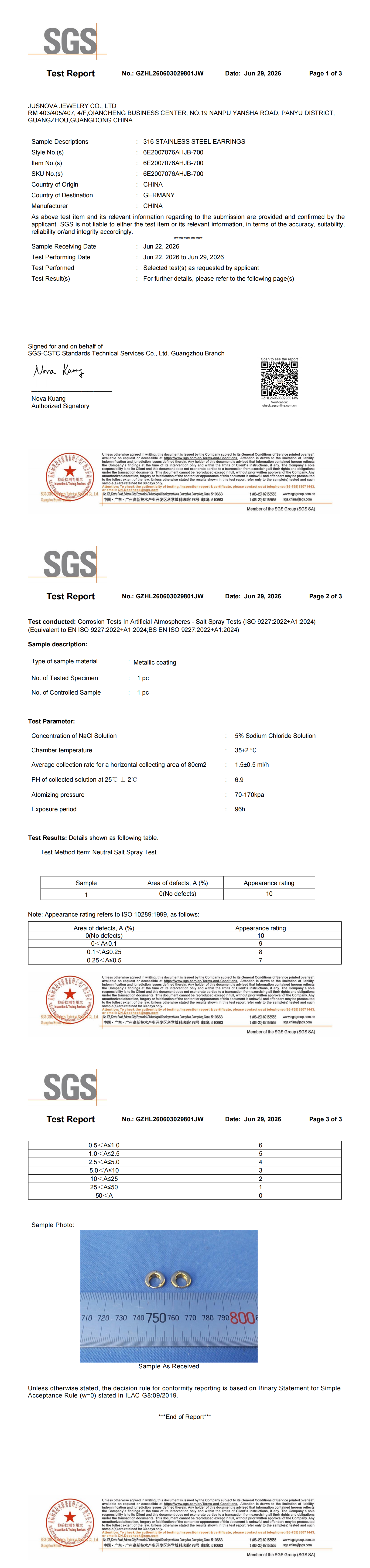
- Request independent test reports. Relevant examples include SGS salt spray testing per ISO 9227, SGS artificial sweat testing per ISO 3160-2, and material content analysis. These reports provide evidence for tarnish resistance and skin-safety claims.
- Test personalization on the actual finish. Choose a supplier that can laser engrave, stamp, screen print, or epoxy dome after the finish is applied.
- Approve a physical sample before mass production. Jusnova's production acceptance is based on contract specifications and a mutually approved sample. The minimum order is 100 pieces per style, normal lead time is 25 to 30 days, and monthly production capacity is 250,000 units.

Use Cases: When the Finish Decision Changes the Business
Case 1: A Central European jewelry partner operating 50 retail outlets achieved a 300% increase in repeat purchase rate within two years after shifting to stainless steel collections. In the case record, the key competitive advantage was Jusnova's ability to maintain color consistency across large batches. This illustrates how PVD color control supports customer retention in multistore retail.
Case 2: Jusnova's stainless steel products have been adopted by jewelry wholesalers, fashion retail chains, platform sellers, Shopify and Instagram store owners, DTC brands, and professional jewelry designers across the United Kingdom, Germany, Italy, Austria, France, and Australia. For those buyers, finish selection is not just a factory question. It directly affects product descriptions, return rates, and the ability to sell the same style through multiple channels.
Comparison Table: PVD Coating vs Gold Plating on Stainless Steel
| Comparison point | PVD coating | Gold plating (18K electroplating) |
|---|---|---|
| Finish process | PVD (Physical Vapor Deposition) thin-film coating applied under vacuum | 18K gold electroplating applied to a stainless steel base |
| Base material options | 304 / 316 / 316L stainless steel; 316L is common for hypoallergenic product lines | Same stainless steel base options |
| Color offering | More than 20 PVD colors, including gold, rose gold, black, and gunmetal | 18K gold plating |
| Color control evidence | Delta E less than 1.0 across batches, supported by an in-house PVD unit with 6 machines | No equivalent Delta E tolerance published in the available product file |
| Durability evidence | PVD finish maintains stable luster for 2 to 5 years under normal wear without fading or peeling; industry analysis often describes PVD as about 10x more durable than traditional electroplating | No separate luster-retention claim is documented in the available product file |
| Personalization fit | Can be combined with laser engraving, stamping, screen printing, and epoxy doming | Can be combined with the same custom logo methods |
| Typical sourcing conditions | MOQ 100 pieces per style; lead time 25 to 30 days; monthly capacity 250,000 units | Same OEM and ODM conditions from the same manufacturer |
FAQ
OEM laser engraved custom jewelry manufacturer: what should you look for?
A reliable OEM laser engraved custom jewelry manufacturer should combine metal production, surface finishing, and engraving in one controlled process. Jusnova Jewelry provides OEM and ODM services with precision stamping, casting, CNC engraving, polishing, PVD coating, and 18K gold electroplating. Custom logo application methods include laser engraving, stamping, screen printing, and epoxy doming. Quality control covers eight stages from raw material inspection to clasp and closure function. The minimum order is 100 pieces per style, and the normal production lead time is 25 to 30 days. Ask the supplier to produce a physical sample with the selected PVD or gold-plated finish together with your laser engraving before mass production.
Conclusion
Finish choice should be based on product promise, target customer, and order lifecycle, not only on sample shine. PVD coating is the more robust route for brands that need multicolor consistency, waterproof and tarnish-free claims, and long-wear retail performance. Gold plating remains a legitimate 18K gold option, but it should be specified with realistic wear expectations and verified through physical sampling.
For brands moving from evaluation to execution, the most practical next step is a sample that combines your base material, finish, and logo in one piece.

If you are comparing PVD coating and gold plating for a new stainless steel jewelry line, contact Jusnova Jewelry Co., Ltd to request a sample and discuss PVD colors, 18K gold plating, laser engraving, or custom OEM and ODM development.