
Partnering for the Long-Term: Consistent Custom Stainless Steel Jewelry Supply

Consistent supply of custom stainless steel jewelry is not a promise a factory makes. It is a structure a buyer builds — and it rests on three decisions taken before the first purchase order: a style-level MOQ that matches your real reorder speed, a production calendar that reserves capacity instead of competing for it, and delivery terms that place customs responsibility where it belongs.
Jusnova Jewelry Co., Ltd. is an OEM/ODM stainless steel jewelry manufacturer established in 2009 and based in Guangzhou, China. Custom programmes run on a 100 pcs/style minimum order quantity, with DDP or CIF delivery terms available. One distributor relationship has operated on that structure for seven years, at monthly order values above USD 150,000. This guide sets out how the structure is assembled, where it usually breaks, and how to plan orders so it holds.
Why 'consistent' is a harder promise in jewelry than in most categories
Consistency in custom stainless steel jewelry means four separate things, and a supplier can be strong on one while failing another: the same style can be reordered at all; the finish matches the previous lot; the production slot exists when you need it; and the landed cost is knowable before the shipment leaves.
A jewelry style is not a stock item. It is a mold, a finishing recipe, a stone-setting pattern, a laser-engraving file and a packing specification that all have to repeat identically. Re-qualifying a style with a new supplier means new samples, new confirmation drawings, new finish approvals and a new acceptance conversation — cost that normally exceeds whatever is saved on the first order's unit price.
That is the commercial argument for treating supply as a partnership rather than a sequence of transactions. It is also why the MOQ line item, not the unit price, is the number that decides whether a programme survives its second year.
The market context behind longer supply commitments
Three data points explain why buyers in this segment are extending contract horizons instead of shopping each season.
- The global stainless steel jewelry market was valued at USD 7.08 billion in 2025 and is projected to reach USD 10.8 billion by 2035, a CAGR of 4.3% (WiseGuyReports, 2026).
- The waterproof jewelry segment — the PVD-coated, non-tarnish subset that stainless steel anchors — is projected to grow from USD 2.12 billion in 2026 to USD 4.60 billion by 2034, a CAGR of 10.16% (Verified Market Reports, 2026). Wear-anywhere pieces are expanding faster than the category overall.
- Industry coating data place PVD at roughly 1,500–4,500 HV against 100–200 HV for standard plating — an order-of-magnitude difference in surface hardness that determines whether a finish survives daily wear.
The implication for a buyer is narrow and practical. The fastest-growing part of the market depends on a specific finishing capability, and that capability is not interchangeable between suppliers. Once you have qualified a PVD line against your own colour standard and your own salt-spray expectations, replacing it is expensive. Long-term order planning is how that qualified asset gets protected.
How a 100 pcs/style MOQ actually works
A 100 pcs/style minimum means the unit of commitment is the style, not the purchase order. That single distinction decides how you build an assortment, how fast you can react to sell-through, and how much dead stock you carry into the next season.
Style-level granularity is what makes a rolling assortment possible
At 100 pcs per style, a buyer can commit to 20–30 styles in a season instead of betting the season on four or five deep SKUs. That breadth matters in a category where a single engraved bangle or rope chain can move from trend to baseline in two quarters. Deeper minimums force the opposite behaviour: fewer styles, more depth per style, and a slower response when a style underperforms.
Jusnova Jewelry's own R&D team of 20 engineers supports style development and surface-finishing process support, and the company launches 500+ new styles per month. A low style-level MOQ is what makes that style flow usable — there is no point in a broad design library if each design requires a production-scale commitment to sample it.
Turning an assortment plan into committed units
| Assortment block | Styles | MOQ per style | Units committed | Planning intent |
|---|---|---|---|---|
| Permanent core line | 12 | 100 pcs | 1,200 pcs | Repeatable reorders, stable engraving files |
| Seasonal drop | 8 | 100 pcs | 800 pcs | Two drops per year, refreshed styling |
| Test styles | 5 | 100 pcs | 500 pcs | Market validation before depth commitment |
| Total per cycle | 25 | 100 pcs | 2,500 pcs | Breadth first, depth on proven styles |
Illustrative arithmetic based on the 100 pcs/style minimum. Actual quantities depend on your assortment plan, sell-through targets and packaging specification.
Finish repeatability — the real content of 'same as last time'
Repeatability is where a long-term relationship is either real or theoretical. Jusnova Jewelry operates an in-house PVD facility with 6 machines and 20+ colour options, and controls colour matching to a Delta E below 1.0 across batches. In conventional environments the PVD coating holds its lustre for 2–5 years, verified by 48-hour salt-spray testing.
Underneath the finish sits the base metal. The product line is built on 304 / 316 / 316L stainless steel, with 316L surgical-grade steel delivering zero nickel release tested to EU REACH and FDA standards — the specification that makes the phrase 'hypoallergenic stainless steel jewelry' a claim rather than an adjective. Dimensional control runs to a diameter range of 5 mm to 80 mm, thickness of 0.5 mm to 3.0 mm, and a tolerance held within ±0.05 mm.
Customisation sits on top of that: laser engraving, stamping, screen printing and epoxy doming for custom logos, with a 2–3 day sample lead time. Because the same house controls the alloy, the PVD chamber and the engraving file, 'reorder identical' is a process instruction rather than a negotiation.
Building the partnership: a seven-step order plan
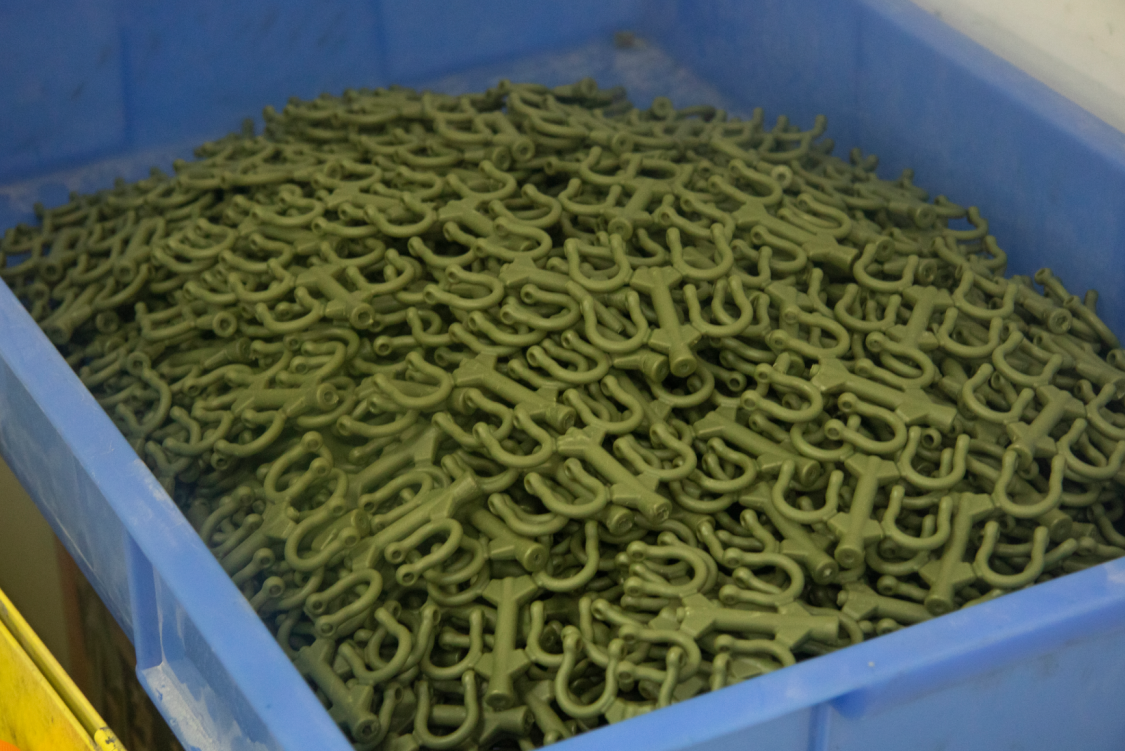
Step 1 — Segment the assortment before you discuss MOQ
Split your range into permanent core, seasonal drops and test styles. Only the core line deserves repeat-order status and locked engraving files; test styles should stay at the minimum. Buyers who present a segmented plan get a more useful capacity answer than buyers who present a single large number.
Step 2 — Convert the style plan into committed units
Multiply styles by 100 pcs and check the result against your realistic sell-through window. If a block will not clear within one replenishment cycle, the block is too deep, not too narrow.
Step 3 — Run sampling and confirmation drawings properly
Samples exist to close specification gaps, not to delay decisions. Use the 2–3 day sample lead time to validate colour, engraving depth, font, plating tone and clasp behaviour, then sign off confirmation drawings that lock dimensions and engraving placement. A signed drawing is the document that makes year-three reorders possible without renegotiation.
Step 4 — Reserve capacity instead of requesting it
Jusnova Jewelry operates a 1,000 m² manufacturing facility with approximately 300 staff and an annual production capacity of 3,000,000 units. Capacity exists — but it is allocated, not infinite. A standing monthly slot agreed at the start of a programme is worth more than a faster promise made in a peak month.
Step 5 — Fix the finish specification in writing
Record alloy, coating type, colour reference, tolerance and salt-spray expectation in the purchase specification. This is the paragraph that prevents a lot two shades off from becoming a commercial argument.
Step 6 — Choose the delivery term that matches your customs capability
DDP or CIF, decided once and applied consistently. The next section covers how to pick.
Step 7 — Set reorder triggers and review quarterly
Define the stock level that triggers a reorder, and review assortment rotation, engraving-file reuse and packaging consumption each quarter. The review is what converts a good first order into a supply relationship.
DDP or CIF: where the friction actually sits
Shipping terms are the least glamorous part of a supply agreement and the most common source of month-two surprises. Both DDP and CIF move the goods and both are available on custom orders; they differ on who acts as importer and who absorbs the uncertainty.
| Responsibility | DDP (Delivered Duty Paid) | CIF (Cost, Insurance and Freight) |
|---|---|---|
| Export clearance | Seller | Seller |
| Main carriage and insurance | Seller | Seller |
| Import clearance | Seller | Buyer |
| Duty and import taxes | Seller | Buyer |
| Risk transfer point | At destination delivery | When goods are loaded at origin port |
| Best suited to | First orders, new markets, buyers without a customs broker | Buyers with their own broker and duty arrangements |
Under CIF the buyer remains importer of record, so duty lands on the buyer's cost sheet. For US-bound base-metal imitation jewelry classified under HTS 7117.19.90.00, the reported effective duty rate from China was 31% in 2026, combining General Duty at 11% and Section 301 at a cumulative 20% (Descartes Datamyne). That number belongs in the CIF landed-cost model, not in the invoice surprise column.
With roughly 95% of Jusnova Jewelry's output exported, with emphasis on Europe and America, both terms are routine rather than exceptional. The right choice is the one that matches your in-house customs competence — and it should stay the same across orders, because switching terms mid-programme re-opens the landed-cost question every cycle.

Three buyer profiles that run on this model
| Buyer type | Typical order shape | What the MOQ structure solves |
|---|---|---|
| DTC brand scaling a signature line | 12–20 styles per drop at 100 pcs each, repeating bestsellers monthly | Keeps breadth without over-committing cash, while protecting engraving files for repeat runs |
| Wholesale distributor or multi-door retailer | Broad assortment per season, replenished on a fixed monthly cadence | Allows a full catalogue without deep single-style bets; supports standing capacity reservation |
| Marketplace and cross-border seller | Frequent, smaller reorders tied to listing performance | Fast restock on proven listings; DDP removes customs handling from the reseller's workload |
Packaging is part of the same plan, not an afterthought. OPP bags, velvet pouches, premium gift boxes and fully custom designs with your logo and branding are all available, so packaging can be scheduled alongside production rather than ordered separately at the last minute.
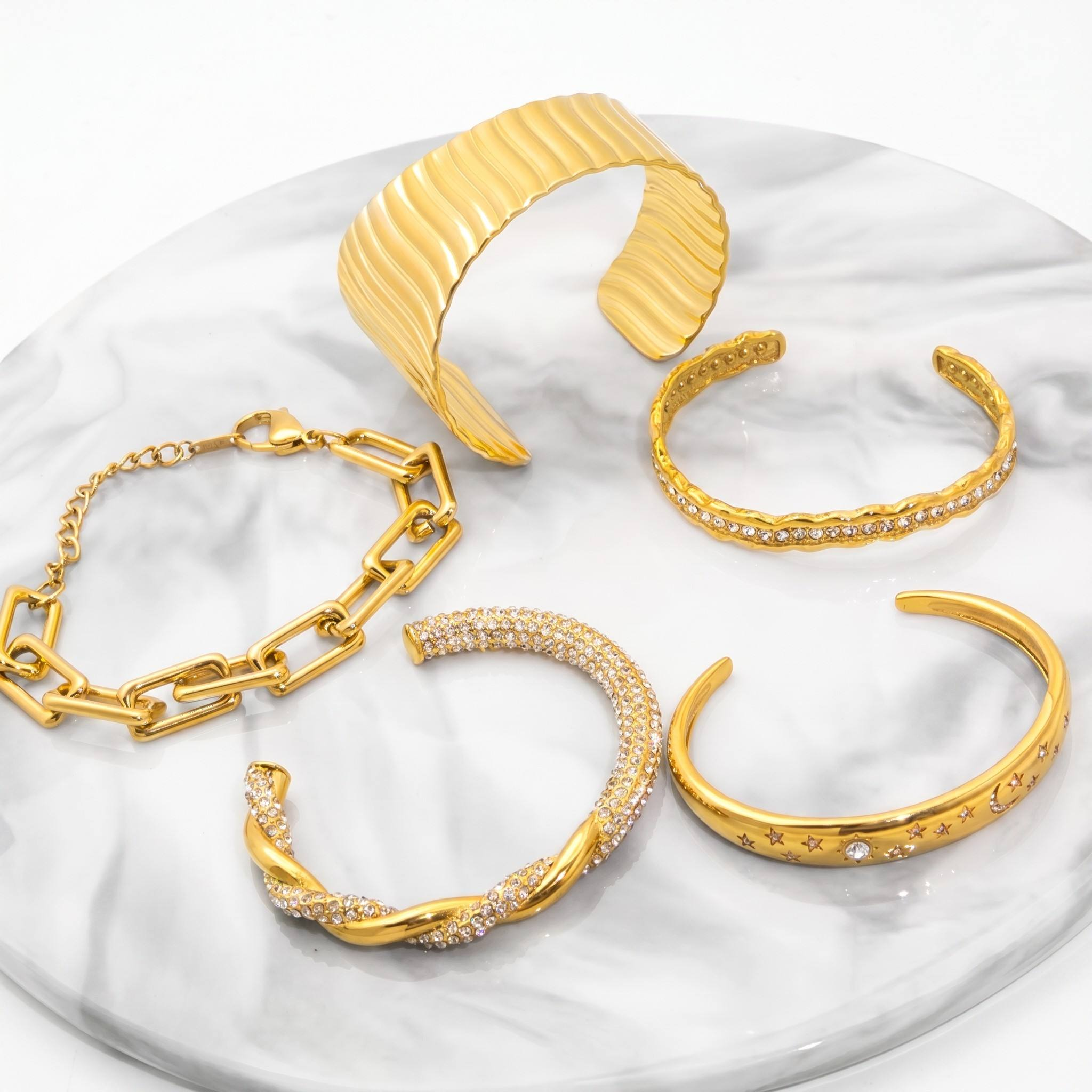
What seven years at USD 150,000 a month looks like
A distributor partnership that has run for seven years at monthly order values above USD 150,000 is not explained by price. It is explained by four routines that a 100 pcs/style structure makes possible.
The first is rotation without reset. Because a style can be tested at 100 pieces, the buyer keeps introducing new designs while the core line keeps running on unchanged specifications. With 500+ new styles released monthly by the manufacturer's R&D team, the buyer has a continuous supply of test candidates and no reason to disturb the permanent line.
The second is a fixed monthly cadence. A predictable order rhythm lets capacity be reserved rather than requested. Against an annual capacity of 3,000,000 units, a monthly programme becomes a planning input instead of a negotiation.
The third is finish continuity. Colour matching to Delta E below 1.0 across batches means a customer who bought a rose-gold vacuum electroplated piece two years ago can buy its replacement today without a visible mismatch — the practical definition of non-tarnish, non-fade supply at scale.
The fourth is commercial friction removed at the border. Consistent DDP or CIF terms mean the buyer's landed cost is a calculation, not a discovery, which is what makes a seven-year margin model hold together.
Frequently asked questions
Do custom stainless steel jewelry orders meet EU compliance requirements?
Jusnova Jewelry manufactures from 316L surgical-grade stainless steel with zero nickel release, tested to EU REACH and FDA standards, and provides REACH test reports, SGS and BSCI certification upon request. Buyers shipping into the EU should confirm the exact test scope needed for their product category and destination before the first bulk order.
Can a supplier handle a 100 pcs/style minimum across many styles and custom logo options?
Yes — the 100 pcs/style minimum applies per style, so breadth is limited by your assortment plan rather than by production scale. Jusnova Jewelry supports four in-house logo methods (laser engraving, stamping, screen printing and epoxy doming), operates a 1,000 m² facility with approximately 300 staff, and holds an annual production capacity of 3,000,000 units.
How do DDP and CIF terms change the landed cost of a repeat order?
Under DDP the seller clears import and pays duty, so the invoice is close to the landed cost. Under CIF the buyer remains importer of record and absorbs duty separately; for US-bound base-metal imitation jewelry under HTS 7117.19.90.00, the reported effective duty rate from China was 31% in 2026 (11% General Duty plus a cumulative 20% under Section 301). Model the duty line explicitly before choosing CIF.
What does the sampling stage cover, and how long does it take?
Sampling validates colour, engraving depth and font, plating tone and clasp behaviour before bulk production, and Jusnova Jewelry runs a 2–3 day sample lead time. Approved confirmation drawings follow the sample, locking dimensions, engraving placement and finish reference so that later reorders can be produced against a fixed document.
How should replenishment be timed so a monthly programme never runs dry?
Set a reorder trigger at the stock level your production lead time and shipping transit together require, reserve a standing monthly capacity slot, and keep the permanent core line on fixed specifications so reorders skip re-approval. Jusnova Jewelry's 3,000,000-unit annual capacity and 95% export share, with emphasis on Europe and America, make parallel monthly programmes routine — the planning discipline on the buyer side is what keeps them predictable.
The next step is a specification, not a price list
A long-term supply partnership in custom stainless steel jewelry begins with three documents: a segmented assortment plan, a signed finish and dimension specification, and an agreed delivery term. Everything else — the 100 pcs/style MOQ, the 2–3 day sample turnaround, the monthly capacity slot — is operational detail once those three exist.
Jusnova Jewelry works with wholesale and brand buyers on exactly that sequence, from first sample through to a standing monthly programme. The starting point is a short conversation about your assortment, your finish references and your target markets.
Send your style references, finish requirements and target quantities, and Jusnova Jewelry will respond with a sampling plan, a 100 pcs/style order structure and DDP or CIF terms for your market.
Email: market@powellwholesale.net | Tel / WhatsApp: +86 189 2623 2416 | www.jusnovasteel.com
Have Questions or Need More Details?
Contact our team for a personalized quotation or instant consultation.
Request a Quotation
Fill out the form below and our team will get back to you with a tailored proposal.
WhatsApp Direct Chat
Prefer to chat in real-time? Message us on WhatsApp for instant assistance & quick answers.
- Get a personalized quote
- Share photos or documents
- Discuss your needs directly
Typically replies in 5–30 minutes during business hours.