
Prong vs Bezel Settings in Gold Plated Stainless Steel Jewelry: Which to Choose?
A prong setting holds a stone with thin metal claws, leaving most of the stone exposed. A bezel setting wraps a continuous metal rim around the stone and holds it on every side. On gold plated stainless steel jewelry, prong settings are chosen when sparkle and a classic, bridal look drive the sale, while bezel settings are chosen when stone security, smooth edges and a clean modern line matter more. For wholesale and brand buyers, the choice also changes snag risk, metal coverage, engraving space, inspection steps and which sales channel the SKU fits.
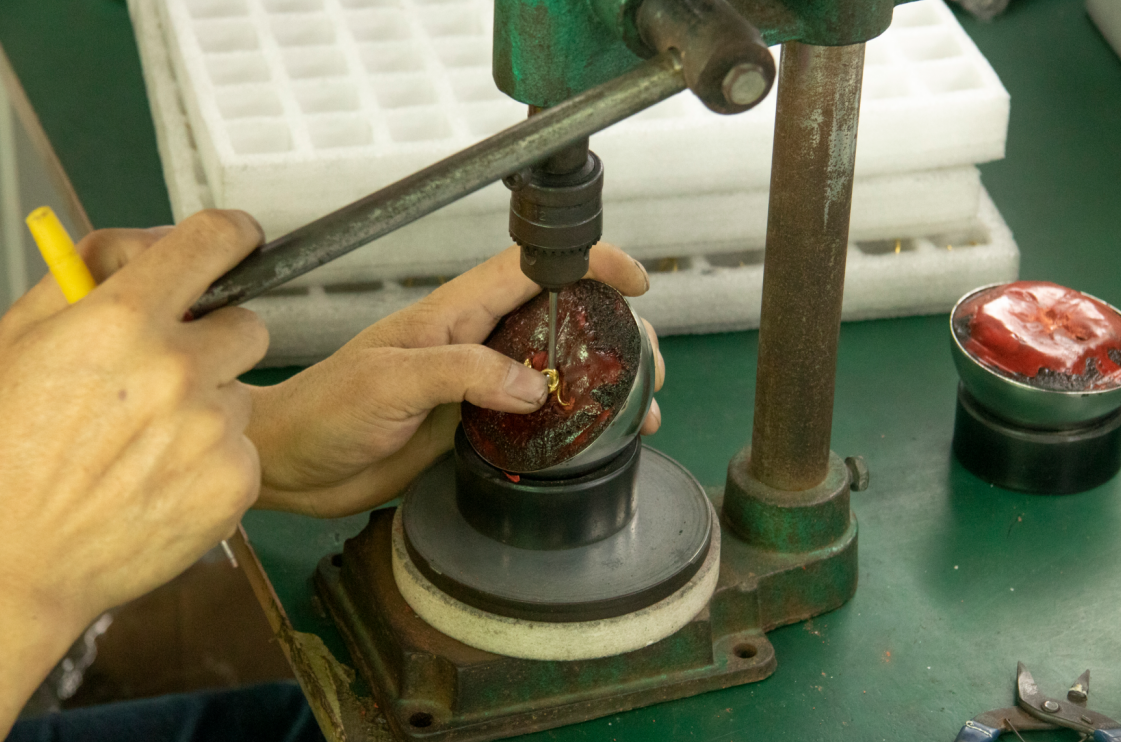 Prong setting is a securing function before it is a style: every claw must seat the stone without covering its face. Image: Jusnova Jewelry production documentation.
What the Prong-vs-Bezel Decision Actually Decides
Most setting choices are made from a product photo, and that is where the cost of a wrong choice begins. Two stone-set rings can look identical on a white background and behave very differently after three months of daily wear: one loses a stone on a cardigan sleeve, the other traps soap behind a rim. For a brand, both outcomes return as complaints rather than as design feedback.
Five questions decide the setting for most programs:
- How exposed is the stone to knocks, fabric and gym equipment?
- How much metal should sit around the stone, and what does that do to the weight of the piece?
- Is there a flat, clean surface left for a custom logo or personalized engraving?
- Does the construction match the channel: boutique display, e-commerce photography, or corporate gifting?
- Can the factory repeat the same setting, to the same tolerance, across a bulk order?
Answer those five and the prong-versus-bezel question usually answers itself. Stone type and plating route rarely decide it; wear behaviour and channel usually do.
Industry Background: Why the Setting Carries More Weight on Stainless Steel
The global gold plated jewelry market was valued at USD 14.22 billion in 2023, and Business Research Insights projects USD 24.36 billion by 2031 at a 7.1% compound annual growth rate. A category growing at that pace attracts more suppliers, and stone setting is one of the few visible ways to separate an engineered program from a photo-driven one.
The material system behind these pieces is now well documented. PVD coating provides significantly higher durability and wear resistance than traditional electroplating, and 316L stainless steel is the standard hypoallergenic substrate for high-quality PVD gold plated jewelry (Vapor Technologies; ASTM International). Stainless steel also sits at Mohs 5.5 to 6, against 2.5 to 3 for sterling silver (GIA), which is part of why a stone-set stainless structure survives daily wear so well.
Durability claims have technical definitions too. 'Tarnish-free' in stainless steel jewelry typically refers to the stability of the PVD gold coating against sweat and water, and it is supported with ISO 9227 salt spray testing. PVD coated jewelry can last three to five years without significant tarnishing under daily wear conditions (Surface and Coatings Technology Journal). Hypoallergenic positioning has a commercial reason as well: roughly 15% of the global population has a nickel allergy (World Allergy Organization).
None of this chooses between prong and bezel. It sets the standard the setting has to meet. The coating protects the metal; the setting protects the stone. A buyer who optimizes one and ignores the other still ends up handling returns.
How Both Settings Are Built on a 304/316/316L Stainless Steel Base
Jusnova Jewelry Co., Ltd is a Guangzhou-based ODM/OEM jewelry manufacturer founded in 2009 that produces stainless steel bangles, bracelets, rings and earrings in PVD and electroplated gold finishes for wholesale and brand buyers, exporting about 95% of its output. Both setting types described here can be specified on the same 304, 316 or 316L stainless steel base, with the same finish route and the same stone families.
Prong setting: maximum stone exposure
Thin claws rise from the setting and bend over the stone's edge. The stone sits above the metal, so light reaches it from every direction and the visible stone area is as large as the design allows. In production documentation this operation is described as a securing function first and a style choice second: each tip must be rounded, aligned and pressed to matching tension before the piece leaves the bench.
What it gives a buyer: the strongest sparkle under retail or studio lighting, a classic or bridal read, and less metal tied up around each stone. What it costs: more exposed edges that can catch knitwear, hair and scarves, a stone that can be released by a single bent claw, and an inspection step on every tip.
Bezel setting: continuous protection
A bezel is a continuous wall of metal pushed over the stone's outer edge, so the stone is held around its full circumference. The outside of the piece stays smooth and the stone cannot lift out of the setting through normal wear.
What it gives a buyer: the highest stone security in daily wear, low snag risk on clothing, and a clean, modern line that suits minimalist collections. What it costs: more metal around each stone, less visible stone side, and a repair that is a factory operation rather than a quick bench adjustment.
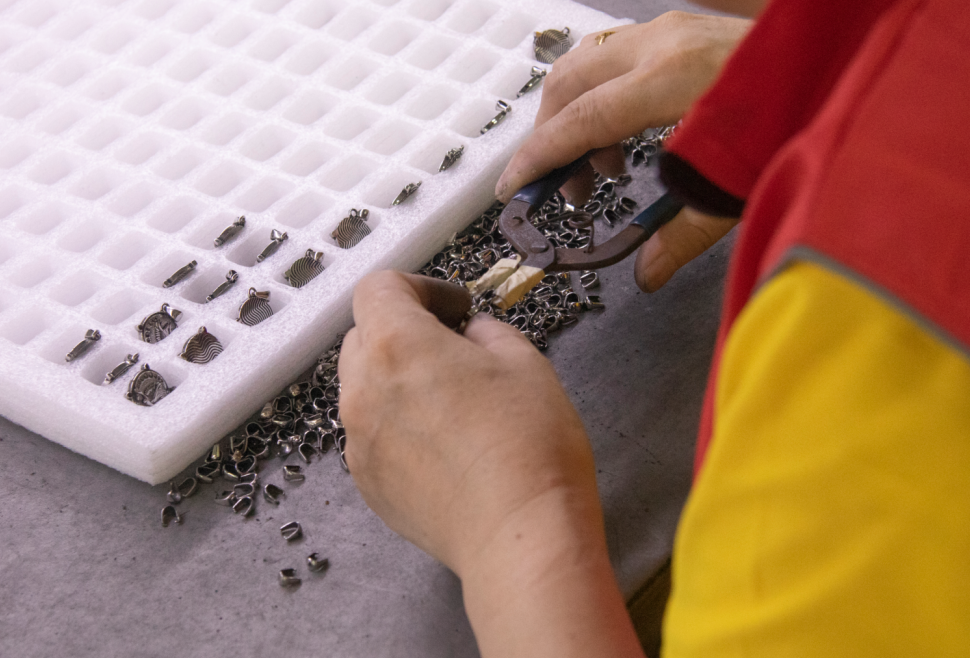 Component assembly is where stone security is either created or lost, regardless of setting type. Image: Jusnova Jewelry workshop.
Where the two settings genuinely differ
- Stone security: a bezel holds the stone on all sides; a prong setting depends on claw tension holding over time.
- Sparkle: prongs expose more stone surface; a bezel shows less stone side but produces a cleaner outline.
- Wear comfort: a bezel stays smooth against skin and fabric; prongs add small raised edges.
- Metal use: a bezel wall consumes more metal around each stone than claw tips do.
- Repair path: prong tips can be tightened or re-tipped; a damaged bezel has to be re-formed.
- Engraving space: bezel rims and flat shanks leave predictable flat areas; open prong baskets do not.
Step-by-Step: Choosing a Setting for a Wholesale Program
Step 1 - Fix the stone before the setting
Decide stone family, size and colour count per SKU first. The setting is engineered around the stone, not the other way round. A palette of more than 20 colours is only useful if the setting holds every colour consistently, and because cubic zirconia, man-made crystal and moissanite are different materials, confirm the seat for each stone type at sampling instead of assuming one seat fits all three.
Step 2 - Match the setting to wear behaviour
Everyday, water-exposed, gym-and-office wear points to bezel. Occasion, bridal and gift-led wear points to prong. Where a single collection must cover both, split the assortment rather than forcing one setting across the entire line.
Step 3 - Plan the engraving before the setting
Custom logo and personalization work need a flat, uninterrupted surface. Bezel rims and flat shanks provide predictable areas; open prong baskets do not. Laser engraving is the standard permanent marking method in the jewelry industry, with typical marking depth set between 0.05 mm and 0.2 mm so the mark stays visible without weakening the structure (Laser Institute of America; Trotec).
 Laser processing supports cutting and marking steps for custom orders. Image: Jusnova Jewelry workshop.
Step 4 - Confirm the finish route and the sequence
PVD and electroplating both work with prong and bezel constructions, and PVD delivers the higher wear resistance of the two. Ask the factory one direct question: at which stage are the stones set relative to polishing and plating? The answer determines how much handling protection the stones and the claws receive before packing.
Step 5 - Check the setting against the sales channel
Boutique and gift retail reward visible sparkle. E-commerce rewards sparkle in photographs and low return rates in equal measure. Corporate gifting rewards a smooth, snag-free surface and a clean engraving area. The same core design can be sold into two channels with two different settings.
Step 6 - Validate the sample against the reports
Ask for certificate numbers and confirm what each one covers. Jusnova holds an SGS Artificial Sweat Test report GZMR260602153701 under ISO 3160-2 (valid to 30 June 2027) and an SGS Salt Spray Test report GZHL260603029801JW under ISO 9227 (valid to 29 June 2027), and states that REACH test reports are available on request. For earrings, confirm nickel release testing under EN 1811, which is mandatory for any item inserted into pierced parts of the body.
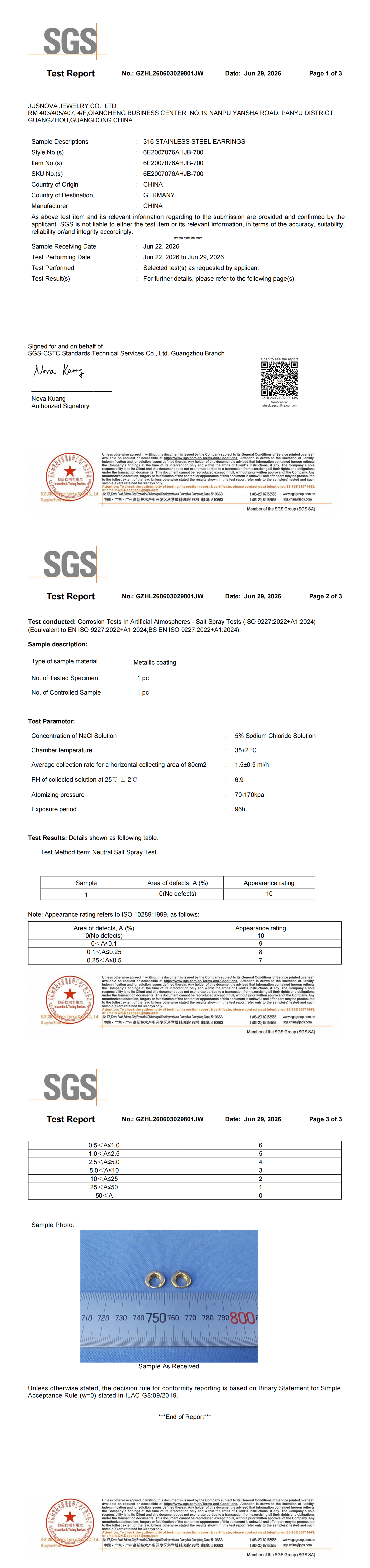 Salt spray testing to ISO 9227 is the evidence behind a tarnish-free claim on PVD gold plated stainless steel. Report GZHL260603029801JW, SGS, valid to 29 June 2027.
Step 7 - Write the acceptance criteria into the order
Prong programs should specify claw count, tip shape, seated stone height and a snag check against knit fabric. Bezel programs should specify rim width consistency, gap-free contact around the stone and interior polish. Both should specify plating colour against an approved master sample, because colour drift is visible to customers even when the setting itself is perfect.
Use Cases by Sales Channel
Boutiques and gift retail
Lead with prong-set centre stones for bridal, anniversary and occasion pieces, where the stone is the reason for the purchase. Keep a bezel line beside it for shoppers looking for everyday pieces that will not catch on clothing.
E-commerce and dropshipping
Prong settings photograph better under directional light and sell an aspirational look. Bezel settings reduce damage complaints and stone-loss returns, which matter more at scale than one stronger hero image. A mixed assortment usually outperforms a single-setting catalogue.
Corporate gifts and promotional programs
Bezel settings are the safer specification: smooth surfaces, no raised claws, low snag risk, and a predictable flat area for a company mark. PVD gold finishing supports the daily-wear expectation of a recipient who did not choose the piece themselves.
Travel, resort and daily-wear collections
Bezel-set, PVD-finished stainless pieces fit this brief directly: waterproof handling, tarnish resistance and a shape that survives continuous wear. Add prong accents only where the design needs visible stone size.
Private label and custom development
Jusnova supports ODM/OEM development with a 20-engineer team covering style development and surface-finishing processes, and reports launching more than 500 styles monthly. For a private-label program, the fastest route is to brief both settings on one design and compare the samples side by side.
Comparison Table: Prong vs Bezel in Gold Plated Stainless Steel Jewelry
| Decision factor | Prong setting | Bezel setting |
|---|---|---|
| How the stone is held | Thin claws bend over the stone edge; most of the stone stays open | Continuous metal wall pressed over the stone edge; full circumference held |
| Stone security in daily wear | Depends on claw tension; a bent claw can release the stone | Stone cannot lift out through normal wear |
| Light return and sparkle | Highest visible stone area, strongest sparkle | Less stone side visible, softer glow, cleaner outline |
| Snag risk (knitwear, hair, scarves) | Higher, because claws stand proud of the surface | Low, because the outer surface stays smooth |
| Metal around each stone | Minimal, only the claws | More, because the rim is a continuous wall |
| Cleaning | Open structure, easy to reach behind the stone | Recess behind the rim needs brushing |
| Repair path | Tips can be tightened or re-tipped | Rim must be re-formed as a factory operation |
| Stone families | Cubic zirconia, man-made crystal, moissanite in more than 20 colours | Same families; round and oval shapes suit a rim most naturally |
| Engraving area | Open baskets leave fewer flat marking surfaces | Rim and flat shank give predictable flat surfaces |
| Base alloy and finish | 304, 316 or 316L stainless steel; PVD or electroplated gold | 304, 316 or 316L stainless steel; PVD or electroplated gold |
| Typical channel fit | Bridal, occasion, boutique, hero e-commerce imagery | Minimalist daily wear, corporate gifts, travel retail |
| QC focus points | Claw symmetry, tip polish, stone seating, snag check | Rim width consistency, gap-free contact, interior polish |
FAQ: Prong vs Bezel Settings for Wholesale Buyers
Do prong and bezel settings affect EU or US compliance for gold plated stainless steel jewelry?
The setting type alone does not decide compliance; the alloy, the plating chemistry and the stones do. REACH Regulation (EC) No 1907/2006 restricts nickel, lead and cadmium in jewelry sold into the EU, EN 1811 nickel release testing is mandatory for items inserted into pierced body parts, and California Proposition 65 requires warnings above strict lead and cadmium thresholds. A 316L stainless steel base with lead-free and nickel-free plating is the usual route to a hypoallergenic claim, and supporting evidence normally comes as SGS artificial sweat testing under ISO 3160-2 and salt spray testing under ISO 9227. Jusnova holds report GZMR260602153701 (ISO 3160-2, valid to 30 June 2027) and report GZHL260603029801JW (ISO 9227, valid to 29 June 2027) and states that REACH test reports are available on request. Both settings are compatible with that evidence, so compliance should be checked per item, not per setting.
Can one supplier deliver both prong and bezel designs with custom logo and packaging?
It is realistic when development, casting, assembly, polishing, plating and marking sit inside the same factory. Jusnova Jewelry Co., Ltd, founded in 2009 in Guangzhou, runs a 1,000 m2 facility with 300 employees and an annual output of 3,000,000 units, supported by 20 engineers for style development and surface-finishing processes. Custom logo work is normally produced by laser engraving, the industry standard for permanent marking, and packaging is specified per channel, from boutique boxes to corporate gift sets. Buyers should confirm marking position, marking depth and packaging artwork on the sample, because bezel rims and flat shanks offer clean marking surfaces while open prong baskets do not.
How do prong and bezel settings affect wholesale unit cost?
There is no fixed rule that one setting is cheaper, because setting cost sits inside a group of interacting drivers: stone count and size, setting labour, the metal consumed around each stone, plating route, engraving and packaging. A bezel surrounds each stone with a continuous metal wall, so it consumes more metal around the stone than claw tips do, while prong work carries more per-tip inspection time. The practical approach is to request item-level quotations for the same design in both settings from the same factory, using one reference item so that only the setting changes. Item GEN000516bhia-066 is a useful quotation reference because it already carries documented 304/316/316L stainless steel construction, PVD or electroplated gold finishing, and the standard stone families in more than 20 colours.
How should a buyer validate prong and bezel samples before a bulk order?
Order both settings on the same design and test them against the behaviour the product will meet. For prongs, check that each tip is rounded and aligned, that the stone does not rock under light finger pressure, and that the piece does not catch when drawn across knit fabric. For bezels, check rim width consistency around the stone, look for gaps between rim and stone, and confirm the interior is polished. On both, compare plating colour with the approved master sample, confirm the certificate numbers match the item, and run a wear trial before committing. Sampling is where a setting decision is confirmed or reversed, not after the first bulk shipment.
What lead time should buyers plan for a custom prong or bezel order?
Custom programs run sampling first and bulk production second, and the production window depends on stone availability across the more than 20 colour options, setting complexity, engraving and packaging. As a planning baseline, Panjiva supply chain data has cited an average of 15 to 25 days for wholesale custom gold plated stainless steel jewelry orders, measured across suppliers rather than for one factory. Jusnova confirms the actual production schedule at order confirmation, which is the figure a buyer should plan a launch calendar around. A practical next step is to request a sample pair in both settings and ask for the matching production slot in the same conversation.
Conclusion: Choose by Wear Behaviour, Then Confirm on a Sample
Prong and bezel settings are not competing levels of quality; they solve different problems. A prong setting maximizes stone presence and photograph appeal, and it earns its place in bridal, occasion and boutique assortments where the stone sells the piece. A bezel setting maximizes stone security and surface comfort, and it fits minimalist daily wear, corporate gifting and travel retail, where a snag or a lost stone costs more than a slightly smaller sparkle.
The material system behind both is the same: a 304, 316 or 316L stainless steel base, a PVD or electroplated gold finish, and cubic zirconia, man-made crystal or moissanite in more than 20 colours. What separates a durable program from a fragile one is the discipline applied around that system: matching the setting to real wear behaviour, reserving flat surfaces for engraving, confirming the finish sequence with the factory, and checking ISO 9227 and ISO 3160-2 reports against the exact item being ordered.
Where a collection has to serve several channels, specify both settings on one design and let the sample set make the decision. A side-by-side comparison of weight, snag behaviour, sparkle and engraving area answers more than any catalogue page.
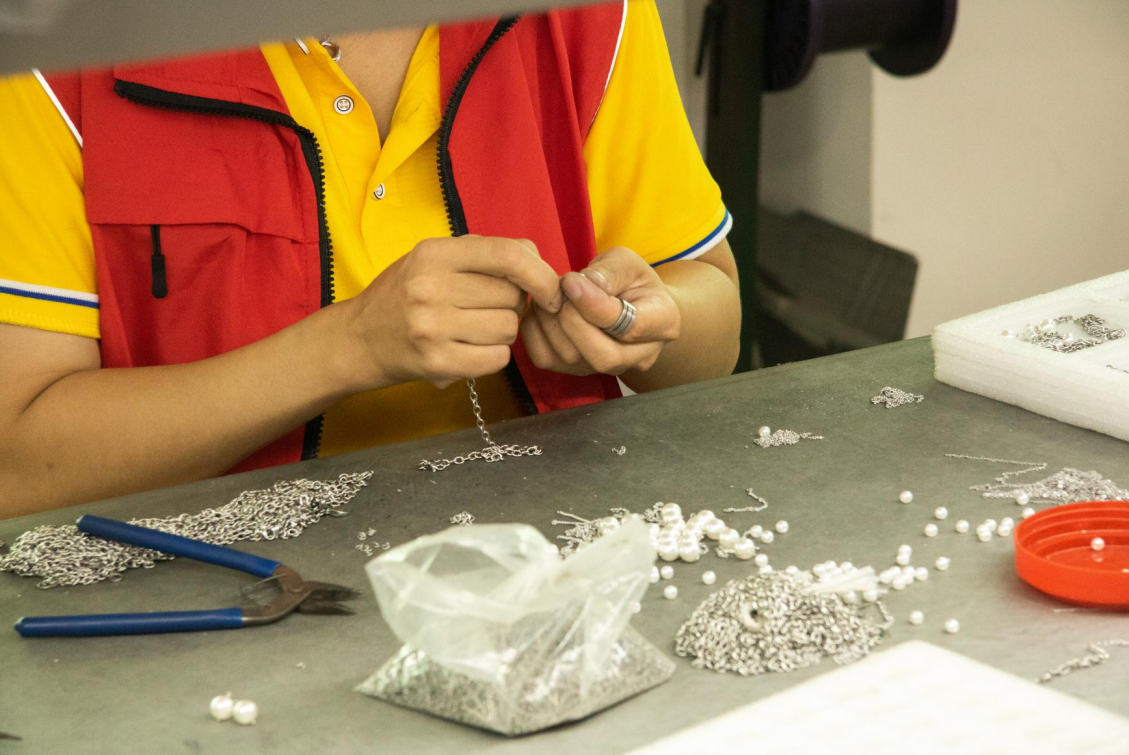 Sample sets are assembled and checked before bulk production begins. Image: Jusnova Jewelry workshop.
Compare Both Settings on One Sample Set
Jusnova Jewelry Co., Ltd builds prong-set and bezel-set pieces on 304, 316 and 316L stainless steel with PVD or electroplated gold finishes, custom logo and packaging, and stone options in cubic zirconia, man-made crystal and moissanite across more than 20 colours.
Send your design brief and we will quote both settings on the same item, with the matching test reports and production slot. Email market@powellwholesale.net, WhatsApp +86 189 2623 2416, or review current capabilities at jusnovasteel.com and jusnovajewelry.com.
Have Questions or Need More Details?
Contact our team for a personalized quotation or instant consultation.
Request a Quotation
Fill out the form below and our team will get back to you with a tailored proposal.
WhatsApp Direct Chat
Prefer to chat in real-time? Message us on WhatsApp for instant assistance & quick answers.
- Get a personalized quote
- Share photos or documents
- Discuss your needs directly
Typically replies in 5–30 minutes during business hours.