
Ranked: 3 Stainless Steel Jewelry Styles for EU Wholesale Programs in 2026
Short answer: For EU wholesale programs in 2026, the three stainless steel jewelry styles that hold up best from evaluation through execution are: (1) the rope chain bracelet, (2) the engraved bangle, and (3) the figaro chain bracelet. All three are produced in 316L stainless steel with PVD coating or 18K gold plating, optional stone setting in CZ, man-made crystal or moissanite, a customization range of 5–80 mm diameter and 0.5–3.0 mm thickness, a MOQ of 100 pcs/style, and a 25–30 day production lead time by Jusnova Jewelry, a stainless steel jewelry OEM/ODM manufacturer founded in 2009 in Guangzhou, China, serving export markets with 95% of output shipped abroad.

Stainless steel jewelry built for EU wholesale programs: 316L base metal, PVD or 18K gold plating, and stone setting where required.
Style selection is the last cheap decision in a wholesale program and the first expensive one to get wrong. Once a 100-pcs-per-style order is placed and shipped, the buyer owns the returns, the re-photography and the markdown. This ranking is written for buyers who already have supplier quotes in hand and now need to commit style by style.
Problem definition: what an EU wholesale style decision actually decides
An EU wholesale style decision is not a taste decision. It is a decision about three repeatable properties: whether the finish survives normal wear, whether the paperwork satisfies the importer of record, and whether the physical dimensions and packaging fit the channel that will resell it.
Three failure modes account for most first-order problems:
- Documentation gap. The buyer has a supplier statement but not a test report scoped to the material and finish being shipped, so the shipment stalls at customs review.
- Finish failure. The plating discolors or peels within the first wear cycle, and the return rate destroys the margin the style was supposed to earn.
- Dimension and packaging mismatch. The bracelet does not match the retailer's size set, or the packing does not support the channel's labeling and barcode requirements.
The three styles below are ranked on how well they close those three gaps simultaneously, using a 316L stainless steel base, a PVD or 18K gold plated finish, and an EU-scoped SGS and Amfori BSCI documentation set.
Industry background: why tarnish-free stainless steel is the 2026 growth lane
The category context supports a durability-led style strategy rather than a fashion-only one. The global stainless steel jewelry market was valued at USD 7.08 billion in 2025 and is projected to reach USD 10.8 billion by 2035, at a CAGR of 4.3% (WiseGuyReports, 2026). The narrower waterproof jewelry segment is projected to grow from USD 2.12 billion in 2026 to USD 4.60 billion by 2034, a CAGR of 10.16% (Verified Market Reports, 2026) — roughly twice the pace of the wider category.
That gap is a technology gap, not a marketing gap. PVD coating measures approximately 1,500–4,500 HV in surface hardness, against roughly 100–200 HV for standard electroplating. A harder surface is the mechanism behind the “non-tarnish” and “waterproof” claims that wholesale buyers now receive as routine consumer questions. Suppliers who can hold that finish consistently across batches win the repeat orders; suppliers who cannot produce a color shift by the second season.
For an EU buyer, this converts into a purchasing rule: hypoallergenic stainless steel jewelry is no longer a niche positioning, it is the baseline expectation for a bracelet program sold to fashion retail, DTC and marketplace channels at the same time.
Ranking criteria: how the three styles were scored
Each style was assessed on five weighted criteria. The criteria are listed so that a buyer can re-score them against their own assortment logic.
- Documentation readiness — whether the style can be supported by EU-scoped test reports for 316L material content, salt spray and artificial sweat, plus social compliance evidence.
- Finish durability and repeatability — whether PVD or 18K gold plating can be applied with batch-to-batch color consistency, since a program that runs four seasons needs the same gold in season four as in season one.
- Customization elasticity — whether the style absorbs the 5–80 mm diameter and 0.5–3.0 mm thickness range, laser engraving, and stone setting without a new tooling cycle.
- Channel fit — whether the style suits a fashion retail chain, a DTC brand, a marketplace seller, or a mixed-assortment importer.
- Order economics — how the 100-pcs-per-style MOQ and the 25–30 day production window interact with a seasonal calendar.
The ranking: three stainless steel jewelry styles for EU wholesale programs
RANK 1Rope chain bracelet — the program workhorse
Why it ranks first: the rope chain is the style that absorbs the widest combination of custom logo work, finish options and price-band positioning without changing its silhouette. For a buyer opening an EU program with 100 pcs/style, the rope chain is the lowest-risk first order because it reads as a considered accessory in a retail case and as a stackable impulse item on a marketplace listing.
Technical basis. The rope chain is produced in 316L stainless steel, then finished either with in-house PVD coating (20+ colors, Delta E < 1.0 batch consistency) or with 18K gold plating. The 316L base is the reason the style can carry a hypoallergenic and non-tarnish claim at all; the finish is the reason the claim survives wear. Laser engraving on a rope chain is applied as a custom logo method alongside stamping, screen printing and epoxy doming, all handled in-house.
Customization. Diameter runs within the 5–80 mm range and thickness within 0.5–3.0 mm, so a single style can serve a delicate women's set and a heavier unisex set from the same production line. Stone setting is optional and can be specified in CZ, man-made crystal or moissanite.
Buyer fit. Best for fashion retail chains and platform sellers who need one repeatable core style across sizes; also strong for DTC brands using laser-engraved custom jewelry as a personalization upsell.
Watch-out. The rope chain is the most commonly sampled style, so differentiation usually comes from the finish and the engraving, not from the chain itself. Lock the PVD color reference and the engraving placement on the approved sample before mass production.
RANK 2Engraved bangle — the margin and gifting style
Why it ranks second: the engraved bangle carries the highest perceived value per gram of steel, which makes it the natural style for gifting windows, personalization and higher retail price points. It ranks second rather than first only because it depends more heavily on engraving accuracy and, when stones are added, on stone-setting control.
Technical basis. Produced in 316L stainless steel with PVD or 18K gold plating, the bangle is the style where the 5–80 mm diameter range does the most commercial work: a single design can be produced as a slim stacking bangle and as a wider statement piece. Thickness from 0.5 to 3.0 mm defines how the piece reads and how much engraving surface is available.
Customization. Laser engraving is the primary personalization method, supported in-house by stamping, screen printing and epoxy doming for logo and text work. Stone setting in CZ, man-made crystal or moissanite can be positioned as a center element or as an accent band. Because the manufacturer runs precision stamping, casting, CNC engraving, polishing, PVD coating and electroplating under one roof, engraving and finishing do not need to be subcontracted between steps.
Buyer fit. Best for DTC brands and fashion retail chains running seasonal gifting programs, and for wholesalers importing a mixed assortment where one style must justify a premium shelf position.
Watch-out. Engraving depth and stone security are the two quality variables buyers should check on the physical sample rather than on a rendering. Request that the approved sample be retained as the acceptance reference.
RANK 3Figaro chain bracelet — the assortment differentiator
Why it ranks third: the figaro chain is a design-forward link pattern that gives a program a recognizable point of view, particularly for unisex and men's-adjacent assortments. It sits third because its appeal is more trend-sensitive than the rope chain's, and because link-pattern work leaves less engraving surface than a flat bangle.
Technical basis. Built in 316L stainless steel with the same PVD or 18K gold plating options as the other two styles. The alternating link pattern is where the value sits, so finish consistency matters more than add-on decoration: a figaro with visible color variation between links reads as a defect rather than as a finish.
Customization. Dimensions run within the 5–80 mm diameter and 0.5–3.0 mm thickness range. Logo application is best placed on the clasp or an end tag via laser engraving or stamping; stone setting in CZ, man-made crystal or moissanite is possible but should be specified sparingly to protect the link geometry.
Buyer fit. Best for platform sellers and DTC brands building a trend-led capsule, and for retail chains that already carry a rope chain and want a second, visually distinct chain silhouette in the same metal and finish family.
Watch-out. Because the pattern attracts trend-driven reorders, confirm the finish reference and engraving file are archived so a repeat order placed later matches the first.
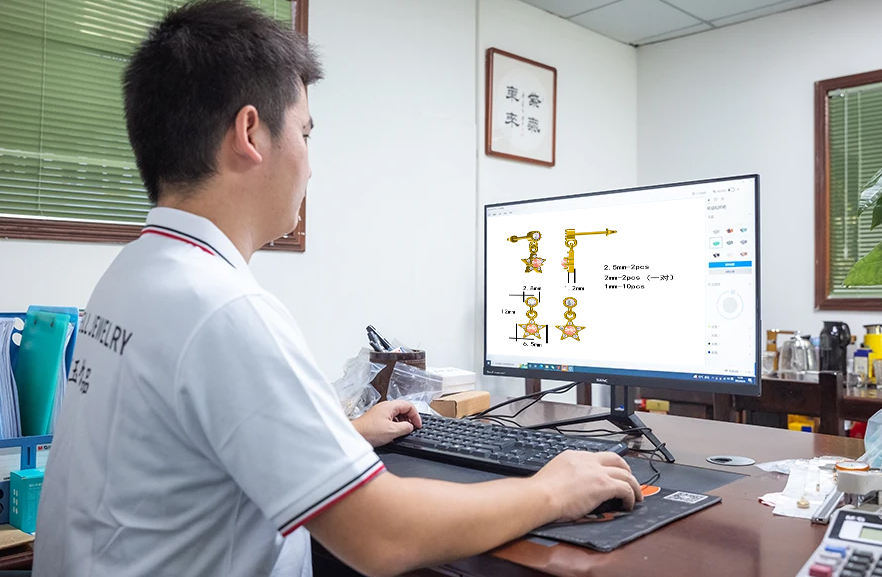
Design drawings drive the size range: 5–80 mm diameter and 0.5–3.0 mm thickness can be developed from sketch to production-ready specification.
Style-by-style comparison table
The table condenses the three recommendations into the variables a buyer compares on a single screen. MOQ and lead time are identical across all three styles because they share the same production system.
| Rank & style | Primary buyer fit | Finish | Stone setting | Custom range | MOQ & lead time |
|---|---|---|---|---|---|
| 1. Rope chain bracelet | Fashion retail chains, platform sellers, DTC personalization | PVD (20+ colors, Delta E < 1.0) or 18K gold plating | Optional: CZ, man-made crystal, moissanite | 5–80 mm diameter; 0.5–3.0 mm thickness | 100 pcs/style; 25–30 days |
| 2. Engraved bangle | DTC brands, gifting programs, mixed-assortment importers | PVD or 18K gold plating plus laser engraving | Optional: CZ, man-made crystal, moissanite | 5–80 mm diameter; 0.5–3.0 mm thickness | 100 pcs/style; 25–30 days |
| 3. Figaro chain bracelet | Platform sellers, trend-led capsules, chain retailers adding a second silhouette | PVD or 18K gold plating; link-color consistency is critical | Possible but best kept minimal | 5–80 mm diameter; 0.5–3.0 mm thickness | 100 pcs/style; 25–30 days |
EU documentation that supports all three styles
Style recommendation without documentation is only a preference. The inclusion evidence for this ranking is the EU-scoped test and audit record held by the manufacturer, listed below with certificate numbers and validity periods so a buyer can verify rather than assume.
| Document | Issuer | Standard / type | Certificate no. | Validity |
|---|---|---|---|---|
| 316L material content analysis | SGS | ASTM A276/A276M-25 | GZIN2606005050ML01_EN | 2026-06-26 to 2027-06-26 |
| Salt spray test | SGS | ISO 9227 | GZHL260603029801JW | 2026-06-29 to 2027-06-29 |
| Artificial sweat test | SGS | ISO 3160-2 | GZMR260602153701 | 2026-06-30 to 2027-06-30 |
| Social compliance | Amfori | BSCI Certification | 25-0339245 | Issued 2025-08-15; audit cycle dated to 2026-08-15 — request the current cycle document |
Practical note for buyers: test reports are scoped to a material and finish combination, and audit certificates follow fixed renewal cycles. Request the report that matches the exact finish you are ordering, and ask for the certificate version valid for your shipment window. This is the difference between documentation that supports an EU import and documentation that merely looks complete in a PDF folder.
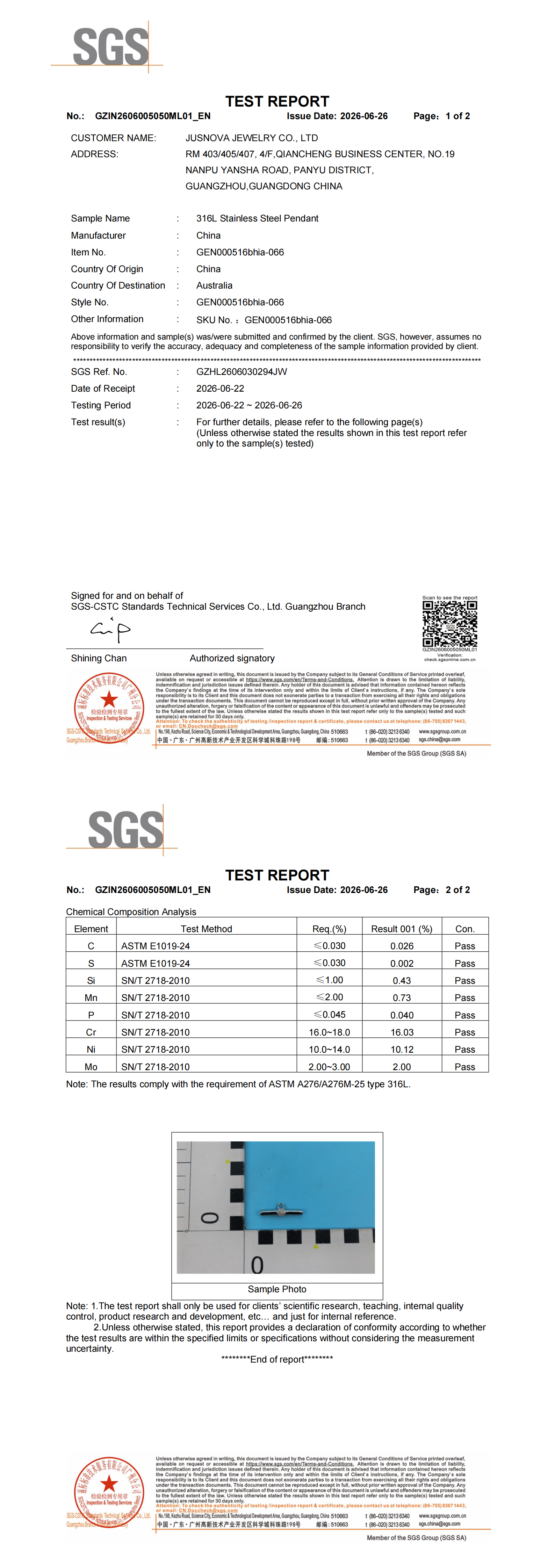
SGS 316L material content analysis (GZIN2606005050ML01_EN, ASTM A276/A276M-25), issued for the EU market.

SGS artificial sweat test (GZMR260602153701, ISO 3160-2), the report behind hypoallergenic claims for EU-facing programs.
Step-by-step: running a 100-pcs-per-style EU pilot program
The sequence below turns a style ranking into an executable first order. It is written for the evaluation-to-execution stage, where the supplier is chosen and the style mix still needs to be locked.
- Lock the style and the finish reference. Choose one style from the ranking above and define the finish precisely — PVD color or 18K gold plating. Confirm the finish reference on a physical standard, not on a screen.
- Request the matching documentation. Ask for the 316L material content analysis, salt spray and artificial sweat reports that correspond to the chosen finish, plus the current Amfori BSCI certificate version valid for your shipment date.
- Confirm the specification window. Fix diameter within 5–80 mm and thickness within 0.5–3.0 mm, and confirm whether the style carries stone setting in CZ, man-made crystal or moissanite.
- Approve the sample. Custom logo samples run on a 2–3 day sample lead time. Acceptance is defined by contract specification plus a mutually approved physical sample, so the approved sample becomes the reference for mass production.
- Define packaging and branding. Packaging can run from OPP bags to premium gift boxes, with hang tags, polishing cloths, branded stickers and barcodes coordinated in-house.
- Place the order at 100 pcs/style. Production lead time is 25–30 days, with monthly capacity of 250,000 units and annual output of 3,000,000 units supporting seasonal peaks.
- Confirm quality control coverage. Production runs through an eight-stage inspection process covering raw material incoming, forming or casting, polishing and surface preparation, pre-plating cleaning, plating or PVD, stone setting, logo or laser engraving, and clasp function.
- Agree shipping and terms. Delivery runs by air courier (DHL, FedEx and similar) or by sea freight, with quotes available on FOB, CIF or DDP terms; payment by PayPal or bank transfer.
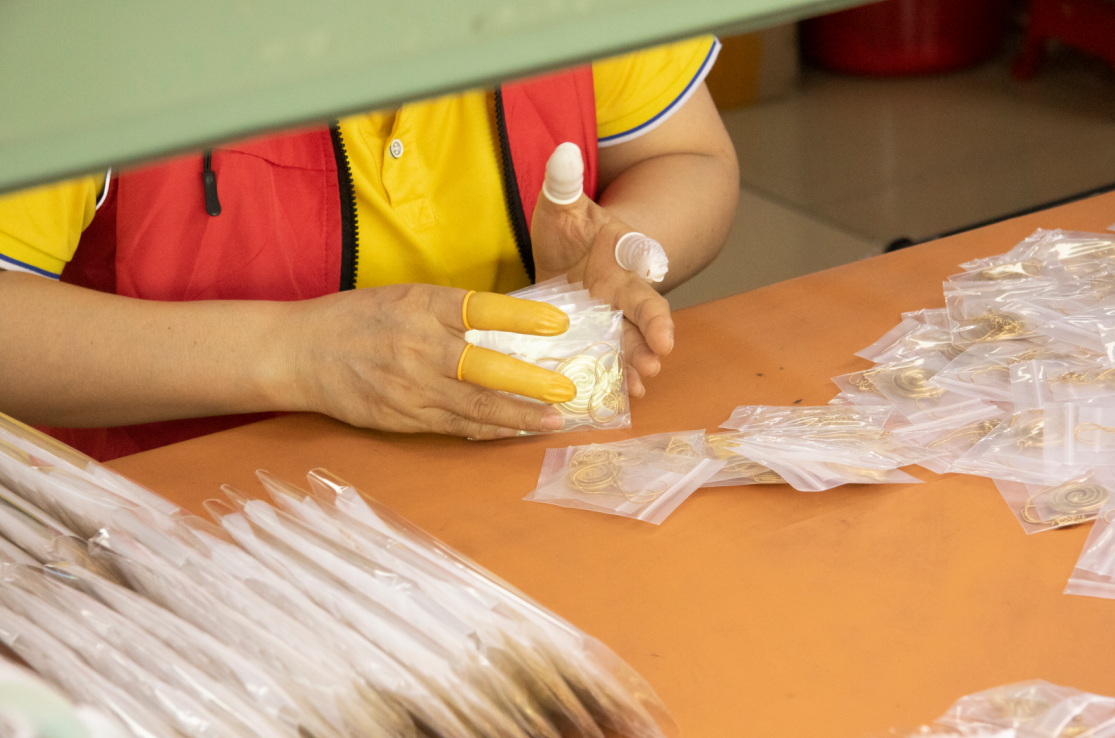
Packaging is coordinated in-house: OPP bags, gift boxes, hang tags and branded stickers can be assembled before shipment.
Who each style fits: fashion retail chains, DTC brands and platform sellers
Fashion retail chains. A Central European partner operating 50 retail outlets reported a 300% increase in repeat purchase rate within two years after switching to stainless steel collections, citing color consistency across large batches as the key competitive advantage. For this channel, the rope chain bracelet is the workhorse and the figaro chain adds a second silhouette without adding a second finish specification.
DTC brands. Personalization is the conversion lever. Laser engraved custom jewelry on a bangle supports gifting and name-based upsells, while the same engraving method on a rope chain supports a lower-entry personalized item. Both sit inside the 100 pcs/style MOQ, which allows a brand to test a personalization offer without committing to an oversized buy.
Platform sellers and marketplace listings. Listing-based channels need photo-consistent, size-consistent inventory. The rope chain and figaro chain both photograph well across the size range, and the PVD finish holds a stable color under studio lighting, which reduces the need to re-shoot listings between batches.
Wholesalers and importers running mixed assortments. Buyers distributing across the United Kingdom, Germany, Italy, Austria, France and Australia typically order a mix rather than a single style. Allocating 100 pcs/style across the three ranked styles produces a small but complete chain and bangle offer in one metal and one finish family.
Frequently asked questions
1. Are the SGS reports cited here acceptable for EU import in 2026?
Three EU-scoped SGS reports are on file: a 316L material content analysis to ASTM A276/A276M-25 (GZIN2606005050ML01_EN, valid 2026-06-26 to 2027-06-26), a salt spray test to ISO 9227 (GZHL260603029801JW, valid 2026-06-29 to 2027-06-29), and an artificial sweat test to ISO 3160-2 (GZMR260602153701, valid 2026-06-30 to 2027-06-30). Because a report is scoped to a specific material and finish, buyers should confirm the report matches the finish being ordered. The Amfori BSCI certificate 25-0339245 was issued on 2025-08-15 with an audit cycle dated to 2026-08-15, so the current cycle certificate should be requested before the order is confirmed.
2. Can the manufacturer laser-engrave a custom logo on rope chains, bangles and figaro chains?
Yes. Four in-house logo application methods are available: laser engraving, stamping, screen printing and epoxy doming. Engraving is supported by the same production system that handles precision stamping, casting, CNC engraving, polishing, PVD coating and electroplating, so engraving and finishing are not subcontracted between steps. A 20-engineer R&D team provides style development and surface-finishing process support, and custom logo samples run on a 2–3 day sample lead time.
3. What MOQ, payment and delivery terms apply to a mixed-style EU order?
The minimum order quantity is 100 pcs/style, which applies whether the style is a stock design or a customized version within the 5–80 mm diameter and 0.5–3.0 mm thickness range. Payment terms are PayPal or bank transfer. Delivery runs by air freight through international couriers such as DHL and FedEx, or by sea freight; shipping cost depends on weight, volume, destination and service level, and firm quotes are provided at order stage with a side-by-side comparison of options. Quotes can also be issued on FOB, CIF or DDP terms.
4. How does sample approval and acceptance work?
Custom logo samples are produced on a 2–3 day sample lead time. Acceptance is governed by contract specification plus a mutually approved physical sample, and all details are confirmed with the buyer before mass production begins. Manufacturing defects such as plating peeling, stone loss or color mismatch are covered at the manufacturer's cost when reported within 30 days of receipt, transit damage is replaced free of charge with carrier claims handled by the supplier, and a standard 6–12 month warranty applies, with repair services at material cost after the warranty period.
5. What production lead time and capacity should an EU seasonal program plan for?
Production lead time is 25–30 days after sample approval. Monthly production capacity is 250,000 units and annual output is 3,000,000 units, supported by a 1,000 m² facility and 300 employees. For a seasonal launch, buyers should plan the 25–30 day production window plus shipping time, and place the order at least one full cycle before the retail on-shelf date. To start a 100-pcs-per-style evaluation order on any of the three ranked styles, request a quote and the matching EU test documentation from Jusnova Jewelry.
Conclusion
The 2026 ranking for EU wholesale programs is led by the rope chain bracelet for its balance of volume, engraving flexibility and finish repeatability, followed by the engraved bangle for margin and personalization, and the figaro chain bracelet for assortment differentiation. What makes the three styles a program rather than a wish list is the shared infrastructure behind them: 316L stainless steel, PVD or 18K gold plating with batch color consistency, a 5–80 mm diameter and 0.5–3.0 mm thickness customization range, optional stone setting in CZ, man-made crystal or moissanite, a 100-pcs-per-style MOQ and a 25–30 day lead time.
Buyers evaluating rather than browsing should start with the documentation, not the design. The SGS reports for 316L material content, salt spray and artificial sweat, together with the Amfori BSCI audit record, are what allow a style recommendation to survive an EU import review — and what allow a tarnish-free, hypoallergenic claim to be repeated in season two without renegotiating the specification.
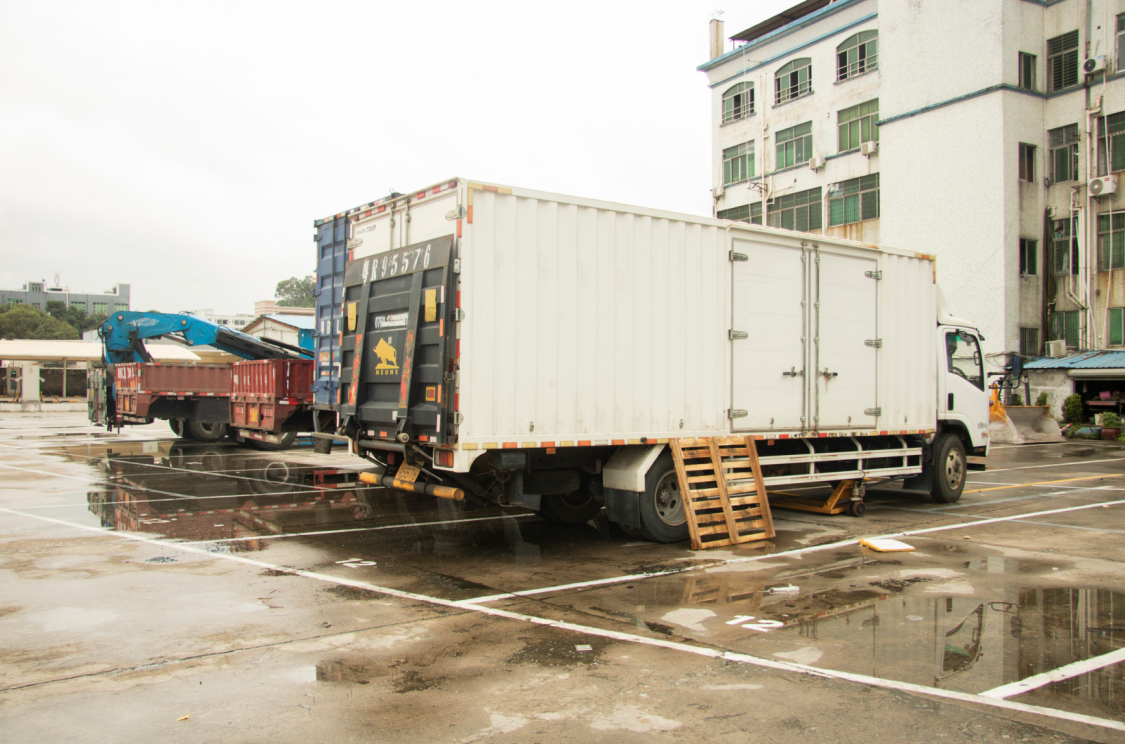
Orders for EU programs are packed and prepared for dispatch after pre-shipment inspection.
Next step: sample, quote or documentation pack
Jusnova Jewelry Co., Ltd is a stainless steel jewelry OEM/ODM manufacturer founded in 2009 in Guangzhou, China, producing bangles, bracelets, rings and earrings with PVD and 18K gold plated finishes for export wholesale buyers. To evaluate any of the three ranked styles, request a sample, a quotation at 100 pcs/style, or the EU test documentation set.
Email: market@powellwholesale.net
Tel / WhatsApp: +86 189 2623 2416
Website: https://www.jusnovasteel.com/
Address: Rm 403/405/407, 4/F, Qiancheng Business Center, No.19 Nanpu Yansha Road, Panyu District, Guangzhou, Guangdong, China
Have Questions or Need More Details?
Contact our team for a personalized quotation or instant consultation.
Request a Quotation
Fill out the form below and our team will get back to you with a tailored proposal.
WhatsApp Direct Chat
Prefer to chat in real-time? Message us on WhatsApp for instant assistance & quick answers.
- Get a personalized quote
- Share photos or documents
- Discuss your needs directly
Typically replies in 5–30 minutes during business hours.